Introduction
In recent process generations, the Dennard scaling of power consumption with transistor dimensions has been interrupted, resulting in stagnation of clock frequencies and giving rise to a fundamental utilization wall.[Reference Dennard, Gaensslen, Rideout, Bassous and LeBlanc1] As a result, much of the benefits derived from aggressively scaled feature densities are squandered in current computing architectures. In practical terms, this break-down in synergy between scaling of transistor density and native transistor speed on the one hand and transistor power consumption on the other hand is mitigated by leaving a substantial fraction of valuable chip real estate underclocked, engendering the term, “dark silicon”.[Reference Taylor2] “Dark silicon” is, in fact, a casualty of the metal–oxide–semiconductor field-effect transistor paradigm (MOSFET), which is fundamentally constrained by the immutable thermodynamics of electric field-modulated switching of Si devices from OFF to ON states. Circumnavigating these fundamental limits requires either the development of new classes of materials that exploit novel resistance switching mechanisms not subject to the fundamental limitations of conventional FETs,[Reference Zhou and Ramanathan3] or alternatively the development of a computing architecture that encodes complexity through highly parallelized operations, similar to the human brain.[Reference Taylor2]
Memristive systems have received significant interest as potential circuit elements for energy-efficient neuromorphic computing,[Reference Chua and Kang4, Reference Pershin and Di Ventra5] particularly as they relate to mitigating the problems presented by “dark silicon”. A fundamental imperative for such computing vectors is “on-chip learning” wherein specific states are encoded and accessed within circuitry and reflect the evolution of internal state variables as a function of previous voltage, current, or flux exposure.[Reference Pickett, Medeiros-Ribeiro and Williams6, Reference Kim, Jang, Lee, Choi, Lee, Jang, Choi, Moon and Cheon7] Memristive systems are distinctive non-linear circuit elements that are amenable to this approach since they encode resistance values that capture not just the state of the system at a specific time but also the historical evolution of the possible states.[Reference Pershin and Di Ventra5] Notably, the Na+ and K+ channels of neurons exhibit fundamentally memristive behavior,[Reference Chua and Kang4, Reference Pershin and Di Ventra5] and there are close similarities between memristive circuits and spike time-dependent plasticity processes thought to underpin learning within neuronal networks. Unlike traditional linear circuit elements, voltage-controlled memristors can be described by the equations:
 $$I(t) = G(x,\, V,\, t)V(t),$$
 $$x = f(x,V,t),$$
where V and I are time-dependent input (voltage) and output (current) of the system, and the conductance, G, varies with an internal state variable, x, which explicitly evolves with voltage and time [Eq. (2)].[Reference Chua and Kang4, Reference Pershin and Di Ventra5] A voltage-controlled memristor can equivalently be described as a current-controlled device by a corresponding pair of relationships in which the state variable evolves as a function of current, rather than voltage. This state variable reflects some internal aspects of device structure that dynamically evolve in response to specific physical phenomena each of which may be described by appropriate equations of motion.[Reference Chua and Kang4, Reference Pershin and Di Ventra5]
Memristive behavior is underpinned by a variety of mechanisms involving electronic or ionic transport mediated by defect migration, formation of hot filaments, electrochemical reactions at interfaces, phase transitions, and Mott–Hubbard modulation of electron correlation.[Reference Pershin and Di Ventra5, Reference Marley, Horrocks, Pelcher and Banerjee8, Reference Ha and Ramanathan9] Perhaps the most studied example of a memristive material is TiO2, wherein memristivity arises from changes in internal resistance due to the migration of oxygen vacancies between the two terminals.[Reference Sun, Liao, Dou, Hwang, Park, Jiang, Kim and Dou10] Alternatively, memristive behavior with a marked hysteresis has also been observed in correlated transition metal oxide systems such as in the case of VO2,[Reference Driscoll, Kim, Chae, Kim, Lee, Jokerst, Palit, Smith, Di Ventra and Basov11–Reference Singh, Abtew, Horrocks, Kilcoyne, Marley, Stabile, Banerjee, Zhang and Sambandamurthy13] rare-earth nickelates,[Reference Shi, Ha, Zhou, Schoofs and Ramanathan14] and M xV2O5.[Reference Wu, Stabile, Patridge, Banerjee and Sambandamurthy15–Reference Marley, Singh, Abtew, Jaye, Fischer, Zhang, Sambandamurthy and Banerjee17] In these systems, the memristive behavior is mediated by electronic phase transitions that bring about a pronounced modulation of conductivity, oftentimes mediated by an underlying structural transformation or disruption of charge ordering.[Reference Marley, Horrocks, Pelcher and Banerjee8]
A versatile class of compounds that has proven to be particularly intriguing for the realization of pronounced non-linear switching is two-dimensional (2D)-layered oxide materials with the general formula M xV2O5[Reference Marley, Horrocks, Pelcher and Banerjee8, Reference Yan and Maggard18, Reference Marley and Banerjee19] where M is an intercalated cation and x is its stoichiometry. Several structurally distinct polymorphs are known with infinite 2D bilayered V4O10 sheets (δ-type) or 2D V2O5 monolayer sheets (γ- and α-type) separated by intercalated cations. The electronic structure of these compounds can be precisely modulated by choice of the cation M and stoichiometry x. The intercalated cations within these structures can furthermore potentially be solvated and such compounds are more rigorously delineated as [M(X)n]xV2O5 where M is a cation, X is a solvating species or coordinating ligand for the cation, n is the number of solvent molecules coordinated to the intercalating cation, and x is the stoichiometry of the intercalated cation.[Reference Yan and Maggard18, Reference Oka, Yao and Yamamoto20, Reference Marley and Banerjee19] While several of these compounds have been examined for electrochemical energy storage,[Reference Clites, Byles and Pomerantseva21] to the best of our knowledge, the transport properties of intercalated vanadium oxide bronzes with solvated cations have not thus far been explored. Herein we demonstrate pronounced non-linearity, hysteretic loops, and memristive switching in individual nanowires of a family of isostructural 2D ternary vanadium oxides δ-[M(H2O)4]0.25V2O5 (where M = Co, Ni, Zn). The memristive behavior is of type II nature with pinched hysteresis loops characterized by an avoided crossing at zero bias and further shows a pronounced thermal dependence. The hysteretic behavior appears to be underpinned by ion diffusion and is suppressed upon desolvation of the intercalated cations. The interlayer separation of 2D-layered δ-[M(H2O)4]0.25V2O5 compounds is readily varied by preparing binary mixed-cation solid solutions.
Experimental methods
Synthesis of δ-[M(H2O)4]0.25V2O5 nanowires
The δ-[M(H2O)4]xV2O5 nanowires were prepared by a facile single-step hydrothermal reaction. In a typical reaction, 178.1 mg of V2O5 (Sigma Aldrich, St. Louis, Missouri) were ball-milled together in a Spex Certiprep ball-mill with 121.9 mg of Ni(COOCH3)2·4H2O (Sigma-Aldrich) in a 2 : 1 molar ratio for 1 h using polystyrene beads as the milling media. A 2 : 1 molar excess (as compared with the final reported stoichiometry of 4 : 1) was observed to improve the crystallinity of the product. The resulting mixture was added to 15 mL of a 1.17 M aqueous solution of acetic acid and then transferred to a 23 mL polytetrafluoroethylene-lined stainless steel autoclave. The sealed autoclave was heated at 210 °C for 72 h. The cobalt and zinc analogs, as well as the solid-solution mixed-cation compounds were prepared via the same method and by replacing appropriate amounts of Ni(COOCH3)2•4H2O with the desired concentrations of cobalt and zinc acetate(s) to obtain the desired 4 : 1 molar ratio of reactants. Upon completion of the hydrothermal reaction, the resulting light-to-dark green solids were filtered, washed with copious amounts of water and 2-propanol, and allowed to dry in air overnight. The dehydrated δ-Ni0.25V2O5 bronze was prepared by annealing the hydrated powder at 300 °C within a tube furnace while flowing Ar at 100 mL/min for 5 h.
Materials characterization
High-resolution x-ray powder diffraction data for δ-[Ni(H2O)4]xV2O5 was collected in a poly(4,4′-oxydiphenylene-pyromellitimide) capilliary in transmission geometry at 295 K at beamline 11-BM of the Advanced Photon Source (λ = 0.4133410 Å). Details of the Rietveld refinement performed on the high-resolution synchrotron diffraction data are provided in the supporting information. Laboratory diffraction data were collected in Bragg–Brentano geometry for the Co and Zn analogs as well as the mixed-cation compounds using a Bruker D8-Focus diffractometer (Cu Kα: λ = 1.5418 Å; 40 kV voltage; 25 mA current).
Scanning electron microscopy (SEM) images were obtained using a JEOL JSM-7500F FE-SEM equipped with an Oxford energy-dispersive x-ray spectrometer (EDS) for elemental characterization. SEM images were collected at an accelerating voltage of 5 kV; EDS spectra were collected at an accelerating voltage of 20 kV. Differential scanning calorimetry was performed on δ-[Ni(H2O)4]xV2O5 nanowires using a Q2000 instrument (TA) under a flowing nitrogen atmosphere.
Device measurements
Individual nanowires were isolated by dilution in 2-propanol followed by ultrasonication. A Si/SiO2 substrate comprising a Si wafer passivated with a SiO2 oxide layer with a thickness of 300 nm was cleaned by ultrasonication in acetone, methanol, and deionized water and the dilute dispersion containing the nanowires was drop cast onto the substrate. Individual nanowires were identified by optical microscopy and multi-terminal devices were fabricated using standard photolithographic techniques. Typical devices had a channel length of 5 µm between the source and the drain. Finally, Cr/Au layers (5 nm/70 nm) were deposited using an electron-beam evaporator. Transport measurements were performed in a two-terminal DC configuration using a Keithley 2400 SourceMeter under high vacuum in a temperature-controlled cryostat cooled using liquid nitrogen. For resistance versus temperature measurements, an initial low bias in the linear regime was applied while temperature was swept from 100 to 400 K. The sweep rate was kept at < 3 K/min in order to avoid any thermal lag.
Synthesis and structural characterization of δ-[M(H2O)4]0.25V2O5 nanowires
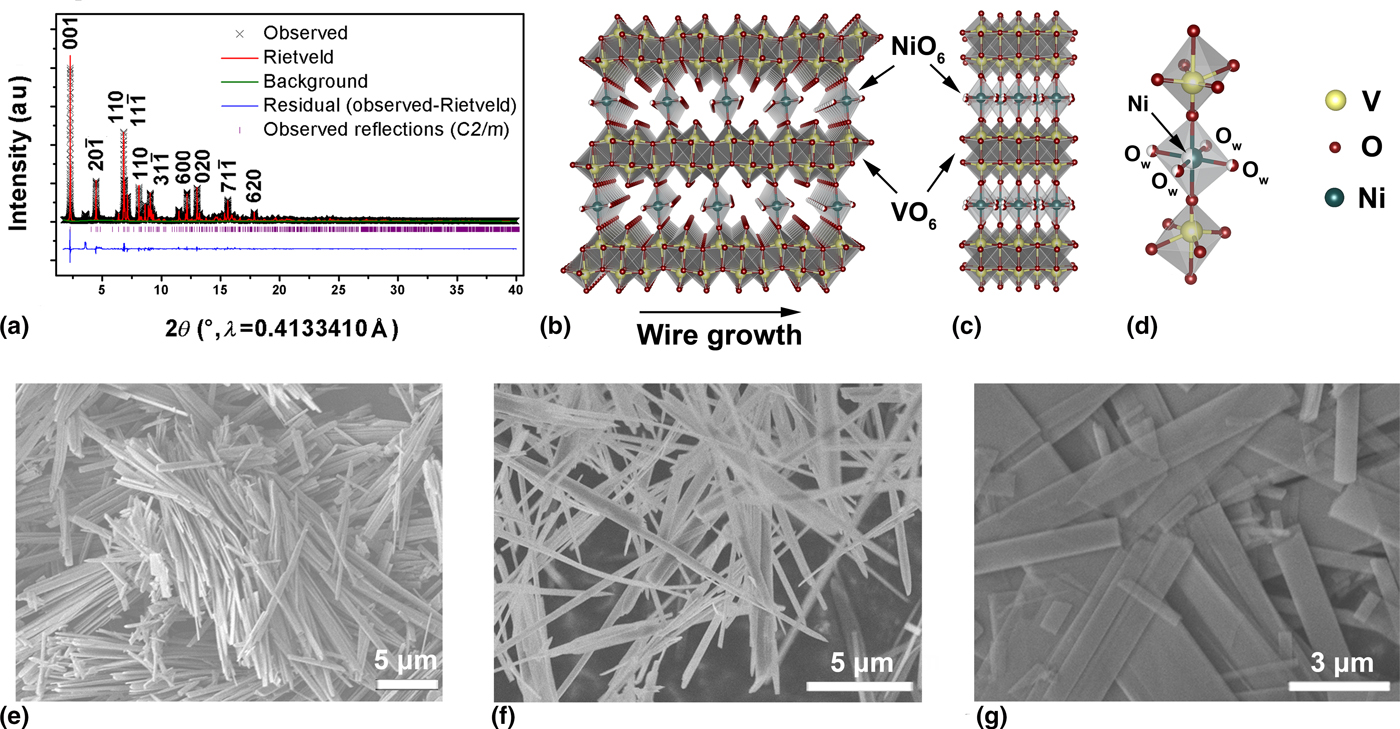
The size, charge, and polarizability of the cation M and its stoichiometry x provides a means to precisely modulate the carrier density and electronic structure of δ-[M(H2O)4]xV2O5 (similarly for 1D β/β′-M xV2O5 systems) and allows for the manifestation of a broad range of electronic instabilities.[Reference Marley, Horrocks, Pelcher and Banerjee8, Reference Andrews, De Jesus, Tolhurst, Marley, Moewes and Banerjee22] While numerous 2D-layered M xV2O5 phases with solvated cations have been crystallized, detailed evaluation of their intrinsic transport properties has thus far been absent from the literature. To this point, the aforementioned hydrated bronze was synthesized by the hydrothermal reaction of Ni(COOCH3)2•4H2O with V2O5, which yielded a dark green paper-like product. Figure 1(a) exhibits a synchrotron powder x-ray diffraction pattern (λ = 0.4133410 Å) of the obtained material. The pattern is characterized by intense (00l) reflections suggestive of anisotropic growth of the material along the a–b-plane. A Rietveld refinement to the pattern is depicted in red and the refined average structure is illustrated in Figs. 1(b) and 1(c). The structure comprises alternating condensed double layers of [V8O20] built from edge- and corner-sharing VO6 octahedra separated by [Ni(H2O)4] layers.[Reference Oka, Yao and Yamamoto20] Unit-cell parameters, atom positions, thermal parameters, and site occupancies have been refined and are listed in Tables S1 and S2 (Supporting Information). The refinement to the powder pattern yields a final stoichiometry of δ-[Ni(H2O)4]0.248V2O5•0.147H2O. In comparison to vanadium oxide bronzes[Reference Marley, Singh, Abtew, Jaye, Fischer, Zhang, Sambandamurthy and Banerjee17] with unsolvated cations, every alternate cation site is occupied by the hydrated Ni ions, resulting in a maximum site occupancy of x = 0.25 versus x = 0.5 for δ-M xV2O5 with unsolvated cations. Figure 1(d) depicts the local coordination geometry of the intercalated Ni-ions, which reside at the centers of subtly distorted octahedral coordination environments; the Ni-ions are located midway between adjacent [V8O20] double layers and serve to bridge the apical vanadyl groups of these layers; water molecules defining an approximately square planar geometry complete the local coordination environment of the Ni-ions. Table S3 (Supporting Information) lists the bond distances and bond angles for the vanadium- and nickel-centered polyhedral building blocks of the structure. The large isotropic thermal parameters of the coordinated water molecules suggest considerable disorder in the 3D orientation of the water ligands at room temperature and are further suggestive of the presence of some interstitial non-coordinated water. The cobalt and zinc analogs of the structure are entirely isostructural and also crystallize in the C 2/m space group (vide infra).
Structural characterization of δ-[M(H2O)4]xV2O5. (a) High-resolution synchrotron x-ray (λ = 0.4133 Å) powder diffraction data collected for the M = Ni compound depicted as black crosses; a Rietveld fit and residuals are depicted in red and blue, respectively. Refined structure as viewed down (b) the b axis and (c) the a-axis (see Supplementary Tables S1–S3). (d) The local coordination geometry of intercalated Ni cations, where the apical oxygens are labeled as “O”; the local coordination environment is completed by coordination to the oxygen atoms of the water ligands, labeled here as “Ow”. Scanning electron micrographs of the δ-[M(H2O)4]xV2O5 nanowires, where (e) M = Ni; (f) M = Co; and (g) M = Zn.

The morphologies of the isostructural δ-[M(H2O)4]0.25V2O5 materials (M = Co, Ni, Zn) have been investigated by SEM and are depicted in Figs. 1(e)–1(g). The micrographs display evidence for highly anisotropic growth, as deduced from the diffraction patterns. The δ-[M(H2O)4]0.25V2O5 nanowires have lateral dimensions of approximately 350 nm and range tens of microns in length. The elemental composition of the isostructural hydrated bronzes has been investigated by EDS (Fig. S1, Supporting Information), which indicates intercalated cation stoichiometries in reasonable agreement with values derived from refinements to diffraction data.
Observation of hysteretic loops, manifestation of memristive behavior, and mechanistic underpinnings
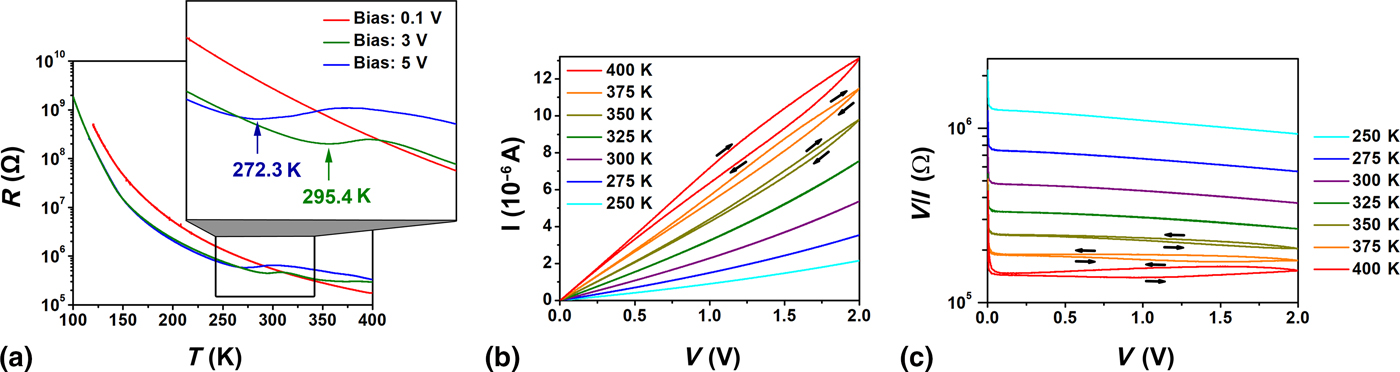
Individual nanowires of δ-[M(H2O)4]0.25V2O5 have been integrated within device architectures as depicted in Fig. S2 (Supporting Information). Figures 2, 3, and Supplementary Fig. S3 depict transport data acquired for individual nanowires of δ-[Ni(H2O)4]xV2O5, δ-[Co(H2O)4]xV2O5, and δ-[Zn(H2O)4]xV2O5, respectively. The resistance versus temperature plots acquired for δ-[Ni(H2O)4]xV2O5 in Fig. 2(a) indicate a quasi-exponential decrease of resistance with increasing temperature at low bias (0.1 V) as is typical of a semiconductor; however, at higher bias values, a pronounced discontinuity is discernible, corresponding to stabilization of a second, higher resistance state. The temperature required to access this higher resistance internal state is a function of voltage and is reduced from 295 K for a bias of 3 V to 272 K at a bias of 5 V. Figure 2(b) depicts current–voltage sweeps measured for this compound as a function of temperature. A pronounced non-linearity is discernible at all temperatures; however, at temperatures of 350 K and above, a clear hysteretic loop opens and furthermore become wider with increasing temperature. The sweep direction is delineated by black arrows and indicates that with increasing voltage (from 0 → 2 V), the system transitions to a more highly resistive internal state and then remains in this state as the voltage is decreased from 2 → 0 V. However, the original, more highly conductive, state is entirely recovered if the device is allowed to relax at zero bias (without need for a change of polarity). This feature is highlighted in Fig. 2(c), where two distinct resistance states are observed at temperatures of 350–400 K. Figures 2(b) and 2(c) indicate that the current through the nanowire is not just a function of the applied voltage and temperature but also reflects its previous thermal and voltage history, which determines the dynamical evolution of the resistance states.
Single-nanowire transport properties of δ-[Ni(H2O)4]xV2O5. (a) Resistance versus temperature plots acquired at different DC biases; the inset highlights the varying temperatures at which a second internal resistance state is accessed. (b) current versus voltage (I–V) plots for an individual nanowire of δ-[Ni(H2O)4]xV2O5 measured at different temperatures. (c) Resistance versus voltage curves in the voltage range from 0 → 2 V showing the existence of two distinct resistance states (low resistance on sweeping from 0 → 2 V, high resistance when sweeping from 2 → 0 V, as indicated by the black directional arrows).
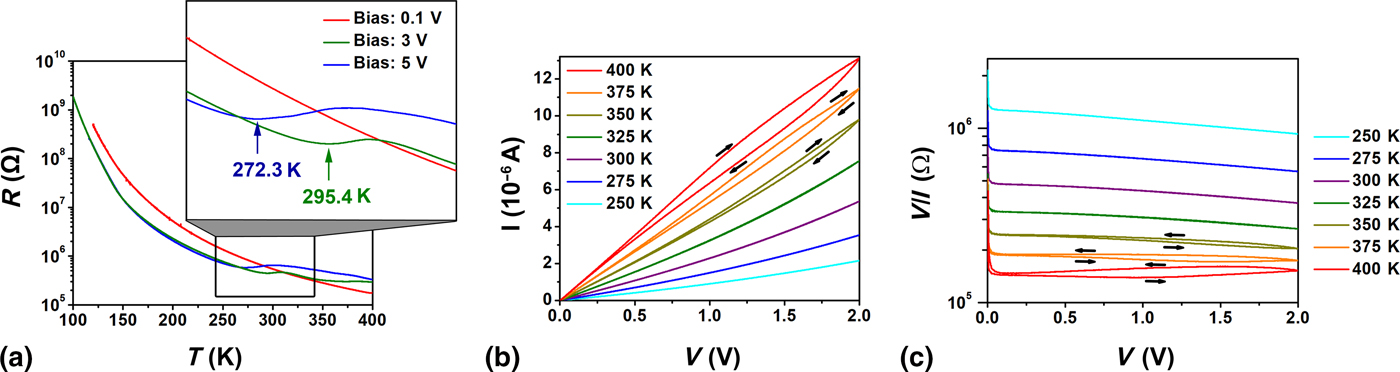
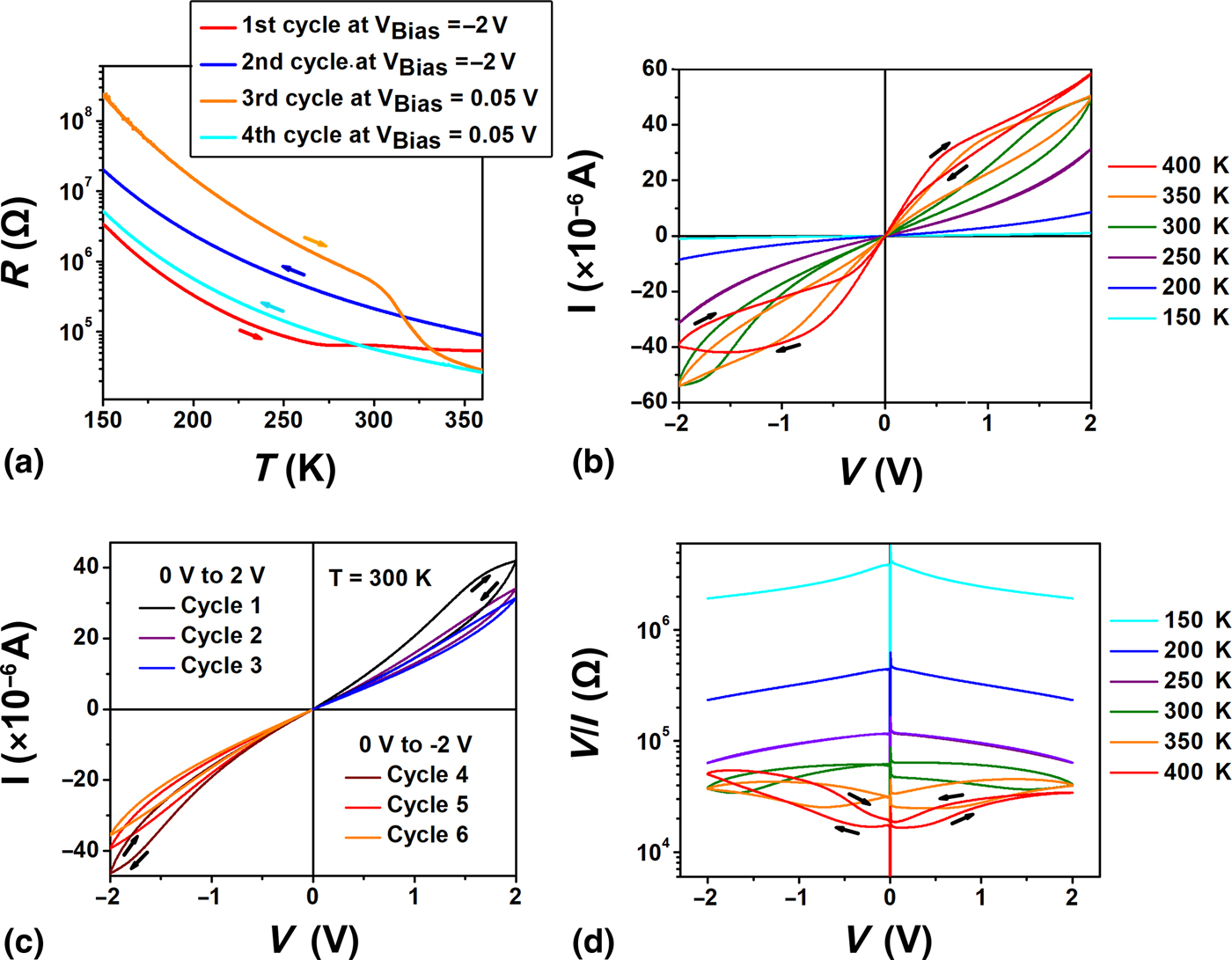
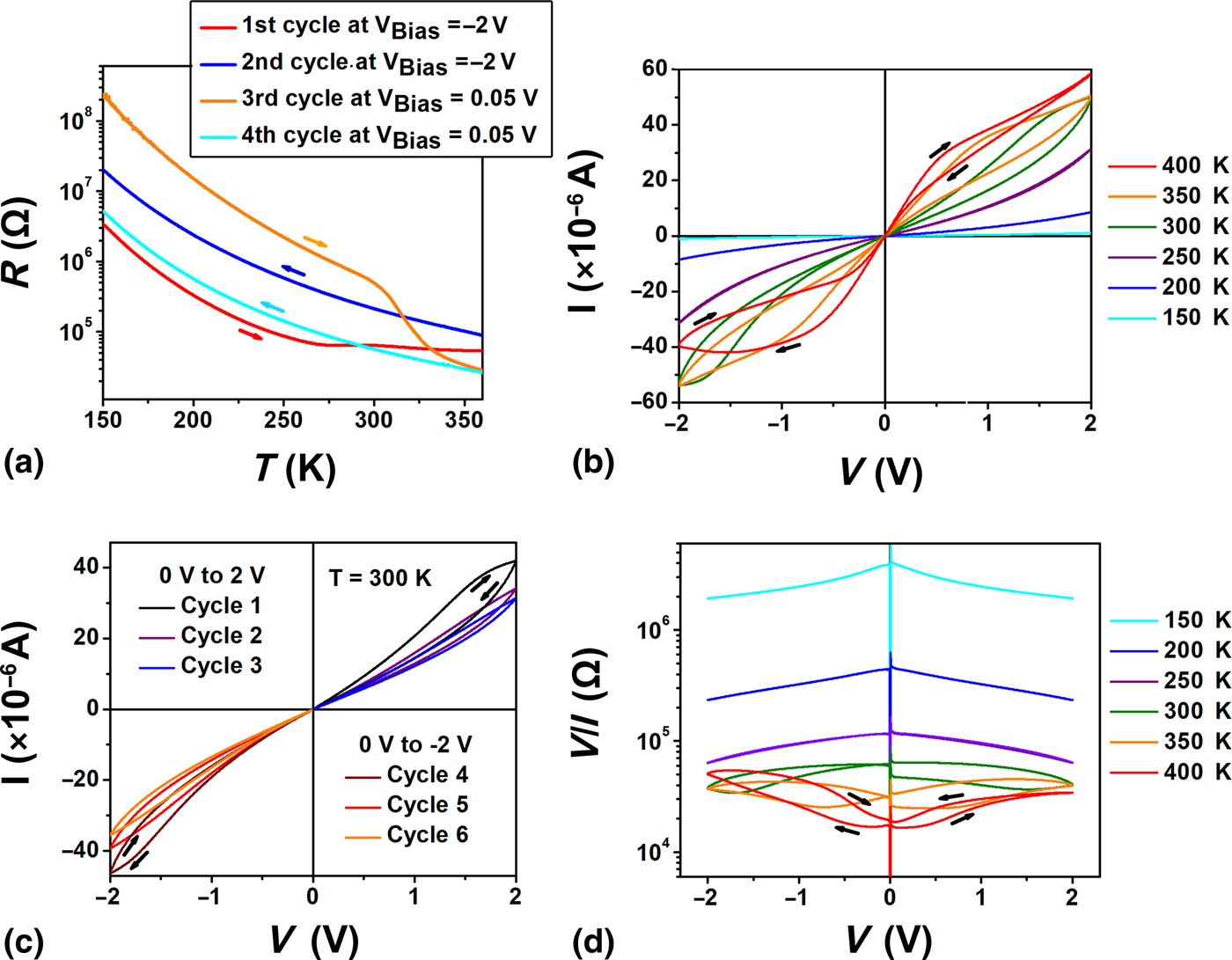
Figure 3(a) depicts the evolution of the resistance of an individual nanowire of δ-[Co(H2O)4]xV2O5 as a function of temperature at different bias voltages. In this case, as the material is heated at a constant bias of −2 V (red plot), a pronounced discontinuity of the resistance, again with a transition to a higher resistance state, is observed at approximately 275 K. Upon cooling, the dark blue line indicates that the resistance follows the function of the “as written” higher resistance internal state. When the polarity is reversed from negative to positive bias, at a bias of 50 mV, the material remains in the highly resistive state up to a threshold temperature of approximately 302 K at which point it is “rewritten” to its initial low-resistance state. As is characteristic of memristive systems,[Reference Pershin and Di Ventra5] the resistance is a function not just of the temperature and applied bias but also reflects the voltage sweep direction and history of the voltage magnitude. The distinct resistance states can be reversibly transformed (“written”) or simply “read” depending on the applied bias. Figure 3(b) depicts the relatively more pronounced pinched hysteretic loops observed in current–voltage measurements as a function of temperature; pronounced hysteretic behavior but with a greater degree of asymmetry between the positive and negative voltage regimes is observed at temperatures of 300 K and above. The directions delineated by the arrows in Fig. 3(b) suggest that the observed characteristics are typical of a type-II memristor with an avoided crossing at null bias.[Reference Chua and Kang4, Reference Pershin and Di Ventra5] While such behavior cannot uniquely identify the origin of memristive behavior, it can provide a useful test for some proposed physical mechanisms. Figure 3(c) depicts multiple voltage sweep cycles up to 2 V; Fig. S4 (Supporting Information) shows details of ten cycles along each polarity. The hysteresis width successively decreases with multiple 0 → 2 → 0 V cycles, ultimately collapsing to a finite hysteresis width that is retained through cycles 7—10 (Supplementary Fig. S4). The collapse to a higher resistance state is thought to reflect depletion of ionic carriers that likely accumulate at the current collector electrodes where they are attracted to image charges.[Reference Savel'ev, Alexandrov, Bratkovsky and Williams23] Consistent with this idea, reversing the polarity allows for restoration of the higher conductance state; prolonged cycling at negative bias further results in a diminution of the hysteretic width. The resistance versus voltage plots corresponding to Fig. 3(b) are depicted in Fig. 3(d) and indicate classical double-loop characteristics, which further cements the assignment of the observed transport characteristics to type-II memristive behavior. It is worth noting that for both mentioned systems, application of a high-magnitude voltage drives the system to a higher resistance state regardless of polarity; reversing the polarity restores the higher conductance state. The temperature dependence of the hysteresis widths and the dependence of current at a specific applied bias on both voltage and thermal history is reminiscent of memristive thermistors.[Reference Pershin and Di Ventra5] Figure S3 (Supporting Information) exhibits transport data acquired for an individual nanowire of the isostructural C2/m Zn analog. Pinched hysteretic loops, albeit with smaller widths as compared with the Ni and Co bronzes, are discernible at temperatures of 350 K and above and are again characterized by avoided crossings at null bias characteristic of type-II memristors. From a mechanistic perspective, the observation of memristive behavior in δ-[Zn(H2O)4]xV2O5 is intriguing and suggests that phenomena noted in this isostructural family of compounds is not predicated on having a magnetic cation.
Single-nanowire transport properties of δ-[Co(H2O)4]xV2O5. (a) Resistance versus temperature plots acquired for a single nanowire of δ-[Co(H2O)4]xV2O5 when cycling between 0 and −2 V. Current versus voltage curves plots acquired (b) as a function of temperature and (c) at a fixed temperature over multiple cycles. (d) Resistance versus voltage curves for each of the individual plots depicted in (b) allowing for unambiguous assignment of the observed behavior to a type-II memristive element.
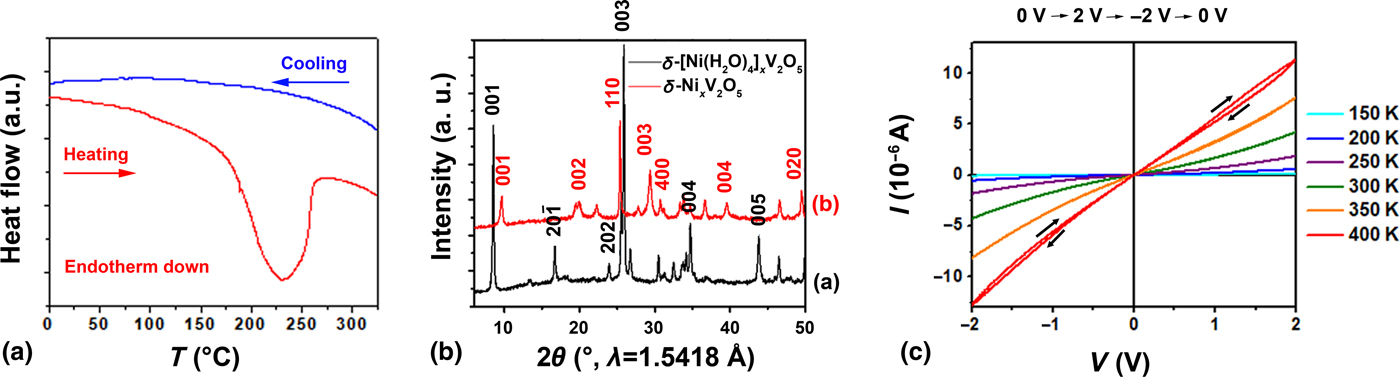
In order to further elucidate the role of the water molecules coordinated to the intercalated cations, a dehydrated δ-Ni0.25V2O5 phase has been prepared. The annealing temperature is above the irreversible endothermic peak attributable to dehydration of δ-[Ni(H2O)4]0.25V2O5 observed at 230 °C in a differential scanning calorimetry measurement shown in Fig. 4(a). The diffraction pattern of the annealed sample is depicted in Fig. 4(b), and exhibits a structure similar to that observed upon annealing δ-[Ca(H2O)4]0.25V2O5.[Reference Marley and Banerjee19] The shift of the (00l) reflections to higher 2θ values is consistent with a decrease of the interlayer separation from 10.33 to 9.15 Å upon loss of water.[Reference Yao, Oka and Yamamoto24] Transport properties measured for the dehydrated compound shown in Fig. 4(c) are characterized by a pronounced increase of resistance and substantially diminished hysteresis. This result thus suggests that the intercalated water molecules play a pivotal role in mediating charge transport in these systems. Voltage-induced transitions to a higher resistance state and an increase of hysteresis with temperature observed for δ-[M(H2O)4]0.25V2O5 are markedly different from the transport characteristics measured for β- and δ-phase M xV2O5 bronzes with bare (unsolvated) cations.[Reference Marley, Stabile, Kwan, Singh, Zhang, Sambandamurthy and Banerjee16, Reference Marley, Singh, Abtew, Jaye, Fischer, Zhang, Sambandamurthy and Banerjee17] The distinctive transport characteristics noted here, specifically, the depletion of charge carriers at high bias [Figs. 2(b) and 3(b)], the relaxation to a higher conductance state upon removal of bias [Fig. 3(c) and Supplementary Fig. S4], and the ability to recover the higher conducting state by reversing polarity point to ionic conductivity as the primary underlying mechanism of charge transport. Next, it is worth considering the specific ions involved in transport. The temperature dependence of the hysteresis, corresponding to thermistive behavior,[Reference Yang, Pickett, Li, Ohlberg, Stewart and Williams25] is further consistent with a thermodynamically driven increase of ionic carriers with increasing temperature. In analogy with the reactivity of divalent transition metal complexes of nickel, cobalt, and zinc dissolved in aqueous solution[Reference Milic and Jelic26, Reference Giasson and Tewari27] (pK a values of [Ni(H2O)6]2+, [Co(H2O)6]2+, and [Zn(H2O)6]2+ are 9.9, 9.6, and 9.0).[Reference Baes and Mesmer28] It is reasonable to expect that hydrated transition metal cations intercalated between the V8O20 layers can be readily hydrolyzed as per:
 $$\left[ {ML_{\rm 2} ({\rm H}_{\rm 2} {\rm O})_{\rm 4}} \right]^{{\rm 2 +}} \leftrightarrow \left[ {ML_{\rm 2} ({\rm OH})({\rm H}_{\rm 2} {\rm O})_{\rm 3}} \right]^{\rm +} {\rm + H}^{\rm +}, $$
where in this case L represents the apical vanadyl oxygen ligands to the transition metals. Such a hydrolysis reaction would yield protons as potentially mobile ionic species and would result in each of the cations donating one (instead of two) electrons to the V8O20 layers with the protons, also likely bound to vanadyl species, providing charge balance. Diffusion of protons would result in the local oxidation of vanadium sites, utilizing a readily accessible redox couple [note that the oxidation state of the intercalated cation remains unchanged in Eq. (3)],[Reference Marley, Horrocks, Pelcher and Banerjee8] and would result in loss of charge ordering. The idea of proton-mediated conductivity is supported by the loss of hysteresis upon dehydration (Fig. 4), which would substantially diminish the available number of carriers. Furthermore, data for hydrolysis of aqueous cobalt(II) complexes suggests a pronounced monotonic increase of pK a and a decrease of pH with increasing temperature.[Reference Giasson and Tewari27] Indeed, this temperature dependence suggests that the equilibrium for the endothermic reaction depicted in Eq. (3) is shifted to the right with increasing temperature, thereby making available a greater concentration of protons, which serve as the mobile ionic species, at higher temperatures. The protons created as per Eq. (3) likely drift along the interlayer sites upon application of a voltage along a pathway defined by the vanadyl oxygen atoms. The relatively low occupancy of interlayer sites by hydrated cations (as compared with layered bronzes with unsolvated cations) likely further facilities proton diffusion along the 2D layers. Increasing temperature thus increases the carrier concentration within this system as well as facilitates carrier diffusion, bringing about a decrease in resistance spanning orders of magnitude, as observed in Figs. 2(c) and 3(d). However, since the charge carriers are limited by the number of intercalated hydrated cations, beyond a specific voltage, the accumulation of protons at one electrode results in the nanowire being transformed to a higher resistance state. Removal of the voltage allows for protons to drift back along their diffusion gradient across the 2D layers, which incidentally have been found to define very favorable diffusion pathways for monovalent Li- and Na-ions.[Reference Parija, Prendergast and Banerjee29] Indeed, nudged elastic band calculations suggest that the specific diffusion pathway for cations within such structures depends sensitively on the stacking of the 2D layers.[Reference Parija, Prendergast and Banerjee29] The large asymmetry observed in Figs. 2 and 3 likely derive in large measure from accumulation and large concentration gradient of ionic species defined at charged surfaces upon sweeping voltage along one direction and is also increased with increasing temperature as a result of the higher carrier concentration and increased mobility of carriers. However, unequivocal determination of the underlying mechanism of the memristive behavior will require in situ atomic resolution imaging and detailed theoretical evaluation of ion transport mechanisms in these novel intercalation compounds.
Characterization of dehydrated δ-Ni0.25V2O5. (a) Differential scanning calorimetry (DSC) showing gradual dehydration of the bronze from 190 to 260 °C. (b) X-ray diffraction of the pristine δ-[Ni(H2O)4]0.25V2O5 bronze (black) and the same material after being annealed in vacuum at 300 °C under vacuum for 5 h (red). (c) Current versus voltage curve for the dehydrated material showing dramatically reduced hysteresis, underlining the crucial role that water plays in the hysteretic behavior. The resistance of the material is also dramatically increased in the dehydrated state relative to the hydrated state (Fig. 1).

Solid-solution mixed-cation vanadium oxide bronzes
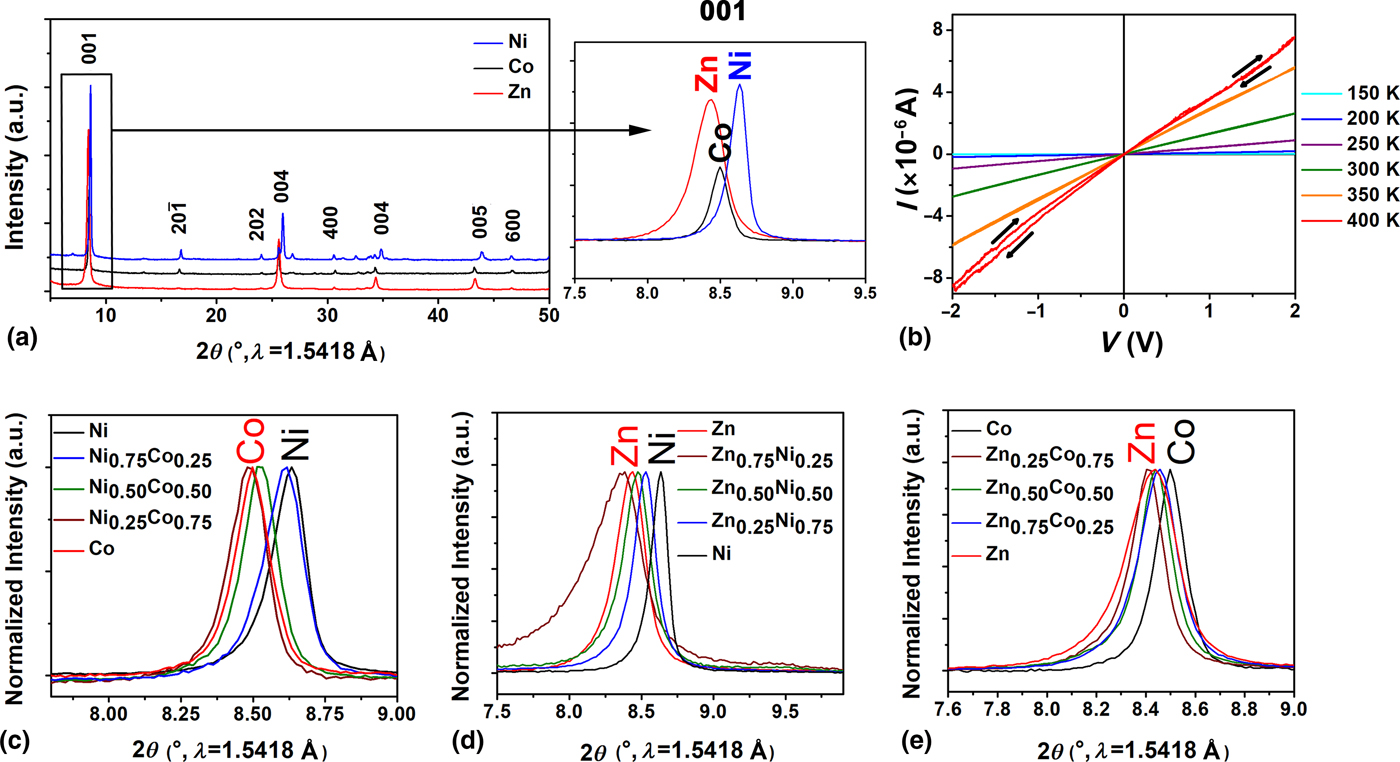
Figure 5(a) contrasts the powder XRD patterns of δ-[Ni(H2O)4]0.267V2O5, δ-[Co(H2O)4]0.270V2O5, and δ-[Zn(H2O)4]0.168V2O5; the patterns can all be indexed to the monoclinic C2/m space group. The inset to Fig. 5(a) depicts a shift of the (001) reflection, corresponding to the separation between the layers of the 2D compound, to lower 2θ values from Ni to Co to Zn. This trend of increasing interplanar separations is well correlated with values of hydrated radii determined for the hexa-aqua complexes wherein Ni2+ (4.04 Å) < Co2+ (4.23 Å) < Zn2+ (4.30 Å).[Reference Nightingale30] Given the close structural similarity of the three compounds, mixed-cation quaternary systems have been prepared. Figures 5(c)–5(e) depict powder XRD patterns of quaternary bronzes with mixed hydrated cations: δ-[NixCo1−x(H2O)4]0.25V2O5 [Fig. 5(c)]; δ-[NixZn1−x(H2O)4]0.25V2O5 [Fig. 5(d)]; and δ-[CoxZn1−x(H2O)4]0.25V2O5 [Fig. 5(e)]. The monotonic shift of the (001) reflection to lower 2θ values (corresponding to larger interlayer spacing) with increasing incorporation of the larger hydrated metal cation is striking and generally consistent with Vegard's law. However, in each series, the sample with intended stoichiometry of δ-[M large(0.75)M small(0.25)(H2O)4]0.25V2O5 exhibits anomalous behavior wherein the interlayer spacing is further expanded with respect to the single-cation δ-[M large(H2O)4]0.25V2O5 material. The anomalous behavior is likely a result of disorder introduced at these stoichiometries that allows for incorporation of additional water molecules. EDS spectra obtained for nanowires intermediate in the δ-[NixZn1−x(H2O)4]0.25V2O5 and δ-[CoxZn1−x(H2O)4]0.25V2O5 series are presented in Fig. S5 (Supporting Information). The preparation of mixed-cation bronzes thus allows for modulation of the interlayer separation, which is known to profoundly affect the electronic structure of layered vanadium oxides.[Reference Andrews, De Jesus, Tolhurst, Marley, Moewes and Banerjee22] Figure 5(b) depicts the transport properties measured for an individual nanowire of δ-[Co0.5Ni0.5(H2O)4]0.25V2O5, which again shows pinched hysteretic type-II memristive behavior albeit with a narrow hysteresis. The disorder in the intercalated cation layer of mixed-cation bronzes likely serves as an impediment to proton transfer. Nevertheless, the high degree of tunability of structure suggests a versatile family of compounds with tunable coupling between [V8O20] layers.
Synthetic control of composition and interlayer spacing in hydrated δ-phase mixed-cation δ-[M xM′1−x(H2O)4]0.25V2O5 (M/M′ = Ni, Co, Zn). Powder diffraction patterns (λ = 1.5418 nm) for (a) ternary bronzes (Ni, Co, Zn) verifying the isostructural nature of the bronzes. An expanded view of the (001) reflection clearly shows a monotonic increase in the separation between basal planes mirroring the increase in hydrated ionic radii from Ni2+ to Zn2+. (b) Transport measurements for a nanowire with mixed Ni2+/Co2+ occupancy showing similar type-II memristive behavior as the end-member nickel and cobalt analogs. Diffraction patterns for mixed-cation quaternary compositions namely (c) δ-[NixCo1−x(H2O)4]0.25V2O5; (d) δ-[NixZn1−x(H2O)4]0.25V2O5; and (e) δ-[CoxZn1−x(H2O)4]0.25V2O5. EDS spectroscopy data for two of the intermediate compositions in depicted in Supplementary Fig. S5.

Conclusions
Single-crystalline nanowires of isostructural δ-[M(H2O)4]0.25V2O5 (M = Co, Ni, Zn) compounds have been prepared by a facile hydrothermal route involving the reaction of metal acetate precursors with V2O5. The compounds comprise hydrated cation layers separating condensed [V8O20] double layers with the divalent metal cations coordinated by vanadyl oxygens from the layers above and below. Transport measurements of individual nanowires of all three compounds are characterized by pinched hysteretic loops with avoided crossings at null bias, characteristic of type-II memristive elements. Higher voltages drive the systems from a high conductance to low conductance state; the high conductance state is recovered upon relaxation of the system at zero bias or upon reversal of polarity. The measured current in these devices is a function of voltage and thermal history. The memristive behavior observed within single domains likely derives from ion diffusion. The crucial role of both coordinating water as well as free water within the intergallery spacing has been established through comparison of water-coordinated and dehydrated samples and suggests the establishment of a proton-mediated conductivity channel, a direct consequence of the 2D structure of the material, which allows for facile diffusion pathways to be defined along the layers.[Reference Parija, Prendergast and Banerjee29] The distinctive layers of hydrated, intercalated transition metal centers within alternating layers of the material are intrinsically related to the observed phenomena. The observation of pronounced memristive behavior at room temperature and above makes these systems particularly intriguing for integration within neuromorphic circuitry wherein specific internal states are encoded based on dynamical evolution of temperature and voltage.
The interlayer separation within these materials is readily tunable through substitution of the intercalated cations to form mixed-cation quaternary intercalation bronzes that appear to retain type-II memristive behavior. The facile ability to substitute the solvated cations between double-layered V2O5 slabs provides a versatile family of compounds that can perhaps further be elaborated to other transition metal cations and ligand molecules other than water.[Reference Yao, Oka and Yamamoto24] Future work will be focused on detailed elucidation of ion conduction pathways in this system as well as an evaluation of the modulation of electronic structure as a function of increasing interlayer separation.
Supplementary material
The supplementary material for this article can be found at https://doi.org/10.1557/mrc.2017.64.
Acknowledgments
J.L.A. and S.B. acknowledge funding support from the National Science Foundation under DMR 1504702. S.B. and P.J.S. acknowledge support from a College of Science Strategic Transformative Research Program award. Synchrotron data for δ-[Ni(H2O)4]0.25V2O5 was collected at beamline 11-BM of the Advanced Photon Source. S.S., C.K., and G.S. acknowledge partial support from the National Science Foundation under DMR 0847324.