INTRODUCTION
Disentangling the factors that determine patterns of species diversity remains a central theme of ecology and is fundamental to understanding processes that govern ecological communities (MacArthur Reference MACARTHUR1965, Ricklefs & Schluter Reference RICKLEFS and SCHLUTER1993). Understanding diversity patterns becomes increasingly important for conservation prioritization in light of current rates of habitat destruction and fragmentation, which have created the current biodiversity crisis (Raven & Wilson Reference RAVEN and WILSON1992, Soulé Reference SOULÉ1986). Although universal rules governing the arrangement of biodiversity remain elusive, it is clear the interplay between historical, regional and local processes together result in the present-day patterns of species diversity (Brown & Lomolino Reference BROWN and LOMOLINO1998, MacArthur & MacArthur Reference MACARTHUR and MACARTHUR1961, Pianka Reference PIANKA1966a, Reference PIANKA1966b; Ricklefs & Schluter Reference RICKLEFS and SCHLUTER1993, Rosenzweig Reference ROSENZWEIG1995). However, the roles of historical and local factors vary according to taxonomic group and geographic setting, and the contributions of each are not equal at all spatial scales (Scott et al. Reference SCOTT, HEGLUND, MORRISON, HAUFLER, RAPHAEL, WALL and SAMSON2002).
At the regional scale, species diversity (gamma diversity) is a consequence of within-community diversity at all sites (alpha diversity) as well as the similarities and differences in diversity among sites (beta diversity) (Whittaker Reference WHITTAKER1972). Therefore, to understand the species diversity of a region, we must elucidate patterns of both alpha and beta diversity. Information about topographic features, rainfall, seasonality and habitat affinities of species may allow us to infer drivers of alpha and beta diversity at the regional and local scales.
Costa Rica provides an excellent opportunity to study correlates of species diversity. A small country (50 900 km2), roughly the size of West Virginia, USA, Costa Rica contains close to 4% of the earth's total biodiversity (Vargas Ulate Reference VARGAS ULATE1992). This high diversity is reflected in its herpetofauna, which consists of 174 amphibian and 222 reptile species (Savage Reference SAVAGE2002). These species are distributed across a varied landscape that includes many climatic regimes, life zones and elevations. Furthermore, the country has protected approximately 25% of its land (Evans Reference EVANS1999) and has encouraged biological study, providing incentives to gather data necessary to analyse diversity at multiple scales.
Herein, we utilized Costa Rica's herpetofauna to investigate species diversity patterns and correlates to those patterns at local and regional scales. We began at the local level by comparing amphibian and reptile richness at 17 individual sites throughout Costa Rica. We then scaled up to regional patterns by examining species similarity among sites. Next, we tested for relationships between species distributions and a suite of environmental variables to gain insight into the role of abiotic drivers of local and regional patterns of diversity. Virtually all aspects of the natural lives of amphibians and reptiles are influenced at large and small scales by abiotic factors. As ectotherms, the metabolism, whole-organism performance, daily and seasonal activity patterns, habitat affinity, foraging, defence, reproductive phenology and geographic distributions of both amphibians and reptiles are inextricably linked to climatic factors, especially those that influence thermoregulation and water balance (Cruz et al. Reference CRUZ, FITZGERALD, ESPINOZA and SCHULTE2005, Fitzgerald et al. Reference FITZGERALD, CRUZ and PEROTTI1999, Hillman Reference HILLMAN1969, Huey & Slatkin Reference HUEY and SLATKIN1976, Huey et al. Reference HUEY, BENNETT, JOHN-ALDER and NAGY1984, Pough Reference POUGH1980, Zug et al. Reference ZUG, VITT and CALDWELL2001). Energy and moisture are also known correlates of tropical forest diversity and structure (Gentry Reference GENTRY1988), which in turn leads to ecological feedbacks that play a role in the history of community organization at local and regional scales (Ricklefs Reference RICKLEFS2006). Therefore, we predicted that climate variables relating to energy and moisture, as well as topography, would help explain species turnover among sites (beta diversity).
Because beta diversity is predicted to increase as an effect of distance in addition to other factors (Soininen et al. Reference SOININEN, MCDONALD and HILLEBRAND2007), we also examined the decay of similarity with geographic distance to evaluate the extent to which distance influences regional diversity patterns. Additionally, we used the assembled species diversity data sets to examine Savage's delineation of herpetofaunal regions (Savage Reference SAVAGE2002).
METHODS
Data sources
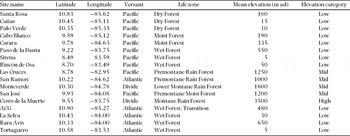
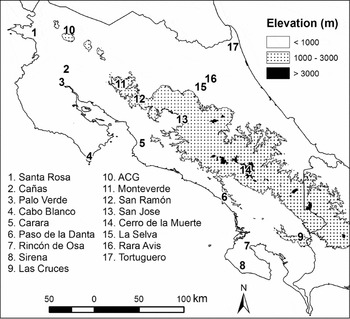
We used literature, our own field surveys, and the specimen database at the Natural History Museum of the University of Costa Rica (UCR) to compile lists of amphibian and reptile species from 17 well-surveyed sites throughout Costa Rica (Table 1, Figure 1). Sources for each species list are listed in Table 2. We followed taxonomic designations and nomenclature in Savage (Reference SAVAGE2002), O'Neill & Mendelson (Reference O'NEILL and MENDELSON2004) and Savage & Wake (Reference SAVAGE and WAKE2001). Sites were selected to include major habitat types while allowing for replication within major ecoregions. Three sites were tropical dry forest, four were lowland Atlantic rain forest, three were lowland Pacific rain forest, and four were mid-elevation sites. Only one well-surveyed high-elevation site (Cerro de la Muerte) was available for analysis. High-elevation sites are not common in Costa Rica, are mostly confined to the Cordillera de Talamanca in the south, and contain relatively depauperate herpetofaunal assemblages. Despite their scarcity, high-elevation sites represent a distinct ecoregion with a unique combination of environmental variables. Additionally, two sites (Carara, Cabo Blanco) were located along the transitional central Pacific coast. Laurencio & Malone (Reference LAURENCIO and MALONE2009) demonstrated that Parque Nacional Carara is a transitional site that most closely resembles the herpetofauna of the country's wet lowland Pacific forest, yet also contains tropical dry-forest species. Conversely, Reserva Natural Absoluta Cabo Blanco, located at the tip of the Nicoya Peninsula in north-west Costa Rica, contains a tropical dry-forest herpetofaunal assemblage (Laurencio Reference LAURENCIO2009). For these reasons, we treat Carara as a lowland Pacific site and Cabo Blanco as a tropical dry-forest site. For the mid-elevation site Monteverde, we use only the species listed for distributional zones 2, 3 and 4 (Hayes et al. Reference HAYES, POUNDS and TIMMERMAN1989).
Summary of 17 Costa Rican sites used in this study. Life zones follow the Holdridge (Reference HOLDRIDGE1967) classification system. All life zones are tropical.

Map of Costa Rica showing the 17 sites used in this study. Elevations between 1000 and 3000 m are stippled and those greater than 3000 m are black. All low-elevation sites are found lower than 1000 m, mid-elevation sites are all found between 1000 and 1600 m elevation and the high-elevation site has an elevation greater than 3000 m.

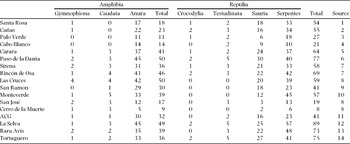
Summary of amphibian and reptile alpha diversity values for 17 sites in Costa Rica. Sources for amphibian and reptile data are: 1 = Sasa & Solórzano Reference SASA and SOLÓRZANO1995; 2 = Scott et al. Reference SCOTT, SAVAGE, ROBINSON and Janzen1983; 3 = UCR Museum of Natural History; 4 = Laurencio Reference LAURENCIO2009; 5 = Laurencio & Malone Reference LAURENCIO and MALONE2009; 6 = M. Ryan pers. comm.; 7 = McDiarmid & Savage Reference MCDIARMID, SAVAGE, Donnelly, Crother, Guyer, Wake and White2005; 8 = Scott et al. Reference SCOTT, SAVAGE, ROBINSON and Janzen1983; 9 = Bolaños & Ehmcke Reference BOLAÑOS and EHMCKE1996; 10 = Hayes et al. Reference HAYES, POUNDS and TIMMERMAN1989; 11 = Laurencio (unpubl. data); 12 = Donnelly Reference DONNELLY, McDade, Bawa, Hespenheide and Hartshorn1994, Guyer Reference GUYER, McDade, Bawa, Hespenheide and Hartshorn1994; 13 = T. Leenders pers. comm.; 14 = Burger Reference BURGER2001.

To test for relationships between species distributions and environmental variables important to the ecology of amphibians and reptiles, we compiled environmental data from the Atlas Climatológico de Costa Rica (Barrantes et al. Reference BARRANTES, LIAO and ROSALES1985) as well as maps from the Instituto Meteoreológico Nacional of Costa Rica. Most of the climate data are based on 20 y of data. We derived two environmental variables (mean dry-season rainfall and mean wet-season rainfall) by adding the monthly mean rainfall values from Barrantes et al. (Reference BARRANTES, LIAO and ROSALES1985) for January–March and April–December respectively. We used three inter-related temperature variables at each site: mean annual temperature, annual mean maximum temperature and annual mean minimum temperature. All three annual mean temperatures were all based on monthly means for each variable. To test for the effect of solar influences on amphibian and reptile diversity, we selected four variables related to ambient solar energy: annual mean daily sunshine hours, March mean daily sunshine hours, August mean daily sunshine hours and mean annual insolation. Sunshine hours, measured with a Campbell Stokes sunshine recorder, quantifies the amount of time the sun is shining at a site, a variable especially important to heliophilic and basking ectotherms. Sunshine-hour means for March and June represented the maximum and minimum monthly values, respectively. Insolation, a measure of solar energy per unit area per unit time, is an important variable that relates to both potential and actual evapotranspiration and well as primary production at a site. Rainfall was quantified using total yearly precipitation, dry-season precipitation, wet-season precipitation and number of dry months. We also used potential evapotransporation (PET), because this variable was found to be both positively and negatively correlated to species richness in previous studies (Currie Reference CURRIE1991, van Rensburg et al. Reference VAN RENSBURG, CHOWN and GASTON2002). Additionally, elevation has long been associated with diversity patterns (Lomolino Reference LOMOLINO2001), so we also included mean elevation.
Analyses
Amphibian and reptile data were analysed separately because these groups have not shared a common ancestor in >200 million y, and have vastly different life histories and physiological requirements. Separate analyses also allowed us to contrast findings between these groups that have distinct physiological requirements. Marine and introduced species were not considered, however species recently presumed extinct (e.g. Craugastor escoses, Incilius holdridgei, Incilius periglenes) were included. Alpha diversity was the species richness at each site. Beta diversity was measured using Jaccard's Similarity Index (JSI):
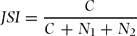
where C = species found in both sites, N1 = species found in site one but not two, N2 = those found in site two but not one. The JSI values were used in a cluster analysis with the UPGMA (unweighted pair-group method using arithmetic averages) option. This method produced clusters of similar species assemblages (low beta diversity), which were visualized with dendrograms (McGarigal et al. Reference MCGARIGAL, CUSHMAN and STAFFORD2000, Sneath & Sokal Reference SNEATH and SOKAL1973).
We used Canonical Correspondence Analysis (CCA) in the program CANOCO 4.5 (Plant Research International, Wageningen, the Netherlands) to analyse the influence of environmental variables on patterns of species diversity among the sites. CCA is a direct gradient analysis in which the site and species distributions are constrained by the environmental variables. We initially selected 13 environmental variables for use in the CCA. However, due to multicollinearity among these variables, a reduced set of five (elevation, mean annual sunshine hours, mean annual precipitation, insolation, dry months) was used for the CCA analysis with the forward manual selection option to include only significant variables. The significance of each factor was computed with a Monte Carlo test (9999 permutations), and only factors with P < 0.05 were retained. Because only one high-elevation site was available for our analyses, we tested for any possible effect by running the CCA both with and without the highland site, Cerro de la Muerte. The ordination of the 16 sites with exclusion of the highland site was similar in both the relative positions of the sites and the amount of variation explained; therefore, we report only the results of the analyses with all 17 sites.
We quantified decay of similarity in species assemblages over geographical distance by constructing a distance matrix (straight-line distance) and a matrix of JSI values for all pairs of sites. Because each site was compared to every other site, making the data points interdependent, linear regression was not appropriate. Therefore, we used Mantel tests to determine correlation in distance decay trends (Manly Reference MANLY1997). A Monte Carlo procedure randomized the site-pairs (9999 permutations) with JSI values and re-calculated the correlation to construct a statistical distribution to which the observed data were compared. To understand if decay-by-distance was significant across the entire study area or by ecoregion, we ran tests for the overall dataset, for pairs of sites within the same ecoregion, and for pairs of sites in different ecoregions.
RESULTS
Amphibians
One hundred and twenty-eight amphibian species from 10 families occurred at the 17 sites, representing 71.1% of Costa Rican amphibian species. Amphibian alpha diversity values ranged from nine species at Cerro de la Muerte to 50 at Paso de la Danta and Las Cruces, with a mean of 31.8 species per site (N = 17, SD = 14.0; Table 2). Anurans made up the majority (> 70%) of amphibian species at all sites except for Cerro de la Muerte, the highland site (40%).
Lowland Pacific sites contained the highest mean amphibian species diversity (mean = 43.3, N = 4, SD = 6.08), whereas the highland site, Cerro de la Muerte, had the fewest (S = 9). Tropical dry-forest sites averaged 16.5 amphibian species (N = 4, SD = 5.20). Mean alpha diversity of caecilians was highest at mid-elevation sites (mean = 1.75, N = 4, SD = 1.71) and lowest in the tropical dry forest (mean = 0.5, N = 4, SD = 0.58). Salamanders were altogether absent from tropical dry forest sites, and their mean alpha diversity peaked in the mid-elevation (mean = 3.25, N = 4, SD = 1.71) and lowland Pacific sites (mean = 3.25, N = 4, SD = 0.50). Mean anuran alpha diversity was highest in the lowland Pacific (mean = 38.5, N = 4, SD = 5.97) and was lowest at Cerro de la Muerte (S = 5) and in the tropical dry forest (mean = 16, N = 4, SD = 4.69).
Families that contributed most to amphibian alpha diversity were: Leptodactylidae (8.3–60.0% of total anuran alpha diversity) and Hylidae (20.0–36.7% of total anuran alpha diversity). Two families, Centrolenidae and Dendrobatidae, were not represented in tropical dry forest sites while one family, Rhinophrynidae, was restricted to three dry-forest sites.
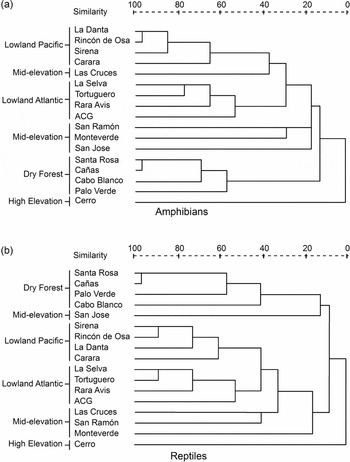
Jaccard's Similarity Index values for amphibians ranged from zero between Cerro de la Muerte and several sites to 0.783 between Santa Rosa and Cañas. The dendrogram based on amphibian JSI values illustrated three distinct groups of lowland ecoregions (lowland Pacific, lowland Atlantic, tropical dry forest) (Figure 2). This grouping reflected the high number of species shared between sites within each of three ecoregions. Beta diversity was high among mid-elevation sites and between ecoregions. Interestingly, Las Cruces, a mid-elevation site clustered with the lowland Pacific sites (although at a low similarity) and not with the other mid-elevation sites. The tropical dry-forest sites and highland site, Cerro de la Muerte, were the most distinct clusters. Among lowland groups, the dry-forest cluster was the least similar to the other lowland clusters. When amphibians were analysed at the level of taxonomic order, the same three clusters (lowland Pacific, lowland Atlantic, tropical dry forest) were produced for Caudata and Anura but not Gymnophiona.
Dendrograms based on UPGMA cluster analysis of Jaccard's similarity values for amphibian (a) and reptile (b) species assemblages at 17 sites in Costa Rica. Abbreviations for sites not named on the figure are Paso de la Danta (La Danta); Área de Conservación Guanacaste (ACG); Cerro de la Muerte (Cerro).

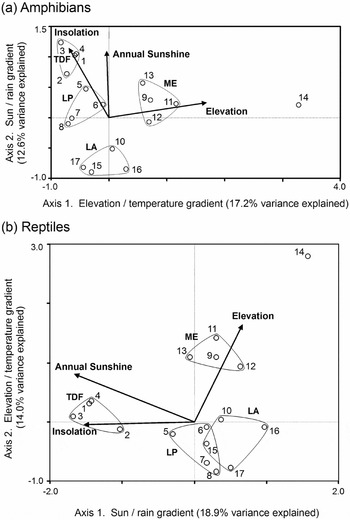
The amphibian CCA distributed the 17 localities along two primary environmental gradients that explained 29.8% of the variance in the data (Figure 3). Axis one explained 17.2% of the variation and was positively related to elevation. Axis two explained an additional 12.6% of the variance and described a gradient of insolation and annual mean daily sunshine hours that corresponded to amphibian diversity across the sites. The pattern reflected in the CCA supported the results of the cluster analysis. In a CCA ordination space, proximity of sites along the axes equates to species similarity between two sites based on environmental conditions, whereas the cluster analysis was based on JSI values. As in the cluster analysis lowland sites in the same regions were similar. Mid-elevation sites grouped loosely near each other, and the one high-elevation site (Cerro de la Muerte) was distinct. Dry-forest sites were negatively associated with axis one and positively with axis two, corresponding to sites in lowland hot sunny areas with little rainfall. The lowland Pacific sites were negatively related to axis one and somewhat positively related to axis two. Lowland Atlantic sites were primarily negatively related to axis two. The mid-elevation sites were positively related to axis one and Cerro de la Muerte was highly related to axis one.
Axes one and two of canonical correspondence analyses ordination diagram showing the distribution of 17 Costa Rican amphibian (a) and reptile (b) species assemblages in relation to the three significant forward-selected environmental variables. The length of the arrows indicates the relative importance of each environmental variable. The polygons enclose the locations of the sites scores for each ecoregion: TDF = tropical dry forest, LP = lowland Pacific, LA = lowland Atlantic, ME = mid-elevation sites. The numbers indicate sites: 1 = Santa Rosa, 2 = Cañas, 3 = Palo Verde, 4. = Cabo Blanco, 5 = Carara, 6 = Paso de la Danta, 7 = Rincón de Osa, 8 = Sirena, 9 = Las Cruces, 10 = Área de Conservación Guanacaste, 11 = Monteverde, 12 = San Ramón, 13 = San José, 14 = Cerro de la Muerte, 15 = La Selva, 16 = Rara Avis, 17 = Tortuguero. Abbreviations used: annual mean daily sunshine hours (Annual Sunshine).

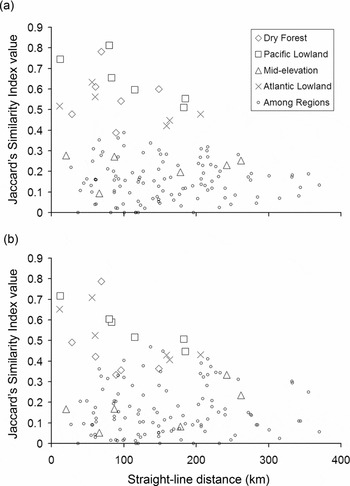
The JSI values decreased significantly with distance for the entire amphibian data set (r = −0.241, P = 0.015), but the trend was weak and driven by the lowland Pacific sites (Figure 4). When analysed alone, the lowland Pacific sites had a strong significant decreasing trend in similarity with distance (r = −0.831, P = 0.044). When all sites were reanalysed with lowland Pacific sites removed, there was a weak, and not significant pattern of decay with distance (r = −0.218; P = 0.070). There was no clear pattern of decay by distance within other ecoregions, nor between sites in different ecoregions.
Relationship of Jaccard's Similarity Index values and distance for assemblages of amphibians (a) and reptiles (b) at 17 sites in Costa Rica. The correlation, as determined by a Mantel test, was significant for amphibians (r = −0.241, P = 0.015); but not for reptiles (r = −0.160; P = 0.088).

Reptiles
A total of 188 reptile species in 24 families was documented, representing 90% of all Costa Rican reptile species. Reptile alpha diversity values ranged from 8 at Cerro de la Muerte to 89 at La Selva, with a mean of 51.2 species per site (N = 17, SD = 22.9; Table 2). Snakes constituted the majority of reptile species present at all sites. Overall reptile alpha diversity was highest in the lowland Atlantic (mean = 69.5, N = 4, SD = 20.3) and lowest for Cerro de la Muerte (S = 8) and the tropical dry−forest (mean = 39.3, N = 4, SD = 17.8). Among reptile orders, alpha diversity patterns varied. Crocodilians and, to a lesser extent, turtles were restricted to lowland sites. The greatest turtle diversity was in the lowland Atlantic (mean = 3.8, N = 4, SD = 1.5). Lizard alpha diversity was highest in the lowland Pacific sites (mean = 24.3, N = 4, SD = 4.0) and low at Cerro de la Muerte (N = 2) and the tropical dry forest (mean = 12.3, N = 4, SD = 5.7). Snake alpha diversity was greatest in the lowland Atlantic (mean = 42.3, N = 4, SD = 14.4) and lowest at Cerro de la Muerte (N = 6) and in the tropical dry forest (mean = 23.8, N = 4, SD = 11.7). The families that contributed most to reptile alpha diversity were Polychrotidae (11.1–66.7% of total lizard alpha diversity) and Colubridae (65.2–92.3% of total snake alpha diversity).
Reptile JSI values ranged from zero between Cerro de la Muerte and several sites to 0.787 between Santa Rosa and Cañas. As with amphibians, low beta diversity within lowland ecoregions produced clusters of lowland Pacific, lowland Atlantic and tropical dry-forest sites (Figure 2). Dry-forest sites once again were most dissimilar among lowland groups and the lowland Pacific and lowland Atlantic groups clustered together. Mid-elevation sites had low similarity values and did not cluster into a defined group. Cerro de la Muerte is greatly dissimilar to all other sites and groups. Similar patterns emerged when reptile orders were analysed separately, albeit with exceptions. For example, the turtle dendrogram grouped Carara with the dry-forest sites.
The first two axes in the reptile CCA explained 32.9% of the variance in the data (Figure 3). Axis one explained 18.9% of the variation and was negatively related to insolation and annual mean daily sunshine hours. Axis two explained an additional 14% of the variance and was positively correlated with elevation. Tropical dry-forest sites were closest to each other (signifying they were more similar) as were lowland Pacific and lowland Atlantic sites. Mid-elevation sites were close to each other as well, and the high-elevation site was distinct. Dry-forest sites were negatively associated with axis one, while Atlantic and Pacific lowland sites were positively related to axis one and negatively related to axis two. Mid-elevation sites were positively related to axes one and two, and Cerro de la Muerte was highly positively related to both axes.
The overall pattern of decay of similarity for reptiles was not significant for the overall dataset (r = −0.160; P = 0.088) (Figure 4). As in the amphibian dataset, there was a strong and significant decay with similarity for reptile assemblages in the lowland Pacific sites (r = −0.953; P = 0.045). There was no significant pattern of decay within other ecoregions, nor between ecoregions.
DISCUSSION
Our analyses revealed three general patterns of herpetofaunal diversity in Costa Rica. First, alpha diversity is highest in lowland wet tropical forests on both the Pacific and Atlantic versants, and is lower in the tropical dry forests and the highland site. Second, beta diversity is low within, and high between, ecoregions and elevations. As such, the cluster analysis grouped similar assemblages among lowland Pacific, lowland Atlantic and tropical dry-forest sites with less clear similarity among mid-elevation sites. Third, the CCA indicated that insolation, mean daily sunshine hours and elevation were associated with the distribution of amphibian and reptile species, and therefore constrained patterns of species diversity. These findings suggest that, for both amphibians and reptiles, environmental factors strongly influence species diversity patterns.
In both amphibians and reptiles, high and mid-elevation sites were separated along an elevation/temperature gradient, and lowland sites along a sun/rain gradient. These results are concordant with the physiological ecology of amphibians and reptiles (Huey & Slatkin Reference HUEY and SLATKIN1976). The links between energy and moisture, as these environmental factors influence temperature and water balance of ectotherms, was evident in the results. Water requirements presumably exclude many amphibian clades (e.g. Caudata, Centrolenidae, Dendrobatidae) from tropical dry-forest sites, resulting in overall lower alpha diversity of amphibians at tropical dry-forest sites. Furthermore, the presence of amphibian species tolerant to hot, dry conditions explains why tropical dry-forest sites grouped towards the end of the sun/rain gradient and clustered distantly from other sites in the amphibian analyses. Alpha diversity was higher for reptiles than amphibians in tropical dry-forest sites, which was expected, and the higher richness was largely due to presence of snake species. Reptiles are generally more resistant to desiccation, have higher operating temperatures than amphibians, and several clades are heliophilic. Iguanids, teiids and xeric-adapted snake species, for example, were largely missing from mid- and high-elevation sites resulting in lower richness values and species turnover as elevation increased. These general biological characteristics help explain why both the sun/rain gradient and the temperature/elevation gradient were important in determining reptile species diversity patterns.
Reptile species responded similarly to environmental cues at Atlantic and Pacific lowland sites, a pattern not seen for amphibians. Furthermore, beta diversity values were lower between the Atlantic and Pacific lowland rain forests for reptiles (especially snakes) than for amphibians. These differences were due to greater overlap of reptile species among groups of lowland sites despite being separated by the Talamancan mountain range. Many reptiles have ranges that include the Atlantic and Pacific lowland forests as well as adjoining areas in Panama. In addition, a greater number of reptile species (especially snakes) are generalists and occurred on both versants, further decreasing beta diversity.
Geographic distance did not play a strong role in determining regional diversity patterns for amphibians and reptiles in Costa Rica. Beta diversity was high (low JSI similarity) among many sites that were geographically close, largely because they were in different ecoregions. The high-elevation Cerro de la Muerte site, for example, had zero similarity to sites < 50 km away (Figure 4). Mid-elevation sites spanned 250 km, with no apparent trend in similarity. The exception was the four lowland Pacific sites that showed a strong effect of distance for both amphibians and reptiles. It is possible that with more sites the trend could weaken, but we note this is the one ecoregion within Costa Rica that showed a significant climatic gradient. The sites were also arranged linearly along the climatic gradient. There was an appreciable decrease in rainfall from south to north. Thus, although we cannot discount an effect of distance per se in the Pacific lowlands, it appears the climatic gradient interacted strongly among these four sites. There was no consistent relationship between beta diversity and distance among sites across other ecoregions, reflecting the general finding that environmental factors determined beta diversity at the regional scale more than distance per se. A relationship between distance and species turnover may result from limits to dispersal among species (Condit et al. Reference CONDIT, PITMAN, LEIGH, CHAVE, TERBORGH, FOSTER, NUNEZ, AGUILAR, VALENCIA, VILLA, MULLER-LANDAU, LOSOS and HUBBELL2002). Costa Rica is a relatively small region, however, and dispersal limitation may not have played a major role in regulating the distribution of amphibians and reptiles. Thus it was not surprising that we did not find a strong relationship between geographic distance and JSI values.
Our results corroborate other studies of amphibian and reptile diversity in other regions. Previous work showed a combination of water and energy variables were important in shaping amphibian species richness patterns in Europe, South America and North America (Crowe Reference CROWE, Peters and Hutterer1990, Duellman Reference DUELLMAN1966, Owen Reference OWEN1989, Rodriguez et al. Reference RODRIGUEZ, BELMONTES and HAWKINS2005, Rogers Reference ROGERS1976, Schall & Pianka Reference SCHALL and PIANKA1977). Studies of reptile diversity also agree with our results, in that energy variables were important for determining species richness patterns at regional to continental scales (Pianka & Schall Reference PIANKA, SCHALL and Keast1981, Rodriguez et al. Reference RODRIGUEZ, BELMONTES and HAWKINS2005, Schall & Pianka Reference SCHALL and PIANKA1977). Species richness of both amphibians and reptiles at 245 sites throughout China was correlated with temperature, precipitation, net primary productivity and elevation (Qian et al. Reference QIAN, WANG, WANG and LI2007). Taken together, these works demonstrate that at least for amphibians and reptiles, climatic variables may work to constrain diversity at local sites (alpha diversity). In both China and Costa Rica, species differences among sites (beta diversity) were at least partly driven by abiotic factors, and these differences thus contributed to patterns of regional diversity.
Faunal areas
Following the herpetofaunal area designations of Savage (Reference SAVAGE2002), the 17 sites used in this study fell into these categories: (1) Lowland-Pacific Northwest; (2) Lowland-Southwest; (3) Lowland-Atlantic; (4) Upland/Highland montane slopes and Cordillera Central; and (5) Highland-Cordillera de Talamanca. Our results largely agreed with his classification, with some notable differences. For both amphibians and reptiles, lowland sites within the tropical dry forest, lowland Pacific and lowland Atlantic ecoregions fell within Savage's Lowland-Pacific Northwest, Lowland Southwest and Lowland-Atlantic faunal areas respectively. However, the four mid-elevation sites, which fall within Savage's Upland/Highland montane slopes and Cordillera Central faunal area, had relatively high beta diversity and did not cluster together in our analyses (Figure 2). Interestingly, the CCA grouped mid-elevation sites, even though beta diversity was relatively high among those sites compared with the low-elevation sites (that also had similar CCA loadings) (Figures 2 and 3). The explanation for these results may reside in the region's history. Savage (Reference SAVAGE2002) postulated that higher-elevation species spread to lower elevations during glacial maxima. This allowed for dispersal of mid- and high-elevation species between mountain masses. As populations moved higher in elevation during warming, speciation by vicariance could occur. This was repeated during cyclical cooling and warming cycles, generating distinct yet ecologically similar species on different mountains. Such a process would lead to the pattern of alpha and beta diversity that we described for mid-elevation sites, with different suites of species at sites with similar environmental correlates.
ACKNOWLEDGEMENTS
We thank Dr James Dixon, Dr Robert Wharton and members of the Herpetology Lab at Texas A&M University for providing comments on the manuscript. Laura Laurencio assisted with figures and reviewed the manuscript. Twan Leenders and Mason Ryan graciously made available species lists. We thank the anonymous reviewers for their careful reviews. This is publication number 1220 of the Texas Cooperative Wildlife Collection.