


Introduction
Theoretical and research basis for the chosen therapy
According to the Diagnostic and Statistical Manual of Mental Disorders (DSM-5; American Psychiatric Association, 2013), post-traumatic stress disorder (PTSD) is a debilitating problem occurring as a result of experiencing, witnessing or learning about one or more traumatic event(s). These events can include assault, serious accidents, natural disasters, witnessing death, serious injury or illness, abuse and torture. Individuals with PTSD often experience symptoms which were not present before the trauma for more than a month. These symptoms include re-experiencing of the traumatic event(s) (e.g. recurring images, thoughts, nightmares, flashbacks), persistent avoidance of stimuli associated with the trauma, hyperarousal and dissociative symptoms (e.g. emotional numbing, depersonalisation, derealisation and dissociative amnesia). These symptoms of PTSD can occur in isolation but often co-occur with other problems including sleep disturbances, mood disorders, somatisation, chronic pain, guilt, shame, disgust, interpersonal difficulties and substance abuse. This can cause significant distress and functional impairment in areas including family, social interactions and work. Diagnosis for PTSD can be made by the use of the Clinician-Administered PTSD Scale (CAPS-5) for the DSM-5 (Departments of Veterans Affairs and Defense, 2021). People who are assessed as having PTSD on a validated scale, as indicated by baseline scores above the clinical threshold, without a diagnosis of PTSD, are referred to as having clinically important symptoms of PTSD [National Institute for Health and Care Excellence (NICE), 2018].
Routine first-line psychological treatment options for PTSD in adult primary care in the UK are solely individual formats of trauma-focused cognitive behavioural therapy (CBT) and eye movement sesensitisation and reprocessing (EMDR). However, clients may express other preferences. This necessitates the need for clinicians to take full account of the NICE guidelines alongside the client’s needs and preferences. Group therapy for PTSD in adults has been a subject of debate over the past few years. Although there is some evidence to suggest its efficacy (e.g. Schwartze et al., Reference Schwartze, Barkowski, Strauss, Knaevelsrud and Rosendahl2017), there is still no real-world evidence for its cost-effectiveness to justify its use as a first-line intervention.
What is the evidence base for group therapy for PTSD?
Several meta-analyses have suggested that group therapy is effective in the treatment of homogenous or heterogeneous traumas. For example, Harris (Reference Harris2014) conducted a meta-analysis of six studies covering homogeneous and heterogeneous trauma groups including combat, road traffic accident (RTA), sexual abuse and assault. The studies included randomised controlled trials (RCTs) and uncontrolled designs of group trauma-focused CBT. They suggested that group trauma-focused CBT was efficacious regardless of the index trauma. However, they also highlighted group size, session length and standardised exposure techniques as elements needing further consideration. Schwartze et al. (Reference Schwartze, Barkowski, Strauss, Knaevelsrud and Rosendahl2017) conducted a meta-analysis of group psychotherapy for PTSD in adults compared with no treatment or other active treatments. Their results showed significant effects of group psychotherapy in reducing symptoms of PTSD compared with no treatment control groups. They also reported no significant differences in efficacy between group psychotherapy and other active treatments. They recommended group therapy (particularly exposure-based group CBT) for those who might not be able to access alternative treatments. Sloan et al. (Reference Sloan, Bovin and Schnurr2012) conducted a comprehensive review of the literature on the efficacy of group therapy for PTSD. They also suggested that group therapies are associated with improvements in symptoms of PTSD. They highlighted that there is little evidence to guide clinicians on what group therapies to apply for PTSD and that careful selection of group participants is key. Sloan et al. (Reference Sloan, Feinstein, Gallagher, Beck and Keane2013) conducted a meta-analysis of published RCTs for adult survivors of trauma to examine efficacy. They suggested that group therapy for trauma symptoms is better than no treatment. These authors also discussed limitations of the current groups especially for clients with repeated or chronic traumatisation. Sloan and Beck (Reference Sloan and Beck2016) suggested examining group formats of currently available first-line individual PTSD treatment approaches as one obvious path to pursue. In their review they examined studies which developed group formats of currently available first-line individual treatments such as cognitive processing therapy (CPT) and prolonged exposure (PE). They emphasised the need for further group interventions with a focus on methodological rigour, replicability, client preference and cost-effectiveness. This is in line with other findings. For example, client-reported outcome research with military veterans also suggests that group therapy is a favourable modality (Thompson-Hollands et al., Reference Thompson-Hollands, Litwack, Ryabchenko, Niles, Beck, Unger and Sloan2018). Schwartze et al. (Reference Schwartze, Barkowski, Strauss, Knaevelsrud and Rosendahl2017) have also suggested that sufficient evidence exists to recommend group therapy for PTSD in adults. For example, Levi et al. (Reference Levi, Wald, Svetlitsky, Zusmanovitz, Parasha, Shoval-Zuckerman, Afik, Haikin and Fruchter2017) completed a pilot study on trauma-focused group therapy. They administered a combat-related trauma-focused group which combined principles from prolonged exposure, cognitive processing therapy, and art therapy. These authors reported a reduction in PTSD symptoms and improved functioning at the end of therapy which was maintained at 6-month follow-up. They recommended follow-up RCTs to determine treatment efficacy. Similarly, a meta-analysis by Lewis et al. (Reference Lewis, Roberts, Andrew, Starling and Bisson2020) suggested some evidence to support the efficacy of group trauma-focused CBT for the treatment of PTSD in adults.
What are the current international clinical treatment guidelines on group therapy for PTSD in adults?
Group therapy, in particular CBT, is recommended as a first-line treatment option for some emotional disorders including depression and anxiety disorders (Whitfield, Reference Whitfield2010). However, although group trauma-focused CBT is recommended for specified traumas in children and adolescents (e.g. Deblinger et al., Reference Deblinger, Pollio and Dorsey2016), its clinical and cost-effectiveness in adults still remain unestablished.
Hamblen et al. (Reference Hamblen, Norman, Sonis, Phelps, Bisson, Nunes, Megnin-Viggars, Forbes, Riggs and Schnurr2019) compared five international clinical practice guidelines on various treatment options including group therapy in the treatment of PTSD in adults. The compared guidelines included the American Psychiatric Association (American Psychiatric Association, 2017), the International Society for Traumatic Stress Studies (ISTSS, 2018), the NICE (2018) guidelines, the Phoenix Australia Centre for Posttraumatic Mental Health (Phoenix Australia Centre for Post-traumatic Mental Health, 2013) and the Departments of Veterans Affairs and Defense (2017) guidelines. Regarding group therapy for PTSD, the ISTSS guideline gave a moderate recommendation for group CBT with a trauma focus. The Phoenix guidelines gave a low recommendation for group CBT (with or without a trauma focus). The Departments of Veterans Affairs and Defense guideline gave a moderate recommendation but only compared with no treatment. The NICE guidelines provided no formal recommendation as they found limited evidence for the cost-effectiveness of group therapy for PTSD. Despite these differences, these international guidelines unanimously recommend shared decision-making with clients to determine which treatment best meets their needs and preferences. They highlight that clients need to make an informed choice and may even choose a treatment that does not have the highest level of recommendation.
Purpose of this case study – why implement this follow-on group therapy?
In line with the above guidelines, the current group therapy case study was necessitated by client request. The majority of clients presenting to the service prefer individual therapy. However, a minority of clients expressed a preference for group therapy for their PTSD symptoms. The cohort in a previous case study (Skilbeck and Spanton, Reference Skilbeck and Spanton2020) had reported that they would feel safer to have therapy amongst others with a shared trauma. In the current cohort, the clients expressed a preference for group therapy for various personal reasons. The international treatment guidelines (e.g. NICE) have recommended using the guidelines flexibly whilst taking into consideration the needs, values and preferences of the service user (Hamblen et al., Reference Hamblen, Norman, Sonis, Phelps, Bisson, Nunes, Megnin-Viggars, Forbes, Riggs and Schnurr2019; NICE, 2018; NICE team, personal communication). This is also in line with the NHS England (2017) patient and public participation initiative (PPI), which emphasises collaborating with clients by letting them have a say in their treatment plans whilst also being transparent with them about the evidence base for the decisions. Therefore, the aim of the current trauma-focused CBT group was to offer an accessible, acceptable and beneficial intervention to those clients who expressed this preference. This therapy group capitalised on the outcomes of a previous case study (Skilbeck and Spanton, Reference Skilbeck and Spanton2020) and the current evidence base to support group therapy for PTSD in adults. It also capitalised on the fact that group trauma-focused CBT is recommended by the NICE (2018) guidelines for specified traumas in children and adolescents.
Ethical considerations
As the NICE guidelines do not recommend group therapy as a first-line treatment for PTSD in adults, careful ethical considerations and approval were sought as follows:
-
(1) The NICE (2018) guidelines on PTSD for adults were consulted and indicated that group therapy was not recommended, but did not state that groups should not be used at all. Rather they emphasised the importance of taking into account the person’s preferences.
-
(2) Ethical approval for the group was sought from the Trust’s Governance and Ethics Committee for Studies and Evaluations (GECSE – G1912). The study was also conducted in line with the Trust guidelines.
-
(3) The NICE guideline ethics and surveillance team were also consulted. They advised that: ‘The recommendations in our guidelines represent the view of NICE, arrived at after careful consideration of the evidence available. When exercising their judgement, professionals and practitioners are expected to take NICE guidelines fully into account, alongside the individual needs, preferences and values of their patients or the people using their service. It is not mandatory to apply the recommendations, and the guidelines do not override the responsibility to make decisions appropriate to the circumstances of the individual, in consultation with them and their families and carers or guardian (as appropriate).’ (NICE Team, personal communication).
-
(4) In line with the NICE guidelines for clinicians to provide full information, clients were fully informed that the trauma-focused group is not a first-line treatment for PTSD compared with the individual format.
-
(5) The clients also provided written consent to publish this case study, in line with the Trust’s GECSE guidelines.
Case introduction
Participants
Group therapy participants included clients who were referred to the service and offered a triage assessment. This consisted of 24 clients (11 male and 13 female) with an age range of 18–60 years. The client ethnic backgrounds included eight white, nine Asian, six black and one mixed (black/white). Time ranges since the trauma were 6 months to 4 years. These were broken down as 6–12 months (15 clients) and more than 12 months (9 clients).
Presenting problem
Clients presented to the service following various single-incident traumas including violent assault (6 attack, 2 mugging), serious accidents (7 RTA, 5 accidents at work), exposure to sudden unexpected death (2), witnessing a traumatic birth (1) and natural disaster (1). Following triage, diagnostic assessment indicated PTSD as the main presenting problem.
Measures
To measure the baseline level of severity and to establish therapeutic outcome, the following questionnaires were administered. Criteria for PTSD provisional diagnosis were screened using the PCL-5, a 20-item checklist for the DSM-5 (Blevins et al., Reference Blevins, Weathers, Davis, Witte and Domino2015). Symptom severity of PTSD was measured using the Impact of Event Scale-Revised (IES-R), a 22-item self-report measure that assesses subjective distress caused by traumatic events (Weiss and Marmar, Reference Weiss, Marmar, Wilson and Keane1997). Depression symptoms were assessed using the Patient Health Questionnaire9 (PHQ-9) scale, a reliable and valid diagnostic measure of depression (Kroenke et al., Reference Kroenke, Spitzer and Williams2001). Anxiety symptoms were assessed using the Generalized Anxiety Disorder Assessment-7 (GAD-7) scale, a valid and efficient tool for generalized anxiety disorder (Spitzer et al., Reference Spitzer, Kroenke, Williams and Lowe2006). Functional impairment impact of distress symptoms was assessed using the Work and Social Adjustment Scale (WSAS), a reliable and valid tool (Mundt et al., Reference Mundt, Marks, Shear and Greist2002). Dissociation was screened using the Dissociative Experiences Scale (DES), a self-assessment questionnaire for dissociative symptoms (Bernstein and Putnam, Reference Bernstein and Putnam1986). Improvement was measured in line with the IAPT (2014) manual. The PHQ-9 scores range from 0 to 27, with a clinical cut-off of 10, and a reliable change index of 6 points. The GAD-7 scores range from 0 to 21, with a clinical cut-off of 8, and a reliable change index of 4 points. The IES-R scores range from 0 to 88, with a clinical cut-off of 33, and a reliable change index of 9 points. Recovery was defined as a score shift falling below the clinical cut-off. Qualitative information about the therapy process was gathered using a patient experience questionnaire where the clients evaluated and rated what aspects of therapy were most helpful. Outcomes were measured throughout therapy from beginning, end and at 3month follow-up.
Assessment
All clients were offered an initial screening assessment to determine the main problem, desired change and treatment options. Clients were offered individual trauma-focused interventions (CBT or EMDR) as the first option. The group treatment option was offered within a pool of options after assessment in the context of a minority of clients requesting alternative options. In line with the NICE guidelines and PPI, the service was responsive and offered this group. Group therapy for depression and other anxiety disorders constitutes a large offering in the service with around 25% of presenting clients completing this format. Therefore, it is familiar and widely accepted by clients. In this case, clients requested the group for three main reasons: because they had heard of/experienced groups being helpful (9 people), because they had not had full recovery from an individual intervention (6 people), and because they preferred not to wait for an individual therapy (9 people). All clients were fully informed of the current status and recommendations for group therapy for PTSD. Criteria for the group were set as shown below.
Inclusion criteria
Inclusion criteria were: exposure to a single-incident trauma at least 1 month prior; the threat is no longer present; clinically important symptoms of PTSD according to PCL-5 (DSM-5 and interview); self-reported presence of PTSD symptoms; ability to provide fully informed consent to group therapy; ability to talk and write about the event in English; motivation to engage in group therapy; ability to tolerate associated distress; acceptance of the rationale for writing a narrative of the trauma memory.
Exclusion criteria
Exclusion criteria were: complexity including repeated, multiple, chronic or ongoing traumatisation; severe PTSD symptoms including dissociation or trauma-related hallucinations; severe depression including hopelessness or suicidal risk; severe co-morbid anxiety such as panic attacks, psychotic or neurological disorders; substance misuse; presence of psychosocial crises; inability to speak or write in English.
The assessment included a PTSD diagnostic interview. This consisted of open questions corresponding to the DSM-5 (American Psychiatric Association, 2013) criteria and was guided by the PCL-5. All group clients showed clinically important symptoms of PTSD as indicated by the interview and PCL-5. In line with the DSM-5, clients reported re-experiencing in the form of nightmares, flashbacks or vivid intrusive trauma memories coupled with a sense of current threat, hyperarousal and avoidance. This was also captured by their scores on the IES-R. Each client also reported altered cognitions and low mood which were captured by their scores on the PHQ-9 and GAD-7 measures. Clients also reported that PTSD was having a major functional impact as captured on their individual WSAS scores. All clients consented to their data being used in this case study. Therapy goals of the group members focused on PTSD-symptom alleviation.
Case formulation and design
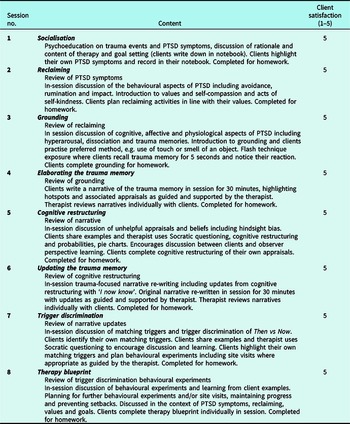
This intervention designed a protocol which followed on from a previous design for single-incident shared trauma (Skilbeck and Spanton, Reference Skilbeck and Spanton2020). Similarities were that the protocol was drawn from the established individual formats (e.g. Ehlers and Clark, Reference Ehlers and Clark2000). The protocol was a brief 8-session design with the same session content as the previous design. The difference was that the current design was for heterogenous single-incident traumas as opposed to a shared single incident. This design also used the same principles of managing the session by focusing on trauma memory rather than the events. For the purposes of trauma containment in a group setting, focus was placed on a written rather than spoken narrative. In line with CBT principles, the design emphasised homework. The use of homework assignments is a key intervention in CBT. For example, using homework to help clients develop skills in testing their beliefs, and also help alleviate anxiety symptoms (Kazantzis et al., Reference Kazantzis, Brownfield, Mosely, Usatoff and Flighty2017). The design also incorporated values in the context of what was important to them, and self-compassion in the context of what they would say to a loved one/friend (Beck and Coffey, Reference Beck and Coffey2005; Hoffart et al., Reference Hoffart, Øktedalen and Langkaas2015; Orsillo and Batten, Reference Orsillo and Batten2005). Although these elements were not treatment targets, the rationale for their inclusion was to enhance the interventions. According to Braehler and Neff (Reference Braehler, Neff, Tull and Kimbrel2020), self-compassion is a helpful way of relating to oneself in times of suffering, whether suffering is caused by failure, perceived inadequacy, or general life difficulties. It allows individuals to treat themselves with the same kindness as they would with a good friend who was struggling. This enables people to better tolerate uncomfortable thoughts, feelings and emotions, including anxiety, anger and shame. Values clarification can help clients choose meaningful directions which can help with symptom alleviation and improved functioning (Meyer, Reference Meyer2019). The treatment protocol is outlined in Table 1.
Outline of session content and mean client satisfaction rating (0–5: not satisfied to completely satisfied)

Course of therapy
Twenty-four clients showing clinically important symptoms of PTSD attended three therapy groups of eight sessions. This allocation was based on client date and time preference. The number of group members and sessions were based on outcomes and feedback from a previous case study (Skilbeck and Spanton, Reference Skilbeck and Spanton2020) and other PTSD groups (e.g. Taylor et al., Reference Taylor, Fedoroff, Koch, Thordarson, Fecteau and Nicki2001; Thompson et al., Reference Thompson, Wild and Boon2009). Of these clients, five dropped out of treatment and two others were offered alternative treatment. Of the five clients who dropped out, two had high levels of experiential avoidance and disengaged, one had work commitments, one relocated to another borough, and another disengaged for unknown reasons. Of the two clients that were offered alternative treatment, one had compounding physical health problems and the other had emerging complexity from previously undisclosed childhood trauma. The remaining 17 clients completed treatment.
In line with Table 1, each client was provided with a pen and notebook which was used throughout therapy. The groups were conducted by two accredited and experienced CBT therapists supervised by accredited senior CBT therapists and clinical psychologists, who collectively developed the intervention. The therapy consisted of a brief 8-session group running for 2 hours weekly (Skilbeck and Spanton, Reference Skilbeck and Spanton2020). The intervention was a treatment group rather than guided self-help as it involved therapist input to assist clients to approach the trauma memory, elaborate it, identify/challenge hotspots, update the memory and overcome avoidance strategies. It offered initial psychoeducation about PTSD. In order to assess whether the clients would engage with the trauma memory within their affective window of tolerance, the flash technique, which is borrowed from EMDR (Manfield et al., Reference Manfield, Lovett, Engel and Manfield2017), was applied. This application was not a treatment target and was used to gauge the clients’ reactivity to recalling the trauma memory. This enabled the therapist to assess the client distress levels and safety for trauma-focused narrative writing in a group setting. Using this technique, the therapist invited the clients to recall their trauma memory for five seconds and assessed their reactivity. Clients provided their feedback on their subjective distress levels. Any distressed clients were followed up individually. This ensured that clients were within their affective window of tolerance during the narrative session. The narrative was written in first-person over 30 minutes. Clients were guided to narrate the trauma as it happened as though they were replaying a video with a focus on their sensory experiences. Clients were advised to not skip through the event and to rewrite the narrative if they completed it too quickly. The therapist guided the clients through the allocated time. Feedback was elicited from the clients. Following the session, the therapist arranged individual appointments with each client where the narratives were reviewed in detail and feedback shared. The clients then engaged further with the narratives for homework. Similar to the individual format, clients engaged with the narrative and identified hotspots. Common hotspot themes were challenged through discussion in the group as guided by the therapist with clients sharing their learning and feedback. The clients were then guided through a second narrative with new individual updates which were reviewed individually with the therapist. This was reinforced for homework, which focused on the Then v Now discrimination. This was followed by further discussion in the group to reinforce what the clients know Now and challenge any hindsight bias, shame or self-blame cognitions as guided by the therapist. Homework involved behavioural experiments where clients approaching avoided matching triggers as complimented by reclaiming activities (Table 1).
Outcome
Quantitative outcomes
At the end of treatment, 11 clients no longer showed clinically important symptoms of PTSD. These clients also showed improvements in their mood and general anxiety scores. These improvements were sustained at 3-month follow-up. One other client showed reliable change across all three measures which was sustained at 3-month follow-up. Three clients showed reliable change on the IES-R but still exhibited symptoms of depression at the end of treatment and at 3-month follow-up. The last two clients showed minimal change across all measures at the end of treatment and at follow-up. These clients also had ongoing psychosocial factors. Overall, the majority of clients who remained in the group showed reliable change in their PTSD symptoms and accompanying moods. Table 2 shows the overall mean outcomes PHQ-9, GAD-7 and IES-R including the standard error of the mean (SEM).
Mean outcomes on the PHQ-9, GAD-7 and IES-R

The standard error of the mean (SEM) comprises a sample size of 17 and is included in parentheses.
Figure 1 shows the overall distribution of group outcomes including the median and range.
Overall distribution of symptom outcomes for depression, anxiety and PTSD as measured on the PHQ-9, GAD-7 and IES-R. Each box indicates the interquartile range. The vertical solid lines denote medians, and vertical whiskers denote range, as measured on the PHQ-9 (top), GAD-7 (middle) and IES-R (bottom). Each chart shows pre-therapy (Pre), post-therapy (Post) and follow-up scores (FU). Dotted vertical lines denote clinical cut-offs, above which each measure is considered to indicate clinical symptoms.

Qualitative outcomes
Qualitative outcomes were captured from: attendance and drop-out rates, client cognitive and shift; group processes; and feedback from clients and therapists.
Attendance and drop-out rates
The three groups had an average of seven cancellations and three non-attended over the eight sessions. This suggests that the average attendance rates were over 95%. Of the 24 clients, five dropped out. This suggests that the average drop-out rate was 20.8%.
Client cognitive shift
Overall, clients reported updated peri-traumatic appraisals (Then v Now) and post-traumatic beliefs about themselves, the world and the future. These are summarised below.
Peritraumatic appraisals: I am in danger (fear); I am going to die (fear/horror); I am never going to get out of this (helpless/freeze); nobody will help (helpless).
Peritraumatic updates: The danger has passed; I did not die; I did get out of the situation; other people did help.
Posttraumatic appraisals: I should not have gone out (responsibility, guilt); I am reckless (self-defectiveness, shame); bad things always happen to me; it was my fault (responsibility, self-blame, guilt); other people cannot be trusted (distrust); the world is unsafe.
Post-traumatic updates: Going out was not the problem; it could happen to anyone; it was not my fault; it was a shared responsibility; other people can be trusted; the world is generally a safe place.
These cognitive shifts were coupled with symptom alleviation including decreased hyperarousal, re-experiencing and avoidance of matching triggers as captured from the symptom measures and qualitative comments from the clients. This change was maintained at 3-month follow-up.
Overall group processes
Most of the clients had never experienced group therapy and did not know what to expect. However, the groups formed naturally. From the outset the therapists emphasised that focus was on the client’s experience of the trauma rather than the factual content of the event. The emphasis on the clients’ individual trauma memory ensured that they worked at their own pace. This was mostly apparent in the narrative sessions where the clients were able to silently write and engage with their trauma memory. During the updating stage there was collective support and shared learning, although they each experienced their own process of change.
Client feedback on the group
Overall client feedback on the group was positive, with minor negative feedback from one client as summarised below.
Positive feedback: The protocol was simple, client-centred and well supported by the therapist; the number of session was adequate; it was helpful to work through my trauma memory with other people without having to focus on their trauma; working with others with similar experiences created a safe space; each session followed on from the previous one and was easy to implement; it was helpful to follow things through with homework and get encouragement from the group; writing the narrative with other people with similar experiences and having the therapist guide this was supportive; reflecting on my values and what was important helped with the reclaiming life activities; reflecting on self-compassion helped me overcome self-blame, guilt and shame.
Negative feedback: The group was beneficial, perhaps there could have been more sessions.
Therapist feedback on the group
Therapists reported that emphasis on the client’s experience of the trauma rather than factual descriptions was key to the intervention. They also reported the importance of simplification and careful explanation of rationales behind the interventions, e.g. writing a narrative of the trauma. Capitalising on group processes including normalising, collective suffering, common goals and imitative learning supported the building of a safe therapeutic and supportive environment. This enabled the clients to feel safe enough to engage with the trauma memory work. The group was also enhanced by explicit homework setting which placed emphasis on careful planning and addressed any possible barriers. This enabled the clients to translate in-session learning to real life change.
Discussion
Group therapy for PTSD in adults continues to be a subject for debate. However, updates from the international clinical guidelines provide advice for circumstances when clinicians may need to offer clients their preferences even if their choice may not be the most recommended. They however emphasise the importance of fully informing the clients in order to help them to make a fully informed choice. The current therapy group was necessitated by the client preferences. It was encouraged by the updates and recommendations from the international clinical guidelines and the findings from a previous case study. This intervention applied the learning from the previous homogenous design to this heterogeneous group. The outcomes and learning from this design are comparable to the previous ones. This lends further evidence for the usefulness of the group design for single incident PTSD in adults.
Strengths
The group provided a preferred treatment option for this minority of clients. It was timely, brief and acceptable by the clients. It presented a simplified protocol which offered the benefits of individual therapy including targeting and processing the trauma memory. It also offered the added benefits of group therapy including universality, cohesiveness, support and imitative learning (Penk et al., Reference Penk, Little, Ainspan, Moore and Penk2019).
Limitations
Although this case study illustrates the use of group trauma-focused CBT for heterogenous single incident traumas, it cannot be generalised. There were only 24 clients, which is insufficient for generalisability. The study did not include a control such as no treatment or other models of therapy. Therefore, the effects of natural recovery and non-specific factors of the group process cannot be ruled out. Furthermore, the study excluded multiple-incident and complex traumas. As illustrated with the clients who were removed from the group, this intervention may not be suitable for complex or multiple trauma cases which constitute over 50% of the service PTSD. Although the attendance rates of 95% were higher than the service rates of around 70%, the drop-out rates of 20.8% were higher than reported elsewhere. For example, Lewis et al. (Reference Lewis, Roberts, Andrew, Starling and Bisson2020) reported an average of 16%. However, these higher drop-out rates are reflective of the average service PTSD drop-out rates of around 30% and present a topic for further exploration. Furthermore, this study did not quantify the effects of interpersonal processes/trust on outcomes. This is also a topic for further exploration. Although most clients who completed the group found the number of sessions adequate, one client expressed that the group could have had more sessions. However, the client did not specify any aspects of the protocol. This is an area for further consideration. For example, could an extra trigger discrimination session add room for rehearsal? Despite these limitations, this case study illustrates the effective delivery of a heterogenous trauma-focused CBT group for single-incident PTSD in adults.
Clinical implications
This study could benefit clients who present to primary care and express a preference for a treatment that does not have the highest level of recommendation. This trauma-focused CBT group appears to be a useful option for those with single-incident trauma, who express a preference or willingness to engage in group therapy for a range of reasons. Points for consideration are taking full consideration of the NICE guidelines alongside client needs and preferences and having open discussions with them about the evidence base for their treatments. Consulting directly with the NICE guideline ethics and surveillance team was also helpful in this case.
Recommendations for practice and development
Finding effective ways to deliver trauma-focused CBT in a group format is of interest to services treating PTSD. A recommendation to clinicians and researchers is to continuously involve clients in their treatment planning. Using clinical guidelines and having open discussions with clients is important, especially where clients are willing to use a treatment which does not have the highest recommendation. This will help clients make informed decisions about their treatment. In this case, the clients who completed this trauma-focused group therapy found it beneficial. Therefore, clinicians and researchers need not rule out group trauma-focused CBT in adults. Future research could explore client experiences of the trauma-focused group therapy. There is also still a need for RCTs to ascertain the efficacy of group trauma-focused therapy for PTSD in adults.
Summary
This case study illustrates the implementation of a brief trauma-focused CBT group intervention for heterogeneous single-incident traumas in adults. This further supports that the group protocol designed for homogenous single-incident trauma also works for heterogeneous single-incident traumas. It also highlights the need for further research on this important topic.
Data availability statement
The authors confirm that the data supporting the findings are available in the article.
Acknowledgements
The authors would like to acknowledge the support and encouragement of Daniela Antonie (clinical lead) and Ian Roylance (deputy clinical lead) at Newham Talking Therapies. Thanks also goes to the clients for their consent and the NICE guideline ethics and surveillance team for their advice.
Author contributions
Lilian Skilbeck: Conceptualization (equal), Formal analysis (equal), Methodology (equal), Supervision (supporting), Writing – original draft (lead), Writing – review & editing (lead); Christopher Spanton: Conceptualization (equal), Methodology (equal), Supervision (lead), Writing – original draft (supporting), Writing – review & editing (supporting).
Financial support
None.
Conflicts of interest
There are no known conflicts of interest.
Ethical standards
The authors have abided by the Ethical Principles of Psychologists and Code of Conduct as set out by the BABCP and BPS. In line with this, ethical approval was sought from the East London Foundation Trust board of Ethics committee (GECSE - G1912). Client consent and data management was conducted in line with their recommendations.





Comments
No Comments have been published for this article.