Older Drivers
Over the next five decades, there will be a substantial increase in both the number and proportion of older people in most industrialized countries (Organization for Economic Cooperation and Development [OECD], 2001). With the aging of the population, an increase is also anticipated in older drivers’ licensing rates (Sivak & Schoettle, Reference Sivak and Schoettle2011). Further, the private motor vehicle is likely to remain the principal mode of transport for the emerging cohorts of older drivers who will be more mobile, and travel more frequently and at greater distances when compared with earlier cohorts (OECD, 2001). Demographic growth, increased licensing rates, and increased motor vehicle use will combine to produce a marked increase in the number of older drivers on the road.
Although there is strong support around the world for older people to maintain independent vehicular mobility for as long as possible, their safety is also a serious community concern necessitating development of innovative measures to reduce crash and injury risk (Langford & Koppel, Reference Langford and Koppel2006). While current figures show that older drivers are involved in few crashes in terms of absolute numbers, they represent one of the highest risk groups for crashes involving serious injury and death per number of drivers and per distance travelled (Koppel, Bohensky, Langford, & Taranto, Reference Koppel, Bohensky, Langford and Taranto2011; Langford & Koppel, Reference Langford and Koppel2006).
Older Driver Risk Factors
Much of the older driver crash profile has been attributed to older drivers’ greater frailty and reduced tolerance to injury (OECD, 2001). The energy required to cause injury reduces as a person ages (Augenstein, Reference Augenstein2001): Older adults’ biomechanical tolerances to injury are lower than those of younger persons (Mackay, Reference Mackay1998; Viano, Culver, Evans, Frick, & Scott, Reference Viano, Culver, Evans, Frick and Scott1990), primarily due to reductions in bone and muscular strength and fracture tolerance (Dejeammes & Ramet, Reference Dejeammes and Ramet1996; Padmanaban, Reference Padmanaban2001). For example, according to Evans (Reference Evans2004), in crashes of equal severity, consider these statistics: A 79-year-old man is 3.2 times more likely to die as a 32-year-old man; a 79-year-old woman is 2.7 times more likely to die as a 32-year-old woman; and one-half of the deaths to those aged 70 and older would not occur if the individuals were as robust as those aged 69 and younger. Li, Braver, and Chen (Reference Li, Braver and Chen2003) used the U.S. Fatality Analysis Reporting System (FARS) and a national probability sample of all crashes (both non-casualty and casualty) to compute the role of frailty in older driver crashes. After due statistical correction, the authors reported that older drivers’ (and especially older female drivers’) overrepresentation in fatalities could be explained mainly by frailty, accounting for around 60 to 90 per cent of the fatalities.
In addition to the frailty factor, older drivers’ crash risk has been attributed to their age-related sensory, cognitive, and physical impairments. Although there are many individual differences in the aging process, even relatively healthy older adults are likely to experience some level of functional decline in sensory, cognitive, and physical abilities. These include a decline in visual acuity and/or contrast sensitivity; visual field loss; reduced dark adaptation and glare recovery; loss of auditory capacity; reduced perceptual performance; reductions in motion perception; a decline in attentional and/or cognitive processing ability; reduced memory functions; neuromuscular and strength loss; postural control and gait changes, and slowed reaction time (Janke, Reference Janke1994; Stelmach & Nahom, Reference Stelmach and Nahom1992). Of relevance to older drivers is how the declines in these abilities relate to skills required for safe driving and whether skill changes put them at an increased risk of crash-related injuries and/or death.
Current evidence for causal relationships between specific medical conditions and increased crash risk is limited (Charlton et al., Reference Charlton, Koppel, Odell, Devlin, Langford and O’Hare2010; Dobbs, Reference Dobbs2001; Marshall, Reference Marshall2008). Clearly, not all medical conditions affect injury risk in the road system to the same extent, and not all individuals with the same condition will be affected in the same way (Charlton et al., Reference Charlton, Koppel, Odell, Devlin, Langford and O’Hare2010). The severity of the condition and other characteristics of the disorder are likely to be important determinants of crash risk. Notwithstanding the paucity of evidence linking health, medical conditions, and driving, there is mounting evidence that a number of age-related functional impairments may be of sizable concern to road safety. Importantly, it is not necessarily the medical condition and/or medical complications per se that affect driving, but rather the functional impairments that may be associated with these conditions. In discussing the merits of focussing on impairments in assessing risk, Marottoli (2001) noted that functional impairments are “the common pathway through which … medical conditions affect driving capability and … can be relatively easy to test” (p. 11). Moreover, the extent to which individuals may be able to adapt or compensate for their impairment while driving will undoubtedly have some bearing on their likelihood of crash involvement (Charlton et al., Reference Charlton, Oxley, Fildes, Oxley, Newstead and Koppel2006).
Indeed, Meyer (Reference Meyer2004) has proposed that drivers can be highly adaptive and can compensate for deficiencies in certain areas by adapting their behaviour (i.e., changing the conditions in which they drive, using different driving techniques, or using in-vehicle technologies to assist with some of their deficiencies) to minimise their crash risk. Older drivers’ capacity to moderate their risk is a crucial element in determining their safety. Many older drivers become aware of their declines in functional capacities and adapt their driving patterns to match these changes by self-regulating when, where, and how they drive (Baldock, Mathias, McLean, & Berndt, Reference Baldock, Mathias, McLean and Berndt2006; Blanchard, Myers, & Porter, Reference Blanchard, Myers and Porter2010; Charlton et al., Reference Charlton, Oxley, Fildes, Oxley, Newstead and Koppel2006; Molnar & Eby, Reference Molnar and Eby2008). For example, older adults may reduce their exposure by driving fewer annual kilometres, making shorter trips, and making fewer trips by destination chaining (i.e., linking multiple trips together) (Benekohal, Michaels, Shim, & Resende, Reference Benekohal, Michaels, Shim and Resende1994). Older drivers have also been found to do the following: avoid complex traffic maneuvers that are cognitively demanding (Ball et al., Reference Ball, Owsley, Stalvey, Roeneker, Sloane and Graves1998; Hakamies-Blomqvist & Wahlstrom, Reference Hakamies-Blomqvist and Wahlstrom1998); limit their peak hour and night driving; restrict long-distance travel; take more frequent breaks; and drive only on familiar and well-lit roads (Ernst & O’Connor, Reference Ernst and O’Connor1988; Smiley, Reference Smiley1999).
Several studies have also shown that most older drivers recognize that good vision is one of the most important elements for safe driving and often cite poor vision as a major determinant for reducing their driving at night or in poor weather (Kostyniuk & Shope, Reference Kostyniuk and Shope1998; Marottoli et al., Reference Marottoli, Ostfield, Merril, Perlman, Foley and Cooney1993; Persson, Reference Persson1993). This evidence suggests that at least some older adults are able to compensate well for limitations in their abilities in such a way that is likely to minimise exposure to difficult driving situations to reduce their crash risk.
In addition, recent research has demonstrated a link between psychosocial factors (e.g., attitudes, beliefs, and perceptions) and older driver self-regulation (Tuokko et al., Reference Tuokko, Myers, Jouk, Marshall, Man-Son-Hing and Porter2013). For example, measures of these constructs specific to the context of driving have been linked to self-reported restrictions in older drivers (Blanchard & Myers, Reference Blanchard and Myers2010; MacDonald, Myers, & Blanchard, Reference MacDonald, Myers and Blanchard2008; Myers, Paradis, & Blanchard, Reference Myers, Paradis and Blanchard2008; Webber, Porter, & Menec, Reference Webber, Porter and Menec2010), as well as objectively measured restrictions in driving exposure (i.e., distance, duration) and patterns (i.e., radius from home, driving at night and in bad weather) (Blanchard & Myers, Reference Blanchard and Myers2010; Myers, Trang, & Crizzle, Reference Myers, Trang and Crizzle2011; Myers et al., Reference Myers, Paradis and Blanchard2008).
On-road Assessments
On-road assessments have been described by driving rehabilitation specialists as the “gold standard” for determining a driver’s true driving ability and for identifying potential remediable elements (Justiss, Reference Justiss2005; Marcotte & Grant, Reference Marcotte and Grant2009; McCarthy, Reference McCarthy2005). Despite the potential importance of on-road assessments for determining older drivers’ fitness to drive, there is a paucity of research in this area.
Within the limited number of studies that have been conducted in this area, most researchers acknowledge the value of standardizing on-road assessments to allow objective measurement of driving performance (e.g., Di Stefano & Macdonald, Reference Di Stefano and Macdonald2010; Korner-Bitensky, Bitensky, Sofer, Man-Son-Hing, & Gelinas, Reference Korner-Bitensky, Bitensky, Sofer, Man-Son-Hing and Gelinas2005; Withaar, Brouwer, & Van Zomeren, Reference Withaar, Brouwer and Van Zomeren2000). On-road assessments are standardized by developing geographically replicable pre-determined maneuvers rated on explicit criteria on fixed routes (Kowalski & Tuokko, Reference Kowalski and Tuokko2007). Moreover, it has been argued that when a representative range of traffic conditions at an appropriate level of difficulty are performed by the driver, driving competence is more accurately evaluated, as the assessor is able to observe critical aspects of driver performance (Di Stefano & Macdonald, Reference Di Stefano and Macdonald2003). Consequently, researchers have developed a wide range of psychometrically sound standardised on-road assessments that can be applied to specific populations with specialised conditions and broader populations of older drivers (Kowalski & Tuokko, Reference Kowalski and Tuokko2007).
Although standardised on-road assessments serve a vital purpose in distinguishing safe from unsafe older drivers (MacDonald, Pellerito, & Di Stefano, Reference MacDonald, Pellerito, Di Stefano and Pellerito2006), there are circumstances where a less-structured assessment route and protocol may be justified. The appropriateness and value of assessments conducted over routes familiar to and chosen by the older driver have been asserted by driving rehabilitation specialists and researchers (Justiss, Reference Justiss2005; Withaar et al., Reference Withaar, Brouwer and Van Zomeren2000). These on-road assessments, commonly referred to as personalised assessments, are inherently non-standardised (MacDonald et al., Reference MacDonald, Pellerito, Di Stefano and Pellerito2006). Although, in theory, all drivers are expected to deal with any environmental demands, in practice the intensity and quantity of environmental demand experienced are unique to each driver (Nasvadi, Reference Nasvadi2007). The core assumption behind the utilisation of non-standardised tests is that customised assessments provide more ecological validity in terms of matching assessment requirements to the specific real-world driving needs of the driver (Nasvadi, Reference Nasvadi2007).
It has been noted that personalised non-standardised tests could be appropriate where geographic licensing restrictions are available (Justiss, Reference Justiss2005). Indeed, some research suggests that driving restrictions may be an effective measure for reducing crash risk for some older drivers, thus prolonging their continued independence and mobility (Nasvadi & Vavrik, Reference Nasvadi and Vavrik2007). Furthermore, it has been argued that personalised, non-standardised assessments more closely resemble drivers’ everyday driving and provide greater ecological validity (Withaar et al., Reference Withaar, Brouwer and Van Zomeren2000).
A major consideration for on-road assessments is whether to use the driver’s own vehicle, or an instrumented, dual-control test vehicle. Using the same instrumented vehicle with dual-control brakes for each assessment enhances the standardization of the evaluation by ensuring that the mechanical conditions of the vehicle are the same for each driver. This also has the simultaneous benefit of improving passenger (assessor) safety (Fox, Reference Fox1989; Kowalski & Tuokko, Reference Kowalski and Tuokko2007). However, research has shown that the processes involved in adapting to an unfamiliar vehicle may be problematic for driving performance in older drivers, and thus compromise the validity of the overall assessment (Lundberg & Hakamies-Blomqvist, Reference Lundberg and Hakamies-Blomqvist2003). Indeed, research has demonstrated that for older drivers, simple motor components of the driving task, such as manual gear shifting, are not easily automated and can impair driving performance, until familiarised (Lundberg & Hakamies-Blomqvist, Reference Lundberg and Hakamies-Blomqvist2003). Moreover, Lundberg and Hakamies-Blomqvist (Reference Lundberg and Hakamies-Blomqvist2003) suggested that various features of compensatory behaviour will not emerge unless the driver can make strategic decisions regarding the choice of the vehicle.
Candrive/Ozcandrive Study
The Candrive/Ozcandrive study is a longitudinal, multi-centre international research program with the core objective of identifying solutions to promote older drivers’ safe mobility (Marshall et al., Reference Marshall, Man-Son-Hing, Bédard, Charlton, Gagnon and Gélinas2013). The Candrive/Ozcandrive study involves 928 drivers aged 70 and over in Canada and 302 drivers aged 75 and older in Australia and New Zealand (Australia: n = 257; New Zealand: n = 45). Using a longitudinal study design, the project is tracking this cohort of older drivers for up to six years, assessing changes in their functional abilities, driving practices (e.g., exposure and patterns), as well as crashes and citations. The primary purpose is to determine and validate a screening test (Decision Rule) to identify potentially at-risk drivers (Marshall et al., Reference Marshall, Man-Son-Hing, Bédard, Charlton, Gagnon and Gélinas2013). Participants’ usual (or naturalistic) driving practices (e.g., trip distance, duration, type of road, speed) are recorded through an in-car recording device installed in the participant’s own vehicle, and measures of participants’ functional ability, medical conditions, and self-reported driving-related abilities and practices are documented annually. In addition, participants’ driving behaviour is evaluated annually through an on-road driving task.
electronic Driver Observation Schedule (eDOS)
The eDOS is an on-road driving task, designed initially for use in the Ozcandrive study to evaluate older drivers’ driving behaviour in order to monitor changes in individual driving behaviours over time (Koppel et al., Reference Koppel, Charlton, Langford, Vlahodimitrakou, Di Stefano and Macdonald2013; Vlahodimitrakou et al., Reference Vlahodimitrakou, Charlton, Langford, Koppel, Di Stefano and Macdonald2013). Additionally, it was expected that such a tool could supplement the (relatively rare) primary outcome measures of crashes and police-recorded infringements/violations of traffic safety rules and regulations for validation of the screening test.
In developing the eDOS driving task, key criteria were that it should reflect drivers’ everyday driving and be feasible (in light of both time and resources) to sustain within the multi-site longitudinal study. More specifically, the five eDOS driving task requirements were as follows:
-
• observation of “natural” driving with no intervention/instruction by the observer;
-
• conducted in driver’s own vehicle (following positive effects reported by Lundberg & Hakamies-Blomquist (Reference Lundberg and Hakamies-Blomqvist2003) as noted above);
-
• conducted over routes familiar to and chosen by the older driver;
-
• took approximately 20–25 minutes to complete;
-
• rated behaviours specifically associated with older driver safety.
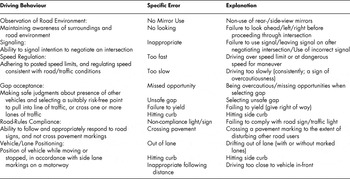
The Person-Environment (P-E) Fit theory of driving competence (Willis, Reference Willis2000) and Michon’s Model of Driver Behaviour (Michon, Reference Michon1989) were influential in determining the nature of the eDOS driving task. Consequently, the eDOS driving task was designed to be undertaken on driver-selected routes to observe drivers’ competency in environments encountered in their everyday driving. In addition, item selection and operationalization of the eDOS driving task was based on three factors: (a) older-driver crash epidemiology (e.g., Catchpole, Styles, Pyta, & Imberger, Reference Catchpole, Styles, Pyta and Imberger2005; Fildes et al., Reference Fildes, Corben, Kent, Oxley, Le and Ryan1994; Langford & Koppel, Reference Langford and Koppel2006), (b) older driver self-regulatory behaviour (e.g., Baldock et al., Reference Baldock, Mathias, McLean and Berndt2006; Charlton et al., Reference Charlton, Oxley, Fildes, Oxley, Newstead and Koppel2006), and (c) published driving measures (Di Stefano & Macdonald, Reference Di Stefano and Macdonald2003; Dobbs, Heller, & Schopflocher, Reference Dobbs, Heller and Schopflocher1998; Galski, Bruno, & Ehle, Reference Galski, Bruno and Ehle1993; Hunt et al., Reference Hunt, Murphy, Carr, Duchek, Buckles and Morris1997; Justiss, Reference Justiss2005; Kowalski & Tuokko, Reference Kowalski and Tuokko2007; Ott, Papandonatos, Davis, & Barco, Reference Ott, Papandonatos, Davis and Barco2012). Based on these findings, we identified six categories of driving behaviours for inclusion in the final eDOS driving task: (a) observation of road environment; (b) signalling; (c) speed regulation; (d) gap acceptance; (e) road-rule compliance; and (f) vehicle/lateral lane positioning (see Table 1 for the definitions for inappropriate driving behaviours). We scored the behaviours during driving maneuvers, as appropriate or inappropriate: intersection negotiation, lane-changing, merging, low-speed maneuvers, and maneuver-free driving (i.e., straight travel path).
Definitions for inappropriate driving behaviour

The eDOS was initially developed with a paper-based evaluation form. Vlahodimitrakou et al. (Reference Vlahodimitrakou, Charlton, Langford, Koppel, Di Stefano and Macdonald2013) evaluated the inter-rater reliability, feasibility, and acceptability of the eDOS driving task on a sub-sample of 33 Ozcandrive participants (20 male [61%], 13 female [39%], mean age = 80.12 years, SD = 3.39, range: 75–88 years). The authors reported that the eDOS driving task was possible to implement in participants’ own vehicles, could be scored reliably (r [18] = .83, p < 0.05), was practical in terms of duration, and was acceptable to participants. Koppel et al. (Reference Koppel, Charlton, Langford, Di Stefano, Macdonald and Mazer2012) revised the eDOS driving task, including (a) an electronic score sheet to record and score driving behaviour, and (b) installation of video recording equipment in participants’ vehicles to capture images of the driver and the forward driving environment throughout the drive. Based on a sub-sample of 96 Ozcandrive participants, the authors reported that it was possible to observe and score detailed driving behaviour during intersection negotiation, lane-changing, merging, and maneuver-free driving, and that the revised (eDOS) driving task demonstrated practicality and high user acceptance. Koppel et al. (Reference Koppel, Charlton, Langford, Vlahodimitrakou, Di Stefano and Macdonald2013) then investigated the relationship between participants’ driving performance during the eDOS driving task and their cognitive performance for a subset of 144 Ozcandrive participants (104 male [72%], 40 female [28%], mean age = 81.49 years, SD = 3.58 years, range: 76–96 years).
Preliminary analyses of the eDOS driving task revealed a high level of appropriate driving behaviour among Ozcandrive older drivers. The authors reported that there was no significant relationship observed between participants’ overall eDOS driving task scores and age, and participants’ performance on various cognitive assessments. However, the authors suggested that it would be important to explore the potential relationship between performance on the eDOS driving task and cognitive performance with the full sample (n = 227), as well as to explore the potential relationship between participants’ performance on the eDOS driving task and other functional performance measures, as well as participants’ perceptions of driving comfort and abilities.
Aims
The aim of this study was to examine a cohort of older drivers using the eDOS driving task and investigate the relationship between performance on the task and (1) driver characteristics (e.g., age, gender, frequency of driving, etc.); (2) functional abilities; (3) perceptions of driving comfort and abilities; and (4) self-reported driving restrictions using a number of measures from the Candrive/Ozcandrive assessment protocol (Marshall et al., Reference Marshall, Man-Son-Hing, Bédard, Charlton, Gagnon and Gélinas2013).
Method
Participants
In all, 227 Ozcandrive participants completed the eDOS driving task in Melbourne, Australia. Footnote 1 All participants were required to meet the following inclusion criteria: (a) aged 75 or older; (b) held a valid driver’s license; (c) drove at least four times per week, and (d) did not have an absolute contraindication to driving, as defined by the Austroads Fitness to Drive Guidelines (Austroads, 2012).
Materials
All participants underwent their Year 2 annual Candrive/Ozcandrive assessment that incorporated a range of demographic and driving history questions, as well as a range of functional ability measures, medical conditions, and self-reported abilities and practices related to driving (Marshall et al., Reference Marshall, Man-Son-Hing, Bédard, Charlton, Gagnon and Gélinas2013).
Functional Ability Measures
Five measures of functional ability were analysed.
-
• Montreal Cognitive Assessment (MoCA), a brief cognitive assessment, where scores range from 0 to 30 and with scores less than 26 suggestive of mild cognitive impairment (Nasreddine et al., Reference Nasreddine, Phillips, Bédirian, Charbonneau, Whitehead and Collin2005);
-
• Mini-Mental State Examination (MMSE), a brief cognitive assessment, where scores range from 0 to 30 and with scores less than 24 suggestive of cognitive impairment (Folstein, Folstein, & McHugh, Reference Folstein, Folstein and McHugh1975);
-
• Trail Making Test B (Moses, Reference Moses2004), a timed executive functioning task, where scores greater than 180 seconds have been associated with increased crash risk (Staplin, Gish, & Wagner, Reference Staplin, Gish and Wagner2003);
-
• Rapid Pace Walk, a measure of motor speed, balance, and coordination (Carr, Schwartzberg, Manning, & Sempek, Reference Carr, Schwartzberg, Manning and Sempek2010), where scores greater than 10 seconds may indicate an increased crash risk (Staplin et al., Reference Staplin, Gish and Wagner2003);
-
• Snellen eye chart, a measure of visual acuity, Footnote 2 where 6/6 (LogMAR = 0) is considered normal vision, 6/12 (LogMAR = +0.3) is considered “reduced vision” and is the Australian legal driving limit (Austroads, 2012).
Self-reported Driving-Related Abilities and Practices
Four measures of self-reported abilities and practices were analysed.
-
• Driving Comfort Scales (DCS): The 13-item daytime (DCS-D) and 16-item nighttime (DCS-N) Driving Comfort Scales ask participants to rate their level of comfort while driving in a range of driving situations. Possible scores range from 0 to 100 per cent, with higher scores indicating greater driving comfort (Blanchard et al., Reference Blanchard, Myers and Porter2010; MacDonald et al., Reference MacDonald, Myers and Blanchard2008). Both scales have demonstrated good test–test reliability over a two-week period (intraclass correlation coefficients [ICCs] = 0.70 and 0.88) and excellent structural properties (unidimensionality, hierarchiality, goodness of fit, interval properties) (MacDonald et al., Reference MacDonald, Myers and Blanchard2008; Myers et al., Reference Myers, Paradis and Blanchard2008).
-
• Perceived Driving Abilities (PDA) scale: The 15-item Perceived Driving Abilities (PDA) scale asks participants to rate various aspects of their current abilities (e.g., see road signs at night, make quick driving decisions) on a four-point scale (where 0 = poor, 3 = very good). The PDA scale has strong, internal consistency (α = 0.92) and moderate test–retest reliability over one week (ICC = 0.65). Total scores can range from 0 to 45, with higher scores indicating more-positive perceptions of driving abilities (Blanchard et al., Reference Blanchard, Myers and Porter2010; MacDonald et al., Reference MacDonald, Myers and Blanchard2008).
-
• Situational Driving Frequency (SDF) and Situational Driving Avoidance (SDA) scales: Driving practices were assessed using the Situational Driving Frequency (SDF) and Avoidance (SDA) scales. On the SDF scale, participants are asked how often they drive, on average, in 14 different driving scenarios (e.g., at night, on highways, in rural areas, in heavy traffic or rush hour in town, on trips lasting 2 hours each way, etc.) on a 5-point scale: never (0), rarely (1 = less than once a month), occasionally (2 = more than once a month but less than weekly), often (3 = one to three days per week), or very often (4 = four to seven days a week). Total scores can range from 0 to 56 with higher scores indicating driving more often in challenging situations. On the SDA scale, participants are asked “If possible, do you try and avoid any of these driving situations? Check all that apply” on a list of 19 Footnote 3 situations (e.g., night, dawn or dusk, bad weather conditions in general, heavy rain, making left-hand turns, etc.). The last item, “No, I don’t try to avoid any of these situations”, is used to ensure that people have considered all the situations. Scores can range from 0 to 19, with higher scores indicating greater avoidance. Both scales were developed inductively with older drivers and have shown good internal consistency and test–retest reliability (MacDonald et al., Reference MacDonald, Myers and Blanchard2008; Myers et al., Reference Myers, Paradis and Blanchard2008).
-
• Driving Habits and Intentions Questionnaire (DHI): The Driving Habits and Intentions Questionnaire (Kowalski et al., Reference Kowalski, Love, Tuokko, MacDonald, Hultsch and Strauss2011) was adapted from an existing short questionnaire (Webber et al., Reference Webber, Porter and Menec2010) designed to assess driving-related thoughts, beliefs, and action. The questionnaire contains items related to current driving restrictions (i.e., situations under which they prefer not to drive such as turning right Footnote 4 at intersections, driving in unfamiliar locations). These were recoded into a global continuous driving restriction variable ranging from 0 to 17 indicating current driving restrictions, with higher scores representing more restrictions.
eDOS
In the current study, participants’ driving behaviour was observed by a single trained observer who scored the driving behaviour using an electronic score sheet (for a more detailed description of the eDOS driving task, see Koppel et al., Reference Koppel, Charlton, Langford, Di Stefano, Macdonald and Mazer2012; Koppel et al., Reference Koppel, Charlton, Langford, Vlahodimitrakou, Di Stefano and Macdonald2013; Vlahodimitrakou et al., Reference Vlahodimitrakou, Charlton, Langford, Koppel, Di Stefano and Macdonald2013).
Although the driving route itself was selected by each participant to represent their everyday driving environment and was therefore not standardized, driving behaviours were observed and documented using standardized procedures for intersection negotiation, lane-changing, merging, maneuver-free driving, and low-speed maneuvering. Six categories of driving behaviours, each scored as appropriate or inappropriate, were recorded for each intersection negotiation, lane change, and merge (see Table 1). Route complexity was recorded in terms of traffic density, speed zone, and number of road lanes.
The observer also documented the occurrence of “critical errors”, defined as errors which result in (1) the vehicle being involved in a crash or near-crash, and/or (2) the observer using verbal prompts either to prevent an error escalating in severity or to correct the error.
The eDOS driving task score (maximum 100 points) was calculated as the total number of driving maneuvers completed appropriately, minus 1 point for each error performed during maneuver-free driving and minus 2 points for each critical error, divided by the total number of maneuvers observed, multiplied by 100. The computation of the eDOS driving task score was adapted from an approach commonly employed in driving assessment research (Di Stefano & Macdonald, Reference Di Stefano and Macdonald2003).
A post-drive survey comprising four items was developed to assess drivers’ perceptions of the eDOS driving task experience. Participants were asked to rate (1) the overall quality of their driving during the eDOS driving task, (2) the difficulty of the eDOS driving task compared with their everyday driving, (3) their familiarity with the selected route during the eDOS driving task, and (4) their level of comfort with being observed during the eDOS driving task.
Procedure
Ethics approval was obtained from the Monash University Human Research Ethics Committee (MUHREC), and all participants provided written informed consent.
All participants underwent an annual assessment as part of the Candrive/Ozcandrive protocol that incorporated a range of psychometric measures of functional ability (e.g., cognitive, vision, and physical assessments), medical conditions, and self-reported abilities related to driving (e.g., perceived driving comfort, abilities, and self-reported driving restrictions) (Marshall et al., Reference Marshall, Man-Son-Hing, Bédard, Charlton, Gagnon and Gélinas2013). The annual assessment was conducted up to eight months before participants completed the eDOS driving task.
The eDOS driving task was implemented by a single trained observer who underwent 6 hours of training with an Occupational Therapist Driving Expert in both classroom and on-road environments. Training included familiarization with the eDOS observation and recording procedures, general principles of driving assessment and the video recording equipment setup and installation.
The eDOS driving task commenced from each participant’s home and was conducted on routes familiar to and chosen by the participant. Prior to the start of the driving task, participants were asked to nominate up to four nearby locations to which they regularly drive, and to devise a driving route commencing and ending at home and linking the nominated destinations within a 20–25 minute round-trip.
The observations were conducted in the participant’s vehicle with the observer seated in the rear left seat (i.e., behind the front passenger seat) to ensure that critical aspects of driving behaviour were observable (Fox, Reference Fox1989).
Throughout the eDOS driving task, the observer documented and scored the maneuvers specified in the eDOS driving task as they occurred on the agreed route, using the eDOS driving task criteria.
The eDOS driving task was designed to study driving behaviours that reflect everyday driving, so drivers were encouraged to behave as they normally would, including listening to the radio or a CD. They were also permitted to have their regular passenger travel with them and assist with navigation. However, none of these participants required assistance with navigation from their passengers. In addition, several eDOS driving task appointments were rescheduled due to bad weather when participants reported that they never drove in bad weather (e.g., rain, hail, etc.).
Data Analysis
Descriptive statistics were used to document the driver characteristics, functional abilities, self-reported driving-related abilities and practices, and eDOS driving task scores of the sample. Univariate analyses (student t-tests and χ2) were conducted, where appropriate, to explore the relationship group differences in eDOS driving task scores and driver characteristics, functional abilities, self-reported driving-related abilities, and practices. Where the assumption of sphericity was not met, degrees of freedom were adjusted using Welch’s correction. A Bonferroni correction (p < 0.01) was applied to adjust for the number of comparisons being performed and to protect against an inflated probability of Type 1 errors.
Results
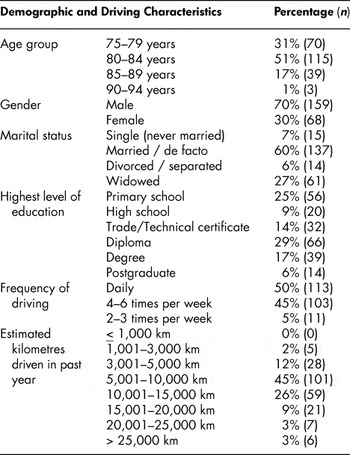
A total of 227 Ozcandrive participants (159 male [70%], 68 female [30%], mean age = 81.53 years, SD = 3.37 years, range: 76–96 years) completed the eDOS driving task. Participants’ demographic and driving characteristics are shown in Table 2. As the table shows, most participants were between ages 80 and 84 (51%), male (70%), married (60%), had achieved a diploma as their highest level of education (29%), reported driving daily (50%), and estimated that they had driven 5,001–10,000km in the past year (45%).
Demographic and driving characteristics for participants who completed the eDOS driving task

Functional Ability Measures
Participants’ performance on a range of functional ability measures from the Candrive/Ozcandrive annual assessment is described in Table 3. Overall, participant performance was quite high according to conventional benchmarks for impairment.
Performance on functional ability measures a

a Visual acuity scores were converted to the logarithm of the minimum angle of resolution (logMAR) as recommended in the literature (McGwin & Brown, Reference McGwin and Brown1999).
Self-reported Driving-Related Abilities and Practices
Participants’ self-reported driving-related abilities and practices are described in Table 4. Participants reported high driving comfort scores for both daytime and nighttime driving, positive perceptions regarding their own driving abilities, high frequency of driving in challenging situations, and low levels of driving avoidance or restrictions.
Self-reported driving-related abilities and practices

eDOS Driving Task Descriptives
The average duration for the eDOS driving task was 24 min, 26 s (SD = 7 min 25 s, range 11 min, 50 s – 1 h, 5 min, 57 s), with the majority of participants completing the eDOS driving task within 5 minutes of the target range of 20–25 minutes (82%). The average distance driven was 12.75 km (SD = 5.06, range = 5 km – 29 km). Due to technical difficulties with the electronic recording device, driving distance was only available for 170 participants.
Most participants drove to one (54%) or two (34%) nominated destinations near their home; a small proportion drove to three (11%) or four (1%) destinations. Most commonly, participants chose a local shopping centre as one of their destinations (45%), followed by places for sports or hobbies (25%), family or friends’ houses (13%), medical centres (5%), and churches (3%).
eDOS Driving Task Scores
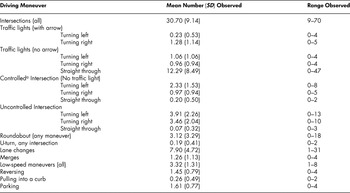
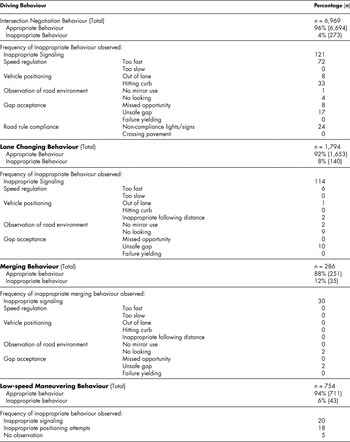
The average eDOS driving task score (maximum = 100) was high (M = 94.74; SD = 5.70; range = 65.63–100.00). A summary of the frequency of driving maneuvers observed during the eDOS driving task, including intersection negotiation, lane changing, merging, and low-speed maneuvering, is presented in Table 5. The average number of intersections negotiated by participants per eDOS driving task was 30.90 (SD = 9.14). The majority of turns were conducted at uncontrolled intersections (turning left: M = 3.91, SD = 2.26; turning right: M = 3.46, SD = 2.04) and at roundabouts (M = 3.12, SD = 3.29). On average, 7.90 (SD = 4.72) lane changes were observed per eDOS driving task, with relatively few merges observed per driving task (M = 1.26, SD = 1.13). Detailed analysis of participants’ driving behaviour during intersection negotiation, lane changing, merging, and low-speed maneuvering revealed a high level of appropriate driving behaviour (96%, n = 6,969 maneuvers), with few errors (4%, n = 273 maneuvers) (see Table 6). The most common type of error observed was inappropriate signaling (intersection negotiation: n = 121; merges: n = 114; lane changing: n = 30).
Frequency of driving maneuvers observed during the eDOS driving task a

a Note that Controlled Intersection refers to stop and giveway signs.
Appropriate and inappropriate driving behaviour observed during intersection negotiation, lane changes, merges, low-speed maneuvering

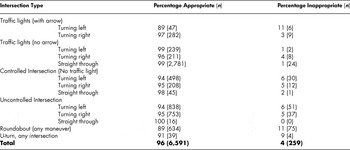
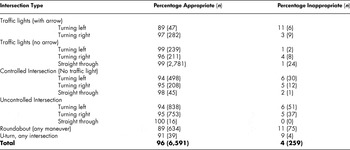
Both appropriate and inappropriate behaviours observed during different intersection types are shown in Table 7. Due to technical difficulties with electronic scoring, intersection type was available only for 98 per cent of the intersections observed (n = 6,850). As shown in Table 7, participants were most likely to make errors while negotiating a roundabout (11%), turning left at a traffic light with an arrow (11%), and making a U-turn (9%). Note, in Australia, right turns are made across traffic.
Appropriate and inappropriate driving behaviour observed during different intersection types
Post-drive Survey
When asked about their driving behaviour during the eDOS driving task compared with their everyday driving (where 1 = much better, 3 = about the same, 5 = much worse), most participants rated their eDOS driving task behaviour as “about the same” as their everyday driving (97%). The remaining participants indicated that their driving behaviour was “better” (2%, n = 4) or “worse” (1%, n = 2) during the eDOS driving task.
Participants were then asked to rate the difficulty of the eDOS driving task compared with the difficulty of their everyday driving (where 1 = much less difficult, 3 = about the same, 5 = much more difficult). Most participants rated the difficulty of the eDOS driving task as “about the same” as their everyday driving (68%). Interestingly, 27 per cent of participants rated the eDOS driving task as “a little less difficult”, 1 per cent rated the eDOS driving task as “much less difficult”, and 4 percent rated the eDOS driving task as “a little more difficult” compared with their everyday driving.
Participants were asked to rate their level of familiarity with the route undertaken during the eDOS driving task (where 5 = completely familiar, 3 = neither familiar nor unfamiliar, 1 = completely unfamiliar). Most participants reported that they were “highly familiar” (93%) or “familiar” (7%) with the eDOS route.
Finally, participants were asked to rate their level of comfort with being observed during the eDOS driving task (where 5 = completely at ease, 1 = completely uneasy). Approximately two thirds reported they were “completely at ease” (68%), 31 per cent reported that they were “at ease”; only 1 per cent felt “uneasy”.
Relationship between eDOS Driving Task Scores, Functional Scores, and Self-reported Driving-Related Abilities and Practices
Participants’ eDOS driving task scores were not normally distributed; therefore, participants were allocated to one of three equally sized groups based on their eDOS driving task score (low eDOS driving task score: 65.63–93.65, n = 74; moderate eDOS driving task score: 93.66–97.87, n = 78; high eDOS driving task score: 97.88–100, n = 75). The following analyses are restricted to comparing participants with low and high eDOS driving task scores. No further analyses were conducted for the moderate eDOS driving task score group.
Relationship between eDOS Driving Task Scores, Driver Characteristics, and Functional Ability Scores
Although participants with low eDOS scores were older (M = 82.41 years, SD = 3.96) than those with high eDOS driving task scores (M = 80.93 years, SD = 2.98), this difference failed to reach statistical significance, t(135.71) = 2.56, p = 0.01). In addition, there was no significant relationship between eDOS driving task score groups and gender, reported frequency of driving, or estimated kilometres driven in the past 12 months (gender: χ2(1) = 2.41, p > 0.1; frequency of driving: χ2(2) = 2.16, p > 0.1; estimated kilometres driven in past year: χ2(2) = 3.09, p > 0.1).
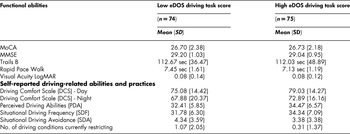
Participants’ scores on selected functional ability measures are shown in Table 8. There was no significant relationship between eDOS driving task scores and functional abilities (MoCA: t(147) = –0.08, p = 0.94; MMSE: t(147) = 1.00, p = 0.32; Trails B: t(146) = 0.09, p = 0.93; Rapid Pace Walk: t(147) = 1.35, p = 0.18; Visual Acuity LogMar: t(146) = 0.06, p = 0.95).
Functional abilities and self-reported driving-related abilities and practices across eDOS driving task score groups

Relationship between eDOS Driving Task Scores and Self-reported Driving-Related Abilities and Practices
Participants’ scores on selected measures are shown in Table 8. Those with lower eDOS driving task scores had lower driving comfort scores for both day and night driving and reported higher levels of situational driving avoidance compared to those with higher eDOS driving task scores; however, these differences failed to reach statistical significance (DCS – Day: t(146) = –1.65, p = 0.10; DSC – Night: t(138.80) = –1.66, p = 0.10; SDA: t(146) =1.67, p = 0.10). However, those with lower eDOS driving task scores had significantly lower scores on the Situational Driving Frequency (SDF) Scale, the measure of Perceived Driving Abilities (PDA) Scale, and the number of driving restrictions reported compared to participants with higher eDOS driving task scores (SDF: t(146) = –2.32, p < 0.01; PDA: t(146) = –2.02, p < 0.01; driving conditions restricted: t(126.92) = –2.66, p < 0.01).
Discussion
The eDOS driving task was developed for use in the Candrive/Ozcandrive five-year prospective study of older drivers to observe the driving behaviour of older drivers and monitor changes in driving behaviours over time. This study examined a cohort of older drivers using the eDOS driving task and investigated the relationship between performance on the eDOS driving task and (1) driver characteristics; (2) functional abilities; (3) perceptions of driving comfort and abilities; and (4) self-reported driving restrictions using a number of measures from the Candrive/Ozcandrive assessment protocols.
Driving Behaviour
Consistent with the findings of the pilot study described by Vlahodimitrakou et al. (Reference Vlahodimitrakou, Charlton, Langford, Koppel, Di Stefano and Macdonald2013), overall eDOS driving task scores (maximum = 100) were very high (M = 94.74; SD = 5.70). Detailed analyses of participants’ driving behaviour revealed high levels of appropriate driving behaviour during intersection negotiation (96%), lane changing (92%), and merging (88%). Compared with other studies (e.g., Di Stefano & Macdonald, Reference Di Stefano and Macdonald2003), drivers’ error rates were very low. This difference may reflect the better health and functional abilities of the present sample compared with that of Di Stefano and Macdonald (Reference Di Stefano and Macdonald2003), in which drivers had been referred to the licensing authority for review because their driving competence was in question. Interestingly, the majority of inappropriate behaviours observed in the current study across all driving maneuvers were signaling errors. Arguably, while signaling errors potentially have serious consequences, other behaviours may impact more on safety, including poor gap choices at intersections and inappropriate speed choices (too fast) for all three maneuvers categories.
In terms of intersection negotiation, the most common errors observed were inappropriate signaling, driving too fast, or hitting curbs. These types of errors are consistent with those observed in other recent intersection error studies with younger, middle-aged, and older drivers (Gstalter & Fastenmeier, Reference Gstalter and Fastenmeier2010; Young, Salmon & Lenne, 2012). Although errors were compared across intersection types, participants in the current study were most likely to make errors while turning left at a traffic light with an arrow (11%) or negotiating a roundabout (11%). This finding is consistent with Gstalter and Fastenmeier (Reference Gstalter and Fastenmeier2010) who reported that the highest errors occurred for non-signalized intersections and roundabouts for all drivers. In particular, the authors noted that older drivers were most likely to commit inappropriate signaling errors (false or missing) at roundabouts, especially at the exit.
Undergoing a driving “evaluation” in which driving behaviour is scrutinized can often be very stressful for older individuals. Therefore, ensuring that drivers are at ease with being observed and comfortable with demands of the route is a key requirement for eDOS driving task acceptability (Vlahodimitrakou et al., Reference Vlahodimitrakou, Charlton, Langford, Koppel, Di Stefano and Macdonald2013). Although the researchers were careful to emphasize to participants that the eDOS driving task was not a test, we were conscious that the task was somewhat contrived in its destination-chaining requirements (i.e., linking together two or more purpose-specific trips prior to their returning home which was primarily to ensure that the driving task duration was not excessive), and that presence of an observer may cause discomfort and/or alter behaviour. Results of the post-drive survey showed that most participants rated their overall driving during the eDOS driving task as “about the same when compared with their normal driving” (97%), and that, even though they knew they were being observed, they were “completely at ease” (68%). These findings are consistent with previous research which has suggested that personalised, non-standardised assessments more closely resemble drivers’ everyday driving and provide greater ecological validity (Withaar et al., Reference Withaar, Brouwer and Van Zomeren2000).
It seems likely that the use of drivers’ own vehicles contributed to their feelings of ease with the eDOS driving task procedure, although there is no direct evidence of this. Research by Lundberg and Hakamies-Blomqvist (Reference Lundberg and Hakamies-Blomqvist2003) reported higher fail rates for medically referred drivers using a test vehicle compared with drivers using their own vehicles. The authors attributed the result to drivers’ need to adapt to an unfamiliar vehicle which imposed an additional cognitive load that compromised their driving ability. Overall, the current findings suggest that the participants believed that their behaviour on the eDOS driving task was representative of their everyday driving. This suggests that the eDOS driving task has a high level of face validity in reflecting drivers’ everyday driving. Given the increasing international interest and use of modified (local area) licenses (Langford & Koppel, Reference Langford and Koppel2011), the eDOS driving task also offers a promising approach for the purpose of local-area license testing.
Relationship between Driving Behaviour on the eDOS Driving Task and Driver Characteristics and Functional Abilities
Participants’ performance on the eDOS driving task was not significantly related to age, gender, reported frequency of driving, or estimated kilometres driven in the past 12 months. In addition, participants’ eDOS driving task scores were not significantly related to any of the functional measures; this is not surprising as few people showed impairments according to conventional benchmarks (e.g., 27% scored < 26 on the MoCA [Nasreddine et al., Reference Nasreddine, Phillips, Bédirian, Charbonneau, Whitehead and Collin2005]; 0% scored < 24 on the MMSE [Folstein et al., Reference Folstein, Folstein and McHugh1975]; 7% scored > 180 sec on Trails Making Part B [Staplin et al., Reference Staplin, Gish and Wagner2003]; 3% scored > 10 sec on Rapid Pace Walk [Staplin et al., Reference Staplin, Gish and Wagner2003]; 1% scored > + 0.3 on Visual Acuity [Austroads, 2012]). The findings are consistent with the preliminary analyses previously reported by Koppel et al. (Reference Koppel, Charlton, Langford, Vlahodimitrakou, Di Stefano and Macdonald2013) with 144 Ozcandrive participants. It will be important to explore relationships over time as functional abilities may decline with the development of health conditions (Marshall, Reference Marshall2008).
Relationship between Driving Behaviour on the eDOS Driving Task and Self-reported Driving-Related Abilities and Practices
The current study revealed several interesting relationships between participants’ eDOS driving task scores and their self-reported driving-related abilities and practices. For example, participants with lower eDOS driving task scores (1) were significantly less likely to report driving in challenging situations (e.g., at night, on highways, in rural areas, in heavy traffic or rush hour in town, on trips lasting 2 hours each way, etc.); (2) reported significantly lower levels of perceived driving abilities; and (3) reported restricting significantly more driving conditions compared to participants with higher eDOS driving task scores. In addition, participants with lower eDOS driving task scores were more likely to report lower driving comfort for both day and night driving and higher instances of situational driving avoidance compared to participants with higher eDOS driving task scores; however, these differences failed to reach statistical significance.
These findings are consistent with previous research which has shown that many older drivers become aware of their functional capacities and adapt their driving patterns to match these by self-regulating when, where, and how they drive (Baldock et al., Reference Baldock, Mathias, McLean and Berndt2006; Blanchard et al., Reference Blanchard, Myers and Porter2010; Charlton et al., Reference Charlton, Oxley, Fildes, Oxley, Newstead and Koppel2006; Molnar & Eby, Reference Molnar and Eby2008). For example, older adults may reduce their exposure by driving fewer annual kilometres, making shorter trips, and making fewer trips by destination chaining (i.e., linking multiple trips together) (Benekohal et al., Reference Benekohal, Michaels, Shim and Resende1994; 9). Older drivers have also been found to avoid complex traffic maneuvers that are cognitively demanding (Ball et al., Reference Ball, Owsley, Stalvey, Roeneker, Sloane and Graves1998; Hakamies-Blomqvist & Wahlstrom, Reference Hakamies-Blomqvist and Wahlstrom1998), limit their peak hour and night driving, restrict long-distance travel, take more frequent breaks, and drive only on familiar and well-lit roads (Ernst & O’Connor, Reference Ernst and O’Connor1988; Smiley, Reference Smiley1999). Taken together, these findings suggest that at least some older adults are able to compensate well for limitations in their abilities in such a way that is likely to minimise exposure to difficult driving situations to reduce their crash risk.
Several limitations should be noted. The analyses are based on baseline driving data from the Ozcandrive cohort study. This is a convenience sample of independent, healthy older drivers who made a commitment to participate in a five-year study, and therefore the results may not be generalizable to all older drivers. Indeed, participants’ performance on a range of functional ability measures from the Candrive/Ozcandrive assessment protocol was quite high according to conventional benchmarks for impairment.
Scores on the perception measures (comfort and driving abilities) were also high relative to prior samples of older drivers whereas SDF and SDA scores were lower (Blanchard & Myers, Reference Blanchard and Myers2010). As already noted, functional abilities and driver perceptions, as well as driving performance (on the eDOS driving task or simulator tasks), may decline over time as the sample ages and develops age-related functional declines and/or health problems. It will be important to explore the potential relationship between age-related functional fitness to drive changes over the five-year period of the cohort study.
Participants completed their Candrive/Ozcandrive annual assessment up to eight months before they completed the eDOS driving task. It is possible that changes in functional abilities and/or driving-related attitudes and practices may have occurred in the interval. Participants in the current study reported that their eDOS driving task driving performance was representative of their everyday driving; however, these responses may have been influenced by social desirability (Coughlin, Reference Coughlin2009). Future research will explore the representativeness of participants’ eDOS driving task performance using participants’ naturalistic driving practices recorded through the in-car recording device.
Several issues relating to the coding and computation of eDOS driving task scores need further investigation. First, coding of appropriate/inappropriate behaviour for the driving maneuvers within the eDOS driving task relied on subjective judgments of the trained observer. However, we provided a detailed data dictionary and instruction manual to guide the coding of observations and to improve objectivity of judgments.
Second, the computation of the total eDOS driving task score was adapted from an approach commonly employed in driving assessment research (see Di Stefano & Macdonald, Reference Di Stefano and Macdonald2003; Odenheimer et al., Reference Odenheimer, Beaudet, Jette, Albert, Grande and Minaker1994). Weighting of errors is controversial due to the multitude of factors that contribute to the level of “severity” assigned to a given error and the possible range of safety implications resulting from the error (Dobbs et al, Reference Dobbs, Heller and Schopflocher1998; Di Stefano & Macdonald, Reference Di Stefano, Macdonald and Pellerito2006). For example, Justiss and Stav (Reference Justiss and Stav2006) and others (e.g., Dobbs et al., Reference Dobbs, Heller and Schopflocher1998) used a more complex rating of errors and applied heavier penalty to critical errors. It should be noted that only 17 critical errors were observed, and therefore, regardless of the weighting assigned here, its contribution to overall eDOS driving task scores in the current study was minimal. Future research will examine error weighting and implications for safety, as we will discuss.
Third, a limitation of the total eDOS driving task score is that it can be interpreted only in relative terms over time or in comparison to other drivers. It is also possible to use observations from the eDOS driving task to describe driving behaviour in terms of patterns of maneuvers made and types of errors (e.g., gap acceptance, signaling). There is an opportunity for refinement of the current scoring approach to enable determination of how much a given difference in scores matters from a safety viewpoint. Recent work by Classen et al. (Classen, Shechtman, Awadzi, Joo, & Lanford, Reference Classen, Shechtman, Awadzi, Joo and Lanford2010) demonstrated a hierarchy of error importance in predicting crash-related injury with the highest probability for injury associated with lane maintenance, yielding, and gap acceptance errors; moderate probability for injury associated with speed regulation; and the lowest probability for injury associated with vehicle positioning and adjustment to stimuli. Based on their findings, it will be important that further analyses be conducted to explore the potential refinement of eDOS scoring.
Conclusion
Analyses of the eDOS driving task revealed a high level of appropriate driving behaviour among this presently healthy cohort of older drivers. Participants’ eDOS driving task scores were significantly related to their frequency of driving in challenging situations, their perceived driving abilities, as well as the number of driving conditions that are currently restricted. Although scores on the eDOS driving task were not related to any of the functional measures, most of the sample was not impaired.
Future analyses are planned to explore potential changes in participants’ eDOS driving task scores over time, as well as to explore the relationship between eDOS driving task scores and a wider range of functional measures.