Leaf-cutting ants (species of Atta and Acromyrmex) are dominant herbivores and play a key role as ecosystem engineers of tropical and subtropical America (Fowler et al. Reference FOWLER, PAGANI, SILVA, FORTI and SALES1989, Weber Reference WEBER1972). Not only are they among the most polyphagous and voracious herbivorous insects, cutting up to 15% y−1 of the leaf standing crop (Urbas et al. Reference URBAS, ARAÚJO, LEAL and WIRTH2007, Wirth et al. Reference WIRTH, BEYSCHLAG, RYEL, HERZ and HÖLLDOBLER2003), but also they strongly affect the light environment and the nature of plant assemblages via ant-nest-mediated disturbances (Farji-Brener & Illes Reference FARJI-BRENER and ILLES2000, Hull-Sanders & Howard Reference HULL-SANDERS and HOWARD2003, Moutinho et al. Reference MOUTINHO, NEPSTAD and DAVIDSON2003). Some leaf-cutting ant species have turned into an omnipresent feature of present-day neotropical landscapes and a wealth of studies has documented their abundance to drastically increase with increasing agricultural land use, disturbance and deforestation/fragmentation (Fowler et al. Reference FOWLER, SILVA, FORTI, SALES, Lofgren and Vander Meer1986, Jaffe Reference JAFFE, Lofgren and Vander Meer1986, Terborgh et al. Reference TERBORGH, LOPEZ, NUNEZ, RAO, SHAHABUDDIN, ORIHUELA, RIVEROS, ASCANIO, ADLER, LAMBERT and BALBAS2001, Vasconcelos & Cherrett Reference VASCONCELOS and CHERRETT1995, Wirth et al. Reference WIRTH, MEYER, ALMEIDA, ARAÚJO, BARBOSA and LEAL2007). In view of their ecosystem engineering capacity and the ever-increasing conversion of tropical forests into agricultural landscapes (Wright Reference WRIGHT2005), it has been concluded that disturbance-driven accumulation of Atta colonies leads to far-reaching and deleterious consequences in present-day neotropical landscapes (Wirth et al. Reference WIRTH, MEYER, LEAL and TABARELLI2008). But what about the opposite scenario of regenerating forests? Is disturbance-mediated hyper-abundance of leaf-cutting ants a reversible phenomenon? We believe that this question is highly relevant because (1) knowledge of the dynamics of leaf-cutting ant populations during forest regeneration is lacking and (2) natural secondary succession has become a widespread phenomenon after land is abandoned or temporarily fallowed (Wright Reference WRIGHT2005). In the Brazilian Amazon during the 1990s, for example, secondary forests have reclaimed 31% of the once deforested land (Perz & Skole Reference PERZ and SKOLE2003).
Here we expect that the abundance of leaf-cutting ant colonies declines while that of inactive/abandoned nests increases with increasing age of regenerating forests, based on the assumption that the availability of highly palatable tree species decreases due to the successional replacement of pioneers by shade-tolerant forest species (Guariguata & Ostertag Reference GUARIGUATA and OSTERTAG2001). As a mechanistic corroboration of this hypothesis, we further predict that leaf-cutting ant foraging areas should increase with regeneration age because foraging ants have to travel a greater distance to find and collect more sparsely distributed food plants (see Shepherd Reference SHEPHERD1985 for dietary diversity in early versus late secondary forests, and Urbas et al. Reference URBAS, ARAÚJO, LEAL and WIRTH2007 for foraging areas along pioneer-dominated edge versus forest interior habitats supporting this conclusion). To test these hypotheses we assessed a large (3500 ha) and well-preserved remnant of the Atlantic forest in north-east Brazil – the Coimbra forest (8°30′S, 35°52′W). This privately owned fragment is situated on a low-altitude plateau (300–400 m asl), and completely embedded into a stable matrix consisting of sugar cane plantations (Oliveira et al. Reference OLIVEIRA, GRILLO and TABARELLI2004). An average annual rainfall of ~2000 mm supports an evergreen, lowland forest. Leguminosae, Lauraceae, Sapotaceae, Chrysobalanaceae, Euphorbiaceae and Lecythidaceae hit the highest scores of tree species richness (Grillo et al. Reference GRILLO, OLIVEIRA, TABARELLI, Porto, Almeida-Cortez and Tabarelli2006).
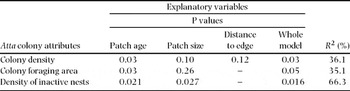
In 2005, we assessed Atta cephalotes colonies within a total of 17 secondary-forest patches (ranging in size from 0.53 to 7.4 ha, with a total area of 43.3 ha), which consisted of formerly clear-cut sites within flat, core areas of the Coimbra forest. Although embedded in the same matrix of mature forests, these second-growth patches were at least 200 m apart from each other (i.e. spatially independent patches) and represented a well-known 25–47-y-old chronosequence created by the abandonment of slash-and-burn gaps following 5–10 y of subsistence agriculture (maize, cassava, beans) as described in Santos et al. (Reference SANTOS, PERES, OLIVEIRA, GRILLO, ALVES-COSTA and TABARELLI2008). Colony density was determined by systematic patch-wide searches, which provided a complete inventory of all adult/active, as well as all inactive nests of A. cephalotes within two subsets of 14 and 10 second-growth patches, respectively. We determined the size of nests by measuring two perpendicular maximal and minimal diameters across the respective structure and calculating the area as an ellipsoid. In order to estimate the foraging area covered by colonies across the chronosequence, we mapped the foraging trunk trail systems of 12 similar-sized (20.5 ± 2.7 m2, mean ± SE) adult colonies occurring across a subset of 12 second-growth patches (one colony per patch, 25–47 y old). To obtain adequate estimates, colony foraging areas were mapped via a single, monthly observation during the peak of colony activity by measuring compass bearings and lengths of all quasi-linear trail segments. This procedure was repeated throughout a year, resulting in 12 estimates per colony, which were further collapsed into a single annual measure of foraging area per colony. Briefly, annual foraging areas were approximated by firstly superimposing the monthly foraging trail systems, and then generating contour maps that excluded those forest sectors not visited by ant workers (Wirth et al. Reference WIRTH, BEYSCHLAG, RYEL, HERZ and HÖLLDOBLER2003). In synthesis, we assessed nearly all second-growth patches available in the Coimbra forest but, for accessibility reasons and to control for colony size when measuring foraging area, we had to rely on different subsets of patches to obtain colony-related attributes (i.e. colony density, density of inactive nests and foraging area). As patch size and age were not correlated (R2 = 1.4%, F = 0.81, P = 0.383), they were used as explanatory variables to explain variation in colony-related attributes through general linear models (GLMs), after Lilliefors tests for normality (Table 1). For colony density we also incorporated in the model the patch distance to the nearest border of Coimbra forest, as this variable has been proved to affect Atta density across this site (Wirth et al. Reference WIRTH, MEYER, ALMEIDA, ARAÚJO, BARBOSA and LEAL2007). The relationships between nest size and patch size and patch age were examined via two simple regression analyses.
Results from generalized linear models (GLMs) applied to three colony attributes of Atta cephalotes in the Coimbra forest, north-eastern Brazil.

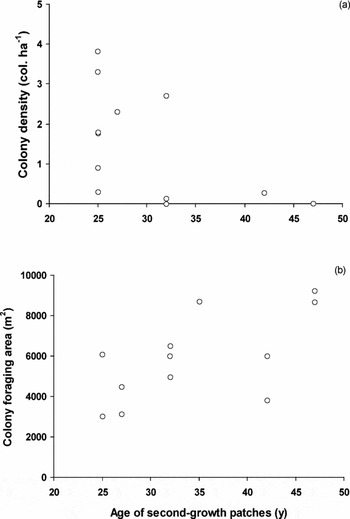
A total of 26 adult Atta cephalotes colonies were recorded within the 14 second-growth patches, and colony density consistently varied among patches. It reached 2.01 ± 0.46 colonies ha−1 with a range of 0.3–3.8 colonies ha−1 among 25–27-y-old patches, but sharply declined to 0.53 ± 0.37 colonies ha−1 among 32–47-y-old patches. As expected, colony density drastically dropped from early secondary (25 y old) towards mid-successional forest patches (Figure 1a), but it was not affected by patch size or distance to edge (Table 1). On the other hand, the density of inactive nests increased with patch age but decreased with patch size (Table 1). The annual foraging area of the colonies varied widely as well, reaching an average of 5870 ± 618 m2 (n = 12 colonies/patches). In contrast to colony density, foraging areas substantially increased, in fact, tripled across the regeneration chronosequence ranging from 3010 m2 in a 25-y-old to 9050 m2 in a 47-y-old patch (Figure 1b), but without correlation with patch size (Table 1). Based on the means of foraging area (5870 m2) and colony density (1.2 colonies ha−1), we calculated that, overall, ants accessed c. 70% of the entire secondary forest area via foraging. Age-specific estimates, however, revealed that in mid-successional patches (42–47 y old) ants explored only a small portion of the available forest (16–23%), whereas they accessed up to 100% of the area covered by early secondary patches (25 y old). This implies that the increment in the average size of colony foraging area did not compensate for reduced colony density in the oldest patches, thus limiting the spatial impact of Atta as forest recovers toward old-growth/late-successional forests. Finally, as colony nest size did not correlate with either patch size or patch age (P > 0.05, two simple regression analyses), differences in nest size across the second-growth patches can neither explain the reduced colony density nor the increased foraging area as forest ages.
Relationship between the time of recovery of second-growth patches and density of Atta cephalotes colonies (n = 14) (a), and the size of annual foraging areas of colonies (n = 12) (b) within the Coimbra forest, north-eastern Brazil. Note that GLMs identified only patch age as a significant explanatory variable for these two colony-related attributes (Table 1).

A number of studies have already documented a notable increment (up to a 30-fold increase) in the density of leaf-cutting ants across human-disturbed habitats (Wirth et al. Reference WIRTH, MEYER, ALMEIDA, ARAÚJO, BARBOSA and LEAL2007), but the long-term dynamic of leaf-cutting ants in anthropogenic landscapes remains poorly investigated. Here we used a robust and replicable study design to reveal a remarkable and consistent shift in Atta cephalotes colony attributes, which accompanied/paralleled forest regeneration following small-scale, slash-and-burn agriculture within a single and exceptionally large fragment of Atlantic forest. As we predicted, density of both active and inactive/abandoned nests, as well as foraging area, drastically changed as forest patches aged, and the whole forest area accessed by ants via foraging drastically dropped by one third despite a relatively short time period covered by the studied chronosequence (c. 20 y). How can these findings be interpreted with regard to the causal factors controlling the abundance of leaf-cutting ants and their ecological roles in anthropogenic landscapes?
The underlying mechanisms for altered abundance of leaf-cutting ants in human-disturbed habitats are commonly attributed to either top-down (consumer-driven) or bottom-up (resource-driven) mechanisms of population control (Farji-Brener Reference FARJI-BRENER2001, Terborgh et al. Reference TERBORGH, LOPEZ, NUNEZ, RAO, SHAHABUDDIN, ORIHUELA, RIVEROS, ASCANIO, ADLER, LAMBERT and BALBAS2001). Recent studies have offered empirical evidence that the loss of natural enemies (Almeida et al. Reference ALMEIDA, WIRTH and LEAL2008, Rao Reference RAO2000, Wirth et al. Reference WIRTH, MEYER, LEAL and TABARELLI2008) and the increased abundance of less effectively defended and more palatable pioneer plants (Peñaloza & Farji-Brener Reference PEÑALOZA and FARJI-BRENER2003, Urbas et al. Reference URBAS, ARAÚJO, LEAL and WIRTH2007) may lead to the ecological release of leaf-cutting ants, particularly in small fragments and forest edges. In this investigation we did not explicitly address the driving forces for shifts in the abundance of A. cephalotes, but we have some previous findings from the Coimbra forest that are consistent with the hypothesis of bottom-up control. First, A. cephalotes ants increased massively in abundance (5.9 colonies ha−1) along the edges of Coimbra forest (Wirth et al. Reference WIRTH, MEYER, ALMEIDA, ARAÚJO, BARBOSA and LEAL2007), where ants intensively harvested the predominant pioneer vegetation (Oliveira et al. Reference OLIVEIRA, GRILLO and TABARELLI2004) by using reduced foraging areas (Urbas et al. Reference URBAS, ARAÚJO, LEAL and WIRTH2007). Conversely, those colonies inhabiting mature core forest (1.1 colonies ha−1) explored larger foraging areas (as we found here) in order to overcome the spatial scarcity of suitable pioneer foliage (Urbas et al. Reference URBAS, ARAÚJO, LEAL and WIRTH2007). In fact, edge colonies removed about twice as much leaf area from their foraging grounds as interior colonies (14.3% vs. 7.8% per colony y−1, Urbas et al. Reference URBAS, ARAÚJO, LEAL and WIRTH2007). A second support for the bottom-up hypothesis refers to the fact that the second-growth patches included in this study represent a subset of a long regeneration chronosequence (5–65 y), in which the relative abundance of pioneer tree species and stems dropped from 100% to 13.5% of all stems (the extreme scores), while the overall tree species richness and the abundance of shade-tolerant trees at least doubled over the transition from early to late-successional stands (Santos et al. Reference SANTOS, PERES, OLIVEIRA, GRILLO, ALVES-COSTA and TABARELLI2008). In synthesis, an irreversible but rather continuous and strong spatial decline in the availability of palatable plants over the regeneration process is likely to increasingly limit ant populations as predicted by the palatable-forage hypothesis (Farji-Brener Reference FARJI-BRENER2001). This obviously does not exclude other additional mechanisms, for example, that increasing colony mortality (as indicated by higher numbers of inactive/abandoned nests) may possibly be due to the recovery of predator/parasite communities during forest regeneration. At present, however, the reduced strength of bottom-up control is the most parsimonious hypothesis to explain the regeneration-related shifts documented in this study.
Like the Coimbra forest landscape, anthropogenic and highly fragmented agro-mosaics have become the predominant landscape type across many previously forested tropical lands (Harvey et al. Reference HARVEY, KOMAR, CHAZDON, FERGUSON, FINEGAN, GRIFFITH, MARTÍNEZ-RAMOS, MORALES, NIGH, SOTO-PINTO, VAN BREUGEL and WISHNIE2008). In these landscapes, large-scale forest clearance invariably converts a considerable portion of pristine forests into small forest fragments, forest-edge habitats, and isolated patches of secondary forests of varying ages in response to the subsequent abandonment of agriculturally marginal lands (Aide & Grau Reference AIDE and GRAU2004). These sort of edge-affected habitats have been shown to promote a landscape-scale hyper-proliferation of pioneer plants, with unanticipated impacts on forest community structure and ecosystem functioning (Laurance et al. Reference LAURANCE, NASCIMENTO, LAURANCE, ANDRADE, FEARNSIDE, RIBEIRO and CAPRETZ2006). Assuming the prevalence of a pioneer-related bottom-up control of leaf-cutting ants, this group of organisms is expected to greatly proliferate and spread across landscapes as a more general pattern. However, their ultimate abundance and tangible ecological impacts as ecosystem engineers will largely depend on the way land-use affects the deforestation/recovering balance and the persistence of pioneer-dominated plant assemblages and habitats such as early secondary-forest patches. We urge additional studies to investigate the generality of our patterns and proposed mechanisms to better understand the pervasive impact leaf-cutting ants likely have on the biological dynamics of many anthropogenic landscapes.
ACKNOWLEDGEMENTS
The study was supported by the Brazil-Germany collaboration project (PROBRAL CAPES/DAAD, project 257/07), Conselho Nacional de Desenvolvimento Científico e Tecnológico (CNPq, project 540322/01-6) and German Science Foundation (DFG, project WI 1959/1-2). We are grateful to three anonymous reviewers for helpful criticisms on the manuscript.