The study of market integration has engendered lively interest thus giving rise to a wide range of theoretical and empirical studies of historical and contemporary commodity markets. Most economic historians analyzing the political and socioeconomic structure of the Near East or, more broadly, of the Ottoman Empire agree that during the nineteenth century, the region became more integrated in the global economy. As such, the Near East follows the experience of many regions of the world at the time of the so-called first wave of globalization.Footnote 1
The vast majority of the available studies describe Ottoman international economic integration relying on simple quantitative indicators such as the dramatic surge in trade volumes and values and the rising ratio of exports to output experienced by the empire. Trade volumes inform us of changes in the economic structure of the empire, but they are not good indicators of the degree of integration between internal and foreign markets. Indeed, as emphasized by Kevin O'Rourke and Jeffrey Williamson, “the worst way to gauge the process of integration is to measure only the changing amount of trade taking place between markets” (2004, pp. 109–10). Instead, the correct measure of commodity market integration is the extent of price convergence between markets, i.e., the degree to which price changes are transmitted between spatially separated regions. In fact, imports and exports can rise (or fall) owing to factors unrelated to integration, such as exogenous shocks to supply and demand.Footnote 2
Since cotton was a key export of the Near East, and of crucial significance in the world economy, analyzing its trade, as well as the evolution of its prices in different markets, helps us understand the nature of the relationship between the Near East and the global market. In the nineteenth century, cotton played a pivotal role in the world economy because it was a key raw material during the Industrial Revolution. Cotton became “the core input of the world's most important manufacturing industry, in terms of amount of labor employed, value of output, and profitability” (Beckert 2004, p. 1408). Moreover, the cotton textile industry benefited from many technological innovations. The unprecedented increases in productivity and a rapid reduction in prices transformed cotton textiles into a mass commodity.
I consider two regions of the Near East, Western Anatolia, and Egypt, the former located at the core of the Ottoman Empire, the latter at its periphery. While scholars agree that Western Anatolia belongs to the Ottoman realm, Egypt's situation is open to debate. In fact, most scholars treat Egypt as a separate entity with its own government and head of state.Footnote 3 Egypt increased its administrative, political, and financial autonomy during the early nineteenth century.Footnote 4 Nevertheless, from an international trade perspective, it was subject to Istanbul's policies in terms of tariffs and the taxation of foreigners.Footnote 5 On the other hand, Egypt had complete control over domestic taxation.
This study aims to assess whether the extent of cotton market integration in the Near East improved or worsened over time and also to connect changes in the nature of spatial market integration between these markets to major economic and political developments. The pace at which the Ottoman Empire (including Egypt) was incorporated into the European-dominated world economy was both gradual and uneven. The empire was a heterogeneous entity, so that some regions were affected at an early stage of the nineteenth century, while others remained comparatively untouched until the twentieth century (see for example, Quataert 1987). The main implication of the Ottoman Empire's territorial vastness and its regional diversification was that commodity market integration took place at over a long period of time. I must therefore investigate whether the two major Ottoman cotton exporting cities, Alexandria and Izmir, experienced different patterns and degrees of international price transmission.
The multitude of quantitative studies investigating the intensity of price transmission and the degree of linkages of commodity markets in the nineteenth century is largely restricted to developed countries, leaving the experience of developing countries in the dark.Footnote 6 In a recent article, Şevket Pamuk provides some evidence of the co-movement of commodity prices between the main Ottoman and European cities, thus attesting to the existence of market integration between the empire and the global economy (Pamuk 2004).Footnote 7 But the statistical analysis is quite elementary and the author himself suggests the need for further research using more sophisticated statistical techniques, in order to gain better insights about the dynamics of the process of market integration. The use of co-integration and error correction models provide statistical tools to explore the evolution of price transmission over time and to detect changes in the relationship between markets. In fact, what I aim to measure and understand is the degree/pace to which prices tend to converge and the reasons for any changes in this dynamic adjustment process over time. Our study undertakes a more in-depth analysis of one aspect of the Near East's participation in the international market, focusing on a major commodity, raw cotton.
THE NEAR EAST AS A GLOBAL COTTON SUPPLIER
Raw cotton has been an important commercial commodity in the Near East for centuries. From the late sixteenth century until the end of the eighteenth century, it was an essential crop for the Ottoman economy. It was used in domestic textile production and shipped in large quantities to Europe, mainly from the Western Anatolian port of Izmir. In Egypt, cotton was used mainly domestically and its cultivation for export began to play an important role in the country's economy only from the early nineteenth century.Footnote 8 In general, the expansion of the British and Western European textile industries based on American raw cotton led to a decline in Near Eastern cotton production.Footnote 9
Western Anatolia and Egypt's fortunes as cotton suppliers revived during the American Civil War (1861–1865), when raw cotton shipments from American ports to Europe essentially stopped. The crisis, which came to be known as the “cotton famine,” raised concerns about the United States's reliability as a source of supply and resuscitated interest in alternative producers, mainly India, but also the Near East.Footnote 10 Both Egypt and Western Anatolia saw a considerable extension of the area under cotton cultivation and a spectacular increase in output and exports. Adana, in Southern Anatolia, another significant Ottoman producer of the raw fiber, also gained importance as a cotton supplier during the American Civil War.
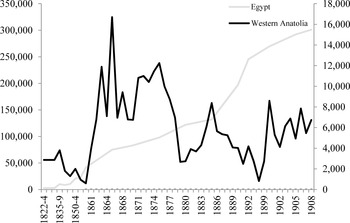
At the end of the Civil War, U.S. exports resumed, prices fell, and cotton production in the two regions undertook two separate paths (see Figure 1). Exports of Western Anatolian cotton fell at the end of the century. In contrast, by the 1870s Egypt's output was two and a half times as large as it had been in the previous decade and cotton's importance continued to grow, until it became the country's major export commodity. The average yearly export growth rate was above 18 percent from the 1820s to the early 1880s; for the next three decades, the growth was slower (6.3 percent) but still substantial (Owen 1969, pp. 161, 198–99).
WESTERN ANATOLIAN COTTON EXPORTS FROM IZMIR, 1834–1910 (RIGHT SCALE) AND EGYPTIAN COTTON EXPORTS, 1822–1913 (LEFT SCALE) IN TONS

At the turn of the century, cotton production in Western Anatolia experienced a modest recovery, encouraged by public subsidies for cotton seeds and new infrastructure. The Adana region, where government intervention was coupled with the decisive role of German capital, underwent a more substantial increase in cotton production and exports.Footnote 11 In Southern Anatolia, cotton exports increased over time, in Western Anatolia production edged upwards, but exports rose slowly to an annual average of 30,000 bales in the post-1900 era, a level lower than that reached in the late 1870s (Quataert 1973; Todd 1915). Hence, it appears that an increasing proportion of local cotton was absorbed by the nascent mechanized cotton textile industry.
While the contrast between the rapid growth of Egyptian exports and the more fluctuating path of Western (and Southern) Anatolia informs us about changes in production and trade patterns in the Near East, it is not sufficient to analyze its level of integration with the global economy. As specified in the previous section, I study changes in the behavior of cotton prices over time, in order to gain insights on the process of market integration.
ANALYTICAL FRAMEWORK
The empirical analysis is based on the Takahashi Takayama and George Judge (1971) model of market integration. When transaction costs are zero, the law of one price (LOP) should hold between markets for a homogenous good.Footnote 12 Since trade costs are almost always present in real world markets, the literature distinguishes between the “strong” and “weak” forms of LOP. The “strong” form of LOP holds in the absence of any trade costs, so that for an identical good a common unique price will exist in spatially separated markets that are linked by trade and arbitrage (Fackler and Goodwin 2001, p. 977). However, owing to the presence of positive trade costs, the LOP in its “strong form” is rarely observed, particularly in the short run. This is because the presence of trade costs produces price differences between markets that cannot be completely arbitraged away, so that price changes in one market are almost never instantaneously transmitted to prices in another market.Footnote 13 As a result, economists treat price integration as a long-run relationship, and consider the LOP as an example of a long-run steady-state equilibrium. This has led to the specification of a “weak form” of the LOP, whereby markets are “integrated” when price changes in one market lead to similar proportional changes in price in other markets, when trade costs remain unchanged.
The Takayama and Judge model assumes the traded good is homogeneous. However, cotton is a heterogeneous commodity; thus, the theoretical concept of market integration requires some modification. There are three major subspecies of the cotton plant. Gossypium herbaceum (“Asiatic” cotton) found in India and the Near East has a short fiber with a length ranging from 3/8 to one inch. Gossypium hirsutum (“non-Asiatic” cotton), includes American Upland and has a medium to long-staple fiber with a length varies between one and one and half inch. Gossypium Barbadense (the Peruvian group) includes Sea Island, Egyptian, and Peruvian cottons. This specie had the best kinds of lint and the longest fiber, starting from one and half inch, reaching over two inches for the best qualities.
These varieties are in principle substitutes, but not perfect substitutes. The degree of substitutability among the different typologies of cotton depended on the length, strength, fineness, and character of the lint: while there was a good degree of substitution between American and Egyptian cotton (i.e., between Gossypium hirsutum and barbadense), the substitutability between these two and Gossypium herbaceum was considerably less (Todd 1915, pp. 7–17). In fact, the short-fiber cotton supplied by India and Western Anatolia was only used in coarser cloth, and it was also more difficult to spin and generated a higher share of waste during the production process than the better varieties.Footnote 14
Because cotton is a differentiated commodity, I cannot expect the strong form of the LOP to hold, even if transaction costs were zero.Footnote 15 However, the substitutability among the various cotton strains suggests there should be some interrelationship among prices, at least in the long run. I would also expect that an improvement (worsening) in the extent of substitutability would increase (hinder) price convergence. Hence, I test for spatial market integration within the framework of the “weak form” of the LOP.
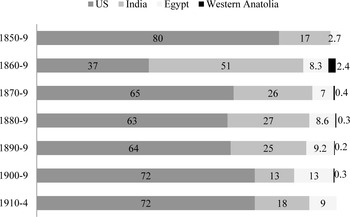
In my analysis of market integration, I use the price of Western Anatolian and Egyptian raw cotton sold in Izmir and in Alexandria, respectively, and the price of American and Indian raw cotton sold in Liverpool (in the rest of the article, American and Indian cotton implicitly refer to these commodities sold in the Liverpool market). Liverpool was the principal global harbor for the import of raw cotton during the nineteenth century, and the United States the main global supplier, followed by India (Jacks, O'Rourke, and Williamson 2011, see also Figure 2).
AVERAGE ANNUAL SHARE IN WORLD COTTON EXPORTS, 1850–1914

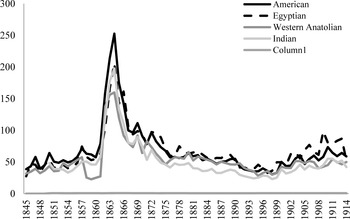
Figure 3 shows the price movements of the four types of cotton from 1845 to 1913. There is a pattern common all the series: a slow rise from 1845 to 1858, followed by a price drop till 1861. The fall in prices was caused by rapid output growth in the United States, which was not met by an equivalent expansion of the textile industry.Footnote 16 After the huge jump in the early 1860s, coinciding with the American Civil War (1861–1865), prices underwent a downward trend till the end of the century, corresponding to the global depression (1873–1896). The trend reversed after 1896 and price increased until the First World War. Alexandria and Izmir cotton markets clearly matched American and Indian price patterns. There are also times when prices diverge, for example between the mid-1850s and 1860 in the case of Izmir and in the early twentieth century each series goes its own way. In any case, a visual inspection of the data cannot provide an accurate analysis of the degree of interconnectedness (or absence thereof) between Near Eastern and Liverpool prices. Another important characteristic of the series involves price differentials: Egyptian cotton generally fetched more than American owing to its superior quality.Footnote 17 On the other hand, Western Anatolian, like the Indian fiber, was cheaper than both Egyptian and American cotton because it was of lower quality.Footnote 18
PRICE MOVEMENTS OF AMERICAN, INDIAN, EGYPTIAN AND WESTERN ANATOLIAN COTTON, 1845–1914, IN BRITISH POUND PER METRIC TON

Two crucial factors related to the features of the cotton market need to be examined in order to assess the impact of the dynamics of price transmission: the change in trade policy, in other words the lowering of export tariffs in 1861/62 and the reduction in transport costs. As can be inferred from the analysis presented in the following paragraphs, I expect these two factors to have facilitated the process of market integration, since they generated a decrease in transaction costs.
Export Taxes
Until 1861 the Ottoman government imposed a 12 percent duty on all exports, as established by the 1838 Anglo-Turkish convention and the Hatt i-Serif (Imperial Script) of the following year. Export duties were dramatically reduced in 1862 from 12 percent to 1 percent, market integration could only have benefited from this change which applied to both Egypt and Anatolia.
Transport Costs
In the Near East as in the rest of the world, the adoption of the steam engine and increased ship size reduced costs and uncertainty in maritime transport. Steamships began entering Near Eastern waters in the 1820s and started replacing wind-powered vessels. By the end of the century, steamships carried the majority of all goods. Such developments, together with the introduction of the telegraph in 1869 and the expansion of the railway system, provided crucial improvements to the links between the Near East and the global economy in general and in the cotton trade in particular. Furthermore, both Izmir and Alexandria's harbors were modernized. Between 1867 and 1875 new port facilities comprising a 4 kilometer-long quay and 32 hectares of dock space were built in Izmir. In Alexandria, new jetties, wharves, and docks were built between 1869 and 1880, and further port development occurred at the end of the nineteenth century. Market integration could only have improved over time as a result of transport improvements.
The process of market integration was influenced not only by changes in transaction costs, but also by the different extent of substitutability among cotton varieties. I expect stronger integration between Anatolian and Indian than between Anatolian and American cotton, due to the higher degree of substitutability between them. For the same reason, I expect better integration between Egyptian and American than between the former and the Indian fiber. I can also anticipate that any change in the degree of substitutability between cotton types would have an impact on the process of price pass-through.
DATA AND METHODOLOGY
Price Data
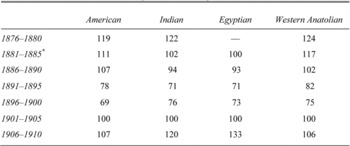
The highest frequency cotton price data I can use are annual. As they were expressed in different units of measurement, all the data have been converted to metric tons per British pound, using exchange rates given by Pamuk for Turkey and by E. J. Roger Owen for Egypt.Footnote 19 For Izmir, wholesale domestic cotton prices have been acquired from both unpublished and published sources.Footnote 20 For Alexandria, domestic cotton prices have been found in published sources (1845–1873: Owen 1969; 1874–1913: Richards 1987, 1914; Johnson 1926). Prices of American (Middling) and Indian (Dhollerah) cotton sold in Liverpool are from David Jacks, Kevin H. O'Rourke, and Jeffrey G. Williamson (2011). I have not been able to test price transmission using Egyptian and Anatolian cotton sold in Liverpool owing to the lack of a complete series in the period under analysis. For the years in which such data are available (from 1863 to 1875 and 1882 to 1914 for Egyptian cotton sold in Liverpool and from 1876 to 1908 for Izmir cotton export price), a clear co-movement among the series is observable. Table 1 compares the price indexes for American, Indian, Egyptian, and Turkish cotton.
APPLICATION
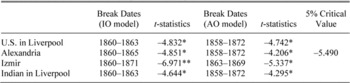
The first step for understanding the relationship among variables to detect the presence of market integration is to test for the level of integration of the log transformation of each price series, in order to ensure that the regression results are not spurious. Table 2 reports the results using the Jesús Clemente, Antonio Montañés, and Marcelo Reyes approach that allows for two regime shifts.Footnote 21 A first set of results allowing the changes in mean to take place at once (Additive Outlier model) show that all prices are non-stationary. If, however, I allow the mean changes to take place gradually (Innovative Outlier model), the Izmir data prove to be stationary (the other series are non-stationary).
INDEX OF ANNUAL AVERAGE PRICES FOR AMERICAN, INDIAN, EGYPTIAN, AND WESTERN ANATOLIAN COTTON

*1882–1885 for Egyptian prices.
Sources:
Egyptian: index derived from Owen (1969); American and Western Anatolian: Quataert (1973).
According to the unit root test results, the four variables under study show a different level of integration and they all contain structural breaks. To overcome these difficulties, I estimate an autoregressive distributed lag co-integration test (ARDL). This method has been supplemented with the cumulative sum of residuals (CUSUM) and cumulative sum of residuals squared (CUSUMSQ) analysis to detect structural breaks.
The ARDL test is one of the most widespread approaches when variables exhibit different degrees of integration. This methodology also allows the determination of different lag lengths for each variable, unlike other co-integration tests and models, and its bound testing is superior in small samples.
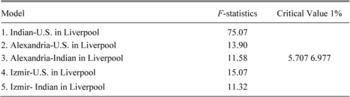
The ARDL co-integration procedure, in other words, tests the absence of a long-run relationship between the dependent variable and the regressors. The validity of the null hypothesis can be examined comparing the F-statistics obtained from the regression with the F-test critical values computed by Kumar Narayan.Footnote 22 The results, reported in Table 3, confirm that the Indian and American cotton prices are co-integrated and that Alexandria and Izmir are co-integrated with both Liverpool series.Footnote 23 The specifications I used here are with unrestricted intercept and no trend (case III in Narayan 2005).

Given the existence of co-integration in all markets, I can use the ARDL error correction approach to analyze the long and short-run relationship between Near Eastern and Liverpool cotton prices, following the model suggested by M. Hashem Pesaran, Yongcheol Shin, and Richard Smith (2001). In ARDL models the dependent variable is explained by lags of itself, other explanatory variables, and their lagged values. Including lags creates a dynamic specification of price changes that can allow for lagged adjustment of prices in markets, so that, for example, while prices in two spatially separated markets may not adjust instantaneously to a shock, thus widening price differentials in the short-run, arbitrage will cause this divergence to be temporary and not permanent. The estimation of a long-run model is specified as follows



where PIND is the price Indian cotton and PUS the price of American cotton sold in Liverpool, while Pi is the price of cotton in Alexandria or Izmir. α1, α2, β1, β2, γ1,γ2 embody the long-run coefficients describing the co-integrated relationship. A dummy variable (war) has been added to equations 1, 2, and 3, in order to take into account the effects of the American Civil War (1860–1865).
ARDL BOUND TEST FOR CO-INTEGRATION IN LIVERPOOL AND THE NEAR EASTERN COTTON MARKETS

Sources:
See Figure 3.
Following the Schwarz Bayesian Information Criteria, one lag was added to each variable. Once the long-run relationship is established, I can estimate the short-run relationship among domestic and Liverpool cotton prices. This takes the form of an error correction model where the error correction term (ECT) is given by the residuals of the long-run model lagged once and where all variables are expressed in their first difference.
The coefficients of the error correction terms show how fast variables converge to equilibrium and therefore describe the speed of adjustment effect. Hence, by defining how much of the price difference among prices is eliminated in each subsequent period, they represent the short-run speed of adjustment to reach the long-run equilibrium: the closer their value is to −1, the faster is the speed at which convergence takes place. However, since the various cotton strains were not perfect substitutes, I do not expect to observe an ECT equal to −1 (complete price transmission). The presence of an ECT different from zero is a necessary condition for long-run price convergence.
A further step in the analysis of the co-integration relationship consists of testing for the stability of the parameters which define it. This is to ensure that no structural break is present. Unstable parameters would, in fact, undermine the validity of the model and lead to misspecification and biased results.
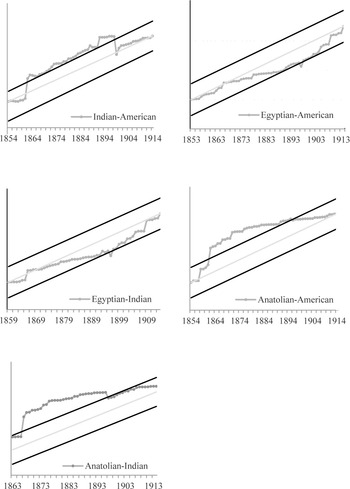
I follow Pesaran and Shin (1998) and Narayan and Russell Smyth (2005) to find structural breaks in the co-integrated cotton market of Liverpool and of the Near East. The approach applies CUSUM and CUSUMSQ tests to the residuals of the estimated error correction model. The CUSUM test detects systematic changes in the regression coefficients. It utilizes the cumulative sum of recursive residuals based on the first observations and it is updated recursively and plotted against break points. The CUSUMSQ adopts the same procedure, it seeks any sudden departure from the constancy of the regression coefficients. The absence of structural breaks in the co-integration relationship is ensured if the plot of the CUSUM and CUSUMSQ remains within the 5 percent critical bounds.
In Figure 4, I report the CUSUMSQ tests' results for the Liverpool and Near Eastern cotton markets. In the Liverpool market (Indian-American prices), the plot lies outside the 5 percent critical value bounds of the CUSUMSQ test between 1862 and 1898, indicating two structural breaks in the model during those years. These results are of crucial importance since the Liverpool market serves as benchmark for our study of integration.Footnote 24 In the case of the Egyptian-American and Egyptian-Indian relationships, one regime shift was found in 1898 and in 1896, respectively. In the case of Izmir, the CUSUMSQ plot lies outside of the bounds between 1862 and 1896 with respect to the American fiber and between 1867 and 1896 with respect to the Indian one.
The breaks detected between Indian and American cotton in Liverpool signal a change in the relationship between the two prices. Given that such relationship is based on the extent of substitution between the two fibers, the identified regime shifts are likely to reflect a change in the degree of substitutability between the Indian and American varieties.
In the Egyptian-Indian and Egyptian-American tests, breaks were found at the end of the 1890s. This period marked the beginning of a favorable phase for Egyptian cotton production. Productivity was rising, reversing a decade of stagnation due to civil unrest (Schanz 1913; Owen 1969).Footnote 25 The main factor was a rise in demand for Egyptian cotton; in particular, the spread of the process of “mercerizing,” which made the yarn finer and of higher luster so that it resembled silk, revolutionized the industry.Footnote 26 Egyptian cotton, being the longest staple, was one of the most suitable varieties for mercerized threads and fabrics. The rise in demands for Egyptian cotton resulted in stronger linkages with the international market and in a consolidation of trade networks between Egypt and Europe. The end of the 1890s and the beginning of the new century saw an intensification of European involvement in the processing of cotton in Egypt, characterized by a considerable increase in foreign investments in ginning and pressing (Owen 1969).
PLOTS OF CUSUMSQ FOR LIVERPOOL, ALEXANDRIA, AND IZMIR MARKETS

In the case of Izmir, three regime shifts occurred. The first phase of integration with the American cotton ended in 1861, while that with Indian prices in 1866: these roughly coincide with the American Civil War. The war led to an unprecedented expansion in cotton production for export on its own. But it was part of a broader trend towards agricultural commercialization in the Near East (Issawi 1966). The American Civil War was particularly important because it was then that cotton became a pivotal export of the Near East. The period after 1896 (the third phase) signals the end of the price depression, after which the empire underwent a period of relative stability. Furthermore, a rise in global demand and the prices for cotton gave new impetus to the Anatolian cotton market (Quataert 1973).
The structural breaks imply that I should dig deeper and estimate long- and short-run parameters before and after the period of the breaks. Doing so allows us to compare the dynamics of the price movements in the various phases and examine the changes in the market relationship between the two Near Eastern regions and the global cotton industry.
Liverpool
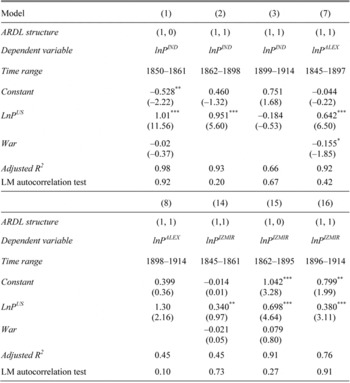
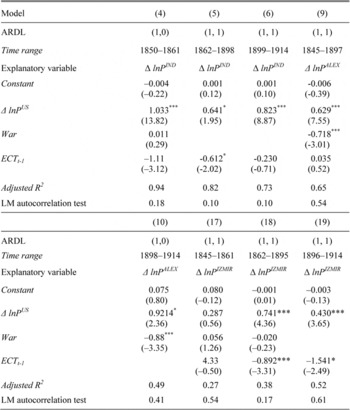
The relationship between Indian and American cotton prices in Liverpool was characterized by three phases (see Tables 4 and 5). During the first period (1850–1861), I observe no integration, probably due to the low degree of substitutability between the two fibers. In fact, the vast majority of cotton spun in Lancashire mills was American while Indian short-staple cotton was not considered a good substitute by the British textile industry (Chauduri 1983, pp. 848–49).
The two price series became co-integrated between 1862 and 1898. Integration was spurred on by the American Civil War, when the engineering industry associated with Lancashire mills rapidly adapted mule spinning technology to permit the cotton industry to shift from scarce, longer staple American cotton to the more abundant, shorter staple Indian cotton (Mass and Lazonick 1990, p. 14).
In the last phase (1899–1914), the linkages between the two prices became weaker, reflecting a change in the degree of substitutability between the fibers. The reasons for such developments are not easy to find but one does stand out: the diffusion of ring spinning in Lancashire, especially among vertically integrated firms, at the turn of the century. While ring spinning became economically viable in the mid-1880s, British mills were slow to embrace the new technology and the mule continued to represent the preferred method of spinning (Leunig 2001; Ciliberto 2010). However, during the last period of expansion of the Lancashire cotton industry, after the global price depression, the number of rings increased considerably. In 1902 around 10 percent of mills in the industry adopted the ring, jumping from around 2 percent in 1894 (Ciliberto 2010). Since ring spinning subjected the cotton fiber to more strain, Indian short staple was not suitable for it. Thus, such technological change may have impacted the degree of substitutability between Indian and American cotton, rendering the Indian fiber less valuable.
ARDL LONG-RUN COEFFICIENTS WITH U.S. PRICES AS EXPLANATORY VARIABLES

* indicates significance at 10 percent.
** indicates significance at 5 percent.
*** indicates significance at 1 percent.
Notes:
Figures in parentheses are t-ratios.
Sources:
See Figure 3.

Alexandria
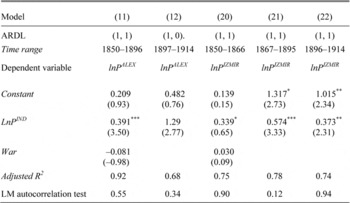
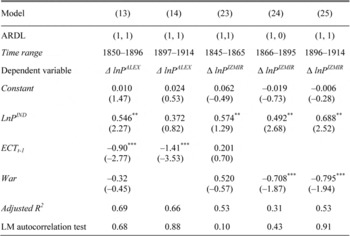
I investigate price relationships between Alexandria and Liverpool for the subperiods indicated by the CUSUMSQ tests. Tables 4 and 5 show that price convergence between the Egyptian and the American cotton improved over time: the error correction terms are significant both before and after 1898. Nevertheless, integration was never complete. On the other hand, after an initial phase of price converge between Egyptian and Indian cotton between 1850 and 1896, the linkages between them weakened (see Tables 6 and 7). Given that the Egyptian fiber was a good substitute for the American one and that their degree of substitutability did not change, these results can be related to the decoupling of the Indian-American series in the Liverpool market and to the change in substitutability between them.
Izmir
Within the three phases identified earlier for the Izmir cotton market, the process of market integration varied remarkably over time (see Tables 4–7). In the first phase, the error correction terms of the coefficient of the co-integration equation with the price of American cotton is not significant. The same is true for the price of Indian cotton. Prices were not converging. These outcomes can be attributed to the fact that a large share of raw cotton production was used domestically and its export represented only a residual market. According to a consular report, in 1851 total output was around 30,000 bales, of which 12,000–15,000 were exported and the rest was used in the domestic market. The situation changed drastically in the 1870s, when cotton became, overwhelmingly, an export crop as domestic spinning and weaving activities shrank considerably. Another consular report in the 1870s indicates total production at 60,000 bales, of which more than 51,000 were exported (Issawi 1980). It is not surprising that the raw cotton market responded more to domestic changes, rather than to global ones. Moreover, the lack of a good transport system and high taxes imposed on exports until 1861 (at 12 percent) may have hampered the process of price transmission.
During the second phase (1862–1895 and 1867–1895 for American and Indian cotton, respectively), Izmir was tightly integrated with Liverpool: the improvement was likely due to improvements in transport and infrastructure, particularly the development of the Izmir port and the construction of the Izmir-Aydin railway, which acted as a catalyst in strengthening market linkages. Furthermore, the effect of lowering the export tax (from 12 percent to 1 percent) may have contributed to the process of price convergence. The error correction coefficient of the equation with American (Indian) prices is −0.89 (–0.71), indicating that 89 (71) percent of the disequilibrium in Izmir's domestic cotton prices was corrected each year.


In the last phase, from 1896 to 1914, the computed error correction parameter of the equation with American prices is −1.54.Footnote 27 On the other hand, the error correction term of the equation with Indian prices is −0.795. It thus appears that while the process of price transmission weakened with American cotton, it continued with the Indian fiber. Given the good degree of substitutability between the Anatolian and Indian fibers, the slowing down of price transmission with the American series can be connected to the co-integration results in the Liverpool market, and hence to the fact that short-staple cotton may have become a less valuable substitute of the American type.
I conducted the same analysis of international price transmission for Southern Anatolia, using annual prices of Adana's short-staple cotton sold in Istanbul (1876–1908).Footnote 28 The results showed that Adana was integrated with Indian prices during the whole period and with the American series only until 1898.Footnote 29 This outcome provides further strength to our argument on the change in substitutability between short and medium- to long-staple cotton.
CONCLUSION
In this article, I explored the evolution of the process of cotton market integration between Izmir, Alexandria, and Liverpool. The relationship between Near Eastern and international markets was multifaceted, since it encompassed differentiated products, varying export levels, changes in trade and market conditions. Particularly, the fact that cotton is not a homogenous good complicated the analysis of price converge, since it was difficult to identify the effects of changes in substitutability and changes in market integration.
The process of international price transmission in the Near East followed an uneven pattern over time. And the Alexandria and Izmir prices underwent separate paths. Although a large body of literature describes the first wave of globalization as a period in which commodity markets became increasingly more integrated, our study indicates the speed of convergence varied over time.
In Egypt, cotton market integration began in 1845: while strengthening in relation with the American fiber, the process of convergence with Indian prices weakened at the turn of the century. In Western Anatolia, I observed almost the opposite scenario. Market integration started later, with the American Civil War, and it continued intensifying only with respect to Indian cotton. On the other hand, convergence with American prices slowed down considerably.
Improved market integration between the Near Eastern and the Liverpool markets between the 1860s (1845 for Egypt) and mid to late 1890s was undoubtedly aided by lowering transaction costs, particularly connected with transportation and communication improvements worldwide. However, at the turn of the century, some of the established price linkages changed: integration worsened between Anatolian and American and between Egyptian and Indian cotton.
The reasons for such deterioration in price convergence between some cotton types are not easy to extract. I know that there was neither an increase in transport costs nor changes in market conditions or trade policy. I also know that Anatolian cotton was a close substitute of Indian and Egyptian of American throughout the period under analysis. Therefore, some of these divergences in integration are likely to be attributed to variations in the extent of substitutability between short- and medium- to long-staple fibers. Thus, technology changes in spinning that impacted the degree of substitutability between Indian and American cotton in our benchmark market in Liverpool had repercussions on the integration of the Near Eastern markets.
 meaning privileges for foreigners; the capitulations were part of treaties between the Sultan and European powers, which granted tax exemption and other privileges to foreigners. They recognized the status of conditional extraterritoriality to foreign subjects and some non-Muslim Ottoman citizens.