INTRODUCTION
It has been well established that before they are 3;0–3;6, children typically do not engage with peers in focused interaction, and, in particular, young peers do not engage in conversation. Instead, they mostly engage in non-social (solitary and parallel) play with peers, rather than in social types of interaction such as talk or cooperative play (Bronson, Reference Bronson1981; Eckerman, Whatley & Kutz, Reference Eckerman, Whatley and Kutz1975; Parten, Reference Parten1932). The intriguing fact is that at the very same developmental period, young children do engage in talk, cooperative play, and other forms of focused interaction in dyadic situations with older partners, in particular their parents and caretakers. Often, interaction consists of games with verbal components such as give-and-take and peek-a-boo (Bruner, Reference Bruner1983; Bruner & Sherwood, Reference Bruner, Sherwood, Bruner, Jolly and Sylva1976; Green, Gustafson & West, Reference Green, Gustafson and West1980; Ratner & Bruner, Reference Ratner and Bruner1978) or joint picture-book reading (Dickinson, Griffith, Golinkoff & Hirsh-Pasek, Reference Dickinson, Griffith, Golinkoff and Hirsh-Pasek2012; Fletcher, Perez, Hooper & Claussen, Reference Fletcher, Perez, Hooper and Claussen2005; Ninio, Reference Ninio1980, Reference Ninio1983; Ninio & Bruner, Reference Ninio and Bruner1978; Snow, de Blauw & van Roosmalen, Reference Snow, de Blauw, van Roosmalen and Bullowa1978; and see also Garvey, Reference Garvey, Bruner, Jolley and Sylva1976; Goldman & Ross, Reference Goldman, Ross, Glick and Clarke-Stewart1978; Hay, Ross & Davis, Reference Hay, Ross, Davis and Sutton-Smith1979). Preverbal infants gradually increase their participation in these collaborative activities and perfect the necessary action repertoire (Camaioni & Laicardi, Reference Camaioni and Laicardi1985; Gustafson, Green & West, Reference Gustafson, Green and West1979; Rome-Flanders, Cossette, Ricard & Gouin Decarie, Reference Rome-Flanders, Cossette, Ricard and Gouin Decarie1995). In addition, young children also engage with parents and other older partners in non-game conversations, using language to direct the adult's attention or to ask for help (Ninio & Snow, Reference Ninio and Snow1996; Ninio & Wheeler, Reference Ninio, Wheeler, Feagans, Garvey and Golinkoff1984; Pan, Imbens-Bailey, Winner & Snow, Reference Pan, Imbens-Bailey, Winner and Snow1996; Snow, Pan, Imbens-Bailey & Herman, Reference Snow, Pan, Imbens-Bailey and Herman1996). We do not yet understand fully this disparity in interaction style and this paper will try to contribute to the explanation.
The preference for interacting with an adult was recently demonstrated in a well-controlled study by Brooks, Aldrich, Yuksel-Sokmen, and Ragir (Reference Brooks, Aldrich, Yuksel-Sokmen and Ragir2014) in which 7- to 15-month-old twins preferred to interact with their mother rather than with their twin when both were available. Brooks et al., discussed the finding as reflecting children's choice to interact with an expert rather than with novice modelers in the acquisition of conventional, communicative, and instrumental behavior.
Another explanation often offered for the preference for adult interactive partners is in terms of some deficit or limitation in young children's abilities to carry out social behaviors on their own (Bronson, Reference Bronson1981; Eckerman et al., Reference Eckerman, Whatley and Kutz1975), and adults' provision of support or ‘scaffolding’ that makes such behaviors possible. According to this approach, conversational and interactive social abilities are skills that develop gradually, requiring at the onset considerable contextual support (e.g. Bruner, Reference Bruner1983; Eckerman & Stein, Reference Eckerman, Stein, Rubin and Ross1982; Forrester, Reference Forrester1992; Kaye & Charney, Reference Kaye, Charney and Olson1980; Lieven, Reference Lieven, Waterson and Snow1978; Snow, Reference Snow1977, Reference Snow and Collins1979). It is possible that adult support (scaffolding) of the interaction makes it possible, resembling the situation regarding the gradual mastery of other higher capacities (cf. Fischer, Reference Fischer1980). According to such authorities as Wood, Bruner, and Ross (Reference Wood, Bruner and Ross1976), Bruner (Reference Bruner1982), and Bakeman and Adamson (Reference Bakeman and Adamson1984), adults' scaffolding of focused interaction consists of such behaviors as establishing a joint topic, following the attentional focus of the infant, establishing and interacting within repetitive activity ‘formats’ consisting of sequences of predictable actions, and assisting the child in the motor elements of the activity. It is claimed that young children experience a relatively prolonged apprenticeship at such situations, during which they gradually increase their participation in collaborative activities and perfect the necessary action repertoire. Thus children may not engage in focused interaction with peers because they do not yet possess the conversational and interactive social abilities to do so without the support provided for them by adults.
I would like to explore a further possibility as to why young peers would not engage in focused interaction with each other but they would with an adult. Although the explanations appealing to adults' expertise and scaffolding and their absence in peers are convincing, there may be additional reasons for avoiding focused interaction with peers. I want to explore some of the possible pragmatic reasons to do with the focus of interaction and, especially, focus of talk available for young children.
Focused interaction and in particular conversation either relates to the ‘here-and-now’ or it is about non-present topics. We know that talk discussing non-present or fantasy topics is a late achievement, rarely observed before 3;0 either with adults or with peers (Ninio & Snow, Reference Ninio and Snow1996). At the young ages, up till 3;6, dyadic interaction of young children with parents and other adults centers around the here-and-now (Snow, Reference Snow1977). That is, young children's joint action and conversation with older interactants tends to be exclusively about a joint focus of attention which is a perceptually present object or event. The question is, then, why do young peers not interact around the here-and-now, namely, present objects and events? In particular, why do they not discuss present objects and events with peers, the way they do with older partners?
Our hypothesis is that the reason is not because they cannot but because they will not. Namely, the absence of conversation is not due to lack of ability but to lack of motivation.
As our hypothesis is that there are reasons for the absence of peer conversation besides lack of parental facilitation and scaffolding, we focused on an interactive event that does not involve scaffolding; that is, we concentrated on attention directives in children's speech. An attention directive is an initiative to begin focused interaction involving the here-and-now, and it is not obviously scaffolded by parents. It is the child's initiative. Scaffolding, as we mentioned, consists mainly of responding to the child, establishing a topic, setting up a repetitive format, and assisting in motor acts. A new attention directive by the child is the first move of a new interactive cycle and it does not involve those aspect of interaction which we cover by the concept of scaffolding, namely, adult responsiveness, format setting-up, and assisting in motor action. In addition, in order to discount semantic ambiguity and syntactic complexity as confounding effects in the study, we considered only bids for attention consisting of single-word directives, such as Look!, See!, and Watch!
We hypothesized that very young children do not attempt to establish joint attention to an object present in the environment when addressing a peer out of a pragmatic choice, not because they cannot do so.
We are testing three hypotheses:
First hypothesis: parents model bids for joint attention to present objects and events when addressing young children, providing models for learning the behavior;
Second hypothesis: young children do not initiate joint attention with peers;
Third hypothesis: young children do initiate joint attention with adults, showing they can if they want to.
This design provides two controls on young children's ability to produce attention directives consisting of verbs in a single-word utterance: First, we ask if children at this age receive such directives from parents, proving the necessary input for learning. Second, we ask whether young children produce such directives in other contexts, demonstrating that they are able to do so.
METHOD
To test these hypotheses we compared three speech corpora for the presence and relative frequency of attention directives. The corpora were of speech of parents to young children; children to peers; and children to parents. The samples were taken from the English-language observations transcribed and stored in the CHILDES (Child Language Data Exchange System) archive (MacWhinney, Reference MacWhinney2000; MacWhinney & Snow, Reference MacWhinney and Snow1985). CHILDES is a public domain database for corpora on first and second language acquisition. The publicly available, shared archive contains documentation of the speech of several hundred English-speaking parent–child dyads containing typically developing children, and some documentation on peer–peer conversations. These data served in the present study.
Samples of child–child and parent–child dyadic interaction
The peers' sample taken from the CHILDES archive consisted of fifteen children engaging in dyadic peer-interaction, collected by Garvey and Hogan (Reference Garvey and Hogan1973). The children ranged in age from 2;10 to 3;7. The children were videotaped in 15-minute play sessions, with no experimenter or other children present.
For samples of child-directed parental speech and parent-directed child speech, we made use of a large corpus or collection of transcribed sentences of English-language parent–child conversations. These are all the fruit of naturalistic observations of dyadic interaction between young children at the start of multiword observations and their parents. The corpus was built systematically, based on English-speaking dyads whose speech is transcribed and stored in the public CHILDES archive. The archive contains documentation of the speech of more than 500 English-speaking parents addressed to their infants and young children, and of the speech of their children. Although each separate study is by necessity limited in its coverage of the phenomenon, the different studies pooled together can provide the requisite solid database for generalization.
As for parents, the use of pooled corpora of unrelated parents as a representation of the linguistic input is a relatively conventional move in child language research (e.g. Goodman, Dale & Li, Reference Goodman, Dale and Li2008; Huttenlocher, Haight, Bryk, Seltzer & Lyons, Reference Huttenlocher, Haight, Bryk, Seltzer and Lyons1991; Lee & Naigles, Reference Lee and Naigles2005; Zamuner, Gerken & Hammond, Reference Zamuner, Gerken and Hammond2005). Multiple speakers of child-directed speech may provide a good estimate of the total linguistic input to which children are exposed, which includes, besides the speech of the individual mother or father, also the speech of grandparents, aunts and uncles, older siblings and other family members, neighbors, care professionals, and so forth, represented in our corpus by the speech of mothers and fathers unrelated to the individual child. The pooled database represents the language behavior exhibited by the community as a whole when addressing young children. This research strategy has its own existence and justification in the field of linguistics where it is known as corpus-based linguistics. Corpus-based linguistics is applied in cases when the focus of interest is not an individual speaker (or writer) but the central tendencies of the language variety. In building our corpora, we followed closely the principles established in linguistics for constructing systematically assembled large corpora (Francis & Kučera, Reference Francis and Kučera1979).
The CHILDES archive stores the transcribed observations collected in various different research projects, each with its individual population and methodology. We have selected projects among the ones available using the criteria that the observations were of normally developing young children with no diagnosed hearing or speech problems, and of their parents, native speakers of English, their speech produced in the context of naturalistic, dyadic parent–child interaction. We only included naturalistic observational studies in which children interacted with their parents, not ones in which children interacted only with investigators or only with peers. We have restricted the child's age during the observed period to 3;6. Each parent was selected individually, so that from the same research project involving the same target child, we included either the mother, or the father, or both parents as separate speakers, as long as either or both passed the criteria for inclusion.
This process resulted in the selection of parents and children from thirty-three research projects in the CHILDES archive: the British projects Howe (Reference Howe1981), Korman (Reference Korman1984), Theakston, Lieven, Pine, and Rowland (Reference Theakston, Lieven, Pine and Rowland2001), Wells (Reference Wells1981), and Wilson and Henry (Reference Wilson and Henry1998), and the North American projects Bates, Bretherton, and Snyder (Reference Bates, Bretherton and Snyder1988; and see also Carlson-Luden, Reference Carlson-Luden1979), Bellinger and Gleason (Reference Bellinger and Gleason1982), Bernstein (Reference Bernstein1982; and see also Bernstein-Ratner, Reference Bernstein-Ratner1984), Bliss (Reference Bliss1988), Bloom (Reference Bloom1970, Reference Bloom1973), Brent and Siskind (Reference Brent and Siskind2001), Brown (Reference Brown1973), Clark (Reference Clark, Farkas, Jacobsen and Todrys1978), Demetras (Reference Demetras1989a, Reference Demetras1989b), Feldman (Reference Feldman1998), Hayes (Reference Hayes2000), Higginson (Reference Higginson1985), Kuczaj (Reference Kuczaj1976), McMillan (Reference McMillanunpublished; see description in MacWhinney, Reference MacWhinney2000), MacWhinney (Reference MacWhinney2000), Morisset (Reference Morisset1991), Post (Reference Post1992), Rollins (Reference Rollins2003), Sachs (Reference Sachs and Nelson1983), Snow et al. (Reference Snow, Pan, Imbens-Bailey and Herman1996), Suppes (Reference Suppes1974), Tardif, Gelman, and Xu (Reference Tardif, Gelman and Xu1999), Valian (Reference Valian1991), Van Houten (Reference Van Houten1986), Warren-Leubecker (Reference Warren-Leubecker1982; and see also Warren-Leubecker & Bohannon, Reference Warren-Leubecker and Bohannon1984), and Wilson and Peters (Reference Wilson and Peters1988). From these projects, we selected the observational studies of 471 different parent–child dyads involving a target child of the correct age range, namely, below 3;6. In thirty-five of the studies there were two active parents interacting with the target child, resulting in a parental sample of 506 different parents.
In order to avoid severely unequal contributions to the pooled corpus, the number of utterances included from each parent was restricted to a maximum of 3,000. We have excluded the speech of parents addressed to other adults present in the observational session or on the telephone, as this speech may be ignored by young children because of unfamiliar subjects. All transcribed dialogue and the action and other contextual comments were checked in order to ascertain that we include only spontaneous utterances from target parent to target child.
The resultant parental corpus contains almost 1·5 million (1,470,811) running words of transcribed speech based on naturalistic observations of interaction between parents and their young children, representing several hundred hours of transcribed speech. Most of the children addressed were under three years of age, and 93% of the parents in the sample talked to a child between one year and two and a half years of age in all or the majority of the observations we included in the corpus. The mean age of the children addressed was 2·25 years. For more details of the construction of the source corpus, see Ninio (Reference Ninio2011).
The child corpus of parent-addressed speech was derived from the same collection of transcribed observations as the parents' corpus, above. We began by selecting observational studies of naturalistic interaction between children and their parents. After deciding which observational studies and which speakers to sample, we applied a set of criteria for the inclusion of utterances in the child corpora, checking the speaker, addressee, and spontaneity of speech. We only included spontaneous child utterances, excluding immediate imitations of previous parental utterances in the last three turns of speech. For each utterance marked in the original transcriptions as one uttered by the child, we hand-checked the context to made certain that the line was indeed child speech (and not, for example, an action description or parental sentence erroneously marked as child speech). The size of each participant child's individual contribution to the corpus was restricted to 300 multiword utterances, starting from the first observation in which they produced multiword utterances. This was done to ensure that the pooled corpus represents each participant in a relatively equal manner, rather than over-representing the more talkative children. The total size of this corpus was about 200,000 (194,359) running words.
Some of the children the parents talked to were preverbal infants; others were children barely beginning to produce speech. Of the original 471 ‘target children’, 184 were 1;8 or below, and it was not expected that many of them would produce attention directive verbs addressed to their parents. In order to restrict the sample to likely children and to ensure fair comparisons with the other sample of speakers, we employed a developmental criterion in selecting children for this study. We formed the child sample only of those children who produced at least one single-word utterance which consisted of a verb. This ensured that the young children we compared with parents and with older children were developmentally capable of producing single-word attention directives. To ensure a fair comparison, we employed the same criterion in selecting the sample of parents and of children addressing peers. Thus, we included in this study all participants, children as well as parents, only if they produced at least one single-word utterance which consisted of a verb. Applying this criterion resulted in a sample of 268 children, between 1;2 and 3;3, addressing parents; 15 children, between 2;10 and 3;7, addressing peers; and 391 parents addressing infants and young children.
Identifying single-word verb attention directives
In this study, the operational definition of single-word utterances serving as bids for attention was perceptual verbs typically used as directives to pay attention to a present focus, which are look, see, listen, hear, watch, touch, and feel. The method of identifying such utterances made use of macros and other computational functions that made it possible to partially automatize the task, which was necessary as, together, the three corpora contained over 1,700,000 words. We selected from the dyadic parent–child and the peers corpora all single-word utterances, using a macro that counts the length of the utterances in words. Next, we searched the single-word corpora for verbs, utilizing a list composed of all the verb forms in the corpus and subsequently manually double-checking the classification for possible errors. Next, we searched the single-word verbs for the list of verbs typically used as attention directives, namely for look, see, listen, hear, watch, touch, and feel. All cases of ambiguity as between verb and noun use (e.g. of watch) were checked in the original transcribed observations.
RESULTS
Table 1 presents the data on single-word attention directives produced by the parental sample. Almost all parents – 88% – produced attention-directing requests with single-word verbs. Such utterances made up 60% of their single-word verbs. We may summarize that there is ample input for young children to learn attention bids from parental speech.
Attention directives produced by the parental sample

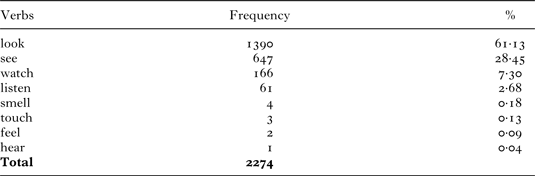
Table 2 presents the distribution of the verbs in single-word attentional bids, in the parental corpus. We can see in Table 2 that the verb look is the clear favorite in this group of perception verbs, with see a far second and the other verbs appearing with a much lower frequency in the data.
Verbs serving as attention directives in parental speech and their token frequency
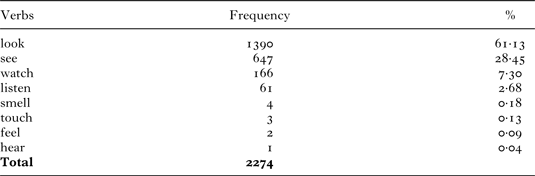
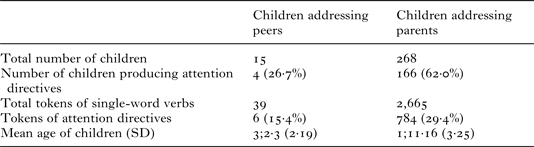
Table 3 presents the results of locating attention directives in the two child samples. In the peer sample, only 4 children (26%) produced single-word attention-directives, which were look and see produced by two children each. These comprised 15% of the total single-word verb tokens of the sample.
Attention directives produced by children addressing peers and by another group of children addressing parents
Of the sample of children addressing parents, a large proportion of the children – 62% – addressed such directives to parents. The proportion of children addressing at least one attention directive to parents was significantly higher than the proportion of those who addressed such directives to peers. The difference was highly significant by chi-square (7·37, p < ·01). Checking the ages of the speakers, it appeared that 99% of the directives were produced by children who were younger than the children in the peers' sample.
Because of the large mean age difference between the two samples, in order to rule out the possibility that the results are confounded with an age effect according to which younger children use more attention-getters in general than older children, we have redone the analyses on subsamples of children falling into the age range of 2;10–3;3, in which the two samples overlap. In the peer-addressing group there were 12 children in this age range, their mean age was 3;2·0 (1·22). Three of this group – 25% – addressed at least one attention-directive to peers. In the sample of children addressing parents there were 10 children in the relevant age range, their mean age was 3;0·15 (1·7). Six of this group – 60% – addressed such directives to parents. The results of the subgroups falling into an overlapping age range replicate the results of the total samples almost exactly, confirming that the differences we found cannot be due to the difference in age across samples.
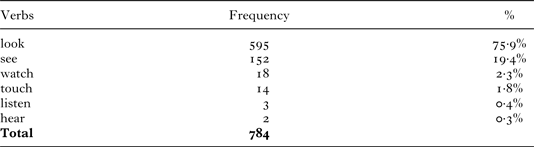
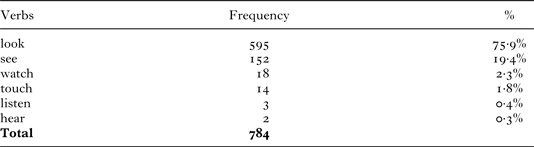
Table 4 presents the distribution of the verbs in single-word attentional bids, in the parent-addressing child corpus. Verbs serving as attention directives comprised only about 30% of all single-word tokens of verbs in these children's speech. Other single-word verbs children produced served a variety of communicative functions. There were requests for action rather than for attention, as for example in the speech of child aged 2;6 observed by Morisset (Reference Morisset1991). The child said Eat! The context is that the child did some pretend-cooking and now requests that Mother eat some of the pretend-food. Another example of a request for action is by a child observed by Tardif et al. (Reference Tardif, Gelman and Xu1999), who at 1;8·6 said Go! This request was addressed to a wind-up toy of a frog, requesting it to move. Another communicative intent expressed by the children was statement of intent to act. Another child aged 2;6 observed by Morisset (Reference Morisset1991) said Write! The mother was holding the questionnaire she was asked to fill and the utterance expressed that the child wants to write on the questionnaire.
Verbs serving as attention directives in parent-addressed child speech and their token frequency
Statements describing a present object were also made, for example, by another child observed by Tardif et al., who at 1;9·19 said Shaking! After the child made this descriptive statement on a present toy, the mother repeats the statement by rephrasing it as a full sentence, saying It's shaking.
Children also produced statements describing the speaker's feelings, for example by the same girl as in the last example, who at 1;9·19 said Like!, claiming she liked a toy frog. The context was that the mother said He's a pretty neat frog, isn't he?, the child answered Uh, yeah, the mother repeated He's neat., and here the child said Like! The mother asked a clarification question, Do you like him?, and the child answered by saying again Like!
Statements were also made on a recent event, as by a child observed by Valian (Reference Valian1991) who at 2;1·21 said Fell. The context is that the mother asked the child to make a toy bear stand up, the child tried to but didn't succeed and the bear fell down. The child then made a descriptive statement of what happened with the bear as a result of her failed attempt.
Lastly, some single-word verbs were uttered by children as answers to wh-questions. For example, the child aged 1;9·19 observed by Tardif et al. (Reference Tardif, Gelman and Xu1999) whom we have already cited above said Catch. The context of the utterance is that mother and child were looking at a ball, the mother asked What do you do with a ball?, and the child answered her question with Catch. The mother then asked a clarification question, Catch it?, and the child answered Yeah. Checking the peer-addressing children's speech, the communicative intents they expressed by single-word verbs were similar to the above, including requests for action, statements of intent, and statements describing objects and events.
Returning to attention directives, we compared the verbs used by the children addressing parents to the verbs used by parents addressing children. As we included in the corpora only spontaneous, non-imitative utterances, any similarity between the two distributions is the result of learning and not immediate copying. We computed Pearson correlation coefficients between verbs' token frequencies in parental speech, and between the verbs' token frequencies in children's speech. Verbs used by parents predicted children's verbs with a highly significant correlation (r(8) = 0·98, p < ·001), accounting for 95·4% of all variance. It appears that young children address parents in bids for attention with the verbs used by parents to address them, demonstrating that parental single-word models of such communicative acts can truly serve as the input for acquisition.
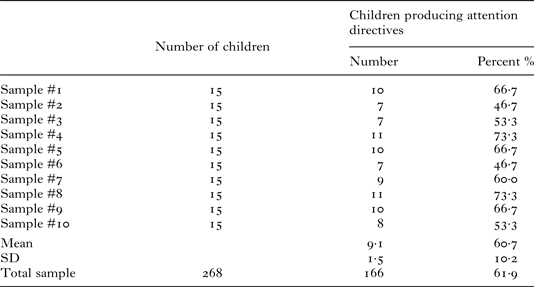
Given the sufficiency of parental input, it is significant that children addressing peers do not produce a larger number of such utterances. As the two child samples were severely unequal in size, we decided to check whether the effect we found did not stem from the difference in sample size, with the parent–child sample being potentially more representative. For this purpose, we performed a further analysis that made it possible to base our comparison on identical-sized samples. As we could not increase the number of children in the peers' sample, we artificially reduced the parents-addressing sample to the size of the peer-addressing one. In a move often used in statistical physics but seldom in developmental psycholinguistics (but see Ninio, Reference Ninio2011, and Rowland & Fletcher, Reference Rowland and Fletcher2006), we generated ten virtual samples of children addressing parents, equal in size to the peers' sample, by randomly sampling the larger child–parent sample. We used the RAND function of the Excel program to generate random numbers between 0 and 1 for each child ID in the larger sample, used them as probabilities, and then, for each of the simulated virtual samples, we generated a sample of size fifteen by picking the fifteen children with the highest probability. Repeating this procedure ten times, we constructed ten different simulated samples of children addressing parents, each with a sample size of fifteen.
In each simulated sample, we counted the number of children producing attention directives. Table 5 presents the results. As we can see in Table 5, on average 60·7% of children in the virtual samples of fifteen children each, produced attention directives to their parents, which is practically identical to the proportion in the total sample of 268 children, namely, 61·9% of the children. The sample size did not have an effect on the mean proportion of children directing attention directives to their parents. The range in the ten samples was between 46·7% and 73·3%. The comparison with the fifteen children engaging in dyadic peer-interaction, of whom only 26% produced such utterances, still stands, as the proportion of peers producing attention directives to each other falls considerably outside the range of the child-parent virtual samples.
Ten samples of children addressing parents equal in size to sample of peers, and number of children producing single-word attention-directives in each (SD is Standard Deviation)
As the size of the child samples does not cause an artifactual contrast, we may summarize the results of the three studies. Table 6 presents the summary comparison. It appears that interaction with peers by young children tends not to involve requests to attend to a shared environmental focus, although interaction with parents does. The majority of children younger than the peers sample produce such directives when addressing their parents, demonstrating that the peer-interacting group is probably well-able to express such directives.
Attention directives produced in three kinds of dyads
These results join previous findings that show young children engage in verbal attention-directing at an early age when interacting with their parents (Ninio & Wheeler, Reference Ninio, Wheeler, Feagans, Garvey and Golinkoff1984; Snow et al., Reference Snow, Pan, Imbens-Bailey and Herman1996). In fact this is the earliest and most frequent interpretable verbal communicative act children produce at 1;2 (Ninio & Snow, Reference Ninio and Snow1996). As requests for joint attention to a perceptually present focus are necessary first moves in developing a conversation about the here-and-now, avoiding such bids for joint attention may account to a large extent for young children not engaging with peers in focused interaction at an age when they are too young to interact about non-present topics.
Events consisting of child bids for attention leading to interaction
It appears that young children are not hindered by linguistic or communicative limitations to make bids for joint attention to present objects to peers, but rather, avoiding such moves is a matter of pragmatic choice.
To try to understand why children would not wish to address peers with attention-directives, we turned to an examination of their bids to parents, to see what such attention-directives provide to the children. In previous research it was found that object-mediated verbal initiatives produced by young children are typically responded to by middle-class Western parents with utterances that take up the child's topic choice and elaborate on it so that a conversational event develops (e.g. Bornstein, Tamis-LeMonda, Hahn & Haynes, Reference Bornstein, Tamis-LeMonda, Hahn and Haynes2008; Dunham, Dunham & Curwin, Reference Dunham, Dunham and Curwin1993; Fletcher et al., Reference Fletcher, Perez, Hooper and Claussen2005; Goldfield, Reference Goldfield1990; Tomasello & Farrar, Reference Tomasello and Farrar1986). In the present study, we found that children's verbal requests from the parent to attend to some object or event by saying Look and so forth lead to a small conversational event anchored at the focus of attention chosen by the child. The following present some episodes where child began an interaction cycle with an attention-directive at his mother. Informal tabulation revealed that, in very many cases, the child's attention-directives opened a typical naming episode. Example (1) presents such a case, involving a child aged 2;6 observed by Morisset (Reference Morisset1991). This child contributes the very minimum to the conversational event, the mother providing the remaining turns that belong to a typical naming episode. That is, the child makes the attentional request but the mother does all the rest: She asks What's that?, then labels the object, and even adds some extra information.
(1)
CHILD: Look! [laughs]
MOTHER: What's that?
MOTHER: That's a jack-in-the-box. [Child laughs, then Mother does]
MOTHER: That's a present.
CHILD: [nods yes]
Example(2) is another naming episode with the child contributing slightly more than in the previous example. This child has been observed by Tardif, Gelman, and Xu (Reference Tardif, Gelman and Xu1999), and she is 1;5·16. The child directs the mother's attention to some picture, and then tries unsuccessfully to build on the jointly attended topic, without much success. As in the previous example, the mother supplies the object's name and elaborates on it with additional information. Her organization of the speech event results in the child getting the label as well as producing onomatopoeic noises appropriate for the object.
(2)
CHILD: Look.
MOTHER: Oh.
CHILD: It.
MOTHER: Oh [surprised], I think it's a rabbit.
MOTHER: I think it's a rabbit.
MOTHER: See its big ears?
MOTHER: Hop # hop # hop # hop.
CHILD: Hop # hop.
Example (3) presents a more mature naming episode. The child has been observed by Morisset (Reference Morisset1991) and she is 2;6. She not only directs the mother's attention to an object but also asks for its name. The mother, on her part, elaborates on the topic and the conversation continues for some time.
(3)
CHILD: Look.
MOTHER: I see.
CHILD: What that?
MOTHER: It's a nipple # for a bottle.
CHILD: A bottle?
MOTHER: Mmhm.
MOTHER: For a baby bottle.
CHILD: A baby bottle?
MOTHER: Mmhm # you're a big girl now # aren't you?
CHILD: Yeah.
MOTHER: Yeah.
CHILD: That baby bottle.
MOTHER: Mmhm.
Example (4) presents a different type of episode. As before, the conversation starts with the child directing the mother's attention to an object in the environment. The child has been observed by Morisset (Reference Morisset1991) and he is 2;6. This event is not a naming event; rather, the child expresses fear of the object (the cameraman) and apparently appeals to the mother for help to deal with the strange situation.
(4)
CHILD: Look. [points to cameraman]
MOTHER: What do you see?
CHILD: He scare me.
MOTHER: He scare you?
CHILD: Yeah.
MOTHER: He do not scare you.
These two kinds of talk interchanges cover the events that begin with young children directing their parent's attention to some object or event in the environment. Such attention directives lead either to the parent identifying the object by name and making it the topic of some informative conversation, or else they were apparent appeals for help by the child, which the parent then responded to as such.
By contrast, interactive events that begin in an identical way, with a young child addressing a peer with a verbal request to attend to some object or event by saying look, see, and so forth, do not bloom into a conversational event anchored at the focus of attention chosen by the first child. In the peers' corpus (Garvey, Reference Garvey, Bruner, Jolley and Sylva1976) there were four such events. The first of them, example (5), presents a conversation between Ben (3;7) and Kay (3;6), the original comment of the transcript included.
(5) comment: for the next 1 line(s): do not elicit response and Ben looks around, pauses, Ben returns to driving
BEN: See?
time: 00:16:00 00:16:15
Example (5) starts at the middle of an episode in which Ben is holding a toy phone but does not succeed in operating it. After several comments and questions to Kay, none of which gets an answer from Kay, who is absorbed with a tool belt, he produces the attention directive See?, which also gets ignored by Kay. There is a 15-second pause in the session in which no interaction takes place, after which Ben changes the topic and proposes to open the door, saying Let's open this see.
This episode demonstrates that attentional bids between peers may go unanswered in any form, and the child who had made the bid may give up getting an answer and in fact gives up on the interaction for a longish moment.
The second episode, example (6), is a conversation between Ava (3;2) and Sam (2;11).
(6) comment: Sam begins to turn steering wheel.
AVA: Look.
comment: Ava commands this in high voice.
SAM: What's that?
comment: Sam asks this still turning wheel.
AVA: There's not much toys is there.
comment: is interrupted by Ava's question.
SAM: Beep beep. [ = motor noise]
SAM: Beep beep [ = motor noise] beep beep.
comment: Sam excitedly ‘drives’, Ava comes over to car and picks up broom and sweeps around car, watching Sam with interest.
Ava tries to interest Sam in the toys present in the room. In this episode, Sam, the child addressed, does acknowledge the attentional bid and even asks a clarification question that could lead to a discussion. Ava answers with more information, but then Sam drops the conversation completely, returning to his original game. The next move by the child who tried to make the bid for attention is to give the attempt up and, instead of the conversation, take up some new solitary activity.
The third episode, example (7), is a conversation between Peg (3;1) and Ron (3;3), with the attentional bid made by Peg.
(7) comment: for the next 3 line(s): Peg manipulates truck and obviously wants Ron to observe although no direct gaze
PEG: See?
PEG: See?
PEG: See?
PEG: &Ha hey I didn't he's gonna ride to +…
RON: Here.
comment: Ron watches but does not comment until quietly while still turning wheel.
PEG: To the oh.
comment: Peg maneuvers car across floor to self.
In this episode, Ron ignores Peg's bid for attention to a toy truck. Peg does not give up and repeats the bid twice more, without getting any response from Ron. As far as the attention directives are concerned, all three made by Peg were ignored. Just to see the rest of the interaction, after this failure Peg makes some statement on the toy's behavior, which Ron actually responds to and completes. Peg also continues her original statement but the interaction between the children about the truck ends here, without any further development. Subsequently, Peg addresses a comment to the truck; then makes another descriptive statement about it but neither of these get a response from the other child.
The last episode in the peer corpus is given here as example (8), which again presents a conversation between Peg (3;1) and Ron (3;3), but this time the bid for attention is made by Ron. Unfortunately, at the time these utterances were produced, there was no videotape recording, so this example only demonstrates another episode of ignoring an attentional bid, or maybe acknowledging it minimally but not taking up the topic.
(8)
RON: Look +…
RON: Wait +…
RON: &Uh I got ta &uh go down here.
RON: &Hmm.
PEG: I don't know.
Ron continues to ask questions that also get answered with I don't know.
To summarize, it is clear that an attention-directive addressed to a peer does not develop into a conversation in any of the four episodes in which it was made. The major reasons for this is that, by contrast to what parents do in similar circumstances, the peer addressed does not respond to the attentional bid by either information or offer of help. The responses given by the peer are ignoring the bid ((5), (7), (8)) or giving a polite acknowledgement such as What's that? (6), or I don't know. (8) but no further take-up. From the contextual notes provided, it is clear that when the attentional directive is given, the child addressed is busy with his or her own play, and the attention directive comes as an interruption which the addressee prefers to ignore instead of taking it up ((5), (6), (7); in example (8) there is no information on what the children are doing). Lastly, the child who makes the unsuccessful bid for attention may repeat it a few times (7) but soon enough gives the bid up and switches to some other activity, as a rule a solitary one. By contrast to the parent-directed attention-directives that we saw in examples (1–4), which blossomed into meaningful conversations, making an attentional bid to a peer appears a futile communicative move.
DISCUSSION
We began this inquiry with a well-established finding that young children typically do not engage with peers in focused interaction, and in particular they do not conduct conversations with them. We also know, however, that at the same developmental period, young children do engage in talk and other cooperative social interaction with older partners, in particular their parents and caretakers. To explore a factor besides adults' scaffolding of child actions, we concentrated in this study on children's initiations of interaction focusing on present topics, in the form of bids for joint attention.
Attention directives are of central importance in adult–child dyadic interaction. In particular, adult–child interaction has been found to consist of two-step formats: the first step is to establish joint attention to some object, the second step is to name it or to direct some action to it. Some examples of such interaction formats are naming games (Ninio & Bruner, Reference Ninio and Bruner1978), where attention is first focused on some object or picture, which then makes it possible to ask what is its name and to name it. A very similar format underlies parental directives, proposals, and offers: Schaffer, Hepburn, and Collis (Reference Schaffer, Hepburn and Collis1983) found that adults first focus joint attention to an object and only then direct the child to act on the object. The same principle applies to requests for help by adults or the children (see also Akhtar, Dunham & Dunham, Reference Akhtar, Dunham and Dunham1991). That is, initiating interaction around a perceptual focus of attention requires directing the other's attention to some object in the environment, either to subsequently ask its name, or to request some act involving it.
When young children interact with adults, the interaction formats they are leading to by an attention directive are precisely these two-step formats. We hypothesized and found that very young peers do not attempt to establish joint attention to an object present in the environment.
In the reported study, it appeared that interaction with peers in young children rarely involves bids for joint attention to a shared environmental focus, although young children often engage in such a bid with parents. We examined the outcome of such bids and came to the conclusion that the reason may be pragmatic: at this age, bids for shared attention in parent–child dyads is a means to get information or help. Attention directives are typical first steps in such interactive formats as asking for unfamiliar objects' names, asking the hearer to help to get to an object or to see it, or asking for help when the object causes distress, and so on. When the bid for joint attention is addressed to a parent, the outcome is that the parent provides the information asked for, usually telling the child what an unfamiliar object is, and even elaborating on the subject some more. Similarly, when a child turns a parent's attention to an object in order to ask the parent's help in dealing with the object, the outcome is, usually, that the parent provides such help. It seems that young children do not consider their peers to be likely sources for the provision of information and help, hence they do not address such attentional bids to them. Upon examination, it appears that interaction formats centering on attentional objects in the environment are utilitarian moves and require asymmetrical participants. Peers usually do not deliver, thus children apparently do not bother to start this kind of interaction with them. We say this is not lack of ability but a deliberate pragmatic decision. Peers are unable to provide the services, which are the point of interaction with adults in the here-and-now.
However, this leaves very few alternatives for any kind of interaction. Interestingly, Garvey and Hogan (Reference Garvey and Hogan1973) report that, at a slightly older age, beyond 3;6, interaction between peers is still not concerned with the hear-and-now but consists of conversations on the past and future. At the younger age-group we are investigating, we know that children usually cannot yet discuss non-present topics. Thus, avoiding interaction around the here-and-now effectively leaves them without workable interactive formats. It may seem pointless for a child to establish shared attention with a peer who cannot follow up with information or help. Without a workable interactive format, young children abstain altogether from conversation and other focused interaction with peers.