


Introduction
Paranoid thoughts are increasingly recognized as a common phenomenon in the general population, with many people holding a few paranoid ideas and a few people holding many (Freeman et al., Reference Freeman, Garety, Bebbington, Smith, Rollinson and Fowler2005; Bebbington et al., Reference Bebbington, McBride, Steel, Kuipers, Radovanovic and Brugha2013; Wong, Freeman and Hughes, Reference Wong, Freeman and Hughes2014). The implication for research is that studying individuals in the general population who experience paranoid thoughts can be informative for understanding clinical disorder. The key hypothesis studied in the current report is that paranoid thoughts build upon negative ideas about the self (Freeman et al., Reference Freeman, Garety, Kuipers, Fowler and Bebbington2002). When an individual has negative self-esteem they are more likely to believe that they are inferior, apart, and different from others and therefore more vulnerable to harm. Paranoia may be an extension of such concerns.
Three recent systematic reviews indicate that negative beliefs about the self are associated with paranoia (Garety and Freeman, Reference Garety and Freeman2013; Kesting and Lincoln, Reference Kesting and Lincoln2013; Tiernan, Tracey and Shannon, Reference Tiernan, Tracey and Shannon2014). In a study of 301 patients with psychosis over 12 months, negative beliefs about the self were a predictor of the persistence of persecutory delusions (Fowler et al., Reference Fowler, Hodgekins, Garety, Freeman, Kuipers and Dunn2012). Similarly, a longitudinal study of 60 patients with persecutory delusions showed that negative beliefs about the self predicted the persistence of paranoia over 6 months (Vorontsova, Garety and Freeman, Reference Vorontsova, Garety and Freeman2013). When self-esteem is improved in treatment then positive symptoms of psychosis decrease (e.g. Laithwaite et al., Reference Laithwaite, Gumley, Benn, Scott, Downey and Black2007).
There have, however, been only two experimental tests of the role of self-esteem in the occurrence of paranoid ideation. These have both indicated the potential causal role of negative self cognition. Lincoln, Hohenhaus and Hartmann (Reference Lincoln, Hohenhaus and Hartmann2013) tested an unselected group of 71 students. The participants were randomly assigned to a brief compassion-focused intervention targeting negative emotions and low self-esteem or a control condition. They were then encouraged to re-experience a distressing memory. Participants in the intervention group reported significantly higher self-esteem, which accounted for a reduction in the frequency of paranoid thoughts. Freeman, Evans et al. (Reference Freeman, Evans, Lister, Antley, Dunn and Slater2014) tested 60 females with paranoid thoughts in the past month (i.e. an analogue population). Paranoia was assessed by participants’ interpretations of a neutral immersive virtual reality social situation. Self-concept was manipulated by altering the participants’ height in VR, since height is a marker of social status. It was found that reducing a person's height caused more negative comparison of the self in relation to others that fully accounted for an increase in paranoia.
The current study followed on from that by Freeman, Evans et al. (Reference Freeman, Evans, Lister, Antley, Dunn and Slater2014). This time self-esteem was manipulated more directly before experiencing virtual reality. The effects of high self-confidence and low self-confidence manipulations on paranoia in virtual reality were tested. It was predicted that a low self-confidence manipulation, relative to a high self-confidence manipulation, would result in more negative appraisals of the self in relation to others and greater levels of paranoia.
Method
Participants
Two hundred and forty-two potential participants from the general population were screened for current persecutory ideation. They were identified from the screening stage of a different experimental study (see Freeman, Dunn et al., Reference Freeman, Dunn, Murray, Evans, Lister and Antley2014) in which they had not participated. To meet inclusion criteria, participants had to be: aged between 18 and 70; male; report paranoid thinking in the past month as assessed by a score of 17 or above on the Green et al. (Reference Green, Freeman, Kuipers, Bebbington, Fowler and Dunn2008) Paranoid Thoughts Scale Part B (GPTS-B). The 26 participants had a mean age of 43.4 years (SD = 16.3), and a mean GPTS-B score of 24.2 (SD = 13.1).
Design
The study had a within-subjects design, whereby all participants experienced both conditions of the independent variable of confidence induction (high and low self-confidence). The participants were allocated to whichever condition they would complete first using a simple randomization procedure. There was a 5-minute break between the two testing conditions. This study had received approval from the University of Oxford's research ethics committee.
Self-confidence inductions
The inductions were devised for this study. In the high self-confidence condition participants were told to think of a time in their life that they established as the most self-confident they had ever been. They were provided with a list of 16 “confident qualities” to aid them (e.g. Admired, Skilled, Intelligent). They were asked why they identified that time as their most self-confident, how that self-confidence felt, and what emotions they associated with it. The interviewer then asked the participant to choose five qualities from the list that represented their characteristics at that time (or to add extra words, if necessary). Participants explained why they had chosen each word in particular, giving if possible examples of having displayed that characteristic, before narrowing down to the three most defining qualities. They then took part in a visualization task with the interviewer, designed to aid induction of their past feelings of high self-confidence. Participants first visualized themselves at the time they had chosen, and elaborated on the associated emotions, with the help of the interviewer. Next, they were asked to imagine that they, at that most self-confident time, had been invited to a gathering, and were talking to a stranger. Participants were asked questions about how they felt in the imagined situation, what they perceived about the unknown person, and what they believed the person might be thinking about them. The low self-confidence condition used the same procedures but this time focused on a time that the participants established as the least self-confident they have ever been, and the word list presented comprised the opposites of the qualities noted above (e.g. Disrespected, Unskilled, Unintelligent). Visualization also concerned this negative self-image.
Assessments
Paranoid Thoughts Scale Part B (GPTS-B; Green et al., Reference Green, Freeman, Kuipers, Bebbington, Fowler and Dunn2008)
This scale, used for screening participants, measures persecutory thinking over the past month. It consists of 16 statements concerning paranoid thoughts about others (e.g. “I have definitely been persecuted”; “I was distressed by people wanting to harm me in some way”). Statements are rated on a 5-point scale, where: 1 = Not at all; 3 = Somewhat; 5 = Totally. Higher scores indicate greater levels of paranoia
Visual analogue scale (VAS) of confidence
At the beginning of the study, and following each confidence induction procedure, participants marked on a scale of 0 to 100 (0 = Not at all, 50 = Moderately, 100 = Totally) how confident they felt “right now”.
Social Comparison Scale (SCS; Allan and Gilbert, Reference Allan and Gilbert1995)
This was used to assess how participants compared themselves to computer avatarsin VR. It contained 14 bipolar scale items (e.g. Inferior–Superior, Left out–Accepted), which included three extra items: Less powerful–More powerful; Less respected–More respected; Less able to harm–More able to harm. These were rated on a scale of 1 to 10, which represented the bipolar ends of the scale. Higher scores indicated the perception of a greater social rank than the avatars. In the current study, the internal consistency of this scale was high (Cronbach's α = .85).
State Social Paranoia Scale (SSPS; Freeman et al., Reference Freeman, Pugh, Green, Valmaggia, Dunn and Garety2007)
This scale was used to measure paranoid thoughts about the avatars in VR. It consists of 10 persecutory ideation items (e.g. “Someone was hostile towards me”; “Someone was trying to intimidate me”). Statements were rated on a 5-point scale, where: 1 = Do not agree; 2 = Agree a little; 3 = Agree moderately; 4 = Agree very much; 5 = Totally agree. Higher scores indicated greater persecutory ideation. The internal consistency of this scale was high (Cronbach's α = .90).
Virtual reality
The equipment used was identical to that in Freeman, Evans et al. (Reference Freeman, Evans, Lister, Antley, Dunn and Slater2014). Participants viewed the VR environment using an NVIS SX111 head mounted display (HMD), which has dual displays presenting images to each eye. The HMD has an 111˚ diagonal binocular field of view, with a resolution of 1280 × 1024 in each eye and a refresh rate of the images presented to each eye of 60Hz. Audio of the underground was presented over in-built headphones. The HMD was driven from a Windows XP PC. The participant's head position and orientation was monitored by an Intersense IS900 tracker attached to the HMD, which fed back to ceiling sensors. This data were read by a Virtual Reality Peripheral Network (VRPN) IS900 server application. However, due to technical difficulties with this HMD, it was replaced partway through the study with the VR1280 HMD (as used in Freeman et al., Reference Freeman, Pugh, Antley, Slater, Bebbington and Gittins2008). With this, the field of view was reduced to 60˚, but all other HMD specifications remained the same, as did the method of tracking. The change of HMD did not affect levels of paranoia in either induction condition (p > .05).
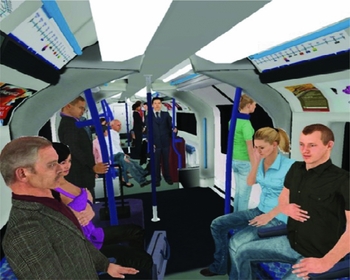
The environment used was the same as that created for Freeman, Evans et al. (Reference Freeman, Evans, Lister, Antley, Dunn and Slater2014). The same VR scenario was used in both confidence induction conditions, consisting of a 6-minute London underground tube journey with three stops at platforms. The virtual platform and tube train cars were created using Maya, and rendered using the XVR application platform. The software for this platform was run on a Windows XP PC, which had a Nvidia GTX580 3D graphics card to generate the images in the HMD dual displays. There were 21 other virtual characters, for which Rocket Box avatars were used. Their movements were modelled on real human movements recorded using Arena OptiTrack motion capture software, which were edited in MotionBuilder and applied to the avatar models using the hardware accelerated library for character animation (HALCA) (Spanlang, Reference Spanlang2009). This included breathing motions and a randomization of gaze direction. Several avatars were additionally programmed to look towards the participant when they were oriented towards them, but their expressions remained neutral across conditions. The audio used was pre-recorded background conversation, overlaid with the soundtrack of the tube journey (e.g. car doors opening and closing). An image of the VR situation is provided in Figure 1.
View inside the virtual tube train

Analysis
Data from this two-period crossover trial were analyzed using Stata13 (StataCorp, 2013). There were no missing data. Although these data could be analyzed through a repeated measures analysis of variance, a simpler but mathematical equivalent procedure is to look at a simple linear regression model to evaluate the effect of order of the self-confidence inductions on the change in the outcome variable from period one to period two (or, more accurately, the change score divided by half so that the resulting regression coefficient is interpreted as the effect of the experimental condition – i.e. self-confidence induction - on outcome). The logic and procedure for doing this, including the demonstration that the difference between the two groups defined by their treatment order is an estimate of twice the treatment effect (the rationale for dividing the change by 2, above) is explained by Armitage, Berry and Matthews. (Reference Armitage, Berry and Matthews2002, page 631). Significance test results for all the analyses are quoted as two-tailed probabilities. This procedure was first carried out on the VAS confidence ratings, in order to verify that the induction procedures had been effective, and then on the results from the Social Comparison Scale (SCS) and the State Social Paranoia Scale (SSPS).
Results
The self-confidence inductions
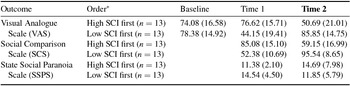
Summary statistics are provided in Table 1. It can be seen from the Table that compared to the baseline, the low self-confidence condition lowered the VAS scores considerably but the effect of the high self-confidence condition was much less marked. However, it is the contrast between the high and low self-confidence conditions that is of relevance here. Examination of the means at time 1 and time 2 for the VAS data presented in Table 1 indicates a clear difference between these two conditions. The effect of the low induction condition compared to the high induction condition was highly statistically-significant and was estimated to be −33.81 (SE 4.91; 95% CI −43.43 to −24.18; p < .001).
Results: summary statistics: mean (SD)

*SCI: Self-Confidence Induction
Paranoia in VR
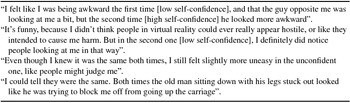
Table 1 illustrates a consistent effect of the low self-confidence induction on the mean paranoia scores (SSPS) – low self-confidence being associated with greater paranoia. The effect of the low induction condition compared to the high was estimated to be +3.00 (SE 1.30; 95% CI +0.45 to +5.55; p = .021). A list of spontaneous statements from participants with regards to paranoia is presented in Table 2.
Spontaneous participant comments concerning paranoid ideation

Social comparison in VR
The SCS scores were considerably lower in the low self-confidence condition than in the high self-confidence condition. The effect was highly statistically-significant and was estimated to be −34.53 (SE 2.88; 95% CI −40.18 to −28.89; p < .001).
Discussion
This study used virtual reality to examine the interpretation of a neutral social situation by individuals vulnerable to paranoid ideation i.e. an analogue population. It tested the causal role of self-esteem, by manipulating whether the person felt self-confident or unconfident before entering virtual reality. The findings were very clear: going into the environment with low self-confidence, relative to high self-confidence, led to more negative views of the self in relation to others and greater levels of paranoia. The results support the hypothesis in a cognitive model that paranoia builds upon negative views of the self (Freeman et al., Reference Freeman, Garety, Kuipers, Fowler and Bebbington2002; Freeman and Garety, Reference Freeman and Garety2014), and it is consistent with observational (e.g. Fowler et al., Reference Fowler, Hodgekins, Garety, Freeman, Kuipers and Dunn2012) and experimental study results (e.g. Freeman, Evans et al., Reference Freeman, Evans, Lister, Antley, Dunn and Slater2014; Lincoln et al., Reference Lincoln, Hohenhaus and Hartmann2013). Tests of self-esteem interventions in patients with clinical paranoia are warranted (Freeman, Pugh et al., Reference Freeman, Pugh, Dunn, Evans, Sheaves and Waite2014).
There are several limitations to the study. Although the use of a social situation has ecological validity, the effects of self-esteem were only tested during a short period of time. The sample size was small, although the effects of the manipulations were moderate to large. In a two-period crossover trial such as this, valid statistical inferences are also dependent on the assumption of no carry-over effects. The study was only carried out with one gender, so the applicability to females was not established. Further, the addition of a neutral condition would have aided in the interpretation of the results. Unlike the study of Freeman, Evans et al. (Reference Freeman, Evans, Lister, Antley, Dunn and Slater2014) we did not test social comparison scores as mediators of paranoia scores in VR; this is because in the current study self-esteem was directly manipulated and therefore this additional analysis was unnecessary. Changes in social comparison merely provided a further check for the self-confidence manipulations. Despite the limitations, the study clearly provides causal evidence for a direct role of negative views about the self in the occurrence of paranoid ideation.
Acknowledgements
The study was supported by a Medical Research Council (MRC) Senior Clinical Fellowship awarded to Daniel Freeman (G0902308). Mel Slater is supported by the ERC Advanced Grant TRAVERSE227985.



Comments
No Comments have been published for this article.