Introduction
The global economic downturn combined with the well-documented ageing of the population highlights the importance of European labour market policy focussing upon counteracting age discriminatory practices, reconciling home and work pressures (e.g. family care responsibilities and the work–life balance) and promotion of ‘intergenerational solidarity’ (see, for example, AGE, 2009; European Commission (EC) 2010a and 2010b). Whilst such recommendations are all important, they often have little direct and immediate impact at the level of the enterprise and in particular upon the quality of life of the individual worker. In addition, there is extensive research evidence indicating that poor health and illness is one of the major factors in shortening the working lives of individuals. This is often a direct outcome of poor quality of work and workplace design (see, for example, Phillipson and Smith, Reference Phillipson and Smith2005) and poor management practices. Additionally, extending working lives is now seen as important to the future success of the economy across the European Union (EU) (Dini, Reference Dini2009) and Governments have indicated their desire to raise the state pension age to 68 or higher (European Commission (EC), 2010a and 2010b). Most older people would consider, and many would like, to work longer than they do (Lissenburgh and Smeaton, Reference Lissenburgh and Smeaton2003; Smeaton et al., Reference Smeaton, Vegeris and Sahin-Dimen2009). The recent announcement from the UK Government that the mandatory retirement age of sixty-five (known as the default retirement age) will be abolished by October 2011 will assist with these desires. However, it is vitally important to both individuals and enterprises how such extensions to working life might be pursued, since a high proportion of older people say they would only consider this on a part-time or ‘flexible’ basis (Vickerstaff et al., Reference Vickerstaff, Loretto, Billings, Brown, Mitton, Parkin and White2008; Smeaton et al., Reference Smeaton, Vegeris and Sahin-Dimen2009). Yet importantly Vickerstaff et al. (Reference Vickerstaff, Loretto, Billings, Brown, Mitton, Parkin and White2008: 4) also suggest that:
the treatment they had received at the end of their working life was less than dignified. For some this was related to a dramatic event such as ill health, early retirement or redundancy, but for a significant number of others it was related to what they saw as worsening conditions at work and a reduction in job satisfaction.
In the UK and European context, the term ‘older workers’ currently refers to the workforce over fifty years of age. For the UK, the employment rate for men and women aged fifty to state pension age presently stands at around 70 per cent. Over the 1992 to 2009 period, the proportion in employment over state pension age has risen from 8 per cent to 12 per cent, but mainly working part time (ONS, 2009). ‘Older workers’ have spent, on average, a little over thirteen years in their current employment, longer than any younger age group. On the negative side, those aged fifty to state pension age (SPA) are more likely to have fewer qualifications than their younger counterparts, with 19 per cent having no formal qualifications. This cohort is also more likely to be long-term unemployed (36.5 per cent have been unemployed for more than a year) and 1.22 million individuals are claiming Incapacity Benefits, a key statistic in the context of this article (ONS, 2009).
At the time of writing, the current UK government's focus is on the ‘Pathways to Work’ programme, which seeks to assist those in receipt of Incapacity Benefits, and more recently Employment and Support Allowance (ESA), back into work, whilst at the same time attempting to redress previous governments’ mistakes in ‘pushing’ ‘older workers’ out of the workforce. Similar trends are noted across the European Union. Policy is thus concentrating upon excluded and discouraged workers, a high percentage of who are ‘older workers’. The framework of ‘push’, ‘pull’, ‘jump’, ‘stay’ and ‘stuck’ (Shultz et al., Reference Schultz, Morton and Weckerle1998; Jensen, Reference Jensen2005) is relevant here, as it allows an accessible mechanism for a structural analysis of the complexity of the transitions of this fifty-plus cohort from employment to ‘retirement’.
Using such an analytic framework, rather than being ‘pushed’ or ‘pulled’ from the workforce (Phillipson and Smith, Reference Phillipson and Smith2005), many of this cohort can be described as being ‘stuck’ (that is, they remain in a job they dislike because, for example, they have no pension or their pension has changed from a defined benefit to defined contribution arrangement), or choose to ‘stay’ (they remain in a job they may enjoy but do so for financial or other reasons, such as the intrinsic benefits of work (see, for example, Snartland and Øverbye, Reference Snartland and Øverbye2003; Smeaton et al., Reference Smeaton, Vegeris and Sahin-Dimen2009). Indeed, for the UK, employment rates for those over sixty-five show the greatest rate of growth over the past few years and these trends have continued despite the current economic recession (Dini, Reference Dini2009). Few are now able to ‘jump’ out of the labour market because they are often not financially secure enough to do so. Policy measures aimed at changing ‘early exit’ to ‘late exit’ – that is, extending working lives – must therefore be sensitive to the actual processes and flows out of the labour market and to the quality of the work undertaken in order to help retain staff, particularly ‘older workers’.
Although the ‘Pathways to Work’ programme and policy direction is a positive development in many ways, ‘older workers’ currently in the workforce are clearly ignored. It is these people that policy needs to enable to seek more enduring, better-quality working lives. The UK Age Regulations 2006 (OPSI, 2009), and to a lesser degree the Equality Act 2010, may have a hand in achieving these better working lives, but arguably only to a limited extent. A broader, more proactive and holistic policy is required. Such an approach is one that has the concept of Work Ability at its core and is implemented through age management techniques and practices.
This short article focuses upon UK practice and presents an approach that has been used across continental Europe for nearly thirty years. The central argument is that improving the quality of life of older adults is not simply and only about a better ‘work–life balance’ and other policy prescriptions, but the adoption of a holistic approach to worker well-being and health, broadly defined at the level of the enterprise. The article provides a short review of existing policy and describes yet distinguishes between employability and Work Ability. It then suggests that the Work Ability approach used for over thirty years in Finland (Ilmarinen, Reference Ilamrinen2010) be trialled in the UK and that the UK government provide fiscal incentives for UK enterprises to adopt and implement such preventative approaches within a broader age management structure.
Employability and Work Ability
Employability, as distinct to Work Ability, is an attempt to describe the ability of people to become employed and be able to sustain that employment or find new employment. It therefore involves reference to a person's skill set and formal (e.g. vocational and academic) and informal qualifications for a job. In brief, employability is about the access, retention and progression of people in paid work across their life course. Yet it is set within the dominant paradigm of a retirement discourse that arose during the twentieth century, where those over the State Pension Age are (culturally at least) expected to retire from employment. Indeed, those who do not are today considered ‘exceptional’ or heroic. The use of the term ‘employability’ came to prominence as a result of the previous European Employment Strategy, reformulated in 2000, and yet has been the dominant paradigm for employment policy in Europe since 1945. More recently, it was delivered through and became the central focus of the EQUAL Community Initiative. For example, EQUAL (rounds 1 and 2) in Great Britain operated in thematic fields defined in the context of the four pillars of this strategy. namely employability, entrepreneurship, adaptability and equal opportunities.
In addition to these themes, the programme supported a further theme of activities to help the social and vocational integration of asylum seekers. Through those themes, the strategy for EQUAL (and within an employability framework) aimed to:
• ensure that activities principally benefit those subject to the main forms of discrimination and inequality and that each thematic field would be fully accessible to all such groups;
• ensure that the promotion of equality between women and men was integral to the thematic fields in all four pillars as well as being targeted through specific actions in the fourth pillar;
• promote the ideal of improving the supply of and demand for quality jobs with a future;
• encourage the effective use of existing mechanisms (for example those that exist for social dialogue) to improve awareness of the factors leading to discrimination, inequality and exclusion in connection with the labour market.
This led to UK Government policy emphasising the development and accreditation of knowledge and vocational skills, rather than the ‘softer’ skills and attitudes, and on the demonstration of assets rather than their deployment, particularly for adults (e.g. the lack of provision of a careers education and guidance service for adults) and for (younger) individuals looking to enter the labour market (e.g. from education or unemployment) rather than to move within the market. Finally, the emphasis has been upon the individual and the supply side, rather than on employers and the demand side (see Reday-Mulvey, Reference Reday-Mulvey2005).
The literature further suggests that although, and fundamentally, employability is about ‘getting into’ and ‘staying in’ employment, it does make three assumptions for social and public policy in this area: that ‘key skills’, careers advice and an understanding about the world of work are embedded in the education system; that any individual has the ability to maintain employment and make ‘transitions’ between jobs and roles within the same organisation to meet new job requirements; and that individuals should possess the ability to obtain new employment if required and be independent in the labour market by being willing and able to manage their own employment transitions between and within organisations (EC, 1999). This may not always be the case, and clearly describes an ideal type (see Mcquaid and Lindsay, Reference McQuaid and Lindsay2005). The ‘Flexicurity’ approach now dominant within EU discussions (EC, 2007) attempts to address some of these difficulties, by encouraging ‘flexibility’ in the transitions between jobs, and can be considered as ‘an integrated strategy to enhance, at the same time, flexibility and security in the labour market’ (EC, 2007). Yet it still has employability and an economic rather than a social paradigm as its central core (see Burroni and Keune, Reference Burroni and Keune2011). It perpetuates the dominance of what Reday-Mulvey (Reference Reday-Mulvey2005) terms the traditional three-stage life-course paradigm of ‘education–work–retirement’.
In contrast, Work Ability (Ilmarinen, Reference Illmarinen2005; EC, 2006) seeks a proactive preventative and holistic approach to working lives: through better age management throughout people's working lives. Its primary aim is to improve the quality of their work, through encouraging better health in mind and body, linking and improving the working and home environment and ultimately the quality of life and productivity of the individual. It has been found in Finland, where it was first developed, that as a consequence of the widespread introduction of the approach, workers work better and more productively and feel able to extend their working lives and have better-quality ‘retirements’. They thus provide benefits to the economy, the enterprise, society and the individual (see Ilmarinen, Reference Illmarinen2005). This is because Work Ability considers the interplay between all the factors that enable a person to function well in a job. It aims to balance personal factors, such as physical and mental health, skills and motivation, with the job itself, how it is managed, what the working environment is like and what the role actually entails. The Work Ability concept aims to encourage employers to tailor work to individuals as they age – and also to improve those individuals’ health, skills or knowledge required for the job (see Ilmarinen and Tuomi, Reference Ilmarinen and Tuomi2004, and Ilmarinen, Reference Illmarinen2005 for a comprehensive discussion).
The key features of the Work Ability concept involve a simple instrument for measuring current Work Ability (the Work Ability index (WAI) (Tuomi et al., Reference Tuomi, Ilmarinen, Jahkola, Katajarinne and Tulkki1998)), and predicting future Work Ability. It aims to support the worker through holistic interventions to improve their Work Ability, and thus increase the productivity and retention of (older) workers later in life. Unlike some other approaches, it incorporates issues of work management and design, skills, attitudes and motivation as well as health and ergonomics. Additionally, in contrast to the traditional British medical model of occupational health, it adopts a social model of occupational health incorporating the development of more fruitful and purposive working conditions that extensive empirical evidence built up over thirty years has demonstrated can extend working lives (Ilmarinen, Reference Illmarinen2005).
The key tool is the WAI (Tuomi et al., Reference Tuomi, Ilmarinen, Jahkola, Katajarinne and Tulkki1998) which aims to scientifically measure:
How good is the worker at present, in the near future, and how able is he or she to do his work with respect to the work demands, health and mental resources. (Ilmarinen and Tuomi, Reference Ilmarinen and Tuomi2004: 2)
It does this through a relatively simple self-completion questionnaire, which examines areas such as physical health, mental well being, job coherence, stress levels and job satisfaction.
The WAI was validated on a range of different populations, including some large ones, over significant periods (up to eleven years). It has been shown to: accurately measure job satisfaction and depression; predict future levels of mental well-being and emotional exhaustion; predict active and meaningful life after retirement; and identify the types of work that cause problems for ‘older workers’. It has also been demonstrated that the WAI of an individual can be improved, or deterioration stopped, by specific interventions (Ilmarinen, Reference Illmarinen2005 and Reference Ilamrinen2010).
Since its publication in 1992, the WAI has been translated into 26 languages (Ilmarinen, Reference Ilamrinen2010). Four international symposia have been held to develop and discuss the ideas, the most recent being in 2010. In 1989, the promotion of Work Ability was incorporated into a national agreement between employers and trades unions in Finland and now 80 per cent of Finnish companies have made some use of the concepts. It has been used and piloted in several EU countries, notably The Netherlands and Germany as well as several other Scandinavian countries, and is currently being evaluated for use in Australia (Taylor et al., Reference Taylor, Mclaughlin, Oakman, Palermo, Parker, Worringham and Swan2010).
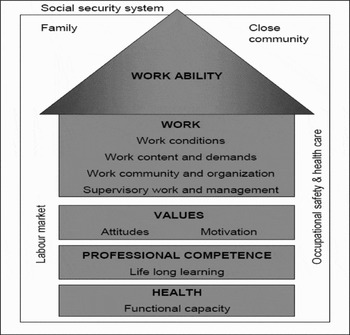
Work Ability has four principal dimensions:
1. work organisation and leadership (environment, content and demands, community and organisation, management and leadership);
2. values (attitudes and motivation);
3. competence (knowledge and skills), which is of increasing importance within UK debate; and
4. health (functional capacities, mental and physical);
and these can be graphically represented as the Work Ability house (see Figure 1).
The Work Ability house: a holistic approach to age management (Ilmarinen)

This attempts to demonstrate the importance of external non-work based factors in influencing working performance and productivity, such as the family, relatives and friends and society (see Ilmarinen and Tuomi, Reference Ilmarinen and Tuomi2004). Integral to the application of Work Ability is age management, which Ilmarinen (Reference Illmarinen2005: 120) defines as:
taking the employee's age and age related factors into account in daily work management, work planning and work organisation; thus everyone – regardless of age – can achieve personal and organisational targets healthily and safely.
Hence, although issues related to access, retention and progression are present, Work Ability as a model extends the scope to focus upon the individual and his/her work environment with equal benefits for the economy, for society and enterprises.
Work conducted by McNair and Flynn (Reference McNair and Flynn2005) demonstrated clearly that older people (in general) like work, and would like to work longer, but that they often feel prematurely forced out of the labour market by discrimination, poor job design and ill health (McNair and Flynn, Reference McNair and Flynn2005 and Reference McNair and Flynn2006). More recent research by Smeaton et al. (Reference Smeaton, Vegeris and Sahin-Dimen2009) supports these findings. Both studies suggest that people value work for a range of reasons, including intrinsic interest and sense of purpose, the ability to use skills and knowledge acquired over a lifetime, social status and self-respect and social engagement with colleagues and workmates, customers and partners. For a substantial number, continuing to work is also a financial necessity (that is those that could be characterised as ‘stuck’), although in surveys ‘older workers’ typically place money relatively low on the list of motivations. We know that poor health is the main reason for people leaving the labour market before fifty-five, and that stress and mental health conditions form a growing proportion of these causes (see Black, Reference Black2008). However, the people with the highest levels of health and well-being after sixty are those who are still in part-time work (Hirsch, Reference Hirsch2003). This confirms Waddell and Burton's findings about the relationship between work and health for the population as a whole (Waddell and Burton, Reference Waddell and Burton2006). However, as the literature also demonstrates, work can also lead to negative impacts (see, for example, Hill et al., Reference Hill, Lucy, Tyers and James2007; Griffiths, Reference Griffiths, Loretto, Vickerstaff and White2007), especially if it is poorly managed and organised.
Employment policy in the UK
The UK is among those countries with the highest employment rates in the world, and higher than many of the UK's trading partners including the United States, Japan, Germany, France and Italy. Indeed, UK Government papers prior to the recent recessionary period often used to cite the fact that there were 2.6 million more people in employment than in 1997. Yet it is clear that these trends are directly attributable to a combination of factors, including a period of economic growth, the flexibility of the European labour market and more recently a change in the attitude of over fifties and that of their employers towards their employment (Hotopp, Reference Hotopp2005; McNair et al., Reference McNair, Flynn and Dutton2007). Even so, 1.2 million people over fifty are claiming Incapacity Benefits, whilst vacancies remain unfilled, mainly in fields of technical and craft skills, people skills (including communication and customer care) and management and supervisory skills (House of Commons, 2005; Learning and Skills Council, 2004).
In outline, the rationale for current policy as set out in various governmental policy documents since 1997 can be summarised as ‘work first’, and is argued from a position where work is seen as a economic good, of benefit for the individual, state and society. Yet little attention is paid to either the individual or the quality of that work. It assumes the central argument of the employability framework outlined above. Indeed, the title of a UK government paper, published in July 2007, which introduced the Flexible New Deal implemented from October 2009, was, In Work, Better Off (Department for Work and Pensions, 2007).
It is argued here that, although the New Deal programme of the last Labour administration has increased the employment rate quite considerably over the past ten years, or at least has made a significant contribution, there still remain pockets – lone parents and those on incapacity benefits – where policy has had no effect. The Green Paper, In Work, Better Off suggested that ‘job pledges’ will be given by major employers, as part of Local Employment Partnerships, to disadvantaged people in the labour market – lone parents and those on incapacity benefits – to enable their return to paid employment. This new programme would encourage a stepped intensification of job search after three months, at six months and twelve months. Claimants, or as is the preferred term now, ‘customers’, would be referred for skills checks and appropriate training and engage with both public private and third sectors in delivering an outcome-focused service. This consolidates an employability paradigm within the policy framework and ignores the quality of work issues.
Further, among the more recent policy developments that has influenced (in theory at least) the employment situation of ‘older workers’, has been the Equal Employment (Age) Regulations 2006 (hereafter Age Regulations) (although it applies to the entire workforce) (OPSI, 2009). This is the result of a European Directive and came into force on 1 October 2006. This only covers age discrimination in employment and training across the whole age range, yet it is clear that where age-based discrimination (or ageism) is most keenly felt and where the Age Regulations may have greatest impact, is among those considered ‘older workers’. The regulations should, therefore, be viewed as a token, providing a legal framework to support the access, retention and progression of such older employees, that is their employability.
Research from McNair et al. (Reference McNair, Flynn and Dutton2007) seems to suggest that the evidence on recruitment practice is mixed. Most employers had taken steps to eliminate formal age discrimination, but this did not appear to have led to increased recruitment of older people. They suggest that the processes of indirect discrimination at the level of line managers may need further attention. The mismatch between those findings and previous research into discrimination suggests that the potential of ‘older workers’ is underdeveloped as a result of poor communication, or unwillingness by managers to have what McNair et al. (Reference McNair, Flynn and Dutton2007) term ‘difficult conversations’. Yet the same research suggests that while employers also report a willingness to provide training and to adapt working patterns to make jobs more attractive to ‘older workers’, nevertheless most employees fail to request such practices.
Conclusions
It is suggested here that extending the working lives of all adults can only be successfully achieved when they, and ‘older workers’ in particular, are valued, and that better ways of working are widely supported through the Finnish concept of Work Ability and stability to work groups is provided. This, in effect, means the promotion of better-quality working lives, the full expression of the ‘active ageing’ principle (Walker, Reference Walker2002) and applying it to working time as well as non-working time across the life course.
What is currently suggested as a remedy to current economic ills by governments, policy makers and informed commentators alike, is limited and piecemeal and may even worsen the employment situation of ‘older workers’. A more radical yet positive solution would be for further research on the applicability of a Work Ability approach within the UK context, prior to its full implementation. The concept of Work Ability has, indeed, been around for a long time. It seems, as argued in a European Commission document (EC, 2006), that it is not a lack of knowledge on how to measure and implement better work practices using a Work Ability method that is required, but first the ability to bridge what Pfeffer and Sutton (Reference Pfeffer and Sutton2000) describe as the ‘knowing–doing’ gap. This is where we stand at present, and why business, government and the research community must support longitudinal pilot investigations across the UK in a variety of businesses and sectors prior to a full implementation of Work Ability-based methods within enterprises. It is one thing to make a free choice to work longer, quite another to be forced to do so by (fear of) poverty or due to poor health. Many feel great concern when the debate goes in the direction of simply raising the age of entitlement to pensions (as has been the general trend across Europe) without contemplating the consequences, rather than enabling people to have better-quality working lives and be more productiveFootnote 1 up to the existing pension age.
In this regard, Finland is leading the world with the Work Ability approach, and it seems that this preventative and holistic policy to employment could be an effective way of reducing the number of ESA/Incapacity Benefit recipients (a continuing difficulty), and of finding ‘older workers’ proper meaningful and longer, as well as better quality work, across their working lives. Many Europeans are likely to work to a more advanced age in future than in the immediate past and out of choice. It is time, therefore, to focus upon the positive contributions that older people can and do make to society.
Acknowledgement
The author wishes to convey his thanks to the helpful comments of two anonymous referees.