Introduction
The bone objects which form the subject of this short paper are characterised by having a flat, spoon-shaped bowl, sometimes with a ‘moulding’ underneath, and at the other end a carved weapon — an axe, spear or sword. These finds are quite rare, with only ten examples known to the author, from five sites, all in the western part of Britain. Although dating evidence is limited, they appear to date to the late fourth and early fifth centuries. This paper brings together the current information regarding this small group of objects and discusses function, distribution and dating as well as their contribution to furthering our knowledge of material culture regionality in Roman Britain.
The finds
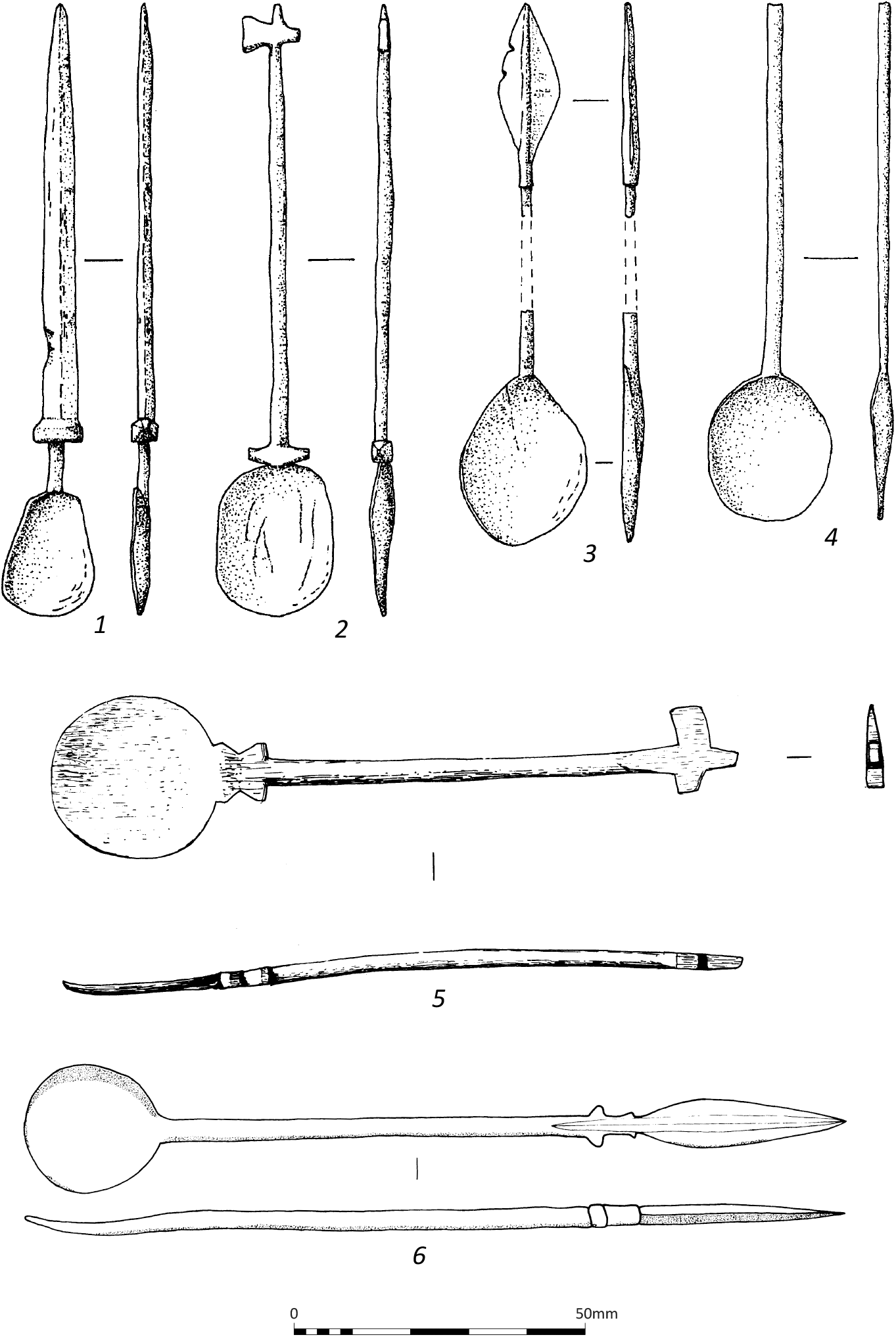
Frocester Court, Gloucestershire (three types; spear, sword, axe terminals). Three objects with ‘spoon-shaped’ ends were found in late fourth-/fifth-century contexts at Frocester Court (Fig. 1.1-1.3). They were found in a ‘crushed jar’ on the floor of room 2, most probably a kitchen in the Roman villa building, with a fourth found nearby. In total there were four spoons, but only three possessed weapon-shaped terminals — an axe, sword and spear, the fourth having no terminal surviving. Unfortunately, it is not clear which were found in the jar and which nearby, but it was clearly assumed during the excavation and in the published report that they formed a part of a set.Footnote 1 The interim report simply lists them as being found on the kitchen floor and of fourth-century date, with no mention of the jar.Footnote 2
(1–4) Frocester Court, Gloucestershire (reproduced courtesy of Mr Arthur Price); (5) Wroxeter (by permission of English Heritage); (6) Minchin Hole, Gower (reproduced by permission of Archaeologia Cambrensis). Scale 3/4.

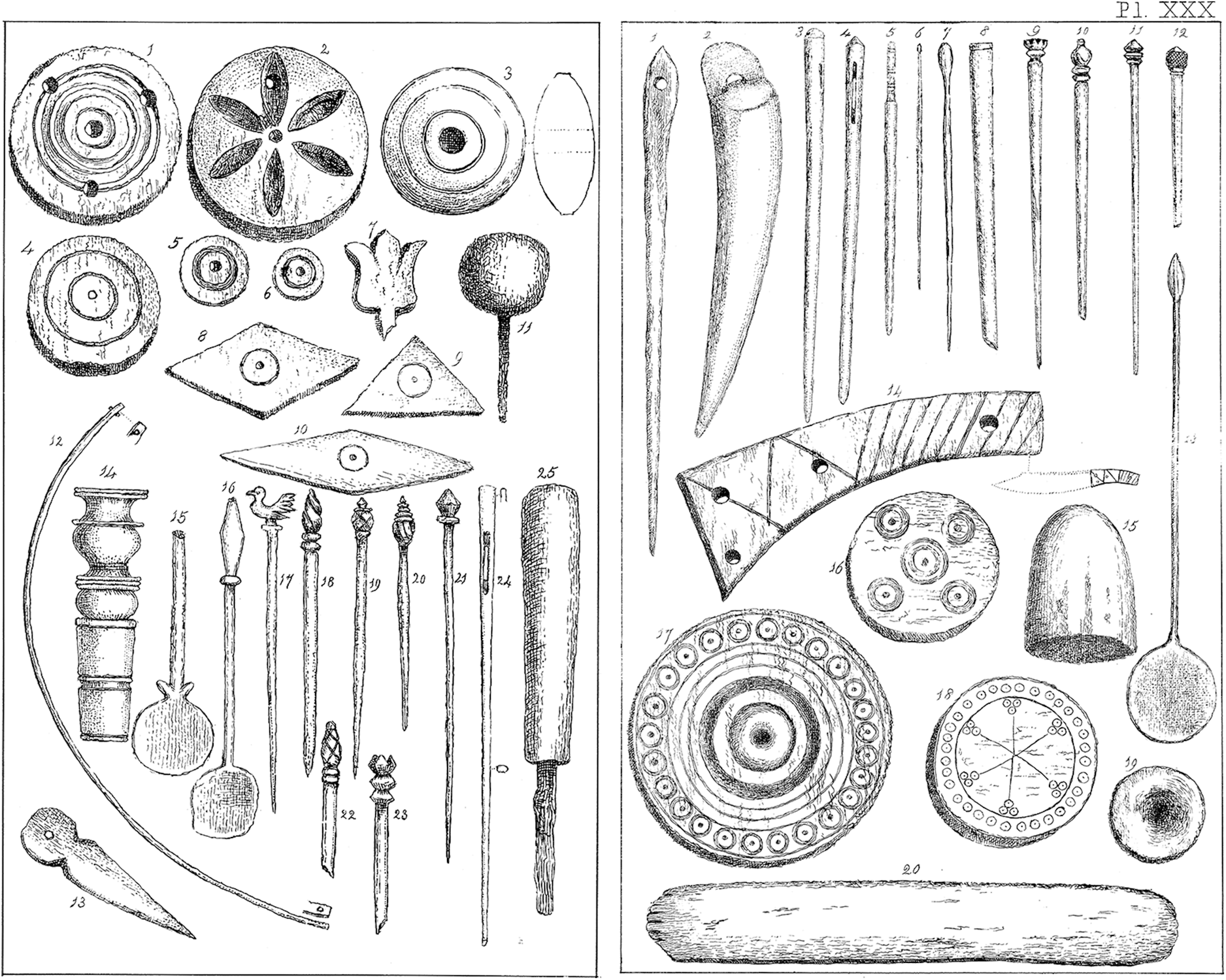
Lydney, Gloucestershire (two types, one with a spear terminal and the other likely to have also been a spear terminal). Although not published by WheelerFootnote 3 and not seen by the author when he examined the Lydney material as a part of his PhD research in 1979, Bathurst and KingFootnote 4 clearly show two objects from Lydney which fall into this group (Fig. 2). The first has an oval-shaped ‘bowl’ with a spear terminal, although the illustration does not show a central mid-rib to the spear as on the Frocester Court and Minchin Hole pieces (Fig. 1.3 and 1.6). The second has lost its terminal, but the flat oval-shaped bowl with simple ‘moulding’ where the bowl joins the stem is so close in form to the axe terminal examples from Frocester and Wroxeter (Fig. 1.2 and 1.5) that this may originally have possessed a similar axe terminal.
Lydney (left, after Bathurst and King Reference Bathurst and King1879) and Caerwent (right, after Lee Reference Lee1862).

Caerwent, Gwent (two examples both spear terminals). Lee, in his catalogue of material in the Museum of Antiquaries in Caerleon, illustrates (Fig. 2) a complete example of a spoon-shaped object with a spear terminal (with a central mid rib).Footnote 5 The text notes that the bowl was ‘very slightly hollowed, in fact it is nearly flat’. This example is now in the National Museum of Wales, where it is recorded as coming from the 1855 excavations of the ‘baths’ at Caerwent.Footnote 6
A second Caerwent example (not illustrated) is represented by the survival of the spear terminal only. This is also from early excavations in Caerwent but unfortunately has no further provenance information. The spear has a central mid-rib like the other Caerwent example and that from Frocester Court (Fig. 1.3 and 2), but unfortunately, although it clearly belongs with this group, there is no further contextual information.Footnote 7
Wroxeter, Shropshire (one example; axe terminal). A complete example with an axe terminal. The bowl is flat and oval; there is an ‘arrow-shaped’ end to the bowl where it meets the stem — both features similar to the Lydney example (Fig. 2). The shape of the axe is closely paralleled by the Frocester Court piece (Fig. 1.2), although this has a more oval-shaped ‘bowl’.
This object is from excavations in the Wroxeter Baths Basilica. From the same context comes an oval-shaped flat ‘bowl’. Both finds are from Phase Z dated in the report to the sixth/seventh centuries, although there were no objects which could be determined as post-Roman, the overwhelming quantity of finds being fourth century in date.Footnote 8
Minchin Hole, West Glamorgan (two examples, both spear terminals). A series of eight bone ‘spoons’ were found during excavation in 1946–59.Footnote 9 Two are of particular interest here as they have terminals in the shape of a spear.Footnote 10 These objects without weapon-shaped terminals might be linked as the shape of the ‘bowl’ is generally flat and two have collars just above the bowl element in the manner of the axe terminal examples from Frocester Court and Wroxeter. Six of these spoons were ‘exceptionally fine’, leading the authors to suggest that they were manufactured at the cave site, but for sale elsewhere. This suggestion stemmed from the view that there was bone working in the cave, although there is no direct evidence that this was so, and certainly not that the spoon-shaped objects with spear terminals were manufactured here.
Between Hartlepool and Seaton Carew (a possible spear terminal). There is one further find (not included in Fig. 3) we should consider. In publishing a group of objects found ‘between West Hartlepool and Seaton Carew’, Middleton describes and illustrates ‘a beautiful spoon-shaped implement of bone, the “bowl” of which is rudely perforated, flat and strengthened with a longitudinal ridge at the back’.Footnote 11 This has usually been interpreted as belonging to a group of ‘perforated spoons’,Footnote 12 but the ‘spine’ running down the back of the terminal looks very similar to that on the spear-shaped terminals now under discussion. There is a small hole which looks from the illustrations to be wear rather than drilled as on the perforated spoons but the ‘bowl’ end is lost. Unfortunately, the object can no longer be found in the collections of the Great North Museum, so it has not been possible to examine it to confirm its identification.Footnote 13
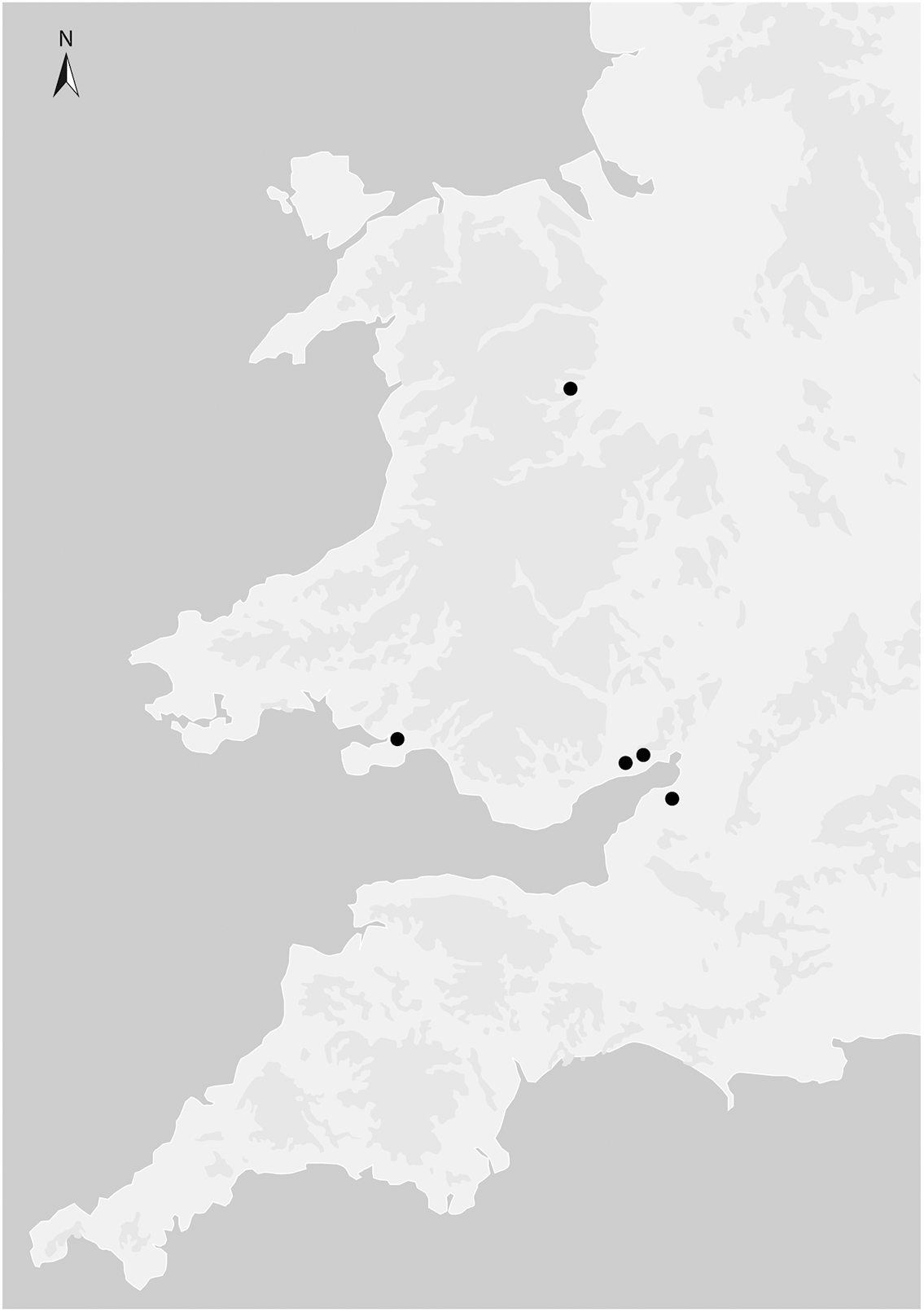
Distribution of spoon-shaped objects with weapon terminals (Mark Hoyle).

Discussion
The ten objects which form this group are linked by a combination of a flat-‘bowled’ spoon shape at one end and a decorative, weapon-shaped end at the other. The most common are those with a spear (seven), while those with axe (two) and sword (one) terminals are rarer. The collection of three objects as a ‘set’ at Frocester Court demonstrates that spear, axe and sword belong together, but it is also apparent from the finds at Frocester Court and Minchin Hole, that they can be associated with other ‘spoon-shaped’ objects which, although they have a flat ‘bowl’, do not have a weapon terminal. It may also be noted that there was a spoon-shaped object with a flat lyre-shaped bowl from Wroxeter in associated contexts to that with the axe terminal.Footnote 14 It is clear therefore that the pieces now under discussion only formed a part of the available ‘sets’ of objects. A spoon with a spear-shaped terminal in ‘white metal’ is known from Holt in an undated context,Footnote 15 although the shape of the bowl might suggest a second- or third-century date, and there is a possible spoon spear-shaped terminal in bronze from Nettleton in a fourth-century context.Footnote 16
Function
It is difficult to assign a function to these objects. Bathurst and King described them as ‘styles for writing upon wax tablets; the broad end served to smooth the wax, when required for another inscription’.Footnote 17 They are not spoons in the accepted sense as their bowls are flat, although they have been described as such.Footnote 18 They are neither models nor miniatures of either spoons or weapons. One of the Caerwent examples was found in a set of private baths;Footnote 19 there is no further information on the precise discovery locations of the other Caerwent piece and the example from Lydney. The Wroxeter object was found in a rubble spread, not in a feature which aids interpretation of function.Footnote 20 The Frocester Court objects were found on a kitchen floor, possibly in a jar, and one of the Minchin Hole finds was associated with a hearth. Until more finds can help in their interpretation, we may assume that their function was in some way domestic, perhaps as ‘spatulas’ rather than spoons.
Distribution
Their distribution is clearly ‘western’Footnote 21 (Fig. 3), all the more surprising perhaps in that (partly) due to soil conditions the numbers of bone and antler objects from Britain are far greater in the eastern side of the province. Eckardt has used bone objects extensively in her discussions of localised distributions and regional identities,Footnote 22 and to her list may now be added the object type under discussion here, although I am unaware of any other object type of similar date with such a distribution.Footnote 23 As the material is readily available and often requires less skill in manufacture, objects in bone (and antler) lend themselves to local production of unique types. While more examples would help confirm the distribution, these forms already add to the growing evidence of regionality in Roman Britain in the late Roman period.
Dating
In terms of chronology, only the examples from Frocester Court come from well-dated contexts — of the later fourth or early fifth century. The Wroxeter example should certainly be dated to the fourth century in terms of the associated finds, although its context is much later. In the discussion of the material from Minchin Hole the authors thought that the material dated from the late third–early fifth centuries.Footnote 24 While there is plentiful late Roman material from Caerwent and Lydney, there is also much earlier material as well, so the examples from these sites must remain effectively undated. On present evidence it seems likely that these objects may be dated to the later Roman period and perhaps the later fourth–early fifth centuries, although more evidence is clearly required to confirm this conclusion.
The weapon representations
Model representations of weapons occur throughout the Roman period. Kiernan’s comprehensive study of model object forms includes axes, spears and swords.Footnote 25 Green discusses their possible religious associations, concluding that ‘the precise function of models as votive objects and their symbolism is not at all obvious’.Footnote 26 However, elsewhere she notes that the symbol of an edged weapon or tool may have had a role in warding off evil as well as promoting the protection of the gods.Footnote 27 Crummy discusses the possible representation of swords on early Roman nail cleaners,Footnote 28 and model swords are a well-recorded earlier Roman type.Footnote 29 Sword and spear are known attributes of MarsFootnote 30 and the axe is associated with Jupiter Dolichenus.Footnote 31 The occurrence of examples of our spoon-shaped objects in domestic settings would seem to argue against (although not preclude) a primary ritual or votive interpretation, but there is no reason why we should not see these objects as both functional and with ritual associations.
While we must remember that the representations on our spoon-shaped object terminals are simple, the weapon types (the sword, spear and axe) may all be paralleled in late Roman weapon forms. The most common representation, the leaf-shaped spear, sometimes with a central mid-rib, is known from seven examples. The leaf-shaped spear is paralleled in earlier Roman spear types but are also common in fourth-century finds and representations.Footnote 32 While there are only two certain examples with axe-shaped terminals, one from Lydney is likely to represent a third on the basis of the ‘mouldings’ beneath the bowl. Representations of axes of this form are common in other object types in the later Roman period and similarly shaped axes are represented in bone and bronze hairpins.Footnote 33 The form of the axe clearly has military associations also as shown in a relief from Gamzigrad, Serbia,Footnote 34 and is similar to Kiernan’s Type 3 and 4 model axes which he notes have a strongly British distribution.Footnote 35 The sword is represented by a single example representing a long spatha. Footnote 36 While we may parallel individual representations, the relevance of the ‘set’ of sword, spear and axe is uncertain and does not seem to find parallels in other groups of objects.
Conclusion
The appearance of a small group of spoon-shaped objects with weapon terminals in western Britain in the fourth or early fifth centuries is a further example of regionality in Roman Britain. The examples found together at Frocester Court demonstrate that there was a ‘set’ of axe, spear and sword terminals. The finds from Frocester Court and Minchin Hole suggest a ‘kitchen’ function, perhaps as stirring spatulas. While more examples from secure contexts are required to confirm the dating, our objects are a representation of weapon forms which may may have a possible wider symbolic interpretation but which, first and foremost, may be regarded as functional, domestic artefacts.