Introduction
Radiotherapy is the treatment of choice in cases of localised non-small cell lung cancer (NSCLC) for which co-morbidities preclude surgery. After radical radiotherapy, local disease control and survival are limited.Reference Qiao, Tullgren and Lax1–Reference Janssen-Heijnen, Smulders and Lemmens3 Although increasing the dose may improve local control, this may also be limited by the radiation-induced normal tissue toxicity. Lungs are the main organs-at-risk structures (OAR), and any increase in dose may result in an increase of the V 20 (percentage volume of healthy lung receiving at least 20 Gy deduced from the volume of both lungs minus the internal target volume, ITV).Reference Qiao, Tullgren and Lax1
The potential advantage of stereotactic body radiotherapy (SBRT) in the treatment of small tumours is the increased accuracy of delivery of higher biological effective doses, through better immobilisation and more precise delivery of multiple radiation beams.Reference Brock, Bedford and Partridge4 SBRT has shown a promising progression in free survival rates without a significant increase in toxicity and no significant detrimental effect on lung function or quality of life in comparison with standard techniques.Reference Brock, Bedford and Partridge4 The major limitations of SBRT are its complexity, resulting from the multiple beams ranging from 2 to 20, the image guidance procedures and the delivery of a large number of monitor units. The latter may be more time-intensive per fraction than conventional fractionated radiation therapy.Reference Brock, Bedford and Partridge4 The longer treatment times mean that SBRT may be more affected by intra-fraction tumour motion, which increases with the duration of each treatment session. The long treatment times may not be well-tolerated by patients, as most lung cancer patients are either frail or elderly.Reference Brock, Bedford and Partridge4
Volumetric arc therapy (VMAT) is a novel form of intensity-modulated radiotherapy optimisation that allows a highly conformal treatment to be delivered in a single (or multiple) arc(s).Reference Palma, Vollans and James5 It utilises at least 35 beam segments, using either a constant dose rate or a variable dose rate VMAT during rotation.Reference Palma, Vollans and James5 VMAT offers an alternative to SBRT for NSCLC, and the potential advantage of VMAT is the reduced treatment times over SBRT.Reference Palma, Vollans and James5 VMAT allows the delivery of treatment with a continuously rotating gantry, simultaneous variation of dose rate, gantry speed and segment shape.
The aim of the study was to compare SBRT and three different VMAT plans for small peripheral NSCLC tumours. The dose parameters of dose conformity results and target dose constraints results were compared for these plans.
Methods and Materials
Patient selection
This is a retrospective study of five randomly selected early stage lung cancer patients. All the patients had peripheral lesions outside a 2-cm radius of the main airways and the proximal bronchial tree 1A-1B (TNM 7th edition), World Health Organisation performance status 0–2. For each patient, five plans were created: SBRT plan and four VMAT plans. Of the four generated plans for each patient (SBRT and three different VMAT plans), the differing variables for the VMAT plans included different collimator angles (0° and 15°), single arc and dual arc plans.
Target and OAR definition
The radiation oncologist outlined the ITV, which was the macroscopic disease visualised on the average four-dimensional (4D) dataset images. The ITV was expanded in all directions by a margin of 0·5 cm to form the planning target volume (PTV). All the datasets were planned to the PTV on the time-averaged dataset computed tomography (CT) images. The OARs delineated included the oesophagus, the proximal bronchial tree, the trachea and the heart. The planner delineated the lungs and the spinal cord (SC). All these OAR delineations were contoured as per national guidance produced by the ‘UK SBRT consortium based on the Radiation Therapy Oncology Group’ and ‘ROSEL’ protocols.Reference Coen, Johan and Frank6
Based on these recommendations, a planning organ-at-risk volume (PRV) was contoured for the SC by adding a 0·5-cm margin to evaluate the impact of organ motion. The SC and the oesophagus were contoured starting at least 10 cm above the PTV and to at least 10 cm below the inferior edge of the PTV. The heart was contoured as a single structure extending from the inferior aspect of the aortic arch to the apex of the heart inferiorly.
Treatment planning
All the plans used 6 MV photons, and the multi-leaf leaf collimators (MLCs) were conformed to the PTV with a 6-mm margin to allow for penumbra. The main objectives for each plan were that 95% of the PTV receives the prescription dose (60 Gy), 99% of the PTV volume had to receive >90% of the prescription dose and that the maximum dose to 1 cc of the PTV should be <140% (84 Gy) of the prescribed dose.
An enhanced collapsed cone algorithm, with full inhomogeneity correction based on individual pixel Hounsfield values and a 0·25-cm dose calculation grid, was used.Reference Bedford7 The dose–volume histogram (DVH) data for the PTV and OAR were used to determine the plan acceptability measured against the dose conformity requirements for the collapsed cone algorithm.Reference Bedford7 A VMAT plan was generated and optimised using ‘Autobeam’, following the same constraints as for the SBRT. The optimisation algorithm consisted of a fluence optimisation, followed by a classical segmentation and then direct aperture segmentation.Reference Richmond, Green, Peedell, Shakespeare and Walker8 The final apertures were approximately conformal, using simple modulation to achieve homogeneity of the PTV dose, with the maximum allowable aperture extent equal to the PTV. The final dose distribution was achieved by iterative adjustments of relative beam weights.
Target dose conformity
The target dose conformity constraints used as dosimetric acceptance criteria for all the plans were the ratio of volume of tissue receiving the prescription dose V 100% to the volume of the constructed PTV itself (V PTV: V 100%/V PTV). The conformity index was given as the ratio of volume of tissue receiving the prescription dose V 100% to the volume of the constructed PTV itself, V PTV (V 100%/V PTV). The closer to 1 the conformity index was, the more conformal the plan, and if <1 the less conformal it was.
Dose volume constraints
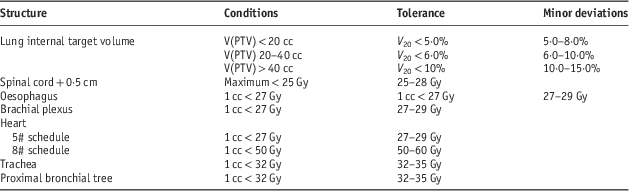
Normal tissue goals (lungs, SC, oesophagus, brachial plexus, heart and the proximal bronchial tree) were based on the departmental dose tolerances, as shown in Table 1. The percentage volume of the healthy lung receiving 15, 10 and 5 Gy was also set to calculate the volume of the lung being radiated. This emanated from the assumption that VMAT was spreading dose around, as the whole arc was spreading the dose around the patient. The mean lung dose (MLD) was also calculated and used for predicting lung toxicity. The oesophageal surface area receiving at least 55 Gy and the oesophageal volume receiving at least 60 Gy were the most statistically significant predictive factors for early oesophagitis in a study of lung carcinoma radiotherapy.Reference Bradley, Deasy, Bentzen and El-Naqa9 The dose tolerance to 1 cc of the oesophagus was <27 Gy with a minor deviation of between 27 and 28·5 Gy. The tolerance for 1 cc of the heart was set at <27 Gy, with an acceptable minor deviation of between 27 and 29 Gy. For tumours situated in the apex of the heart, the dose tolerance to 1 cc of the brachial plexus was set <27 Gy. The trachea and the bronchial tree were the other OAR that were recorded and compared for this study.
Organs-at-risk dose constraints used in plan optimisations
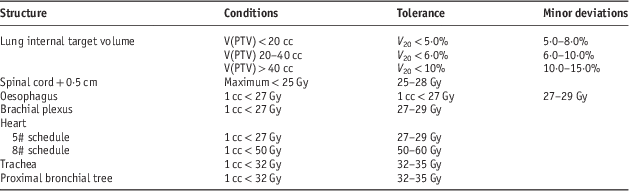
Abbreviation: PTV, planning target volume.
Statistical analysis
The one-way analysis of variance was used to determine whether there are any significant differences in the target conformity indices between SBRT, VMAT 0°, VMAT 15° and dual arc plans. The statistical data included the mean and standard deviations derived using three different post-hoc tests: the least significant difference (LSD) test, Bonferroni post-hoc analysis and Dunnet analysis.10 The significance of the difference between the target conformity indices was indicated by a p-value. The differences were considered significant when p<0·05.
Results
Target dose constraints
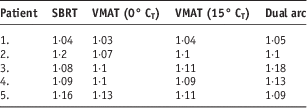
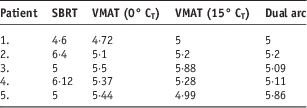
Table 2 shows the volume of PTV receiving 100% of dose for patient 1–5 for the SBRT and the other three different VMAT plans, as well as the dose conformity indices for the different plans. Table 3 shows the volume of tissue receiving 50% of the dose, and this is a representation of the gradient index. The value of the gradient index was greater than unity in all patients. A value that is closer to unity represents a faster dose fall-off in normal tissue and may imply lower dose to the OARs.
Dose conformity indices for the SBRT and the VMAT plans computed based on 100% conformity, 100% body volume and 100% PTV
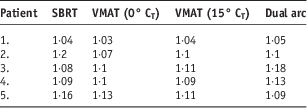
Abbreviations: SBRT, stereotactic body radiation therapy; VMAT, volumetric modulated arch therapy; CT, collimator twist; PTV, planning target volume.
Dose conformity indices for the SBRT and the VMAT plans computed based on 50% conformity, 50% body volume and 50% PTV
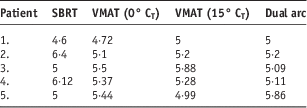
Abbreviations: SBRT, stereotactic body radiation therapy; VMAT, volumetric modulated arch therapy; CT, collimator twist; PTV, planning target volume.
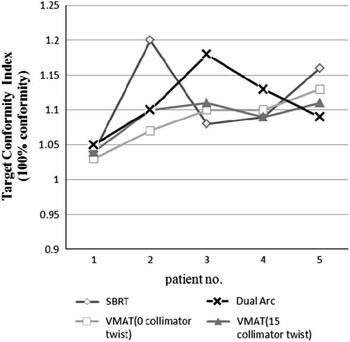
As shown in Figure 1, VMAT0° and VMAT15° plans had better conformity. The VMAT15° plans never drifted further away from the perfect value than the other plans. All the plans for patient no. 1 were close to the perfect value, whereas the SBRT plan for patient no. 2 drifted the furthest, followed by the dual arc plan for patient no. 3. Overall, the graphical data show that the VMAT15° had an average closer to the near perfect plan.
Conformity indices for the stereotactic body radiotherapy (SBRT) and the volumetric modulated arch therapy (VMAT) plans.

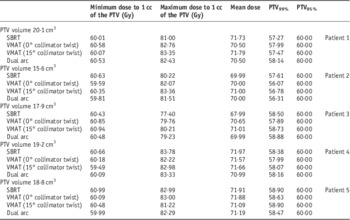
Table 4 shows the DVH indices for patient 1–5. The table shows the minimum doses delivered to 1 cc for each plan for every patient. This table also showcases the dose to 99 and 95% of the target. As per the departmental protocol, 95% of the target was expected to receive the prescription dose, a parameter that all the plans for the patients met. The average dose for the four plans for patient no. 1 was 60·3 Gy. It also shows the maximum dose to 1 cc of the target volume for patient no. 1. The mean value of the maximum dose for the plans for patient no. 1 was 82·39 Gy. VMAT plans had higher doses than SBRT plans for all the patients. The mean dose for the target volume for all the patients was also noted for their different plans.
The dose–volume histogram indices showing the PTV doses for each computed SBRT and VMAT plan

Abbreviations: SBRT, stereotactic body radiation therapy; VMAT, volumetric modulated arch therapy; PTV, planning target volume.
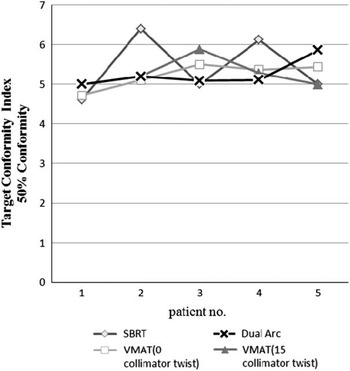
Figure 2 shows the gradient index for all the plans for the five patients, as shown in Table 3. Most of the dual arc plans and all the VMAT15° plans were closer to a unit than most plans, which meant a faster dose fall-off for these plans. The difference in the plans for the five different patients was marginal, as can be seen in Figures 1 and 2.
Conformity indices for the stereotactic body radiotherapy (SBRT) and the volumetric modulated arch therapy (VMAT) plans.

Two of plans had the PTV close to the chest wall and the other three were in the lungs further from the chest wall. The mean PTV volume for all the plans (SBRT and VMAT) was 18·3 cm3, with a range from 15·6 to 20·1 cm3. As shown in Table 4, the maximum dose tolerance to 1 cc of all the plans was within 140% (84 Gy) of the prescribed dose, and 95% of the PTV of all the plans received 100% of the prescribed dose (60 Gy). In all the plans, 99% of the PTV received a dose >90% of the prescribed dose, and the mean dose of all the plans ranged from 67 to 72 Gy.
PTV dose conformity
Table 2 shows that there was not much difference in the dose conformity for the SBRT and the VMAT plans. The values for the conformity index ranged from 1·03 to 1·2. The volume of tissue receiving 50% of the prescription dose, V50%, was used as a dosimetric measure of the dose fall-off outside the target volume (Table 3). When expressed as a ratio to the volume of the PTV, it ranged from 4·6 to 6·12. This meant that the dose fall-off from the PTV varied for both plans, but there was no significant difference between the SBRT and the VMAT plans. The statistical outcome of the target conformity values shows that the p-values for all the plans were close to unity, with VMAT 15° and VMAT 0° being the closest. With the Bonferroni post-hoc analysis, the p-value was unity for all plan comparisons. The LSD test had lower p-values. For instance, in the SBRT comparison with VMAT 0° and VMAT 15°, the p-values were 0·360 and 0·431, respectively.
Organ-at-risk doses
The lung V 20 is defined as the percentage volume of both lungs minus the ITV receiving at least 20 Gy (Table 1). In this study, we used the ITV as defined on the free breathing localisation CT scan to determine V 20. The V 20 had a mean value of 5·9% for a total of five patients. The patient with the smallest tumour had a V 20 value of 7·0%, which represented a minor protocol deviation. The percentage volume of the lung receiving 15 Gy (V 15), the percentage volume of the lung receiving 10 Gy (V 10) and volume receiving 5 Gy (V 5) were all calculated. The MLD ranged from 2·6 to 6·4 Gy, with a mean value of 4·6 Gy. This dosimetric parameter was calculated from the dose volume histogram statistics for the combined left and right lung volumes. The tolerance for the SC and SC PRV were considered. The SC PRV had a maximum tolerance of <25 Gy. The average dose to the SC +0·5-cm margin was 6·885 Gy, and on average 1 cc of the SC +0·5 cm received 3 Gy. The mean dose to 1 cc of the oesophagus for the five patients was 9·665 Gy. The doses to 1 cc of the brachial plexus, 1 cc of the heart, 1 cc of the trachea and 1 cc of the bronchial tree were also recorded.
Discussion
This study showed that both SBRT and VMAT techniques achieved high dose conformity treatment plans. Previously published studies regarding SBRT report promising progression-free survival rates with less significant increase in toxicity compared with standard techniques.Reference Brock, Bedford and Partridge4 This could be explained by the fact that in SBRT plans the tumour dose is increased significantly while maintaining high dose conformity as indicated in this study. A reviewed report approximated a 2-year actual survival of 89%, a 2-year local progression-free survival of 65% and incidence of grade ≥2 pneumonitis of 6·5%.Reference Brock, Bedford and Partridge4 This compares favourably with the reported 2-year survival of 53%, incidence of grade 2 late radiation pneumonitis of 1·9–18% and grade ≥3 pneumonitis of 6% for conventional radiotherapy for stage I disease.Reference Brock, Bedford and Partridge4
The DVH values for SBRT and VMAT plans showed no significant difference in the percentage volume of the healthy lung receiving 20 Gy and the MLD. Therefore, this study did not pursue the idea of comparing the doses received by the OARs. The amount of dose deposited on healthy tissue could also be calculated from the rapid dose fall-off provided by SBRT and VMAT. The conformity (50%): a volume (body 50%)/volume PTV (Table 3) showed that these different plans provided a significant dose fall-off from the target, which meant a reduction in V 20 and the MLDs. The results from this study about the rapid fall-off of dose from the target allayed all the concerns that had risen at the beginning of this study about VMAT increasing the chances of radiation pneumonitis, because it spread the dose around the patient in both the lungs.Reference Bertelsen, Hansen and Brink11 Toxicity is not expected to be a hindrance to using VMAT and will profit from the shorter delivery time of VMAT compared with SBRT.Reference Bertelsen, Hansen and Brink11
In the SBRT plans, it was recommended that wherever possible no entrance beam would pass through the SC and the same recommendation was used for VMAT, no arcs were allowed to pass through the SC. This allowed the dose to this structure to be minimised in case of any future treatments for the patient. In the SBRT plans, this was carried out by just deleting the beams that passed through the structure, and in the VMAT plan it was carried out by just selecting the arc angles that avoided the structure. In the SBRT plans, it was also important to avoid the direction of the beams from being directly opposed, as this would have compromised on the dose conformity.
As the intended dose to the PTV volume was 60 Gy, increasing the minimum DVH dose constraint to the PTV was a good way to help achieve better coverage. The percentage volume can also be lowered if coverage is achieved easily, but the OAR doses are being compromised. If the tumour volume is very small, the relative size of the MLCs may reduce the ability to conform closely to the tumour. This can lead to a more baggy 100% isodose line, which would be unavoidable. After optimisation of the SBRT plans, each of the segments was checked for shape irregularity. All the segments were expected to conform to the shape of the PTV with minimum modulation. If any of the segments had individual MLCs protruding towards the isocentre, this would have been caused by the maximum dose objectivity. The PTV maximum objective would have to be reduced or remove the segment and re-optimise the plan in order to improve this. In the VMAT plans, the jaws and the MLCs could not be adjusted after the plan had been optimised; therefore, for this reason, the only way of adjusting the dose coverage or the tolerances to the OAR was to adjust the objective values and re-optimise the VMAT plans. This contributed to a considerably increased planning time. Introducing a 15° collimator twist helped to counter for this problem by removing the 95% (57 Gy) isodose on the slice just after the PTV in some plans. The 15° VMAT plan had better coverage than the 0° plan, especially in cases where the PTV was embedded within the lung. This is because introducing a 15° collimator twist angle removed the extra 57 Gy isodose on the slice just after the PTV margin. In some of the plans that had the PTV attached to the chest wall, the 15° collimator twist did not manage to get rid of the extra 95% outside the PTV.
When using the VMAT technique, the single arc VMAT managed to achieve the required target coverage and homogeneity in all cases, managing to keep the OAR dose tolerances. Adding a second arc did not improve plan quality considerably and at times led to similar results to the single arc. Target goal doses were achieved and OAR tolerance doses were respected in all cases. This meant that there was no need to use dual arc VMAT, which instead would have increased the treatment time and probably increased the skin doses. There was no real benefit of using dual-arc VMAT over single-arc VMAT.
This study was based on the use of 4D-CT lung scans. Therefore, the expansions used for the ITV to CTV and then to PTV margins were small. The use of these scans resulted in lesser expansion margins, which in the end meant fewer doses to the PTV+2-cm margin, and this reduced dose to the surrounding healthy tissue. Several studies have shown that using 4D CT for treatment planning results in a smaller PTV for most tumours than fast CT with a standard motion margin applied.Reference Francis, Purdie and Dawson12 Treating in breath-hold or with gating, previously constrained by the length of every treatment session, can now be tried with the use of VMAT.Reference Ping-Fang, Shih-Min and Shen-Hao13
Although the isodose coverage between VMAT and SBRT is similar, VMAT can be delivered in a shorter time even without taking into account the time taken for setup in the protracted treatment.Reference Matuszak, Yan, Grills and Martinez14 The small dosimetric differences between the SBRT and VMAT plans are unlikely to be clinically relevant. Shorter treatment sessions make for a more comfortable experience for the patient with reduced risk of changes in patient positions and intra-fraction tumour and organ position variation and allow for greater departmental efficiency.Reference Matuszak, Yan, Grills and Martinez14 Some studies showed that volumetric modulated arc therapy reduced the treatment time of SBRT plans by 37% and improved isodose conformity.Reference Matuszak, Yan, Grills and Martinez14 Conformal and VMAT techniques for lung SBRT had similar dosimetric quality, but VMAT had improved target coverage and took 59% less time to deliver, although monitor units were increased by 5%.Reference Matuszak, Yan, Grills and Martinez14
The main challenge with VMAT is that the dosimetric and calculation time is currently greater than that for the SBRT, as the former involves longer optimisation times on Pinnacle treatment planning system. The dosimetric time should, however, decrease when this is an integrated process within Pinnacle. The other disadvantage of VMAT is the inability to adjust the jaws and MLCs after optimisations, which means that the plan has to be re-optimised all the time and adjustments have to be made. This also contributes to the increased planning time for VMAT plans.
Limitations
The major limitation encountered in the study was that there were not many SBRT patients, and thus this study had a small population of patients.
Conclusion
SBRT and VMAT are radiotherapy approaches that increase doses to small tumour targets without increasing doses to the OAR. Although VMAT offers an alternative to SBRT for NSCLC and the potential advantage of VMAT is the reduced treatment times over SBRT, the statistical results show that there was no significant difference between the SBRT and VMAT optimised plans in terms of dose conformity and organ-at-risk sparing.
Acknowledgements
The authors thank Robert Appleyard from Sheffield Hallam University and the treatment planning team at the Christie Hospital for their support during this project.
Financial Support
This research received no grant from any funding agency, commercial or not-for-profit sectors.
Conflicts of Interest
The authors declare no conflicts of interest.