


Introduction
Costa and McCrae (Reference Costa and McCrae1987, p. 301) define neuroticism as ‘a broad dimension of individual differences in the tendency to experience negative, distressing emotions and to possess associated behavioural and cognitive traits’. Consistent with this delineation, neuroticism encompasses an array of negative traits (anger, hostility, sadness, irritability, vulnerability and self-consciousness) (Costa and McCrae, Reference Costa and McCrae1992). Concomitantly, research has established links between neuroticism, exaggerated negative and distressing emotionality, and the inclination to experience adverse life events (Magnus et al., Reference Magnus, Diener, Fujita and Pavot1993).
From an information processing perspective, high neuroticism correlates with the perceived inability to manage demanding situations (Clark and Watson, Reference Clark, Watson, John and Robins2008) and sensitivity to environmental threat (Barlow et al., Reference Barlow, Ellard, Sauer-Zavala, Bullis and Carl2014). Indeed, several preceding studies indicate that neuroticism influences perception of life events (Ozer and Benet-Martínez, Reference Ozer and Benet-Martínez2006), and can have incapacitating consequences on thinking (Suls and Martin, Reference Suls and Martin2005). In some cases this produces a ‘neurotic cascade’, where minor habitual problems become magnified (Hecht, Reference Hecht2013). Neurotic cascade refers to the notion that high neuroticism inclines individuals towards appraisal of events as harmful or threatening, and that ensuing negative affect carries over to contiguous experiences or thoughts, regardless of their valence (Ryckman and Lambert, Reference Ryckman and Lambert2015). In support of this supposition, Suls and Martin (Reference Suls and Martin2005) found that high (vs low) neurotic individuals reported more daily problems, reacted with more severe emotions, experienced more residual emotion arising from previous events, and exhibited stronger reactions to recurring problems.
Over time, neurotic temperament can result in the accumulation of negative and damaging cognitions (i.e. thoughts, associations and memories), which can adversely affect somatic health (Neeleman et al., Reference Neeleman, Sytem and Wadsworth2002). Theorists have explained the relationship between neuroticism and somatic complaints using a range of models (Neeleman et al., Reference Neeleman, Bijl and Ormel2004). The symptom perception hypothesis (Costa and McCrae, Reference Costa and McCrae1987; Watson and Pennebaker, Reference Watson and Pennebaker1989) contends that high neuroticism increases perception of pain levels, which results in over-reporting of physical grievances (Howren and Suls, Reference Howren and Suls2011). This occurs because neurotic individuals possess an excessively sensitive behavioural inhibition system (BIS) (Pennebaker, Reference Pennebaker1982).
The BIS regulates negative affect and avoidance behaviour in response to threats or punishment (Steimer, Reference Steimer2002). Hence, neuroticism is associated with heightened perception of stimuli as threatening (Gray, Reference Gray1982). Accordingly, when neurotic individuals feel physical pains or aches, increased apprehension places them in a mental state that intensifies their current physical grievance. Within a conceptual analysis, Cioffi (Reference Cioffi1991) postulated that this results in incorrect appraisal of concurrent bodily sensations arising from neuroticism as symptoms of disease or illness. Consistent with this perspective, Cohen et al. (Reference Cohen, Doyle, Skoner, Fireman, Gwaltney and Newsom1995) reported that individuals with higher (vs lower) levels of neuroticism reported increased common cold symptoms.
This account is not universally accepted and alternative models exist. Notably, the disability and psychosomatic hypotheses (Watson and Pennebaker, Reference Watson and Pennebaker1989). The disability hypothesis proposes that accumulated health problems lead to personality changes, including the development of higher trait negative affect. Hence, neuroticism is a by-product, rather than a cause of poor physical health. Instead, the psychosomatic hypothesis proposes that neurotic individuals share negative personality traits that render them vulnerable to health issues (e.g. migraines and neck pain) (Rosmalen et al., Reference Rosmalen, Neeleman, Gans and de Jonge2007). This perspective advances that neuroticism is associated with susceptibility to somatic complaints (Claridge and Davis, Reference Claridge and Davis2001). Indeed, Johnson (Reference Johnson2003) found that neurotic individuals reported somatic complaints associated with prolonged tense mood state (i.e. increased migraines, higher blood pressure and more instances of neck pains).
A prominent feature of neuroticism is the occurrence of recurrent, negative thoughts. These are also associated with anxiety and depressive disorders (Muris et al., Reference Muris, Roelofs, Rassin, Franken and Mayer2005). Indeed, neuroticism correlates strongly with depressive and anxiety symptoms (Jylhä and Isometsä, Reference Jylhä and Isometsä2006). Within anxiety, unproductive repetitive cognitions manifest as worry, specifically the expectation that future events will result in adverse outcomes (Borkovec et al., Reference Borkovec, Robinson, Pruzinsky and DePree1983). In contrast, in depression repetitive negative thoughts manifest as rumination, which denotes the tendency to focus on the nature, cause and consequences of depressive symptoms (Nolen-Hoeksema, Reference Nolen-Hoeksema, Heckhausen and Dweck1998). These conceptualizations indicate that worry and rumination are repetitive cognitive processes closely aligned to depressive and anxiety symptomology (Watkins, Reference Watkins2008). Correspondingly, research reports that worry and rumination relate strongly to a neurotic disposition (Lam et al., Reference Lam, Smith, Checkley, Rijsdijk and Sham2003).
In relation to the present study, Muris et al. (Reference Muris, Roelofs, Rassin, Franken and Mayer2005) examined relationships between neuroticism, rumination, worry, anxiety and depression. Following correlational analysis, Muris et al. (Reference Muris, Roelofs, Rassin, Franken and Mayer2005) observed that neuroticism, rumination and worry correlated. These factors also related to anxiety and depression. Pertinently, worry and rumination mediated the relationship between neuroticism and depression and anxiety. Specifically, neuroticism correlated with worry and rumination, which in turn were associated with anxiety and depression. It is important to note that although rumination and worry positively correlated, the relationship between the two constructs was only in the moderate to low range; the variables shared only approximately 10% variance. Moreover, previous factor analytical studies have found that worry and rumination items load on separate dimensions (Fresco et al., Reference Fresco, Frankel, Mennin, Turk and Heimberg2002; Muris et al., Reference Muris, Roelofs, Meesters and Boomsma2004; Hoyer et al., Reference Hoyer, Gloster and Herzberg2009). Subsequent work supports this notion. Particularly, Hoyer et al. (Reference Hoyer, Gloster and Herzberg2009) found that worry was more predictive of anxiety, whereas rumination was a greater predictor of depression.
Generally, worry links to anxiety, especially generalized anxiety disorder, whereas rumination is associated with depression (Nolen-Hoeksema, Reference Nolen-Hoeksema2000). The reason why worry and rumination differ in this way is due to worry consisting of a focus on potential negative future outcomes (Borkovec et al., Reference Borkovec, Ray and Stober1998), whereas rumination incorporates a focus on the past and/or present, and on negative symptoms (Segerstrom et al., Reference Segerstrom, Tsao, Alden and Craske2000).
Research has linked rumination and worry with somatic complaints. Rumination relates to both perceived impairment in somatic health and genuine somatic distress. For example, rumination correlated with self-reported somatic complaints in Dutch and British children (Miers et al., Reference Miers, Rieffe, Terwogt, Cowan and Linden2007) and health anxiety among US college students (Marcus et al., Reference Marcus, Hughes and Arnau2008). Additionally, Zoccola (Reference Zoccola2010) established associations between rumination and cortisol response, and Hogan and Linden (Reference Hogan and Linden2004) found rumination negatively impacted blood pressure levels (resting and ambulatory). Worry is associated with various somatic complaints, including pain (Borkovec, Reference Borkovec, Davey and Tallis1994). Brosschot and van der Doef (Reference Brosschot and van der Doef2006) found worry to be associated prospectively with general somatic complaints (pain, dizziness, headache, etc.).
Building on previous work, the current study examined whether worry and rumination mediated the relationship between neuroticism and somatic complaints. Identification of the mechanisms that play a prominent role in the materialization and/or the maintenance of this relationship has important clinical and health implications. Particularly, individuals with multiple somatic symptoms are an increasing healthcare problem, and currently represent approximately half of all primary care visits (Janca et al., Reference Janca, Isaac and Ventouras2006).
In addition, somatic symptoms are a costly burden to healthcare systems in general, correlating positively with disability, healthcare use and sick leave (De Gucht and Maes, Reference De Gucht and Maes2006). Primary care patients typically present with somatic complaints. In comparison with patients reporting minimal to no symptoms, individuals with greater levels of somatic symptoms use more inpatient and outpatient medical care and cost twice as much annually (Barsky et al., Reference Barsky, Orav and Bates2005). Thus, it is important to increase cognisance of the factors that influence the tendency to report somatic symptoms. This will help to reduce false symptoms and increase awareness around the detection and treatment of genuine symptoms.
Furthermore, a lack of research has examined links between worry and general somatic complaints (Brosschot and van der Doef, Reference Brosschot and van der Doef2006), and assessed rumination and worry as potential mediators between neuroticism and somatic complaints. An assessment of indirect effects in this relationship is important for healthcare implications because worry and rumination represent cognitive processes that are to an extent malleable (Danielsson et al., Reference Danielsson, Harvey, MacDonald, Jansson-Fröjmark and Linton2013; Jacobs et al., Reference Jacobs, Watkins, Peters, Feldhaus, Barba, Carbray and Langenecker2016). If found to mediate, these processes provide a modifiable focus to help lessen the burden on primary healthcare of individuals presenting with multiple somatic complaints.
Method
Participants
A convenience sample of 170 participants took part in the present study (64 males, 106 females). Sixty (35%) were undergraduate students. Mean age was 29.60 years (SD = 13.80), with an age range of 18–72 years. Participant recruitment was via emails to university students/staff and local stakeholders (businesses, leisure and vocational/sports classes). The only exclusion criterion was age. Involvement discontinued if potential participants were younger than 18 years of age.
Measures
The neuroticism subscale of the Eysenck Personality Questionnaire Revised-Short Form assesses neuroticism (Eysenck et al., Reference Eysenck, Eysenck and Barrett1985). It consists of 12 dichotomous questions with a binary response, ‘yes’ or ‘no’. Example items include: ‘does your mood often go up and down?’ (item 1), and ‘are you an irritable person?’ (item 3). Level of neuroticism and emotional instability increase as a function of score. The subscale possesses satisfactory internal consistency (α = .77; Tiwari et al., Reference Tiwari, Verma, Singh and Tuli2009). In this study internal reliability was good (α = .80).
The Penn State Worry Questionnaire (PSWQ; Meyer et al., Reference Meyer, Miller, Metzger and Borkovec1990) measures trait-like worry, operationalized as the inclination to engage in extreme, generalized and unmanageable worry. It consists of 16 items with an accompanying 5-point scale from 1 (not at all like me) to 5 (very much like me). Example items include: ‘my worries overwhelm me’ (item 2), and ‘when I am under pressure I worry a lot’ (item 6). The PSWQ possesses good reported internal reliability (α = .93; Meyer et al., Reference Meyer, Miller, Metzger and Borkovec1990). Internal reliability in the present study was excellent (α = .91).
The Ruminative Response Scale (RRS; Treynor et al., Reference Treynor, Gonzales and Nolen-Hoeksema2003) assesses trait-like rumination. It has 22 items, which consider ruminative coping responses in relation to a depressed mood state. Example items include: ‘why can't I handle things better?’ (item 16), and ‘what am I doing to deserve this?’ (item 5). The measure incorporates a 4-point response scale, ranging from 1 (almost never) to 4 (almost always). The RRS has good reported internal consistency (α = .90; McLaughlin and Nolen-Hoeksema, Reference McLaughlin and Nolen-Hoeksema2011). In this study, internal reliability was excellent (α = .94).
The Somatic Symptom Scale-8 (SSS-8; Gierk et al., Reference Gierk, Kohlmann, Kroenke, Spangenberg, Zenger, Brähler and Löwe2014) measures participants’ vulnerability towards somatic complaints. Statements index the extent to which specific somatic ailments have affected participants within the past 7 days. The SSS-8 consists of eight items assessed via a 5-point scale, from 0 (not at all) to 4 (very much). Example ailments include: ‘chest pain or shortness of breath’ (item 5), and ‘dizziness’ (item 6). The scale possesses good alpha reliability (α = .80; Gierk et al., Reference Gierk, Kohlmann, Kroenke, Spangenberg, Zenger, Brähler and Löwe2014). Internal reliability in the current study was good (α = .83).
Procedure
Prospective participants read the information sheet (detailing the study's purpose and participant rights) and provided informed consent before taking part. On completion of the survey, participants were debriefed. The order of questionnaires on the survey rotated across participants to prevent order effects. All aspects of the study followed the protocols and procedures outlined within the British Psychological Society ethical guidelines, and the University Ethics Committee approved the study prior to data collection.
Analysis plan
Analysis consisted of two related phases. The first examined variable means, standard deviations and zero-order correlations. The second employed structural equation modelling (SEM) using AMOS 23. Consistent with Anderson and Gerbing (Reference Anderson and Gerbing1988), the first stage of SEM analysis tested a measurement model depicting all latent variables (neuroticism, worry, rumination and somatic complaints) as covarying with one another. Item parcelling within latent variables initially occurred to enhance the statistical power and degrees of freedom of models (Coffman and MacCallum, Reference Coffman and MacCallum2005). A further advantage of item parcelling is that latent variables are more likely to be normally distributed and to satisfy the assumptions of the maximum likelihood method (Thompson and Melancon, Reference Thompson and Melancon1996). Exploratory factor analysis (EFA) with oblique (promax) rotation tested items pertaining to each latent variable. Factor loadings informed item to parcel allocation in descending order (Coffman and MacCallum, Reference Coffman and MacCallum2005). Comparison of item content with results from relevant research informed the identification of factor labels. The second stage of SEM analysis tested the fit of a mediation model that assumed neuroticism would have an indirect effect on somatic complaints via cognitive processes of rumination and worry.
Absolute [standardized root mean square residual (SRMR) and root mean square error of approximation (RMSEA)] and incremental indices [the comparative fit index (CFI) and the incremental fit index (IFI)] assessed model fit. Absolute indices indicate the degree to which a priori models fit sample data (Hooper et al., Reference Hooper, Coughlan and Mullen2008), while incremental indices compare chi-square results with baseline models (Hooper et al., Reference Hooper, Coughlan and Mullen2008).
According to Brown and Cudeck (Reference Browne, Cudeck, Bollen and Long1993), an acceptable model requires SRMR < .08, RMSEA < .08, CFI > .90 and IFI > .90. CFI and IFI values of .86 to .90, and SRMR and RMSEA values of .08 to .10 indicate marginal fit (Nigg et al., Reference Nigg, Nikolas, Miller, Burt, Klump and von Eye2009). The 90% confidence interval was included when reporting RMSEA. Bootstrapping estimates (resampled 5000 times using the bias-corrected percentile method to create 95% confidence intervals) tested indirect effects. Model comparison considered Akaike's Information Criterion (AIC) where relevant, with lower values supporting superior fit (Dagnall et al., Reference Dagnall, Denovan, Drinkwater, Parker and Clough2016).
Results
Descriptive statistics
Prior to conducting the inferential tests, it was confirmed that data met the assumption of no multicollinearity for neuroticism [tolerance = .49, variance inflation factor (VIF) = 2.01], worry (tolerance = .59, VIF = 1.69) and rumination (tolerance = .51, VIF = 1.75). Furthermore, data met the assumption of independent errors (Durbin-Watson value = 1.8); scatterplots revealed no issues with linearity or homoscedasticity.
Neuroticism correlated positively with worry [r (168) = .63, p < .001], rumination [r (168) = .62, p < .001] and somatic complaints [r (168) = .30, p = < .001]. Worry correlated positively and significantly with rumination [r (168) = .53, p < .001] and somatic complaints [r (168) = .30 p < .001]. Finally, rumination correlated positively with somatic complaints [r (168) = .38, p < .001] (see Table 1).
Means, standard deviations and correlations among all study variables

**p < .001.
The correlation between worry and rumination lessened when neuroticism was controlled (partial r = .23, p = .002). Even when shared variance for each of the respective cognitive variables was controlled correlations between worry and neuroticism (partial r = .45, p < .001) and between rumination and neuroticism (partial r = .43, p < .001) remained within the moderate range. Lastly, the correlation between neuroticism and somatic complaints disappeared (partial r = .03) when worry and rumination were controlled.
Model test
Results from EFA (to establish item parcels) indicated that neuroticism possessed three factors (all loadings >.4 apart from items 12 and 8), accounting for 53.6% of variance: factor 1 (items 5, 1, 11, 2, 3, 12) ‘moody’, factor 2 (items 10, 6, 7, 8) ‘tense’, and factor 3 (item 4, 9) ‘nervous’. These conceptualizations were consistent with Lauriola and Iani (Reference Lauriola and Iani2015). Worry consisted of two factors (all items loaded above .4) explaining 57.2% variance: factor 1 (items 5, 16, 7, 14, 9, 15, 13, 6, 12, 4, 2) ‘worry engagement’, and factor 2 (items 11, 1, 10, 8, 3) ‘absence of worry’. Factor labelling was consistent with Zhong et al. (Reference Zhong, Wang, Li and Liu2009). Three factors emerged for rumination (all >.4 apart from items 14, 8), accounting for 58.9% of variance: factor 1 (items 16, 18, 15, 17, 10, 22, 13, 20) ‘brooding’, factor 2 (items 3, 4, 6, 19, 9, 2, 5, 14, 1) ‘depression’, and factor 3 (items 12, 21, 11, 7, 8) ‘reflection’. Apart from a couple of minor inconsistencies, this structure replicated that of Treynor et al. (Reference Treynor, Gonzales and Nolen-Hoeksema2003). Somatic complaints consisted of one factor explaining 50.26% of variance. This was congruent with research supporting a single general factor (Gierk et al., Reference Gierk, Kohlmann, Kroenke, Spangenberg, Zenger, Brähler and Löwe2014). The measurement model indicated acceptable fit on all criteria, but RMSEA, χ2 (22, N = 170) = 88.37, p < .001, CFI = .91, IFI = .91, SRMR = .07, RMSEA = .13 (CI of .11 to .16), and all factor loadings were significant (p < .001).
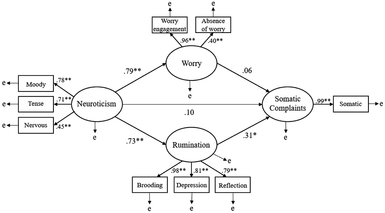
A structural mediation model (Model 1) (see Fig. 1) reported acceptable fit on all criteria, but RMSEA, χ2 (23, N = 170) = 89.50, p < .001, CFI = .91, IFI = .91, SRMR = .07, RMSEA = .13 (CI .10 to .16). Inspection of structural paths revealed that neuroticism significantly predicted higher levels of worry (β = .79, p < .001) and rumination (β = .73, p < .001). Rumination significantly predicted higher levels of somatic complaints (β = .31, p = .014). However, worry did not significantly predict somatic complaints (β = .06, p = .698). Additionally, neuroticism did not significantly predict somatic complaints (β = .10, p = .651). Bootstrapping estimates revealed neuroticism had a significant indirect effect on somatic complaints across bias-corrected percentile point estimates (p = .001, 95% CI .17 to .54).
Model 1: mediational effects of rumination and worry on the relationship between neuroticism and somatic complaints. Latent variables are represented by ellipses; observed variables are represented by rectangles; error of measurement is indicated by ‘e’; *p < .05, **p < .001.

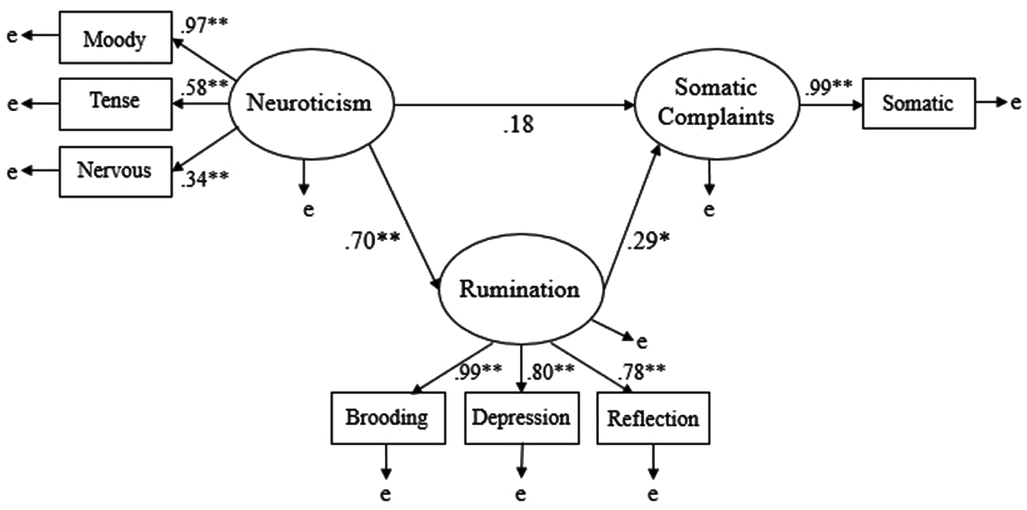
It is not immediately obvious, though, which proposed mediator (worry or rumination) is responsible for the mediating effect because AMOS cannot examine the unique influence of two or more mediators when simultaneously included in SEM. The observation that only rumination significantly predicted somatic complaints suggested that neuroticism might have an indirect effect through rumination. Specification of an alternative model (Model 2) assessed this notion (see Fig. 2). This removed paths linked to worry. Model 2 reported good fit on all indices, except RMSEA which suggested marginal fit, χ2 (12, N = 170) = 28.21, p = .005, CFI = .97, IFI = .97, SRMR = .05, RMSEA = .08 (CI .05 to .10). A comparison of AIC statistics indicated superior fit for Model 2 (AIC = 74.22) vs Model 1 (AIC = 151.51). As with Model 1, structural paths revealed that neuroticism predicted higher levels of rumination (β = .70, p < .001) and rumination predicted greater somatic complaints (β = .29, p = .006). Additionally, neuroticism did not significantly predict somatic complaints (β = .18, p = .109). Bootstrapping estimates indicated that neuroticism had an indirect effect on somatic complaints through rumination across bias-corrected percentile point estimates (p < .001, 95% Cl .24 to .52). The indirect effect was .38. This indicated a .38 standard deviation increase in somatic complaints for every one-unit increase in neuroticism indirectly via rumination. Presence of a significant indirect effect, a non-significant path between neuroticism and somatic complaints, and a significant relationship between neuroticism and rumination support full mediation. The model explained 50% of the variance in rumination and 19% of the variance in somatic complaints.
Model 2: mediational effects of rumination on the relationship between neuroticism and somatic complaints. Latent variables are represented by ellipses; observed variables are represented by rectangles; error of measurement is indicated by ‘e’; *p < .05, **p < .001.

As Model 2 is cross-sectional, further models were tested. These examined plausible alternative solutions. One model examined neuroticism as a mediator between rumination and somatic complaints (Model 3), and another included somatic complaints as a mediator between rumination and neuroticism (Model 4). Analysis revealed identical data-model fit in comparison with Model 2 (only direction altered). However, significant indirect effects were not apparent in either analysis. A further model (Model 5) tested whether somatic complaints mediated the relationship between neuroticism and rumination. The indirect effect was weaker (.07). In addition, the predictive relationship between neuroticism and the outcome was stronger (.63 vs .18) and significant vs non-significant, indicating a weaker presence of a mediating variable. A final analysis (Model 6) examined rumination as a mediator between somatic complaints and neuroticism, which reported a significant, albeit weaker indirect effect (.27). The presence of a stronger indirect effect in Model 2 is, according to Zhao et al. (Reference Zhao, Lynch and Chen2010), evidence of stronger mediation and indicates that the pattern of relationships proposed in the study hypotheses more convincingly represent the data. Overall, the results of these alternative tests support the direction among the variables proposed in Model 2.
Discussion
This paper investigated whether worry and rumination mediated the relationship between neuroticism and vulnerability to somatic complaints. Analysis revealed significant correlations (medium to high) between factors. However, worry and rumination were associated differently with neuroticism and somatic complaints. Explicitly, rumination mediated the neuroticism and somatic complaints association, whereas worry did not have a meaningful influence on this relationship.
Previous research has often explored relationships between worry, rumination, neuroticism and somatic complaints using correlation. Hence, in order to enable comparisons with preceding work it is necessary to consider zero-order correlations obtained within the current study. In agreement with earlier investigations, worry and rumination were moderately associated (Fresco et al., Reference Fresco, Frankel, Mennin, Turk and Heimberg2002; Muris et al., Reference Muris, Roelofs, Meesters and Boomsma2004; Segerstrom et al., Reference Segerstrom, Tsao, Alden and Craske2000). Furthermore, these factors were moderately associated with neuroticism. Controlling for neuroticism reduced the correlation between worry and rumination demonstrating conceptual overlap between these constructs. Hence, findings indicated that rumination and worry are, in part, manifestations of neuroticism. Indeed, neuroticism explained a meaningful proportion of shared variance among these constructs.
Neuroticism correlated positively with somatic complaints. This observation accords with preceding studies (e.g. Cohen et al., Reference Cohen, Doyle, Skoner, Fireman, Gwaltney and Newsom1995). The absence of an association between neuroticism and somatic complaints, after controlling for worry and rumination, suggests that these cognitive factors play an important direct role in the neuroticism–somatic complaints relationship. The finding that rumination (not worry) mediated the association between neuroticism and somatic complaints relationship reflects the importance of rumination. This result agrees with Thomsen et al. (Reference Thomsen, Mehlsen, Olesen, Hokland, Viidik, Avlund and Zachariae2004). They argued that rumination, by centring attention on negative material, directly influences perceived health. In this context, somatic symptoms (e.g. pain, headaches) act as instances of negative material. Additionally, rumination sustains focus on potential physical problems (headaches, pain, aches, etc.) and augments pain sensitivity (Villemure and Bushnell, Reference Villemure and Bushnell2002).
The current findings were consistent with the symptom perception hypothesis (Howren and Suls, Reference Howren and Suls2011). This proposes that ‘neurotic individuals are more likely to perceive, overact to, and/or complain about minor physical problems and sensations’ (Rosmalen et al., Reference Rosmalen, Neeleman, Gans and de Jonge2007, p. 305). Accordingly, participants with higher levels of neuroticism report more somatic symptoms because they are inclined to focus internally on self-generated bodily feelings and sensations. Once detected, a negative interpretative bias arising from neuroticism results in the perception of symptoms as indicators of illness (Williams et al., Reference Williams, O'Brien and Colder2004).
Thus, rumination provides a potential explanatory mechanism for internal focus. Rumination represents a self-absorbing focus on depressing stimuli, symptoms and a difficulty in detaching oneself from this introspection (Nolen-Hoeksema, Reference Nolen-Hoeksema1991). This definition is consistent with the view that self-focus on symptoms is a defining feature of rumination. The current findings suggest that this extends to the perception of somatic symptoms. Moreover, within an alternative mediational model neuroticism did not vary as strongly as a function of somatic complaints. This contradicted the disability hypothesis, which assumes that neuroticism is the consequence (not the cause) of ill health (Rosmalen et al., Reference Rosmalen, Neeleman, Gans and de Jonge2007).
Although the findings generally accord with the symptom perception hypothesis, specifically the notion that neuroticism is associated with a lower threshold for detecting somatic symptoms, it is important to note that somatic complaints can actually reflect poor health. Indeed, genuine symptoms may give rise to neuroticism, worry and anxiety. Thus, because the study was not causal, readers should interpret the findings and suggested implications cautiously. At a general level, it is essential to increase awareness of somatic symptoms; particularly, to reduce false symptoms but remain conscious of the need to detect and treat real symptoms.
In the present study, it was unclear why worry failed to mediate the neuroticism–somatic complaint relationship. It is possible that this was due to differences in the content of worry and rumination. Specifically, a principal feature of worry is a focus on prospective negative consequences (Borkovec et al., Reference Borkovec, Ray and Stober1998). Additionally, reduced concreteness and the tendency to divert attention away from arousing, negative and/or painful material (e.g. somatic symptoms) are prominent features of worrisome thought (Borkovec et al., Reference Borkovec, Ray and Stober1998). This suggests that worry functions as a form of cognitive distraction.
Although reduced concreteness also characterizes ruminative thought (Watkins and Moulds, Reference Watkins and Moulds2007) rumination tends to focus on the past and/or present and consists of self-focused attention (Segerstrom et al., Reference Segerstrom, Tsao, Alden and Craske2000). Hence rumination promotes a focus on arousing, negative and/or painful material (Hoyer et al., Reference Hoyer, Gloster and Herzberg2009). This distinction potentially explains why rumination more directly predicted symptom reporting than worry. It would be useful for subsequent research to assess this conceptualization further. This would greatly enhance understanding of the relationship between neuroticism and somatic complaints.
Previous work supports the view that worry and rumination are conceptually related but distinct cognitive processes (Hoyer et al., Reference Hoyer, Gloster and Herzberg2009; Segerstrom et al., Reference Segerstrom, Tsao, Alden and Craske2000; Yang et al., Reference Yang, Kim, Lee, Lee, Yu, Jeon and Kim2014). For example, Yang et al. (Reference Yang, Kim, Lee, Lee, Yu, Jeon and Kim2014) found that worry and rumination played a differential role in the diagnosis of major depressive disorder (MDD) and generalized anxiety disorder (GAD). Worry increased the likelihood of a diagnosis of GAD, whereas rumination was associated with greater odds of an MDD diagnosis. Based on this, Yang et al. (Reference Yang, Kim, Lee, Lee, Yu, Jeon and Kim2014) concluded that worry and rumination possess unique features that influence diagnostic outcomes. Thus, although the presence of repetitive negative thinking is a defining feature of both cognitive processes, the actual contents of thought differ (Yang et al., Reference Yang, Kim, Lee, Lee, Yu, Jeon and Kim2014). Following on from this previous research, subsequent studies should assess the degree to which worry and rumination differentially affect reporting of somatic symptoms.
Furthermore, repetitive negative thinking is common within a range of Axis I disorders (e.g. panic attacks, obsession, social phobia) (Ehring and Watkins, Reference Ehring and Watkins2008). In this context, similarities between worry and rumination are transdiagnostic. They represent central criteria (i.e. repetitive, passive and/or relatively uncontrollable and focused thought), which embody common features of repetitive negative thinking. This is congruent with Ehring and Watkins’ (Reference Ehring and Watkins2008) definition of negative thinking as repetitive thinking about one or more negative topics that is experienced as difficult to control.
Clear clinical implications follow from the observation that rumination is associated with the reporting of somatic symptoms, particularly in the context of individuals presenting with multiple somatic complaints in primary healthcare. Treating these individuals is both time and resource intensive (Tylee and Gandhi, Reference Tylee and Gandhi2005). Focusing on strategies to reduce rumination may help to alleviate this burden. A number of existing therapeutic techniques exist, which could serve this function. For example, rumination-focused cognitive behavioural therapy is effective for tackling excessive self-focus (Watkins et al., Reference Watkins, Scott, Wingrove, Rimes, Bathurst, Steiner, Kennell–Webb, Moulds and Malliaris2007). In addition, rumination-cued activation involves educating individuals to understand when and why they are ruminating (Addis and Martell, Reference Addis and Martell2004). Future work could usefully examine the effects of rumination reduction, via established therapeutic methods, in relation to neuroticism and somatic complaints using controlled trials.
It is important to acknowledge the presence of limitations within the present study. Firstly, the study was cross-sectional. Collecting data at one time point prevents the establishment of cause–effect relations. However, extant research provides a framework in which to interpret findings. Specifically, neuroticism is a relatively stable personality trait with a genetic basis (Flint, Reference Flint2004), whereas worry and rumination are cognitive processes. This is consistent with previous work, which has examined worry and rumination as mediators of the effects of neuroticism (e.g. Muris et al., Reference Muris, Roelofs, Rassin, Franken and Mayer2005), supporting the proposed conceptualization in this study.
Longitudinal research would test how rumination is associated with neuroticism and somatic complaints over time by providing repeated assessments in accordance with designated time intervals. Analysis of lagged effects of neuroticism through rumination could examine how mediation effects unfold. This would build on the current study and further determine how somatic complaints vary as a function of rumination in response to neuroticism.
Secondly, given that 19% of variance in somatic complaints was accounted for, variables not assessed in this study may enhance understanding of the observed mediation effect. A specific example is interoceptive awareness (body awareness). Interoceptive awareness and negative self-referential thought (e.g. rumination) represent integrated processes (Lackner and Fresco, Reference Lackner and Fresco2016). Research indicates that interoceptive awareness interacts with rumination in relation to the reporting of somatic complaints (e.g. pain) (Scheuren et al., Reference Scheuren, Sütterlin and Anton2014). Interoceptive awareness, then, may complement the assessment of somatic complaints in the context of neuroticism and rumination. Broadening the focus to include additional variables is important for mediation analysis given this method is limited in the sense it does not account for unmeasured variables (i.e. constructs that may correlate with rumination) that can drive the relationships between exogenous and endogenous variables (i.e. neuroticism and somatic complaints).
Thirdly, self-report measures potentially influence data in adverse ways, by introducing response bias and shared method variance (Denovan et al., Reference Denovan, Dagnall, Dhingra and Grogan2017). Incorporating physiological measures can add concurrent validity to the assessment of worry and rumination, given that these are associated with arousal in the form of higher cardiovascular activity (Borkovec et al., Reference Borkovec, Ray and Stober1988; Hogan and Linden, Reference Hogan and Linden2004). Finally, this study used a non-clinical sample. Consequently, generalizing the findings to a clinical sample is difficult to achieve. This is problematic because the individuals mostly likely to benefit from the current research are those within clinical samples.
Overall, the current study indicates that moderate relationships exist among neuroticism, worry and rumination. In addition, rumination mediated the relationship between neuroticism and somatic complaints. It makes sense, therefore, for future research to corroborate the mediating role of rumination given that this cognitive process can be modified using appropriate therapeutic techniques (Addis and Martell, Reference Addis and Martell2004; Watkins et al., Reference Watkins, Scott, Wingrove, Rimes, Bathurst, Steiner, Kennell–Webb, Moulds and Malliaris2007). Such work can have important implications for healthcare systems in terms of managing individuals who present with multiple somatic complaints.
Acknowledgements:
The authors would like to thank Dr Ken Drinkwater for his advice in setting up the study.
Conflict of interest: None declared.
Ethical statement: The authors have abided by the Ethical Principles of Psychologists and Code of Conduct as set out by the American Psychological Association. Ethical approval for the study was granted by Manchester Metropolitan University's Psychology Ethics Committee (MMUSW18/04/16).
Financial support: None provided.




Comments
No Comments have been published for this article.