Appointed executives of bureaucratic agencies in the United States (US) federal government are agents of both presidential and congressional power. Connecting the bureaucracy to the political branches of the US Constitution, they can also serve as prominent symbols of government dysfunction, particularly when these positions remain vacant for extended periods of time. Roughly 1,100 such positions require the advice and consent of the Senate, which confers legitimacy and mediates conflict between politics and expertise (Mashaw Reference Mashaw1997). As a result, executive appointees often find themselves serving two masters, and this shared influence often manifests in the relative ideological distance they have among key principals, generally falling somewhere between the appointing president and key Senate pivots (Bertelli and Grose Reference Bertelli and Grose2011).Footnote 1 Indeed, nested among constitutional principles, appointees have become the institutional embodiment of the administrative state (Bertelli and Lynn Reference Bertelli and Lynn2006; Nathan Reference Nathan1983; Stayn Reference Stayn2001). Among the consequences of the expanding reach of appointee politics is a pattern of vacant positions peculiar to American government.
Based on the most comprehensive empirical research on the subject, O’Connell (Reference O’Connell2009) finds that an average of one-quarter of agency Senate-confirmed, presidentially-appointed positions were vacant between 1979 and 2003.Footnote 2 As few as 15% of positions may be vacant during the second year of a presidential administration, while during the final year of an administration that figure may rise to 50% (O’Connell Reference O’Connell2009). This can impose potentially serious operational and reputational hindrances for an agency and political costs for a president. For instance, in the months before Hurricane Katrina, more than one-third of Federal Emergency Management Agency’s policy positions were vacant (Lewis Reference Lewis2008; O’Connell Reference O’Connell2009). In the wake of the COVID-19 epidemic, nearly half of all scientific leadership positions in the Trump administration were vacant (Union of Concerned Scientists, 2020). O’Connell (Reference O’Connell2009) concludes, “Vacancies, particularly if frequent and lengthy, may have detrimental consequences for the modern administrative state. They contribute to agency inaction, foster confusion among nonpolitical employees and undermine agency legitimacy” (914). While much media coverage and scholarship identify vacancies as a problem, we leave open the possibility that some political actors may prefer vacancies and acting career civil servants to a confirmed appointee, since some actors may benefit from stability and preserving the status quo. Before embarking on a project that explores the consequences of vacancies, however, scholars must first map and analyse the extent of appointee vacancies.
What accounts for the duration of appointee position vacancies? Are certain positions vacant more than others? Answering these questions is difficult, despite mandated reporting of all Presidential appointees requiring Senate confirmation (PAS) vacancies. Haglund and Lewis (Reference Haglund and Lewis2013) examine the influence of appointees on agency performance by measuring performance according to compliance with the Federal Vacancies Reform Act. They find compliance to be spotty, and the U.S. Government Accountability Office came to a similar conclusion; not all agencies are aware of the law’s requirements, and in some cases, agencies do not make timely reporting a priority (United States General Accounting Office 2001).
To address the lack of a comprehensive repository for appointee vacancy data, we built our own dataset from a variety of sources for 416 PAS positions to executive branch departments and single-headed agencies from January 1989 to January 2013.Footnote 3 The dataset includes periods of Republican and Democratic presidents, and both divided and unified government under both parties. Therefore, the dataset serves as the most complete extant data on Senate-confirmed, presidential appointees in executive positions. In leveraging these data, we find that institutional factors such as position status matter a great deal for determining vacancies in the most important PAS positions, as does ideological conflict between target agencies and key Senate pivots. When agencies are ideologically divergent from the relevant Senate committee chair, vacancy length is shortened as much as half for lower status appointees as agency ideology diverges to the chair’s party extreme. This relationship holds across presidencies. In other words, ideological divergence matters most when the agency is to the right (left) of Republican (Democrat) Senate committee chairs.
Vacant by design
Senate-confirmed agency appointees (i.e., PAS) arose as a combination of constitutional design and institutional development (Stayn Reference Stayn2001). The separation of powers limits each branch’s influence over bureaucratic agencies. The founders designed the separation of powers as a “means of keeping each other [part of government] in their proper places” (Rossiter Reference Rossiter1961, Federalist Papers, No. 41, 367). The shared, yet separate, powers of the presidency and Congress over appointments provide multiple avenues for representation, but leave open the possibility of disagreement and vacancy (Bertelli and Lynn Reference Bertelli and Lynn2006). These powers are truly shared, since the confirmation and oversight processes allow the Senate to redirect policy towards its preferences administratively as much as might be assumed of the president through the “administrative presidency” (Bertelli and Grose Reference Bertelli and Grose2011; MacDonald and McGrath Reference MacDonald and McGrath2016). For example, Bertelli and Grose (Reference Bertelli and Grose2011) locate cabinet appointees in between the president and the Senate majority’s ideological preferences, despite them being traditionally seen as responsive to the president.
Importantly, vacancies occur through a three-step revolving process – nomination, Senate confirmation and then departure. Each stage represents a bargain among three actors – the president, Senate and appointee – under the Constitution’s design for the separation of powers. Appointee vacancies are byproducts of these bargains that have substantive consequences for administration. Vacancies are rarely observed empirically, in contrast to confirmation and length of tenure, because appointee departure is not in the Senate record and not publicly available (except for coverage during the first year of an administration). Hollibaugh and Rothenberg (Reference Hollibaugh and Rothenberg2017), Kinane (Reference Kinane2019) and O’Connell (Reference O’Connell2009, Reference O’Connell2020) are recent exceptions to the dearth of empirical scholarship on vacancies. The obscurity of data results from rules governing information about appointee departure and positions vacancies, which are themselves shaped by generations of bargaining.
A delay in either the nomination or confirmation stages can prolong a vacancy. The president may fail to nominate someone because of other business or because of a particularly long search process. On this point, Hollibaugh (Reference Hollibaugh2015) reports that nomination delay is extended when a president’s vetting process finds that the candidate is relatively incompetent compared to a pool of potential nominees. Kinane (Reference Kinane2019) adds that presidents may strategically leave positions vacant, especially when presidents prioritise retrenchment in that agency’s policy aegis.
Presidents use nomination and appointment as tools to control the bureaucracy and to ensure that their policy preferences are reflected in administrative agencies (Lewis Reference Lewis2008). However, appointments are made for both patronage and policy, and seldom are the constructs wholly separate considerations, as presidents use patronage to prompt backing for their agenda and to signal policy concurrently (Rose Reference Rose, Aberbach and Peterson2005). This is not always an easy balance. Hence, one source of delay and extended vacancies is the length of time it takes to find the right appointee who satisfies a mix of loyalty and competence (Hollibaugh Reference Hollibaugh2015; Krause and O’Connell Reference Krause and O’Connell2016). Importantly, this balance must also be met to satisfy the Senate majority.
The Constitution’s “advice and consent” provisions require that presidents take into account Senate preferences (Article II, Section 2, Clause 2). The second step in the appointment process, Senate confirmation, is a longstanding source of delay and as a result, extended vacancies (Binder and Maltzman Reference Binder and Maltzman2002; Bond et al. Reference Bond, Richard and Krutz2009; Dull and Roberts Reference Dull and Roberts2009; Dull et al. Reference Dull, Roberts, Keeney and Choi2012; McCarty and Razaghian Reference McCarty and Razaghian1999; O’Connell Reference O’Connell2009; Nixon Reference Nixon2001; Shipan and Shannon Reference Shipan and Shannon2003). Most of the literature on Senate confirmation choices and delay focuses on judicial nominees, but the broad findings are similar across appointee types. Senators decided whether nominees are competent and ideologically acceptable. Many models frame this process as bivariate – a successful or failed nomination – and some include delay as a third option (Chiou and Rothenberg Reference Chiou and Rothenberg2014; Hollibaugh and Rothenberg Reference Hollibaugh and Rothenberg2017). We propose vacancies as another lens through which to view the combined problem of nomination and confirmation delays.
We show vacancies result from a variety of processes beginning when a predecessor departs and extending to when the next appointee arrives. Senate majorities can extend the time between when a nominee departs, and another one is confirmed. They may prefer longer vacancies in order to bring forward appointees who match their preferences, but they may also have a greater preference for stability than the president, regardless of the appointee. Senate staff may have a better relationship with career executives who serve in acting roles than they would expect to have with a new appointee, as is suggested by the metaphor of the iron triangle of Congressional staff, interest groups and the bureaucracy (Jordan Reference Jordan1990; Peterson Reference Peterson1993). Importantly, Senate preferences for an ideological ally or for stability in agency leadership may both contribute to vacancies through confirmation delay or through extending the time it takes for a president to find an acceptable nominee. Because the president may anticipate Senate preferences, the Senate can influence the president for any given position.
In some positions, Congress may prefer the stability of acting appointees to the uncertainty of new nominees. McCarty and Razaghian (Reference McCarty and Razaghian1999) hypothesise that careerists’ long experience working with congressional oversight and budget procedures makes them more responsive to the wishes of Congress than to presidential administrations that come and go. Others present arguments that vacancies are not as serious of a problem as many perceive. Mendelson (Reference Mendelson2011) speculates that vacancies may be associated with greater attention to the qualifications of a position and to an agency’s decision-making structure. Resh (Reference Resh2014, Reference Resh2015) argues that vacancies can, in some instances, lead to increased responsiveness to presidential prerogatives. McGarity (Reference McGarity1991) argues that average appointee tenure is so brief that appointees “must trust the staff to make the ‘right’ calls on scores of micro-issues…,” vacancy or not (61). Chase Untermeyer was criticised in the press for not filling vacancies quickly enough when he was the director of presidential personnel for George H. W. Bush. Untermeyer went to great lengths to try to explain that vacancies at the beginning of the term “were not literally empty desks” since Reagan appointees continued to serve until positions were filled (Untermeyer Reference Untermeyer2000). If the new president is of a different party, however, filling vacancies may be a more pressing issue.
Most scholarship on the topic, however, links vacancies to reduced functional authority and democratic accountability. Vacancies might deprive the president of a tool for control as part of the administrative presidency, but more importantly, they deprive the public of one part of the chain of electoral accountability that reaches into the bureaucracy (Aberbach and Rockman Reference Aberbach and Rockman2000; Mendelson Reference Mendelson2011; Stephenson Reference Stephenson2013). Since extended vacancies result from delays in nomination and confirmation, they may exacerbate problems with finding competent nominees willing to endure an extended appointment process (Hollibaugh Reference Hollibaugh2015).
How serious a problem are vacancies for government? The truth is that some vacancies impede agencies more than others, and a necessary step in analysing their effects is to obtain a complete picture of where they occur. Our analysis advances beyond the simplistic story of vacancies as good or bad by analysing variation in vacancies according to contextual factors.
In the following section, we present a formal theory of vacancies. We focus on three aspects of the appointments process – vacancy onset and duration, the relationship between agencies and political principals (especially the Senate) and the role of hierarchy. Using this model, we derive four empirically testable hypotheses, which we examine using this novel dataset. We distinguish ourselves quite plainly from prior work in that we focus on both vacancy onset and duration separately.
A theory of bureaucratic vacancies
To examine why vacancies are created and how long they persist, we examine a simple model of the appointments process inspired by the one presented by Chiou and Rothenberg (Reference Chiou and Rothenberg2014), which is itself in a long line of models based on Romer and Rosenthal’s (Reference Romer and Rosenthal1978) setter model. Like Chiou and Rothenberg (Reference Chiou and Rothenberg2014), as well as others (e.g. Bond et al. Reference Bond, Richard and Krutz2009; Hollibaugh and Rothenberg Reference Hollibaugh and Rothenberg2018; Krutz et al. Reference Krutz, Richard and Bond1998; Ostrander Reference Ostrander2016), we note very few nominees are rejected outright and instead focus on delay in the process.
Our model has three players – a President, a Senate and an Agency.Footnote 4 The game proceeds as follows:
Nature chooses some status quo agency policy and creates an imminent vacancy that will open if it is not immediately filled.Footnote 5
-
1. The President makes a nomination.
-
2. Once the President nominates, the Senate has the chance to confirm the nominee.Footnote 6
-
3. Once the Senate confirms, the Agency implements the policy at its ideal point.Footnote 7
Importantly, the President and the Senate can both delay their actions (potentially indefinitely) by taking some nonnegative amount of time before making a decision.Footnote 8 We assume players have quadratic preferences over policy outcomes and are potentially concerned with the effects of stalling. We further assume the Senate is concerned with how the nominee might affect the relative preference divergence between itself and the agency. This is of particular concern for the Senate because of its inability to change administrative policy unilaterally.Footnote 9 Our solution concept is subgame perfection.Footnote 10
The Senate’s decision
We first examine the Senate and consider the decision to delay. As mentioned, we assume the Senate cares about policy outcomes, how the nominee might affect the preference divergence between the Senate and the agency, as well as the ultimate policy outcome. In principle, we assume its utility function to take the general form of
 ${U_S} = {\rm{Delay}} \times \left( {{\rm{Unfavourable}}\,{\rm{policy}}\,{\rm{shifts}} - {\rm{audience}}\,{\rm{costs}}} \right) - {\rm{policy}}\,{\rm{divergence,}}$
which is broadly consistent with Chiou and Rothenberg’s (Reference Chiou and Rothenberg2014) treatment of the appointments process. That is, while the Senate derives positive utility from delaying nominees that will shift agency policy away from itself – either through ideological/programmatic reorientation, different managerial techniques, or something else – it also incurs negative utility from delay-associated audience costs; we further assume the Senate cares about the ultimate policy outcome in addition to the relative policy shift, in that it wants the ultimate agency orientation to be as ideologically compatible with itself as possible. Written more formally, its utility function can be written as:
 $${U_S}\left( {{t_S}|{t_P},{x_A},{x_S},{x_N},\gamma } \right) = -{{\gamma ({t_P} + {t_S}^2)}\over{2}} + \left( {{t_P} + {t_S}} \right)\left( {{{\left( {{x_N} - {x_S}} \right)}^2} - {{\left( {{x_A} - {x_S}} \right)}^2}} \right) - {\left( {{x_N} - {x_S}} \right)^2},$$
where,
 $\gamma \gt 0$
is the penalty for delay.Footnote 11 To account for ideology,
 ${x_A}$
,
 $${x_S}$$
,
 $${x_N}$$
are the ideal points of the preconfirmation Agency (hereafter “Agency”), the Senate and the postconfirmation Agency (hereafter “Nominee”), respectively.Footnote 12,
Footnote 13 Finally,
 $${t_P}$$
and
 $${t_S}$$
indicate how long the President and Senate took to reach their respective decisions; both are weakly greater than zero.
Consistent with Chiou and Rothenberg (Reference Chiou and Rothenberg2014), we assume higher levels of
 $$\gamma $$
are associated with higher delay-related audience costs, likely correlated with higher-profile or higher level positions.Footnote 14 Further note the Senate derives negative utility from delay and divergent policy outcomes, and positive utility from delaying nominees that will shift the Agency away.
As the Senate’s only decision is when to confirm, we take the partial derivative of Equation 2 with respect to
 $${t_S}$$
and solve for the equilibrium
 $$t_S^*$$
. Doing so, we find that
 $$t_S^* = \max \left\{ {0,\frac{{{{\left( {{x_N} - {x_S}} \right)}^2} - {{\left( {{x_A} - {x_S}} \right)}^2}}}\over{\gamma }} \right\},$$
since we assume
 ${t_S} \ge 0$
. Substantively, if the Nominee will move Agency policy towards the Senate, the Senate will confirm immediately. Otherwise, the Senate will delay.
We now analyse the President’s decision.
The President’s decision
As mentioned, the President’s main decision given a vacancy is who and when to nominate. We assume the following utility function:
 $${U_P}\left( {{x_N},{t_P}|{t_S},{x_P},\gamma } \right) = - \gamma ({t_P}^2 + {t_S}) - {\left( {{x_N} - {x_P}} \right)^2}.$$
We assume the President cares about policy outcomes and delay in and of itself.Footnote 15 Inspection of the utility function makes it clear that
 $$t_P^* = 0$$
in equilibrium. Given this, we focus on finding the Nominee
 $$x_N^*$$
and solve for the optimal level of Senate delay
 $t_S^*$
.
Case 1
First, suppose
 $$t_S^* = 0$$
, which implies
 $${\left( {{x_N} - {x_S}} \right)^2} \le {\left( {{x_A} - {x_S}} \right)^2}$$
. Clearly, the Senate will confirm any Nominee such that
 $$x_N^* \in \left[ {\min \left\{ {{x_A},2{x_S} - {x_A}} \right\},\max \left\{ {{x_A},2{x_S} - {x_A}} \right\}} \right]$$
, since this would provide the same utility as the status quo, and set
 $$t_S^* = 0$$
. In this case, the President will simply nominate the
 $$x_N^* \in \left\{ {{x_A},2{x_S} - {x_A}} \right\}$$
that maximises her own utility. However, when
 $$x_P^{} \in \left[ {\min \left\{ {{x_A},2{x_S} - {x_A}} \right\},\max \left\{ {{x_A},2{x_S} - {x_A}} \right\}} \right]$$
, the President will nominate someone who shares her own ideal point, and the Senate will confirm without delay.
Case 2
Next, suppose
 $$t_S^* = {\frac{{{{\left( {{x_N} - {x_S}} \right)}^2} - {{\left( {{x_A} - {x_S}} \right)}^2}}}\over{\gamma }$$
. In this case, given Equation 4, the optimal Nominee is
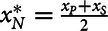 $$x_N^* = {\frac{{{x_P} + {x_S}}}\over {2}$$
, which can be found by examination of
 $\frac{{\partial {U_P}}}\over{{\partial {x_N}}}$
. As such, the optimal length of Senatorial delay – when it is nonzero – can be rewritten as
 $t_S^* = {\frac{{{{\left( {{x_P} - {x_S}} \right)}^2} - 4{{\left( {{x_A} - {x_S}} \right)}^2}}}\over{{4\gamma }}}$.
Inspection of this quantity indicates that higher levels of Senate–Agency divergence correspond to lower levels of Senate-induced delay, presumably because the Senate will be keener to confirm nominees who will reorient an agency closer to its own ideal point.Footnote 16 Moreover, increases in
 $$\gamma $$
also result in lower levels of delay. Combining these results, and letting
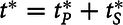 $t_{}^* = t_P^* + t_S^*$
, which allows us to write
 $t_{}^*$
in terms of the equilibrium values of
 $$x_N^*$$
, we find that
 $${t^*} = \left\{ {\matrix{ {{{{{({x_P} - {x_S})}^2} - 4{{({x_A} - {x_S})}^2}} \over {4\gamma }}}\ {{\rm{if}}\,{{({x_A} - {x_S})}^2} < {{{{({x_P} - {x_S})}^2}} \over 4}} \hfill \cr \hskip -110{0}\ \ {\rm{otherwise}}} \hfill \cr } } \right.$$
and
 $$\scale 75%{x_N^* = \left\{ {\matrix{ {{{{x_P} + {x_S}} \over 2}\,{\rm{if}}\,{{\left( {{{{x_P} + {x_S}} \over 2} - {x_S}} \right)}^2} \gt {{({x_A} - {x_S})}^2}\,{\rm{and}}\,{{({x_P} - {x_S})}^2} \gt {{({x_A} - {x_S})}^2}} \hfill \cr {{x_A}\,{\rm{if}}\,{{\left( {{{{x_P} + {x_S}} \over 2} - {x_S}} \right)}^2} \le {{({x_A} - {x_S})}^2},\,{{({x_P} - {x_S})}^2} \gt {{({x_A} - {x_S})}^2},\,{\rm{and}}\,{{({x_A} - {x_P})}^2} \le {{(2{x_S} - {x_A} - {x_P})}^2}} \hfill \cr {2{x_S} - {x_A}\,\,{\rm{if}}\,\,\,{{\left( {{{{x_P} + {x_S}} \over 2} - {x_S}} \right)}^2} \le {{({x_A} - {x_S})}^2},\,{{({x_P} - {x_S})}^2} \gt {{({x_A} - {x_S})}^2},\,{\rm{and}}\,{{({x_A} - {x_P})}^2} \gt {{(2{x_S} - {x_A} - {x_P})}^2}} \hfill \cr {{x_P}\,\,\,{\rm{otherwise}}} \hfill } } \right.$$
Given that we assumed higher
 $$\gamma $$
was likely associated with higher profile and higher status positions, as well as the fact that the sole source of delay in our model is due to the Senate, we can derive our main empirical hypotheses:
Hypothesis 1: Conditional on a vacancy occurring, higher status positions will correspond to lower levels of delay.
Hypothesis 2: Conditional on a vacancy occurring, greater Senate–Agency ideological divergence will correspond to lower levels of delay.
Furthermore, under the assumption that an outcome where no delay occurs is equivalent to one where no vacancy occurred, we can derive the following additional hypothesesFootnote 17:
Hypothesis 3: Greater Senate–Agency ideological divergence will correspond to lower vacancy rates.
Hypothesis 4: Higher status positions will have lower vacancy rates.
Overall, our model suggests several important relationships between position status, Senate–Agency divergence, onset and duration. We use these results to inform our empirical analysis.
Data and methods
To evaluate our formally derived hypotheses, we use our data on appointee vacancies across 416 PAS positions from January 1989 to January 2013.Footnote 18 We analyse a dependent variable we call Vacant Days (V), which is the total number of days each position is vacant during each of 12 congressional terms – from the 101st Congress through the 112th Congress. As written, our model focuses on how Senate–Agency ideological divergence and position status relate to vacancy onset (i.e. whether vacancies exist at all) and vacancy length. We also flesh out our empirical model by including other potentially relevant control variables. Alternative models are provided in Appendix B. We employ a zero-inflated negative binomial (ZINB) model that fits both the formal model and the data. In terms of theory, we are the first to propose hypotheses on institutional causes for both vacancy rates (onset) and conditional lengths of vacancies that do occur. As well, the data are indicative of why one needs to consider both stages of vacancies conjointly. In the following paragraphs, we describe this data and how we operationalise our independent variables. We then move to a description of our modelling choice.
Senate–agency ideological divergence
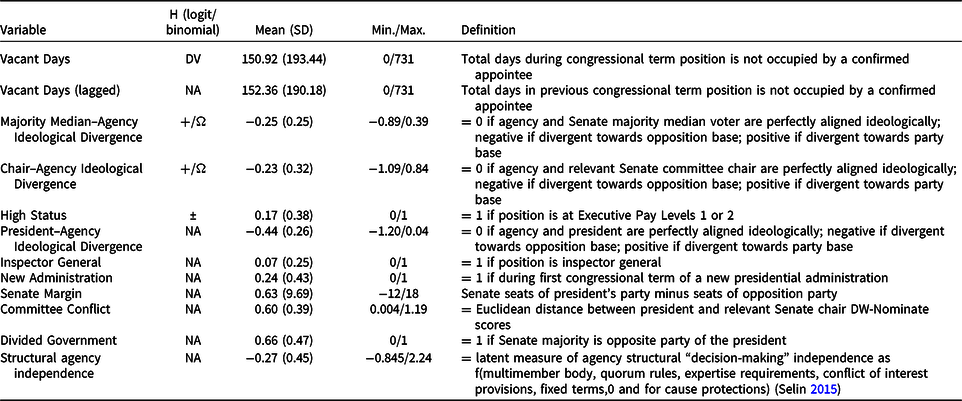
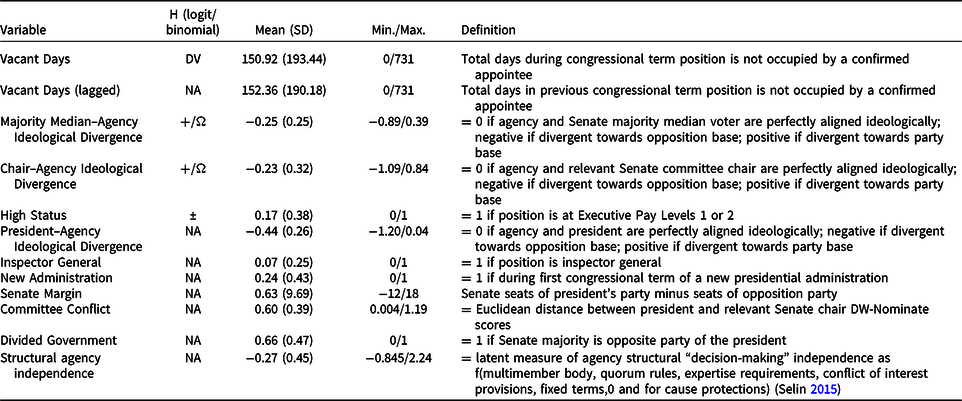
We operationalise this concept using estimates of two critical Senate pivot points: the Senate majority median and the relevant committee chair.Footnote 19 First, we measure the ideological divergence between a given agency and the median member of a Senate’s majority. We determined this measure using Chen and Johnson’s (Reference Chen and Johnson2015) agency ideology scores that place agency ideology as an ideal point on the 1st dimension of the DW-NOMINATE ideological continuum. Likewise, we measure the ideological divergence between a Senate committee chair handling the nomination and the agency. Hence, Senate Median–Agency Ideological Divergence (S) and Chair–Agency Ideological Divergence (C) are positive if divergence occurs away from the principal’s preference and towards the opposition party’s ideological extreme. S and C are negative if divergence occurs away from the principal’s preference and towards the principal’s party extreme. S = 0 would represent perfect ideological alignment between the agency and the median member of the Senate majority. S ranges from −0.89 to 0.39 (SD = 0.25). C ranges from −1.09 to 0.84 (SD = 0.32).
Per Hypothesis 2, we then expect the relationship between S or C and V to be curvilinear, where Pr(V = 0) is highest at both extremes. Per Hypothesis 3, we expect a similar curvilinear relationship, where V = aS 2 + bS, V ≠ 0, and V highest when S = 0. In other words, agencies with nonzero S or C values should have shorter vacancies and, per Hypothesis 3, the same agencies should have lower rates of vacancy onset.
President–Agency Ideological Divergence
One of the most legitimate constitutional resources for a president to move administrative outputs towards his preferences is presidential appointments (Bertelli and Feldmann Reference Bertelli and Feldmann2007; Lewis Reference Lewis2008; Resh Reference Resh2014). Presidents achieve responsiveness through the selection of appointees based on loyalty, ideology and identifiable support of the president’s policy prerogatives (Moe Reference Moe, Edwards, Kessel and Rockman1993). Thus, we include President–Agency Ideological Divergence (P). At the same time, the apparent need for responsiveness through appointments can be attenuated if careerists’ ideological and programmatic proclivities align with the president’s without the stimulus of appointed loyalists (Resh Reference Resh2014) or if presidents seek policy retrenchment (Kinane Reference Kinane2019). Given these differentiating reasons for strategically choosing to leave an appointee position vacant, we did not propose formal hypotheses for P. Footnote 20 Nonetheless, its consideration is necessary for any model of appointee vacancies. As with S or C, P = 0 represents perfect ideological alignment between the agency and the president’s ideal point on the DW-NOMINATE scale. P ranges from −1.20 to 0.43 (SD = 0.26).
Position status
We can operationalise the concept of position status in two ways. High Status is a dichotomous variable representing Executive Pay Levels I & II, which include higher executive-level appointments such as those appointees who head cabinet-level agencies (secretaries), large bureaus and subagencies independent from the cabinet-level agency (directors, commissioners and administrators).Footnote 21 Per Hypothesis 1, High Status should be associated with shorter vacancies and, per Hypothesis 4, it should be associated with lower rates of vacancy onset.Footnote 22
Control variables
To these key independent variables, we add several control variables that other scholars have suggested might also be important to the appointments process. Continuing on the theme of ideological conflict, previous research on the confirmation process has noted the importance of ideological divergence between the President and key members of the Senate (Bonica et al. Reference Bonica, Chen and Johnson2015; Chiou and Rothenberg Reference Chiou and Rothenberg2014; McCarty and Razaghian Reference McCarty and Razaghian1999; Ostrander Reference Ostrander2016). Thus, we include Committee Conflict, a continuous measure indicating the Euclidean difference between the committee chair’s and the president’s 1st dimension DW-NOMINATE scores. Relatedly, previous research has found that partisan warfare increases both the time to confirmation and the probability thereof (Asmussen Reference Asmussen2011; Bell Reference Bell2002; Chiou and Rothenberg Reference Chiou and Rothenberg2014; McCarty and Razaghian Reference McCarty and Razaghian1999; Shipan and Shannon Reference Shipan and Shannon2003). As such, we include President–Senate Margin, which represents the number of seats in the Senate controlled by the president’s party minus the number of seats controlled by the opposition party. As well, we include a dummy variable for whether the majority party in the House of Representatives is in opposition to the president’s party (House Divided).
Other research (Hollibaugh and Rothenberg Reference Hollibaugh and Rothenberg2018) has noted the importance of agency structure in the appointments process. We, therefore, include Agency Independence, a latent construct formulated by Selin (Reference Selin2015) through a “thorough review of the provisions of agency authorising statutes and the literature on political control and agency design… [confirming] the theoretical argument that agencies are not only structured in ways that can elaborate on the qualifications and characteristics of key individuals at the top of the agency but also are structured in ways that affect the insulation of agency policy decisions from political influence and review” (Supplementary Information, p. i). We use the first of two dimensions of agency independence that Selin constructs – that is, “Decision-maker Independence” – which is generated from a Bayesian latent factor model based on 50 structural features of 321 federal agencies. This variable is positively correlated with structural features such as fixed and longer-term lengths, staggered terms (limiting the ability to change a board or commission’s entire membership at once), constraints on the President or other political principals to remove appointees except for cause, expertise and/or partisan balancing requirements, quorum requirements, limits on the number of members and features that otherwise enhance decisionmaker independence or potential appointee pools; conversely, this factor is negatively correlated with features that limit decisionmaker independence via removal powers such as whether an agency/department is located within the Executive Office of the President or the cabinet, whether it has a bureau structure, and if the relevant statute specifies that service is at the President’s pleasure.
Additionally, to account for a specific position in our data that might be particularly affected, we include Inspector General, which equals 1 when an appointee is an agency inspector general (IG). We also account for the panel nature of our data by including a lag of V on each position. Finally, we account for appointment timing. To account for factors relating to new administrations, we include New Administration coded as 1 for the congressional term immediately following the inauguration of a new president.
Model estimation
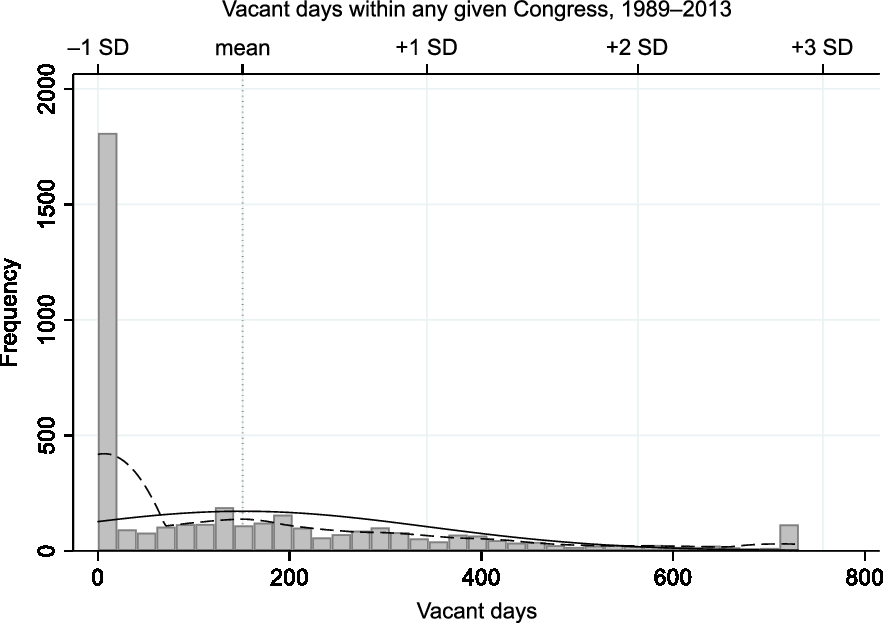
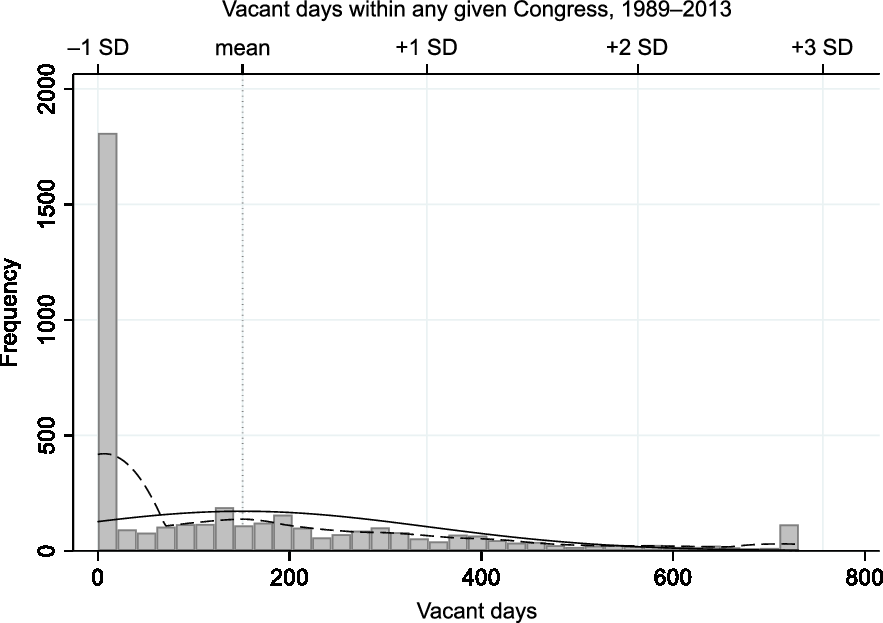
Table 1 presents summary statistics for all variables, and Figure 1 graphs the distribution of the V. Many positions are filled throughout one or more full congressional terms, so V often equals zero. One benefit of our theoretical model is that it combines two possible sources of vacancies – Presidential and Senatorial – and provides sharp theoretical predictions about aggregate vacancies and their lengths. It suggests that vacancy length is largely driven by the Senate and, as such, ideological concerns by the upper house are largely responsible for delays in filling vacancies. At the same time, lower status positions are more likely to see a vacancy than high status positions. Hence, overdispersion is likely, and the data indeed reflect that. The data are overdispersed and characterised by high within-panel (i.e. position) autocorrelation. There are also many positions that were occupied without pause across a given Congress (39.83%).
Model variables and expectations
Histogram of vacant days.
Note: Normal distribution = solid black line; Kernel density estimation = dashed line.
As mentioned, to account for overdispersion – and to account for the fact that two of our key hypotheses are related to vacancy onset as opposed to vacancy length – we use a ZINB model, run in two stages.Footnote 23 The first stage of the ZINB model predicts whether there is a vacancy at all. In other words, the first stage uses a logistic estimation to predict the probability of seeing a position with no vacancies [i.e. Pr(V = 0)]. The second stage predicts the number of events (V) using a standard negative binomial model, given that the position will be subject to vacancy (V ≠ 0). We model V as a polynomial function of Principal–Agent Ideological Divergence for relevant principals. Hence a quadratic term is included for the ideological divergence between a given agency and two key Senate pivots – the Senate majority median and the relevant committee chair – for both the logit and count portions of the model.
Model results
We present models here and in Appendix B with both “dynamic” and “static” agency ideology estimates. In other words, the Chen and Johnson (Reference Chen and Johnson2015) agency ideal point estimates are dynamic in that they are measured via campaign contributions of agency employees for each presidential administration. Hence, they change within agency across presidential administrations. This is important to recognise because some Chen and Johnson (2015) estimates have wide within-agency variance. For instance, the Small Business Administration’s ideal preference under the first Clinton administration is estimated at −0.25 (liberal), whereas it is estimated at 0.21 (conservative) during the first George W. Bush administration and liberal (−0.19) again during the first Obama administration.
While aggregating individual actions to institutional preferences, it may present some challenges, the dynamism of their measure carries some advantages over other agency ideology estimates that are static and based on external perceptions (e.g. Richardson et al. Reference Richardson, Clinton and Lewis2018). Nonetheless, using the dynamic estimates means that we lose observations in the George Herbert Walker Bush presidency as Chen and Johnson (2015) measure only for the Clinton through first Obama administrations. By averaging these estimates across time, we are able to leverage a static measure of their estimates that we can place on a common ideological space across all Congresses in our vacancy dataset. Moreover, the static (average) measure of Chen and Johnson’s (2015) agency estimates compare reassuringly with the popular static measure estimated by Richardson et al. (Reference Richardson, Clinton and Lewis2018), correlating to that ideology measure at r = 0.72.Footnote 24
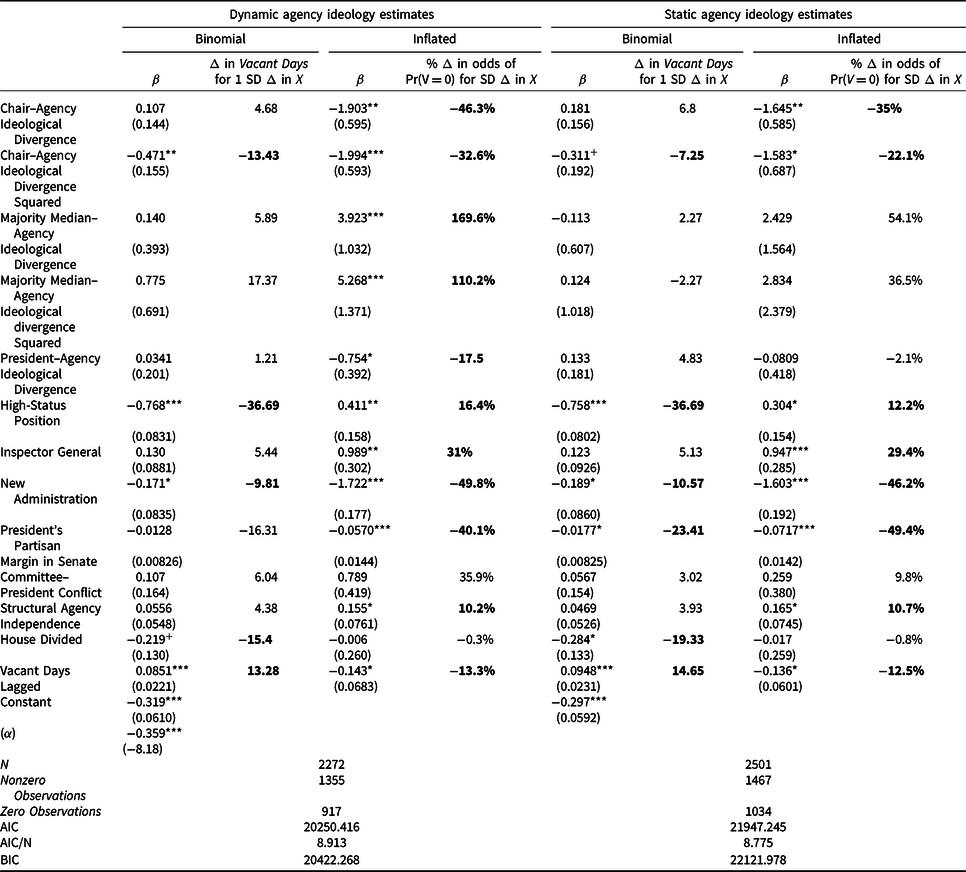
Table 2 reports the results of our analysis. ZINB model coefficients are estimated in two stages. Among the several models we estimated, we present the most complete models that test our theoretical conceits.Footnote 25 To address autocorrelation, we estimate robust standard errors clustered on agency. The first two columns in Table 2 report zero-inflation stage logit model estimates. The second two columns report second-stage negative binomial count model estimates. Because interpretation of the coefficients can be less than intuitive for these models, even columns present the predicted change in the dependent variable given a one-unit change in the independent variable. For the zero-inflated portion of the model, this is presented as a percentage change in the likelihood that a position has zero vacancy days. For the negative binomial stage, we present this as the change in the predicted number of days a position stays vacant.Footnote 26
Zero-inflated negative binomial model of vacant days
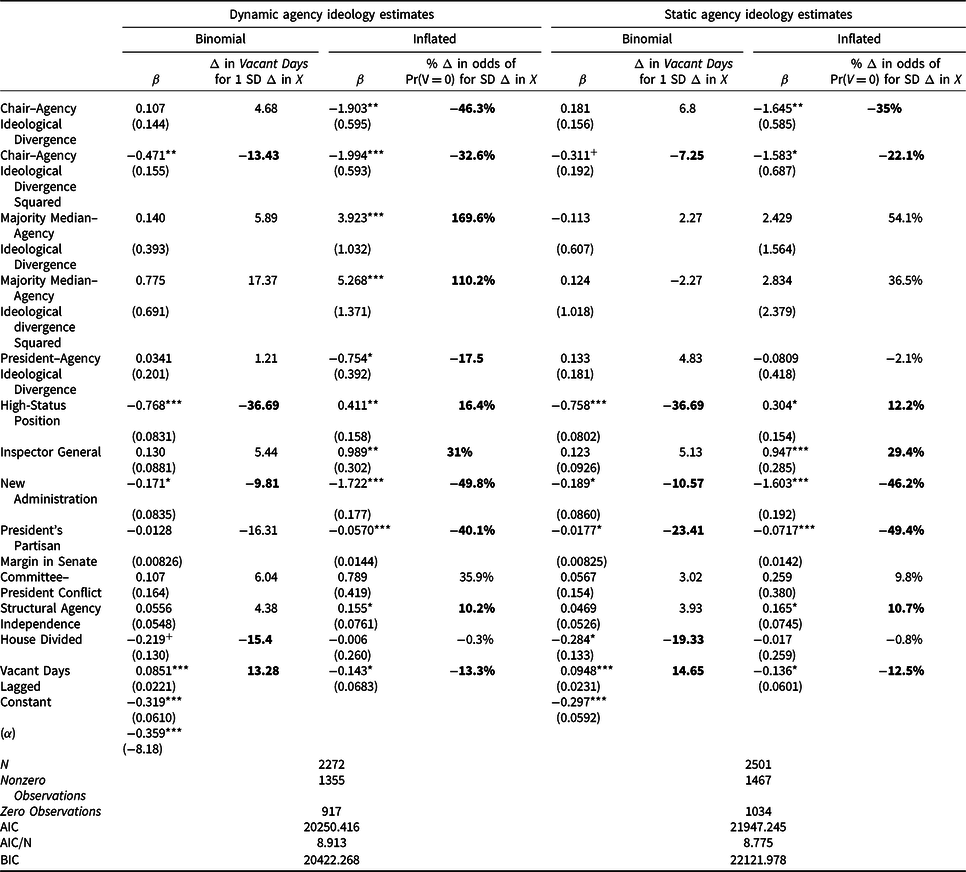
Note: Standard errors in parentheses, clustered on agency (31 clusters). Fixed effects for presidents.
+ p < 0.1, *p < 0.05, **p < 0.01, ***p < 0.001 (two-tailed tests).
Our hypotheses regarding position status find relatively strong support. For example, a change from 0 to 1 for the dichotomous variable High Status will result in an associated 12.2–16.4% increase in the likelihood that there will be zero V associated with that position, whereas a High Status position is also associated with 37 fewer V, on average, than other positions (conditional on a vacancy onset). In line with H1 and H4, these findings hold statistical significance and substantive consistency across both the dynamic and static agency ideology estimate models.
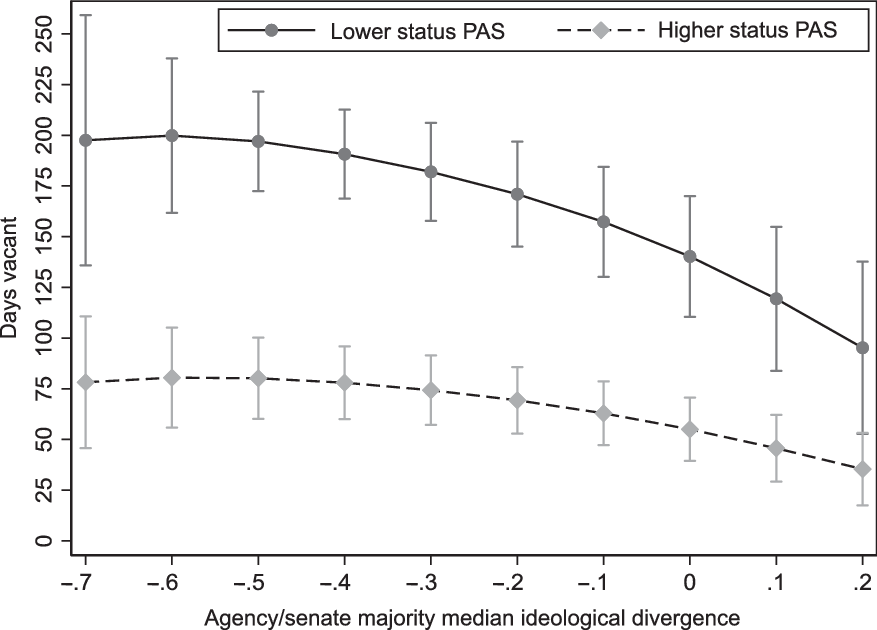
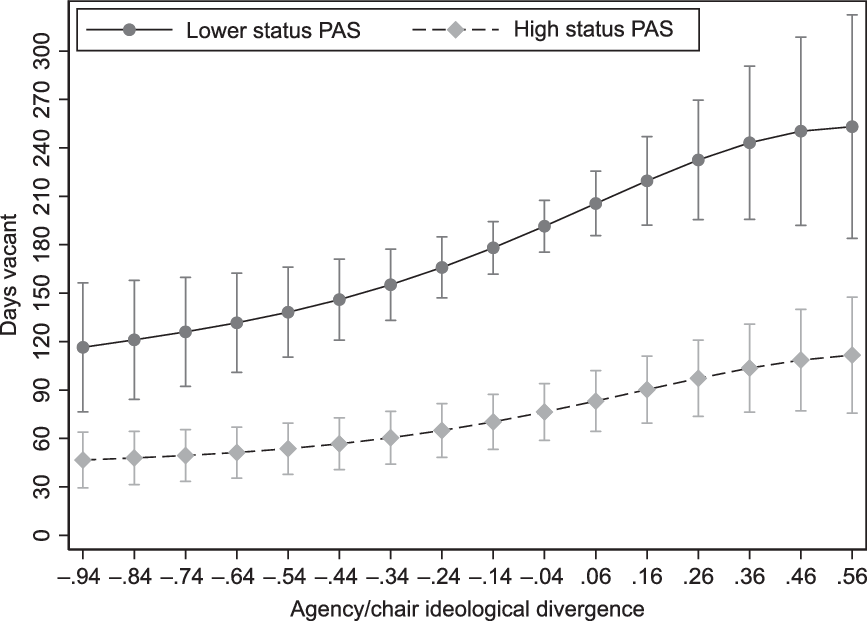
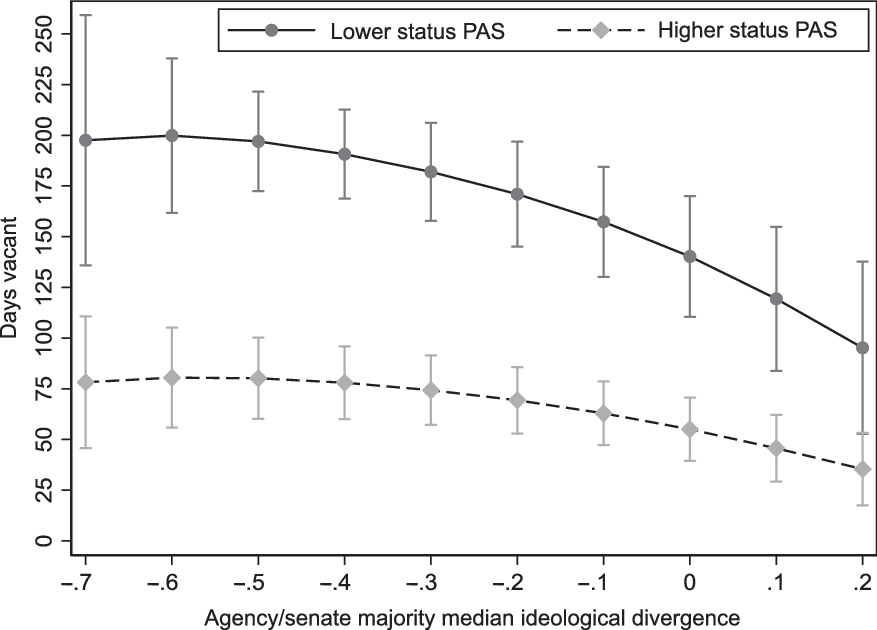
Additionally, Hypothesis 3 appears not to be supported in our analysis. We find that there is a statistically significant negative relationship in the logit portion of the model between V and the quadratic term for Chair–Agency Ideological Divergence, whereas the positive relationship for Senate Median–Agency Ideological Divergence does not hold statistical significance in the static agency ideology model. However, we do have some indication from Table 2 that there is support for Hypothesis 2. To consider both the quadratic term and the conditional nature of that hypothesis, we provide Figures 2 & 3 as the clearest way to interpret the model’s results.
Predictive margins of PAS status by agency–senate majority median ideological divergence.
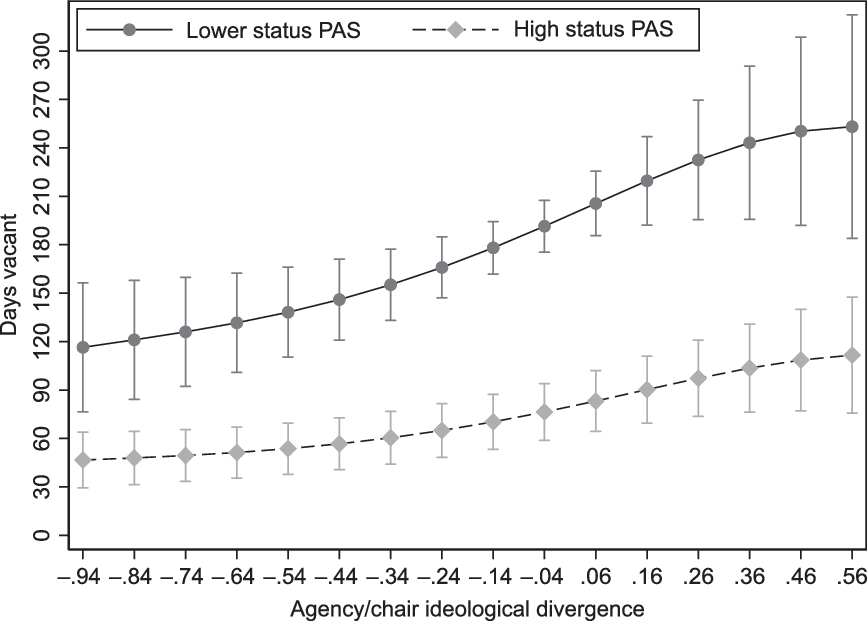
Predictive margins of PAS status by agency–chair ideological divergence.
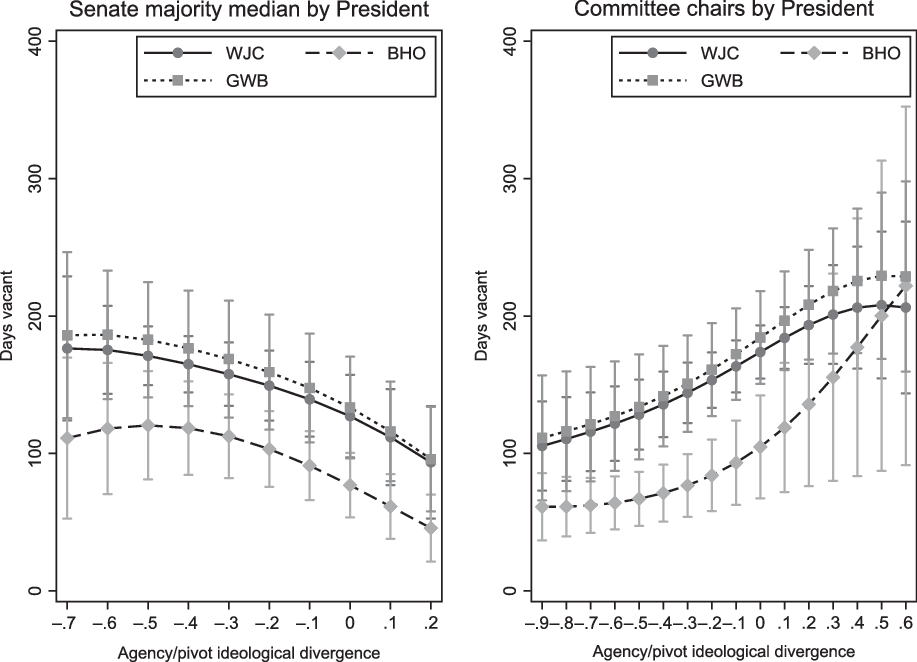
In assessing the two pivots separately, we find some indication of the curvilinear relationship that we expected. Findings for the majority median voter indicate that there are fewer V as a function of ideological divergence between the Senate majority median and the agency in the direction of the opposition’s base. That difference, however, is small and only holds true in comparison with agencies divergent at the party’s extreme, therefore forcing us to reject H2 when testing it using the majority party median. This effect washes out when estimating agency ideology on a static basis and including observations from the George H. W. Bush administration.
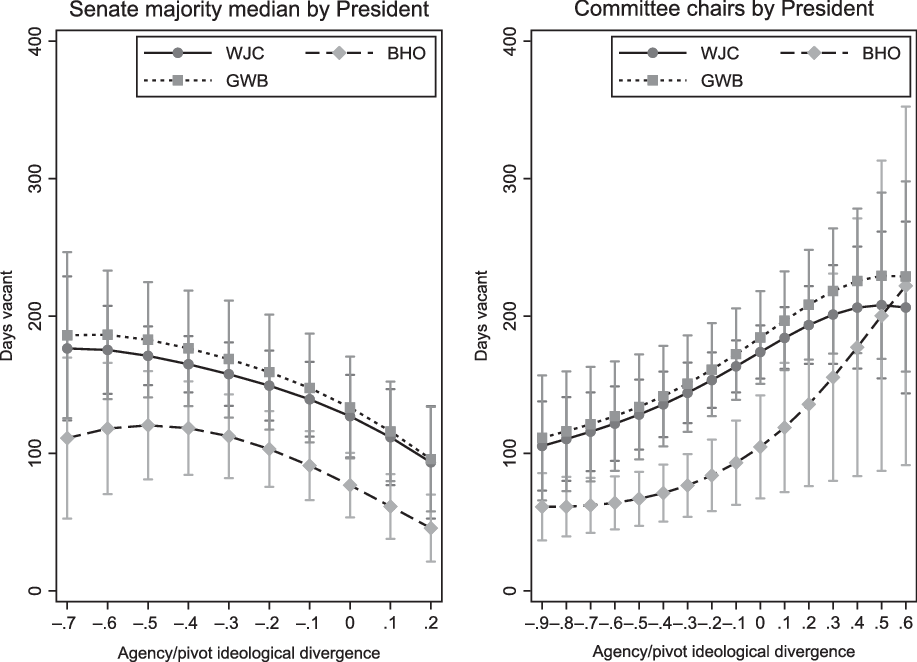
At the same time, the distribution of ideological divergence is much wider when comparing agencies to their respective committee chairs. In that relationship, as an agency preference diverges from the chair and towards their party’s base, there is a dramatic decrease in the length of vacancy. At the extreme, this divergence as much as halves the V per congress in lower-level appointments. This finding holds across both the dynamic and static agency ideology estimates. Hence, we can make the argument that ideological divergence between key Senate pivots and a given agency does lead to a decrease in vacancy days, but on four conditions: (1) this relationship depends on the key Senate pivot (i.e. the committee chair); (2) holds only for agency divergence towards the party’s own extreme preference;Footnote 27 (3) holds only for lower status PAS and (4) in respect to whether there is, first, a vacancy at all. As indicated in Figure 4, the relationship for either Senate pivot is consistent substantively across presidencies.
Predictive margins of presidents by agency–pivot ideological divergence.
As for the control variables, there are several interesting results. For the purpose of brevity, we focus on the relationship between the president and a given agency and its potential impact on V. It appears by the results that the President’s relationship to a given agency has less influence than might otherwise be expected on the onset of a position vacancy. There is no consistent effect on the likelihood of vacancy onset by whether an agency is ideologically opposed to the preferences of a given president. We also find little indication of a relationship between President–Agency Ideological Divergence and V (i.e. conditional on vacancy onset).
Together, our findings are consistent with Bertelli and Grose (Reference Bertelli and Grose2011) in that they provide evidence the Senate seeks to exercise more administrative influence through the appointment process than previously thought. If an agency is ideologically predisposed against a Senate majority’s interests in a given policy domain (as reflected by the relevant committee chair’s), then it might behove that majority to install leadership that it has a role in placing in comparison to future coalitions making that placement or maintaining the status quo preferences of an agency that is substantially divergent. At the same time, because a president is likely to suffer from an accrual of nonpolicy penalties, putting an appointee in place in a Senate-opposed agency may likely give the agency a political buffer to advance policy. Though they may provide more nuance than our theoretical model, our empirical results are in line with most of our predictions regarding the roles of position status and Senate–agency conflict.
All that said, our findings regarding the primacy of the committee chair are rather novel and, despite the consistent finding that most nominations die before reaching the floor (Bonica et al. Reference Bonica, Chen and Johnson2015; Krutz et al. Reference Krutz, Richard and Bond1998), are somewhat distinct from previous findings that have focused on other ideological or partisan mechanics; indeed, Bonica et al. (Reference Bonica, Chen and Johnson2015) is one of the very few studies on executive appointments that examines the role of committee chairs. However, the unique institutional power of the chair relative to other key actors, the greater informational advantages possessed by committees (Epstein Reference Epstein1997; Gilligan and Krehbiel Reference Gilligan and Krehbiel1990; Krehbiel Reference Krehbiel1991), as well as the possibility that committees are composed of “preference outliers” or “high demanders” relative to the legislature as a whole (Adler and Lapinski Reference Adler and Lapinski1997; Snyder Reference Snyder1992; Weingast and Marshall Reference Weingast and Marshall1988) suggest that committees might possess heretofore understudied influence on the advise and consent process, at least relative to other key partisan and/or institutional actors.Footnote 28
Conclusion
In Federalist #37, James Madison acknowledges that “a frequent change of measures from a frequent change of men” may reduce the government’s capacity to govern. Madison’s Constitution sought to balance what he called energy and stability, noting that “energy in government requires not only a certain duration of power but also the execution of it by a single hand.” During the 20th Century, expanding numbers of appointee positions and growing workloads on both ends of Pennsylvania Avenue created new concerns about the tradeoff between energy and stability. No aspect of the appointments process better illustrate the costs and tradeoffs, than the persistence of long-term vacancies.
In this article, we analyse the frequency and duration of appointee vacancies, highlighting two overriding factors: position status and the Senate’s efforts to influence the bureaucracy. High-ranking positions and positions responsible for heading an agency are associated with fewer vacancies. Additionally, when Senate and agency preferences are not aligned, our analysis indicates more likely appointee placements and continuity. The word “acting” may erode authority, shorten horizons and create uncertainty that pervades administrative commitments (O’Connell Reference O’Connell2009). Conversely, acting officials may be capable experts whose institutional competence enables them to negotiate sensitive issues.
What are the consequences of appointee vacancies for leadership continuity and agency administration? Appointee vacancies may limit the reach of presidential administration and symbolically weaken the chain of electoral accountability binding federal agency bureaucracies to the Constitution (Aberbach and Rockman Reference Aberbach and Rockman2000; Mendelson Reference Mendelson2011; Stephenson Reference Stephenson2013). From the point of view of Congress, however, they can have a counterbalancing effect.
While vacancies resulting from long delays in nomination and confirmation may exacerbate the recruitment of competent nominees willing to endure an extended appointment process (Hollibaugh Reference Hollibaugh2015), they can also be seen as “[handing] the keys to bureaucrats,”Footnote 29 thereby maintaining the status quo and responsiveness to the Senate when agency outputs are ideologically aligned to the preferences of the Senate. Committee and agency staff may prefer working with acting officials they deem more reliable (Mendelson Reference Mendelson2011; Resh Reference Resh2014).
We encourage further attention and work from scholars on the implications that vacancies have on bureaucratic behavior and agency outputs. The first step in understanding the effects of vacancies is to map the dynamics that determine this unique feature of American politics. Here, we present both a novel dataset that helps advance scholarship on the phenomenon of appointee vacancies, generally. From these data, we provide empirical results of a theoretically derived model that is the first to incorporate both vacancy onset and vacancy length as a function of Senate–agency relations.
Data Availability Statement
Replication materials are available in the Journal of Public Policy Dataverse at https://doi.org/10.7910/DVN/FYTCEW.
Supplementary material
To view supplementary material for this article, please visit https://doi.org/10.1017/S0143814X20000215.
Acknowledgement
The authors thank both the editor and the reviewers for their perspicacious insights throughout the review process. We also thank the several doctoral and masters students who contributed to the data collection central to this work.