Introduction
Patients with chronic fatigue syndrome (CFS) have severe fatigue lasting longer than 6 months. The fatigue is not the result of a known organic disease or ongoing exertion, not alleviated by rest and leads to substantial functional impairment (Fukuda et al. Reference Fukuda, Straus, Hickie, Sharpe, Dobbins and Komaroff1994; Reeves et al. Reference Reeves, Lloyd, Vernon, Klimas, Jason, Bleijenberg, Evengard, White, Nisenbaum and Unger2003). Several systematic reviews and controlled trials have shown that cognitive behaviour therapy (CBT) leads to a significant reduction in symptoms and disabilities in patients with CFS (Malouff et al. Reference Malouff, Thorsteinsson, Rooke, Bhullar and Schutte2008; Price et al. Reference Price, Mitchell, Tidy and Hunot2008; White et al. Reference White, Goldsmith, Johnson, Potts, Walwyn, DeCare, Baber, Burgess, Clark, Cox, Bavinton, Angus, Murphy, Murphy, O'Dowd, Wilks, McCrone, Chalder and Sharpe2011). CBT is aimed at cognitions and behaviours assumed to perpetuate the fatigue. It is a safe treatment and a subgroup of patients fully recovers (Knoop et al. Reference Knoop, Bleijenberg, Gielissen, van der Meer and White2007; Heins et al. Reference Heins, Knoop, Prins, Stulemeijer, van der Meer and Bleijenberg2010; White et al. Reference White, Goldsmith, Johnson, Potts, Walwyn, DeCare, Baber, Burgess, Clark, Cox, Bavinton, Angus, Murphy, Murphy, O'Dowd, Wilks, McCrone, Chalder and Sharpe2011).
CBT for CFS is an intensive treatment, with 13–16 sessions depending on the protocol used (Sharpe et al. Reference Sharpe, Hawton, Simkin, Surawy, Hackmann, Klimes, Peto, Warrell and Seagroatt1996; Prins et al. Reference Prins, Bleijenberg, Bazelmans, Elving, de Boo, Severens, van der Wilt, Spinhoven and van der Meer2001; Quarmby et al. Reference Quarmby, Rimes, Deale, Wessely and Chalder2007; Scheeres et al. Reference Scheeres, Wensing, Knoop and Bleijenberg2008b ). There is evidence that not all patients need such intensive treatment. Knoop et al. (Reference Knoop, van der Meer and Bleijenberg2008) showed, in a randomized controlled trial (RCT), that a minimal intervention for CFS, guided self-instruction, leads to a significant decrease in fatigue and disabilities. For a subgroup of patients, the minimal intervention sufficed. If the minimal intervention was not successful, patients needed substantially fewer sessions of additional CBT, compared to patients who were referred directly for regular CBT (Tummers et al. Reference Tummers, Knoop and Bleijenberg2010). The minimal intervention consisted of a booklet with instructions, based on the protocol of CBT for CFS, and 2-weekly email contact with a therapist.
Guided self-instruction was delivered at a tertiary university hospital with the guidance of qualified cognitive behavioural therapists, who had extensive experience in treating patients with CBT for CFS. In The Netherlands, there is a lack of treatment capacity for patients with CFS (Gezondheidsraad, 2005). To increase treatment capacity it is necessary to offer evidence-based treatments for CFS outside specialized treatment settings. The objective of this study was to test whether the minimal intervention was also effective when delivered at a community-based mental health centre (MHC). An MHC in the southwest of The Netherlands was chosen as the clinical practice setting. This centre had not previously treated CFS patients. Psychiatric nurses, novices with respect to CBT and the treatment of CFS, were trained to deliver the minimal intervention.
Method
Patients
Patients could participate in the study (NTR1223) if they had been referred by a general practitioner (GP) or consultant to GGZ WNB, a Dutch regional community-based MHC in the southwest of The Netherlands, and were diagnosed as having CFS according to the US Centers for Disease Control and Prevention (CDC) criteria (Fukuda et al. Reference Fukuda, Straus, Hickie, Sharpe, Dobbins and Komaroff1994; Reeves et al. Reference Reeves, Lloyd, Vernon, Klimas, Jason, Bleijenberg, Evengard, White, Nisenbaum and Unger2003). All referred patients, aged between 18 and 65 years, received a baseline assessment. In accordance with the CDC criteria for CFS, patients were eligible to enter the study if they (1) were severely fatigued, operationalized as scoring ⩾35 on the subscale fatigue severity of the Checklist Individual Strength (CIS; Vercoulen et al. Reference Vercoulen, Swanink, Fennis, Galama, van der Meer and Bleijenberg1994), (2) were fatigued for 6 months or longer, (3) were severely disabled, operationalized as scoring ⩽70 on the physical and/or social functioning subscale of the Medical Outcomes Survey Short Form-36 (SF-36; Stewart et al. Reference Stewart, Hays and Ware1988), and (4) reported at least four out of eight additional symptoms: unrefreshing sleep, post-exertional malaise, headache, muscle pain, multi-joint pain, sore throat, tender lymph nodes and impairment of concentration or memory (Fukuda et al. Reference Fukuda, Straus, Hickie, Sharpe, Dobbins and Komaroff1994; Reeves et al. Reference Reeves, Lloyd, Vernon, Klimas, Jason, Bleijenberg, Evengard, White, Nisenbaum and Unger2003). The assumption was made that the referring GP or consultant excluded the presence of somatic diseases or psychiatric disorders and the use of medication that could explain the fatigue.
Design and procedures
The study was an RCT in which the minimal intervention was compared to a waiting list. The ethics committee of the Radboud University Nijmegen Medical Centre approved the study. Referred patients were contacted by telephone to ascertain that they understood they were being referred for a study investigating the effectiveness of a minimal intervention for CFS. Patients who were willing to participate were given verbal information and sent written information about the study. After written informed consent was obtained, patients were requested to complete a set of questionnaires to assess fatigue severity, duration of the fatigue, number of CDC symptoms and level of disabilities, and also to gain information on medication use and self-reported level of psychopathology, including depressive symptoms. If the diagnosis of CFS was doubtful, based on this assessment and/or the referral letter, a CFS expert contacted the referring GP or consultant for additional information to evaluate whether the diagnosis CFS was justified. Eligibility was examined again during the 30-min intake session with the psychiatric nurse, who asked the patient about the presence of somatic or psychiatric conditions other than CFS. If they were present, the nurse contacted the researcher who informed the CFS expert. If necessary, the expert contacted the GP or consultant for additional information. If the diagnosis of CFS could be confirmed, the patient was included in the study. Furthermore, psychiatric nurses were instructed to temporarily exclude patients who were engaged in a legal procedure concerning disability-related financial benefits. This was done because a previous intervention study had shown that being engaged in such a procedure predicted a negative treatment outcome (Prins et al. Reference Prins, Bazelmans, van der Werf, van der Meer, Bleijenberg, Sivik, Byrne, Lipsitt, Cristodoulou and Dienstfrey2002). During the intake session, the nurse who coached the patient during the minimal intervention explained the goals of guided self-instruction to the patient. Randomization took place at the end of the session. If a patient was assigned to guided self-introduction, they were advised to stop other treatments for fatigue (Prins et al. Reference Prins, Bleijenberg, Bazelmans, Elving, de Boo, Severens, van der Wilt, Spinhoven and van der Meer2001).
To ensure concealed allocation, a statistical advisor, independent of the study, prepared numbered and sealed envelopes by coding them according to a computer-generated list of random numbers. Randomization was performed in blocks of six. During the intake session, in the presence of the patient, the psychiatric nurse telephoned the researcher, who opened the next envelope and stated the condition to which the patient had been assigned. The name of the patient was written on the envelope before it was opened, to prevent resealing and reusing. Group allocation was open to all those involved. Patients who were allocated to the waiting list received the minimal intervention after a delay of 6 months. Patients in both conditions were assessed at baseline and directly following the waiting period or intervention. If patients were not willing to fill in all of the questionnaires at the second assessment, they were asked to complete only the two questionnaires assessing the primary outcome variables.
Intervention
The guided self-instruction consisted of a booklet (58 pages) with information about CFS and assignments (Knoop et al. Reference Knoop, van der Meer and Bleijenberg2008). Patients could follow the programme, described in the booklet, week by week. The intervention was based on the protocol of CBT for CFS and took at least 20 weeks (Vercoulen et al. Reference Vercoulen, Swanink, Galama, Fennis, Jongen, Hommes, van der Meer and Bleijenberg1998).
The first chapter in the booklet challenges patients to establish the goals of the therapy. In the following chapters the precipitating (triggering) and perpetuating (maintaining) factors are explained and individualized. Fatigue-related cognitions are challenged and patients are encouraged to develop a sense of control over their symptoms. In the third chapter patients learn to reduce the focus on fatigue. Subsequently, the patients establish a sleep routine as described in chapter 4. Chapter 5 explains to patients that there are two different physical activity patterns: a relative-active and a low-active pattern. Relatively active patients, characterized by an alternation of periods of (over)activity and periods of rest, first have to learn to divide their activities more evenly (chapter 6). Then they gradually increase their physical activity level, by walking or riding a bicycle. Patients with a low-active physical activity pattern start immediately with gradually increasing their physical activity level (chapter 7). In chapter 8, beliefs that activity would exacerbate symptoms are challenged. Chapter 9 invites patients to make a plan for work resumption. This plan contains the date when a patient will resume work, and how the patients will increase the number of hours worked. The next module is directed at modifying the patients excessive expectations regarding the response of their social environment to their symptoms. Often patients experience a lack of understanding from others. Patients learn how to communicate about CFS. In chapters 11 and 12 patients gradually increase their mental and social activities. In chapter 13, patients attain the goals as formulated in chapter 1 step by step, including resumption of work. Finally, in the last two chapters, patients learn how to prevent a relapse and how to further improve self-control.
The booklet was sent to the patients after randomization. During the intake session, the patients who were assigned to the intervention were asked to email once every 2 weeks. This enabled patients to ask questions about the treatment and nurses to monitor the progress patients made. If a patient did not email every 2 weeks, the nurse sent a reminder. The intervention was carried out by eight psychiatric nurses. They were trained in coaching patients with the minimal intervention in four training sessions of 4 h, in which they practised writing replies to emails. After the training, the nurses were given a test to evaluate their skills. This test, passed by all nurses, consisted of writing replies to emails of fictitious patients. The nurses received 2-weekly supervision by a cognitive behavioural therapist experienced in CBT for CFS.
The minimal intervention is adapted for two levels of physical activity: a relative-active and a low-active pattern of activity (van der Werf et al. Reference van der Werf, Prins, Vercoulen, van der Meer and Bleijenberg2000). Activity patterns are usually assessed with an actometer, a small device worn around the ankle, and activity levels are assessed over a period of 12 days. However, as this was an implementation study, actometers were not available because of the high costs involved. Instead, the Physical Activity Questionnaire (PAQ) was used to gain an insight into the physical patterns (Goedendorp et al. Reference Goedendorp, Peters, Gielissen, Witjes, Leer, Verhagen and Bleijenberg2010). Using a regression analysis in a group of 120 CFS patients, for whom both PAQ and actometer scores were available, the parameters were obtained for a formula that predicted the patients' activity patterns assessed with the actometer using the PAQ. The optimum cut-off score for the PAQ was set at 0.75, for which a sensitivity of 74.0% and a specificity of 79.2% were reached. If patients did not agree with their assignment to one of the two conditions, they were free to switch.
Outcome measures
The questionnaires were given at baseline and post-treatment or after the waiting list (6 months after baseline assessment). The primary end-points were fatigue severity and disabilities. Psychological distress was a secondary end-point.
Fatigue
Fatigue was measured with the fatigue severity subscale of the CIS. This subscale assesses fatigue severity over the past 2-week period. The questionnaire consists of eight items that have to be answered on a seven-point scale, with scores ranging from 8 (no fatigue) to 56 (severe fatigue). Reference values for healthy Dutch subjects are 17.3±10.1 (Vercoulen et al. Reference Vercoulen, Alberts and Bleijenberg1999). The CIS has good internal consistency, and discriminative validity, and is sensitive to change detection (Vercoulen et al. Reference Vercoulen, Swanink, Fennis, Galama, van der Meer and Bleijenberg1994).
Disabilities
The level of disabilities was assessed with the SF-36 subscales ‘physical functioning’ and ‘social functioning’. These subscales measure the extent to which health interferes with a variety of activities. Scores on both subscales range from 0 (maximum limitations) to 100 (no limitations). Reference values for healthy Dutch subjects for physical and social disabilities are 83.0±22.8 and 84.0±22.4 respectively (Aaronson et al. Reference Aaronson, Muller, Cohen, Essink-Bot, Fekkes, Sanderman, Sprangers, te Velde and Verrips1998). The SF-36 is a reliable and valid instrument (Stewart et al. Reference Stewart, Hays and Ware1988).
Psychological distress
This was assessed with the Brief Symptom Inventory (BSI; Derogatis & Melisaratos, Reference Derogatis and Melisaratos1983), which consists of 53 items scored on a five-point Likert scale. The BSI is a brief form of the Symptom Checklist 90 (SCL-90; Derogatis, Reference Derogatis1994). The general severity index, which combines the number of symptoms and the intensity of the perceived distress brought on by the symptom, was used as an indicator of the current distress level.
Significant clinical improvement
To determine whether the changes in fatigue severity were clinically meaningful, a cut-off score for significant clinical improvement was used. Patients were regarded as significantly clinically improved with respect to fatigue if (1) the change in fatigue was statistically reliable (reliable change index >1.96) (Jacobson & Truax, Reference Jacobson and Truax1991) and (2) the fatigue score at post-treatment was <35 on the CIS subscale fatigue severity. This latter score is within 2 standard deviations (s.d.) of the mean for healthy adults and below 2 s.d. of the mean for CFS patients (Knoop et al. Reference Knoop, Bleijenberg, Gielissen, van der Meer and White2007).
Analysis
Power calculation showed that, to reach a clinical relevant change of 5.5 points on the subscale fatigue severity of the CIS, assuming a significance of 5%, a power of 85% and a drop-out rate of 20%, 60 patients were needed in each condition. Calculations were based on the results of the study testing the efficacy of guided self-instruction for CFS in a tertiary treatment facility (Knoop et al. Reference Knoop, van der Meer and Bleijenberg2008).
Data analyses were performed using SPSS version 16.0 (SPSS Inc., USA). Independent-samples t tests and χ2 tests were used to determine whether there were differences in the patient characteristics at baseline between the two conditions. Analyses of the treatment effect were performed using mixed models. Both baseline and second assessment measurements were used as dependent variables, and occasion (pre/post), condition (guided self-instruction/waiting list) and an interaction variable of both were the independent variables. Because of randomization we did not expect any differences at baseline between the two conditions. This made it possible to use the occasion by condition interaction to test the effect of the treatment. Two modelling alternatives were used. The more complex model allowed for a correlation between measurements of the same subjects on the two occasions, together with different variances at baseline and after guided self-instruction or the waiting period. The simpler model assumes a heterogeneous compound symmetry structure for occasion, thus effectively assuming the post-treatment variances in both conditions to be equal.
Comparisons were performed on all observed data. Significance was assumed at p<0.017 in mixed model analyses (0.05 divided by 3, i.e. the number of primary outcome variables).
Differences between the two conditions in the proportion of patients with a significant clinical improvement were examined with χ2 tests on the completers. Controlled effect sizes for fatigue severity, physical and social functioning were also calculated [(mean difference intervention – mean difference control group)/s.d. pooled] (Cohen, Reference Cohen1988) for the completers and compared to the previous study (Knoop et al. Reference Knoop, van der Meer and Bleijenberg2008). A sensitivity analysis was undertaken to test the robustness of the results of the mixed model analysis. Missing values at post-treatment results were replaced by using the last observation carried forward (LOCF) method.
The inclusion criterion that a patient must have disabilities at the level of physical and/or social functioning meant that not all patients experienced disabilities in physical and social functioning. This meant that some patients could not show the expected increase in physical or social functioning following the minimal intervention as they had already scored within the non-disabled range (>70), leading to a reduction in statistical power for these outcome measures. Therefore, post-hoc analyses were performed for the subgroups of patients who did experience disabilities in physical or social functioning. Analysis of the treatment effect using mixed models was repeated for the subgroup of patients who scored ⩽70 on the subscale physical functioning, and the subgroup who scored ⩽70 on the subscale social functioning. Significance was assumed at p<0.05 for all post-hoc analyses.
Results
Study population
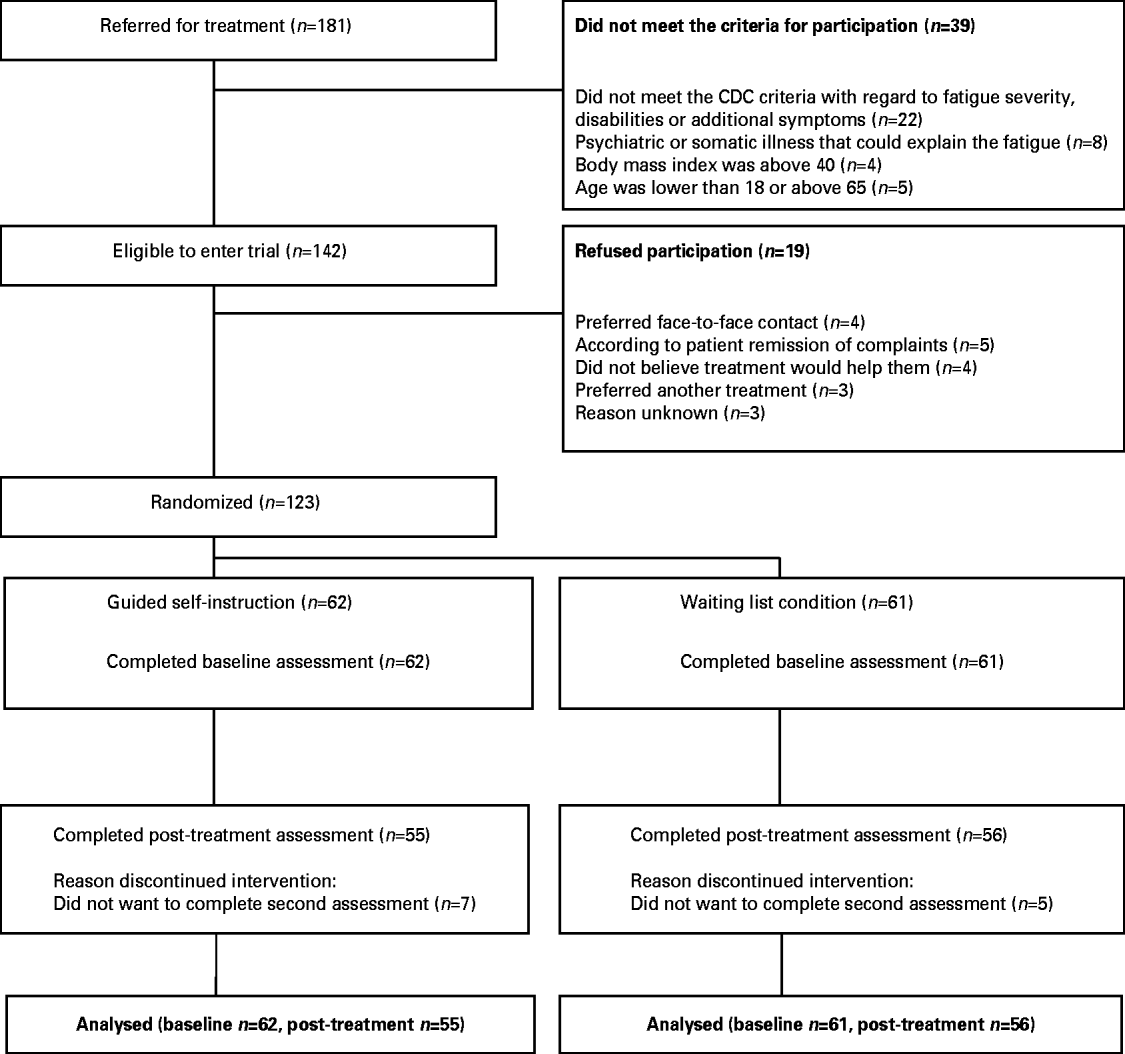
Fig. 1 shows the trial profile. Of the 181 patients referred between February 2008 and January 2010, 142 (78%) were eligible to enter the trial. Reasons for exclusion were failure to meet the inclusion criteria for CFS with regard to fatigue severity, disabilities and additional symptoms (22%), presence of psychiatric or somatic illness (4%), body mass index (BMI) >40 kg/m2 (2%), and aged <18 or >65 years (3%). Nineteen patients (13%, 19/142) refused to take part in the study because they preferred face-to-face contact, experienced remission of complaints, had no faith in treatment or preferred another treatment. For three patients the reason for refusal was unknown.
Flow of participants through the study.

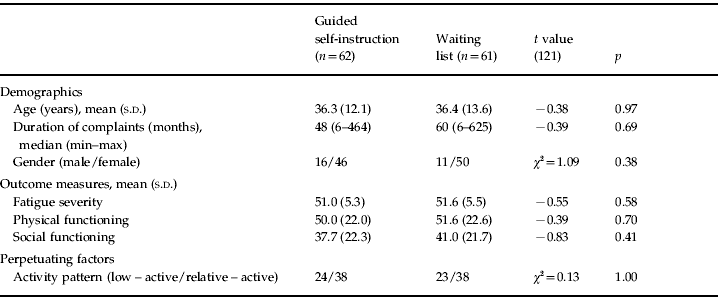
The remaining 123 patients were randomly assigned to guided self-instruction (n=62) or the waiting list (n=61). In the intervention condition, 55 (89%) patients had a complete assessment, including three patients who filled out the shortened post-treatment assessment. Fifty-six (92%) patients, including four patients who completed the abridged questionnaire, had complete data after the waiting period. Baseline characteristics showed no significant imbalances after randomization (Table 1). During the study, for 12 patients the diagnosis of CFS turned out to be incorrect: four patients had a possible somatic explanation for their fatigue (e.g. brain damage), and eight patients seemed to have a psychiatric co-morbidity, of whom two had a substance-related disorder. The 12 patients were equally distributed between the two conditions. None of these patients were excluded from analyses.
Baseline characteristics and comparison of guided self-instruction versus waiting list

s.d., Standard deviation.
As the results (conclusions and confidence intervals) from the simpler model were identical to the results from the more complex model, the results from the simpler model are presented for all analyses.
Efficacy of the minimal intervention
The second assessment was planned 6 months after the baseline assessment. However, not all patients returned the questionnaires immediately, resulting in variation in the time passed between the two assessments. There was no significant difference in the mean time passed from baseline to second assessment between the intervention condition (8.2 months, s.d.=3.6) and the waiting list condition (7.4 months, s.d.=3.5) (t=1.23, df=109, p=0.16). In the intervention condition there was no significant correlation in the time passed between the two assessments and change in fatigue severity (r=0.01, p=0.48). During guided self-instruction the nurses sent a mean of 12.3 (s.d.=5.4) emails per patient. Patients sent a mean number of 8.8 (s.d.=5.4) emails. There was no significant correlation between the numbers of emails sent by the patients and change in fatigue severity (r=–0.12, p=0.39).
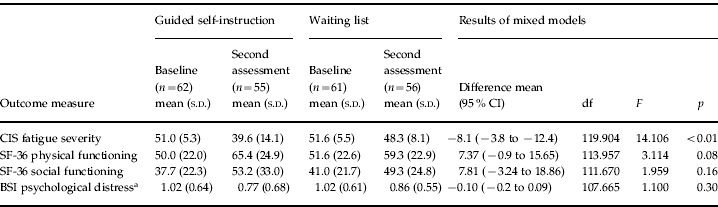
Primary analyses were based on all observed data. Patients in the intervention condition reported a significantly greater decrease in fatigue severity. For the outcome measures physical functioning, social functioning and psychological distress, the contrast was not significantly different between the two conditions. Mean, standard deviation and confidence interval on the outcome variables are presented for completers (Table 2).
Change in outcome between baseline and post-treatment for the primary and secondary outcome variables

CIS, Checklist Individual Strength; SF-36, Medical Outcomes Survey (MOS) Short Form-36; BSI, Brief Symptom Inventory; CI, confidence interval; df, degrees of freedom.
a For the secondary outcome measure, psychological distress, only 52 patients completed post-treatment assessment in both conditions.
The mean, standard deviation (s.d.) and confidence interval (CI) on the outcome variables at the second assessment are presented for the completers. The results of the mixed models are based on all observed data.
After guided self-instruction, 33% of the completers showed a significant clinical improvement in fatigue. This percentage was significantly larger compared to the waiting list condition (9%) (Table 3).
Comparison of proportion of significant clinical improvement in CIS fatigue severity

CIS, Checklist Individual Strength; OR, odds ratio; CI, confidence interval.
The controlled effect size was 0.70 for fatigue severity and 0.32 and 0.29 for physical functioning and social functioning respectively. The controlled effect sizes of the previous trial were 0.67 for fatigue and 0.40 for physical functioning (Knoop et al. Reference Knoop, van der Meer and Bleijenberg2008). The subscale social functioning was not reported in the study of Knoop et al. (Reference Knoop, van der Meer and Bleijenberg2008).
The results of the sensitivity analyses on the three primary outcome variables were not different from the mixed model analyses (data not shown).
Post-hoc analyses
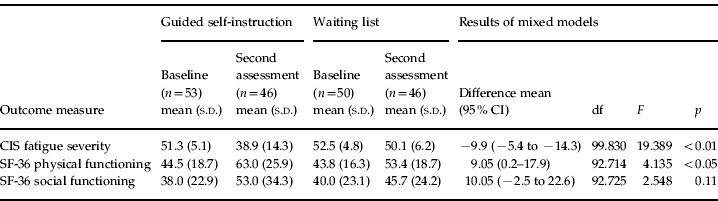
Table 4 shows the data from the post-hoc analyses for patients with a score of ⩽70 on the subscale physical functioning at baseline (guided self-instruction n=53, waiting list n=50). There was a significant difference between the minimal intervention and the waiting list for fatigue severity and physical functioning. There was no significant difference in social functioning. In the subgroup of patients with a score of ⩽70 on the subscale social functioning (guided self-instruction n=58, waiting list n=55), a significant difference was found in fatigue severity between the two conditions (F ratio=13.728, df=109.705, p<0.01). There were no significant differences in physical and social functioning (respectively, F ratio=2.505, df=104.726, p>0.05 and F ratio=1.248, df=101.223, p>0.05).
Change in outcome between baseline and post-treatment for the subgroup SF-36 physical functioning is ⩽70 at baseline

CIS, Checklist Individual Strength; SF-36, Medical Outcomes Survey (MOS) Short Form-36; s.d., standard deviation; CI, confidence interval; df, degrees of freedom.
Discussion
The aim of this study was to evaluate whether guided self-instruction, a minimal intervention for CFS carried out by psychiatric nurses, was effective when implemented in an MHC. The results show a significant reduction in fatigue after the intervention compared to the waiting list. Significantly more patients reported a significant clinical improvement in fatigue following guided self-instruction. No significant differences were found on the other two primary outcome variables, physical functioning and social functioning, although there was a trend in the favour of the intervention. The level of psychological distress was not significantly different between the two conditions at the second assessment. Controlled effect sizes for fatigue severity and physical functioning were similar to those in the previous trial testing the effectiveness of guided self-instruction for CFS (Knoop et al. Reference Knoop, van der Meer and Bleijenberg2008). A significant reduction in fatigue and physical functioning was found in the subgroup of patients who reported substantial impairments in physical functioning at baseline. We conclude from these data that implementation of guided self-instruction in an MHC was partially successful. It does lead to a reduction in fatigue, and in the subgroup of patients with physical disabilities, physical functioning also improves significantly. The criterion that patients with CFS must report impairments in physical functioning is often applied in studies testing the efficacy of behavioural interventions (Price et al. Reference Price, Mitchell, Tidy and Hunot2008; Scheeres et al. Reference Scheeres, Wensing, Knoop and Bleijenberg2008b ; White et al. Reference White, Goldsmith, Johnson, Potts, Walwyn, DeCare, Baber, Burgess, Clark, Cox, Bavinton, Angus, Murphy, Murphy, O'Dowd, Wilks, McCrone, Chalder and Sharpe2011). The results of this study justify a broader implementation of guided self-instruction for those CFS patients who report impairments in physical functioning.
Following the intervention, one-third of the patients reported significant clinical improvement in fatigue. This is less than the 48% reported by CFS patients after regular face-to-face CBT (Tummers et al. Reference Tummers, Knoop and Bleijenberg2010). Guided self-instruction could form the first step in stepped care for CFS, followed by additional CBT, if desirable. It has been shown that patients can profit from CBT after the minimal intervention. In the same study it was found that treatment outcome for stepped care, guided self-instruction, if necessary followed by additional CBT, is not inferior to the outcome of regular CBT (Tummers et al. Reference Tummers, Knoop and Bleijenberg2010).
Besides impairments in physical functioning, patients with CFS also report impairments in other domains of functioning. In the previous RCT testing the efficacy of guided self-instruction (Knoop et al. Reference Knoop, van der Meer and Bleijenberg2008), the Sickness Impact Profile (SIP; Jacobs et al. Reference Jacobs, Luttik, Touw-Otten and de Melker1990) was used to assess disabilities in all domains of functioning. The disabilities were found to decrease significantly following the intervention. However, because of the duration of the SIP and its complex scoring method, it was less suitable for this implementation study. We therefore decided to use the subscale social functioning of the SF-36 (Stewart et al. Reference Stewart, Hays and Ware1988), a questionnaire that is easy to administer and score, and comprises only two questions. It is conceivable that the SF-36 social functioning has limited sensitivity to detect change. To our knowledge, the sensitivity of this subscale to change has never been demonstrated in CFS patients. A recent study showed that the Work and Social Adjustment Scale is a reliable and valid assessment tool for measuring disabilities in work and social functioning in patients with CFS (Cella et al. Reference Cella, Sharpe and Chalder2011). The instrument is also short but sensitive to detecting change brought about by CBT, which makes it suitable for use outside specialized treatment centres. Further research is needed to determine whether not finding significant treatment effects on domains of functioning other than physical functioning is caused by the limited sensitivity of the instrument used or by a reduced efficacy when implementing the intervention outside a specialized treatment setting.
Implementation of behavioural interventions for patients with CFS outside specialized treatment settings is not always successful. Scheeres et al. (Reference Scheeres, Wensing, Knoop and Bleijenberg2008b ) showed that CBT for CFS can be effective in a community-based MHC. Effect sizes for fatigue severity and physical functioning were similar to those of previous RCTs testing the effectiveness of CBT for CFS. However, a recent implementation study found that the effectiveness of CBT for CFS differed significantly between MHCs (Wiborg et al., unpublished observations). A study implementing pragmatic rehabilitation for CFS in primary care showed that fatigue decreased, but no significant effects were found for physical functioning (Wearden et al. Reference Wearden, Dowrick, Chew-Graham, Bentall, Morriss, Peters, Riste, Richardson, Lovell and Dunn2010). A previous hospital-based trial had shown that the same treatment led to a reduction in both fatigue and physical disabilities (Powell et al. Reference Powell, Bentall, Nye and Edwards2001). More research is needed to determine how implementation of behavioural interventions outside specialized treatment settings can be optimized.
By offering guided self-instruction in an MHC instead of in a tertiary treatment centre, it might be assumed that patients would be referred in an earlier stage of their condition. The duration of illness of the CFS patients included in this trial was indeed shorter than that found in the previous study (median duration of complaints was 72 months versus 48 months in the present study; Knoop et al. Reference Knoop, van der Meer and Bleijenberg2008). This suggests that implementation of the minimal intervention results in earlier treatment for CFS patients. However, the median symptom duration is still 48 months, which is long considering that CFS can be diagnosed when patients are severely fatigued for 6 months. By diagnosing CFS in an earlier stage, the suffering of the patient could be reduced, as could the societal and medical costs of the illness. With regard to age, fatigue severity and level of disabilities, the patients who participated in the present study did not differ from the patients in the previous trial (Knoop et al. Reference Knoop, van der Meer and Bleijenberg2008).
This study has some limitations. First, patients could only participate if they fulfilled the operational criteria for CFS. This was assessed on the basis of the referral letter of the GP or consultant, the questionnaires at baseline, and the intake session with the psychiatric nurse. It has been shown that diagnosing CFS on the basis of clinical assessment by a non-CFS specialist can lead to misclassification (Newton et al. Reference Newton, Mabillard, Scott, Hoad and Spickett2010). In our trial we tried to limit misclassifications, (1) by instructing the referring GPs and consultants with brochures, information letters and small group sessions on how to diagnose CFS according to the CDC criteria, (2) by using relevant questionnaires to check if a patient fulfilled the CDC criteria for CFS, and (3) by an intake session with the psychiatric nurse, who asked patients if somatic or psychiatric conditions were present. However, during the trial we had to conclude that 12 patients had psychiatric or medical co-morbidities that could explain the presence of fatigue according to the CDC criteria (Fukuda et al. Reference Fukuda, Straus, Hickie, Sharpe, Dobbins and Komaroff1994; Reeves et al. Reference Reeves, Lloyd, Vernon, Klimas, Jason, Bleijenberg, Evengard, White, Nisenbaum and Unger2003). This became clear during supervision or at the second assessment of patients from the waiting list. In all cases the misclassifications were ascertained by the psychiatric nurse, who had an final interview with the patient at the second assessment, or by a psychologist, who performed an additional assessment. A standardized medical and psychiatric assessment probably would have reduced the number of misclassifications. However, such an assessment is difficult to conduct as part of clinical routine practice. Because this was an implementation study, we deliberately chose a less stringent procedure. Patients who were wrongfully included in this study were not excluded from data analyses, as the effects of the misclassifications on outcome were considered to be a consequence of the chosen implementation strategy.
Second, assessment of the physical activity patterns of patients was not based on actometer scores, a valid and reliable method to determine the activity pattern (van der Werf et al. Reference van der Werf, Prins, Vercoulen, van der Meer and Bleijenberg2000). In the current study a relatively new questionnaire was used to assess the physical activity patterns. When using an actometer, the proportion of relatively active patients is about 75%. In the current study, about 60% of the patients had a relatively active physical activity pattern. Inaccurate allocation to one of the two treatment protocols could have influenced the treatment results.
Third, treatment adherence or treatment dose was not assessed. Patients were asked to email once every 2 weeks about the progress made. The researcher received a copy of all emails sent by the nurses and patients. The number of emails sent by the patient does not give specific information about treatment adherence. Patients were free to decide what they emailed to the therapist, making it difficult to determine adherence from the content of the email. As the emails were discussed in the 2-weekly supervision, it was possible to check if the answers of the psychiatric nurse were in accordance with the treatment protocol. In the previous study testing the efficacy of guided self-instruction, there was no relationship between the number of emails sent by the patient and fatigue severity at the second assessment (Knoop, Reference Knoop2008). Guided self-instruction is a self-paced treatment, which makes it difficult to assess treatment adherence and the dose of treatment received. This is inherent to this type of self-management intervention, where the therapist does not set the pace of the intervention.
Fourth, there are no follow-up data available. As a result, we do not know if the effects of the intervention were sustained once treatment had ended.
This study demonstrated that, after training, less-qualified mental health-care workers without any prior experience in treating CFS patients were able to coach patients during guided self-instruction. There was considerable variability in treatment results between the nurses. The range in clinically significant improvement in fatigue was 17–44% (the nurse who treated only one patient was not taken into account). Because of the limited number of participating nurses and the relatively small number of treated patients per therapist (range 5–11), it was not possible to test for differences in success rates between therapists. This is a shortcoming of the study.
Finally, for implementation of guided self-instruction in an MHC, it is also important to have information about costs and benefits of the treatment for individual patients, the health-care system and society. We did not perform such an analysis. An uncontrolled study (Scheeres et al. Reference Scheeres, Wensing, Bleijenberg and Severens2008a ) established that implementing CBT for CFS in an MHC has a favourable cost outcome ratio from a societal perspective. From a health-care perspective, the outcome of the ratio depended on the value assigned to a clinically significant improvement in CFS.
To conclude, the results of this study suggest that guided self-instruction for CFS, delivered by psychiatric nurses, can be implemented successfully in an MHC for CFS patients with substantial physical disabilities. This increases the prospects of implementation of evidence-based treatments for CFS. Wider implementation of the minimal intervention, preferably in the context of stepped care, would be a logical next step.
Acknowledgements
Grant support was received from the Dutch Medical Research Council ZonMW. ZonMw had no role in the design of the study, data collection, analysis, interpreting results, decision to publish, or preparation of the manuscript. We thank E. Musch and I. de Gucht for assisting in data collection; A. Blaakman, A. de Been, R. van den Bosch, E. Hoppenbrouwers, K. van Kakerken, F. van der Lem, R. Luysterburg and C. de Vries for carrying out the intervention; and R. Donders for advising us on the statistical analysis. [Trial registration no.: NTR1223.]
Declaration of Interest
None.