

Introduction and methodology
In 1821, the Company of Merchants trading to Africa was abolished and all of its property was vested in the British crown. The Company of Merchants had been established by an Act of Parliament in 1750, when the Royal African Company (RAC) was dissolved, and its assets transferred to the newly formed company. Upon the Company’s economic decline and eventual dissolution following the Slave Trade Act of 1807, the company’s books, accounts, and papers, dating from its foundation in 1672 as the Royal African Company to the 1820s, were removed to the Treasury Chamber in Whitehall. The Deputy Keeper of the Public Records commented in his annual report in 1846 that following the Company’s dissolution that:
the only place of deposit that could be found for them, was a dark and damp room in the basement of the [Treasury] building, whence they have been removed for Mr Black’s inspection, to a spacious loft at the top of the house, and where, after having been sorted and tied in bundles, they remain for the present. (Deputy Keeper of the Public Records 1846)
William Henry Black, one of the Assistant Keepers of the Public Record Office, was tasked with reporting on the condition of ‘old records of the treasury’ to facilitate their transfer to the Master of the Rolls. The papers of the Royal African Company and its successor, the Company of Merchants trading to Africa, were transferred to Rolls House in 1849 and later deposited in the Public Record Office in Chancery Lane after it was built in 1851. Now held at The National Archives (TNA) in Kew, the papers form ‘T 70’, the seventieth series of the Treasury department.
Formed of letters, minute books, accounts, fort records, duty ledgers and petitions, T 70 is one of the most significant archives of the transatlantic trade in enslaved Africans in the world. The Royal African Company is reported to have trafficked more enslaved African children, women and men than any other single institution and, as such, has been a natural and important focus of historical scholarship on the transatlantic trade in enslaved Africans for over a century (Pettigrew Reference Pettigrew2013: 11). By comparison, the Company of Merchants has received much less attention, perhaps because, unlike its predecessor, it was a regulated company, not a joint stock company and it did not have a licence to trade. Instead, the Act for Extending and Improving the Trade to Africa (1750) provided an annual parliamentary stipend to the company to manage and maintain the coastal forts of West Africa in order to protect British trading interests in the region. However, the Company of Merchants – while not directly engaged in transatlantic trading – was central to facilitating it. The protection and maintenance of the West African forts, and their use and availability to all British traders, was necessary because trade to and from Africa was considered ‘very advantageous to Great Britain, and necessary for the supplying the plantations and colonies thereunto belonging with a sufficient number of negroes, at reasonable rates’ (Public Act, 24 George II, c. 49 1750). The Company also claimed ownership over hundreds of enslaved African men and women that it referred to as ‘castle slaves’ or ‘Company slaves’, who were made to labour in the British fortifications. Besides this, many of its employees, working in Africa, were directly involved in enslavement by engaging privately in the trade and benefited from the knowledge they acquired while working directly for the Company.
The Detached Papers are an important sub-series of the T 70 collection. They comprise ninety-four boxes of loose, miscellaneous material related to the business of the Company of Merchants from c. 1750 to 1820, documenting their activities in meticulous detail through key events from their parliamentary origins to the abolition of the trade. However, arguably the richest aspect of the papers is the lens they provide onto Company operations on the west coast of Africa from James Island (Kunta Kinteh Island) in Gambia to Whydah (Ouidah) Fort in Benin. These papers, previously unsorted and detached from their original parent records, provide a unique and little used resource for research on the operations of the Company of Merchants trading to Africa, including their impacts on the lives of enslaved people, and on the interactions between local elites and British governors, agents, captains, and Company employees on the Gold Coast. While we can acquire a sense of this through the earlier parts of the collection concerning the RAC, through day books (payments of salaries, supplies and presents) and lists of the living and the dead (relating to people stationed at forts), there is a lack of narrative sources that allow historians to penetrate into the economic, social and cultural life of the British fortifications on the West African coast. Many – though not all – of the RAC’s letter books are in extract or abstract form, which has led them to be considered by Robin Law as ‘disappointing for the historian’ (Law Reference Law1993). This is in contrast to a vast volume of original letters that we have identified among the Detached Papers. In fact, of the thousands of pages of records that we have catalogued so far, over 70 per cent are letters.Footnote 1 These letters are a mostly untapped resource, which have fallen through the cracks of the RAC and Company of Merchants archive.
As part of a cataloguing project at TNA, approximately half of the Detached Papers were itemized and their descriptions uploaded onto The National Archives’ online catalogue, Discovery. The papers were systematically organized using extraction symbols and tagging mechanisms developed collaboratively with TNA’s cataloguing and taxonomy team. This methodology enabled precise categorization of item types such as letters, indents, certificates, invoices, and fort administration reports, resulting in a dataset of over 260,000 data points. As part of an internal research exercise, locations such as Cape Coast Castle, Anomabu, and other forts in Ghana, and James Fort in Gambia, were mapped using GIS tools to contextualize spatial relationships and trade routes. Slave voyage data was reconstructed by piecing together disparate records, and this was then cross-referenced with the Slave Voyages database, identifying 303 voyages, including 126 fully matched entries. This data included vessel names, captains, cargo, and detailed itineraries, enabling a partial reconstruction of voyages across the Atlantic Ocean.
Analysis undertaken to date has incorporated over 8,000 items, including letters, fort reports and financial records, and we are beginning to piece together biographical information of enslaved men, women and children, as well as Company servants – including the Miles family, at the centre of which was the long-term Company Governor, Richard Miles – and free African traders and local Fante leaders, such as Eno Baisie (John) Kurentsi. The resulting new information about these people and the broader communities of which they were a part provides crucial insights into cross-cultural interactions on the West African coast that can support new research into the socio-economic and cultural dynamics of the Atlantic trade in enslaved people and on its human costs.
This article will focus on three distinct areas where the Detached Papers can enrich our knowledge of the little studied Company of Merchants, focusing on life on the West African coastlines: the cultural life and local politics of the Fante; the familial ties and networks of Richard Miles; and the identities and experiences of enslaved people forced to work in the fortifications. Together, these subjects provide insights into the interplay between enslaved people, the Fante, and British governors, contributing to broader understandings of the eighteenth-century Atlantic world. There are naturally methodological and ethical issues that arise from these records, especially concerning the representation of Indigenous and enslaved Africans and the degree to which we can ever access their authentic voices through colonial archives. The silences of the archive, and archives of enslavement in particular, have been the subject of substantial and significant reflection and discussion by scholars such as Saidiya Hartman, Marisa Fuentes, and Stephanie Smallwood (Hartman Reference Hartman2008; Fuentes Reference Fuentes2016; Smallwood Reference Smallwood2016). The absences are immutable, but they are also palpable and, as Smallwood argues, the archive can ‘never fully conceal the counter-history it seeks to disavow’ (Smallwood Reference Smallwood2016: 118). As the Detached Papers demonstrate, there are thousands of fragments of the past still to be retrieved to build up a counter-history of those who initially only appear as whispers in the record.
The Fante
The Fante are one of the largest groups of Akan people in West Africa, mainly located in the central and western region of Ghana. At most British fortifications concentrated in this region – referred to by Europeans as the ‘Gold Coast’ from the fifteenth century until 1957 – the fort governors, lesser fort ‘chiefs’, merchants and labourers of the Company of Merchants were in a constant process of engagement, consultation, and negotiation with Fante leaders. Their significance and power cannot be overstated; in Rebecca Shumway’s study of the Fante she paints a picture of strong Fante influence over European settlements with great commercial acumen and creativity (Shumway Reference Shumway2011), which is also evidenced through the Detached Papers. In a page of notes likely scribbled by Thomas Melville, the Governor of Cape Coast Castle, the Company of Merchants is recorded to have paid ‘£36 per annum to the Braffoe or currientiers of Fante for ground rent, and water custom for Anomabu, Aga and Annishan’ which were three Fante towns (TNA 1752i). Melville explained that the payments had to be sustained for they had ensured that the Fante would remain ‘in the British interest’, which was especially important given that the French were also interested in building their own fortification at Anomabo, a town east of Cape Coast Castle.Footnote 2 Only a few years previously, Melville had been chastised by the Board of Trade and Plantations (a precursor of the Colonial Office) for ‘a neglect of that friendship and good understanding which ought always to subsist between the chief agents and servants of the [Company] and the most considerable natives or caboceers of the Fante country’ (TNA 1752a).
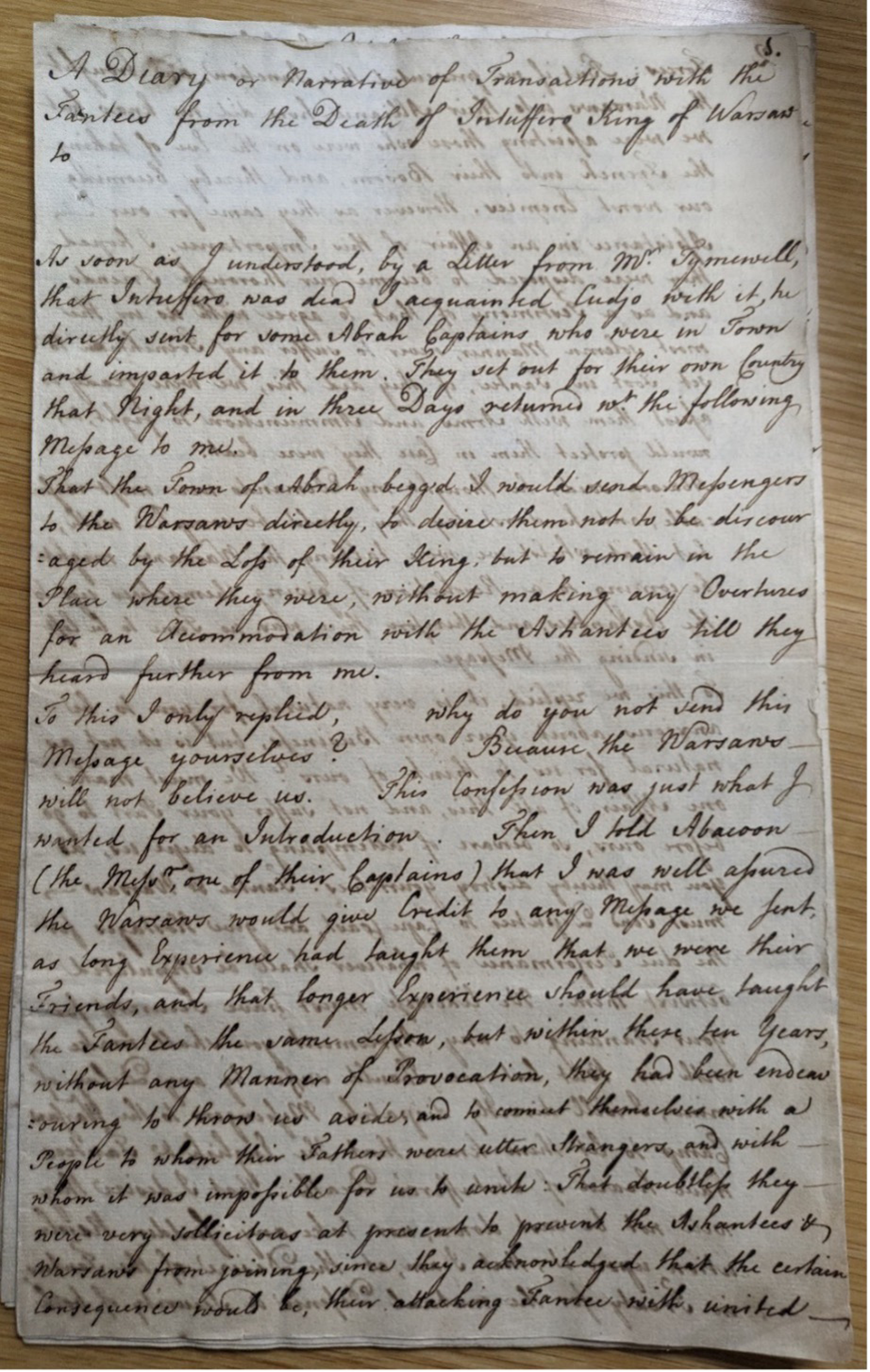
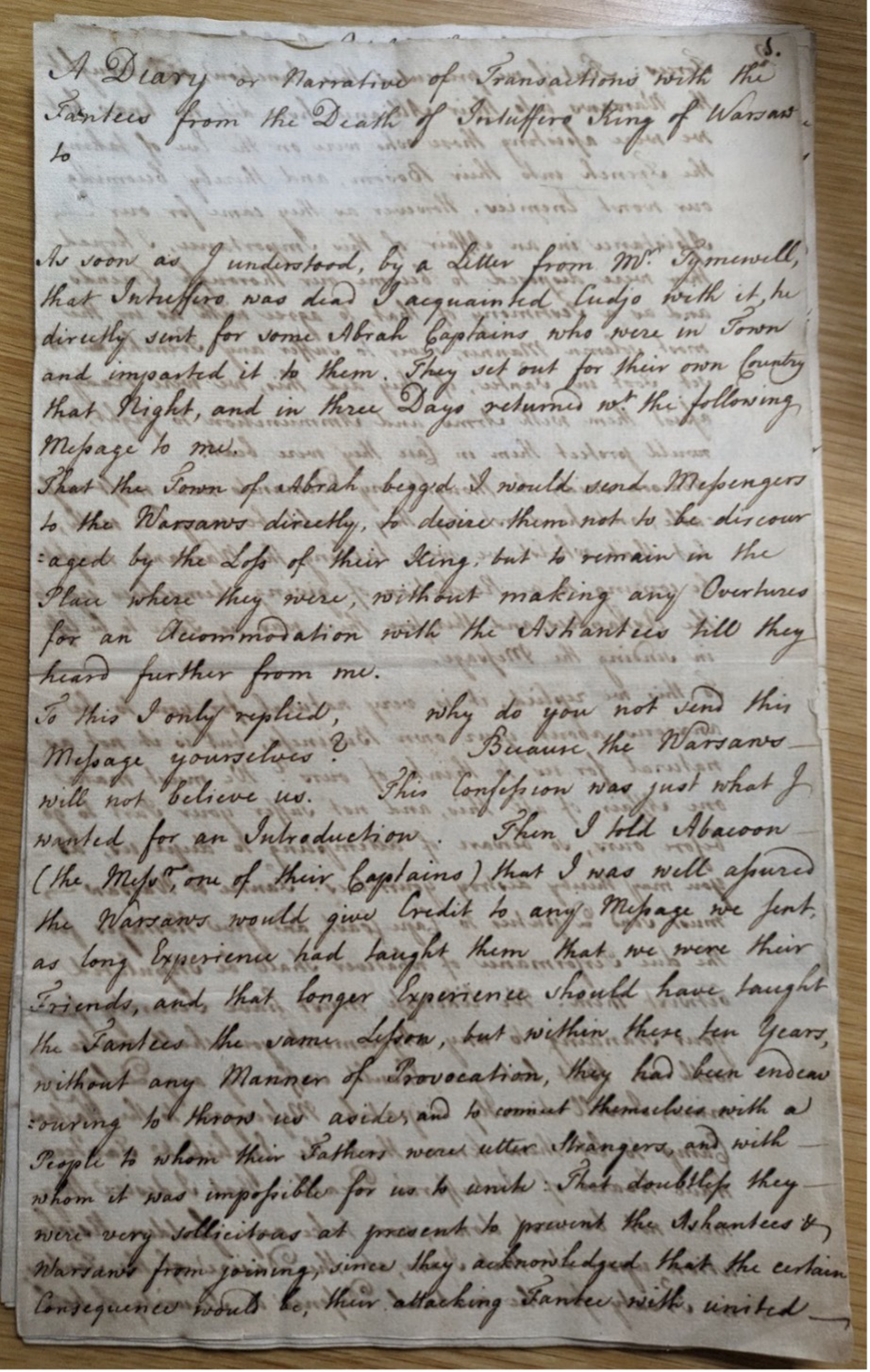
On the mid-eighteenth-century Gold Coast, ‘keeping them in the British interest’ was the key motivating force that shaped British interactions with the Fante, which speaks to the power, influence and skill that the Fante had in manipulating British interest in their lands for their own political and material gain. One leading local figure in the 1750s was the aforementioned Eno Baisie Kurentsi, a caboceer (local ruler or village headman) who became the leader of the town of Anomabo.Footnote 3 A skilled diplomat, trader, and negotiator, he was the archetypal middleman, well-known to African merchants and to European slave traders on the coast. Kurentsi has been studied by Randy Sparks in his book on the construction of Anomabo fort, a place as ‘integral to Atlantic world commercial circuits as those of Liverpool, London, Cádiz, Nantes, Charleston, New York, or Kingston’ (Sparks Reference Sparks2014: 3). Amongst the Detached Papers, Kurentsi’s dealings with the Company, on behalf of the town of Anomabo, are documented in detail in ‘a diary or narrative of Transactions with the Fantees’, which is centred around French designs on Anomabo and the question of Fante allegiance to the English (TNA 1752h) (Figure 1). Although written by a British administrator, probably Melville, to record his efforts with the Fante, the document allows us to build a partial microhistory of colonizer-Indigenous relations; a detailed impression of the bargaining power of local chiefs, British anxieties over imperial competition and the base commercial impulses that were at the centre of intercultural interactions. It gives dimension to the make-up of Indigenous polities, local politics and regional rivalries that help us avoid homogenizing West Africans as one as we the see divisions among them unfold.
A diary or narrative, likely by Thomas Melville, Governor of Cape Coast Castle, recording transactions with the Fante following the death of Intuffero, King of Wassaws (TNA 17152h).

From the beginning of the narrative, which starts in August 1752, the writer documents an unstable local context, a power vacuum left by the death of Intuffero, King of the Wassa people. The Fante feared that the Wassa, north of the coastal Fante, would give themselves up to the Asante, a ‘very powerful’ polity in the interior of the region, who would unite together to attack them. According to the narrative, Fante leaders sought Melville’s help in brokering a deal between the Wassa and the Fante, and, in return, Melville sought assurances that the Fante would not permit the French to build a fort in Fante territory. On 6 February 1753, less than a year since the narrative began, a majority of Fante leaders, one representing each town, met at Cape Coast Castle to sign a resolution to exclude the French from building a fort at Anomabo (TNA 1753e).
In the copy of the resolution in the Detached Papers, the names of the Fante leaders were all listed – including Imorah, the son of the Braffoe (leader) of Fante – but in another copy in T 70 – fragmented and torn into eight pieces – we see the unique marks of each of these leaders through an autographed cross against their name. The resolution stated that this agreement was built on a long history of cooperation between the English and Fante:
We the Braffoe and curanteers, the priests and people of Fantee do declare that our fathers under the conduit of their Braffoe Imorah were brought by the English from the country now Arcania, and buy them furnished with arms, ammunition, and money, not only to take possession of the lands now inhabited by us, but likewise to conquer all those little states around us at present, subject to our dominion. And whereas we are certainly informed that within these ten years past several subjects of the French king had been endeavouring, by bribes of various kinds, not only to dissolve that close connection between English & Fante, which we look upon as a greatest security, but likewise to procure themselves some of that ground which was conquered by the English expense, and which besides the natural injustice of the thing can have no other tendency than to introduce jarring interests and divisions amongst us and thereby deliver up an easy prey to our enemies. (TNA 1753e; 1753f)
Despite this expression of loyalty, the Fante were not beholden to the British and Fante loyalty was not assumed but negotiated. The Fante caboceers were skilled at leveraging their power to obtain money and goods, and various messengers from Fante towns to Cape Coast Castle were plied with brandy, tobacco and cloth to ensure their good will towards the British.
As well as the necessity of differentiating between the identities of different West African polities – Fante, Asante, and Wassa to name just a few in the region of the Gold Coast – we should not assume the unity of these polities and must consider the factional politics within the Fante. Kurentsi, who represented the Fante town of Anomabo, was absent from the signing of the resolution at Cape Coast Castle, which troubled Melville. However, it was reported that Agriphy, from the Fante town of Abrah, responded to Melville’s concern ‘that Anomabo must agree to whatever we do … if they were to oppose us, we would drive them into the sea’ (TNA 1752h: f.5). Melville was displeased by the fragmentation of the Fante and insisted on their unity in order for the resolution to exhibit authority and to avoid the Fante being torn apart into French and English factions. John and all his family had been in the English pay for over a generation – John insisted he was an Englishman and that his father had delivered him into the Englishman’s hands when he was very young. Other records in the Detached Papers show that he was paid a salary of £24 per annum, as was his ‘heir’, Lord Quassah (TNA 1752i). However, the concern over John’s absence from the meeting of the Fante at Cape Coast Castle was compounded by reports that he had welcomed a Frenchman into his home and taken gifts from him. ‘Who is this that pretends to give away our country without our consent?’, those from the town of Abrah apparently remarked. They were disgruntled that John – from Anomabo – had received gifts from the French and distributed them ‘without a sparing hand to the other towns’ (TNA 1752h).
From what we can glean from the narrative, John, and others in Anomabo, were operating under additional familial pressures. John’s sons argued that he was less free to make agreements than the other Fante leaders, because the French were holding his son as a pawn. Because he and another man, Coffee Yango, had given their sons to the French, they felt they could not come to Cape Coast Castle to sign any formal agreement for fear of the French finding out and keeping their sons. Melville was less than convinced by John’s reasoning, writing rhetorically, almost as if he was imagining a confrontation with John:
Answer me a few questions. Can anybody go and live in John’s house without his leave? No. Can any white man carry John’s sons from the shore without his consent? No. In whose house did the Frenchman lodge last February? In John’s. Who assembled the town of Anomabu when the Frenchman wanted to speak with them? John. Who gave his son a pawn that the French should have ground to build a fort on? Was it not John? Yes. (TNA 1752h: f.11)
Melville comes across as almost obsessed with Kurentsi’s apparent duplicity, a signal again of his and other Fante leaders’ power to shape the fortunes of competing European powers. Kurentsi had at least two other sons, who also worked with the English in different capacities. One of them, George Banishee, often represented John to the Company to advocate on his behalf. He was stationed at the Company ‘establishment’ and was paid double John’s salary. At the same time, another of Kurentsi’s sons, Quasah, was disturbed by the Fantes’ turn against his father, apparently ‘having run about like a madman cursing the inland Fantees’ for having taken English presents and denying that they had given consent to the building of a French fort (TNA 1752h: f.15). The familial ties and division of this Fante dynasty emerge quite clearly: according to the narrative, George expressed that he was ashamed of Quasah’s behaviour, but Quasah cursed him for giving up the interest of the family, and leaving him to defend their father alone.Footnote 4
The picture we receive from these records is of complex local negotiations, political fragmentations, split loyalties, familial ties, gifts and hostages. Deputies from Abrah had stated that they had waited several days for a representative from Anomabu to appear to sign the law. Abrah was keen not to make out a quarrel with Anomabu, but threatened that if they did not go heartily into the law it would lead to a civil war: ‘Abrah was the right hand of Fante, Anomabu only fit to fill their liquor’ (TNA 1752h: f.21). Other rumours circulated via Anomabo townspeople to other Fante agents amongst the British that the whole of the town was in favour of giving the French a settlement, for ‘two French ships are on the way out loaded with presents and represent what a foolish step they are taking [by excluding the French]’. An official message from one of Kurentsi’s captains declared, however, that once Anomabu got its pawns back they would be done with the French, and agreed to provide pawns to this effect; ‘we cannot sign our paper as we look at that as selling our pawns.’ Kurentsi received his son safely and Melville sent 10 gallons of brandy to Coffee ‘to try and detach him from his French engagement’, but neither provided pawns to the English to honour the agreement (TNA 1752h: f.23-4).
Beyond the case study of Kurentsi and the web of divided loyalties and self-interested manoeuvrings at the centre of the construction of Anomabo fort, the Detached Papers offer perspective on the broader political, economic and cultural practices of the eighteenth-century Fante. Robin Law and T. M. Reese have written on Fante culture, often drawing on T 70 source material, to reconstruct a historical understanding of the systems and hierarchies of Fante government, trade practices such as the system of pawnship, and also the ritualistic act of taking fetish, all of which slip into corporate narratives (Reese Reference Reese2004; Reference Reese2009; Reference Reese2010; Reference Reese2013; Reference Reese2020; Law Reference Law2013). The Detached Papers offer further scope for exploration into Fante culture, albeit mediated through the lens of a European corporate entity. The documents discussed so far give reference to ‘Braffoe’ and ‘curanteers’ as leaders in the Fante community: the Braffoe was leader of the Fante or Head of State, and the curanteers served as his council. In the mid-eighteenth century, an English observer defined ‘the Fantee Legislature’ as being made up of ‘the Braffo and Curranteers, by & with the advice of their God, whose oracles they receive from the priests’ (Law Reference Law2013: 39). These were the priests of Bura Bura Weigan, who had a judicial role as well as providing advice on public and private matters. The priests of Bura Bura Weigan often administered a kind of ritual oath, called ‘fetich’, which was used to enforce agreements. In the narrative discussed above, fetich is used by the Fante to declare themselves against the French and Kurentsi’s role in courting them:
The priests of Bura Bura Weigan (i.e the Father of Fantee) have sent here to make a fetiche in the following manner. To write on a piece of paper in the English language, these words ‘the practices and designs of the French and John Kurentsi are bad.’ Then the messenger was ordered to carry the paper to the waterside there to tear it & throw it into the water. (TNA 1752h: f.4)
Here, Fante cultural practices were being employed as a symbol of loyalty to the British. ‘Fetich’ comes up occasionally across the Detached Papers; in the minutes from a council meeting at Cape Coast Castle in December 1751, for instance, two men, Acatee and Bogo – with Melville present – ‘took fetich to forgive each other for all past offences and to be good friends for the future’ (TNA 1751e).
The Detached Papers also document other Fante cultural practices in detail. A naval surgeon, John Atkins, described palavers, for example, as the Fante’s ‘courts of judicature, where the principle [sic] or elderly men amongst them meet in rings or under a lodge, to settle the differences that arise amongst themselves, or with the factories’ (Atkins Reference Atkins1735: 52). European merchants were brought into this Indigenous system of adjudication, which could turn violent if a resolution was not reached. This involved panyering, stealing people or goods if the Fante believed that they had been defrauded (Reese Reference Reese2013).
Powerful African traders played an important role in the resolution of palavers. Kwadwo Egyi (known by the English as ‘Cudjoe Caboceer’) was an important trader and interpreter in the employ of the Company, receiving £72 per annum in 1751, and facilitating the trade between the interior and the coast, as well as brokering relationships between the English and the Fante. When Kurentsi and the Fante submitted a complaint about the conduct of an English captain named Darbyshire to the council at Cape Coast Castle in June 1751, Egyi was responsible for translating their grievances (TNA 1751h; Metcalf Reference Metcalf1987). The palaver between Darbyshire and the Fante had begun when Darbyshire had stolen some fish nets from the coastal Fante and they had retaliated by abducting his men. The Fante had kidnapped and beaten Darbyshire after he had panyered a canoeman, and as an agreement was made on trade prices, Darbyshire had taken a Fante man, Quacoon, as a pawn, who later died in his custody (TNA 1751h). Pawns were an important part of the palaver system; they acted as security that a certain debt would be paid or a promise fulfilled, and so the death of Quacoon caused both parties to request payment from the other. Often invisible in these negotiations, people like Egyi were able to capitalize on their ability to arbitrate between the two parties. In 1755, in a rare autographed copy of a letter from an African trader, Egyi reminded the Company of Merchants that he had been promised £400 for the ‘expenses’ occurred when he and his people had gone to Secondee to settle a palaver (TNA 1755c).
The Miles family
Richard Miles (d. 1818) is by far the most frequently listed individual in the T 70 Detached Papers catalogued to date. Miles used a variety of addresses in England, but may have been born near 28 Castle Yard, Holborn, from which his father, William Miles, maintained a correspondence with him between 1773 and 1776 whilst he was on the coast of Africa, and from which he himself corresponded from 1780 onwards when he was in London. According to George Metcalf, Richard Miles joined the Company as a ‘penniless teenager’ in 1765 (TNA 1770; 1768b; Metcalf Reference Metcalf1987: 27).
Miles worked for the Company of Merchants trading to Africa for nearly two decades, being promoted in December 1768 to Warehouse Keeper at Cape Coast Castle and, by 1769, to Chief at Succondee (Sekondi), following which, from 1770, 1771 and 1776 respectively, he was Chief at other forts in modern-day Ghana including Apollonia (Beyin), Tantumquerry (Tantumkweri, Otuam) and Anomabo (TNA 1776a; 1771a; 1768a). His period on the Gold Coast was not unbroken – his signature is on the certificate of his marriage, to Elizabeth Pyatt, at St Sepulchre Holborn in September 1775 (London Metropolitan Archives 1775) – but by 1777, he was Governor at Cape Coast Castle, at which point, since it was the administrative centre of the Company’s operations on the Gold Coast, he became the primordial Company leader working in West Africa, remaining there until at least 1785 (TNA 1785). He remarried to Elizabeth Allden in Hanover Square in February 1799 (City of Westminster Archives Centre 1799) and died – as Richard Miles Wynne, proprietor of Eyarth House, Ruthin, Denbighshire, Wales – in 1818 (Legacies of British Slavery, n.d.b).
As well as being trading, administrative, diplomatic, and domestic spaces, a chief function of the forts from which Miles operated was to provide holding cells for enslaved Africans prior to their transportation across the Atlantic. They also housed stores for stockpiling European goods, strategically placing Miles in an advantageous position for maximizing profits from transactions with ship captains who paid premiums for both. Even after his tenure at Cape Coast Castle had ended, Miles continued to make personal gains from enslaved lives: one recently listed document, for example, shows that between 1771 and 1780, he privately sold 3,041 enslaved people, to ships from London, Bristol, Liverpool, North America, and the Caribbean (TNA 1771b). The high proportion of records related to Miles, and his significance in the trafficking of enslaved Africans, exemplify the access into the paper empire of slavery that the Detached Papers provide, and provide new insights into the lives of the people on whom it centred.
Like his Cape Coast Castle predecessor Melville, Miles depended heavily on Fante intermediaries, who controlled access to inland markets, dictated terms of trade and ensured that European dealers met local demands. His documents reveal transactions with a wide range of merchants, from small-scale African investors to political elites such as Botwe and John Kwamino (Quamino). The decentralized nature of Fante trade networks required his sustenance of strong personal relationships, including with powerful leaders, including Kwadwo Egyi, to secure a steady supply of enslaved people and goods. Miles said that the enslavement of people by the Fante was generally in punishment for ‘Debt, Theft, Adultery and Witchcraft’ (Diptee Reference Diptee2010: 63). This claim was at odds with the fact that he routinely budgeted for inducements to local leaders, especially in the form of brandy, textiles and firearms, that are known and shown by the Detached Papers to have been intrinsic to the establishment of goodwill and trust between European and African actors within the transatlantic system. One account, prepared during his tenure at Cape Coast Castle, for example, compared the average running costs of all the forts across the years 1772, 1773, and 1774, with the same costs in 1781. Within these, ‘presents and dashees’ was a standard heading. Other headings recorded payments to ‘white men’, ‘black men’, and ‘Castle slaves’; the hire of freemen, canoemen, and labourers; the costs of stores and vessels; financial losses caused by sickness, injury and death; costs for housing mutineers and prisoners, and a range of charges against the purchase of enslaved people, fort repairs, defence and war expenses, and charges paid to the Company headquarters in London (TNA 1772).
In addition to profiting in a personal capacity from his position at the epicentre of the Company’s operations on the Gold Coast, Miles used the expertise he had gained there to invest privately in the trade after he stopped working for the Company, appearing as a vessel owner in the Slave Voyages database against fifty transatlantic crossings between 1785 and 1807. This shows his ship-owning partnerships with Robert Ballantine, Thomas Haughan, Robert Taylor, Robert Rolleston and David Dick, and that his most frequent co-owner was Jerome Bernard Weuves (Slave Voyages database n.d.). Given the significance of his involvement in the history of the trade, as well as the coincidence of his lifespan with the period leading up to the abolition acts of 1807 and 1833, a review of Miles’s activities is necessary, especially in light of the fact that there has been no sustained work on him outside biographical studies of others whom he knew, such as Silke Strickrodt’s work on his brother, Thomas Miles and Randy Sparks’s research on Richard Brew, in the context of his study of Anomabo (Strickrodt Reference Strickrodt2001; Sparks Reference Sparks2014).
It was during Miles’s governorship at Cape Coast Castle that he established a private trading outpost, the Popo Factory, near Aného in modern-day Togo. He operated this through Miles and Weuves, the firm he established with Jerome Bernard Weuves – a prominent protagonist within the Detached Papers and Miles’s predecessor as Governor at Cape Coast Castle. Upon Weuves’ death, Miles became sole owner of the private company in 1794. Through this factory – using his younger brother and protégé, Thomas Miles, as his agent, who had succeeded him first at Anomabu and then at Cape Coast Castle – Miles also supplied goods such as corn, yams, and livestock to feed people waiting on ships moored off the coast, as well as to other European posts along it (Strickrodt Reference Strickrodt2001: 25; Legacies of British Slavery n.d.a). This was a practice that Miles had learned during his long career at Cape Coast Castle, when he had sold trade goods to other fort leaders such as the Irishman, Richard Brew (Priestley Reference Priestley1959: 36). At Little Popo, Miles and Weuves again relied heavily on partnerships with African leaders, especially Latévi Awoku, a prominent trader whose influence and cooperation were crucial to the factory’s success. Following Awoku’s death during the defeat of Popo in 1795 against the allied forces of Dahomey and Grand Popo, Thomas Miles temporarily closed the factory; and after Richard Miles had abandoned plans to re-establish it following Thomas’ death in Accra in 1796, he continued his trade through Popo ‘under sail’ (Strickrodt Reference Strickrodt2001: 297–98).
Miles’s correspondence (the Detached Papers catalogued to date contain ninety-seven items containing letters, many of which are bundles) provides a detailed insight into his familial ties, relationships, and roles in Company business. The collection contains seventeen letters to Miles from another brother, Charles, in which Charles repeatedly apologizes for his extravagance, blames their father, bemoans his bad luck at the gaming tables, promises reform, places hope in his new, impecunious wife that she will help him to budget, and then asks Richard for money. Charles’ gambling appears to have severely troubled Richard, as he writes in a letter to Charles:
When I reflect on the whole tenor of your conduct, I am almost at a loss to know what part of it deserves the severest censure. Foster’d as you have been from the age of 18, under the care of a brother whose whole and sole study has been to promote our interest in life, what returns you have made it him, but that of loading him with additional grief, to what the situation of his own affairs (tho’ very undeservedly on his part) actually makes him labour under – Deprived as I was and still am of every shilling of property that I’ve been so long labouring for, except a few hundred pounds that I had the good fortune to keep out of the public’s hands: even out of these few hundreds have I not most willingly supplied you to the prejudice of myself and others … (TNA 1781).
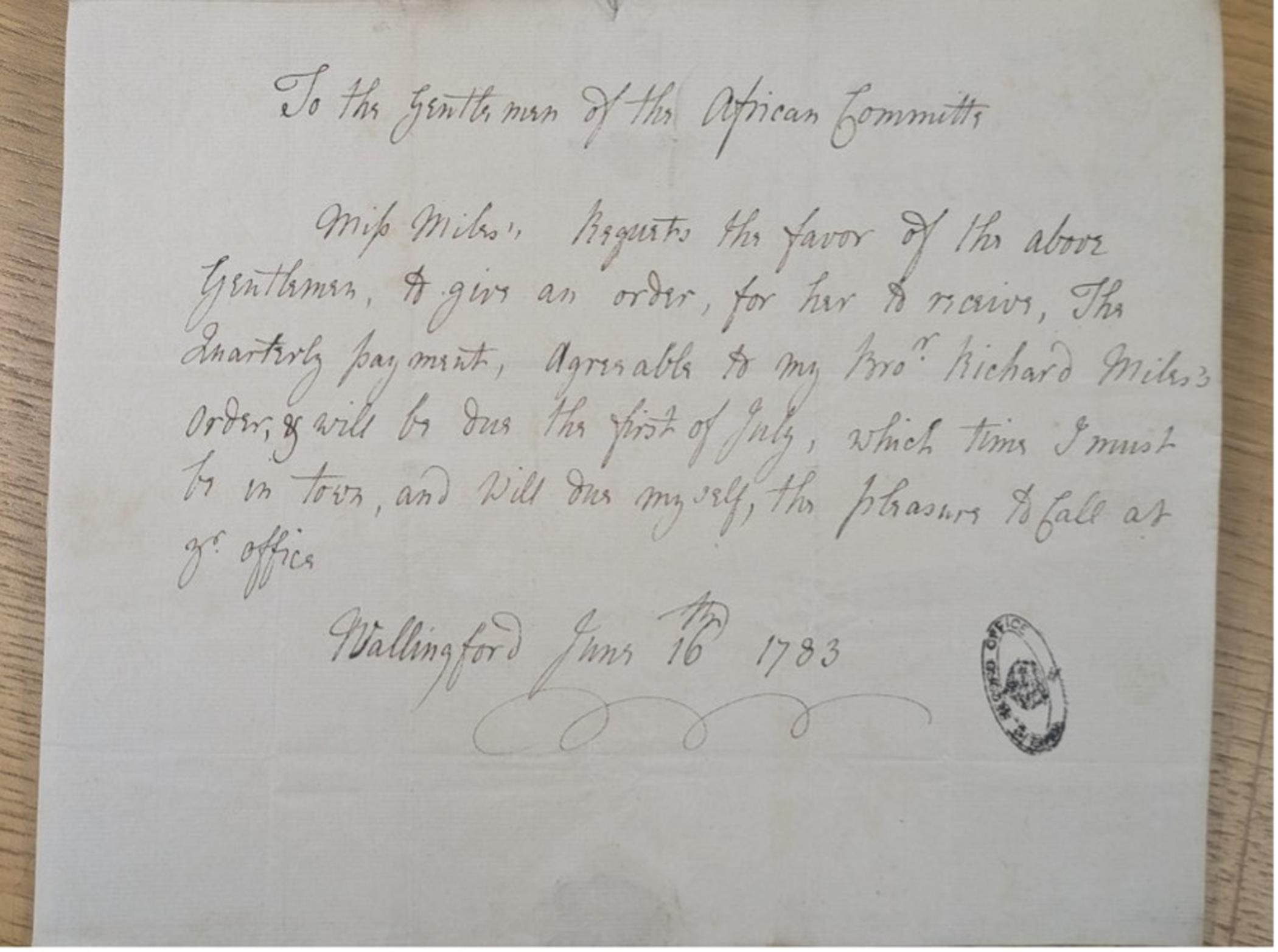
In addition to Richard, Thomas and Charles, we also see traces of the Miles sister, Elizabeth, in the Detached Papers. She appears chiefly in connection with her withdrawals from the Company against her eldest brother’s name, for example requesting in 1783 ‘the above Gentlemen [of the Company], to give an order, for her to receive the quarterly payment, agreeable to my brother Richard Miles’s order, & will be due the 1st of July, which time I must be in town, and will due myself, the pleasure to call at your office’ (TNA 1783) (Figure 2). Miles had written separately both to her and her new fiancé, a slave ship captain named David Dunn, in September 1779, to congratulate them on their engagement – a match to which he predicted his father would object on grounds that Dunn intended to bring ‘Betsy’ to Ireland (TNA 1779a; 1779b). Still unmarried, she was evidently – given her appeals to the Company for money – dependent upon Richard half a decade later.
Letter from Elizabeth Miles to the Committee of the Company of Merchants Trading to Africa. (TNA 1783).

Elizabeth’s rarity in this male, corporate archive is highlighted by other parts of T 70, especially the biographical information compiled in the lists of passengers and the lists of the living and the dead, which mainly listed Europeans stationed and resident at each of the African forts, from 1673–1748. Through an assessment of metadata derived from the digitization of these lists, only 106 of nearly 56,000 name entries belonged to women and girls.Footnote 5 Where ages are given, they range from two to forty-four. Whereas occupation descriptions are given for many men, the most frequent descriptions of the women are as ‘wife’, ‘soldier’s wife’, ‘widow’ and ‘brickmaker’s wife’, with a handful listed as daughters and spinsters. Few names appear more than once: a sample of those that do are Mary Jones, a soldier’s wife, and Elizabeth Swallow, a brickmaker’s wife. Four nurses travelling to the Gold Coast, and one maid, are the only exceptions to the description of women as adjuncts to men.
To this scant information on the roles of women in the Company, the Detached Papers add some context. For example, they show female tradespeople in London: Hannah Bayly invoiced Walter Corbet, captain of the sloop, Africa, for ‘lying at single chain at Horsleydown’; Jane Fuller supplied porter, hock, and beer to the Company; Mary Daniel invoiced it for gunpowder, kegs, nails and sugar; Mary Foreman and her son sold malt spirits to it; and Mary Stephens billed the Rev. John Moore, who looked after two African gentlemen who travelled to London – John Witson Acqua and George Sackey – for doing their washing (TNA 1750a; 1750b; 1752b; 1752c; 1752d; 1752e; 1752f; 1752g; 1753b; 1753c; 1755a; 1755b; 1756).
Like many of his compatriots in Africa, Richard Miles had a relationship with an African woman on the Gold Coast, referred to as ‘Sal’. With ‘Sal’, Miles had a son who was educated, along with other family members, in Hillingdon (Sparks Reference Sparks2014: 84). Sometimes described in the literature as ‘country wives’ and in the documents as ‘wenches’, African women – particularly if they were locally well-connected – were critical to the survival of fort employees, soldiers and mariners on the West African coast. Some free and freed women, especially those who had children with Company men or private traders, travelled to and settled in England (Behrendt and Hurley Reference Behrendt and Hurley2017). Fante women had both matrilineal and patrilineal descent, which made it easier to gain permission from elders to marry European men (Feinberg Reference Feinberg1989; Sparks Reference Sparks2020). An agreement between David Dunn, who proposed to Elizabeth Miles nine years later, and John Bartlett, signed at Cape Coast Castle on 1 January, 1770, reads, ‘Nancy – David Dunn’s wench to receive during his absence three ackies gold per month’. Richard Miles annotates it, ‘I gave her free liberty to look for another husband’ (TNA 1776b).
Enslaved African children, men and women
Situated on a small island (now Kunta Kinteh Island) in the mouth of the River Gambia, James Fort was the centre of the British slave trade in Gambia. We can estimate that Gambia was the principal place of purchase of enslaved people for at least 760 transatlantic voyages in the period 1644-1807 (Slave Voyages database n.d.). In addition to the thousands of enslaved Africans who were forcibly embarked at Gambia and across the Gold Coast, hundreds were also kept as ‘castle slaves’ or ‘Company slaves’, where they were forced to work at the British fortifications. In the words of Shumway, this was a ‘a distinctive and paradoxical form of slavery’; ‘castle slaves’ were considered the legal ‘chattel’ of white Europeans, but were often paid wages, including in the form of commodities, and were able to move freely around local towns and forts (Shumway Reference Shumway2014: 84). This was a separate category of enslaved person when compared with the thousands of Africans who were held in cells in the forts before their forced transportation across the Atlantic.
Within the Detached Papers, there are dozens of lists of ‘castle’ or ‘Company slaves’, taken as part of periodic surveys of the forts, which provided an overview of the state and condition of the fabric of the Company’s buildings and supplies, as well as its personnel and enslaved people working on the fortifications. These surveys were conducted by the navy and delivered to Parliament as stipulated in the 1750 Act of Parliament that established the Company of Merchants (Public Act, 24 George II, c. 49 1750). Through these reports, we get a rare glimpse of the enslaved people working at the forts: their names, their work, their health and their personal ties, bringing the humanity of individual exploited and enslaved Africans to the fore.
These, for example, are the names of the fourteen women who were enslaved at Fort James in Gambia, as recorded in the survey of the fort in November 1757 (TNA 1757a):
Fortimer Bera Dada Lambre
Jobber Califer Fender Bungs
Maria Bristol Settingba
Florer Sacular Fortimer Soggay
Maria Kenny Maria Adams
Bibiana Ingee Sarah Dosa
>Fattyma Fancy >Maria Wallie
Ten of these women had been ‘castle slaves’ since infancy and were classed as ‘superannuated’, meaning that they were unable to work due to old age and were subsequently costing the company money. The other four were made to carry water and clean the bastions. Jobber, Fender, and Dada were also mothers, although it is unclear exactly how their labour was deployed. Jobber was mother to a daughter called Misacuto, Fender to a son called Yamacrew, and Dada to a daughter called Misacuta. A boy called Kecutor was described as the son of Fancy, a mason listed as one of the ‘men castle slaves.’ It appears that Fancy may have had an intimate relationship with Dada as a child named Misacuta is also listed as his daughter. Fancy worked alongside other enslaved men: Hector, a carpenter; Mortimer, a cooper; Wallie Sambo and Bram, who were smiths; Savanna and Sacular who were sawyers; Califar who was a cook, and Harry and Bumbo who were patroons (commanders) of two boats. Califor, the cook, also had a son called Jambo, but there is no mention of the boy’s age or mother. Could she have died in childbirth? Or were they separated in the process of enslavement by their captors? Yamacrew, Fender’s son, does not appear in the earlier survey, which would suggest that he was born sometime between February and November and was under nine months old. Another of the changes between February and November is the absence of a man called Toolie; he was also a cook and described as ‘one of the old company slaves.’ How old was he and how long had he been under the ownership of the company? His absence from the November survey suggests that, between the two surveys, Toolie passed away.
Though the details we can recover are only partial and fragmentary, and generate more questions than they answer, it is clear that at James Fort, there lived a community of enslaved children, women and men, who were family and kinfolk. Some resided at the fort for most or all of their lives; some had sets of skills required to maintain both the social fabric of the community and the material fabric of British fortifications; but all experienced, alongside one another, the emotional rhythms of birth, life and death.
In the racial hierarchy of eighteenth-century European thought, enslaved Gambians were often considered a superior sort of labourer. In places like South Carolina, there was a preference for enslaved people from Gambia because of their skill in rice production, which was the staple plantation commodity of the Carolinas (Carney Reference Carney2009: 90). This was also the case on the other side of the Atlantic, with enslaved Gambians being selected for transfer to Cape Coast Castle for skilled projects, such as the building of Anomabo fort. Construction began in 1753 in the midst of anxiety about expanding French influence, as we saw in the above discussion of the Fante. In a letter from Melville in 1752, he boasted of acquiring thirty-nine ‘Gambia slaves’ for work at Anomabo, but expressed his fears of the Fante ‘stealing them and selling them’ (TNA 1753d). A total of seventy-three enslaved Gambians were listed at Cape Coast Castle and Dixcove Castle awaiting employment at Anomabo in April 1757. Most were labourers, but there were a number of men and women ‘lime pickers’ at Dixcove, likely referring to the practice of burning sea shells to create a durable quicklime used in the construction of forts (TNA 1757b; Reindorf Reference Reindorf1895: 272). Given the number at Cape Coast Castle and Dixcove, and the lack of repetition in names, it would appear that these were not the same people who were enslaved as ‘castle slaves’ at James Fort, and likely were recently captured from the regions encircling the River Gambia.
Compared with Cape Coast Castle, the ‘castle slave’ population on James Island was relatively small. In September 1751, the survey on the state and condition of Cape Coast Castle records 232 enslaved men, women and children (TNA 1751b). This compares with 118 enslaved people at Whydah, sixty-six at Gambia, thirty-six at Accra, twenty-nine at Winnebah, thirteen at Dixcove, twelve at Secondee, and eleven at Tantumquerry during the same month (TNA 1751g). There were some very young children listed as ‘castle slaves’ at Cape Coast Castle, including eight at only two months old: baby girls Accua, Abbah, Eukua and Adjubah and two called Abinnabah, as well as baby boys Quomino and Cudjoe. Although there is no information on parents, some children were listed together – such as seven-year-old Acquaba and three-year-old Aquishebah – which we could assume was an indication of familial ties or matrilineage. Age is recorded on most lists, though as one of the lists indicates, this was the age ‘as near as could be computed’ (TNA 1786). At the other end of the age spectrum, at Tantumquerry Fort the same year, lived Addie, an eighty-five-year-old ‘bomboy’ (a supervisor of enslaved labourers), who was described as ‘very hearty’, and Effebah, a ninety-year-old ‘labouress’, who was ‘very infirm’ (TNA 1751f).
In 1751, 110 enslaved men were working at Cape Coast Castle, with a median age of twenty-nine and a half. The eldest was sixty-six-year-old John who was a canoeman. John was a relatively uncommon name for a ‘castle slave’. Unlike most enslaved people working on Caribbean plantations, whose names had been changed and/or anglicized, most ‘castle slaves’ were listed using traditional West African names, or, as it appears from names like those listed above, were given names by Europeans inspired by their occupations, physical appearance, or paternity. The lists are therefore interesting for analysing African and European naming patterns, and for tracing descent and kinship amongst enslaved people. From this sample, Coffee was the most common name on the list – there were ten Coffees aged from ten years old to fifty-one years old – followed by Cudjoe, Quashee and Quomino. John was one of sixteen canoemen who ferried goods and materials between anchored ships and the shoreline. Many free canoemen were also hired by the Company and, in 1782 when reviewing the Company’s finances, Charles Miles suggested that a ‘shameful abuse was made’ of hiring them and leaving them in constant pay and subsistence over long periods of time (TNA 1782). The other trades of enslaved men at Cape Coast Castle included carpenter, bricklayer, smith, armourer, cook, gardener, sawyer, swimming boy, cooper, goldsmith, and (one) drummer. As part of the same survey of the state and condition of Cape Coast Castle were inventories of the gardeners’ and bricklayers’ stores, illustrating the sorts of tools – garden shears, water pots, and rakes, and sieves, axes and hammers respectively – they had available at their disposal to do their work (TNA 1751c; 1751d). The value of certain employments to the Company’s operations is abundantly clear through the monetary value associated with each enslaved person. Those working as surgeon’s mate, armourer and cooper were ascribed with the highest value, and the gendering of economic value is implicit in the fact that the net financial value ascribed to the 122 enslaved women at Cape Coast Castle was roughly a quarter of the 110 enslaved men.
All the 122 women in the 1751 survey of Cape Coast Castle were described as ‘labouresses’ from eight-year-old Daddie to seventy-year-old Effebah, with a median age of thirty-four (Figure 3). However, other lists show a range of occupations including sweepers at Winnebah Fort and a ‘hospital woman’ enslaved by Horatio Smith. Agoroo, a thirty-three-year-old, ‘hospital woman’ was part of a list of ‘house slaves’ belonging to Smith, a man formerly in the employ of Richard Brew, an employee of the company and later a private trader (TNA 1786). Brew established Castle Brew, a Palladian-style Georgian house built in Anomabo, which was later purchased by Smith and renamed ‘House Smith’. The naming of the enslaved persons as ‘house slaves’ could have been consistent with the change in nomenclature from Castle Brew to House Smith, although the parallels between ‘castle slaves’ in West Africa and ‘house slaves’ in the Americas are worth noting, given their specialized employments and their higher status in comparison with the multitude of Africans forced onto ships and to work in the fields. At the bottom of the list of the nine enslaved men, three enslaved women and five enslaved children were the names of two enslaved people at House Smith who died within one month of each other: a man called Cato and a child of Arrishe, a thirty-one-year-old ‘prapra woman’ (cleaning woman). The child was noted as dying from yaws, a tropical infectious disease that affects the skin and bone.
List of enslaved women at Cape Coast Castle in 1751 (TNA 1751b).

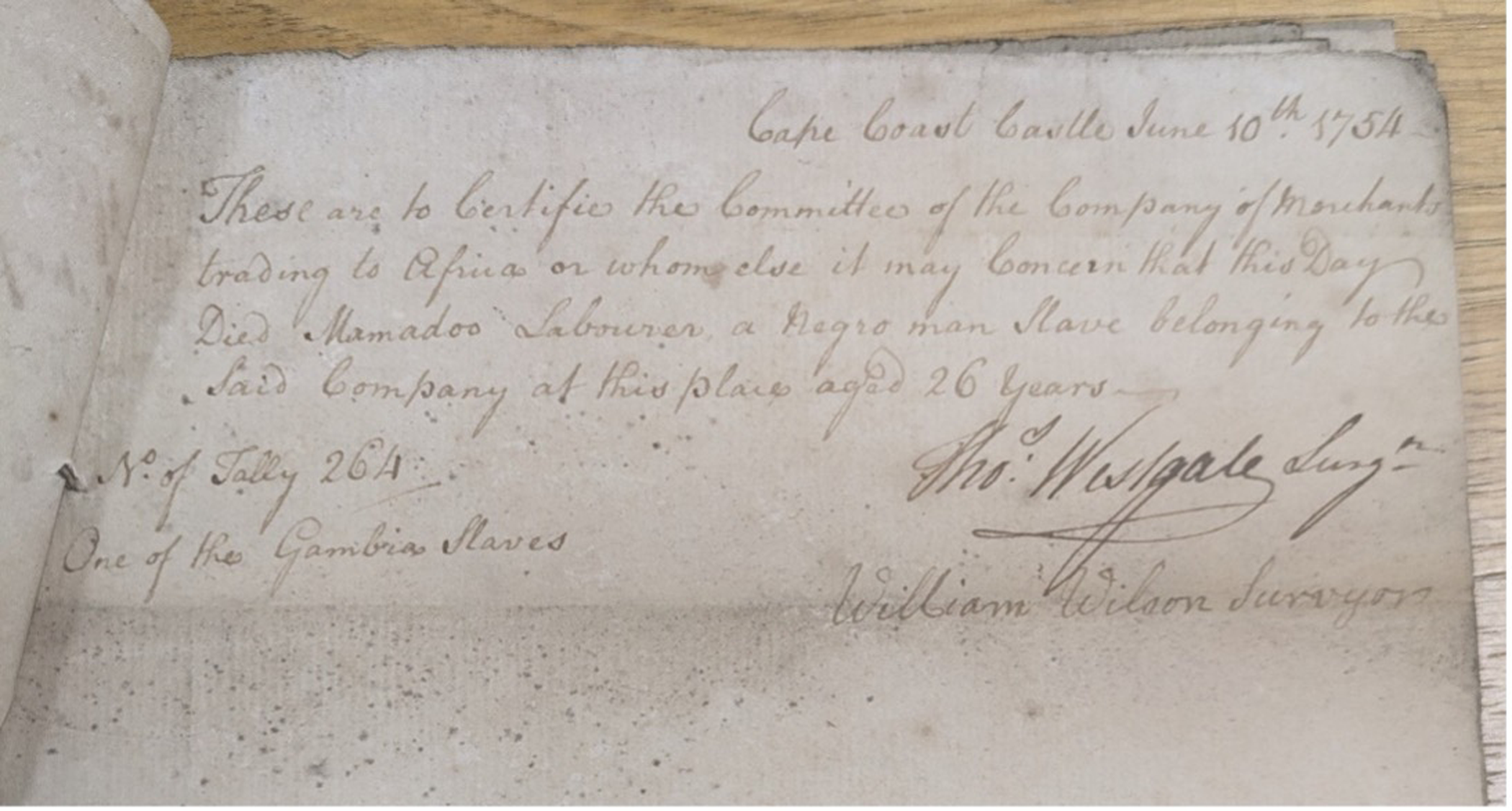
Within the Detached Papers are a few death certificates noting the passing of enslaved people, although there is no evidence that these were produced systematically (Figure 4). They appear bundled with death certificates of soldiers and certificates relating to goods that had arrived in a damaged condition, suggesting that they may have related to insurance claims. These scraps of paper however, although revealing very little about the circumstances surrounding the passing, stand as rare memorials to the stolen lives of enslaved Africans. Characteristic of the other certificates, one certificate dated 25 February 1754 reads:
These are to certify to the committee of the Company of Merchants trading to Africa or whom else it may concern that this day died Quodjebah, labouress, a negro woman, slave belonging to the company at this place aged 24 years. (TNA 1754)
Death certificate of Mamadoo, one of the men enslaved at Cape Coast Castle. (TNA 1754).

Like Quodjebah, most of the names of enslaved women at Cape Coast Castle ended with a-bah suffix, a variant of the Fulani ‘Ba’, which was popular in the region around the Gulf of Guinea. Abbah was the most common name of women in the list, a traditional Akan name referring to a girl born on a Thursday. It was a common Akan naming practice to name children after days of the week, which is why we also occasionally see anglicized versions of weekdays in the lists of names, both on the West African forts (such as fourteen-year-old boy called Monday, who worked as a bricklayer) and in the Caribbean plantations. Effebah was another popular name for enslaved African women. There is another Effebah recorded in the list of working ‘castle slaves’ at Winneba Fort the same year. She was a thirty-year-old sweeper who was described as a ‘lunatick at times’ (TNA 1751a). One can only imagine what the experience of Effebah and her enslaved kinfolk might have been, and we have to question why the behaviour she presented was interpreted as ‘lunacy’ by her captors. Did she resist them? Was she defiant? Was this the manifestation of the trauma of her enslavement? Among the reams of receipts and account books, these fragments from the lists of people who were enslaved give us a small insight into the experience of those whose lives were at the centre of this exploitative trade.
Conclusion
The Company of Merchants trading to Africa constitutes a highly important period in the history of the British transatlantic trade in enslaved Africans. Following the end of the monopoly of the Royal African Company and preceding the abolition of the trade, the Company operated as an essential facilitator of the British trade as the rise in private traders saw the British trade reach its zenith. While other parts of T 70 are rich in detail on the governance of the company from London, the Detached Papers – remarkably underused by researchers – provide substantial evidence of the minutiae of everyday life on the West African coast and the administrative, socio-political, and cultural dynamics that underpinned the transatlantic trade in enslaved Africans. These records expose the intricate networks of interaction between British agents, Fante elites, and enslaved Africans, while also allowing us to interrogate the gaps in colonial and corporate record-keeping. By engaging critically with the fragmentary nature of the records, this article suggests possibilities for finding the submerged narratives of people who were brutally exploited and marginalized within these systems and, consequently, provides opportunities for constructing counter-histories to the economic narratives that were the focus of European record-keepers. Treaties with local leaders, letters between merchants and governors, inventories of goods and stores, lists of enslaved people, certificates of death, receipts from suppliers, the Detached Papers are an ephemeral history of one of the most enduring and darkest periods in humanity. Behind every pen, every slip of paper – even something as mundane as a bricklayer’s inventory – is the constant and haunting hum of the lives of enslaved Africans – their work, their relationships, their resistance, their deaths, captured in fragments. An archive where the enslaved have very little voice but are far from silent.
Acknowledgements
The authors wish to acknowledge the support of The National Archive’s Strategic Research Fund, which funded the cataloguing of the Detached Papers.
Philippa Hellawell is Head of Collections Research and a specialist in pre-modern maritime and colonial records at The National Archives. Previously the Eighteenth Century Records Specialist at The National Archives, she has spent the last few years researching the records of the Royal African Company and its successor, the Company of Merchants Trading to Africa. She is currently the Project Lead for PASSAGE (Partnership for Atlantic Slavery Scholarship, Archiving and Global Exchange) – funded by the Lloyd’s Register Foundation – which combines a programme of archival research on eighteenth-century slave ships with an international research mobility programme that supports the research of scholars from West Africa and the Caribbean. Prior to her appointment at The National Archives, she worked as a Teaching Fellow at the University of York and King’s College London and held research fellowships at Royal Museums Greenwich, The Huntington Library, and Yale University.
Briony Widdis is a heritage and museum studies scholar specializing in the legacies of British imperialism in collections across Ireland and the UK. Formerly acting Eighteenth Century Specialist at The National Archives (UK) with responsibility for cataloguing the T 70 Detached Papers, she has also worked as Curator of Ethnography at National Museums Scotland, Assistant Director at the Northern Ireland Museums Council and Culture and Arts Manager at Belfast City Council. Her current research examines archival and material histories of empire and enslavement, and their relationship with identities. She is Research and Innovation Associate at Queen’s University Belfast on the AHRC project Historic Houses, Global Crossroads (AH/Z506436/1), led by the University of Birmingham in collaboration with the National Trust, Clandeboye Estate, ArtsEkta, Newcastle University, National University of Singapore and University of Toronto.