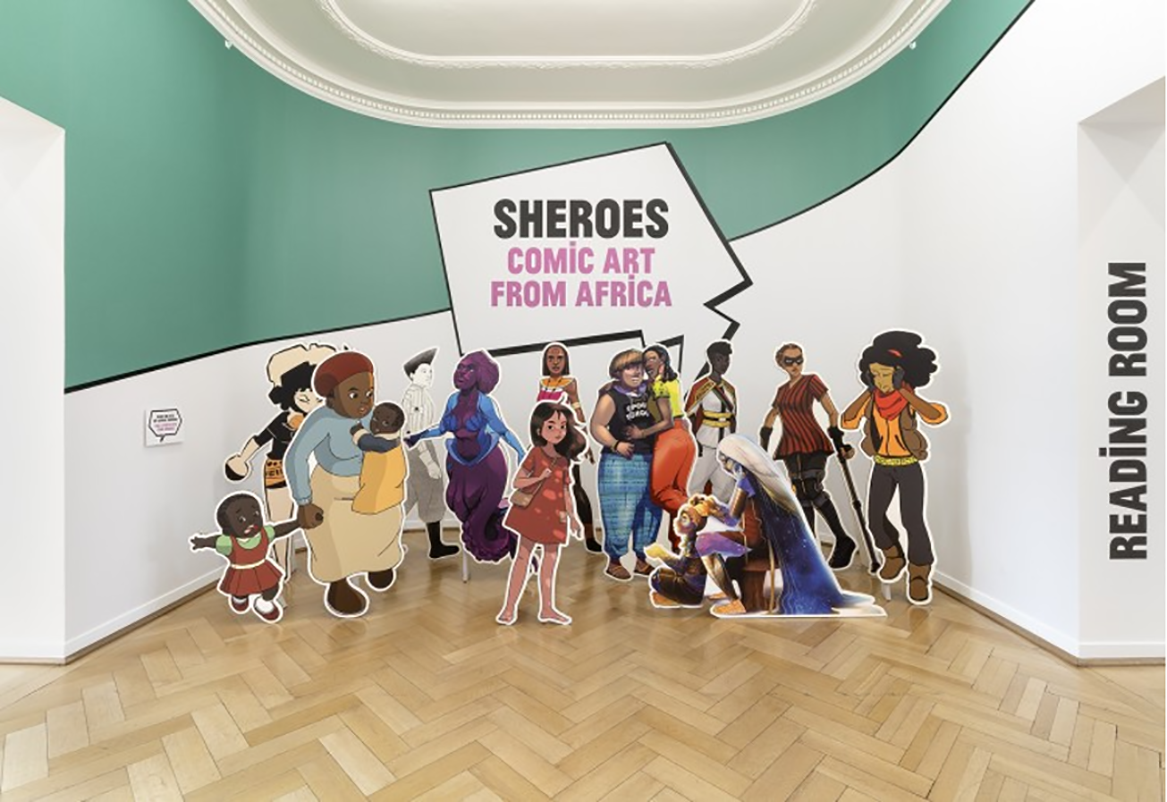


In the entrance area of the Welkulturen Museum in Frankfurt, visitors are greeted by colourful female comic characters (Figure 1). These were drawn primarily by female comic artists from various countries in Africa and the African diaspora.
Foyer of the Weltkulturen Museum. Photograph: Wolfgang Günzel © Weltkulturen Museum.

Africa is not a region that is normally associated with comics, even though the continent has a growing comic scene with comics conventions happening from Lagos to Cape Town. Unfortunately, little of this reaches German-speaking countries. African publishers and comics are nowhere to be found at the Frankfurt Book Fair. The only German translation of an African comic to date is Aya.Footnote 1 A first exhibition, ‘Kaboom! Afrikanische Comics im Fokus’, in Basel in 2015, mainly featured comics by male artists from southern Africa as well as comics about the continent.Footnote 2 Shortly afterwards, the Goethe Institute launched the ‘Africomics’ workshop series to empower African comic artists and improve their networking opportunities. This resulted in comics by artists from fourteen African countries, all dealing with the common theme of decolonization.Footnote 3 The exhibition ‘SHEROES: Comic Art from Africa’, showing from November 2025 to August 2026, aimed to give us an insight into this new buzzing comic scene on the African continent with a focus on female comic characters and artists. The ten artists featured in the exhibition represent a good mix of established artists and newcomers, and come from a wide variety of countries across the continent: Charity Atukunda (Uganda), Juni Ba (Senegal/France), Farida Bedwei (Ghana), Koni Benson (South Africa), Salim Busuru (Kenya), Nur Cherubi (Kenya), Beserat Debebe (Ethiopia/USA), Reine Dibussi (Cameroon/France), Elyon’s (Cameroon/Guinea), Akosua Hanson (Ghana), Catmouse James (Madagascar), Ashley E. Marais (South Africa), Ng’endo Mukii (Kenya/USA), André Trantraal (South Africa), Nathan Trantraal (South Africa).Footnote 4
As an ethnographic museum, the Weltkulturen Museum has been working with artist residencies for many years to critically review and reinterpret its collections. The Museum has also applied this approach to its current exhibition, inviting four of the featured female comic artists from Cameroon, France, Ghana, Madagascar, and Uganda to spend two weeks at the Museum and engage with objects. During the residency, the comic artists were free to decide whether to continue working on their own projects, try something new, or engage with the collection. Most of them found interacting with the objects in the depository to be very important. The products of the residency, including explorations of objects from the collection, such as a poster featuring hairstyles or a comic dealing with carved figures that came into the Museum’s collection from Cameroon, can be seen in the main room on the Museum’s upper floor. Each of the smaller rooms focuses on one or two artists and their comics. Displays explain the biographies of the artists and audio guides provide, in the artists’ own voices, more information about their comics and their motivation for drawing.
One might wonder what comics and museum magazines of an ethnographic museum have in common and dismiss the artists’ residency as part of the Museum’s standard programme. Upon closer inspection of the comics on display, however, it is not uncommon to see depicted in them some of the objects that otherwise lie dormant in the museum’s storage rooms. And it is precisely this element that makes the exhibition interesting not only for comics fans but also from a researcher’s perspective.
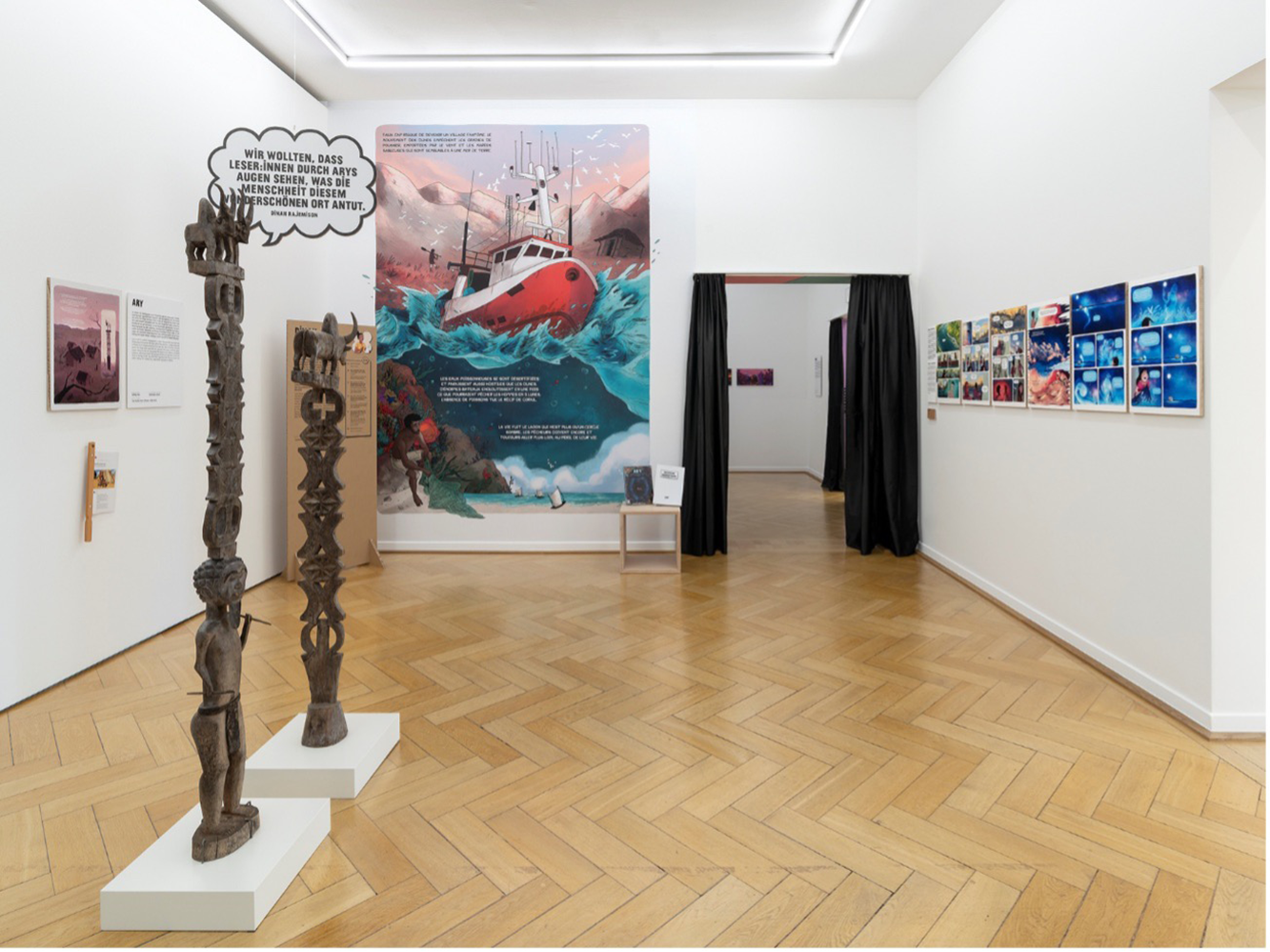
In the comic, Ary by Catmouse James and Rolling Pen from Madagascar, the main character is a girl called Ary who is sent on a journey to avert catastrophe in a region with different ecological problems. Aloalo (wooden grave posts; Figure 2), exhibited alongside the comic, feature in the story and add to its hopeless and eerie atmosphere.Footnote 5 The objects on display lend an exciting historical depth to the comic exhibition, which otherwise focuses on current issues such as environmental problems, recognition of LGBT rights, and visions of the future.
Aloalo, grave posts from Madagascar, displayed in front of the comic, Ary. Photograph: Wolfgang Günzel © Weltkulturen Museum.

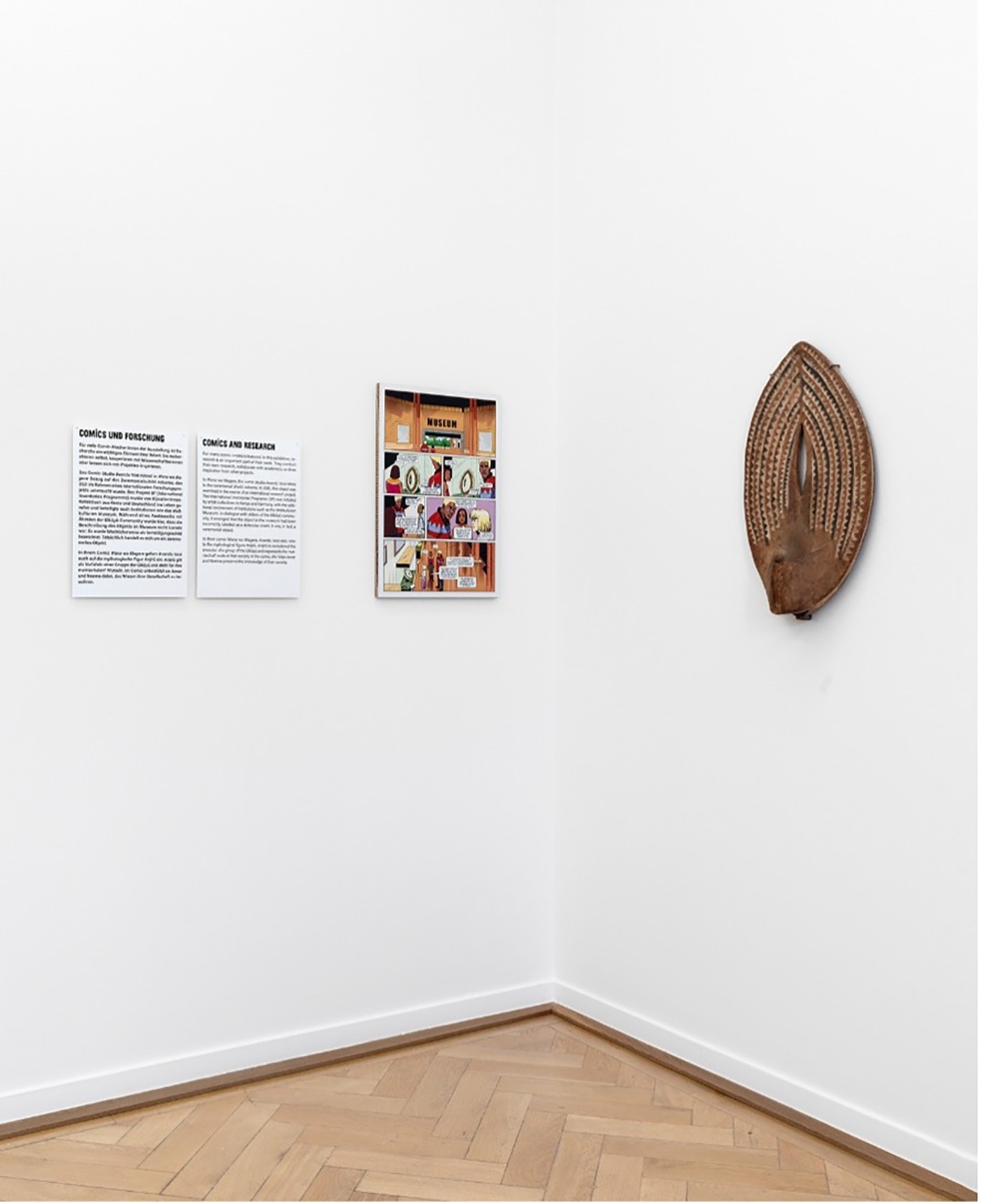
The comic studio, Avandu Vosi from Kenya, also includes a museum object, a ndoome shield, in their comic Wana wa Magere.Footnote 6 The ceremonial shield of the Gikuyu is a museum piece in the comic itself (Figure 3). In their comic, Salim Busuru and Nur Cherubi depict the dilemma faced by many museum objects, about whose origins and significance little is known. The comic idea goes back to a former project in which the Weltkulturen Museum was involved in 2021, the International Inventories Programme. During this programme it was discovered that the ndoome shield of the Weltkulturen Museum’s collection was incorrectly labelled as a ‘defensive shield’ rather than a ceremonial object. This problem of incorrect object classification, as well as the cultural significance of the ndoome in a lively story, is illustrated in the comic for a broader audience.
Installation view with ndoome shield and comic by Avandu Vossi. Photograph: Wolfgang Günzel © Weltkulturen Museum.

The exhibition is multi-layered with current issues and debates surrounding ethnographic museums also incorporated. The rooms are very attractively designed and the comics entertaining.
I congratulate the comic artists and curators participating and hope that their audience was as diverse as their exhibition.