Understanding the conditions which promote legislative activity within a given policy area has important implications for democratic theory—making changes to existing laws and enacting new ones is the fundamental purpose of legislatures. In the context of the American Congress, voters expect members to create new policies consistent with the public’s policy demands, and Congress in turn seeks to satisfy these demands in order to secure electoral benefits. While a significant amount of research focuses on how issues are addressed (i.e., the direction of policy change) and how issues become prominent on the national agenda, relatively little work examines which collection of policies are addressed by the House and Senate during the congressional term.
The theory developed here helps explain which policies majorities pursue by connecting institutional constraints to cognitive constraints. Specifically, I claim limited information about the costs of legislative action within Congress encourages policy stasis. Members, acting in a boundedly rational way, do not search for the optimal policy, which produces the greatest electoral rewards, but instead seek to minimize the risks inherent in lawmaking while still securing electoral benefits. As a result, a policy will not necessarily be addressed, even when institutional constraints may be overcome. Instead, previous successful action serves as an information mechanism for majorities, promoting repeated legislation within the same policy area.
The empirical models predict the set of issues on which congressional action occurs, measuring policy activity on a month-to-month basis, to better understand the dynamics of legislative attention and activity. Despite the influence of public opinion and competing pressures from a variety of sources, the range of issues addressed is limited as a result of members and parties balancing electoral incentives with the unknown costs of legislating within a particular policy area. Previous legislative activity is a strong predictor of future legislative activity, and the relationship between the two increases when a majority has less information about the costs of passage. Specifically, the results show first, that chambers controlled by opposite parties produce more month-to-month stability in terms of policy areas addressed due to the increased uncertainty each majority has about the potential costs of interchamber resolution. Second, majorities which have come to power more recently have less information about the costs of governing, and thus rely on previous legislative success, also promoting greater stability.
Once an issue makes its way onto the policy agenda and adoption process, it tends to remain there despite previous legislative attention. Past legislative activity is a good predictor of future chamber activity, even when accounting for other factors—when Congress successfully enacts a law, it actually encourages future activity within the same policy area. Further, while this result is conditional on the importance of legislation, even very important bills promote future activity, as does the passage of omnibus bills, appropriations, and authorization legislation, indicating that Congress does not pass bills to satisfy some finite level of policy demand, but instead engages in regular legislative “maintenance.” The results also imply that though party leadership seeks to control the bills which reach the floor, they also seek to minimize their uncertainty about the costs of achieving legislative success.
This research adds to our understanding of which issues Congress passes by showing that cognitive constraints limit policy action in ways similar to institutional constraints. Rather than transitioning from issue to issue based on demand generated from salient events or actors, the costliness and uncertainty associated with legislating, as well as the electoral incentives of members to secure policy accomplishments, results in policy stability on the floor. The theory and empirical results challenge the notion that congressional action is driven largely by policy demands generated by the public, the media, and the president. Instead, members respond to internal considerations and address legislation in policy areas, which minimize costs and maximize electoral benefits. Consistent with other recent work, pushing a policy from the policy agenda to congressional action requires more than ideological agreement among members; it requires information about the costs of successfully legislating. By realizing how the costs of action encourage a limited policy focus, we can better understand short-term fluctuations in chamber activity and how uncertainty in the legislative process produces choice inefficiency.
Electoral Incentives and Institutional Constraints
That congressional lawmakers are motivated primarily by reelection is one of the primary tenets of rational choice work on Congress. Mayhew (Reference Mayhew1974) memorably articulated this motivation, and there is significant evidence that members (Polsby Reference Polsby1968; Fenno Reference Fenno1973; Poole and Rosenthal Reference Poole and Rosenthal1997), parties (Rohde Reference Rohde1991; Cox and McCubbins Reference Cox and McCubbins1993; Aldrich Reference Aldrich1995), and the organization of Congress itself (Weingast and Marshall Reference Weingast and Marshall1988; Krehbiel Reference Krehbiel1991) work in ways designed to maximize members’ reelection prospects. Members of Congress and their parties seek to produce policies consistent with party preferences (Aldrich Reference Aldrich1995; Sinclair Reference Sinclair1998; Cox and McCubbins Reference Cox and McCubbins2005), and voters punish incumbents who are seen as ineffective (Sinclair Reference Sinclair2006; Jacobson Reference Jacobson2007; Adler and Wilkerson Reference Adler and Wilkerson2013).
Given that members and majorities have incentives to achieve legislative accomplishments, they must decide which issue or set of issues to address from the menu of options available to them during the congressional term, and by selecting a set of issues, the majorities in each chamber establish their own agendas, which represent a subset of a much larger national agenda consisting of issues of varying salience and public importance. The reasons for the salience of an issue are complex, and involve feedback mechanisms from multiple actors rather than from a single cause or set of causes (Baumgartner and Jones Reference Baumgartner and Jones1991; Baumgartner and Jones Reference Baumgartner and Jones1993). Prominent explanations of agenda-setting focus on salience driven by the media (Edwards III and Wood Reference Edwards and Dan Wood1999; Iyengar, Norpoth and Hahn Reference Iyengar, Norpoth and Hahn2004), the president (Kernell Reference Kernell1997; Canes-Wrone, Herron and Shotts Reference Canes-Wrone, Herron and Shotts2001; Edwards 2006; Beckmann Reference Beckmann2010), other political actors (e.g., interest groups) (Kingdon Reference Kingdon1984; Smith Reference Smith1995), or large-scale events (Uscinski Reference Uscinski2009).
Regardless of the agenda-setting mechanism, Congress is sensitive to public preferences and policy demand (Page and Shapiro Reference Page and Shapiro1983; Burstein Reference Burstein2003). Yet, despite legislators’ desire to enact laws, the American system of separated power makes policy change difficult. Institutional rules, and the ways in which they structure competing ideological preferences, or what Baumgartner and Jones (Reference Baumgartner and Jones1993) call “institutional friction,” means many prominent agenda items are gridlocked. The ideological differences between and within institutions encourage policy stasis and Kingdon (Reference Kingdon1984) argues that a salient agenda item only leads to policy change when ideas and a favorable political environment, or institutional preferences, align. While much of the institutions research focuses on the direction of policy change, institutional limitations also reduce the population of issues which can be acted upon by a congressional majority.
Issue agreement in the American political system demands a majority of the House, a supermajority of the Senate (in many cases), and the agreement of the president, or two-thirds of members in both chambers. Within congressional chambers, parties and their leaders play an important role in determining which issues are brought to the floor by using chamber rules to limit the choices presented to members (Cox and McCubbins Reference Cox and McCubbins2005), or by using partisan goods to encourage members to support a policy preferred by the party (Aldrich Reference Aldrich1995; Jenkins and Monroe Reference Jenkins and Monroe2012). Differences in preferences between members and parties exacerbate the effects of institutional rules, which frequently constrain policy change and may prevent certain issues from being addressed. Separated legislative and executive lawmaking power requires consent from both chambers and the president (Mayhew Reference Mayhew1991; Krehbiel Reference Krehbiel1998), while bicameralism requires agreement from an additional set of political actors (compared with a unicameral legislature), making legislative agreement more difficult (Hammond and Miller Reference Hammond and Miller1987; Riker Reference Riker1992; Tsebelis and Money Reference Tsebelis and Money1997; Heller Reference Heller2007). Within Congress, the filibuster rule in the US Senate promotes policy stasis because the 60th member is likely to constrain the amount of policy change a majority coalition can achieve (Krehbiel Reference Krehbiel1998), while the executive veto forces compromise and bargaining between the two branches, and produces gridlock in many cases (Cameron Reference Cameron2000; McCarty Reference McCarty2000). These effects are exaggerated during periods of divided party control and divergent chamber preferences, resulting in an inability to pass legislation or repeal previous enactments (Edwards III, Barrett and Peake Reference Edwards, Barrett and Peake1997; Howell et al. Reference Howell, Adler, Cameron and Riemann2000; Binder Reference Binder2003; Ragusa Reference Ragusa2010).
In short, agendas are created by political actors outside Congress, the parties and leadership within Congress, and exogenous events, and members of Congress respond to demand in order to satisfy public preferences and secure electoral benefits. However, the ability of Congress to act is often limited by institutional rules whose effects have been well defined in the literature. The institutions literature characterizes policies as existing either within or outside the gridlock interval—if a policy exists outside the gridlock interval and action is demanded by the public (i.e., the policy is salient), then Congress will meet demand and move policy to a position more congruent with members’ and constituents’ preferences.
Information Constraints Within Congress
Other recent work which focuses on legislative activity emphasizes the role of policy stasis and inefficiency in action due not to institutional limitations, but instead due to the role of information, uncertainty, and cognitive limitations. According to theories of bounded rationality in policymaking, these limitations arise from the difficulty of sorting through copious amounts of information to make efficient choices about which issues to address (Jones and Baumgartner Reference Jones and Baumgartner2005). In fact, Congress suffers from too much information about policy solutions rather than too little, and the main challenge members face is uncertainty about which issues to devote time and resources (Hall Reference Hall1996). Thus, policy choice inefficiency occurs not because of limited information on policy solutions, but because of limited information about the electoral costs and benefits of pursuing a particular policy change.
Limited information on the costs and benefits of legislating in one policy area as compared with another has important effects on which issues majorities choose to address. Majorities act in a boundedly rational way to determine which issues to pull from the agenda—they do not compare the costs and benefits of all possible policies open to change. Instead, they satisfice by addressing policies that produce electoral benefits but minimize the costs and uncertainty associated with their search for amenable policies and the process of legislating.
As originally articulated by Simon (Reference Simon1957), individuals are frequently constrained by cognitive limitations, time, uncertainty, and complexity, all of which prevent them from searching out the most optimal solution, despite their desire to do so. If an actor has incomplete information about alternatives, there is sufficient cost complexity, or other environmental constraints exist which prevent an actor from fully understanding the costs and benefits associated with any given action, then the actor cannot determine the optimal action from among all possible options (Simon Reference Simon1972).
Even experts, such as legislators, must frequently use cognitive heuristics to satisfice due to the complexity of understanding complete strategies (Bendor Reference Bendor2010). As Jones (Reference Jones2001) points out, elected officials face the same constraints on their ability to make a fully informed, optimal decision, and these cognitive constraints may shape legislative agendas. Cognitive limitations arrive from uncertainty about the interaction between preferences and institutions or rules. For example, if the filibuster rule has produced a significant legislative hurdle in the past, legislators and party leaders may anticipate that it will again in the future on a particular bill if its use aligns with the preferences of a set of legislators. Similarly, Mooney (Reference Mooney1991, 447) claims that legislators must seek out information and satisfice to complete each of three legislative subprocesses: legislative development, persuasion, and vote choice. Legislators’ information demands for each subprocess are high, making the costs to completion high.
While members may understand proposed solutions, they often are unclear about the costs of action or the electoral consequences of those actions. Rather than pursuing a strategy of seeking out optimal agendas (from an electoral standpoint), members, majorities and their leadership cannot perfectly anticipate the consequences of selecting one issue from the policy agenda as opposed to another. They face uncertainty over the costs that must be sunk to achieve legislative success, and the benefits that will accrue to the coalition and individual members from the passage of a bill. The following sections develop empirical predictions based on the notion that members of Congress do not always optimize when determining which agenda issues to address, accounting for both institutional and cognitive constraints to explain the short-term congressional policy adoption process.
Legislative Costs and Short-Term Policy Activity
While sufficient information exists about policy solutions for agenda problems, the major source of uncertainty for majority coalitions in Congress are the costs and benefits of pursuing passage in one policy area instead of another. The choice about which issues to address is an important one because of uncertainty about whether the resources spent on an agenda item will result in a sufficient payoff for the majority coalition and its members. Party leaders can use available side payments to pressure recalcitrant members, but the quantity necessary to successfully achieve policy change is unknown, and parties have limited influence over members of the opposing party. The response by a boundedly rational majority coalition and its leadership is to minimize the uncertainty associated with policy action, thus reducing the risk that the passage of a policy will be a collective negative benefit, through the sinking of significant costs with little electoral payoff.
The majority and its leadership frequently has limited information on how costly it will be to legislate within a particular policy area. The costs of lawmaking, broadly conceived, have long been recognized as a major constraint on congressional action. These costs include coalition building or the distribution of goods to members by the leadership (Snyder and Groseclose Reference Snyder and Groseclose2000; Jenkins and Monroe Reference Jenkins and Monroe2012), and the limited time frame within which policy changes must occur, imposing opportunity costs on legislative majorities (Cox, Kousser and McCubbins Reference Cox, Kousser and McCubbins2010; Koger Reference Koger2010). By choosing one policy option, majorities may be forgoing possible legislative achievements in other areas (Cox Reference Cox2000; Cox Reference Cox2006; Adler and Wilkerson Reference Adler and Wilkerson2007). Lebo, McGlynn and Koger (Reference Lebo, McGlynn and Koger2007, 466) characterize some of these coalition building costs to the party leadership as “crafting strategies, polling members, structuring debates, and buying votes.”
Costs vary across issues and bills; though some issues will be easy to address and relatively costless, others might require the distribution of benefits to members, significant floor time, or substantial bargaining with the other chamber or the president.Footnote 1 Issues which move through the committee process and onto the floor but fail to pass or fail to become law result in sunk costs and little electoral payoff. A majority coalition must balance the costs inherent in bill passage with the electoral and policy benefits realized if the issue area is successfully addressed (Lebo, McGlynn and Koger Reference Lebo, McGlynn and Koger2007; Koger and Lebo Reference Koger and Lebo2012). Because of the competing effects of lawmaking costs, which constrain legislative activity, and electoral incentives, which promote legislative activity, majority coalitions and their leadership seek to minimize their costs and maximize electoral benefits by reducing the uncertainty associated with legislative activity.
The most efficient strategy which reduces the uncertainty surrounding the costs of passage is to learn from prior experience by constructing policy activity consistent with previous successful action. Majorities can update, revise, and extend previous legislation rather than moving from issue to issue, becoming experts in the new issue area, constructing coalitions, and passing one definitive bill in that issue area. Limited resources can be used on issue areas which are familiar and, importantly, on those issues which have already proved amenable to policy agreement, both within the chamber and between the chambers. By using previous successful legislation as a guide, majority coalitions have greater information about the institutional costs of passing legislation within the policy area, including the costs of constructing a reasonable compromise, the likelihood that a bargain will be struck with the other chamber and the president, and which members will demand party resources (and the necessary quantity) to agree on the legislation.
Past legislative activity is a good indicator of future costs. In the modern Congress, the winning coalitions within each chamber are nearly always made up of a majority of the majority party (Cox and McCubbins Reference Cox and McCubbins2005), and the leadership tries to select issues that provide collective benefits. Member preferences in an issue area are also stable within a Congress (Poole and Rosenthal Reference Poole and Rosenthal2007) so past individual and coalition preferences are reliable indicators of future preferences. By engaging in a strategy where past legislative action allow members and the leadership to update their information, majorities can satisfice on future electoral utility derived from addressing an issue by more accurately estimating the institutional costs of passage. This view of lawmaking sees majorities as constantly revisiting and revising policy within the same issue, performing regular legislative “maintenance” in that area, and engaging in what Adler and Wilkerson (Reference Adler and Wilkerson2007) call their “governing responsibilities.” The result is a more nuanced view of short-term congressional activity—one where policy areas addressed are relatively stable and insulated from short-term fluctuations.
Observable Implications and Empirical Predictions
Congressional activity and policy adoption is about which issues from the larger agenda are addressed and though speeches, hearings, and other actions help constitute the congressional action, they are often driven by a small subset of members with shared interests (e.g., party members on a subcommittee). Therefore, I define congressional policy activity as legislation voted on and passed within a chamber. Advancing bills out of committee and onto the floor is a significant, costly activity that must be undertaken with the approval of a majority or near-majority of members, which avoids confounding majority action with that of a smaller group of members. The theoretical claim is that in addition to institutional constraints, cognitive limitations about the costs of legislating and risk minimizing help determine policy activity. If this is the case, majorities will address issues on which they have information about the costs and likelihood of bill passage, suggesting that passage of a policy is largely determined by previous, successful legislative action within the chamber, and successful resolution with the other chamber and the president. By returning to the same policy area in which it previously achieved success, a majority coalition has information about the likelihood of resolution and the costs of passage. The revelation of information depends on previous interactions within the policy area where the majority is able to update its information about the costs of legislating. A new policy area, by contrast, offers unknown costs of legislating and an unknown probability of success. If a majority seeks out a new policy area, it may invest substantial effort into passage only to learn that its attempts to pass a new policy will not be successful. Therefore, I predict that past legislative action within a policy area will promote future legislative action within the same policy area. Because of its recent success, a majority can anticipate the costs and likelihood of success within the policy area and be relatively confident that future legislative activity will not waste its limited resources.
The passage of comprehensive or important legislation also solves information problems for majorities, and as a result, these types of bills will increase future legislative activity in the same policy area. Important or salient legislation are those on which compromise is relatively difficult. But, if the coalition passes comprehensive bills, it encourages the passage of more bills within the same policy area because it demonstrates that the costs invested in obtaining agreement from a majority of legislators will be rewarded with electoral gains, even though the bill is complex and salient.
Contrast these predictions with institutional-based explanations of congressional activity. These theories predict that after an issue area is addressed through legislation, especially if the legislation is important or comprehensive, less attention will be paid to the policy area in the future, at least in the short term, until public demand builds for policy change again (Binder Reference Binder2003). Determining whether comprehensive legislation increases legislative activity within a policy area is an important test for the theory because it speaks to the question of whether the hypothesized positive effect of past legislative action on future action is driven largely by trivial legislation, reducing the substantive importance of the theoretical claims.
Short-Term Stability Under Varying Information Conditions
Repeated activity within the same policy area is driven by the uncertainty a chamber majority has about the costs of legislating within and across chambers, but information levels likely vary under different sets of political conditions. Ideological differences and changes in the majority promote uncertainty with respect to lawmaking, while ideological similarities between chambers and firmly entrenched majorities have higher levels of information.
One situation in which there is likely to be higher uncertainty about the costs of interchamber negotiation and resolution is when the chambers are controlled by different parties, as it is more difficult to coordinate legislative bargains, and may require a greater investment of resources (Longley and Oleszek Reference Longley and Oleszek1989; Binder Reference Binder1999). If chambers have expectations that successfully addressing new issues is likely to be risky, previous legislative success may be an even more important signal about the areas in which policy compromise is most likely. Under divided chambers then, issue stability should be more pronounced as majorities increasingly rely on past success as a heuristic for likely future success.
A second condition in which majorities are expected are better able to anticipate the costs of lawmaking on various policy issues is based on their length of time in power. New majorities, while perhaps having an ambitious agenda, face greater uncertainty about the costs of passage because they have not had a chance to update their beliefs. The majority must bear all the costs previously discussed, including coalition building, party coordination, and bargaining with the other chamber and the president, with relatively little experience to draw from within each policy area (Fenno Reference Fenno1997). This institutional arrangement should produce a majority more reluctant to engage with new policy areas, and more willing to use past action as a guide for future activity. Conversely, long-serving majorities have better information about the costs and uncertainty of legislating, and therefore gain marginally less information from previous activity.
Past legislative success, both within the chamber, and across chambers, is predicted to be a more important signal of future costs of legislative activity to these more uncertain majorities. Empirically, the predictive power of past bill passage and law enactment will be greater as a majority has been in power a shorter amount of time.
Methodological Strategy
Legislative activity within a policy area is defined as the passage of a bill by a chamber; the sample used in the analysis consists of all public, non-commemorative bills passed by one or both chambers between the 93rd and 109th Congresses. Some characteristics of the bills are taken from both the Congressional Bills Project Data (Adler and Wilkerson Reference Adler and Wilkerson2008) and the Policy Agendas Project (Baumgartner and Jones Reference Baumgartner and Jonesn.d.).Footnote 2 Other data were collected by the author and include a list of congressional reauthorizations, the final passage date of every bill passed by at least one chamber, and the date the chambers passed the same version of the bill reconciled in conference committee or through amendment trading.
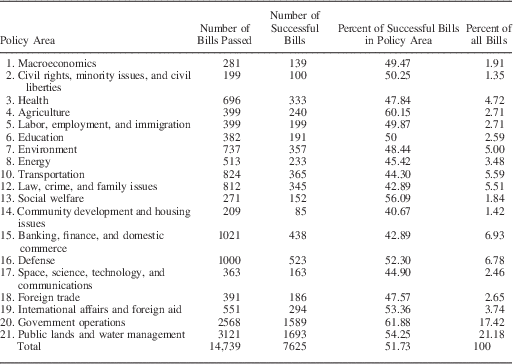
The theory predicts past success within a policy area will influence future policymaking in the same area so bills were ordered by their final passage date within a chamber, within a Congress. The unit of analysis is policy-area month and the data consists of 19 discrete policy areas into which bills are coded by the Policy Agendas Project, measured across 408 months (1973–2005, 93rd–109th Congresses) for a total of 7752 observations (19 policy areas×408 months).Footnote 3 Table 1 lists the number of bills passed by the chambers in a policy area and the number of bills passed in the same form by both chambers and sent to the president (classified as “successful bills” in the table).Footnote 4
Distribution of Bills by Policy Areas

Note: the Policy Agendas numbering system is used. There are no categories 9 or 11.
The value of the time-dependent variables, including the dependent variable, are specific to the policy-area month and are calculated within a congressional term. One of the advantages of the empirical strategy (described below) is that it models the amount of time a return to equilibrium takes. That is, the time-series analysis models the rate at which the effects of the independent variables “wear off.” The results demonstrate that the empirical effect of a bill passage lasts slightly longer than one month, confirming that a month is an appropriate length of time over which to measure effects.
Measurement
The dependent variable measures each chamber’s policy activity, conceptualized here as the amount of legislating by a chamber within a particular policy area and operationalized as the percentage of bills passed at time t in policy area j out of all bills passed by the chamber within the congressional term.Footnote 5 Even though most bills take months to debate and amend, the date of passage is the most obvious way to measure the point at which majorities are able to update their prior beliefs about the costs and benefits of passage.
The dependent variable is meant to capture month-to-month congressional activity in each chamber. Given all the possible policy issues that could be addressed, which ones are members actually staking out positions on, through casting a roll-call vote? By quantifying chamber activity, we can better understand what drives action in different policy areas.
The key independent variables are measures of past activity using different bill types and comprehensiveness. A positive relationship is expected between these bills and future legislative activity. The number of bills reconciled and sent to the president and the number of bills passed by the other chamber are the most obvious ways to measure legislative activity within the policy area and the effect on additional activity.
Compulsory legislation is also an important determinant of congressional action because these bills contain expiring provisions which, if not extended, cause a reversion to an extreme status quo (Hall Reference Hall2004; Adler and Wilkerson Reference Adler and Wilkerson2013). Appropriations and authorizations bills are the most well-known types of compulsory bills. If an authorization bill is not passed, a policy provision cannot receive budgetary funding through an appropriation.Footnote 6 Appropriations bills are an important part of budgetary politics and without funding, a policy provision will lose funding entirely and may cease to operate (see Kiewiet and McCubbins Reference Kiewiet and McCubbins1985; Kiewiet and McCubbins Reference Kiewiet and McCubbins1991).
Appropriations bills are taken from the Agendas data while reauthorizations were coded by the author. Reauthorizations are difficult to identify because they are not consistently passed within Congresses, are inconsistently titled, and may be included as provisions in larger pieces of legislation. I identified reauthorizations by reading both the House and Senate vote summaries in the Congressional Quarterly Almanac (1973–2009) and doing a keyword search on a variety of terms such as “extend,” “extension,” “authorize,” “reauthorize,” “expiring,” etc.Footnote 7 Also included as reauthorizations were bills known to be regular authorizations such as the Elementary and Secondary Education Act and the annual defense spending bill. Bills to extend tax cuts, increase the debt ceiling or unemployment benefits were also usually counted, though bills associated with the annual budgeting process or emergency provisions were not counted, nor were bills which authorized a study or particular policy for a specified period of time but was not part of the regular congressional agenda. The data include 1442 unique reauthorizations identified for the period 1973–2009 or about 85 per Congress.
Large, comprehensive bills are measured in two ways. First, omnibus bills are identified by the Agendas data. Omnibus appropriations bills are an increasingly used policymaking mechanism as a way for party leaders to exert agenda control (Shipan Reference Shipan2006). Krutz (Reference Krutz2000, 545) finds omnibus bills increase legislative productivity and “contribute to an overall push toward constancy in lawmaking,” a claim consistent with the theory outlined here. The average number of lines written in Congressional Quarterly within a policy area is also used by dividing the total number of lines written about all bills within a policy area, from the Agendas data, by the number of bills passed in the policy area. The variable is included in the models, along with an interaction term, which conditions the effect of previous lawmaking on future policy activity. The interaction term captures how congressional activity is affected by the quantity and comprehensiveness of previous legislation.
As described above, the policy formulation process by political actors is complex as Congress, the president, and the media all have an important influence on it. Therefore, a number of control variables are included to capture these influences. Action demanded by voters within a policy area passed by the chambers is measured using the annual “Gallup’s Most Important Problem,” survey question, as coded by the Policy Agendas Project into one of 19 policy areas. Another variable measures issue salience and agenda-setting by the media and is the monthly proportion of articles in a sample of the New York Times, which relate to a policy area.
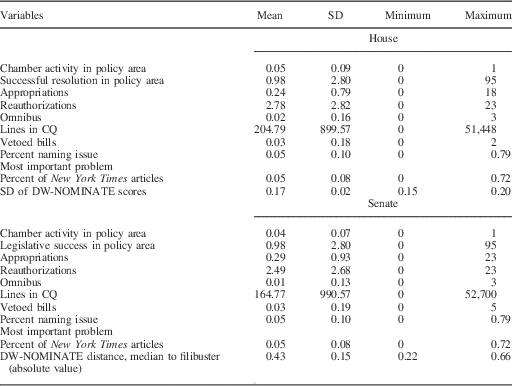
Also included is a variable which measures agenda-setting by the president and is equal to the number of statements specific to a policy area made by the president during his State of the Union speech as coded by the Policy Agendas Project. As Rudalevige (Reference Rudalevige2002) points out, State of the Union statements tend to be the most important presidential proposals and though they only occur once per year, they are frequently used to measure presidential agenda-setting. The number of vetoes in a policy area is also used in the models to measure presidential preferences and the willingness of Congress to pass legislation in a policy area if its preferences diverge from the president’s. A positive effect of vetoes within the policy area on future activity indicates the chambers are able to agree on legislation, and return to the policy area even if the president has divergent preferences, possibly for position-taking reasons or because Congress believes the president will acquiesce during the veto bargaining process (Cameron Reference Cameron2000). Table 2 shows summary statistics for each of the variables used in the analysis.
Summary Statistics for Variables Used in the Analysis

Note: chamber activity in policy area is the proportion of bills in that policy area divided by all bills passed by chamber. Legislative success in policy area is the number of bills passed by the chamber sent to the president for signature. All other bill related variables are counts of bills exhibiting that characteristic, except for CQ lines, which is the average number of lines about bills in that policy area. n=7106 and the unit of analysis is policy-area month and all variables are calculated within a Congress.
It is also important to account for the effects of parties and institutional rules on the issues addressed by the House and Senate. Republicans and Democrats are predisposed to pursue different types of policies at various times and use their control over the floor to manage the types of policies addressed and the outcomes reached (Cox and McCubbins Reference Cox and McCubbins1993). The research design controls for the effects of party coalitions, leadership, ideological differences between the chambers and many other party-based effects because the relationships between the independent and dependent variables are measured within a congressional term, during which many party-based factors are constant. Although the pooling strategy may mask differences in the strength of the effects across Congresses, fixed effects by Congress, included in the models, account for unmeasured within-panel variation.Footnote 8 Measures of partisan-based preferences are also included in the models by using the standard deviation of DW-NOMINATE scores in the House, and the DW-NOMINATE absolute distance between the median and the filibuster pivot in the Senate (Poole and Rosenthal Reference Poole and Rosenthal1997). If policy activity is driven solely by the preferences of the majority party rather than strategic action, there will be a null relationship between previous success and future legislative action as the parties achieve policy success in one area then switch their focus to a new legislative area.
I claim that policy action and adoption is largely determined by information constraints and uncertainty, and that rather than continuously seeking out new legislative areas, members of Congress frequently take an easier path to ensure legislative successes. There is still a role for institutional constraints and partisan preferences, however. Majorities often pursue policies because of issue saliency, but the question asked here is whether the effects of rational updating and each chamber’s incentives to minimize the costs of passage and maximize their payoffs from lawmaking have an independent, positive effect on the type of legislation the chambers address. This story adds a crucial and unrecognized element to our understanding of how issues move on and off the floor, and in turn, which issues are likely to be addressed during a particular congressional term.
Estimation Strategy
Error-correction models, which estimate the effect a variable has on a long-run equilibrium, are used to test the hypothesized relationships. This type of model is commonly used in time-series analysis because it allows for specification flexibility, is relatively easy to interpret, and provides researchers with both the immediate and long-term effects of a variable. The ability to disentangle short-term and long-term effects is an important advantage of the model as these effects have been shown to be quite different in other studies of the dynamics of congressional institutions (Krause Reference Krause2002). Each time-varying independent variable is included in the model as both a differenced variable and as a lagged variable. Though some policy areas may have a larger policy jurisdiction, the variables measure changes in the dependent variable as the independent variable changes (as a percentage of all activity) rather than simply examining cross-sectional variation across all policy areas.Footnote 9
Following the advice of De Boef and Keele (Reference De Boef and Keele2008), I include a first-order lag for each of the independent variables and the dependent variable. The lagged dependent variable is necessary to control for past legislative action, and not including lagged dependent or independent variables restricts the coefficient for the first-order lag terms to zero, an assumption that generally should not be made a priori.Footnote 10 The models were estimated with the variables noted above and interaction terms to measure the specified conditioning relationships. The error-correction models used in the analysis are variants of the following:Footnote 11
 $$\eqalignno{ & \Delta \,Percentage\,of\,legislative\,activity\,in\,chamber_{{jt}}= \cr & {\equals}\alpha _{0} {\plus}\alpha _{1}^{{\asterisk}} \,Percentage\,of\,legislative\,activity_{{jt{\minus}1}} {\plus}B_{i}^{{\asterisk}} \Delta X_{{jt}} {\plus}B_{i}^{{\asterisk}} X_{{jt{\minus}1}} , $$
where X jt is a vector of covariates with values in policy area j at time t.
Predicting Legislative Activity in the House and Senate by Policy Area
Before turning to the empirical results, it is worth examining a typical policy area and the bills passed within it. In 2005, during the 109th Congress, the House passed a large number of bills classified as banking, finance, and domestic commerce. In February of that year, the House did not pass a single bill related to banking, but in March it passed one bill, five more in April, two more in May, two more in June, four more in July, none in August, five more in both September and October, four in November, and six in December. In the Senate, between February and August, a total of two bills related to banking were passed. However, beginning in September, the Senate passed seven bills, two bills, five bills, and eight bills in each month through December.
The original bill passed by the House in March was H.R. 1134, which amended the IRS code to change the tax status of income received from federal disaster payments (before Hurricane Katrina). Subsequent bills include the “Mortgage Servicing Clarification Act,” and the “Realtime Investor Protection Act,” both of which were passed by the House but not by the Senate. The Senate, along with the House, began passing a number of financial bills in the aftermath of Hurricane Katrina, including a number of bills, passed over a few months, which exempted from taxation various types of income received from federal disaster payments. In this policy area, there was no single bill that addressed all the issues related to Katrina; instead Congress legislated over the course of a few months, in an incremental fashion.
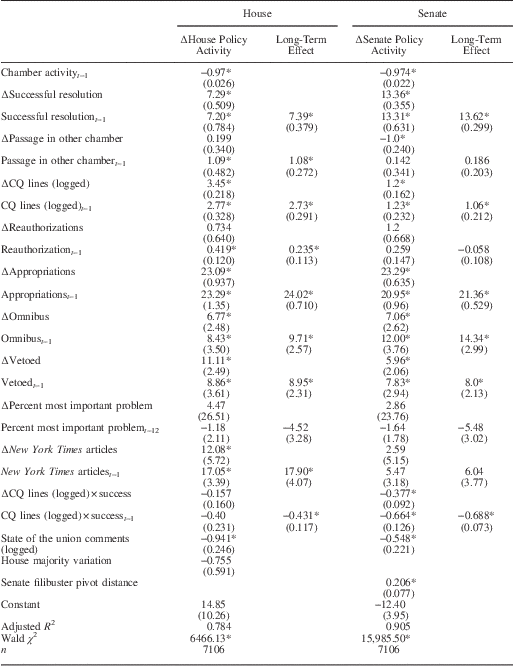
The two models in Table 3 show the ordinary least squares results for all policy areas across all months in the sample.Footnote 12 Bill activity in both chambers has a long-term equilibrium, and perturbations to the equilibrium are quickly corrected. The rate of correction is given by the coefficient for the “Chamber activity t−1” variable and demonstrates that when the House model is out of equilibrium, about 97 percent of errors are corrected in the first month (column 2 in Table 3), while in the Senate, about 97.4 percent of errors are corrected in the first month (column 4 in Table 3).
Model of ∆House and ∆Senate Bill Activity Within a Policy Area, 93rd–109th Congresses

Note: ordinary least squares with panel-corrected standard errors in parentheses. Units are policy-area months from 1973 to 2005 and 19 policy areas/month. Fixed effects for Congress are included. Fixed effects for Congress are not included when calculating the Bewley Transformation. All coefficients report percentage change in policy activity for a one unit increase in the independent variable, except the coefficients for lagged activity, and house majority variation, and senate filibuster distance, which report proportions.
*p<0.05.
The coefficient for a differenced or lagged independent variable is interpreted as the percentage change in chamber activity within a policy area for a one unit (one bill) increase in the independent variable and is equal to the immediate effect of the independent variable on the dependent variable (similar to a cross-sectional effect).Footnote 13 The coefficient for a lagged independent variable is interpreted as the long-term effect of a lagged independent variable on the differenced dependent variable and can be found by dividing the coefficient on the lagged independent variable by the coefficient on the lagged dependent variable. The second and fourth columns of the table give this value and the standard error of the long-term effect found using the Bewley Transformation (see the Supplemental Information for additional details; see Bewley Reference Bewley1979; De Boef and Keele Reference De Boef and Keele2008).
The theory claims that chambers should respond to legislative success within a policy area by passing more bills in the future in the same policy area. In the House, holding the value of CQ lines at 0, a 1 SD increase in the percentage of bills resolved in a month (about 2.8 bills in a policy area) results in an immediate increase of 3.28 bills in the present month and a nearly identical long-term increase of 3.23 bills for a total effect of 6.51 bills. In the Senate, the effect is larger than in the House—a standard deviation increase of successful bills (about 2.8 bills) results in an immediate increase of 4.23 bills and a long-term increase of 4.21 bills for a total effect of nearly 8.5 bills.
The results for the lagged successful resolution variables for both chambers support the theory. After the chambers achieve success in a policy area, members of Congress respond by passing more bills in the same policy area. Legislators learn from past events and put that knowledge toward specific kinds of legislative activity. In short, both the House and Senate choose to revisit issues on which they have already passed legislation. Even after a bill has been sent to the president through agreement by both chambers, the House and Senate return to the same policy area. Issues within Congress are “sticky,” and once majorities devote time and energy to passing legislation, they continue to do so, even when their past efforts have been successful. Additionally, the substantive effect is stronger in the Senate than the House at a statistically distinguishable level, suggesting the Senate uses bill passage as a stronger signal given the higher costs of passage in the Senate.
Salient Bills and Past Activity
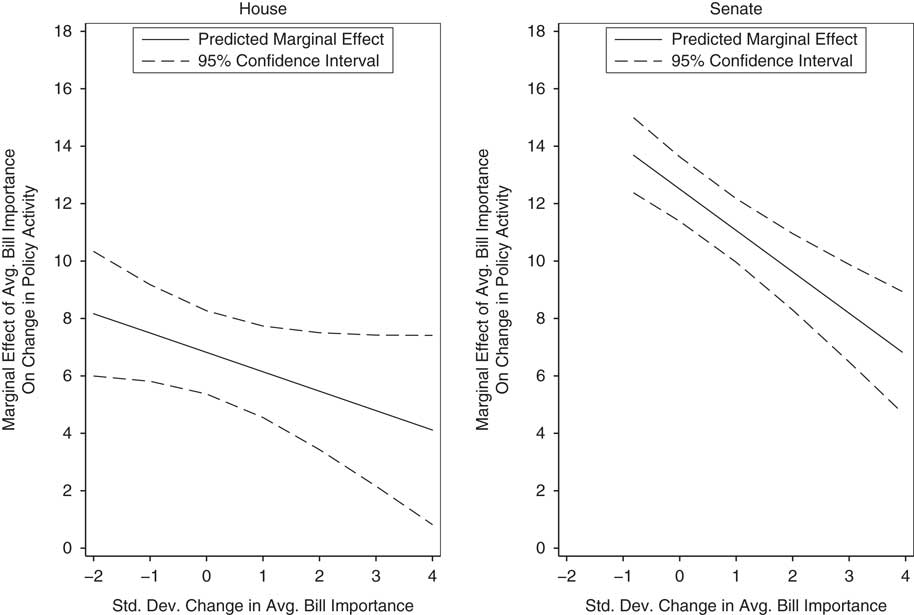
According to the theory, majorities use past legislative success as a guide for future action, so even salient bills, despite their high costs of passage, will increase future legislative activity. Table 3 includes both a differenced and lagged interaction term where the number of successful bills is multiplied by the average number of CQ lines within a policy area at time t. For both the House and Senate, the coefficients on the lagged and differenced terms are statistically significant and negative. However, to determine the size of the effect, the marginal effects for the lagged interactions of legislative success and CQ lines are shown in Figure 1.
The marginal effect of bill importance on the change in legislative activity within policy areas for the House and Senate

Both the differenced and lagged effect in the House are significantly larger than that in the Senate, indicating a greater reliance on comprehensive legislation both immediately and in the future as a predictor of future activity. In the Senate, the effect of success on bill passage within a policy activity is nearly cut in half when the number of lines in CQ increases from the minimum value to the maximum, a reduction of about 1.55 bills/month to 0.77 bills/month. The range of the effect sizes is similar in the House, varying from about 1.31 bills/month to 0.66 bills/month. The difference in results between the two chambers suggests that these types of bills are easier to pass in the House due to its majoritarian nature, sending a stronger signal to the chamber about the future costs of action. However, in both chambers, regardless of the importance of legislation, the effect of post-passage resolution success never equals 0 or become negative. The marginal effects demonstrate that the results are not driven solely by unimportant or trivial legislation but that substantive and important still has a positive effect on future activity.
Other Predictors of Legislative Activity
A number of other variables predict the proportion of bills the House and Senate pass within a policy area during a congressional term. A 1 SD increase in the number of appropriations bills results in a lagged increase of 2.95 bills in the House and 2.24 bills in the Senate for a total effect of 5.88 bills/month in the House and 4.64 bills in the Senate/month. The lagged New York Times article variable is positive and statistically significant in the House and in the Senate (at the 0.1 level) and the effect size is much larger in the House. While the substantive effect is not large (a 1 SD increase in Times articles results in a lagged increase of 0.22 bills/month in the House), the positive and consistent results inform our understanding of House and Senate dynamics. The House is the chamber more responsive to constituents because of its smaller districts, shorter electoral terms, and its majoritarian nature (Fenno Reference Fenno1973; Canes-Wrone, Brady and Cogan Reference Canes-Wrone, Brady and Cogan2002).
The number of presidential vetoes in a policy area increases the number of bills passed by each chamber in that area, resulting in small increases of about 0.32 bills immediately in the House, a long-term effect of 0.25 bills, and effects of 0.055 (immediate) and 0.12 (long-term) bills in the Senate, all given a 1 SD increase in the number of vetoes. This result reflects the willingness of chamber majorities to return to policy areas where they agree (or for position-taking purposes) even if the president does not.
Omnibus bills have a small, but significant relationship to legislative activity. The long-term effects are 0.19 bills in the House and 0.17 bills in the Senate. Surprisingly, reauthorization bills are not a significant predictor of immediate activity in the House or Senate, though they cause a very small future small long-term increase, about 0.19 and 0.07 more bills in the House and Senate, respectively. Finally, passage of a bill in the Senate has a statistically significant long-term effect on House action, equal to about 0.5 additional bills, but not an immediate effect. The Senate does not respond to the House’s legislative activity, but the House will pass slightly more bills within a policy area after receiving a signal from the Senate. The results match our general notions of how the House and Senate relate to each other in the modern Congress—the House usually passes legislation more easily so it should respond more directly to Senate action than the Senate should to the House.
Finally, in the Senate, the greater the absolute distance from the median to the filibuster pivot, the more policy activity increases across all policy areas. The result seems to be driven by only a few policy areas—when examined by specific area, there is usually a negative relationship between filibuster distance and policy activity except in health, transportation, and foreign trade, which are all significantly increased by larger filibuster distances. These areas roughly line up with distributive policies where compromise is likely and where the Senate seems to turn when resolution in other policy areas proves difficult.
Legislative Activity During Divided Chambers
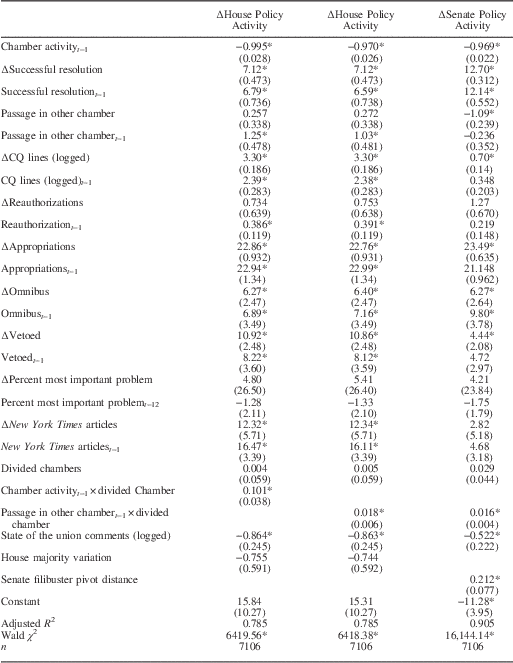
The theory predicts that divided party control of each chamber should produce more stability because of the increased uncertainty surrounding the costs of passage and agreement with the other chamber. When different parties pass a bill within their chamber, they anticipate higher costs associated with the bargaining process with the other chamber, and greater uncertainty about whether those costs will be rewarded with electoral benefits through agreement. To test this prediction, three additional error-correction models are shown in Table 4, where a variable measuring divided chamber control is interacted with the error-correction term (column 1), and the passage of a bill in the other chamber (column 2 for the House and column 3 for the Senate).
Model of ∆House and ∆Senate Bill Activity Within a Policy Area During Divided Chambers, 93rd–109th Congresses

Note: ordinary least squares with panel-corrected standard errors in parentheses. Units are policy-area months from 1973 to 2005 and 19 policy areas/month. Fixed effects for Congress are included. Fixed effects for Congress are not included when calculating the Bewley Transformation. All coefficients report percentage change in policy activity for a one unit increase in the independent variable, except the coefficients for lagged activity, and divided chambers, along with the interaction terms, which report proportions.
*p<0.05.
As expected, in column 1, the interaction between divided chambers and lagged chamber activity is positive, indicating that the error -correction rate is reduced during periods of divided chamber control.Footnote 14 Substantively, shocks to the policy area equilibrium are corrected more slowly, indicating that during divided chambers, lagged chamber passage influences future chamber passage over a longer period of time, resulting in more stability in terms of the policies addressed by Congress.Footnote 15
Likewise, in columns 2 and 3, the divided chamber interaction is positive for passage in the other chamber. When two different parties control each chamber, the passage of a bill in one chamber dictates the activity of the other chamber to a greater extent. For example, in the House, passage of a bill in a policy area produces about 1.8 percent more legislation passed in the House in the same policy area during divided chamber control, while in the Senate, passage by the House produces 1.4 percent more bills in the same policy area during divided chambers.
When comparing the coefficient sizes in Tables 3 and 4, the effect of the differenced and lagged resolution terms are significantly larger in the Senate than in the House. The Senate seems to be more reliant on successful previous action than the House, and there is an obvious explanation for this empirical result, namely that policy action and success in the Senate is more uncertain than in the House. The lack of a germaneness rule, the lack of a time limit on debate, and the filibuster all promote greater uncertainty during the lawmaking process. When successful resolution is achieved, members of the Senate view it as a stronger signal about the preferences of senators and the likelihood of success on future action.
Legislative Activity Conditional on Majority Time in Power
The last test of the theory manipulates information conditions by examining the effect of the length of time a party has been in the majority. Simply put, longer-serving majorities should have better information about the costs of legislative action within a particular policy area. Shorter serving majorities should rely more on past legislative action to guide future policymaking, so a conditional relationship is predicted to exist between length of time in the majority and the effect of previous legislative activity.
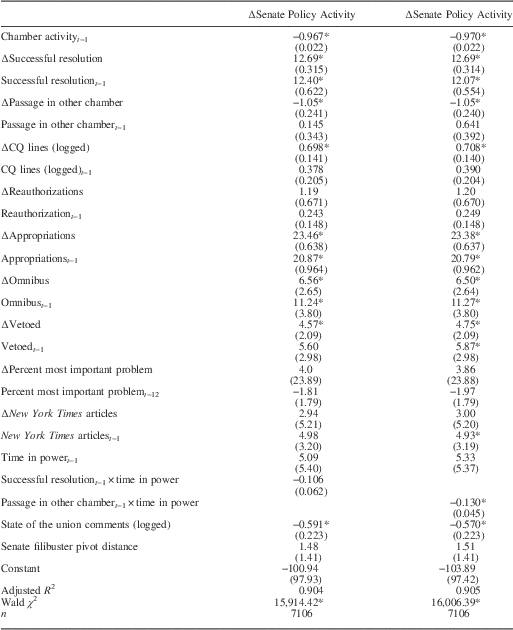
Specifically, I test interactions between Senate majority time in power and lagged successful resolution (bills sent to the president), as well as between Senate time in power and lagged passage in the House.Footnote 16 Newer majorities will view the passage of a bill within the same policy area and the successful resolution of a bill with the other chamber as informative with respect to the costs of legislating and the chances of success of bills within that area. This encourages action by the Senate majority because the coalition is able to update its beliefs about costs, and about the electoral benefits received from successful passage.
As Table 5 shows, there is a negative and significant relationship for both successful resolution of a bill and passage in the other chamber when conditioned on the majority time in power. The longer a Senate majority has served, the smaller effect previous bill passage and interchamber resolution has on future activity. Substantively, the effect is rather small, reducing future policy activity by about 0.1 and 0.13 percent for every additional term a majority serves, for successful resolution and passage in the other chamber, respectively. Nonetheless, for a long-serving majority, the issues addressed become less dependent on previous legislation and there exists a greater variety of issues subject to more change.
Model of ∆Senate Bill Activity Within a Policy Area Conditional on Time in the Majority, 93rd–109th Congresses

Note: ordinary least squares with panel-corrected standard errors in parentheses. Units are policy-area months from 1973 to 2005 and 19 policy areas/month. Fixed effects for Congress are included. Fixed effects for Congress are not included when calculating the Bewley Transformation. All coefficients report percentage change in policy activity for a one unit increase in the independent variable, except the coefficients for lagged activity, and senate filibuster distance, which report proportions.
*p<0.05.
Discussion
This research adds to our understanding of which types of policies Congress will attempt to address during the congressional term. The results suggest that policy action in the House and Senate varies around a long-term equilibrium and there is remarkable short-term stability in the issues Congress chooses to act on. The theory proposed here argues that these empirical findings are the result of cognitive limitations which constrain action on a variety of policy issues, resulting in majorities and their leadership using previous legislative success to guide future action. Rather than taking on an unknown, and potentially costly policy issues, members return to previous areas of success. This strategy allows members of Congress, and the majority coalitions within each chamber, to legislate (and plausibly claim they are doing their jobs), in a way that is efficient and likely to be met with success.
The results also inform our understanding of how the party leadership exerts control over the congressional agenda. As Cox and McCubbins (Reference Cox and McCubbins2005) demonstrate, the leadership pursues policies designed to promote the party brand and prevents divisive or damaging issues from reaching the floor. The theory and results here show this relationship is conditioned by the role of information and uncertainty. Though the leadership seeks to pursue certain types of partisan issues, they are more likely to push known quantities rather than taking risks on potentially costly policy areas. In many cases, the party leadership may want to pass legislation within an issue area, but hesitate due to their uncertainty about the difficulty of passage.
Even salient legislation increases future legislative activity. Despite the passage of an important bill, which makes important changes to existing policy, future legislation is likely to follow in the same issue area. This contrasts with much of the congressional institutions literature that suggests policies move from outside to within the gridlock interval, and offers a reminder that no issue is subject to single dimension, one-shot legislating. Even important or comprehensive bills are not single solutions to a policy problem, but are instead only the first of what are likely to be many bills which revise, extend, and update the previous bill.
The theory also claims, and the empirics support, the claim that information plays a crucial role in the policy adoption process. Members and majorities, pursuing electoral benefits, do not have full information about the future difficulty of passing bills and resolving legislative differences. Their use of past action as a guide for future activity allows them to satisfice on the legislative costs and electoral benefits dimensions. The relationship between past activity and future policy action is more robust when majorities have less information about their costs and benefits, and as the results show, the relationships are stronger during divided party control of the chambers and when a majority has less experience governing.
Could another factor, like public demand be driving the results? The models control for public demand through the most important problem survey question, the salience of legislation, the New York Times articles variable, and the lagged amount of policy activity, but admittedly, none of these are perfect measures of the month-to-month demands of the voting public. However, if the results were entirely driven by public demand, one might expect significant legislative activity in one area as a function of demand, but also a corresponding decrease once bills have addressed that demand.
What Congress acts on is not always determined by what the public wants, but instead by what Congress perceives it can get done. This also suggests the policies Congress chooses to address are less fluid than many believe, and frequently, public demand may not be enough to force legislative action. Instead, members of Congress must believe taking up the bill will be worth their time and effort. This model contrasts sharply with the common view of Congress as problem solving based on constituent outcry. Congress values achieving overall legislative success more than addressing any particular issue at a given time. The results here require a rethinking of how and why certain issues manage to stay off the floor despite their prominence among the public or within the media.
Supplementary Material
To view supplementary material for this article, please visit http://dx.doi.org/10.1017/psrm.2015.66