Introduction
Integrating ethics into health technology assessment (HTA) has become a topic of major interest over the years. In 2005, Hofmann (Reference Hofmann1) wrote that few reports analyzed ethical questions explicitly, even though the integration of ethics had been on the agenda for HTA since 1970. Hofmann, writing with colleagues, held the same position in later papers (Reference Saarni, Hofmann, Lampe, Luhmann, Makela and Velasco-Garrido2;Reference Hofmann, Droste, Oortwijn, Cleemput and Sacchini3). Many reasons have been given for the difficulty of integrating ethics into HTA (Reference Assasi, Schwartz, Tarride, O'Reilly and Goeree4;Reference Bellemare, Dagenais, K-Bédard, Béland, Bernier and Daniel5). An obstacle often discussed in systematic reviews is the absence of shared standard models for ethical analyses. According to Daniels and colleagues, efforts have been made in some countries to integrate ethics into HTA reports, but “most HTA reports even in those countries fail to develop ethical arguments and generally do not even mention ethical issues” (Reference Daniels, Porteny and Urrutia6).
To understand the actual integration of ethics into HTA reports, it is important to analyze how ethical considerations are taken into account. The presentation by Refolo and colleagues at the 2019 annual HTAi meeting in Cologne, in which they examined twenty-seven HTA reports, constituted a rare effort to systematically characterize and analyze ethical considerations in such reports (Reference Sacchini, Refolo and Spagnolo7). Because there exists no shared understanding of the characteristics of ethical analysis in HTA, our own analysis must, like previous studies, not only group together diverse ethical considerations under specific broad headings but also differentiate the types of ethical analysis falling under each heading.
Our study provides a more comprehensive overview than has been conducted hitherto of the current level of integration of ethical considerations into HTA and the variety of models used for ethical analysis. The EUnetHTA core model proposes different ways of conducting ethical or moral analyses in HTA reports (8), but these analyses vary not only in their disciplinary foundations, but also as regards the characteristics of the ethical assessments and their operational processes (Reference Legault, Béland, Parent, K.-Bédard, Bellemare and Bernier9). This variety of moral and axiological perspectives explains why there is no shared definition or shared set of requirements for an ethical analysis, even though proposals have been made for such requirements (Reference Sandman and Heintz10).
The results of this study should clarify the ethical choices made by the different HTA agencies that take ethical considerations into account and broaden the reflection on these social choices.
Methods
A systematic review of gray literature based on the preferred reporting items for systematic reviews and meta-analysis (PRISMA) guidelines (Reference Moher, Liberati, Tetzlaff, Altman and Grp11) was conducted according to a research protocol established prior to our study. This protocol includes a clear definition of documents to be retrieved from the literature. We used the definition provided by the INAHTA to select and discard documents. First, the document must assess a health technology and must be published by an official HTA agency/unit. The technology assessed could be a test, device, medicine, vaccine, procedure, program, or system used to diagnose or treat medical conditions, promote health, provide rehabilitation, or organize healthcare delivery. The documents must include an explicit method to determine the value (intended and unintended consequences) of a health technology (12).
Search Strategy
The search strategy was designed and implemented using the Google™ search engine in Chrome (Version 71.0.3578.98) to systematically identify gray literature published in PDF format. This was done using an equation containing the search term “ethic” applied to HTA agencies’ parent sites (ethic site: https://(HTA agency parent site)/ filetype: pdf). Google's language preference was set to English and French (using “éthique” as a search term in the search equation). The time span for the search was 1 January 2015 to 20 August 2019. An information scientist validated the search strategy. This search procedure was applied to the parent Web sites of ninety-six HTA agencies’ site addresses derived from the convenience-sampling database built for our previous study (Reference Gagnon, Legault, Bellemare, Parent, Dagenais and K-Bédard13) (See Supplementary HTA Agencies’ Sites List, where the name/acronym, country, and Web site addresses of these agencies are listed).
A database of HTA agency documents retrieved was created and a link to each PDF document was saved for further analysis.
To validate this approach, results (document titles) for the year 2018 were obtained by direct use of the search engines of three Canadian HTA agencies: the Canadian Agency for Drugs and Technologies in Health (CADTH), Health Quality Ontario (HQO), and the Institut National d'Excellence en Santé et en Services Sociaux (INESSS). These results were compared with those obtained using the methodology described above. The documents found in the two different searches matched (n = 3, 11, and 18 for the CADTH, HQO, and the INESSS, respectively). The validation exercise revealed an issue with the INESSS Web site, however: we were obliged to conduct a manual search for the term “ethic” in all PDF documents published by the INESSS to compare them with those found by our Google search. Some exceptions were observed owing to the lag between the HTA agencies’ release dates and indexation onto the World Wide Web.
Screening of Documents
Two subgroups of reviewers were created. One group was composed of HTA producers and a scientist (CAB, SKB, and HG), whereas the other consisted of experts in ethics/philosophy (MP and GAL). In both groups, members reviewed all documents independently of the other group. The reviewers applied these inclusion criteria: documents must be HTA assessments (written by an HTA agency and presenting an assessment of a technology) (12) including an ethical section presented in a paragraph or annex. Documents that were not HTA assessments but mentioned the word “ethics” (e.g., in discussing the agency's mission) or referred to ethical research approval were discarded. Reviewers recorded their screening results in a database, using the following status designations: not an HTA assessment, HTA assessment without a section on ethics, and HTA assessment including a section on ethics. The two groups’ results were compared and discussed until a consensus was reached. Cases of unresolved discordant status assignments were arbitrated by a referee (JP).
Data Extraction and Analysis
Data extraction of the ethical sections identified required classification of how ethical considerations were actually used in the report. Reports were grouped under four headings, according to the nature of the ethical content.
The first, “Ethics Sections with No Ethical Analysis,” covers reports that had a section that contained the search term “ethic” (e.g., with the heading “Ethical, Legal, and Social Considerations”), but where, in fact, no ethical considerations could be found. Daniels and colleagues propose a distinction between reports that only identify ethical issues and those that advance ethical argumentation (Reference Daniels, Porteny and Urrutia6). In line with this distinction, the second heading, “Ethics Sections with Ethical Issues Highlighted,” refers to sections that highlight ethical issues and flag certain aspects of the technology without further analysis.
The last two headings were influenced by the following reasoning: The raising of ethical considerations accompanied by ethical argumentation may vary according to the way this argumentation is constructed. In line with this, distinction is made between norm- and values-based ethical assessment. A norm-based assessment of a technology determines whether the technology is ethically acceptable; the arguments show whether or not it complies with the prescriptions stipulated by the norms of reference. In norm-based assessments, the norms of reference may be legal or societal norms. A society's legal norms are often at the core of legal considerations with respect to a technology, but reference may also be made to recognized social norms that are binding within a specific culture and that may, therefore, be applied. The aim of norm-based assessments grounded in either legal norms or social ones recognized as socially binding is to enable decision makers to recognize possible breaches of such norms. Sections taking this approach are referred to as “Ethics Sections with a Norm-based Ethical Assessment (Descriptive Perspective),” because the norms of reference are considered to be actually and factually binding.
One type of norm-based assessment, however, is conducted not according to legal or social norms but according to moral ones. Accordingly, in such an assessment, legitimacy will be grounded in philosophical or theological arguments. Moral argumentation will show that the technology does or does not comply with the moral norms in question. As well, ethical assessments can be made from an axiological perspective, which is different from argumentation based on compliance with norms. Under the axiological perspective, the argumentation will show how the technological impacts of a technology on all stakeholders minimize or maximize values like quality of life, autonomy, fairness, and so on. Axiological argumentation rests on establishing the grounds for the value judgments made, and ethical assessments made from this perspective aim to guide decision makers as to the best course of action in a given societal context. The final heading, then, is “Ethics Sections with Assessments Based on a Moral or Axiological Perspective.”
Two subgroups of reviewers were created. The members of the first subgroup (MP and GAL) analyzed all of the reports, doing so independently of each other. In conducting their review, they collected the information from each report that justified their decision about how to classify its ethics section. A consensus meeting finalized their analysis. The second subgroup (JPB and JP) reviewed this final analysis and a consensus was reached on the final classification of the sections on ethics.
Results
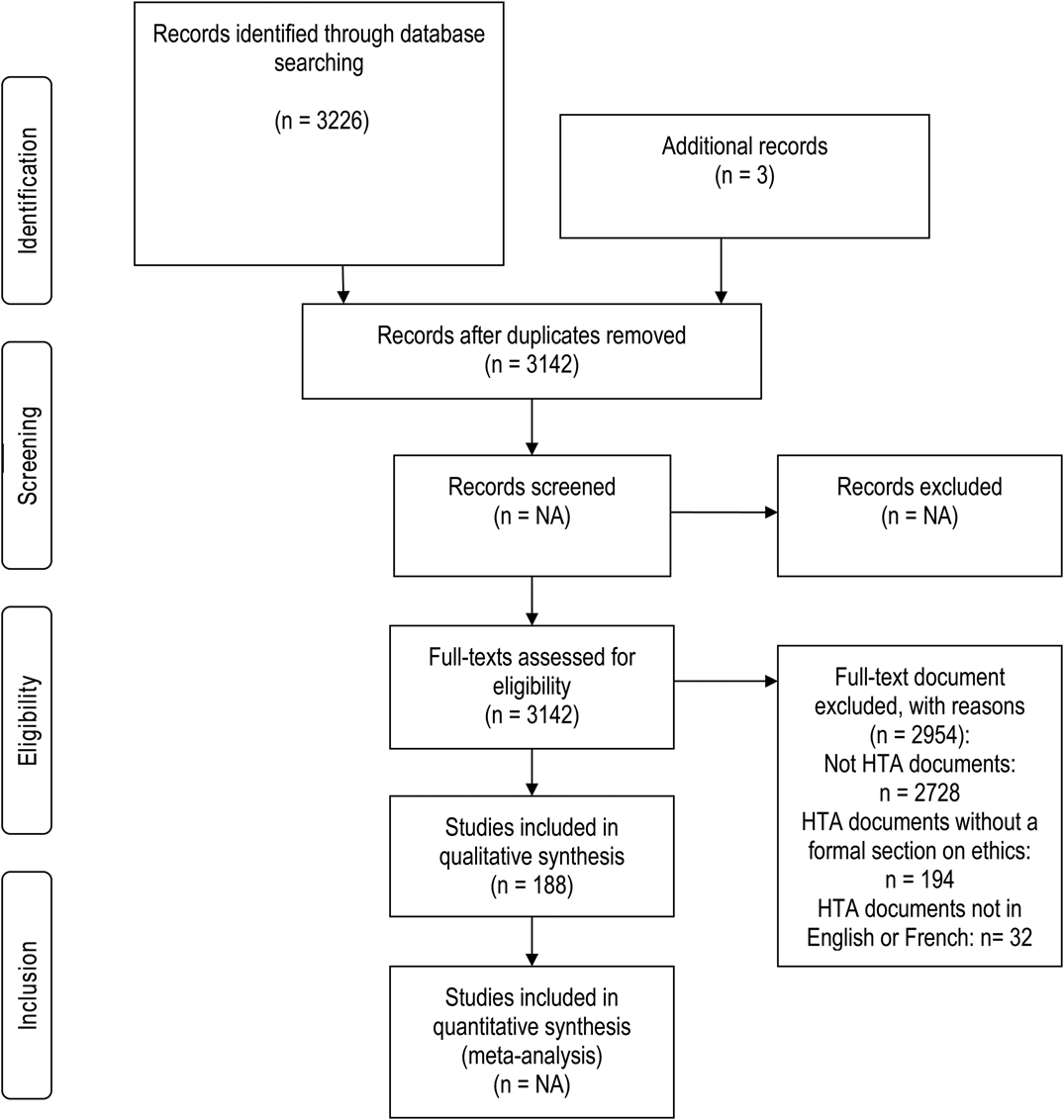
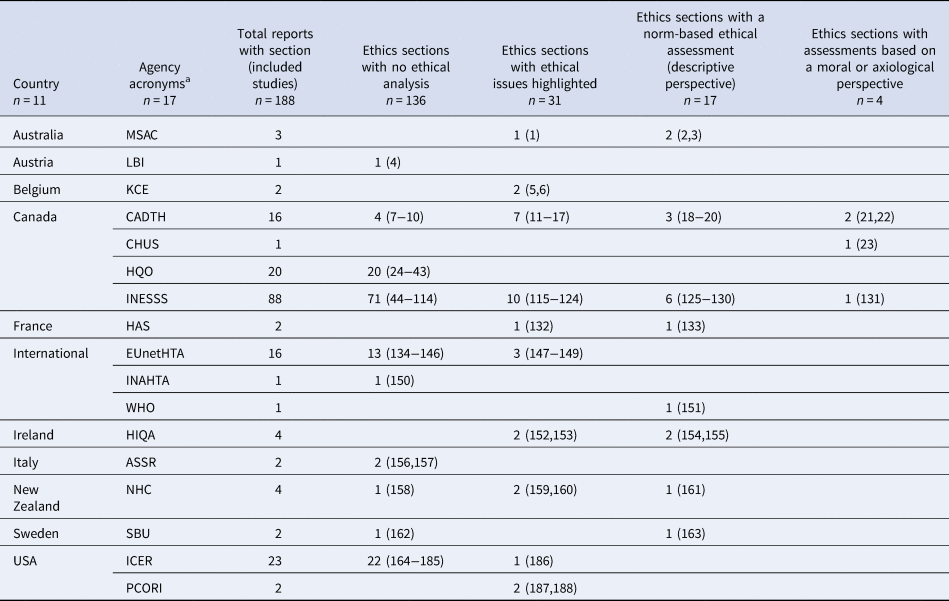
The search strategy was executed using the Web sites of ninety-six HTA agencies; four agencies were international, and the rest were distributed among thirty-four countries (See Supplementary HTA Agencies’ Sites List). The PRISMA diagram (Figure 1) shows that, of 3,142 full texts (i.e., PDF documents) analyzed, 414 were HTA reports containing the search term “ethic.” Only 220 reports had an ethical section, and 32 were excluded because they were not written in English or French. As shown in Table 1, 188 studies were included in the qualitative analysis, representing a total of seventeen agencies from eleven countries. One hundred and thirty-six of the one hundred and eighty-eight studies identified fall into the first category (Sections with No Ethical Analysis), thirty-one of the remaining fifty-two reports reported ethical issues, seventeen presented norm-based ethical assessment from a descriptive perspective, and four presented an ethical assessment based on a moral or axiological perspective.
PRISMA flow diagram.

Categorization of included studies per country/agencies with numbers in parenthesis indicating the reference number in “supplementary included documents" for each of these studies

a Agencies acronyms: MSAC, Medical Services Advisory Committee; LBI, Ludwig Boltzmann Institute; KCE, Knowledge Centre for Excellence; CADTH, Canadian Agency for Drugs and Technologies in Health; CHUS, Centre Hospitalier Universitaire de Sherbrooke; HQO, Health Quality Ontario; INESSS, Institut National d'Excellence en Santé et en Services Sociaux; HAS, Haute Autorité de Santé; EUnetHTA, European Network for Health Technology Assessment; INAHTA, International Network for Agencies for Health Technology Assessment; WHO, World Health Organization; HIQA, Health Information and Quality Authority; ASSR, Agenzia Sanitaria e Sociale Regionale; NHC, National Health Committee; SBU, Swedish Council on HTA; ICER, Institute for Clinical and Economic Review; PCORI, Patient Centered Outcomes Research Institute.
A closer look at the specifics of each of these seventeen agencies’ reports, as grouped under our four headings, will provide a better understanding of the different approaches used in treating ethical considerations.
Ethics Sections with No Ethical Analysis
One hundred and thirty-six reports have a section using the search term “ethic” but provide no specific ethical analysis in these sections (Table 1). This can be explained by a number of factors. The first is that the word “ethics” appears in a section's title, even though that section contains no ethical analysis. The Ludwig Boltzmann Institute (LBI), Austria, report integrates ethical considerations into a section entitled “Socio-economic and Ethical Considerations.” Two Agenzia Sanitaria e Sociale Regionale (ASSR), Italy, reports have a section entitled “Ethical, Social, and Legal Considerations.” In four of the CADTH reports, sections are entitled “Additional Considerations,” “Policy and Ethical Issues,” “Ethical Considerations and Requirements for Healthcare Professionals.” The INATHA report's section entitled “Ethical and Legal Considerations” and “Ethical Considerations” is used in one SBU report.
A second factor is related to the nature of the report. INESSS reports are addressed to the Quebec government and make recommendations on whether or not to include certain medications in its reimbursement list. The ethical section in most of these reports presents the general effect of the drug(s) on the population or on other parts of the health system. In this context, the label “ethical considerations” may be used for both legal and ethical considerations. In seventy-one of these reports, the ethical section did not contain any ethical analysis.
A third factor is the use of grids that include ethical considerations. Thirteen short reports from HQO (Ontario) made explicit recommendations to the government using a decision-making grid where the criterion that addresses ethical considerations is “Consistency with expected societal and ethical values.” Two questions are presented: “How likely is the adoption of the health technology/intervention to be congruent with expected societal values?,” and a second, identical one except for the replacement of “societal” with “ethical.” The responses to these questions contribute to the process of decision making. In another instance, seven reports listed ethical considerations in a section outlining the strategy for identifying patients’ preferences and values. In thirteen of the EUnetHTA reports analyzed, there is a section covering “Potential ethical, organisational, patient, social and legal aspects.” Some reports mention that there are no findings to be reported and reference is made to an appendix, whereas other reports only present an appendix providing answers to the specific questions. In the thirteen reports without ethical analysis, twelve referred to such an appendix, whereas in those highlighting specific ethical issues, the information registered in the appendix is integrated in the report. In twenty-two of the twenty-three reports analyzed from the Institute for Clinical and Economic Review (ICER, USA), a conceptual “value for money” structure is determined through four analyses: “Comparative clinical effectiveness,” “Incremental cost-effectiveness,” “Other benefits or disadvantages,” and “Contextual considerations” (which include ethical, legal, or other issues but not cost).
A fourth factor is when ethical considerations concern the ethical aspects of the research. In National Health Council (NHC, New Zealand) reports, only one mentions ethical research in the ethical section.
Ethics Sections with Ethical Issues Highlighted
Thirty-one reports with a section on ethical issues offered a variety of representations. Specific issues related to a technology are presented by a report from the Medical Services Advisory Committee (MSAC), Australia, which addresses specific impacts rather than providing a broad coverage of all ethical issues.
Two reports from the Knowledge Center for Excellence (KCE), Belgium, highlight ethical issues with a reflective approach. In one, questions are raised about positive or negative impacts; the other extends an invitation to reflect collectively on ethical dilemmas concerning the appropriate end-of-life care.
Some reports address some or all of the four principles of bioethics.
Only one of the seven CADTH reports identifying ethical issues systematically lays out the ethical issues related to all four principles. The other six reports identify some ethical issues relative to the main concerns of beneficence and nonmaleficence.
In ten of the INESSS reports, the ethical issues reported concern beneficence, justice, and autonomy, without any explicit reference to the four-principles approach.
The Haute Autorité de Santé (HAS), France, provides a methodological guide for ethical assessment (14) based on the four principles. In one report, only the ethical issues raised were identified.
In three of the EunetHTA reports, the application of the model clearly raises ethical issues.
Two reports from the Health Information and Quality Authority (HIQA), Ireland, based on the four bioethics principles, lay out the moral principles guiding the specific assessment of a situation.
Two reports from the National Health Council (NHC), New Zealand, present ethical issues related to equity for the Maori people. In one report, the main question raised is: How will a national procedure avoid aggravating existing inequality for the Maori people?
One report from the Institute for Clinical and Economic Review (ICER), USA, addressing drugs for rare conditions, raises many ethical issues related to this specific problem. The two reports from the Patient Centered Outcomes Research Institute (PCORI), USA, are part of a single larger report on the challenges of gene therapy with an ethics in which specific ethical issues are raised.
Ethics Sections with a Norm-Based Ethical Assessment (Descriptive Perspective)
We identified a total of seventeen sections with norm-based ethical assessments, that is, assessments with a descriptive perspective. Here, the ethical analysis assesses the technology from a legal or social perspective, with the aim of grounding the ethical assessment in shared legal or social norms.
In one of the MSAC reports, an explicit ethical framework is defined based on the four-principles approach of bioethics. The aim is clearly descriptive in nature: “to review and synthesize the available evidence to inform a public funding decision. In the case of ethical considerations, evidence synthesis equates to reviewing the relevant literature and assessing the balance of arguments. The synthesis is mainly descriptive, but it is also normative insofar as it seeks to identify ethical ideals for framing policy on how medical professionals should conduct themselves” (15). The other report's focus is based on the ethical dilemma of implantable cardioverter defibrillator deactivation at end of life, which is resolved by appealing to the legal and ethical practices determined by Australian guidelines.
Three of the CADTH reports proposing a descriptive ethical assessment apply the same ethical framework, taking macro-, meso-, and micro-level considerations into account. This complex framework establishes the ethical social background to be considered in final decision making. The macro level refers to the common public good to be considered in resource allocation; the meso level considers impacts of the allocation on healthcare organizations and professional practices; and the micro level involves patients’ individual rights. This ethical analysis gives a description of the legal norms and rights to be considered in the decision-making process. In the INESSS's drug evaluations, five reports’ ethical assessments take a descriptive perspective, where the lack of ethical literature on comparing the differential value of a treatment with its budgetary impact is outlined; this is a major factor for recommendations on costly efficient drugs. Only one report proposing a norm-based ethical assessment formulates explicit obligations to stakeholders based on the principle of nonmaleficence in medical practice and of distributive justice.
In one of the HAS reports, the methodological guidelines were used systematically. These guidelines aim to establish procedures to review the social debate around the technology analyzed. A descriptive analysis constitutes the second step of the procedure and sets out the positions for and against ethical objections. Only conflicting ethical arguments based on reason and not just convictions are considered; their relative weighting determines the final conclusions. The World Health Organization (WHO) report presents an assessment in which reference is made to the socially accepted principle of vaccination, with a comparison of the collective and individual benefits of mandatory vaccination. In cases where assessments continue to be debated by ethicists, these points are noted.
Two reports from the Health Information and Quality Authority (HIQA), Ireland, base their ethical analysis on explicit frameworks that present principles or questions that must be addressed by considering different generally accepted policies or legal stances in society.
One NHC report raises the main question: How can a national procedure not aggravate the existing inequality for the Maori people? References to existing treaties are at the core of the evaluation of this program.
In one of the SBU reports, an appendix provides a full presentation on how existing laws and procedures clarify the question of traumatic shaking.
Ethics Sections with Assessments Based on a Moral or Axiological Perspective
Ethical assessments based on moral norms or an axiological perspective were found in four reports. Two CADTH reports took the same axiological approach, defined from the start as follows: “Ethics is the inquiry into goodness or rightness in life; it examines questions about what we owe to each other and what it means to be a good person. Applied ethics uses ethical or moral theory (both are used interchangeably in this analysis) to find answers to these questions for particular topics and contexts. The goal of an applied ethics inquiry is to balance values and arrive at a resolution for the question at hand” (16). When applying this approach, the main questions addressed are: “(i) Should the technology be endorsed or made widely available? (ii) If yes, how should the technology be made available? (iii) Which, if any, interventions for OSA [Obstructive Sleep Apnea] should we recommend for usage, and why? (iv) How should these interventions be provided to OSA patients?” (16). Answers to these questions require the integration of scientific facts about impacts on the efficacy, safety, and costs of the technology and impacts on integrity, dignity, and value judgments based on this impact analysis. The ethical assessment is not handled in a separate section from the efficiency, safety, and cost analysis. The report from the CHUS, a hospital-based HTA unit, is on an evaluative analysis of chronic musculoskeletal disorders. Their ethical analysis was based on the four bioethical principles and relied on different value judgments made by the stakeholders involved in the therapeutic pathway. The convergence of these value judgments guided their recommendations. Last, only one report presents a moral assessment: the INESSS report formulates explicit obligations to stakeholders based on the principle of nonmaleficence in medical practice and on distributive justice.
Discussion
The ratio of reports whose ethics sections contain no ethical analysis to those that do contain one is 27 percent. However, this is misleading for three reasons. The first is the diversity of report formats: there are full reports, rapid reports, and reports recommending drugs to government agencies. The second relates to how ethical data are considered in the reports. With many agencies, the reports’ ethics sections cover a broad spectrum of issues known as ethical, legal, and social issues (ELSI). Of the report sections from these agencies, some cover social and ethical considerations, whereas others include organizational and legal implications. On the other hand, with reports from nine remaining agencies, a specific section refers explicitly to ethical issues, ethical analysis, or ethical considerations. Where ethics is covered in an ELSI section, social, organizational, and legal implications are focused upon and what is specific to ethics is not clearly identified. When there is a specific section related to ethical issues, reports address the ethical implications of the technology explicitly. Third, in some cases, there is a methodological reason for having an ethics section with no ethical analysis. When the research strategy consists of analyzing the efficacy and safety of a technology before analyzing its economic, organizational, or ethical implications, some technologies do not get past the assessment for efficacy and safety.
These findings also show that the specific way agencies integrate ethics into a report corresponds to their vision in using ethical considerations for decision making. Ethical considerations are often presented in a checklist of questions about the technology. At the core of such checklists, there is a reflective process generating awareness of certain issues. In this process, when specific issues arise, they are considered within the core of the report. Reports with a section on ethical issues also aim to raise the awareness of decision makers regarding certain specific implications of technology. In some reports, explicitly formulated questions are directed at the technology, sometimes raising challenges, but these sections usually analyze specific issues, often based on the four principles of bioethics. Reports presenting norm-based ethical assessments from a descriptive perspective or ethical assessments based on a moral or axiological perspective aim to guide decision makers in how to handle the ethical issues raised. Divergences regarding the role of ethics in HTA reports and the nature of ethical assessments can be accounted for in part by two factors: the social cleavage between EHS/ELS in regulatory law and the different requirements of ethical assessment in the agency's constitutive law (Reference Bernier, Legault, Daniel, K.-Bédard, Béland and Bellemare17).
In our systematic review of the different ethical approaches in HTA, nine identified approaches were analyzed based on their disciplinary foundations, the characteristics of their ethical assessments, and the practical reasoning involved (Reference Legault, Béland, Parent, K.-Bédard, Bellemare and Bernier9). Of these nine, only one ethical framework, the four principles approach of Beauchamp and Childress, could be identified in the documents included in the current study. From the standpoint of moral philosophy, the four principles should be used to evaluate the technology; however, our study rather reveals that these principles are used as a matrix for setting ethical issues even when utilized in a norm-based ethical assessment from a descriptive perspective. There is one exception, an HAS report where the reasons applying these principles are weighted. No other ethical approach identified is referred to in the reports analyzed.
In ethical assessments from a descriptive perspective or those based on a moral or axiological perspective, however, some agencies, such as the CADTH and HIQA, present their own assessment frameworks. The two normative ethical assessments from the CADTH and the one from the CHUS seem to converge on an axiological foundation. The CHUS report is explicitly based on the discussion of value judgments by the partners in the health pathway, whereas the CADTH reports propose to define ethical issues and ethical dilemmas by assessing value judgments.
Norm-based ethical assessments from a descriptive perspective converge on a sociological approach to ethics. In this perspective, ethics is embedded in the laws, statutes, policies, and so on that guide professional, institutional, and citizen conduct. By referring to these existing value assessments of the technology, reports can be addressed to decision makers. In the HQO reports, one can also discern an emotivist conception of ethics, as illustrated by the header “Patient preferences and values.”
Limitations of the Review
This research approach using the Google™ search engine has limitations much like those associated searches using published literature databases (e.g., Medline, SCOPUS, PsyINFO, etc.). In our validation process, we observed a small gap between the search engine of three Canadian HTA agencies and our research equation using Google™. We applied a methodology to produce a systematic review (Reference Moher, Liberati, Tetzlaff, Altman and Grp11) to reduce bias, but no systematic review can claim to reach 100 percent of the targeted literature. Given the rigorous method described, which included a validation process and observing presented results, we are confident that the objective was achieved, with a minimum of nonreached documents. Classification between reports without ethical analysis and those with norm-based ethical assessment from a descriptive perspective was difficult, because in some reports, an assessment of the drug or technology based on professional or organizational normative settings was expressed early, without the use of a complete framework of legal and social values setting.
Conclusions
There are few studies on how ethical considerations are integrated into HTA reports. In light of this, our aim was to study the different ways in which this integration takes place by showing what kinds of ethical considerations are reported and analyzed. Some HTA reports do not have a section referring to ethical considerations, whereas others integrate ethical considerations. The majority of the reports that have a section on ethics mention ethical considerations without ethical analysis. The main reason for this is clearly spelled out in the ICER reports, where ethical, legal, social, and organizational aspects are interpreted as contextual considerations the decision makers should be aware of. In sections on ethical issues, the aim is to make decision makers aware of particular issues. In reports where the ethical section presents an ethical assessment from a descriptive perspective or an ethical assessment based on a moral or axiological perspective, the aim is to guide decision makers in ways of solving the ethical issues at stake and make recommendations to that end. These sections are, thus, considered equivalent to analyses of efficacy, safety, and economic considerations and not as analyses of other considerations that guide decision making directly.
Even though the literature on ethical approaches in HTA refers to a variety of philosophical frameworks applicable to HTA reports, our findings show that if the four-principles approach is the only approach explicitly referred to, the analysis itself does not reproduce the practical moral reasoning expected from this approach. The diversity of ethical foundations in ethics is implicitly present in the reports. When reports present systematic descriptive or normative ethical assessments, there is a tendency to ground these analyses in frameworks created for the purpose, thus defining a concept of ethics that supports the analyses.
As with any research, there are inherent limitations to our study. Our research method did not retrace reports using the triangular model (Reference Sacchini, Virdis, Refolo, Pennacchini and de Paula18). Furthermore, we could not fully assess the ethics sections of reports in languages other than English and French. Our conclusions cannot, therefore, be generalized to all HTA reports, but it clarifies the variety of ways ethical considerations are laid out at least in a convenience sample of English- and French-language HTA reports. Future research, including a systematic analysis of the reports of each agency, should reveal the social and cultural choices involved in defining the role of ethical considerations in HTA.
Supplementary material
The supplementary material for this article can be found at https://doi.org/10.1017/S0266462321000325.
Authors' Contribution Statement
We, the authors listed above, attest that (i) each author contributed to the conception and design or analysis and interpretation of data and the writing of the paper; (ii) each has approved the version being submitted; and (iii) the content has not been published nor is being considered for publication elsewhere.
Acknowledgments
The authors wish to thank Ms. Louise Corbeil and Rina Kampeas for editorial work on the manuscript and the information scientist Mykola Krupko, M.S.I.
Financial support
This work was supported by the Canadian Institutes of Health Research (J.P., grant number 142187).
Conflicts of interest
None.