

1. Introduction
Before Covid-19 hit the world and the United Kingdom, a key aspect of the March 2020 budget contained key pledges on infrastructure spending to fulfil the conservative manifesto pledge to address regional inequalities in the United Kingdom. There is considerable evidence, for both investment in infrastructure and the skills of the local labor force, to support the view that there are wide spread inequalities in the United Kingdom (Overman, Reference Overman2019). Given the wide-spread perception that the vote for Brexit was driven by persistent regional inequalities, it is no surprise that ‘levelling up’ is a key political and policy concern.
This is not the first time that UK government has set out address regional inequalities. Regional selective assistance within which companies could acquire grants or capital allowances in return for protecting jobs were established during the 1930s in response to the uneven regional experience of economic depression. However, as far back as 1973, the House of Commons Expenditure committee noted: ‘Regional policy has been … a game of hit and miss played with more enthusiasm than success’ (Expenditure Committee, Trade and Industry Subcommittee report, HC 85,1973/4 cited by Damesick and Wood, Reference Damesick and Wood1987). In the 1980s, regional policy was significantly rolled back (Roberts and Pollit, Reference Roberts and Pollit1994) with significant re-organisation by successive governments. One consequence of the UK’s membership in the European Union (EU) has been that domestic regional policy has been subject, so far, to EU regional policy framework. It is worth pointing out that areas of the United Kingdom selected for regional selective assistance in the 1930s continue to be the targets of regional policy even today.
The experience of Germany, postunification, is perhaps an indication of just what it takes to fund and implement a moderately successful regional policy. It took Germany 28 years and approximately 2 trillion dollars of investment for the former East Germany to achieve levels of average real disposable income that are 86 per cent of West Germany, average levels of unemployment that are 2 per cent higher than West Germany, although productivity has lagged behind and areas characterised by high unemployment and economic and social exclusion remain in former East Germany (https://www.bmwi.de/Redaktion/DE/Publikationen/Neue-Laender/jahresbericht-zum-stand-der-deutschen-einheit-2019.pdf?__blob=publicationFile&v=22). Somewhat unsurprisingly, the Pew Centre (2019) reports that majorities on both sides of the former Iron Curtain say that since unification, East and West have not achieved the same standard of living, East Germans are less satisfied with the way democracy is working in Germany and the overall direction of the country than those in the West, fewer East Germans have a favourable view of the EU.
In this paper, regional policy is re-examined from a different angle. In much of the existing discussions on regional policy, the starting point is the assumption that the primary channel through which regional policy impacts on disadvantage is by relaxing an external resource constraint. Such a view is wedded to the classical view of poverty traps being caused by external resource constraints.
A different strand of research (e.g. Appadurai, Reference Appadurai, Rao and Walton2004), however, suggests that poverty traps could also be driven by constraints internal to the individual (e.g. impaired agency, lack of hope, a sense of shame and aspirations failure). Appadurai (Reference Appadurai, Rao and Walton2004) talks about how the experience of persistent disadvantage impacts negatively on the ‘capacity to aspire’, perceiving a pathway from the status quo to a future where individuals and communities flourish and prosper. Addressing these concerns requires a new analysis of the origins of self-reinforcing mechanisms, or ‘poverty traps’, which cause poverty to persist.
Building on the formal analysis of poverty and aspirations failure by Dalton et al. (Reference Dalton, Ghosal and Mani2016), in this paper, the role of aspirations failure in contributing to a disadvantage/poverty trap is examined. Evidence for such an effect is presented and then critically analysed.
The key implication for the design of an inclusive regional policy is that it needs to address simultaneously the sources of external constraints (such as the availability of resources or adequate infrastructure) and mitigate the aspirations failure inherently linked to persistent disadvantage.
2. Disadvantage traps: what is missing?
Chronic disadvantage implies the multidimensional processes that trap people in deprivation and marginalisation over long periods. That communities in large parts of the United Kingdom have experienced such persistent disadvantage is undeniable.
Let me take the example of the city I live in, Glasgow. The Glaswegian economy, as a whole, has evolved and prospered significantly from the low points in the 1970s, and it is now a thriving city full of friendly people that is great to live and work in. However, in common with many postindustrial cities in the United Kingdom, parts of the city of Glasgow are characterised by chronic deprivation. As the Glasgow Centre for Population Health (GCPH), in a number of easy to access infographics (https://www.gcph.co.uk/publications/infographics), point out that there is a 15-year gap in male life expectancy at birth across Glasgow’s neighborhoods and an equivalent 11-year gap in female life expectancy (in the period 2008–2012) with male life expectancy is approximately 13.7 years lower in the 10 per cent of most deprived areas of Glasgow compared to the 10 per cent of least deprived of the city (the equivalent gap for women has widened over the last two decades to 10.7 years (in the period 2010–2012).
This variation in deprivation within the city of Glasgow has an overall impact on Glasgow as a whole. In Glasgow (all reported data in the remainder of this paragraph have been taken from infographics developed by GCPH cited above), men and women have a life expectancy at birth less than the average for Scotland as a whole and lower than many post-industrial UK cities. This is so called ‘Glasgow effect’. Twenty-four per cent of working age adults report having a disability (in 2012) and mental wellbeing has been consistently lower in Glasgow than in other Scottish cities with a higher rate of adults claiming out-of-work benefits, incapacity benefits and employment and support allowance; in 2016, 25 per cent of households in Glasgow had no adults in employment. Interestingly, this figure is higher than in other Scottish cities and in most UK cities including Liverpool and Manchester. Households in 10 per cent most deprived areas of the city report lower trust and these figures a lower than those in Liverpool and Manchester.
Beliefs about the role of hard work (vs. luck or other external circumstances) in life will shape efforts, goals and outcomes. A poor person’s beliefs on this issue may be quite different from those of a richer person. Indeed, there is clear evidence that people of lower socioeconomic status tend to place greater weight on external circumstances in deciding life outcomes (Schultz and Schultz, Reference Schultz and Schultz2004).
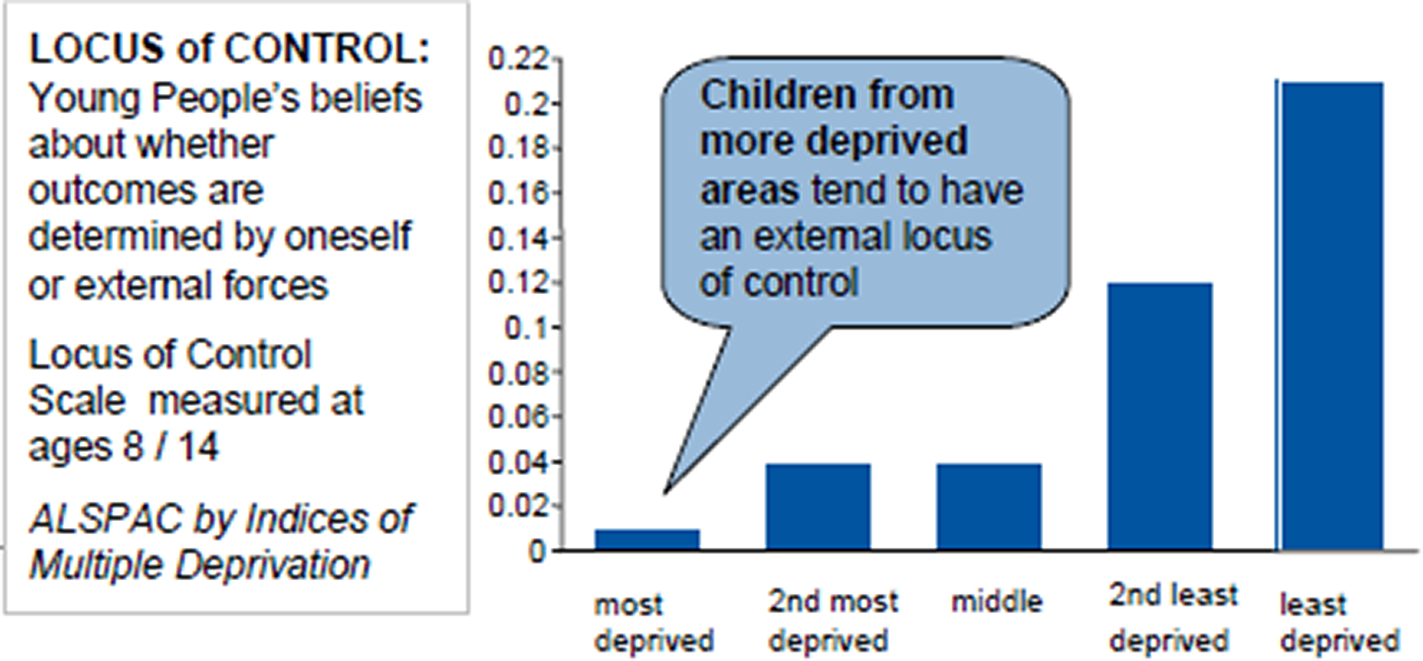
This is of particular importance for younger people, who have more opportunities ahead of them to shape their own futures. In the United Kingdom, for example, evidence of the impact of poverty on young people comes from the Avon Longitudinal Study of Parents and Children (ALSPAC). Figure 1 provides evidence that children 8–14 years of age from the most deprived areas have a strong external locus of control, attaching almost zero weight to their capacity to determine their own outcomes. They believe that external factors will decide how they live, rather than the fruits of their efforts. For other children, the weight placed on their own effort rises strongly with increases in prosperity.
(Colour online) Locus of control and deprivation
Source: Cabinet Office (2008), drawing on LSYPE data.Note: ALSPAC, the Avon Longitudinal Study of Parents and Children, is hosted at the University of Bristol.

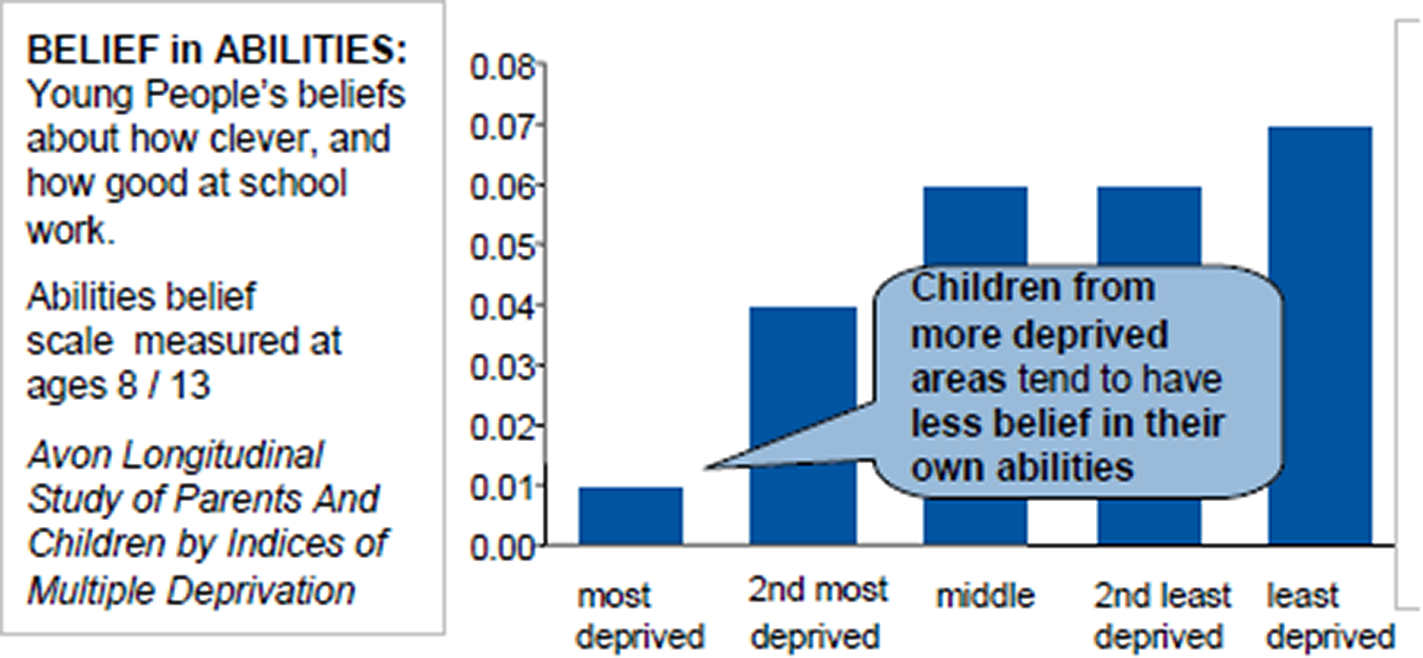
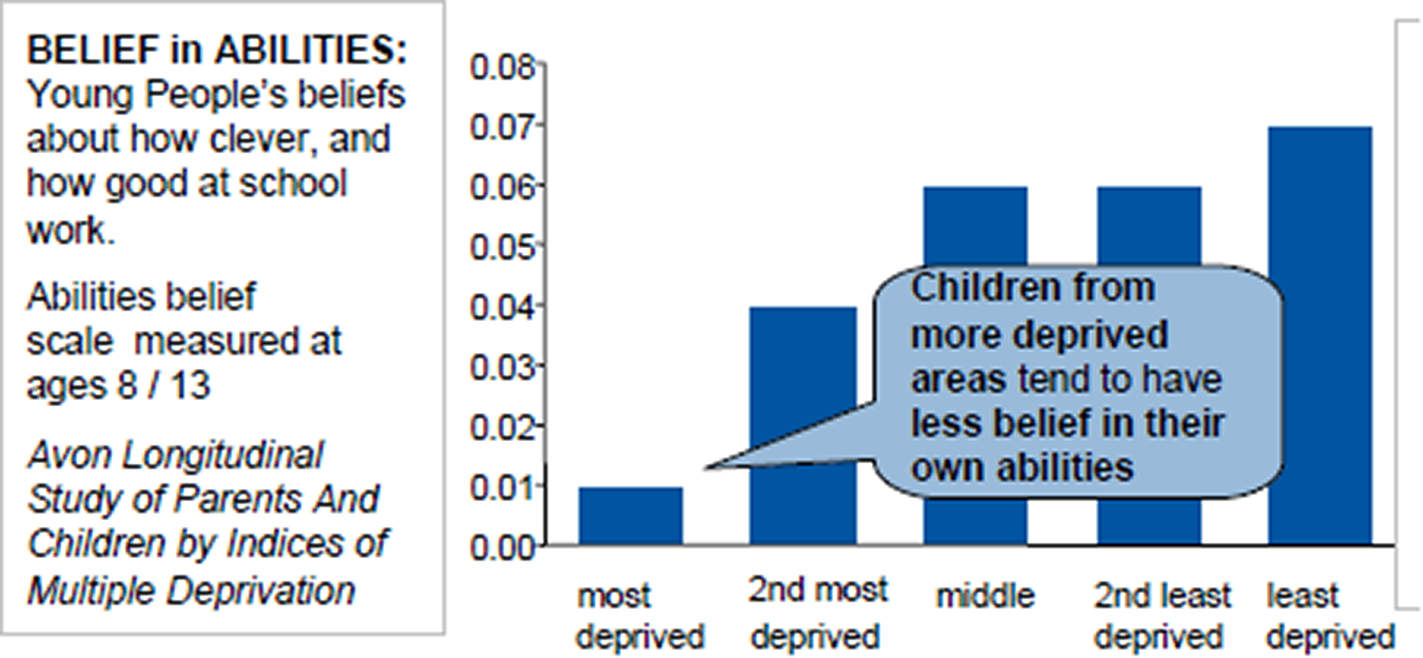
Young people who come from deprived backgrounds also demonstrate less faith in their own academic abilities and overall intelligence. At ages 8–13, children from the most deprived families in the ALSPAC data have almost no confidence in their ability to succeed in schoolwork; again, this confidence rises strongly with family prosperity.
Other research, such as the Longitudinal Study of Young People in England (LSYPE, 2006), shows that children from the most deprived backgrounds have the lowest academic aspirations. They are least likely to say that they will apply to university or that their friends will stay on at school. Such measures of personal and group aspiration rise steadily with family income. Figure 2 provides evidence to support these claims.
(Colour online) Belief in own ability and deprivation
Source: Cabinet Office (2008), drawing on LSYPE data.Note: ALSPAC, the Avon Longitudinal Study of Parents and Children, is hosted at the University of Bristol.
3. Poverty traps; external and internal constraints
An extensive literature on poverty traps (surveyed by Azariadis, Reference Azariadis, Bowles, Durlauf and Ho2004 and Azariadis and Stachurski, Reference Azariadis, Stachurski, Aghion and Durlauf2004) has focussed on the external constraints that may keep people chronically poor. Many possible factors include malfunctioning credit and insurance markets, coordination problems and status quo biases that hinder investment and innovation, lack of infrastructure. While any of these can make a good story, empirical evidence has not pointed decisively to one of these factors in particular (Azariadis and Stachurski, Reference Azariadis, Stachurski, Aghion and Durlauf2004).
Empirical problems aside, these models tend to disregard endogenous psycho-social constraints, such as lack of self-confidence and aspiration failure, although these are well documented in other disciplines – psychology, sociology and anthropology. Literature in these fields shows that poverty, with social exclusion, has detrimental self-reinforcing effects on self-perception, self-confidence and lack of aspirations. As Robert Walker (cited by Atkinson, Reference Atkinson, Atkinson and Hills1998) argues:
‘When poverty predominantly occurs in long spells […] the poor have virtually no chance of escaping from poverty and, therefore, little allegiance to the wider community…In such a scenario the experience of poverty comes very close to that of social exclusion’.
Mookherjee (Reference Mookherjee, Banerjee, Benabou and Mookherjee2003) adds that ‘long-run poverty is fundamentally self-perpetuating [and] the entrapment goes hand in hand with […] lack of hope’. This link between social exclusion and ‘lack of hope or aspirations’ is also highlighted by Atkinson (Reference Atkinson, Atkinson and Hills1998). He argues that social exclusion is, first, a relative concept – people are excluded from a particular society at a given place and time; second, an issue of agency – people are excluded or exclude themselves; and, third, is related not only to present exclusion, but also to future hopes and expectations. People are excluded not just because they are currently without a job or income, but because they have few prospects for the future.
Atkinson’s argument is shared by Appadurai (Reference Appadurai, Rao and Walton2004), an anthropologist, who argues that the poor may lack the capacity to aspire to ‘contest and alter the conditions of their own poverty’. For Appadurai, the capacity to aspire involves not only setting goals, but also knowing how to reach them. Although resources provide the opportunity to aspire, a capacity to aspire is also essential. As Bandura (Reference Bandura1991) points out,
‘People’s beliefs in their efficacy influence the choices they make, their aspirations, how much effort they mobilise in a given endeavour, how long they persevere in the face of difficulties and setbacks…’
When economists ignore such considerations, the result is a theoretical gap in the economic literature and a practical obstacle to designing effective antipoverty policies.
4. Aspirations failure
The paper takes as its starting point the notion that the condition of poverty, the degree to which poor people are satisfied with their lives, their aspirations to escape poverty, the efforts that they make to do so, and the success or failure of their efforts, are dynamically linked.
Chronic poverty generally comes together with social exclusion, and this combination leads to detrimental self-reinforcing effects on self-perception, self-confidence and lack of aspirations. Aspirations are center stage in the work of Stern et al. (Reference Stern, Dethier and Rogers2005) who argue that individuals ‘can be constrained by their aspirations and perceptions of their role, so that development depends on relaxing these constraints’, adding that
‘To understand [the] path out of poverty, we have to focus not only on the growth of opportunity but also on […] internal constraint[s] on aspirations and behaviour […] that limit poor people’s ability to participate’.
Are internal constraints a cause of poverty, or merely its consequence? Do the poor remain deprived because they lack hope, motivation and aspirations or, as Bernard et al. (Reference Bernard, Decorn and Taffesse2011) claim, is it merely that ‘the poor may exhibit the same basic weaknesses and biases as do people from other walks of life, except that in poverty…the same behaviours…lead to worse outcomes?’
Ray (Reference Ray, Banerjee, Benabou and Mookherjee2003) argues that poverty and failure of aspirations may be reciprocally linked in a self-sustaining trap. Indeed, ‘poverty stifles dreams, or at least the process of attaining dreams’.
The work of Wilson (Reference Wilson1987), the renowned sociologist, offers clear evidence of the ‘social exclusion-lack of aspirations-poverty’ link first observed in urban ghettos in the United States in 1970. In Wilson’s view, the increasing ‘social isolation’ of the poor, especially poor African-Americans, has greatly contributed to their poverty. ‘Out of sight, out of mind’ allowed most of the non-poor to deny or forget the conditions in the ghetto. Furthermore, Wilson argues that causality can equally go in the other direction: poverty also implies exclusion. Indeed, a concentration of poverty isolates the poor from the middle class and its role models, resources and job networks. In effect, he concludes, being poor in a mixed-income neighborhood is less damaging than being poor in a high-poverty neighborhood.
Moreira (Reference Moreira, Carr and Sloan2003) argues that lack of hope, with low self-esteem, is a shared characteristic of Brazilians of the poor northeast. ‘As the poor lose their values, they no longer believe in themselves. They go through a process of Nihilism (denial of hope)’. Most poor people, she claims, have lost hope and submit themselves to the destiny given to them by God.
When aspirations have failed, subjective wellbeing may become a poor measure of deprivation and disadvantage. There is evidence of a ‘satisfaction paradox’ (Sen, Reference Sen1999) when the poor describe themselves as no less satisfied with their lives than the population as a whole. As a Pew Centre report (2019) reports, in 1991, 15 per cent of those living in former East Germany said their life was a 7, 8, 9, or 10 on a 0–10 scale, but in 2019 that ballooned to 59 per cent. Meanwhile, life satisfaction in West Germany has also increased since 1991, from 52 to 64 per cent today. The gap between life satisfaction in former East and West Germany has narrowed over time. Rojas (Reference Rojas2004) makes this point forcefully, pointing to a survey of 1540 respondents in Mexico in 2001. Almost 90 per cent of respondents in the survey declared that they were either happy or very happy with their lives. Yet more than half of the people in the survey could be considered poor according to their household income. The lack of a direct link between poverty and dissatisfaction suggests that poor people adapt their aspirations to their condition.
Falk et al. (Reference Falk, Abeler, Gotte and Huffman2011) have shown experimentally that raising ‘reference points’ (or goals) can raise performance outcomes. In their study, when subjects were given higher reference points for earnings, they persevered longer at the experimental task. Because aspirations are ‘reference points for life goals’, this evidence underscores how higher goals can affect life outcomes.
In real life, such reference points emerge from the social settings that people inhabit. It is important, however, to separate two distinct channels of influence. One is the information that a person receives from a deprived social milieu; the other is the set of values, beliefs and preferences that a person forms under the influence of the same milieu. In the first view, aspirations fail because the poor person suffers from an information disadvantage, with fewer role models to copy and less chance of learning what matters for success. Alternatively, aspirations failure is an internal response to the experience of poverty that devalues success, even when it is visibly attainable.
There is considerable evidence to support the second view. Experimental work by Steele (Reference Steele2010), the social psychologist, and others on ‘stereotype threat’ shows that merely invoking racial/gender identity damages the educational performances of African-Americans and women respectively. In another case, Clark et al. (Reference Clark, Poulton and Milne2003) found that more pessimistic expectations raised the likelihood of frequent smoking and reduced that of exercise – suggesting a feedback effect from low aspirations to low effort even in matters such as health, where individual motivations need not be driven by market returns alone.
Jensen (Reference Jensen2010) and Jensen and Oster (Reference Jensen and Oster2009) provide a helpful contrast. Jensen (Reference Jensen2010) reports on the results of a field experiment in the Dominican Republic where students were informed about the benefits of staying in education after primary school, which they had previously underestimated. The result was a substantial increase in perceived benefits from education – but almost no discernible effect on the actual rates of completing secondary schooling. This suggests, at best, a modest effect of the informational role of the social environment on a person’s aspirations, especially among the poor.Footnote 1
In contrast, Jensen and Oster (Reference Jensen and Oster2009) report that, in India, exposure to cable TV programmes with inspiring female protagonists substantially changed beliefs and attitudes on gender-related issues. Women in villages with cable TV reported a lower tolerance of domestic violence and a weaker preference for sons, as well as increases in autonomy and declines in fertility. A greater number of girls enrolled in schools in those villages where cable TV had arrived earlier.
The contrast between the modest effects of information in the Dominican Republic and the significant impact of characters in a soap opera on gender-related beliefs and outcomes in India is striking. Soap operas in this and other contexts (Bandura, Reference Bandura2009) emphasise the similarity between their target audience and the life experiences of the characters. Their impact suggests that a woman’s social environment affects aspirations through beliefs and values, independent of the information obtained from the life experiences of others.
5. Modelling aspirations failure
Dalton, Ghosal and Mani (2016) (DGM hereafter) supply a theoretical framework that links internal constraints and poverty traps.Footnote 2 To understand the psychology of poverty and low aspirations, a key behavioural bias (or ‘internal constraint’) from which individuals suffer in setting life goals or aspirations is explicitly modelled.
Their formulation of aspirations failure is based on three premises.
First, a person’s aspiration level is a reference point that affects his utility from any realised outcome. Higher aspiration could spur greater effort, but it could also adversely affect his satisfaction from a particular outcome (i.e., loss relative to a higher reference point).
Second, an individual’s aspirations and effort are jointly determined in equilibrium. This is because there is a two-way feedback from effort to aspirations: higher aspirations induce greater effort which, in turn, reinforces high aspirations, through the outcome realised.
Third, even though aspirations and effort are jointly determined at a solution of the decision-problem, we assume that individuals take aspirations as given when choosing effort. In other words, individuals who fail to internalise the feedback from effort to aspirations. Typically, in the ladder of their life’s aspirations, most people are able to visualise only one rung above them at a time – not the entire pathway they can travel. As a result, individuals underestimate how their aspirations may evolve over their lifetime as a consequence of their own effort.Footnote 3
The ‘aspirations cycle’ has five steps as follows:
Step 1. Aspirations are set.
Step 2. Effort depends on aspirations.
Step 3. The outcome depends on effort and other exogeneous factors.
Step 4. Utility depends on the outcome, on the effort cost of obtaining it, and the aspirations that motivated it.
Step 5. Aspirations are reset by outcome and utility.
While both the poor and the rich are equally afflicted by such a bias, the more stringent external constraints that the poor face make them more susceptible to an aspirations failure.
The intuition underlying this result is as follows. Think of two behavioural decision-makers who have the same initial aspirations level, one rich and the other poor. At this given level of aspirations, the poor person would optimally choose a lower effort level than the rich one, because his lower wealth reduces his marginal benefit from effort. However, the feedback from effort to aspirations implies that the lower effort of the poor person will cause his aspiration level to diverge from that of the rich person. In equilibrium, the poor person has two reasons to put in low effort: not only are his net benefits lower, his aspiration level, which determines the marginal benefit of effort in equilibrium, is lower as well.
To formalise the above intuition, a simplified version of the formal model developed in DGM is now presented. The interested reader is referred to DGM for further details as well as the proofs of the results reported here.
The decision-maker is characterised by a level of initial wealth  $ {\theta}_0\in \left[\underset{\_}{\theta },\hskip0.35em ,\overline{\theta}\right] $ and a payoff function
 $$ u\left(\theta, \hskip0.35em ,g,\hskip0.35em ,e\right)=b\left(\theta \right)+v\left(\frac{\theta -g}{\theta}\right)-c(e), $$
where  $ \theta \hskip0.35em \in \hskip0.35em {\mathfrak{R}}_{+} $ denotes final wealth,
 $ e\in \left[0,1\right] $ denotes effort,
 $ g\in $
 $ {\mathfrak{R}}_{+} $ denotes an aspiration level (or goal) with respect to final wealth,
 $ b\left(\theta \right) $ the material payoff from achieving final wealth
 $ \theta $,
 $ v(.) $ a gain/loss utility related to final wealth
 $ \theta $ when the aspiration level is
 $ g $ and
 $ c(e) $ is the cost of effort.
The following assumptions are made:
A1:  $ b\left(\theta \right) $ is smooth, strictly increasing and strictly concave with
 $ b\left(\theta \right)=0 $ and
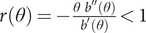 $ r\left(\theta \right)=-\frac{\theta \hskip0.35em {b}^{\prime \prime}\left(\theta \right)}{b^{\prime}\left(\theta \right)}<1 $
A2:  $ v(.) $ is continuously differentiable with
 $ v(0)=0,v^{\prime }(0)>0 $ and for
 $ x=\frac{\theta -g}{\theta } $,
 $ \left[{v}^{\prime }(x)-v^{\prime\prime }(x)\left(1-x\right)\right]\hskip0.35em \ge \hskip0.35em 0 $ for all feasible values of
 $ x. $
A3:  $ c(e) $ is a concave, strictly increasing, continuously differentiable function of effort.
The production function for final wealth  $ f\left(e,{\theta}_0\right) $reflects the fact that the poor face greater external constraints than the rich which effectively reduce their productivity such as lack of access to credit could render their efforts to acquire skills or run a successful business less effective or lack of access to information or influential social networks could make it harder for them to find jobs.
So our final assumption is:
A4:  $ \theta =f\left(e,,,\hskip0.35em ,{\theta}_0\right)=\left(1+e\right) $
 $ {\theta}_0 $
A behavioural solution is a pair  $ \left({e}^{\ast },,,\hskip0.35em ,{g}^{\ast}\right) $ such that:
 $ {e}^{\ast}\in \hskip0.35em \arg\ {\mathit{\max}}_{e\in \left[0,1\right]}\overset{\sim }{u}\left(e,,,\hskip0.35em ,{g}^{\ast },,,\hskip0.35em ,{\theta}_0\right) $ and
 $ {g}^{\ast }=f({e}^{\ast },\hskip0.35em {\theta}_0 $).
At a behavioural solution the decision-maker takes the aspiration level as given while choosing effort although effort and aspirations are jointly determined in the long run.
In contrast, a fully rational decision-maker internalises that fact that aspirations depend on effort via  $ g=f\left(e,,,\hskip0.35em ,{\theta}_0\right). $ Hence, a rational solution is a pair
 $ (\hat{\boldsymbol{e}}, $
 $ \hat{\boldsymbol{g}}), $ s.t.:
 $$ \hat{e}\hskip0.35em \in \hskip0.35em \arg\ {\mathit{\max}}_{e\in \left[0,1\right]}s\left(e,,,\hskip0.35em ,{\theta}_0\right)=u\left(e,,,\hskip0.35em ,f\left(e,,,\hskip0.35em ,{\theta}_0\right),,f\left(e,,,\hskip0.35em ,{\theta}_0\right)\right) $$
and  $ \hat{g}=f\left(\hat{e},,,\hskip0.35em ,{\theta}_0\right) $.
We assume that the decision-maker is behavioural; the rational solution is used as a welfare benchmark only.
We are now in a position to state the following results are stated without proof (the reader is referred to Dalton et al. (Reference Dalton, Ghosal and Mani2016) for the detailed proofs):
1. There exists a unique
 $ (\hat{\boldsymbol{e}}, $ $ \hat{\boldsymbol{g}}) $ which is non-decreasing in $ {\theta}_0 $ (strictly increasing in $ {\theta}_0 $ when the solution is interior) (proposition 1 Dalton et al., Reference Dalton, Ghosal and Mani2016). The interpretation is that a poor but rational decision-maker will choose lower effort and aspire lower than a rational rich. This is not an aspiration failure. This is an implication of the fact that (by A4) an additional unit of effort of a poor person is less effective in producing wealth than an additional unit of effort of a rich person.
2. Effort and aspirations are
$ \boldsymbol{e} $ and $ \boldsymbol{g} $ are complements (lemma 2 in Dalton et al., Reference Dalton, Ghosal and Mani2016). By proposition 2 in DGM, we have the following characterisation of the set of behavioural solutions: there exists a minimal $ ({\underset{\_}{\boldsymbol{e}}}^{\ast },\hskip0.35em {\underset{\_}{\boldsymbol{g}}}^{\ast }), $and a maximal $ \left({\overline{\boldsymbol{e}}}^{\ast },,,\hskip0.35em ,{\overline{\boldsymbol{g}}}^{\ast}\right) $. Hence, at a behavioural solution, high aspirations and high effort go hand in hand. At a behavioural solution, as the decision-maker imposes an externality on herself. A behavioural solution may welfare dominate another. Moreover, we use the rational solution as a benchmark. Hence, the decision-maker is internally constrained at a behavioural solution whenever it differs from a rational solution.


Consider a simplification of the above model so that  $ e\in \left\{0,1\right\} $. In this case, when
 $ e=0,c(0)=0\ \mathrm{and}\ \theta ={\theta}_0 $ and when
 $ e=1,c(1)>0\ \mathrm{and}\ \theta =2{\theta}_0 $. When will the decision-maker choose
 $ e=1 $?
The net benefit to a rational decision-maker from choosing  $ e=1 $ is given by the expression:
 $$ h\left({\theta}_0\right)=b\left(2{\theta}_0\right)-c-b\left({\theta}_0\right)-0. $$
When  $ h\left({\theta}_0\right)>0,\hskip0.35em \hat{e}=1 $. By lemma 2 in DGM,
 $ h\left({\theta}_0\right) $ is increasing in
 $ {\theta}_0 $ so that the poorer the (rational) decision-maker is, the lower the net benefit of exerting effort. Note that the level of aspirations do not matter for the rational decision-maker as the such a decision-maker internalises the effect of her actions on aspirations.
The net benefit to a behavioural decision-maker from choosing  $ e=1 $ is given by the expression:
 $$ h\left({\theta}_0,,,\hskip0.35em ,g\right)=b\left(2{\theta}_0\right)+v\left(\frac{2{\theta}_0-g}{2{\theta}_0}\right)-c-b\left({\theta}_0\right)+v\left(\frac{\theta_0-g}{\theta_0}\right). $$
When  $ h\left({\theta}_0,,,\hskip0.35em ,g\right)>0,\hskip0.35em {e}^{\ast }=1 $. By lemma 3 in DGM,
 $ h\left({\theta}_0,,,\hskip0.35em ,g\right) $ is increasing in
 $ {\theta}_0 $ and in
 $ g $. The poorer the behavioural decision-maker, the lower the net benefit of exerting effort; the lower the aspirations of the behavioural decision-maker, the lower the net benefit of exerting effort. Moreover, the level of aspirations matter for the behavioural decision-maker.
Define  $ \overset{\sim }{g}\left({\theta}_0\right) $ as the level of aspirations s.t. the individual is indifferent between putting effort or staying in the status quo, that is
 $ \overset{\sim }{g}\left({\theta}_0\right) $ s.t.
 $ h\left({\theta}_0,,\hskip0.35em \overset{\sim }{g}\left({\theta}_0\right)\right)=0 $. By lemma 3 in DGM,
 $ \overset{\sim }{g}\left({\theta}_0\right) $ is decreasing in
 $ {\theta}_0 $. Hence, the poorer the behavioural decision-maker, the higher must be her aspirations in order to choose high effort. Given that
 $ e\in \left\{0,1\right\} $, notice that the lowest feasible aspiration level
 $ \underset{\_}{g}=\underset{\_}{\theta } $ and the highest feasible aspiration level is
 $ \overline{g}=2\overline{\theta} $.
Therefore:
1. Whenever
$ \underset{\_}{g}<\overset{\sim }{g}\left({\theta}_0\right)<\overline{g} $, there are multiple behavioural solutions, one with $ \left({e}^{\ast }=0,\hskip0.35em ,{g}^{\ast }=0\right) $ and another with $ \left({e}^{\ast }=1,\hskip0.35em ,{g}^{\ast }=1\right) $. In such a case, the behavioural solution with $ {e}^{\ast }=0,\hskip0.35em {g}^{\ast }=0 $ is not fulfilling her potential and there is a binding internal constraint: there is an aspiration failure as by aspiring to higher goal the decision-maker can achieve that goal by putting in higher effort.2. Whenever
$ \overset{\sim }{g}\left({\theta}_0\right)>\overline{g} $, the decision-maker is so poor that whatever be her aspiration level, she will put in low effort. Only an increase in initial wealth (the binding external constraint) can result in a situation where high effort will be chosen.3. Whenever
$ \overset{\sim }{g}\left({\theta}_0\right)<\underset{\_}{g} $, the decision-maker is so rich that she will choose to put in higher effort whatever be her aspiration level. In this case neither the internal or external constraint binds.






Suppose the initial level of aspirations  $ {g}_0 $ is chosen randomly from
 $ [\underset{\_}{g},\hskip0.35em \overline{g}] $ according to the uniform distribution. Note that we assume that the initial distribution that generates the initial level of aspirations is assumed not to depend on initial wealth so that there is inherent predisposition for lower aspirations the lower the initial wealth.
Given the initial level of aspirations  $ {g}_0 $ and initial wealth
 $ {\theta}_0 $, the decision-maker chooses effort; aspirations and final wealth then adjust to the chosen level of effort. Note that this two-step process of preference and wealth formation depends on the fact that that there are two effort levels.
Then, using the reasoning the above, we obtain the following (see also proposition 5 in DGM):
1. Whenever
$ \underset{\_}{g}<\overset{\sim }{g}\left({\theta}_0\right)<\overline{g} $, the probability that there is a binding internal constraint (aspirations failure) is $ \frac{\overset{\sim }{g}\left({\theta}_0\right)}{\overline{g}-\underset{\_}{g}} $; with probability $ 1-\frac{\overset{\sim }{g}\left({\theta}_0\right)}{\overline{g}-\underset{\_}{g}} $ there is no aspirations failure and the internal constraint does not bind.2. Whenever
$ \overset{\sim }{g}\left({\theta}_0\right)>\overline{g} $, there is aspirations failure with probability one.3. Whenever
$ \overset{\sim }{g}\left({\theta}_0\right)<\underset{\_}{g} $, there is zero probability of an aspirations failure.



Therefore, the very rich are not constrained by either internal or external constraints; the very poor are constrained by both their external and internal constraints. Between the two extremes levels of initial wealth, a decision-maker can be internally constrained by her aspirations and the probability of being so is higher the lower her initial wealth.
Poverty lowers the aspirations’ level of a poor person, relative to what she could aim to achieve, resulting in an aspirations failure. In this sense, poverty curtails a poor person’s capacity to aspire, in the spirit of Appadurai (Reference Appadurai, Rao and Walton2004).
The analysis suggests that an intervention to lift aspirations may also raise effort and outcomes. Two types of poverty traps emerge from the analysis: standard poverty traps that are driven solely by external constraints but also behavioural poverty traps characterised by low effort and low aspirations. While external constraints imposed by poverty make internal constraints more consequential, the latter becomes an independent source of disadvantage in behavioural poverty traps. For some range of initial wealth, it is possible to break a poverty trap by altering aspirations alone. Therefore, policy approaches that influence aspirations among the poor are essential to break this latter kind of trap.
6. Interventions to raise aspirations
What kind of interventions, in practice, raise aspirations and by relaxing internal constraints and what is the evidence?
As Le Ferrara (Reference Le Ferrara2019) points out, policy interventions that alter raise aspirations will need to change what individuals think they are capable of (self-efficacy, motivation, self-image), the reference points people see around themselves (e.g. role models), what society considers acceptable for them (by changing stereotypes and norms) and material endowments as these will have a direct effect on aspirations, and in turn, the changed aspirations will maximise the impact of increased resources.
Le Ferrara’s paper reviews evidence from a number of studies conducted by her co-authors and her to provide evidence on successful inventions that target the channels described in her paper. In what follows, we describe in detail, evidence from studies not covered in her paper.
A classic intervention designed to raise aspirations of low-income children is the Fesnojiv classical music orchestra programme developed in Venezuela 30 years ago by Jose Antonio Abreu. The programme project provides free classical musical training and the opportunity to perform in orchestras, to these children. In the founder’s words, ‘Participating in the orchestral movement has made it possible for them [the children] to set up new goals, plans, projects and dreams and at the same time, it is a way of creating meaning and helping them in their day-to-day struggle for better conditions of life’. About 96 per cent of the young musicians have good to excellent school records – even though education was not the focus of the programme. In terms of our framework in this study, the programme manages to raise the initial aspiration level of the children. Indeed the Big Noise Orchestra in Stirling and Govan (https://www.makeabignoise.org.uk/big-noise) adapts the pioneering work of Abreu to deprived, marginalised communities in Scotland.
In a different setting, Beaman et al. (Reference Le Ferrara2012) find that in India, that exposure to female leaders in local government (as part of a mandated reservation of posts for women) raises both the aspirations and educational attainment of girls significantly – despite no change in the resources available for their education. In terms of our framework, such exposure reduces the behavioural bias of those exposed to female leaders, by helping them see the link between their current effort and future aspirations.
Results from field work (Ghosal et al., Reference Ghosal, Jana, Mani, Mitra and Roy2020) provide evidence about the impact of purely psychological intervention (‘dream-building’) in reducing stigma and raising agency on a marginalised, stigmatised community of sex workers in Kolkata, India. The paper studies the link between self-image and behaviour among those who face stigma due to poverty and social exclusion. Using a randomised field experiment with sex workers in Kolkata (India), it is examined whether a psychological intervention to mitigate the adverse effects of internalised stigma can induce behaviour change. Key findings include significant improvements in participants’ self-image, their savings choices and health clinic visits. Administrative data confirm that these changes in savings and preventive health behaviour persist 15 and 18 months later, respectively. These findings highlight the potential of purely psychological interventions to improve life choices and outcomes of marginalised groups.
Bandura (Reference Bandura2009) cites the case of a national literacy programme in Mexico, in which people who were skilled at reading were urged to organise small self-study groups to teach others how to read. Although it was a good idea, there were few takers. Upon conducting a survey, Bandura’s team identified three beliefs among poor illiterate persons that impeded their participation: that reading is learnable only when one is young, that they lacked the ability to master such a complex skill, and that an educated person would not be interested in devoting his or her time to them. In collaboration with the Population Media Centre (PMC), Bandura developed a soap opera that worked to allay these specific misbeliefs, which resulted in a dramatic increase in the take-up rates for the programme. In the drama, a popular star played the role of the literate person to whom various illiterate characters voice their self-doubts, and the instructor corrects their misbeliefs and persuades them that they have the ability to succeed.
Soap operas have thus been created to tackle beliefs and social issues among the poor in a number of developing countries such as Sudan (forced marriage, genital mutilation), Kenya (property rights for women), India (gender inequality in child-rearing, education for girls) and Tanzania (family planning, HIV/AIDS). These soap operas emphasise the similarity between their target audience and the life experiences of the soap opera characters. Bandura argues that it is this kind of similarity that has allowed the target audience to identify with the drama characters over the course of the series, resulting in a significant change in aspirations and effort.
7. Implications for the design of regional policies
This analysis carried out so far has key implications for the design of inclusive regional policies.
Even if the conditions under which relaxing internal constraints alone (without altering external ones) have short-term effects, the effectiveness of policies targeted to relax external constraints will be maximised if they also reduce internal constraints (e.g. by changing aspirations).
For public investment to make a difference, as the German experience shows, it has to be sustained over a 20–25-year horizon, which in turn, requires cross-party consensus and should be embodied as part of some sort of a constitutional arrangement (e.g. as in Germany). At the very minimum, it ought to be insulated from the temptation of achieving short-term political gains by whichever party happens to be in power and the incentive to redirect investment to regions of the UK economy which are already doing well and where the short-term returns from public investment are likely to be higher. Moreover, public investment is likely to have a larger impact if it is joined up with industrial policy to incentivise and attract private investment in new industries where the United Kingdom has a comparative advantage including green industries.
Moreover, the social returns from such public investment will be higher if they are implemented with policies that also mitigate directly the ‘capacity to aspire’ within local communities. Individuals and communities in deprived communities need to be able to see how increased public investment creates new pathways for them to exit poverty, ‘to contest and alter the conditions of their own poverty’ (Appadurai, Reference Appadurai, Rao and Walton2004).
However, infrastructure investment together with a policy of relocating highly skilled workers from London to the big regional cities may have the unintended consequence of reinforcing economic and social exclusion. Skilled workers may end up getting the bulk of new highly paid jobs being created. Local communities may end up doing the low paid jobs in cities where house prices and private rentals rise in gentrified city centres and selected suburbs while the bulk of the local population remain stuck in low quality social housing reinforcing existing inequalities of income and wealth and resulting in aspirations failure.
Key to a successful inclusive regional policy has to be to involve local people in major infrastructure decisions which ought to hand in hand with a policy that involves upskilling local workers and the provision of low cost credit to local small and medium size businesses to take advantage of new economic opportunities.
Examples of success from within local communities are key as such examples will become role models for others. Local communities need to see that newly created opportunities (e.g. the new higher-paid jobs) are within their (or their children’s) reach and represent a pathway out of persistent deprivation. This would require considerable additional investment in local schools, training, acquisition of new skills from an early stage. An example of a policy that aims to reduce internal constraints is ‘Supporting parents on kids education (SPOKES)’ which works with groups of parents to set personal goals for their children, with promising initial evidence on the reading age of boys and performance in Key Stage 1 exams.
Examples of local success will provide relevant role models to local communities with, potentially a multiplier effect, on mitigating aspirations failure. As the cabinet oofice report (2008) notes; ‘Increasing levels of social capital in deprived communities and engaging businesses in innovative ways can help to provide inspiration… Incentivising disadvantaged young people to take up “horizonbroadening” opportunities, may help to raise their aspirations…Young people in deprived communities may need a broader range of role models’.
SPOKES is only such example. More such carefully designed interventions within a randomised control trial framework are essential in devising policy interventions that aim to impact on the ‘capacity to aspire’ (Appadurai, Reference Appadurai, Rao and Walton2004). Similar programmes, together with easier access to credit, can be designed for local businesses and entrepreneurs so that they too perceive that the new economic opportunities are within their reach.
The uneven impact of Covid-19 across regions and communities in the United Kingdom is evident. The preliminary evidence is that Covid-19 has impacted poorer local authorities in the North East of England disproportionately (Marmot, Reference Marmot2020). The impact on school attendance follows a similar pattern (ONS, 2020). Specific interventions are required to mitigate these negative impacts on both life outcomes as well as the ‘capacity to aspire’. Children left without the appropriate tools for learning at home will negatively impact on both educational outcomes and aspirations going forward. Now is the time to roll out programmes similar to across local communities in Northern England.
Acknowledgements
This paper builds on results from research articles co-authored with Patricio Dalton, Anandi Mani and Sanchari Roy, Sandip Mitra and Dr. Smarajit Jana, for which the author is grateful to them. The author is grateful to Jagjit and Corrado Macchiarelli for their encouragement and patience. The author is grateful to the audience members for their useful comments at the NIESR Festival of Social Science workshop held in 2019. The usual disclaimer applies.