I. INTRODUCTION
The recent rapid development of organic–inorganic halide perovskite solar cells Reference Green, Ho-Baillie and Snaith1 offers opportunities for low cost solution processable high efficiency single-junction devices and tandem solar cells using silicon (Si) as active substrates. As the silicon solar technology is becoming more mature with marginal performance improvement towards its theoretical limit, Reference Swanson2 there is a need to look for low cost options for tandem solar cells. Reference Almansouri, Ho-Baillie, Bremner and Green3 Although impressive result of multijunction tandem using group III–V semiconductors have been reported such as the 46.0% conversion efficiency measured under 508 suns, Reference Green, Emery, Hishikawa, Warta and Dunlop4 the high cost of substrate used hinders its wide-spread use. Developing III–V cells on active silicon substrate is also a challenge due to lattice and thermal mismatch. To evaluate the efficiency potential of perovskite solar cell, theoretical efficiency limits of single junction Reference Wei, Ren, Chen and Choy5–Reference Almansouri, Ho-Baillie and Green7 and dual-junction tandem devices using perovskite as a top junction Reference Almansouri, Ho-Baillie and Green7–Reference Lal, White and Catchpole9 have been demonstrated. The performance and stability of perovskite solar cells under concentrated sunlight have also been studied. Reference Law, Miseikis, Dimitrov, Shakya-Tuladhar, Li, Barnes, Durrant and O'Regan10,Reference Misra, Aharon, Li, Mogilyansky, Visoly-Fisher, Etgar and Katz11
Therefore, the focus of this paper is to determine the efficiency limits of single-junction and tandem perovskite solar cell under different intrinsic and extrinsic loss mechanisms. The effect of varying Auger recombination and carrier diffusion lengths as well as the effect of concentrated sunlight on conversion efficiencies will be reported.
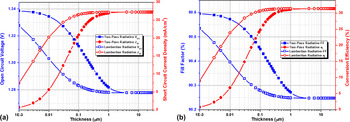
As previously reported by Almansouri et al., Reference Almansouri, Ho-Baillie and Green7 the Shockley–Queisser limit Reference Shockley and Queisser12 of a single junction solar cell and a solar cell with a band gap of 1.55 eV is determined to be 33.7% and 31.4%, respectively. The latter places an ultimate theoretical upper limit achievable by a single junction organic lead halide perovskite solar cell. This is based on absorption events for photons with energy greater than the material's band gap. Each absorbed photon is assumed to create only one electron–hole pair resulting in 100% collection efficiency. An extension of this model accounting for material absorption coefficient Reference Sun, Salim, Mathews, Duchamp, Boothroyd, Xing, Sum and Lam13 with a two-pass optical generation scheme Reference Tiedje, Yablonovitch, Cody and Brooks14 reduces the efficiency limit to 31.2% Reference Almansouri, Ho-Baillie and Green7 while a Lambertian light trapping scheme Reference Tiedje, Yablonovitch, Cody and Brooks14 allows the 31.4% efficiency limit to be retained. Reference Almansouri, Ho-Baillie and Green7 The open circuit voltage, short circuit current, fill factor, and conversion efficiency limits from this model by Almansouri et al. Reference Almansouri, Ho-Baillie and Green7 are shown in Fig. 1. Infinite carrier mobility is assumed and radiative recombination is the only source of recombination.
The (a) open circuit voltage (blue curves), short circuit current density (red curves), (b) fill factor (blue curves) and conversion efficiency (red curves) of a perovskite solar cell accounting for material absorption coefficient and radiative recombination only under two-pass (filled symbols) and Lambertian (open symbols) light trapping schemes.

This work further extends the model by including nonradiative Auger recombination based on a simple three-particle interaction model, Reference Tiedje, Yablonovitch, Cody and Brooks14,Reference Green15 and finite carrier diffusion length under the AM1.5G (ASTM G173–03) 16 spectrum. When light concentrations are considered, the AM1.5D (ASTM G173–03) 16 spectrum is used. In addition, the real (n) and imaginary (k) components of the refractive index are included using the experimental data reported by Löper et al. Reference Löper, Stuckelberger, Niesen, Werner, Filipič, Moon, Yum, Topič, De Wolf and Ballif17 as opposed to a fixed n = 2.55 over an entire wave length range previously used by Almansouri et al. Reference Almansouri, Ho-Baillie and Green7 The choice of n and k is critical when considering Lambertian light trapping. The complex refractive index reported by Löper et al. Reference Löper, Stuckelberger, Niesen, Werner, Filipič, Moon, Yum, Topič, De Wolf and Ballif17 is considered for this work as the value is relatively modest compared with other references and comparable for both pure methylammonium lead iodide (CH3NH3PbI3) and methylammonium lead iodide chloride (CH3NH3PbI3−x Cl x ). Reference Green, Jiang, Soufiani and Ho-Baillie18
II. METHODS
Table I shows the parameters used for this study. A range of Auger coefficients determined by Wehrenfennig et al. Reference Wehrenfennig, Liu, Snaith, Johnston and Herz19 and carrier diffusion lengths determined in other works Reference Xing, Mathews, Sun, Lim, Lam, Grätzel, Mhaisalkar and Sum20–Reference Dong, Fang, Shao, Mulligan, Qiu, Cao and Huang22 are used. The effect of recombination through defects, Reference Shockley and Read23,Reference Hall24 e.g., presence of impurities and crystal defects resulting in the formation of defect energy levels (traps) within the forbidden band, can be modelled via the incorporation of finite diffusion lengths. A wide range has been reported for hybrid organic–inorganic perovskites depending on the fabrication methods and the halide constituents. Reference Xing, Mathews, Sun, Lim, Lam, Grätzel, Mhaisalkar and Sum20–Reference Dong, Fang, Shao, Mulligan, Qiu, Cao and Huang22,Reference Edri, Kirmayer, Henning, Mukhopadhyay, Gartsman, Rosenwaks, Hodes and Cahen25 Values ranging from 110 nm Reference Xing, Mathews, Sun, Lim, Lam, Grätzel, Mhaisalkar and Sum20 to 1100 nm Reference Stranks, Eperon, Grancini, Menelaou, Alcocer, Leijtens, Herz, Petrozza and Snaith21 have been reported for solution-processed CH3NH3PbI3 and CH3NH3PbI3−x Cl x , respectively. The highest ever reported diffusion length for single-crystal perovskite materials is also used i.e., 175 µm. Reference Dong, Fang, Shao, Mulligan, Qiu, Cao and Huang22 These values will be used in the models in this work which will have an impact on short circuit current. Reference Taretto, Rau and Werner26
Parameters for perovskite device in the models.

The intrinsic carrier concentration (n i ) is calculated to be n i ≈ 106 cm−3 using formulation by Green Reference Green27 by assuming effective densities of states in the conduction and valence bands (N c and N v, respectively) = 1019 cm−3 and a band gap (e.g.,) of 1.55 eV. This is in agreement with most semiconductors having similar bandgaps e.g., Gallium Arsenide (GaAs). Reference Sze and Ng28 More details on radiative and Auger limited calculations can be found in Almansouri et al. Reference Almansouri, Ho-Baillie, Bremner and Green3,Reference Almansouri, Ho-Baillie and Green7
III. RESULTS AND DISCUSSION
A. Auger coefficient and finite diffusion lengths on cell efficiency and cell thickness
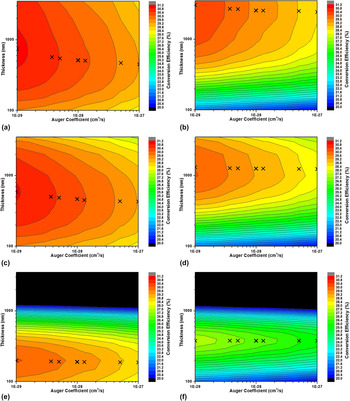
Figure 2 shows the negative impact of Auger recombination and finite diffusion lengths on the conversion efficiency (η) of perovskite solar cell as a function of device thickness, Auger coefficient, and diffusion lengths. The optimum thickness decreases with increasing Auger recombination as indicated by the cross-hatches except with very low diffusion length where optimum thickness is almost constant. If infinite diffusion length is assumed, the required cell thickness will be the highest when light trapping deteriorates from Lambertian to two-pass; see Fig. 1(b). Table II summarizes the optimum thickness with given Auger coefficients; diffusion lengths and light trapping schemes.
The conversion efficiency of perovskite solar cell as a function of Auger coefficient and thickness under (a) Lambertian light trapping with 175 µm diffusion length, (b) two-pass light trapping with 175 µm diffusion length, (c) Lambertian light trapping with 1.1 µm diffusion length, (d) two-pass light trapping with 1.1 µm diffusion length, (e) Lambertian light trapping with 0.11 µm diffusion length, (f) two-pass light trapping with 0.11 µm diffusion length.

Efficiency limit and optimum thickness of perovskite device accounting for Auger recombination and finite diffusion length under Lambertian and two-pass light trapping schemes.

The drop in conversion efficiency with increasing cell thickness is due to the deterioration of open circuit voltage (V OC) and fill factor (FF) with increasing Auger recombination. The drop in FF is also due to the finite mobility and hence increased in the (R s) with cell thickness. These offset the benefit of increased absorption and hence short circuit current (J SC) from increased cell thickness as shown in Fig. 1(a).
B. Extrinsic sources on efficiency limits
For a typical perovskite solar cell on a superstrate configuration, there will be extrinsic losses associated with the fluorine doped tin oxide (FTO) glass such as absorptions in the FTO and glass reflection. Other extrinsic losses also need to be considered such as the nonideality which ranges from m = 1.3 to m = 2.0 (Ref. Reference Hegedus and Shafarman29) for most thin film solar cells. In our model, m = 1.5 will be used which is typical for many of the reported high efficiency perovskite devices. Parasitic resistances having R s = 1 Ω-cm2 and shunt resistance (R sh) = 1000 Ω-cm2 will be assumed in our model.
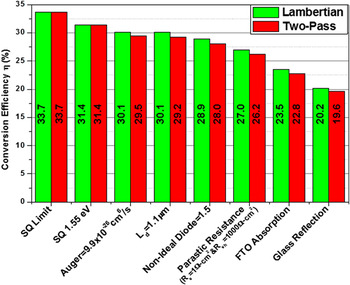
Figure 3 shows the “efficiency waterfall” of perovskite solar cell after taking into account the intrinsic and extrinsic losses under two light trapping schemes (green for Lambertian and red for two-pass). The optimum thickness of an Auger-only-limited device is 520 nm with Lambertian light trapping scheme or 2.57 µm with two-pass light trapping scheme. When the carrier diffusion length is finite (e.g., 1.1 µm), the optimum thickness of the device will be 466 nm with Lambertian light trapping scheme or 1.26 µm with the two-pass light trapping scheme.
“Efficiency waterfall” of perovskite solar cells taking the intrinsic and extrinsic losses into accounts under Lambertian and two-pass light trapping schemes.

Results highlight the need for antireflection control (texturing or antireflective coating). For instance, efficiency can be improved by around 1.3–1.5% absolute if the glass reflection can be minimized by replacing the normal glass Reference Wang, Ball, Barea, Abate, Alexander-Webber, Huang, Saliba, Mora-Sero, Bisquert and Snaith30 with ARCTOP glass. Reference Kalyanasundaram31 New cell designs would probably see the replacement of FTO by other transparent conductive layers that are less absorptive, e.g., titanium-doped indium oxide (ITiO) Reference Kwak, Moon, Lee, Park and Sung32 without sacrificing conductivity. Overcoming nonideality factor and parasitic resistance would further improve the perovskite efficiency by 3.0% absolute. The most recent 22.1% 33 state-of-the-art perovskite device would have been a result of minimizing the various extrinsic losses discussed above.
C. Efficiency limit under concentrations
Auger recombination is the most dominant recombination mechanism under high carrier concentration. For instance, the conversion efficiency of semiconductor material that is heavily doped or under high carrier injection under high illumination is governed by Auger recombination. To study the effect of high concentrations, the conversion efficiency of a perovskite cell with a carrier diffusion length of 1.1 µm is calculated using the AM1.5D spectrum.
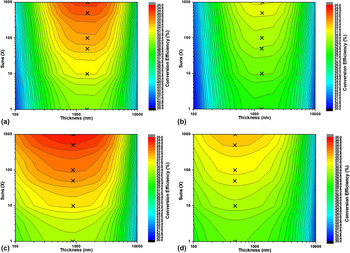
Figure 4 shows the conversion efficiency of perovskite solar cell as a function of thickness under different light concentrations with two-pass [Figs. 4(a) and 4(b)] and Lambertian [Figs. 4(c) and 4(d)] light trapping schemes. The calculations on the left-hand side [Figs. 4(a) and 4(c)] consider with radiative recombination only while the calculations on the right-hand side [Figs. 4(b) and 4(d)] includes Auger recombination using AM1.5D spectrum. The diffusion length is assumed to be 1.1 µm for both radiative and Auger limited efficiency and the Auger coefficient is 9.9 × 10⁻²⁹ cm6/s. The crosshatches show the optimum thickness.
The conversion efficiency of perovskite solar cell as a function of thickness under different light concentrations with two-pass (a and b) and Lambertian (c and d) light trapping schemes with radiative recombination only (a and c) and inclusion of Auger (coefficient of 9.9 × 10⁻²⁹ cm6/s) recombination (b and d) using AM1.5D spectrum. The diffusion length is assumed to be 1.1 µm for all cases. The crosshatches show the optimum thickness.

For cells that are limited by radiative recombination only, see graphs on the left-hand side, i.e., Figs. 4(a) and 4(c), the efficiency increases with increasing thickness and the increment is more pronounced at higher concentrations. Optimized cell thickness is around 1.5 µm under two-pass light trapping scheme [Fig. 4(a)] or just below 1 µm under Lambertian light trapping scheme [Fig. 4(c)]. For Auger limited device shown in Figs. 4(b) and 4(d), optimum thicknesses are around 1.3 µm or 470 nm with two-pass and Lambertian light trapping schemes.
It interesting to note that optimum cell thickness is independent of concentration ratios. Moreover, the efficiency difference between the best radiative and Auger limited devices is only more pronounced at very high concentrations. This is because the voltage improvement with concentrations saturates for Auger limited cells once certain concentrations is reached.
D. Perovskite/silicon tandem devices
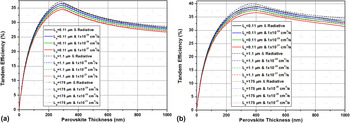
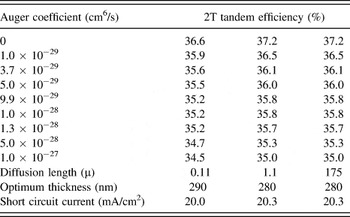
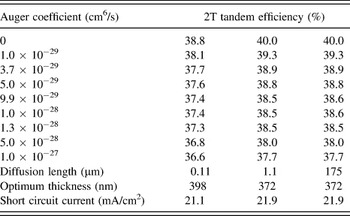
In this section, the impact of Auger recombination in perovskite on the two-terminal perovskite/silicon tandem device efficiency is investigated. The Auger recombination (coefficient of 9.9 × 10⁻²⁹ cm6/s) is also included and is kept constant for the top perovskite subcell. Two different scenarios have been examined with two-pass [see Fig. 5(a) and Table III] and Lambertian [see Fig. 5(b) and Table IV] light trapping schemes within the bottom silicon subcell. Only one-pass in the perovskite layer is considered. The silicon substrate thickness is assumed to be 180 µm including both Radiative and Auger recombination mechanisms.
The tandem conversion efficiency as a function of perovskite thickness assuming (a) two-pass and (b) Lambertian light trapping schemes within the Si. Only one pass is assumed in the perovskite with carrier diffusion lengths of 0.11 µm (solid lines), 1.1 µm (dashed lines), and 175 µm (dotted lines) for radiative and Auger limited devices.

The optimum perovskite thickness and conversion efficiency for current matched two-terminal perovskite/silicon tandem devices for perovskite cell with different diffusion lengths and Auger coefficients. Two-pass light trapping in silicon is assumed.

The optimum perovskite thickness and conversion efficiency for current matched two-terminal perovskite/silicon tandem devices for perovskite cell with different diffusion lengths and Auger coefficients. Lambertian light trapping in silicon is assumed.

The optimum thickness required to current matched with Si bottom junction reduces with increasing diffusion length of the perovskite. However, the thickness remains unchanged when diffusion length exceeds 1.1 µm. In addition, thicker perovskite layer is required for current matching when Lambertian light trapping is present in Si bottom cell. Increasing quality of the perovskite film through increased carrier diffusion length improves the tandem conversion efficiency and requiring thinner perovskite film. Interestingly, the tandem efficiency plateaus once perovskite carrier diffusion length reaches 1.1 µm suggesting that single-crystalline perovskite film (with. huge diffusion length) is not a prerequisite for perovskite/Si tandem.
Obviously the tandem efficiency degrades with increasing Auger recombination resulting in 2.1–2.3% absolute efficiency drop from radiative limited device to severely Auger limited device. From the calculations, a radiative limited perovskite/Si tandem has an efficiency limit of 40.0% and 37.2% with Lambertian and two-pass light trapping schemes in silicon, respectively. With moderate Auger recombination in the perovskite, a tandem efficiency limit of 38.5% and 35.8% is achievable with Lambertian and two-pass schemes in silicon, respectively.
IV. CONCLUSION
In this work, the conversion efficiency of single-junction perovskite solar cell is examined including intrinsic and extrinsic losses. The extrinsic losses have shown to have significant effect on the perovskite performance emphasizing the need to reduce these losses, as devices so far demonstrated are clearly not limited by the quality of perovskite film. Auger recombination is also very critical that impose reduction in the open circuit voltage and hence the conversion efficiency for both single-junction and dual-junction tandem devices. Finally, moderate quality perovskite is sufficient for tandem on silicon alleviating the need for single-crystalline perovskite material.
ACKNOWLEDGMENTS
The Australian Centre for Advanced Photovoltaics (ACAP) encompasses the Australian-based activities of the Australia U.S. Institute for Advanced Photovoltaics (AUSIAPV) and is supported by the Australian Government through the Australian Renewable Energy Agency (ARENA). This work is also supported by ARENA through project 2014/RND075. In addition, I. Almansouri gratefully acknowledges the financial support for this work provided by the Masdar Institute of Science and Technology.