Introduction
Murdannia Royle, with about 52 species (Govaerts & Faden, Reference Govaerts and Faden2012), is most diverse in tropical Asia. The highest number of species is in India, where 25 species are found (48% of the total), many of them (c.38%) endemic. Karthikeyan et al. (Reference Karthikeyan, Jain, Nayar and Sanjappa1989) reported 23 species for India. Since then, five additional names have been reported for India, namely Murdannia striatipetala Faden (Faden, Reference Faden2001), M. fadeniana Nampy & Joby (Nampy & Joby, Reference Nampy and Joby2003), M. satheeshiana Joby et al. (Joby et al., Reference Joby, Nisha, Rameshan, Augustine, Rogimon and Unni2011), M. brownii Nandikar & Gurav (Nandikar & Gurav, Reference Nandikar and Gurav2011) and M. sahyadrica A.Ancy & Nampy (Nampy et al., Reference Nampy, Ancy and Manudev2012). Of these Murdannia striatipetala is a new addition as a species endemic to India and Sri Lanka while M. fadeniana is the correct name for the plant previously called M. glauca in South India. The status of Murdannia satheeshiana and M. brownii as distinct from known taxa is doubtful. Murdannia sahyadrica from the Northwestern Ghats has been very recently described, thus bringing the total number of species in India to 25.
During scientific surveys in the plains of Assam, Northeast India in 2009 and 2011 interesting specimens of Murdannia were collected by the authors in woodland near the rail station of Goalpara town. They were spread over a wide area along the forest floor. Another population was also found near Paikan, on the way to Krishnai, in the same district. On further examination these proved to be an undescribed species, which we name and illustrate here.
Species Description
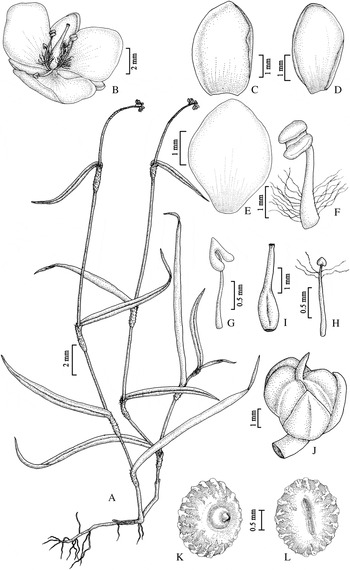
Murdannia assamica Nampy & A.Ancy, sp. nov.Figs 1,2C–D.
Fig. 1.Murdannia assamica Nampy & A.Ancy. A, habit; B, single flower; C, bracteole; D, sepal; E, petal; F, stamen; G–H, staminodes; I, gynoecium; J, capsule; K, seed dorsal view; L, seed ventral view. Drawn by Suhana M. from the holotype.
 Fig. 2.
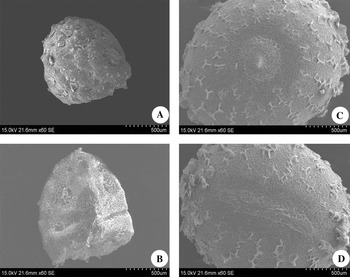
SEM micrographs of seeds of Murdannia nudiflora (L.) Brenan and M. assamica Nampy & A.Ancy. A–B, M. nudiflora: A, dorsal view; B, ventral view. C–D, M. assamica: C, dorsal view; D, ventral view. A–B from Anna Ancy & Santhosh Nampy2310 (DEV), C–D from the holotype.
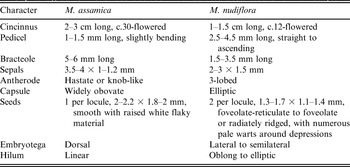
Murdannia assamica is close to M. nudiflora (L.) Brenan but differs in having a 2–3 cm long cincinnus with c.30 flowers, hastate or knob-like antherodes, widely obovate capsules and 1-seeded locules as opposed to a 1–1.5 cm long cincinnus with c.12 flowers, 3-lobed antherodes, elliptic capsules and 2-seeded locules in M. nudiflora. – Type: India, Assam, Goalpara District, Goalpara town rail station, 26°07′26.73″N, 90°37′18.26″E, 50 m, 6 ix 2009, Anna Ancy & Santhosh Nampy2376 (holo DEV; iso CALI, L).


Annual ascending herb, basally 2- or 3-branched. Roots fibrous, from base and from lower nodes which touch the soil. Stem light purple towards base; internodes 6–10 cm long, green, glabrous but with a line of hairs. Leaves cauline, alternate, usually reduced distally on the shoot; sheath 0.3–1 cm long, green with slight purple tinge, minutely pubescent, ciliate at apex and along the fused margin; lamina linear-lanceolate, 6–15 × 0.5–0.7 cm, base narrowly rounded, margin scabrous, hyaline, apex acute to acuminate, both surfaces glabrous to puberulent. Inflorescence terminal, a single pedunculate cincinnus; peduncle glabrous, 2–2.5 cm long; cincinni 2–3 cm long, c.30-flowered; bracteoles ovate, 5–6 mm long, caducous, pale green. Flowers bisexual and male, closely placed on the cincinnus axis, opening at c.10.00 hours in the morning, withering at c.12.00 noon; pedicel 1–1.5 × 0.5 mm, glabrous, slightly bending. Sepals 3, free, elliptic, equal to subequal, 3.5–4 × 1–1.2 mm, pale green, glabrous. Petals 3, free, elliptic, 4–5.1 × 1.5–2 mm, lilac, glabrous, margin entire. Stamens 2, antesepalous, dorsifixed; filaments hairy on the lateral sides basally; anther lobes elliptic, 0.4–0.6 mm long; dehiscence longitudinal; pollen white, elliptic. Staminodes 4, three antepetalous, with antherodes hastate or knob-like, white; filaments glabrous or with 1–3 hairs; one antesepalous with antherode knob-like and filaments with 3–6 hairs. Ovary elliptic to ovate, glabrous; style white, 1.6 mm long, glabrous; stigma papillate. Capsule widely obovate, 4.1 × 4 mm, glabrous, light brown, dehiscent, trilocular. Seed1 per locule, elliptic, 2–2.2 × 1.8–2 mm; testa brown, smooth with raised white flaky material on the surface; embryotega dorsal; hilum linear.
Distribution. Known only from Goalpara District in Assam.
Habitat and ecology. Among woods and on wayside, in shade, in alluvial soil.
Phenology. August–November, flowering time 10.00–12.00 hours.
Etymology. The species is named after Assam, a floristically rich state of Northeast India, which includes the type locality, Goalpara.
Conservation status. Critically Endangered CR B1ab(i,iii,v) B2ab(ii,iii,v). Due to increasing human interference the collection localities near Goalpara town rail station (approximate area 5–6 km2) and near Paikan (< 1 km2) are under threat. The two localities are 22 km apart. As the species is so far known only from a few localities in the Goalpara District of Assam, and this area is subject to urbanisation, there is a high possibility that the species will disappear in the foreseeable future. A seed bank of Murdannia assamica has been established at St Joseph’s College.
Additional specimens examined. India. Assam, Goalpara District, Goalpara town rail station, 4 ix 2011, Anna Ancy & Santhosh Nampy 4606 (DEV); near Paikan, way to Krishnai, 4 ix 2011, Anna Ancy & Santhosh Nampy4676 (DEV).
Murdannia assamica is similar to M. nudiflora in general appearance, in their caducous bracts, inflorescence pattern, flower colour and in their two fertile stamens and four staminodes. It can be differentiated from the latter by the characters given in Table 1. A prominent to less prominent basal rosette and secondary inflorescences are sometimes found in Murdannia nudiflora, but they are lacking in M. assamica.
Morphological differences between Murdannia assamica andM. nudiflora

Acknowledgements
The authors are grateful to Kerala State Council for Science Technology & Environment, Thiruvananthapuram (Council Order No. (T) 048/SRS/2011/CSTE dated 21 May 2011) for financial support; the Department of Nanotechnology, National Institute of Technology, Kozhikode for the SEM of seeds; Dr Robert B. Faden, Smithsonian Institution for commenting on the specimens; Miss Suhana for the illustration; and to Mr Sylesh Raphael for his participation on the collection trips. A.A. is grateful to The Head, Department of Botany and Principal, St Berchmann’s College, Changanacherry for facilities.