Roman art in Greece was wretched stuff made by sneaks to satisfy the taste of bullies.Footnote 1
Every nation edits its own past.Footnote 2
Introduction
The Roman period in Greece has had a relatively short history of inquiry compared to other epochs of the country's long history and, as a result, very little has been written about modern perceptions of this period.Footnote 3 For various reasons, neither modern Greeks nor foreigners have been particularly concerned with the country's Roman past, a period which has often been relegated to a negative realm. As a result, misperceptions about the Roman period in Greece are rampant, with many fallacies being perpetuated by labels and displays in museums and archaeological sites throughout the country, as well as by pedagogical institutions and the media.
This article, which is based on fieldwork in various parts of Greece, presents some observations on perceptions of the Roman period and attempts to add some insights into how this period has been understood in Greece until the present. It also sheds some light on the oft-repeated term of Pωμαιοκρατία (Roman rule), which has long been ingrained in the imagination of modern Greeks. It considers how the Roman history of Greece has been featured in the nation's museums and archaeological sites, the media, and education, and investigates how this period has been neglected or glossed over in favour of other periods. I suggest that the roots of this period bias lie not only in older notions about paganism and Roman decadence in favour of glorifying the pre-Roman and later Christian heritage of the nation, but also in the works of European scholars from the eighteenth century to the early twentieth, who tended to glorify classical Greece and viewed the Roman period as one that produced inferior imitations of classical Greek art, architecture, philosophy, and literature.Footnote 4 By tracing the development of an anti-Roman mentality that led to the misperception and misapplication of a term like Pωμαιοκρατία in favour of pre-Roman glory, we come to realize that we are dealing with yet another negative definition of a historical period that is afforded an undesirable place in the modern Greek imagination, on a par with Toυρκοκρατία (Turkish rule), Ενετοκρατία (Venetian rule), and, more recently although less frequently used, Ευρωκρατία (Euro or European rule) and Tροϊκοκρατία (rule of the ‘Troika’).Footnote 5
Why should one bother to pay attention to this matter at this time? Ever since a few personal encounters with the general public that seemed to me unusual and biased, the perceptions – or rather misperceptions – of the Roman period in Greece have been in the back of my mind. As a doctoral student, I spent a great deal of time researching material dated to the Roman period in archaeological sites, museums, and storage rooms in Greece, especially on the island of Crete, which formed the focus of my dissertation. I realized very early during my research that the Roman period held an inferior status in Greece and that those who studied it were generally viewed as dull and unimaginative by both the general populace and many archaeologists and historians.
This biased attitude can best be illustrated with a few personal anecdotes. During a study season in one of the storage rooms of a major museum, a middle-aged, male guard saw me handling and studying some ancient lamps; he seemed to find the objects fascinating and asked me in Greek ‘Τι είναι αυτά;’ (what are those?), clearly inquiring about the period rather than the material. I answered ‘Pωμαϊκά’ (‘Roman’), to which he replied with visible disapproval ‘A, βρωμαϊκά!’, a derogatory word which translates into English as ‘stinky’. Upon further discussion, he could not fathom why a doctoral student would want to study material from Roman Crete, which, according to him, was so much more inferior in quality compared to Minoan and classical Greek material from the island. Similarly, an older male friend in Athens did not hide his disdain when I informed him that I was going to visit Nicopolis in order to see the house of Manius Antoninus, a Roman nobleman, which I was going to mention in my doctoral thesis. He exclaimed that ‘The Romans were the destroyers of Greece!’ An even more bizarre encounter occurred when a Greek Orthodox priest in the town of Rethymno showed visible disappointment and refused to shake my hand upon being introduced to him as an archaeologist who studies Roman houses and cultural identity in Crete, again stating that the Romans destroyed the country. These anecdotes are not limited to my own experiences with the public in Greece but have in fact been common occurrences in the lives of colleagues who specialize in the history and archaeology of Roman Greece.
It is evident, then, that the general population in Greece is heavily biased against and often misinformed about the Roman period, a trait which appears to have reached its climax in 2014 with the discovery of a funerary monument at Amphipolis in the province of Macedonia, whose dating was initially attributed to either the late fourth century bc (therefore Macedonian) or the first century bc (Roman) and the debate continues to rage. Anti-Roman sentiments have permeated Greek thought since the birth of the modern Greek nation and have shaped much of the public's attitude toward this period of the country's history. But why? Why do Greeks of the twenty-first century hold these views about Greece under Roman rule, which, in most parts of the country, lasted for more than six centuries and, according to both the nature of the archaeological remains and the accounts of historians writing during that period, was a rather prosperous time in the history of the country, particularly after the conquest and the first century of Roman rule?
With the recent and still ongoing economic crisis in Greece, the subject of foreign occupation(s) has once again come to the forefront, with more than one newspaper claiming that Greece's economic and political problems began during the Roman period and have continued intermittently ever since. As foreign occupiers, the Romans are often portrayed as looters, rapists, and murderers, with more than a few mentions of the atrocities committed by individuals such as Sulla and Mummius, the destroyers of Athens and Corinth respectively. Thus, to many Greek people, Roman occupation implies not only a loss of Greek autonomy but also the decline of Greek culture, at least as Greek culture is understood to have been at the height of its glory in the classical period. There are some exceptions to these negative portrayals of the Romans, however, and this fact is particularly evident in a few recently built museums that have chosen to present the Roman period in a more favourable light. Some of these museums refrain from using the term Pωμαιοκρατία on labels because the majority of their material is dated to the Roman period and perpetuating a negative connotation would undoubtedly be damaging for the prestige of the museum, which would inadvertently hurt ticket sales. Similarly, Greek archaeologists and historians of antiquity have focused more on the Roman period in the past decade than ever before, no doubt partly aided by the relative lack of competition in the subject but also because of a general academic trend in embracing neglected periods in Greek history.
A history of misperception
The history of (mis)perception about the Roman period in Greece is long and multi-faceted and it is not the aim of this article to expose its various intricacies. However, a short summary of scholarly thought on the subject that led to the current mindset of the average Greek will clarify the scope of the topic and show that misperceptions in contemporary Greece came about both as a result of Greek national sentiment that was encouraged by various intellectual circles during and after the birth of the Greek nation-state and by the glorification of the classical Greek past by non-Greeks at the expense of other periods in the nation's history. The fascination that European scholars and antiquarians have had with ancient Greece and Rome since the Renaissance contributed to the later fervour about the ancient past that arose during and after the emergence of the modern Greek state.
In the eighteenth and nineteenth centuries, historians and antiquarians were looking for ways to unify antiquity and modern nation-states.Footnote 6 Ancient Greece and Rome became the points of reference for these European states because so much of European culture could be traced back to the Greeks through the preservation of classical Greek culture by the Romans.Footnote 7 In the eighteenth century, the German antiquarian J. J. Winkelmann stated that
the superiority that art achieved among the Greeks is to be attributed in part to the influence of their climate, in part to their constitution and form of government and the way of thinking induced by it; yet, no less to the respect accorded to artists and to the use and application of art among the Greeks.Footnote 8
Furthermore, he argued that the Greeks of his day still retained some of this ancient Greek beauty:
At this very day, the Grecian isles are remarkable for the gracefulness and beauty of their inhabitants; and the female sex there retains still, notwithstanding their intermarriages with foreigners, such peculiar charms of complexity and figure, as exhibit a strong argument in favor of the transcendent beauty of their ancestors.Footnote 9
Such glorification of the Greek past and its continuity in the modern Greek nation – or the islands, in this case – undoubtedly stirred pride among Greeks living under Ottoman rule in Winckelmann's time and encouraged later academic sentiments among European scholars and learned members of the gentry whose philhellenic attitudes provided an impetus for an emerging Greek nationalism at around the time of the Greek War of Independence in the early nineteenth century. Although many European scholars held mixed feelings towards the inhabitants of modern Greece, for the most part Greek academics wrote about a seamless continuity from the ancient Greek period to Byzantium to modern Greece, purporting that the modern population of Greece at that time was directly descended from both ancient and Byzantine Greeks. Aided by the romantic Hellenism that permeated European and American academia and the arts in the eighteenth and nineteenth centuries, the Greek and non-Greek texts of that time focused on the period from the fifth century bc up to the Roman conquest, while dismissing all subsequent periods as inferior unless certain aspects demonstrated an affinity with classical Greece. Thus was born the dislike and neglect of all things Roman, as this period in the nation's history was one that ‘produced wretched stuff made by sneaks to satisfy the taste of bullies’, to quote Stobart.Footnote 10 What is interesting for the purposes of my argument is not the fact that the modern Greek nation in the nineteenth century was built on romantic sentiments that overemphasized and romanticized a golden age of Greek supremacy in many fields lasting from the fifth century bc to the Roman conquest, but rather why these notions have prevailed until today.
The birth of the modern Greek state in 1830 brought the issue of national identity to the forefront. As one would expect, history and archaeology were paramount in constructing the country's identity. The inhabitants of modern Greece, who had lived through several centuries of Ottoman rule before achieving independence in the nineteenth and early twentieth centuries, were eager to demonstrate continuity with the ancient Greeks, and their zeal was aided by the classicizing climate that was sweeping the intellectual circles of Europe at the time when the modern Greek state was ruled by the Bavarian king Otto.Footnote 11 Intellectual attitudes towards the Greek past during that period were characterized by the promotion of classical antiquity and a matching dislike of the more recent Byzantine past, considered at that time a disgraceful era for the Greek nation, an era of foreign occupation.Footnote 12 Interestingly, however, neither Greeks nor foreigners ever referred to the Byzantine period as Βυζαντινοκρατία. The anti-Byzantine sentiment of some intellectuals after the Greek War of Independence was closely linked to negative perceptions about the Roman period. For example, in an address to the Archaeological Society of Athens in 1841, the scholar and antiquarian Iakovos Rizos Neroulos stated that ‘Byzantine history is a long series of foolish deeds and infamous outrages of the Roman state transferred to Byzantium. It is a disgraceful specimen of the extreme wretchedness and decline of the Greeks.’Footnote 13 In this case, the Byzantine period is seen in an unfavourable light because of its direct connection with the Roman period, which was perceived by scholars like Neroulos as a decadent era in human history.
Half a century later, under the pretext of contributing to the modern Greek state an identity, and under the guidance of the Greek Orthodox Church, the Byzantine period began to be propagated as an epoch of continuity of Greek culture, and this sentiment was promoted officially in education, museums, and archaeological sites. The museums that were built during the earlier part of the twentieth century emphasized this historical continuity, with the Benaki Museum, opened in 1930, being the most prominent example. In the National Archaeological Museum of Athens, the Roman period was, until recently, only meagrely represented when taking into account the city's rich archaeological finds from this era, while the Byzantine period was glorified.Footnote 14 This clearly indicates that, whereas the anti-Byzantinists were against the Byzantine period because of its connection to Roman ‘vices’, the pro-Byzantinists were against the Romans because they were seen as the destroyers not only of classical Greece but also of early Christianity. Damaskos summarizes this notion of disturbed continuity by emphasizing that anything that disturbed that linear development was considered a foreign body, which Hellenism resisted, thus maintaining its cohesive structure.Footnote 15 This applied to the periods when Greek territory was ruled by the Romans, the Franks, and the Ottomans, periods known in Greek as the Pωμαιοκρατία, Φραγκοκρατία, and Toυρκοκρατία respectively.
After the mid-twentieth century and with the end of the Second World War, another determinant came to the forefront that emphasized the dislike of the Greeks for all things Roman. Italian troops invaded Greece through Albania in 1940 and the resulting anti-Italian sentiments, augmented by Mussolini's comparisons to Julius Caesar and his professed desire to create a new Roman empire, permeated Greek society at that period. It should be noted that, at that time, parts of Greece were still under foreign rule. The Dodecanese islands were only ceded to Greece by Italy in 1947 and the anti-Italian bias of the majority of the local people, both on the islands and on the mainland, many of whom had lost close family members to the Italian and later the Nazi invasions of Greece, remained strong after the war. However, by the late twentieth century, following the death of the generation that fought during the Second World War or lived under Italian hegemony, Italians ceased to be considered enemies of the Greek nation but the anti-Roman period bias did not abate.
The passage of time and the increasingly global nature of cultural experiences, as well as the migration of Greeks around the world, led inevitably to some of the attitudes toward foreign rule witnessed in the country today. Even with these changes in perception, Greek national history still tends to present a narrative that is continuous in time, beginning with the ancient Greeks, proceeding into Byzantium, and culminating in the construction of the modern Greek nation.Footnote 16 Selective memory has been employed as a mechanism for group identity in order to perpetuate a national distinctiveness which is in agreement with the fervent desire for undisturbed continuity between classical Greece and the present. Group identity relies on the concept of sameness over time and space and is sustained by remembering or choosing to remember events of the past.Footnote 17 Thus, people choose what to remember or forget according to the needs of the present, and social and cultural memory are active and ongoing processes.Footnote 18 As John Gillis notes, identities and memories are highly selective, inscriptive rather than descriptive, serving particular interests and ideological positions. Just as memory and identity support one another, they also uphold certain subjective positions, boundaries, and power.Footnote 19 Closely tied to memory is the concept of heritage, which implies connection with the past – family history, prehistory and antiques, buildings and landmarks, music and paintings, plants and animals, and language and folklore.Footnote 20 Greece's historical heritage is thus perpetuated as a form of collective cultural memory, where ancestral ties, whether real or imagined, are preserved in order to boost the solidarity of the nation.Footnote 21 Antiquities augment identity and community self-esteem in every state and the restitution of cultural heritage has promoted efforts to keep it in place.Footnote 22 Cultural memory, which the Greek national narrative perpetuates, may be characterized best by three criteria proposed by Assman and Czapliczca:
1) ‘The concretion of identity’, or the relation to the group. Cultural memory preserves the store of knowledge from which a group derives an awareness of its unity and peculiarity. The objective manifestations of cultural memory are defined through a kind of identificatory determination in a positive (‘We are this’) or in a negative (‘That's our opposite’) sense. …
2) its capacity to reconstruct. No memory can preserve the past. What remains is only that ‘which society in each era can reconstruct within its contemporary frame of reference.’ Cultural memory works by reconstructing, that is, it always relates its knowledge to an actual and contemporary situation….[It] exists in two modes: first in the mode of potentiality of the archive whose accumulated texts, images, and rules of conduct act as a total horizon, and second in the mode of actuality, whereby each contemporary context puts the objectivized meaning into its own perspective, giving it its own relevance.
3) Formation. The objectivation or crystallization of communicated meaning and collectively shared knowledge is a prerequisite of its transmission in the culturally institutionalized heritage of a society.Footnote 23
In Greece, all three of these criteria are propagated in education, various forms of media, and museums and archaeological sites.
Teaching history
Perceptions of the Roman period in Greece have been largely shaped by school textbooks, which are a product of the country's highly centralized educational system. The curriculum of primary and secondary schools is developed by the State Pedagogical Institute and approved by the Ministry of Education.Footnote 24 Students across the country who are in the same grade are taught from the same history textbook, with the first grade of high-school students currently being taught from Iστορία του Αpχαίου Κόσμου (History of the Ancient World). Although a few chapters toward the end of the book are devoted to the history of Rome, ranging from the early Republic to the founding of Constantinople in ad 330, the essence that students generally derive from the text can be summed up by Quintus Horatius Flaccus’ famous statement Graecia capta ferum victorem cepit et artis intulit agresti Latio (‘Greece, the captive, made her savage victor captive, and brought the arts into rustic Latium’). It is common for secondary school teachers to focus mainly on the parts of Roman history that pertain to the Greek world, with a special emphasis on the Roman conquest and the transfer in the fourth century ad of the Roman capital to Constantinople. In many cases, teachers do not have adequate time to cover the Roman period as delays during the school year – a common occurrence in Greek schools, where students are known to strike almost every year – often force teachers to cover earlier missed material, leaving little time for teaching Roman history, which is placed toward the end of the book. Thus, many secondary school students complete their education in ancient history without gaining enough knowledge about the Roman period.
At the university level, courses in Roman archaeology are offered by departments of history and archaeology. Very few academics in Greece possess diplomas with specialities in Roman history and archaeology per se, whether they were obtained in Greece or abroad. Greek universities usually divide courses into three periods: prehistoric, classical, and Byzantine.Footnote 25 Roman history and archaeology are usually taught by academics who specialize in the classical and Hellenistic periods, although in more recent years, an increasing number of young scholars employed by the major Greek universities have afforded more attention to the Roman period and are increasingly choosing to specialize in it, predominantly because there is less competition in the field compared to those specializing in other periods.
Greece is a deeply religious country and the separation of church and state, although coveted by most academics, has not occurred. The Greek Orthodox Church has played a prominent role in education from the naissance of the modern Greek state; this is evident in the blessings of students and schools by priests at the start of every academic year and by the teaching of religion as a subject in elementary school. But the church has also played a role in presenting the Roman period in a negative light to both believers and non-believers. The persecution of early Christians by the Romans has been ingrained in the minds of much of the population and a quick look at the various saints’ days of the Orthodox Church includes several individuals who were martyred by the Romans: St Peter, St Andrew, St Sebastian, and St Sophia to name only a few. Some archaeological sites dated to the Roman period are physical reminders of the places of martyrdom of early Christian saints: at Gortyn, for example, the famous agioi deka (ten saints) were martyred for professing their Christian faith during the time of religious persecution under the emperor Decius in ad 250.Footnote 26 The name has survived in the nearby village of Agioi Deka and tour guides at Gortyn are quick to emphasize the brutality of the Roman regime in dealing with the local people.
This religious bent in members of the Greek public can be illustrated in the description found in a brochure promoting tourism on the island of Paros which claimed that, from the fifth century bc onwards, the island was successively invaded by the Athenians, Spartans, Thebans, and Macedonians:
Because of these unfortunate events, the time of Paros’ decline finally began. To make matters worse, the period of Roman occupation came immediately after, which went on until the founding of the Byzantine Empire. Once fourth century ad came, idolatry was eradicated and replaced with the Christian religion that steadily swept the whole island.Footnote 27
The above statement implies not only that the Romans occupied the island of Paros – an erroneous statement, since Roman forces never set foot on the island – but that this occupation was somehow worse than the previous ones, and that the people living before the fourth century ad were idolatrists. The implication is that it was only with the arrival of the Christian religion that the island entered a better era.
Given the nation's deep roots in Orthodox Christianity, why, then, should the average citizen of Greece be expected to see the Romans in a positive light when both academic institutions and the Greek Orthodox Church represent them not only as inferior imitators of classical Greek civilization but also as brutal conquerors and murderers?
Pωμαιοκρατία in museums and archaeological sites
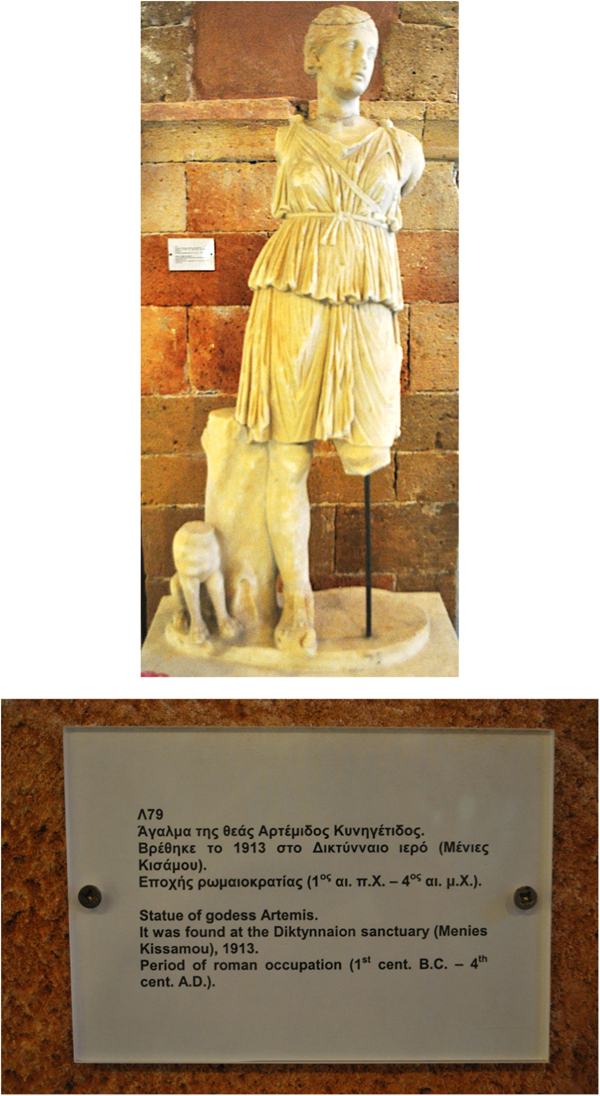
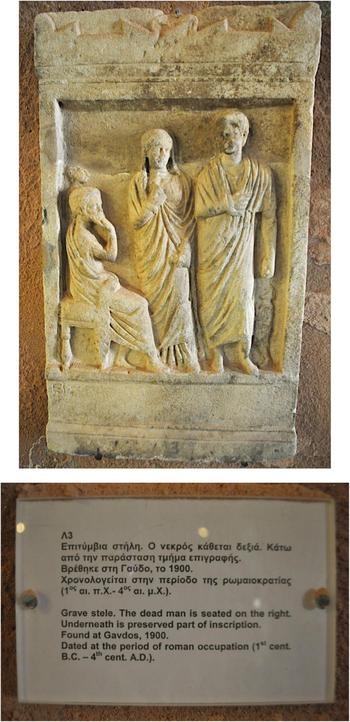
Following the impetus from education, sites and artefacts of the Roman period were relegated to a lesser status and regarded as inferior copies of superior classical or Hellenistic prototypes. The term Pωμαιοκρατία appears on the labels of many museums and archaeological sites throughout Greece. Pωμαιοκρατία translates into English as ‘Roman rule’, from Ρωμαιος (Roman) and κρατία (rule). However, the English translation of the term in many museum labels suggests a slightly different definition. A marble statue of the goddess Artemis found in what is thought to have been a sanctuary in the city of Kissamos in west Crete and now exhibited in the Chania Archaeological Museum, displays the English label ‘Period of roman [sic] occupation (1st cent. B.C. – 4th cent. A.D.)’ (see figure 1) (Kouremenos 2013).Footnote 28 Likewise, the label for a grave stele found on the island of Gavdos states that the artefact is also dated to the period of ‘roman [sic] occupation (1st cent. B.C. – 4th cent. A.D.)’ (see figure 2).The term ‘Roman occupation’ is often repeated on the labels of nearly every museum in Crete, as well as in many other museums and Roman sites across Greece.
Statue of Artemis from the sanctuary of Diktynna with label in Greek and English. Chania Archaeological Museum. Photos by the author.

Grave stele from Gavdos with accompanying label in Greek and English. Chania Archaeological Museum. Photos by the author.

This misleading English translation of Pωμαιοκρατία might bring to mind images of warfare, slaughter, and slavery and may lead visitors to assume that architectural and artefactual remains dated to the Roman period on Crete were products of an occupying force that should not be given as much attention as those produced by the native islanders. The term Pωμαιοκρατία also finds a parallel with the recent usage of Ευρωκρατία (Eurocracy), a derogatory term used by the Greek (and sometimes non-Greek) media and people during the current economic crisis to denote the ‘occupation’ of the country by European, particularly German, politicians and bankers. Even the term ‘occupation’ conveys entirely negative associations for the visitor, which may bring to mind images of the Nazi occupation of Greece during the Second World War, or the occupation of the northern part of Cyprus by Turkish forces during the 1970s. However, did the Romans actually occupy specific towns on Crete?
What exactly is implied by the term occupation? The Oxford English Dictionary provides four definitions for the verb ‘to occupy’:
1. reside or have one's place of business in (a building).
2. fill or take up (a space or time).
3. fill or preoccupy (the mind).
4. take control of (a place, especially a country) by military conquest or settlement. Enter and stay without authority and often forcibly, especially as a form of protest.
The labels in Greek museums clearly point to the usage of the fourth definition of the term, thus indicating that Romans either settled in the towns they had conquered or that they forcibly entered the cities and took control of them, often by killing the native inhabitants. In either case, both implications offer a misleading picture about the Roman period in Crete. Kissamos was the harbour of Polyrrhenia before the Roman conquest of the island and became a city in around 27 bc, four decades after the island's incorporation into the Roman empire in 67 bc (Kouremenos 2013 and 2015). Roman forces never set foot on the island of Gavdos, so the grave stele dated to the period of ‘Roman occupation’ is another erroneous assumption, perpetuated by the exclusion of the Romans from the national narrative, that leads the visitor to form a misleading conclusion.
There is an additional point that needs to be noted here. The seeming insignificance that some Greek archaeologists attribute to the Roman period is also evident in the dating of the material recovered from archaeological sites. Many archaeologists do not bother to date Roman material stratigraphically or by radiocarbon dates; instead, they often provide a span of five centuries (first century bc to fourth century ad) to excavated sites and artefacts, as if the Roman period had a uniform material culture throughout five centuries. Excavations rarely begin with the sole purpose of finding remains of the Roman period. Indeed, most systematic and rescue digs start off with the goal of finding pre-Roman remains and in many cases end up recovering material of the Roman period that is usually put aside and relocated to storage rooms, with the majority of it not being studied mainly because there is a seeming shortage of archaeologists – both Greek and non-Greek – specializing in the country's Roman period. The fate of Roman material in excavations depends almost entirely on the level of interest that past and present excavators have had for this period, and this is not a phenomenon restricted to archaeologists who are themselves Greek. For example, in his zeal to uncover Minoan remains at Knossos, Arthur Evans dug right through the Roman levels of the Minoan palace and the Unexplored Mansion.Footnote 29 In restoring the Minoan palace, he overlooked the plethora of Neolithic and Roman remains found on the site, thus neglecting the historical significance of the site's other periods of prosperity.Footnote 30
This neglect for archaeological remains of the Roman period can also be witnessed in many museums across the nation. For example, the New Acropolis Museum, opened in 2009, vastly under-represents the Roman period: only six portrait busts and three other sculptures from this period are currently on display in a museum that occupies an area of 14,000 square metres. Given that a host of sculptures have been found in excavations throughout the Acropolis area, this is striking, as the extant Hellenistic and Roman portrait sculptures, which were published as a corpus, amount to more than 120 pieces.Footnote 31 While the official line might be that there is not enough room in the new museum for all the material that has been excavated around the Acropolis to be displayed and that the main focus should be on the artefacts from the Acropolis during its heyday in the classical period, one may argue that the real reason is that there is a marked period bias against the Roman period that may have crept into the choice of museum displays.Footnote 32
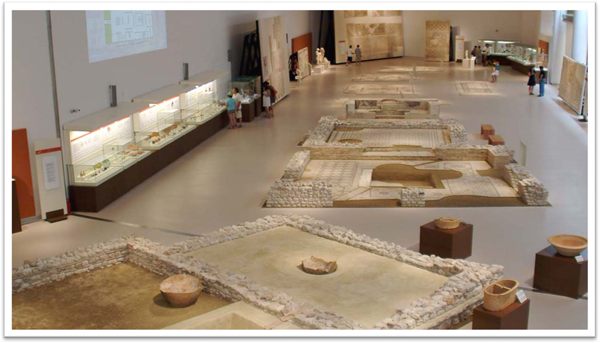
A few other recently inaugurated museums, however, seem to be shedding some positive light on the Roman period, which is an encouraging trend. Three good examples are the Museum of Patras, inaugurated in 2009, the Archaeological Museum of Kissamos, opened in 2006, and the New Archaeological Museum of Nicopolis, opened in 2009. The majority of artefacts displayed in these museums date to the Roman period and were recovered from both salvage and systematic excavations in the three cities throughout the twentieth and early twenty-first centuries. While all three museums contain material from many periods, the emphasis is clearly on Roman artefacts, as these cities flourished during the Roman period and the recovered material (polychrome mosaics, sculptures, jewellery, rooms from houses) is too opulent to be deposited in storage rooms. Thus, the seeming prevalence of Roman material in these museums, as well as its good preservation, is clearly based on the availability of such materials from excavations conducted in these three cities rather than a marked preference for including material from the Roman period in these museums. A few recent exhibits even contain installations of actual Roman-period dwellings, such as a villa rustica and a domus in the Patras museum (see figure 3). These are the only examples of room installations from houses dating to the Roman period in Greece thus far and are a testament to the shift both in the emphasis on other periods of Greek history and towards more innovative types of museum display.
Hall with installation of rooms from villa rustica and domus in the Archaeological Museum of Patras. Photo from the museum's website: http://www.patrasmuseum.gr/.

Pωμαιοκρατία in the media
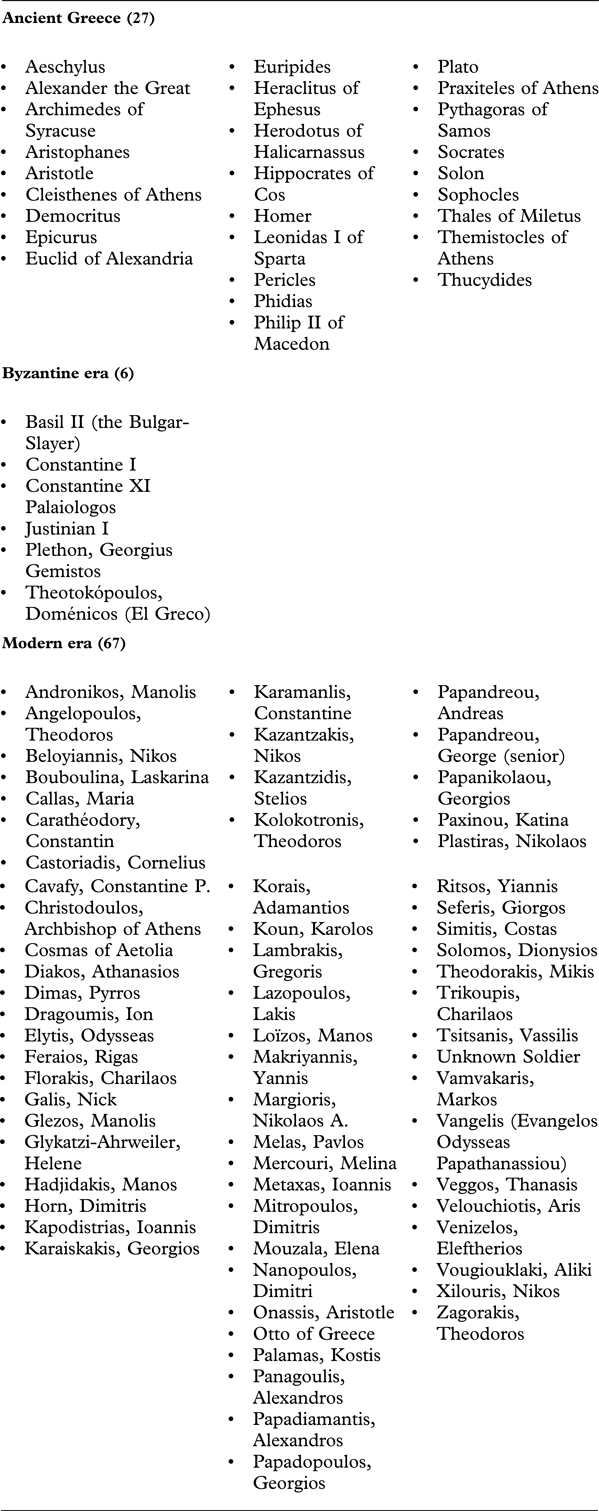
The negative view of certain historical periods in Greece in favour of presumed positive eras is not limited to the Roman period. An anti-Roman mentality tends to be perpetuated in many forms of media, from TV to magazines, newspapers, and social media. An example from a recent TV programme illustrates this attitude clearly. Sky Channel's documentary 100 Great Greeks of All Time aired in January 2009. A spinoff of the BBC's Greatest Britons, the list is composed of one hundred individuals considered by leading historians and the Greek public to be the most important throughout the history of Greece (see table 1). It includes only one individual from the Roman period, the Roman emperor Constantine I (ad 272–337), whom the documentary's writers chose to place conveniently under the Byzantine period. He is presented as a Greek, but is not otherwise known to have had any Greek ancestry, to have been born in Greece (he was, in fact, born in Naissus in Moesia, in what is now Serbia), or even to have spoken Greek as a mother tongue.Footnote 33 Constantine is considered Greek simply because he founded Constantinople, the capital of the Greek-speaking Byzantine empire, and later became a saint of the Greek Orthodox Church. Meanwhile, well-known Greeks of the Roman period – such as Plutarch, Galen, Herodes Atticus, Ptolemy, and many others – are completely omitted.
List of 100 Great Greeks of all time (reproduced from the Sky Channel website).

It is worth noting the historical periods into which the hundred Greeks are split. The ‘negative’ periods of Greek history – Roman, Venetian, Ottoman – are not listed at all. Those Greeks on the list that lived during these periods – El Greco (included under Byzantine rather than Venetian); Cosmas of Aetolia (listed under the Modern Era rather than the Ottoman period) – are placed within the ‘positive’ periods. So pronounced is the dislike of the general public and some scholars towards the ‘negative’ periods that the prominent people who lived during those times are conveniently places in the ‘positive’ periods lest they remind the Greeks that the eras they would rather forget actually produced many laudable individuals and that foreign rule may not have been as damaging to the Greek population as they would like to imagine.
Archaeological discoveries have often been sensationalized in the Greek media during the decade of economic crisis because they provide an outlet from dealing with economic problems while simultaneously reigniting ethnic pride by stirring people's imagination. The recent fervour surrounding the discovery of a massive funerary monument at Amphipolis in northern Greece has brought the subject of Roman occupation once again to the forefront of archaeological debate in all forms of media.Footnote 34 Deliberation since September 2014 has centred on the monument's dating: is it a fourth-century bc Macedonian royal tomb or a Roman funerary monument of the first century bc housing the remains of multiple individuals killed in the Battle of Philippi? What began as a bitter debate between the chief archaeologist at Amphipolis, Katerina Peristeri, and Olga Palagia, a professor of classical archaeology at the University of Athens, who argued for the presence of multiple Roman motifs in the funerary monument, escalated into a subject of national debate. Various forms of media, including newspapers, TV shows, and internet blogs, reported on the zeal of Palagia for daring to suggest that the tomb may in fact be Roman, with some people implying that she is a traitor for daring to insinuate that the tomb is anything but Macedonian. In October 2014, the newspaper Ethnos published an article citing Palagia's opinion that the tomb is Roman, with one commentator stating
Ολοι θα θέλαμε ο τάφος να ήταν ασύλητος, Μακεδοvικός και του Μεγαλέξανδρου η τέλοσπαντων της Ρωξάνης η του Δεινοκράτη. Σε όλους μας αρέσουν αυτά που μας ανεβάζουν και μας αποσπούν την προσοχή. Κανείς δεν θέλει το Ρωμαϊκό παρελθόν της Ελλάδας. Ομως η αλήθεια δεν έχει να κάνει με το τι εμείς θέλουμε.
We would all like the tomb to be unlooted, Macedonian, with Alexander the Great or at least Roxanne to be buried in it, designed [sic] by Deinokrates. We all like to read what makes us feel good and what holds our attention. No one likes the Roman past of Greece. However, the truth doesn't have to be whatever we prefer it to be.
The above sentiments are perhaps best illustrated by Palagia's own statement on NPR that ‘Modern Greeks are very insular, inward-looking and extremely traumatized by the financial crisis; they would feel cheated if it is not Greek and would not give a rat's ass if it were a Roman tomb.’ Although the dating of the tomb has yet to be confirmed, and it is likely that it has more than one phase, the dislike for all things Roman has once again been propagated by the media and serves as a reminder that archaeology and history are utilized by the human imagination in order to preserve a specific national narrative that may or may not be true.
Conclusions
This article has focused on some major misperceptions of the Roman period in Greece. By tracing the usage of the term Pωμαιοκρατία and the way in which the Roman period is represented in education, museums and archaeological sites, and the media, we can come to understand how this era is viewed by modern Greeks. I have argued that, in the modern Greek imagination, there is a dichotomy between ‘positive’ and ‘negative’ periods in Greek history, which can be outlined as follows:
• All periods up to the Roman conquest + Byzantium + Greek War of Independence + Greece from the 1980s up until 2008 (the start of the current economic crisis) = good.
• Roman, Frankish, Venetian, Arab, Slavic, Ottoman, Bavarian, Nazi, Junta, ‘Troika’ = bad.
Some of the misperceptions of the Roman period in Greece discussed above serve to remind us of the powerful phenomenon of selective memory, a trait which often leads individuals and entire nations to choose with which historical reading they would like to identify themselves and their nation. These concepts demonstrate clearly that national identity is based on selected ‘good’ parts of history, while other, ‘inferior’, periods are conveniently supressed by memory. In essence, one is denying something one does not like and focuses on something one chooses to remember. Nations do not possess a linear history but rather a group of accounts which historical groups selectively appropriate, remember, and forget. These constructs are reproduced and accepted in popular consciousness.Footnote 35 Groups and individuals have the need to prove who they are in relation to others. Their identities must be joined to ancestral links that figure significantly in their statuses, ranks, and titles.Footnote 36
It is chiefly this desire for a direct lineage with the classical Greek past that has encouraged in the general population of Greece the dislike and selective ‘forgetfulness’ of periods such as the Roman which are seen as threats to the national narrative of continuity between past and present in Greece. Anything that disturbs this continuity is conveniently repressed, including periods closer to the modern era. In the nineteenth century, the Ottoman buildings on the Acropolis were an unwelcome reminder of a past which had to be erased so that the newly formed Greek state could be shown to be a worthy successor to the ancient Greek heritage.Footnote 37 Architects and conservators began a ‘purification’ programme, which included the removal of Ottoman material from the Acropolis.Footnote 38 However, even though the average Greek is misinformed about archaeological remains of the Roman period, there has never been a systematic ‘purification’ programme to rid Greece of its Roman past. Encouragingly, current trends in scholarship and museology in Greece are beginning to take other, less ‘positive’, periods into consideration; these favourable signs indicate that, from this decade onwards, the Roman era will no longer be seen merely as a negative period of occupation.
The promotion and over-emphasis of certain historical periods at the expense of others is, of course, not limited to Greece alone. The under-emphasis of negative historical events and the promotion of positive ones is rooted deeply in the human psyche. For Greeks, terms like Pωμαιοκρατία and other –κρατίεs are reminders of foreign rule and the loss of their nation's autonomy. Although Roman culture is often seen by many scholars as a continuation of Greek culture, to the modern Greek mind it was a period of inferior imitation and one that forms a lacuna in the national narrative of continuity between classical and modern Greece.