Case report
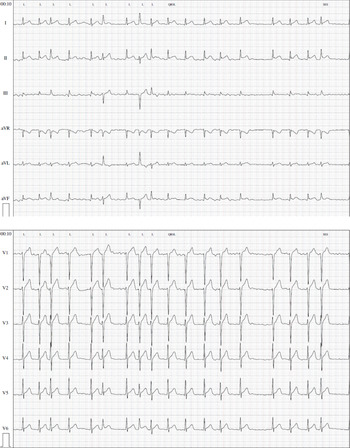
We report on a 16-year-old male presenting at the emergency department with palpitations and chest pain. Onset of symptoms was 1 day prior to admission. He reported no further complaints (e.g., fever, fatigue, or shortness of breath) but claimed to have partied the night before, consuming alcoholic beverages. Recent trauma or infection could be excluded. His personal, as well as family history regarding cardiovascular disease or arrhythmias, were unremarkable. The ECG showed absolutely arrhythmic tachycardia at an average heart rate of 160 beats per minute, highly suspicious of atrial fibrillation (Fig 1). Echocardiography revealed good biventricular function and no signs of structural heart disease. Routine laboratory tests were unremarkable. However, cardiac enzymes revealed normal troponin combined with a slightly elevated brain natriuretic peptide possibly indicating sustained tachycardia. The patient was haemodynamically stable and was subsequently transferred to our paediatric cardiology ward for electrical cardioversion. Synchronised cardioversion applying 100 Joules (i.e., 1 J/kg) immediately conversed AF into sinus rhythm, which remained stable throughout follow-up.
ECG revealed atrial fibrillation.

Discussion
In the paediatric population, isolated AF without any underlying structural heart disease is quite rare (prevalence 0.05% aged before 30 years). Reference Gourraud, Khairy and Abadir2 Young patients usually present with symptoms such as chest pain or palpitations, as in our case, while elderly patients tend to remain asymptomatic. There are some risk factors for isolated AF described in the literature (i.e., alcohol, excessive endurance exercise, drugs, obesity). Reference Gourraud, Khairy and Abadir2 However, it is very important to rule out other pathologies, such as Brugada syndrome, long QT syndrome, or cardiomyopathies that may result in AF. Reference Gourraud, Khairy and Abadir2
Unremarkable diagnostic workup and alcohol consumption are the only remaining risk factors that lead us to the diagnosis of holiday heart syndrome. Thus, careful acquisition of medical and circumstantial history is of outmost importance in cases of HHS.
HHS was first described in 1978, when the occurrence of AF timely related to weekends and public holidays was first noted. HHS is described not only in people with a background of chronic alcohol consumption, but as well in healthy young people consuming alcohol on a non-regular basis. In the latter, AF is mostly seen after binge drinking, and in the absence of other causes. Reference Tonelo, Providência and Gonçalves3
A number of studies have explored the impact of alcohol in atrial fibrillation. Animal models hypothesise a combination of electrophysiological changes (e.g., shorter atrial effective refractory period, enhanced AV nodal conduction), autonomic effects (sympathetic activation, reduced heart rate variability) as well as cellular effects (direct myocyte injury/inflammation, acute oxidative stress) as possible triggers. Reference Voskoboinik, Prabhu, Ling, Kalman and Kistler4
Most patients evolve symptoms at the time of alcohol consumption, others like in our case in the “hangover period” after 12–36 hours. The alcohol withdrawal induces a sympathetic hyperactivity combined with sustained proarrhythmic effects due to alcohol metabolites. Reference Voskoboinik, Prabhu, Ling, Kalman and Kistler4
Patients with HHS have a very good prognosis and most of the cases are resolved after alcohol cessation if there are no other underlying conditions. Also, the response to cardioversion is quite well. In our case, due to the short history of symptoms (< 48 hours), prior anticoagulation was not indicated and we decided to refrain from transesophageal echocardiography. Transthoracic echocardiography was of high resolution and quality in our patients. There is a lack of information on recurrence rate thresholds of alcohol intake that may result in HHS. Reports exist about the occurrence of HHS only after one drink, but also following binge drinking. Reference Tonelo, Providência and Gonçalves3 Our case applies to the latter. However, at the time of admission, blood alcohol levels had already sunken below the threshold for detection.
Conclusion
Alcohol consumption may lead to atrial fibrillation. The awareness of holiday heart syndrome is important for the caring physician when being confronted with the unusual finding of AF in an adolescent patient. HHS remains a diagnosis of exclusion, outlining the importance of careful medical history acquisition and physical examination. Despite its transient nature, the only prevention remains are alcohol restriction, as relapse of AF may occur.
Acknowledgements
Authors thank the staff members of the department of pediatric cardiology in Graz for their valuable inputs.
Financial support
This report received no specific grant from any funding agency, commercial, or not-for-profit sectors.
Conflict of interest
None.
Ethical standards
The authors assert that all procedures contributing to this work comply with the ethical standards.