

Looks can kill – something the narrator of the motetus Dame vostre douz regart (72) knows all too well.Footnote 1 (Appendix 1 presents the texts and translations of the motet’s parts, and an edition of the piece.Footnote 2 ) As he takes leave of the Lady he addresses, her tender parting glance causes symptoms that neatly introduce the subject of this article. The narrator is wound up to breaking point, and it tells in his melody. After verse 10 (b. 35), between the pair of rhyming words ‘aler’ and ‘parler’, the musical setting does something strange: it stops. The two syllables of each word describe a falling fifth, and are set with a single foot of Garlandia’s second rhythmic mode, followed by a silence lasting for a long of three tempora.Footnote 3 Demonstrating the condition he describes, the narrator literally cannot speak – and indeed, his sudden vocal immobility is fitting for one who ‘cannot go’ to his lover either.Footnote 4 The refrain makes the musicopoetic conceit retroactively clear: ‘Li maus d’amer me debrise,/et la douleur que je sent’: ‘The pain of love is breaking me,/and the suffering that I feel.’ Debrisier means ‘to break’, ‘to shatter’, or ‘to fracture’.Footnote 5 The narrator is cracking up, and so is his voice.
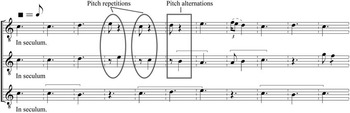
On what grounds can we call this moment a hocket? Certainly it lacks the grand scope of fourteenth-century motet-hockets like those recently discussed by Anna ZayaruznayaFootnote 6 and Thomas Schmidt-Beste.Footnote 7 The passage I highlight in Appendix 1 concerns only a single part, and so construed, it obviously cannot display pitch repetition between voices, or indeed voice-exchange – features widespread in Parisian polyphony of the late twelfth century, foregrounded by the long melismatic hockets of the later thirteenth, and familiar from textbook and reference descriptions of hockets.Footnote 8 Of the pitch-repetition sort, a good example is the famous In seculum hocket, given pride of place at the start of Mo’s fifth fascicle.Footnote 9 (See Example 1.) From their opening unison, the upper two voices soon perform alternating pitch repetitions (bb. 4–5), or just alternations of different pitches (b. 6). Perhaps a little later in time, two further versions of the piece were added as items 2 and 3 of Mo’s fascicle 1.Footnote 10 Both add to it a texted quadruplum, Ja n’amerai (211); but where item 2 casts the edifice in the longer, fifth rhythmic mode,Footnote 11 item 3 casts it in the shorter secondFootnote 12 – a kind of rhythmic transformation that seems to have become characteristic of hockets.Footnote 13 To judge from the prominent position they gave these In seculum pieces in the luxurious Montpellier Codex, contemporary musicians were proud of their big hockets. One might reasonably think a lovelorn singer’s bleatings hardly compare.
Hocket on In seculum, long-mode version, perfections 1–11, transcribed from Mo, fol. 111r

Large hockets have done well in recent scholarship, especially thanks to new discoveries: the two Manere hockets found by Barbara Haggh and identified by Mary E. Wolinski,Footnote 14 and the Ave maria hoquetato discovered by Santiago Ruiz Torres and Juan Pablo Rubio Sadia, and reconstructed by David Catalunya.Footnote 15 The Manere pieces give us a new pair of modally transformed hockets,Footnote 16 while the Ave Maria hoquetato probably furnishes us with another example of what the theorist Jacobus in his Speculum musicae calls the ‘contraduplex’ hocket.Footnote 17 Both discoveries supply practical sources for musical examples cited by the Anonymous of St. Emmeram (writing in 1279), but long thought lost.Footnote 18
However, though our knowledge of large, late hockets has been enriched greatly by these studies, we still have much looser purchase on hockets in early motets, composed perhaps before the device became a genre in its own right. In motets, hockets can be tiny, passing in an instant: the problem is catching them. We have long known they exist in older motets. Yvonne Rokseth pointed to four in the Old Corpus of Mo as long ago as 1939,Footnote 19 and editors have often observed passing hockets in critical commentaries.Footnote 20 Echoing Rokseth, Finn Mathiassen emphasised the diminutive stature of hockets in early motets, going so far as to suggest that ‘such cutting off of single notes and words, even syllables, may be considered a kind of hocket’.Footnote 21 We will see that this was perceptive. He found only three ‘real’ hockets, however, by which he meant ‘the truncation of unaccented notes’.Footnote 22 Rokseth noticed that her hockets figured the sobs and sighs of lovers,Footnote 23 a position on hocket-onomatopoeia echoed in the standard New Grove Footnote 24 and MGG Footnote 25 articles, but held by their authors to be rare.
At least three attempts have been made to list hockets in early motets, but they have not yielded many pieces. Denis Harbinson found only five relevant motets in the Old Corpus of Mo, and ours does not number among them;Footnote 26 while Hans Tischler found nine among the early pieces he edited, and here our motet does feature.Footnote 27 In a 2013 article, Thomas Schmidt-Beste compiled a list of texted hockets from the thirteenth through fifteenth centuries for a palaeographical study of texting practices.Footnote 28 Given his interest in the scribal mechanics of matching words to hockets, he sensibly limited analysis to passages long enough to have presented scribes with problems; thus his list excludes onomatopoetic hockets,Footnote 29 hockets of less than ‘two bars’,Footnote 30 and hockets in only one part, calling them (after the Anonymous of St. Emmeram) ‘imperfect hockets’.Footnote 31 His search found only thirteen pieces from the Ars antiqua,Footnote 32 and once again our motet does not make the cut.
In a recent article, Mary E. Wolinski has examined the musicopoetic import of hockets in thirteenth-century motets, using different case studies from the one I analyse here.Footnote 33 She finds that ‘hocketing helped to project the emotions expressed by a poem through increasingly nuanced and complex effects’.Footnote 34 I too wish to examine how motet-hockets function in relation to their texts; though my interest (complementary with Wolinski’s) is in how hockets handle the motet’s celebrated balance of audible and inaudible meanings.Footnote 35 But from the review offered here, it would seem there remains a diffuse yet pervasive uncertainty about how the hocket should be defined, and then identified in practice. So we must first decide on what a hocket is.
For that task, the theorists are our best guides. The first sections of this article examine their words on the hocket in close detail. I am not the first to comb their testimony. Especially important are studies by Wolf FrobeniusFootnote 36 and Sandra Pinegar,Footnote 37 which mapped the terrain, though Pinegar implicitly and Frobenius explicitly defined hocket as a multi-voice phenomenon involving pitch repetition and/or voice-exchange – a definition I will challenge.Footnote 38 The helpful entry for ‘hoquetus’ in the Lexicon musicum Latinum medii aevi also reports the usages of the early mensural theorists, though does not gloss the passages; it begins with a multi-voice definition, but openly admits single-voice hockets too.Footnote 39 Wolinski has recently offered commentaries on St. Emmeram’s terms for hockets.Footnote 40 This is all excellent, though there remains more to be said about the nuances, assumptions, and implications of the vocabulary used by early theorists when discussing the device.
In part, I seek a working definition of hocket under which to select motets for further analysis. But my emphases differ from those of previous scholarship, because I also look for evidence about how theorists listen to the hocket: how they describe its perceptual properties, or – in the case of the St. Emmeram Anonymous – how the hocket serves within his argument about listening to measurable music more generally.Footnote 41 There turn out to be important divergences. Charting them reveals the discursive range enjoyed by the hocket, a device whose commentators variously found it fragmented or a demonstration of deep integration.
Finally, theoretical auditions can be compared with the paths laid down for the ear in motets.Footnote 42 I suggest that, via the words they chose, motet composers also articulated thoughts on what hockets were good for. Analysis will show that the composer of our case study knew and responded playfully to the full range of meanings which the theorists also found in the hocket. The article’s deeper aim is thus to suggest that the theoretical and creative literatures of thirteenth-century musical practice harboured points of common interest in their treatment of the hocket, interests which can be made visible by the close reading of both in conjunction. To work in this manner will entail a logical corollary, itself a claim: that a motet of the thirteenth century can be a vehicle for commentary not only about the literary but also the musical materials from which it was built.Footnote 43 That claim is best made by way of demonstration. But first, to theory.
breaking
Few will be surprised that the early theorists use terms of breaking to describe the hocket, locating it in the contrast of notes and silence. Not properly acknowledged is that they speak of the hocket as it manifests in qualities of voice and in single lines, and when they measure hockets, their scales are very small.
Perhaps the earliest description of the hocket is in the Discantus positio vulgaris. Footnote 44 Hocket is mentioned only once, in a brief comment at the end of the treatise: ‘Hocket is a diverted and consonant song [diversus et consonus cantus] above a tenor [super tenorem] in one or other of the motet modes, without words.’Footnote 45 For a study of the hocket in the texted genre of the motet, this might not seem promising; but though the definition may seem vague, in fact it entails logical premises which are fruitful to examine.
According to the Discantus positio vulgaris, hocket is a cantus above a tenor; so although it is a feature of polyphonic music, the hocket so defined does not include the tenor. The word cantus, ‘song’ or often ‘part’, is grammatically singular here, for it is qualified with the adjective diversus. Primary among Classical definitions of diversus is ‘turned, pointed, or facing in different directions (from one another)’, said of roads, movements, and such.Footnote 46 The Oxford Latin Dictionary’s seventh definition gives ‘Of the opposing side (in war or other activities)’.Footnote 47 We might therefore suppose diversus characterises the conflict of two hocketing voices; and a reader encountering the description in the later thirteenth century may well have understood it in that way. There is a complication, however. In the vast majority of Classical examples, the adjective diversus takes a plural form, and qualifies the things which diverge from one another.Footnote 48 It is difficult to reconcile such uses with the singular syntax of cantus diversus here in our text. However, diversus is also the past participle of the verb divertere, which has a slightly different semantic footprint in medieval use. Of six definitions for the verb, the Dictionary of Medieval Latin from British Sources gives first ‘to divert, deflect, turn aside’, a behaviour shown by journeys or routes as well as watercourses or ships; a third definition is ‘to depart, betake oneself, resort’, of which a listed figurative sense is ‘to turn away, desist (from)’.Footnote 49 These medieval definitions make for a much more comfortable construal that places no strain on the singular syntax of cantus diversus: a hocket is the name given to that vocal phenomenon heard when a voice has been diverted from the path along which it would otherwise flow by departures from sound.Footnote 50 Thus interpreted, the Discantus positio vulgaris would seem to offer (and at least to embrace) a one-voice definition of hocket.
Subsequent theorists retain a one-voice definition for some time, and often flesh it out with more detail. In the Paris version of Garlandia,Footnote 51 as Edward Roesner has discussed,Footnote 52 hocket is one of several colores – that is, beautiful figures adorning melody, embracing both written and unwritten kinds of decoration. Specifically, it is a species of copula:
Copula is twofold: one kind which is midway between organum purum and discant; the other is the one which is made in the breaking off of sounds [quae fit in abscisio sonorum], or by taking away a tempus after a tempus and tempora after tempora [aut sumendo tempus post tempus et tempora post tempora]. And this mode is taken to be wind-instrument-like [flaiolis]. And some call this mode ‘hocket’ [oquetum].Footnote 53
The noun abscisio derives from the verb abscidere, which in Classical Latin means ‘to remove by cutting’, ‘to amputate’, or ‘to fell, cut down, lop off’,Footnote 54 and which is characteristically used of bodies or of trees. That violent sense remains in medieval usage, and is highly relevant here.Footnote 55 Also relevant are its connotations regarding the quality or sound of the voice making a hocket, for abscisio is also a term in Classical rhetoric that describes a breaking off of the voice, the rhetorical figure of aposiopesis.Footnote 56 It is used this way in the manual Rhetorica ad Herennium, widely read in the Middle Ages. Its author writes that significatio (which in rhetoric means ‘a device by which more is suggested than the words actually state’Footnote 57 ) may be made ‘through abscisio if we begin to say something and then stop short, and what we have already said leaves enough to arouse suspicion, as follows: “He who so handsome and so young, recently at a stranger’s house – I am unwilling to say more”.’Footnote 58 Given that Garlandia deploys a variety of rhetorical terms in this section on colores,Footnote 59 the connection to the Rhetorica ad Herennium was surely deliberate: hocket involves a vocal silence pregnant with implication, produced by a sudden cutting off of sound.
Garlandia also tells us something about both the texture and the scale of the hocket when he writes that abscisio is made by ‘taking away a tempus after a tempus and tempora after tempora’. This is an operation performed in a single part of the polyphonic edifice: tempora are taken away after tempora given, cut from a sound that ought to have continued, like limbs from a body. There is no implication that the sound is replaced by the intervention of another part. And if hocket can manifest in even one tempus taken away after another, and not only tempora after tempora (as the contrastive formulation implies), it can be very short indeed. That may well befit its nature: Garlandia calls hocket a species of copula, a term (as Jeremy Yudkin has shown) adopted from the disciplines of Logic and Grammar which describes a verb joining subject to predicate.Footnote 60 Thus we could consider the hocket a transitory and connective thing – a stylistic place one passes through.
Significantly more space is given to hocket in the Ars musica by Lambertus, which must have been written before 1279, when its theories were lambasted in the treatise of the St. Emmeram Anonymous.Footnote 61 Lambertus’s passage on hockets concludes his treatise, and follows immediately upon the delineation of his system of nine rhythmic modes.Footnote 62 Lambertus introduces hocket with two sentences, of which the first is as follows: ‘Since in the above, the diversity of numerous figures and modes and many other preceding things have been discussed, now a certain “cut-back fitting-together” [armonia resecata] must be discussed, which as far as we are concerned is commonly called “hocket”.’Footnote 63 We will skip over the second introductory sentence for now, to Lambertus’s definition:
Whence it must be borne in mind that cut-back music [resecata musica], that is this very hocketation [ipsa hoccitatio], is that which is made following direct voice and relinquished [est illa que fit secundum rectam vocem et omissam], that is, when a tempus is cut off from some perfection [videlicet quando ab aliqua perfectione tempus sit resecatum]. And I say this in two senses: for sometimes the cutting is made from the part of the beginning, sometimes from the part of the end, such as is made plainly clear in writing as embodied in a brevity of speech [sub breviloquio] brought about by the use of lines and figures.Footnote 64
There is both continuity and change in Lambertus’s definition. Let us examine the continuities first.
Breaking is basic to Lambertus’s definition of hocket, just as it was to earlier writers’ usages. The adjective resecata is the past participle of the verb resecare, meaning ‘to make shorter by cutting, cut back, prune, trim’ in medieval Latin,Footnote 65 a sense inherited from Classical texts.Footnote 66 Classical figurative uses also describe the pruning of language:Footnote 67 like Garlandia’s noun abscisio, Lambertus’s resecata connotes the cutting back of speech acts, something he lends emphasis to by describing the contrast of written strokes and figures by which a hocket appears in writing as a breviloquium, a ‘brevity of speech’.Footnote 68 In turn, this prompts a discussion of how a written rest should be positioned closer to the note from which it is to be taken in musica resecata (and perhaps in general),Footnote 69 and Lambertus illustrates the point with a notated example that presents only a single voice-part (whose source is unidentified): it relays the hocket to the eye as a phenomenon communicated to the ear by a single voice. Lambertus measures hocket in terms of the individual tempus taken from a single perfection, either at its start or its end, so in keeping with tradition, his scale of hocket measurement is minute; and the claim that hocket happens when a tempus (Lambertus gives the singular form) is cut off from ‘some perfection’ (ab aliqua perfectione) shows that the cutting need happen only once to count.
Further details show that, like earlier writers, Lambertus locates the hocket in qualities of voice or of vocal action. He distils into a noun, hoccitatio or ‘hocketation’, the activity of an implied verb (probably hoccitare, ‘to hocket’),Footnote 70 and specifies the kinds of voice by which it is made, vox recta and vox omissa. He has defined these species earlier in the treatise (along with another, vox cassa).Footnote 71 Vox is not ‘pitch’ here,Footnote 72 but rather ‘voice, production of sound by the vocal organs in speaking, singing’;Footnote 73 and Lambertus states that vox recta is ‘as the human voice proceeding from the lung[s]’.Footnote 74 Rectus primarily means ‘straight, not crooked’,Footnote 75 and used of a ‘route or motion’, means ‘straight, direct, that proceeds in a straight line’.Footnote 76 It brings into Lambertus’s definition of hocket something of the sense of the vocal pathway from which the Discantus positio vulgaris hears the hocket deviate.
Vox omissa, by contrast, is
that proportion or delay [illa proportio sive mora], in which any one of the aforementioned figures is brought about proportionally [proportionaliter habet fieri] according to variation in degree [secundum magis et minus],Footnote 77 and by silently reckoning in the mind the correct measure [et hoc tacite rectam mensuram excogitando] that the particular figure for its part contains within itself.Footnote 78
Omissus is the past participle of omittere, whose primary sense is ‘to abandon, relinquish’ a person or an action – to leave off from doing something, to give up, or even to fail in it.Footnote 79 Vox omissa is also a mora: not only the ‘time required for doing something’,Footnote 80 but also the ‘time that elapses before an event takes place’.Footnote 81 Thus Lambertus on vox omissa echoes Garlandia’s hint that hocket is aposiopesis: both theorists hear its silence freighted with anticipation of sound to come. Hocket arouses expectation, as the ear strains to hear what the breaking-off betokens. Notice, however, that Lambertus defines vox omissa both as a ‘proportion’ [proportio] in itself, and as that space in which a particular figure could have been brought about ‘proportionately’ [proportionaliter]. The emphasis signals that although vox omissa falls silent, it does not founder. Rather, its dimensions are quantifiable and marked by congruence, and serve as the object for mental calculation (apparently that of the singer in the time of song), here rendered with the gerund excogitando, ‘by mental calculation’. Vox omissa is governed by the operation of reason.Footnote 82
With this suggestion that vox omissa is the object of synthesising cognitive work, Lambertus inaugurates a new way of thinking about hocket (one that the St. Emmeram Anonymous will explore at length), for his conception of vox omissa is important background when Lambertus defines hocket as an armonia. Armonia may elsewhere imply simultaneously sounding pitches.Footnote 83 But ‘fitting together’ is its primary and pedigreed meaning,Footnote 84 and the one Lambertus intends.Footnote 85 Because armonia (then musica) resecata is the alternation of vox recta and vox omissa, the proportion-based governance by reason proper to vox omissa inheres in hocket too. Lambertus’s hocket is a ‘cut-back fitting-together’ because it alternates sound and silence proportionately.
Now we should return to the second of Lambertus’s introductory sentences on hocket. It reports:
About which it must be determined [considerandum est] that it [i.e. armonia resecata or hokketus] retains one and the same measure as is contained in the modes already discussed, but it is different from them in action and in sound [sed in opere sonoque diversificatur].Footnote 86
Considerandum est is a future passive participial construction (a syntax whose semantic force is always one of necessity), formed from the verb considerare. The sense in which Lambertus uses it here is ‘to decide, determine, appoint, award’,Footnote 87 and it sets in motion a rhetorical strategy indebted to the technique of the scholastic quaestio.Footnote 88 Originally a genre of writing,Footnote 89 by the thirteenth century the quaestio was also the model for disputations (disputationes) as conducted in teaching at the University of Paris (and elsewhere).Footnote 90 As John Marenbon puts it: ‘In disputations, … the quaestio provided the vehicle for genuine argument and counter-argument between those present.’Footnote 91 The magister having supplied his students with a thesis, by turns they would adopt the role of quaerens (who marshalled authorities and arguments in opposition to the thesis) and respondens (who marshalled authorities and arguments to refute those of the quaerens). Then the magister ‘summarized the various arguments given by his pupils for and against the thesis and “determined” the question at issue by giving his own answer and the reasonings which led him to it.’Footnote 92 So at the outset of his passage on hocket, Lambertus signals that he anticipates opposition, but he does so in a manner that turns a disputatio upside down: with ‘considerandum est’ he summarises pithily (and opaquely) two arguments that are to be found convincing, before voicing the two counter-arguments his determination answers. These are given only at the very end of the passage, but in a vocabulary that completes the rhetorical strategy – that is, in two indirect questions introduced with forms of the verb quaerere,Footnote 93 both refuted with cognates of respondere.Footnote 94 Their indirect syntax makes the objections’ precise content difficult to specify (and perhaps that is deliberate). To decipher them, it is useful to bear in mind that they follow immediately upon his discussion of how written rests should be positioned relative to notes in armonia resecata – exemplified, as we have seen, with a one-voice quotation, and continuous with earlier one-voice definitions of the hocket. By implication, the objections should take this intervening material as the thesis they dispute.
Here is the first objection:
Whence if someone should question [si querat aliquis] what mode this kind of harmony is in [cuius <modi> sit talis armonia], to this it must be replied [ad quod respondendum est] that it is considered to go back to the category of any one of the modes in an equipollent manner [equipollentialiter], and is of that particular mode in which it seems to be measured.Footnote 95
The objection is that the hocket presents an obstacle to construal in a rhythmic mode, apparently because the notes of the modal pattern are interrupted by rests (and therefore the one-voice example of hocket Lambertus has just written does not look like any of the incipits with which he earlier exemplified his modes). Relevant here is that Lambertus has just argued that a stroke should be written closer to the note ‘from which it is taken’ (‘a qua sumitur’) because ‘if it were placed in the middle, there could be an uncertainty [ambiguitas] about whether the tempus were to be taken [sumeretur] from the preceding figure or the subsequent’.Footnote 96 Used here in passive form, the verb sumere means not only ‘to take hold of’,Footnote 97 but ‘to take (information, meaning, or sim.) in (with the mind), to come to know, understand, recognize, or appreciate’;Footnote 98 it has a cognitive component, and for Lambertus it implicitly relates to the reason by which vox omissa is governed. Lambertus seems to argue (albeit without expansion) that to perceive the fidelity of a hocket to one of his modes requires mental work. Involved with this is his use of equipollentialiter, which means ‘with equal force’, or ‘with like significance’:Footnote 99 an adverbial form of aequipollentia, a term imported into mensural theory from scholastic Logic, one ‘referring to the equivalency of certain propositions.’Footnote 100 Lambertus uses the term in a sense inherited from earlier mensural theorists: to communicate equivalence in the units of time embodied in different figures or rests. His argument is that the pattern of values in which vox recta and omissa alternate in the hocket should ‘lead back’ [referre] equipollently to the pattern of figures (and the rhythmic values for which they stand) in one of his nine modes. However, he clarifies neither the precise mechanics by which the ‘leading back’ occurs, nor the theory of mind in accordance with which it is possible.Footnote 101 We will see that the St. Emmeram Anonymous develops just these points (which is not to say he solves their problems) when he comes to handle the hocket, contra Lambertus’s theory of nine rhythmic modes.
When he floats the second of the objections he anticipates, Lambertus becomes the first theorist explicitly to consider stylistic situations involving pitch repetition and voice-exchange when talking about the hocket. That much is unambiguous: Lambertus gives as a notated example the beginning of the famous In seculum hocket I discussed above, whose qualities have, for modern scholarship, become synonymous with the hocket tout court.Footnote 102 But he is careful not to contradict his prior, one-voice definition. He writes:
Whereupon it is to be questioned [querendum est] how it [i.e. hocket] behaves in deed or in song [qualiter se habet in opere sive in cantu]. The refutation [responsio]: that it is sung by two, or even as many as three [vel saltim a tribus] in order to perfect the consonance. But it is only by two [sed a duobus tantummodo] that a truncatio is made by each of them alternating his own voice as much recta as omissa, so that between them a pausula or some major or minor suspirium should not remain unoccupied.Footnote 103
Quite what is meant here is less certain. Were it to be rendered in direct rather than indirect syntax, might the challenge have been, ‘Is your received one-voice definition of hokketus compatible with the new practical features hockets display?’ Whatever the case, Lambertus’s vocabulary and syntax closely restrict his concession that there exist hockets with pitch alternation and voice-exchange, such that it does not conflict with the view he has elaborated to this point. He writes that hocket may be sung by two, ‘or even as many as three’ [vel saltim a tribus] when good consonance requires it. That it is sung by two is no barrier in itself to a primarily one-voice definition: like previous commentators, Lambertus thinks of hocket as something found in a part of a polyphonic edifice; a piece with a hocket in one voice would certainly have at least two voices in total. Moreover, though Lambertus says that hockets with pitch repetition happen in two voices, he does not say that hockets must show repetition of pitch when sung by two voices: the restrictive adverb, (‘only, merely’) signals that pitch repetitions appear only in the behaviour of two voices, when they appear at all, in those three-voice pieces he has just mentioned (in which the consonance needs to be perfected).
It is fascinating that the term Lambertus uses in this passage is no longer resecatio or armonia resecata, but truncatio – a word not found elsewhere in the treatise. It would seem it is no synonym for resecatio (which is synonymous with hoccitatio). Rather, I suggest that Lambertus uses the word truncatio precisely to cordon off as a restricted case hockets that show two-voice interaction. (This I infer from the position and function of the term in Lambertus’s argument; truncatio does not obviously connote pitch repetition or voice-exchange in itself.) Moreover, I suggest that the theorist construes the kind of hocket characterised by pitch repetitions and voice-exchange as the simultaneous sounding of two superimposed, one-voice hockets. Arguing strongly in favour of this interpretation is, first, his manner of presenting the In seculum hocket: one voice at a time rather than in score.Footnote 104 The first voice of the pair is captioned ‘An example following the order and measure of the first mode’,Footnote 105 and the second, ‘This shows the altrinsecatio against the same’.Footnote 106 Altrinsecatio is not used elsewhere in the treatise. Perhaps Lambertus coined the term, given how aptly it makes his point. Whoever did so combined the ‘cutting back’ of resecatio with the Classical senses of the adverb altrinsecus, ‘at or on the other side’.Footnote 107 Altrinsecatio names the one-voice hocket that is intended to be sung against another one-voice hocket.Footnote 108
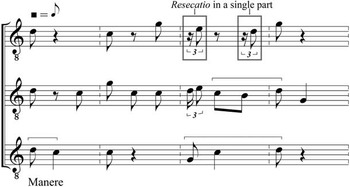
We move now to the St. Emmeram Anonymous, who, like Lambertus, also uses the word resecatio when speaking of the hocket. However, he restricts his use of the word to hockets that break the unit-values of the prevailing (Garlandian) mode; hockets without cutting up (‘sine resecatione’) are those that do not further subdivide them.Footnote 109 Six of his seven notated examples show ongoing alternation of sound and silence in two or more voices, but one has resecatio in a single part only.Footnote 110 I reproduce it as Example 2, where the first and third breves of the third bar (boxed) are broken by rests in the top part. Against it, the middle part shows no rests after its first bar, and though it continues to sound while the top part is silent, the two parts’ articulations do not interleave: it is the top part alone that carries the purpose of the example. St. Emmeram calls such a hocket imperfecta, ‘incomplete’. Certainly the hierarchy has been inverted, and one-voice hockets are understood to deviate from an interactive, multi-voice norm. But an imperfect hocket is a hocket nonetheless, and on St. Emmeram’s authority one-voice hockets should not be excluded from modern definitions. St. Emmeram also explicitly admits that hockets may be found in texted genres. He has much more to say about hocket than any other theorist of the thirteenth century (and indeed about everything else to do with measurable music). We will return to him in the next section.
The Anonymous of St. Emmeram’s example of an ‘incomplete’ hocket, transcribed from Munich, Bayerische Staatsbibliothek, Clm 14523, fol. 153v

The final theorist we shall consider, Franco of Cologne, introduces hocket in chapter 2 of the Ars cantus mensurabilis as the second of three divisions of discant: ‘Discant is divided like this: the one brought forth wholly [simpliciter]; another, truncated [truncatus], which is called hocket; and another, coupled, which is named copula.’Footnote 111 In chapter 13 (entirely concerned with hockets), Franco echoes Lambertus’s terms, writing that ‘truncation [truncatio] is song brought forth truncatedly [truncate prolatus] using direct and relinquished voices’,Footnote 112 where truncatio is synonymous with hocket outright.Footnote 113 Franco’s terms derive from the verb truncare, perhaps the most violent of the hocket words we have encountered. Continuous with Classical senses, the DMLBS Online defines it first as ‘to mutilate by chopping or lopping (w[ith] abl[ative] of part removed)’; combined with the noun capite, it means ‘to behead’; and used of animals, it means ‘to geld’.Footnote 114 Here, the term’s violence is turned on the performing voice itself, for cantus truncatus contrasts with discant simpliciter prolatus, or ‘brought forth wholly’, where simpliciter connotes oneness, an unbroken vocal continuity.
Only with Franco does the interleaving of sound and silence between the voices become part of the very definition of hocket:
Be it known that truncation can be made in as many manners as it happens that the long, breve, or semibreve may be divided [partiri]. The long is divisible in many ways: first into a long plus a breve, and a breve plus a long; and out of this is truncation made, or hocket, which is the same thing, in such a way that if in one [voice] the breve be relinquished, in the other [voice] the long [will be relinquished].Footnote 115
Since truncatio ‘can be made in as many manners as it happens that the long, breve, or semibreve may be divided’, hocket may manifest at the level of any figure; thus it may, once again, be very small indeed, as Franco goes on to specify, writing that the breve ‘is divisible into three semibreves or two; and out of this, hocket is sung, by relinquishing a semibreve in one [voice], and by bringing forth another in the other [voice]’.Footnote 116 But the parts in question are two voices of a larger texture. He writes:
And it must be noted that out of the said truncations vernacular hockets are sung, out of the relinquishing and also the bringing forth of longs and breves. And it must be noted that in all these things [i.e. all the kinds of note division already discussed, and all hockets] equivalence [equipollentia] in tempora must be observed, and concordance [concordantia] in direct voices. Moreover, let it be known that every truncation is to be founded upon a cantus prius factus; either a vernacular or Latin song is permissible [for this purpose].Footnote 117
It is with Franco that early theoretical definitions of the hocket align with that usually assumed by modern scholarship, and so it is with Franco that we draw this historical narrative to a close.
Let us review. Pitch repetitions and voice-exchanges abound in Parisian polyphony early in the thirteenth century, many alternating sound with silence – of that there is no question. Such effects were among the vocal techniques with which singers experimented when creating this new kind of polyphony.Footnote 118 With the foregoing analysis of the theoretical tradition, however, I argue that theorists do not first describe those other phenomena when they begin to describe the hocket. Rather, they begin by describing the sound of sudden silence in an individual voice, breaking and fracturing it, and in such a way that very small appearances count.Footnote 119 Theorists (which is not necessarily to say composers) began by construing hockets one voice at a time. At least up to the time of Lambertus, a theorist might well listen to, say, a discant setting in three parts whose upper voices exchanged in a mixture of sounds and silences, and identify the piece as a hocket; but he would, I suggest, describe it as several superimposed hockets.Footnote 120 If musicians of an earlier period had another word for that fuller texture, or recognised it as a category of its own, they have left no such evidence.Footnote 121
So our love-lorn narrator’s cries are back in, and to catch little hockets a fine-mesh net is required. I suggest that even a single texted note framed by interruption with silence is therefore a hocket, when it appears in an upper part of a motet.Footnote 122 To put this in terms developed by Mark Everist for the criticism of motets, hockets need not be ‘dominant’ among a motet’s ‘modes’ (that is, the elements of design a composer drew upon in a given piece) for a single use to count as a hocket nonetheless.Footnote 123 I therefore propose that some 138 motet texts from the Ars antiqua repertory be considered to contain hockets – or at least that they be spared dismissal for now, pending further analytical work. (They are listed in Appendix 2.) This figure represents a vast increase on previous tallies, but it is not in itself a mighty number: van der Werf indexes 1,229 motet texts,Footnote 124 of which our collection would represent only 11.2%. Admitting tiny hockets has not opened floodgates – probably a good sign that the device remains marked as such.
integration
As our consideration of Lambertus has already suggested, notions of breaking are not the whole story. To see how the alternative, more integrated view implied by Lambertus was developed, we must return to the St. Emmeram Anonymous.
Context is everything. St. Emmeram’s passage on hockets ends a defence of the six Garlandian modes against the nine proposed by Lambertus.Footnote 125 He reserves particular ire for Lambertus’s eighth and ninth modes, which use only semibreves: the eighth consists of pairs of unequal semibreves, and the ninth, groups of three equal ones.Footnote 126 To put things briefly: St. Emmeram finds Lambertus incoherent against a premise they supposedly share, that ‘a completed [or perfect; perfecta] melody cannot be made except by means of a completed mode, nor a perfect mode by means of imperfect figures or notes’.Footnote 127 But St. Emmeram has claimed that semibreves are ‘so called from semus, sema, semum, which is to say, imperfectus, imperfecta, imperfectum [i.e. incomplete] – as if they were incomplete breves’.Footnote 128 Because they are only parts and never wholes, semibreves alone cannot constitute a perfect mode.Footnote 129
Yet semibreves there were – long before the 1270s – and other rhythmic subtleties to boot: dismissing Lambertus does not dismiss these (and other) rhythmic phenomena which his theory accommodates. To outflank Lambertus, it becomes St. Emmeram’s implicit duty to explain how the six Garlandian modes can be perceived latently in pieces (such as those rife with semibreves) where they seem not to obtain. St. Emmeram tackles his problem by developing the inherited concepts of convenientia, ‘agreement’, and aequipollentia, or ‘equivalence’; and he then turns to hockets because it is they ‘through which every aequipollentia or convenientia of the figures … is perfectly distinguished and grasped [dignoscitur et habetur]’.Footnote 130 Hockets showcase these fundamental forces, so we must consider their meaning to St. Emmeram too.
Both convenientia and aequipollentia had already enjoyed long music-theoretical careers by the time St. Emmeram wrote his treatise, and there is no need here to write their philological history.Footnote 131 Suffice it for now to say that St. Emmeram’s use of each term is subtle and idiosyncratic, neither sanctioned by direct precedent in mensural theory nor employed in the same sense by subsequent thinkers.
St. Emmeram’s convenientia is an integrative property, a fact he announces with a topic statement whose Boethian citation likens a song governed by the convenientiae specierum, the ‘agreements of the modes’, to a body coordinated by four humours, or to the world governed by the elements.Footnote 132 St. Emmeram distinguishes two kinds of convenientia, not mutually exclusive, according to musical texture. One manifests in simultaneously sounding voices, the convenientia ‘of the same mode or of several modes, around several songs which press on to the same end’.Footnote 133 The other is the convenientia ‘of several modes, this agreement being commonly attributed to the completion of one song’.Footnote 134 One-voice convenientia primarily handles change of mode: the propensity of patterns characteristically associated with one mode to appear in a phrase primarily governed by another. St. Emmeram writes: ‘If [convenientia occurs] in one voice, note that those six species may by some agreement [per convenientiam aliquam] build a unique song according to the composer’s arrangement [of them] in relation to one another.’Footnote 135 St. Emmeram claims that the new modes of the stupefacti or ‘senseless people’ – that is, of Lambertus – are no more than such superficial supplementations of rhythmic values, poorly understood.Footnote 136 Meanwhile, convenientia between several voices concerns what we would call harmonic rhythm.Footnote 137 Any horizontal combination of modes is permissible, and almost any vertical one, ‘as long as the notes suitably cohere or accord [cohaerent seu conveniant] with the tenor of some mode placed properly [competenter] beneath it’, where the true, Garlandian mode may be discovered. Thus St. Emmeram’s use of convenientia combines newer rhythmic and older harmonic aspects.Footnote 138 It is a property of harmonious discantal motion in time.
We have already encountered aequipollentia in our examination of Lambertus, whose use of the term is very similar to that of St. Emmeram. For the latter, the quality proceeds from the properties of individual unit-values: aequipollentia is the force by which any combination of notes or rests may be placed for a larger value under the prevailing mode, provided they total the same number of tempora as the thing they replace.Footnote 139 The passage on aequipollentia is where St. Emmeram might look most like a theorist of division, for he illustrates the property by listing many substitutions equivalent to a long of three tempora.Footnote 140 Moreover, aequipollentia controls the placement of semibreves in hockets that show ‘cutting up’.Footnote 141 But St. Emmeram explicitly aims to defend a dictum he attributes to Garlandia, that ‘aequipollent things must be understood in all modes’, meaning that ‘if a long or a breve is not used, then in its place is accepted that which is found in the place of a breve or a long’.Footnote 142 Breves and longs, Garlandian modes, all the way. Aequipollentia permits the coordination and addition of the rhythmic things that build those modes. It integrates sounds that divide. Moreover, St. Emmeram retroactively calls his listing of equivalences a iudicium, a judgement, about the quantity of tempora in a simplex note (in a passage, interestingly enough, which specifies that examples which should be so judged are to be found as much in texted as in untexted hockets).Footnote 143 Aequipollentia permits a construal of musical sound that synthesises it rationally.
Woven through the passages is another principle, reductio or ‘reduction’, something convenientia and aequipollentia together enable.Footnote 144 Given the different modern connotations of the English cognate, it may be surprising to find that for St. Emmeram, reductio does not make smaller rhythmic values from larger: for that, the theorist will later use the terms conversio and diminutio.Footnote 145 Rather, reductio is a kind of construal: the term describes the cognitive action by which a varied musical surface (which remains unchanged in itself) is construed in a deeper unity with the Garlandian modes than it initially presents to the ear. For instance, having stated that discant ‘rules melodies by order’, a gloss to the word ordine clarifies that this is order ‘with regard to the reduction of the aequipollent things to a particular mode’.Footnote 146 St. Emmeram’s use of the term is true to its primary late Classical sense, current throughout the Middle Ages, as an ‘act of bringing back (to a proper or original position)’.Footnote 147 This is continuous in turn with the word’s root in the verb ducere, ‘to lead’.Footnote 148 Reductio is a synthesising mental action worked on a plural musical surface.
Reductio is also a kind of judgement, and it is the tenor which determines what the judging ear should hear. To revisit: ‘We indeed judge [iudicamus] such songs from the same mode as which the tenor is, because it is the more worthy part [dignior pars], for from it all the others draw their origin; it is determined [decernitur] to be the foundation to them.’Footnote 149 Here the legalistic verb decernere, to ‘determine’ or ‘to sentence’, tells us this action involves arbitration; while the verb iudicare (‘to judge’) and the worthiness imputed to the tenor (the judgement’s arbiter) imply ethics. To listen discerningly for the fundamentum is a cognitive right action, morally freighted.
It was, by the thirteenth century, an old requirement that auditors listen with reason, and that in failing to do so, they ceased fully to behave in a manner befitting humans rather than non-rational animals.Footnote 150 But St. Emmeram here refracts those older notions of rationality and active perception through the prism of a much more modern, Garlandian rhythmic theory, which is set as the standard of reason – an ingenious means of asserting the auctoritas of Garlandia’s text.Footnote 151 The moralising tone rings out loud when St. Emmeram inveighs against Lambertus. St. Emmeram’s argument, veiled but thinly, is that his antagonist has failed to listen deeply enough: in inventing new modes, Lambertus has neither captured the limitlessness of rhythmic possibilities available in current practice (so his theory fails even by its own standards), nor heard their underlying fidelity to Garlandian precepts. His hearing displays poor judgement, and compromises reason. That is why Lambertus is a stupefactus.Footnote 152
Having declared that hockets are the most magnificent demonstration of convenientia and aequipollentia, a crucial citation of Isidore both confirms St. Emmeram’s departure from the theoretical emphasis on the brokenness of hockets, and stamps a much more deeply historical seal of approval on his alternative way of understanding them. Let us return to a passage I quoted near the outset of this section, of which the full significance will now be more apparent:
that is to say about hockets, through which every aequipollentia or convenientia of the figures, and every kind and potency, and every knowledge, power, and nature of them is perfectly distinguished and grasped. And indeed this hocketation [hoquetatio] can by antonomasia be called harmony by us and by others. And note that ‘harmony’, as Isidore says, ‘is the modulation of the voice and the concord or fitting together of very many sounds’, which stirs and delights the minds of those listening to it, and inspires and instructs those who know and sing to understand and perform more perfectly, and put together easily, every genus of song.Footnote 153
In the passage of the Etymologiae St. Emmeram cites, Isidore discusses the harmonic division of music (divisio harmonica), not ‘harmony’ (harmonia), and in any case, harmonics concerned only matters of relative pitch in the voice: what we call ‘rhythm’ belonged to Isidore’s metrics (musica rhythmica).Footnote 154 Yet for St. Emmeram, harmony is the hocket’s essence. Antonomasia, then as now, is a rhetorical figure akin to metonymy, ‘the substitution of an epithet or appellative, or the name of an office or dignity, for a person’s proper name’.Footnote 155 In medieval usage, the adverb antonomastice could also mean ‘by specialized use’.Footnote 156 Used in antonomasia here, the word ‘harmony’ communicates that hocketation (like Lambertus, St. Emmeram uses the action-conveying term hoquetatio) is quintessentially a fitting together of the voice, not primarily in terms of pitch (though convenientia retains a discantal sense, as we have seen), but in time, one achieved through and instantiating convenientia and aequipollentia. And in an extension not in Isidore, St. Emmeram attributes to this hocket-harmony the power to ‘inspire and instruct those who know and sing to understand and perform more perfectly’. Yet again, the moral stakes are those of human reason; and the hocket is a musical medium through which reason can be honed.
St. Emmeram seems to anticipate that his intuition will surprise, for he speaks of the hocket as if sharing a secret with a lover:
Pay attention therefore, my beloved [mi dilecte] … that you take up those things which follow with the alert ear of desire [aure vigili uringinis suscipias], and put them peacefully in the little book-case of your heart, that something understood by few and reserved with respect not be divulged indiscriminately and now become worthless.Footnote 157
His secret? The hocket’s fragmentation is only superficial, for it is achieved by a deep integration of parts possible only when musical time is measured. That integration is available to understanding, but it is rightly perceived only with difficulty and effort: therein lie the hocket’s moral stakes. One must labour to listen with the ‘alert ear of desire’. Let us call this complementarity of breaking and integration the hocket’s dual character.
But let us acknowledge, too, that for all the pride with which St. Emmeram lays claim to the insight, it was not his. Lambertus got there earlier: calling hocket armonia resecata (a wonderful contradiction-in-terms), he had already captured the hocket’s duality of fragmentation and synthesis. St. Emmeram would explore it at much greater length, and undeniably lent it sharper theoretical definition than had Lambertus. But to use the hocket’s duality as a stick with which to beat him (as he did, as we have seen) was duplicitous. St. Emmeram must surely have known as much.
an early motet
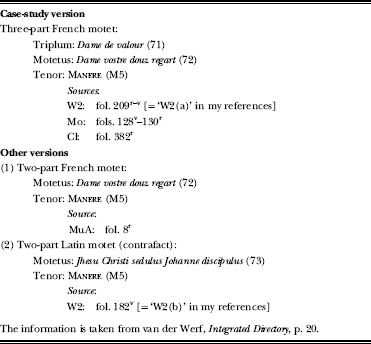
We have seen that the theoretical testimony about hockets clusters in texts whose circumstances of transmission before 1270 are only hazily visible to scholarship. However, many of the motets listed in Appendix 2 belong in family trees whose roots reach into the earliest written documents of Parisian polyphony – and perhaps beyond, to the lively culture of musical making and remaking in the decades around 1200 to which, as Susan Rankin has argued, some early anthology manuscripts stand as monuments.Footnote 158 Our case-study motet Dame de valour (71)/Dame vostre douz regart (72)/Manere (M5) is one such piece: though I take Mo as my copy source, the motet’s earliest witness (W2) was copied perhaps as early as the 1240s or 1250s (for the complete list of the motet’s sources see Table 1).Footnote 159 In the remainder of this article I will examine the piece closely, suggesting that motets themselves may be called as witnesses to the hocket’s semantic range and practical utility, supplementing the theorists’ accounts with earlier testimony. To be sure, motets may say as many things about hockets as there are pieces that use them; the hocket-motets on my list will need a longer hearing than this article alone can give them. But a generation of scholarship has given us powerful ways of listening to what early motets say,Footnote 160 and I move between several of them to interpret how this motet works, and how the hocket functions within it. If the significance of the hocket for the St. Emmeram Anonymous is best appreciated by considering its place in his idiosyncratic theoretical argument, I suggest that is true of the hocket in our motet too: that it is a carefully planned event in the motet’s idiosyncratic musical and poetic arguments.Footnote 161 Indeed, just as St. Emmeram’s argument is foundationally about correct listening, so, I contend, is the motet’s.
Dame de valour (71)/Dame vostre douz regart (72)/Manere (M5): network of witnesses

Some preliminaries. The score in Appendix 1 reports the musical witness of Mo, but supplies readings for verbal errors from the other witnesses listed in Table 1.Footnote 162 As that table shows, W2 preserves a two-part Latin motet, Jhesu Christi sedulus (73)/Manere (M5), whose motetus shares a melody with Dame vostre douz regart (72). However, both Ludwig then Anderson supposed the French motet came first,Footnote 163 a chronology my own philological analysis of the piece upholds,Footnote 164 so Jhesu Christi sedulus will not be considered further here. Ludwig thought the French two-part version transmitted in MuA (which has Dame vostre douz regart [72] / Manere [M5], but no triplum) was probably a reduction of a three-part original.Footnote 165 So closely do the upper voices of the larger version interact (something we will consider shortly) that I find this the most likely chronology too – though it might be suggested that the triplum Dame de valour (71) was composed as an augmentation and an interpretative response to the tenor and motetus, and that would be fine. Finally, the tenor Manere is drawn from the Gradual Exiit sermo V. Sed sic eum, sung at Mass on the Feast of St John the Evangelist (27 December).Footnote 166 The lucid structure of its setting as a tenor can be straightforwardly accounted for. All thirty-six notes of the chant’s melisma on ‘manere’ are used in the motet’s cursus, disposed into twelve three-note ordines in the rhythmic pattern BLB (Garlandia’s second mode). The entire cursus is stated twice.Footnote 167 In Appendix 1 the motet is laid out on two facing pages, with equivalent positions in each cursus placed opposite one another.
The tenor is also the source of our motet’s stance on listening, but to hear why requires deeper contemplation. Here is the text of the source chant:

The chant summarisesFootnote Footnote the point of a longer gospel passage, John 21:20–3.Footnote 170 Peter, walking with Jesus, sees John behind them and asks, ‘“Lord, what shall this man do?”’Footnote 171 (verse 21). Jesus replies: ‘“So I will have him to remain [sic eum volo manere] till I come, what is it to thee? Follow thou me”’Footnote 172 (verse 22). Not without reason, the disciples are confused. As the Evangelist relates:
[23.] This saying therefore went abroad [exiit ergo sermo iste] among the brethren, that that disciple should not die [non moritur]. And Jesus did not say to him that that disciple should not die [quod discipulus ille non moritur]; but, ‘So I will have him to remain [manere] till I come, what is it to thee?’Footnote 173
The passage constitutes a study in faithful versus casual repetition of messages received, and a lesson in disambiguation. The disciples’ confusion becomes a sermo (which among several definitions means ‘remark, saying, utterance’ or ‘talk’; ‘account’Footnote 174 ) that enters into circulation as a faulty rumour at the start of verse 23, to be stamped out quickly before the same verse ends; it is contrasted retroactively (in verse 24) with the verum testimonium (the true ‘attestation’ or ‘testimony’) of John’s witness.Footnote 175 Notice the careful syntax of the passage. By taking sermo itself as the grammatical subject (verse 23) the Evangelist tactfully skirts over who, precisely, is at fault for this gossip-mongering; the sermo becomes an impersonal sort of speech, spoken by several people but owned by none. Complementarily, he encases the rumour’s content, ‘non moritur’, in an indirect-speech construction (introduced with quod yet with a finite verb in the indicative, as usual in the VulgateFootnote 176 ), as if not wanting to utter the sermo (except to refute it, as he does next) lest that fuel its flight, or compromise the authority of his voice. Its syntactic muffling sharpens the imagined sound of ‘manere’: a word spoken by Christ, re-envoiced by the Evangelist twice over, the second iteration an emphatic contradiction to the nonsense of ‘non moritur’. The point, of course, is to demonstrate that John is a transparent and reliable medium for a divine message. And the translation brilliantly distils the whole process – both the corruption into error and its correction – into a property of linguistic sound: whatever Aramaic words Jesus spoke, their rendering in Latin (via Greek) makes ‘moritur’ and ‘manere’ seem the source of the confusion, as if someone failed quite to catch a three-syllable word starting with ‘m’, and took a guess at it incorrectly before passing the message on. At the root of the problem lies faulty listening, and that is the error the second and emphatic ‘manere’ – the one quoted in the chant, and taken as our motet’s tenor – seeks to put right.
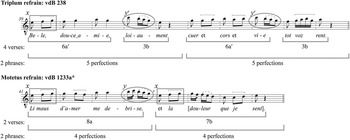
Insofar as our French motet makes no reference to John the Evangelist, our poet-composer ignored the chant’s festal context. But he listened to its scriptural context very closely indeed, crafting in response to it a motet whose upper voices playfully meditate on sayings that travel inaccurately or in variant forms. The point of connection is the word sermo. Both in general and in the specific manner in which it is handled in the gospel text, it makes an apt Latin counterpart to what we call the ‘refrain’,Footnote 177 and which thirteenth-century people often called a ‘motet’.Footnote 178 Our polyphonic motet concludes with two refrains, one in each upper voice, both unica. In the most recent census (by Anne Ibos-Augé and Mark Everist) the motetus’s refrain (bb. 41–8 in Appendix 1) is indexed as ‘vdB 1233a*’,Footnote 179 and the triplum’s (bb. 39–48) as ‘vdB 238’.Footnote 180 I use those numbers for reference from here on.Footnote 181 Example 3 places them in parallel. I give their texts again here, now with versification markers that relate them to one another (rather than relating each to the rhyme-scheme of its motet voice):Footnote 182
Comparative analysis of the refrains vdB 238 and vdB 1233a*

Triplum refrain: vdB 238

Motetus refrain: vdB 1233a*

The refrains’ most striking feature is the degree to which they share phonetic and melodic materials, and then lend them to the voice-parts onto which they are ‘grafted’.Footnote 183 Ironically, Mo’s text scribe confused the two refrains, though he recognised his error;Footnote 184 but his mistake points out how alike they sound. Each consists of two musical phrases.Footnote 185 In vdB 1233a*, each phrase sets one poetic verse, giving the structure 8a+7b, while each phrase of vdB 238 sets two, producing the structure (6a′+3b) + (6a′+3b). Moreover, the two refrains share their b-rhyme (-ent), while – significantly – their disyllabic a-rhymes are almost but not quite the same too (-ise in vdB 1233a*, -ie in vdB 238). In this detail is a nod to the scriptural source: via an imperfect reproduction of the refrains’ rhyme contrast, something of the sound of one is captured and repeated by the other (twice over, in the case of vdB 238), like manere transformed into moritur and going out among the disciples.Footnote 186 And as in their rhymes, so in the refrains’ melodies. Their first phrases each begin with the tag e′f′g′ [BBB] (which I label x); each articulates a′ at the start of its third perfection (with a pitch repetition, a′a′ [BL], in vdB 1233a*); and each shares a common registral goal of c″, marking it with a motif that involves semibreves in fractio modi. Again, this significant motif is almost but not quite the same in each part. I label the version heard in vdB 1233a* y, and the version in vdB 238 y′. Both variants use b′a′g′ [SSB] in the place of the underlying second-mode long; but y also fractures the preceding breve into two semibreves, b′c″ [SS], whereas y′ lands directly on the goal pitch c″ [B].
Each refrain’s second phrase then works a different formal ‘outcome’ from the musical stimuli their first phrases share. In vdB 1233a*, the start of the second phrase is rhymed with its first by a repetition of its melodic opening, motif x;Footnote 187 chiasmatically, the second phrase of vdB 238 is rhymed with its first by use of its melodic goal, motif y′.Footnote 188 Other reminiscences and relations could be pointed out (the sequential use of the contour of x in each phrase of vdB 238, for example). But the formal chiasmus traced by their exact internal repetitions is an especially artful contrivance, and suggests both refrains bear the marks of ad casum formal shaping. Either one refrain served as the model for the other, or both were composed from the same stuff in the making of this motet.Footnote 189 In either scenario, the refrains might also borrow from a shared stock of citational formulae, rigging them across the different frames of their texts.
But we would not need to find citations beyond this motet to admit readily that the material of the refrains does citational work within it. Ardis Butterfield has observed that refrain citations show ‘a tendency towards instability, since there is a large degree of small-scale variation, yet also towards stability, since these very slightly distinctive features are often themselves repeated exactly’.Footnote 190 It is precisely this contradiction upon which our motet plays, one brought to awareness and subjectivated as a response to the motet’s tenor. For the refrains are sculpted and positioned to do in performance what Suzannah Clark has called ‘intersonic’ work:Footnote 191 vdB 238 begins at bar 39, and, introduced by an extra use of y in the motetus at bar 40, vdB 1233a* starts at bar 41, with the result that the y and then y′ motifs echo one another between the parts with a regular periodicity of two perfections,Footnote 192 their likeness and contrast on audible display at the top of the texture.
Moreover, elements of the refrains both accurate and distorted ring throughout the motet, with the effect of variations heard before a theme whose identity they put in question: they play a game called ‘What will my refrain be?’ – and perhaps, when we get two, a game called ‘Which, if either, is the true one?’Footnote 193 The score in Appendix 1 marks all iterations of the refrain motifs y and y′ in ovals, while two kinds of dashed boxes highlight two further figurations that are kin with them (in that all place fractiones for the second-mode long which carry intersonic calls between the parts).Footnote 194 Especially using this set of figurations, the two singers play at call-and-response, now repeating one another exactly, now inexactly, sometimes with regular periodicity, sometimes as an unpredicted interruption. (Arrows between boxes trace citational pathways between the voices that the ear might follow when listening to the piece.) For example, the motetus’s descending g′f′e′d′c′ [SSSSB] figure in bar 7 is repeated by the triplum in bar 9, inaugurating a chain of imperfect fractio replies at two-perfection intervals: the motetus’s y′ at bar 11, then the triplum’s high a′b′a′ [SSB] turning motif at bar 13. That figure is then repeated precisely by the triplum in bar 16 at the longer interval of 3P, only to be exactly parroted with interruptive force one perfection later by the motetus at bar 17,Footnote 195 which is answered by the triplum’s y′ at bar 18. This is all the more comic in that their texts give little sign that the two narrators hear one another, and neither part consistently follows the other’s lead. Rather, they repeat musical messages as if unaware of their origins. As the motet unfolds, then, we hear the refrains’ variant bits – like so many little sermones – disseminate like rumour. Heard this way, the motet models in miniature the world of indeterminate circulation through which refrains in general turned, and in which a message sent might or might not be the message received.
It is little wonder their songs have so much in common. The narrator of the triplum has been wounded by the Lady’s loving look too. Though we have to wait until his tenth verse for a verb (‘a … navré’, ‘has wounded’) for clarification, the triplum’s music implies it as early as bar 4, for he sings the word ‘regart’ to a descending semibreve figure that echoes inexactly the figure his friend has just sung to the same word in bar 3.Footnote 196 Yet from their common point of narrative departure (notice they sing the word Dame simultaneously in the motet’s first bar), they bring about very different songs: the motetus adopts the stance of a complaint, while the triplum would seem to make a lover’s overture in the manner of the ‘High Style’ trouvère song.Footnote 197 Indeed, we are invited to take what separates the narrators as an alternative object of listening over the first seven perfections, in which are heard two statements of y′ in the triplum (bb. 1 and 4, the second transposed to start on g′), and two of a fractio variant that descends from g′ to c′ in the motetus (bb. 3 and 7, in dotted rectangles in Appendix 1). Each figure articulates a phraseological parallel within its own part: y′ links the openings of the triplum’s first two phrases (bb. 1–31 and bb. 4–61); the repeated figuration in the motetus rhymes the third perfections of that part’s first two phrases (bb. 1–43 and bb. 5–81). But the two parts phrase with different periodicities, and the inexact echo linking the word ‘regart’ in each part at bars 3 and 4 heightens that contrast, tempting the ear to follow the citational prompt across the texture rather than to follow how the figurations build up shapes in each part over time. That is a choice the piece makes available again and again – one akin to the challenge laid down by motets that, as Emma Dillon has so elegantly revealed, veil prayer texts in the ‘supermusical’ effect of polytextuality so as both to tempt the mind to wander and to increase the value of contemplation when concentration on the prayer is sustained.Footnote 198 So, let us now choose to follow this other path, and pursue the argument each part constructs from its musical matter, beginning with the motetus.
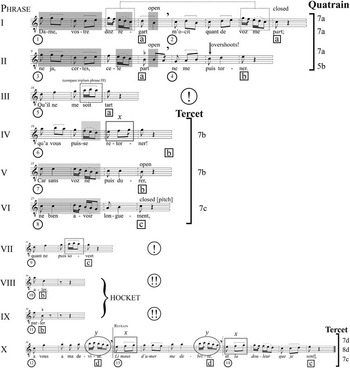
The motetus’s vocal failure is still more terrible a breakdown for the way it is prepared over a longer range – something which can be detected when we consider how the musical phraseology and figuration handle the verse units. To make those relations clearer to the eye, Example 4 presents an analytical transcription of the motetus. Musical lines are divided wherever there is a notated rest in the part, the resulting phrases given Roman numerals at the left margin.Footnote 199 Beneath them, verse numbers are given in circles, rhyme designations in squares.Footnote 200
Analytical transcription of the motetus Dame vostre douz regart (72), from Mo

Our poet-composer knows the devices that a trouvère might deploy to give shape to his song in time, and uses them to set up a representational gambit: the narrator is trying to sing a stanza of ten verses, but he cannot keep his vocal composure.Footnote 201 The stanza’s constituent components are marked with vertical square brackets, and they segment first by rhyme and musical phrase: a quatrain rhyming aaab, and two tercets rhyming bbc and ddc.Footnote 202 They are made shapely by other parameters of musical design too. Thus the quatrain of verses 1–4 is handled melodically as two pairs of verses, each pair set to one phrase. Phrase I sets up an open/closed pitch structure contrasting b with c′ as the goals of verses 1 and 2, while phrase II (verses 3 and 4) repeats the pitches from the opening of phrase I. (Parallel repetitions of material are shaded in Example 4.) Phrases IV through VI set the first tercet, which is organised by phrase length, by the metrically parallel use of transposed figure-repetitions (shaded in Example 4), and concluded by the open–closed relationship of phrases V and VI. The final tercet of verses 12–14, all set in phrase X, is especially nimble. The composer prepares the fractio figure y that will be heard at the end of verse 13 (the first verse of the refrain) by using it at the end of verse 12 too, thus making palpably audible the tercet’s ddc rhyme structure.
Now the interruptions. Things start to go awry near the end of phrase II: hitting c′ on the penultimate perfection, the narrator overshoots the tonal mark, finishing the phrase at e′ with the motion c′d′e′. It is as if worry were showing in his voice, through the song he sings.Footnote 203 At phrase III, the worry causes an outburst: ‘Let it not be too late for me/to be able to return to you!’ he cries out – using, in a comic touch, a fractio motif a′b′a′ [SSB] that the triplum sang only one perfection earlier.Footnote 204 He recovers his nerve long enough to sing the second tercet. But in phrase VII, just as he starts to explain why he is so upset, the melody tells us he is crying out again, for it repeats the distressed phrase III exactly. So when the hocket comes in phrase VIII, it interrupts an interruption, and is framed by a progressive logic that breaks a song apart along its fault-lines.
Something snaps the narrator out of it in time to bring off his last tercet; we may well wonder what. More about that shortly. In the meantime, notice that, just as nimbly, the piece comes to a close with a decorated version of the c′d′e′ tag (we can think it a transposition of x) that finished phrase II. Under the representational conditions set up earlier, the tag showed the narrator’s voice wandering off the song’s path. When it reappears at the end, it rhymes the end of the opening quatrain with the end of the piece. It is as if the composer has changed the map adaptively, and found for his song a suitable close in spite of its singer.Footnote 205 The song’s shapeliness is recuperated, but only at the last, and by cunning.
At least, when one considers the motetus alone. In fact, composerly skill is announced earlier, by a collaboration of the voices. Let us now look at the triplum’s poem (see the text and translation in Appendix 1). In its lexicon of topoi, it is akin to the motetus, and, as we know, it is also about the Lady and her look. At the outset, it shares the motetus’s uncertain temporality: the first nine verses are verbless, and simply describe the Lady by adding bodily and emotive features paratactically. Only when verse 10 gives us a verb in the present perfect (‘a … navré’) do we learn that what might have been thought a lengthy apostrophe in the present tense is in fact an ekphrasis of a Lady who ‘has wounded’ the narrator in the past. Here the descriptive spell seems to end, and this narrator, too, seems to lament: ‘powerless, what can it do?’ he asks ‘Thus I cry when I feel this: Beautiful, sweet sweetheart,/loyally/heart and body and life/I render entirely to you!’ (verses 14–17).Footnote 206 He might seem as powerless as the motetus.
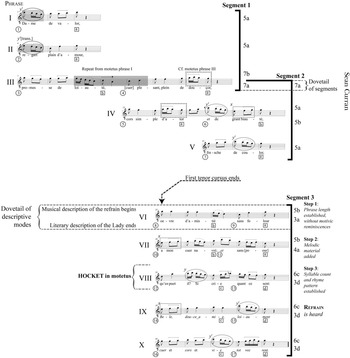
But the design of the triplum he sings is very different indeed from that of the motetus: this narrator’s music tells us he is not as helpless as he lets on. In fact, he is a skilled song-maker, and a protean one, capable not just of building forms, but of transforming them. Example 5 is an analytical transcription of the triplum, once again setting it out according to its musical phrases, dividing lines wherever there is a notated rest. Three little song segments are projected by the voice-part (marked on the diagram with vertical brackets to their right). The third and most substantial (comprising phrases VI to X) leaps off the page, each of its phrases lasting five perfections and setting two verses. Arguing for the significance of the moment when segment 3 begins is its alignment with an important moment of structure in the tenor: the first note of the triplum’s segment 3 begins on the final note of the tenor’s first cursus (b. 241) – as close an alignment as possible under the phraseological conceit being set up in the triplum, which we will examine in a moment.
Analytical transcription of the triplum Dame de valour (71), from Mo

The demarcation of the first two, smaller segments is subtler. Both are quatrains articulated by the rhyme structure aaba; but they dovetail too, so that the last verse of segment 1 (which comprises verses 1–4) is also the first verse of segment 2 (4–7).Footnote 207 Again, other parameters of melodic design create patterns within each segment. Thus in segment 1, phrases I and II (each setting a single verse) are marked as a couplet through parallel figuration derived from the refrain (shaded in the example); and the long phrase III answers them, setting the couplet of verses 3 and 4, and marking it further with a repetition from phrase I of the motetus. Segment 2 has a very similar shape: verses 4 and 5 have rhyming cadence figures (see the dashed boxes in the diagram), to which verses 6 and 7 serve as an answering couplet projected through the symmetrical use of refrain-derived motifs.
Thus the singer can build forms. But the dovetailing signals that he can transform them too, for he inaugurates the second segment by reinterpreting the final cadence of the first as the start of a new pattern, as if morphing one segment into the next. It is significant that this is done with the same a′b′a′ melodic tag with which the motetus will cry out in despair and to disruptive effect: the intersonic echo between the parts directly contrasts the form-building prowess of one singer with the poor composure of the other.
From a formal perspective, the third segment is the triplum’s most shapely; yet, in apparent contradiction with its textual narrative, its second phrase (phrase VII, with the words ‘a mon cuer navré’), is where the narrator starts to speak of his wounding, his helpless undoing by love. But his claim is a red herring. In another dovetailing, the ekphrastic mode continues, having already passed from an imagistic to a formal kind of description, as structural properties of the refrain are added in three steps. Phrase VI describes the refrain’s phrase length; phrase VII uses the refrain’s calling-card opening motif x to intimate what will come; and phrase VIII establishes its syllable count and rhyme (see the annotations in Example 5). By now, all its other formal parameters are there; all that remains is for the refrain to sound with its melody, as if to fill a formed body with spirit at the powerful narrator’s command. No possessive adjectives qualify the heart, body, and life the narrator gives: he is giving a heart, a body, a life, but they are not his own. As the refrain is heard, the music reveals the answer to the poetry’s question. What can one do in the face of such feeling? One can compose.Footnote 208 The triplum’s narrator is a musical Pygmalion, and step by step, he has rendered the lady as a song.Footnote 209
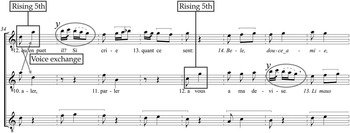
There is a final twist. The narrator attains the height of his form-building power in phrase VIII; and it is at that very moment that the motetus shatters into (carefully prepared) formlessness. The interpretative dilation is knowing, marked by a collaboration of the voices at bar 34, in which each inverts the other’s fifth in contrary motion, a′–d′ in the motetus, d′–a′ in the triplum (see Example 6). The effect is to amplify the motetus’s hocket by drawing on the fund of stylistic devices that were often deployed alongside sudden silence in a single part. Those who want pitch repetition and voice-exchange with their hockets will be satisfied. For a moment, the two developing formal logics reach maximum rupture and maximum logic, all at once. It is just then that the parts take stock of one another. That is what the hocket marks, in a bravura flourish of its dual character. If he heard the piece, and understood it, St. Emmeram would have been thrilled.
Dame de valour (71) / Dame vostre douz regart (72) / Manere (M5), perfections 34–41, transcribed from Mo, fols. 129v–130r

hearing the hocket’s dual character
I suggest, then, that our composer also knew the hocket’s dual character – its balance of broken sound and integrative planning – and turned to it as a creative resource. In so doing, the hocket was made to say something about the motet; and, complementarily, the motet says something about hockets. There are several reasons why this is important, and we should consider them before ending.
First, the chronology of the motet’s sources is such that this creative flourish of dual character was probably composed before hockets were subject to the rationalised processing of the theorists, and certainly long before St. Emmeram’s brilliantly idiosyncratic account – perhaps by as many as thirty or even forty years.Footnote 210 What becomes formalised in later theory, I suggest, seems to have begun in musicopoetic exploration. As composers explored what words went well with hockets – and, more generally, with the measured music in the styles originating in the Parisian organa – their opportunities were not only technical (‘What sort of rhyme patterns can I build with phrases like these?’ or, ‘How can I match this Latin versification scheme with a new one in French?’ and so on); they were also semantic (‘To what ideas, pictures, affects or actions can this musical device lend itself?’ or, ‘What musical device will work well with this idea?’). We have suspected for some time that theorists and scribes of the mid- and late thirteenth century played their part in archiving, shaping and repackaging the styles of music heard around 1200 at Notre Dame, and that the music was transformed as well as transmitted by their mediation.Footnote 211 The case of our motet suggests that to play with texts, and with their delineation in notes, was for poet-composers a similarly mediating activity, which made possible new ways to understand the older musical styles with which they worked. Their musicopoetic work was ‘theoretical’ too, in this more expansive and pragmatic conception of the term;Footnote 212 and doubtless it would have been part of a feedback loop that informed composition in newer styles. From that perspective, the mensural treatises of the later century would be works of criticism as well as of theory; for perhaps St. Emmeram’s insight about the hocket was inspired by pieces like Dame vostre douz regart.
Hockets often serve to point out moments of formal significance in the motet of the fourteenth century. Anna Zayaruznaya has treated several such pieces in her recent study, finding the hocket important among devices for making audible the seams and junctures of the units that build a motet’s form.Footnote 213 The hocket in our motet, too, occurs at an important moment of design – and indeed, one not to do with the tenor structure, but (as in the cases that most interest ZayaruznayaFootnote 214 ) with the structures of the upper parts. Thus it reminds us of deeper thirteenth-century roots to the hocket’s later function.Footnote 215 But how to characterise the hocket’s role here? ‘Formal’ seems not quite right, given prevalent notions of musical form that entail repetition. This hocket is not in itself repeated; and the collaborative work across the parts that augments it does not seem to cut the motet as a whole into an uneven bipartite ‘shape’ (though it does serve to mark off, and thus perhaps to draw attention to, the citation of the refrains). Rather, it occurs in a moment of reciprocity at which the parts arrive as, each following its own course, their individual patterns emerge and change in time.Footnote 216 For this fleeting passage, the varied parts conspire to reveal a unity of purpose before going on their own ways again, inviting a ‘monaural’ listening stance.Footnote 217 The moment reveals that the voices have been purposive all along, a sign that they have indeed been formed.Footnote 218
We arrive at the inevitable question: can the hocket’s significance be heard, or only known? Substitute the word ‘motet’ for ‘hocket’ in that formulation, and the question sums up the motivating concern of very much productive scholarship in the last thirty years. I suggest that what we have heard as a historiographical problem was for our composer yet another creative opportunity: that his motet asks precisely the questions about the audibility of form and of meaning that we have asked, and does so with its hocket. Perhaps the most salient property of the passage (bb. 34–8) is the sudden reduction to an unadorned dyadic texture, the three parts contrived to yield the effect of two by staggering phrases and doubling pitches; set off from what has come before by the motet’s only silence shared by all parts, the passage bears the hallmarks of sonic transparency. But its sense is opaque unless prepared by a herculean effort of will to sustain the operation of reason (a difficulty germane to hockets and intensified by polytextuality),Footnote 219 as the ear battles against perceptual odds to follow the designs taking shape in each texted part through the cloud of intersonic echoes.Footnote 220 This duality of clarity and staggering difficulty, too, is surely contrived. If such a hearing is possible – and perhaps it is not – one would have to listen with the willing ears of a St. Emmeram – and perhaps that is the point.Footnote 221
All this, of course, is another apt response to the scene of disambiguation referenced by the tenor’s chant, where erroneous listening is also corrected. In this sense, too, listening hard to the hocket leads the mind back to the fundamentum of its tenor.
Thus our motet composer knows an opinion about the ethics of listening with active attention that anticipates St. Emmeram’s. The motet, meanwhile, would seem to anticipate some recent thinking on the value of being present to artistic experience, to its liveness and ephemerality – work stimulated by Carolyn Abbate’s stirring invitation to a (scholarly, listening, ethical) practice ‘that at its most radical allows an actual live performance (and not a recording, even of a live performance) to become an object of absorption’.Footnote 222 In Abbate’s account, listening for a piece’s formal features represents an intrusion of a ‘gnostic’ attitude into a time over which the ‘drastic’ better presides.Footnote 223 My account of Dame de valour (71)/Dame vostre douz regart (72)/Manere (M5) is offered as a grateful acknowledgement of that work from another wing of the discipline. It is also offered as another quiet reminder that debates about the relative roles of the intellect and the sensorium in correct and ethical musical perception have a very deep historical lineage indeed, far deeper even than the thirteenth century of the common era.Footnote 224 More, active cognitive labour and affective openness to the ephemeral are complementary in our motet’s casting, not in contest. And if we are to give its ideas their historical due, we must inevitably engage with notated texts, and largely in the absence of the music’s sonic force. For thirteenth-century motets (among many other medieval and early-modern genres) are seldom performed, and who knows whether our modern experiments approximate medieval sounds?Footnote 225
To be quite clear: this is a historiographical intervention, not a philosophical one; I am giving no sermon. To point out that our motet voices a position on musical ethics is not to endorse that position. Indeed, neither need all listeners of the thirteenth century have endorsed it. Whether or to what extent the motet’s advocated brand of close listening has facts of social history on its side is hardly clear.Footnote 226 We are far from certain knowledge about social settings, uses and listening practices for this music, although the surest sign that they were manifold is the variety of kinds of manuscript into which they were copied.Footnote 227 There were, and remain, many ways to hear the motet.
So though I do not agree with St. Emmeram that it will make me (or anyone else) a better person to listen so laboriously, I do enjoy the way our motet’s narrators make their point, and so I will give them the final word. I suspect they would accord with St. Emmeram’s opinion, for theirs is a story about listening and transformation too – one not necessarily unserious for being short and told in a playful manner. At bar 34, where the upper parts invert one another’s pitches, they use the widest melodic interval (a fifth) heard in either part. However, the two a′/d′ dyads that sound cannot have been alike in quality, for they result from quite opposed scripts for vocal action.Footnote 228 As the motetus traces an anguished sigh that falls off into nothing, not knowing how he can go on, the triplum rises to the heights with hortatory force to suggest a course of action. At last the narrators hear one another with understanding, and the effect is wondrous. In bar 35, the motetus’s silence gives him time to listen, and the triplum sings just this one time the version of motif y from which the motetus’s refrain will be formed.Footnote 229 Picking him up from despair, the triplum teaches his friend how to correct his folly, and finish his song. Inspired and brave, the motetus steadies his voice, and embarks on his final tercet.Footnote 230 Trinity College, Cambridge
APPENDIX 1
Motet Dame de valour (71)/Dame vostre douz regart (72)/Manere (M5)
The motet has been transcribed from Mo, fols. 128v–130r, and its texts translated afresh. Previous editions include: Rokseth, Polyphonies du XIII e siècle, ii, pp. 183–5 (which, barred in 3/8, most closely matches my own); Motets of the Manuscript La Clayette, ed. Anderson with Close, pp. 41–2; and The Montpellier Codex, ed. Tischler, part II, Fascicles 3, 4, and 5, pp. 91–2. A further edition and translation of the texts is R. E. Smith, French Double and Triple Motets in the Montpellier Manuscript: Textual Edition, Translation and Commentary (Wissenschaftliche Abhandlungen/Musicological Studies, 68; Ottawa, 1997), pp. 135–6. Words supplied from another manuscript in correction of an error are placed in square brackets, and explained in a comment below. Mo’s musical readings have been upheld, and variants have not been listed separately; for a parallel transcription of all versions and sources, see The Earliest Motets (to circa 1270), ed. Tischler, no. 142, ii, pp. 957–62 (transcription) and iii, p. 139 (commentary). However, where variants might arguably affect the analysis offered in the present article, I address them directly, either in the prose or the notes.
Here as throughout, a long of three tempora is transcribed with a dotted crotchet; a long of two tempora and the brevis altera with a crotchet. Semibreves are transcribed with equal quavers, either as a duplet (when two semibreves divide a breve) or triplet (when three do so). Accidentals have been suggested in order to perfect diminished fifths or augmented fourths between the tenor and an upper part, though not when such intervals appear between the upper voices. I suggest accidentals sparingly, because it seems likely that the different accidentals reported across the sources stem from changing conceptions of the motet’s counterpoint over the course of the thirteenth century;Footnote 231 tampering with them in this transcription (especially when my analysis is largely unconcerned with matters of discant or counterpoint) might obscure rather than clarify historically revealing details.
Although unaccented terminal -e may not have been sounded in spoken Old French, it is handled as a syllable by composers (when not elided with a following vowel), its pitches written with their own figure by scribes. Thus I include it in my syllable counts, even though editorial convention for Old French texts would usually omit it. E.g., I count verse 13 of Dame vostre douz regart as 8 syllables, rather than notating it 7′. For discussing this issue with me, and for their comments on my translation of the French text, I am grateful to Bill Burgwinkle, Irène Fabry-Tehranchi and Jane Gilbert. Any errors are my own. I follow the editorial convention of italicising refrain texts. Spellings in the witness of Mo are preserved, though u/v and i/j have been modernised and abbreviations expanded in italics (or in Roman, where they fall within a refrain), and diacritics and punctuation have been added.

Comments on textual errors:
Triplum:


APPENDIX 2
A Handlist of Ars antiqua Motet Texts containing Hockets
This handlist comprises all motet texts with hockets that I have found in the major manuscript collections of thirteenth-century motets indexed in van der Werf, Integrated Directory. To appear on the list, a piece must show at least one use of a single note, or a group of two notes, set off by silence in the texted voice.
The primary purpose of the list is to guide readers to specific examples of the small kind of hocket whose significance I have asserted in this article. A second purpose is to indicate something of the distribution of the device across the sources. Out of necessity, the search has been conducted on the basis of modern editions. However, this entails problems. Editorial policies with regard to notational strokes vary, as indeed do the meanings of strokes for scribes: they may signal rests, or merely serve as marks of division or alignment between metrical units and voices. Two sources of the ‘same’ motet may vary too, producing a hocket in one but not in the other. A particular hurdle is Tischler’s choice, in The Earliest Motets, to present all witnesses of a piece and all contrafact texts in abbreviated parallel transcriptions. Moreover, although Tischler groups pieces by manuscript repertory, a motet is placed in a given manuscript’s portion of the edition only if it does not share any material with a piece in an earlier source. Thus for the major collections of Ma, W2, MuA, R and N, it is impossible to give a comprehensive view of hockets in each repertory. It is likely that further hockets (or further sources of the listed hockets) will be found should more reliable editions be created, and I will welcome suggestions for further inclusions – and indeed, debate as to which hockets should be rejected.
Column 1: The source for the tenor, by its number in van der Werf, Integrated Directory. Unidentified tenors are marked ‘UI’; tenors with French incipits ‘Fr.’; and tenors with no designation ‘ND’.
Column 2: The tenor incipit, standardised to the version given in van der Werf, Integrated Directory.
Column 3: The motet’s number in van der Werf, Integrated Directory.
Column 4: The motet’s incipit.
Column 5: Any contrafacta (that is, texts sharing the same melody), cross-referenced by their numbers in van der Werf, Integrated Directory. Most have an entry in the handlist in their own right; though where a contrafactum listed in column 5 does not have a hocket in its own source(s), it is not indexed separately.
The remaining columns report the location of the hocket in the five major editions that have been consulted. Arranged roughly in chronological order of their repertory, the editions are as follows:
Column 6: The Earliest Motets (containing the repertories of F, Ma, W2, MuA, N and R, among others). Nos. 209–42 of this edition present pieces from Cl, and were not consulted, because they are presented complete in the more accessible edition by Anderson. A siglum in parentheses reports the earliest manuscript in which the hocket was detected.
Column 7: Motets of the Manuscript La Clayette, ed. Anderson (Cl).
Column 8: The Montpellier Codex, ed. Tischler (Mo).
Column 9: Compositions of the Bamberg Manuscript, ed. Anderson (Ba).
Column 10: Les ‘Motets Wallons’ du manuscrit de Turin: Vari 42, ed. Auda (Tu).
The motet’s number in each edition is given in boldface; following the colon are the bar numbers where hockets are found. When more than three hockets are present, numbers are replaced with ‘Ext’ for ‘extensive’; the reader should be able to find the hockets easily in those motets.