Introduction
Children with a tracheostomy are a diverse group of patients. Some require a tracheostomy as a result of a syndrome or sequence causing airway problems; others may have been born prematurely (less than 37 weeks gestational age), or require prolonged ventilation for an acquired indication such as trauma or infection that has caused a decreased level of consciousness. Conditions associated with airway problems include Pierre Robin sequence, cleft palate and haemangioma. Neurological disorders, most commonly cerebral palsy, may also require tracheostomy for airway and ventilation management.
Our approach to managing this diverse group of patients involves a multidisciplinary team (MDT) consisting of a paediatric otolaryngology consultant, a paediatric respiratory physician, a tracheostomy nurse specialist and a speech and language therapist. The MDT tracheostomy clinic began in February 2009 and is held once a month. Our team meets the child and carers in the out-patients' clinic, with the aim of tackling surgical and medical problems in one appointment. This approach has enabled us to be proactive in the management of tracheostomy-related issues such as emergency tube changes, recurrent chest infections, thick secretions, vocalisation and decannulation. The unified approach also empowers the carers and patient, as a home management plan, long-term plan and goals are generated at the end of each appointment. We have found that one visit is time-efficient for the patient, their carers and the clinical team and is more convenient for the patient.
Prior to the establishment of the MDT tracheostomy clinic, the follow up of children with a tracheostomy was variable; a child may have been followed up by either ENT or respiratory specialties, by neither specialty, or by both specialties but at separate appointments.
In order to generate the tracheostomy clinic patient list, children with a tracheostomy were identified from a number of resources (including tracheostomy tube purchase orders and operating theatre and clinic lists) by our tracheostomy nurse specialist. Children who had a tracheostomy placed after the tracheostomy clinic was established were automatically followed up in the clinic. The current clinic arrangement facilitates communication between specialties and allied healthcare professionals and allows us to quickly disseminate information or new therapies to the group (such as when a manufacturer withdraws or changes their tube style).
Materials and methods
A retrospective case note review was conducted of all children seen in the MDT tracheostomy clinic between February 2009 and September 2014. Data were analysed to determine the current underlying indications for tracheostomy and the number of tracheostomy-related issues managed per clinic appointment.
Results
The MDT tracheostomy clinic began in February 2009 and is held once a month. Between February 2009 and September 2014, 97 different patients were seen in 239 out-patient appointments. The male to female ratio was 3:2, with an age (at first visit) ranging from 2 months to 16 years and 1 month (Figure 1).
Age of patients at first clinic visit.

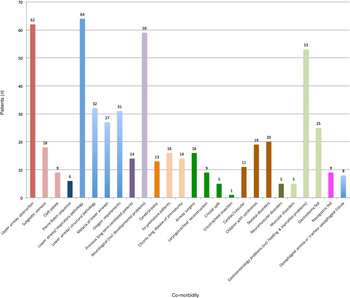
Many children with a tracheostomy have a number of other co-morbidities and each problem is reviewed at the clinic. The number of co-morbidities per patient during the study period ranged from 0 to 12 (median number of co-morbidities = 3). Active conditions that are outside the expertise of ENT and respiratory specialties are addressed by seeking other specialties' opinions during the appointment or by arranging a review if required. Over 100 different conditions and clinical problems have been reviewed in the clinic so far (Figure 2).
Co-morbidities of children with a tracheostomy. Upper airway problems include cleft palate and syndromes causing a cleft, nasal absence, Pierre Robin sequence, haemangioma, and obstructive sleep apnoea. Colour coding is as follows: pink-red – airway issues; dark blue – genetic airway problems; light blue – respiratory issues; dark purple – previously ventilated; light purple – neurological problems; dark orange – cerebral palsy; light orange – prematurity-related problems; green – airway surgical interventions; brown – other; dark green – neuromuscular disorders; light green – gastroenterology problems; and pink – nasogastric tube feeding. Incl = including

A 30-minute timeslot is given for the clinic appointment as each child has a number of issues that need addressing. A surgeon, physician, specialist nurse and speech and language therapist are present at the appointment; thus, the longer appointment time is more efficient than shorter, separate clinic appointments.
Each patient is assessed on three issues. First, the ongoing requirement for the tracheostomy and potential planning for decannulation is reviewed. Second, tracheostomy-related issues are discussed, including: tube size and type; emergency or difficult tube changes; tracheostomy stoma health and tracheal health, assessed via a flexible endoscope; secretions; recent or current respiratory tract infections; oxygen requirement; vocalisation and requirement of a speaking valve; and ventilator settings and requirements (reviewed in ventilated patients). The third issue discussed is other co-morbidities. An overview of the problems reviewed in the clinic is presented in the subsections below.
Tracheostomy requirement
The MDT format of the clinic allows a proactive decannulation assessment at each visit. Each child is assessed for their ongoing need for a tracheostomy and what factors could be improved to facilitate decannulation (i.e. optimising associated lung co-morbidities before a trial of decannulation). All children considered for decannulation undergo microlaryngoscopy and bronchoscopy prior to admission for decannulation.
During the study period, 38 patients were deemed appropriate to try decannulation. Eighteen patients were successfully decannulated either at the first trial of decannulation or after a number of attempts. Adenotonsillectomy was used to facilitate decannulation in some cases. Nine patients were considered for other airway surgery (i.e. laryngotracheal reconstruction or stent removal). Ten children underwent airway reconstruction (one cricotracheal resection and nine laryngotracheal reconstructions).
Tracheostomy-related issues
A median of one tracheostomy-related issue was reviewed at each appointment (with a range of zero to four issues discussed).
The size of the tube is sometimes reviewed during the appointments, particularly if the child has, or needs, a custom-made tube. Custom-made tubes may be required, as standard tubes can cause tracheal mucosa damage if the angle of the tube is not appropriate for the child (e.g. if there is scoliosis or anatomical deformity). Longer, customised tubes are most commonly required for long-segment tracheomalacia. During the study period, the tracheostomy tube size or type was changed or planned to be changed in 27 of the appointments. Two children had multiple appointments for emergency tube changes; one child experienced breath-holding attacks during tube changes and strategies to minimise this were discussed.
Every patient has their stoma site reviewed in the clinic visits and undergoes flexible endoscopy of the trachea to assess the health of the mucosa, the presence of granulation tissue and secretions and tracheomalacia. Granulations were a problem in 12 clinic appointments. Tracheal mucosa damage was noted in two patients, including one who had a custom-made tube and one patient with tracheal suction trauma. Malacia of the distal airways was noted in three patients. If a child has a cuffed tube, the cuff site is reviewed; no issues were identified in any patient. Problems with skin redness and breakdown were present in six clinic appointments, at either the tracheostomy site or due to the tracheostomy ties.
Secretions were a problem discussed in 87 out-patient visits (36.4 per cent). Excessive secretions may have been caused by excess lung secretions, respiratory tract infection or excess saliva. The treatment was tailored to the underlying problem. Treatments included: a change of prophylactic antibiotic, a review of the nebuliser regimen, salivary control management (including medical therapy or botulinum toxin type A) and physiotherapy. One patient's thick secretions resulted in multiple emergency tube changes, despite medical therapy to decrease the viscosity of secretions. Six patients underwent interventional salivary gland treatment (i.e. gland removal or botulinum toxin type A injection) for their excessive secretions.
Respiratory tract infections were a problem in 85 out-patient visits (35.56 per cent). No patients required admission from clinic because of a respiratory tract infection. However, ‘at home’ management plans to treat respiratory tract infections were discussed, as was the frequency of infections in the community and the nature of infections that would require admission. Physiotherapy was recommended in 10 patients. In some chronic lung disorders, such as cystic fibrosis, pseudomonas colonisation has been successfully treated with specific anti-pseudomonal antibiotics including nebulised Colomycin®. Whilst pseudomonas eradication in a tracheostomy would be difficult, Colomycin nebulisers or anti-pseudomonal antibiotic treatment can be useful in treating children with tracheostomies that are colonised with pseudomonas and who have recurrent lower respiratory tract symptoms.
Communication is an important area to address in this patient group as many of the patients are in the age range where speech development begins. Twenty-four patients had a speaking valve and 14 were considered for a trial of a speaking valve.
Twenty-five patients were on ventilators and six had previously been on long-term ventilation. Forty per cent of patients on a ventilator (n = 10) had ventilator issues reviewed. As a consequence, three had elective admissions arranged to facilitate weaning off ventilation. Two patients had their ventilator requirements reduced to try out in the community (i.e. weaning off night-time ventilation or reduced ventilator settings).
Other co-morbidities
Other co-morbidities were also reviewed (Figure 2), particularly if there were ongoing issues that could be expedited by a doctor-to-doctor conversation or in order to co-ordinate for the patient to undergo several procedures under one general anaesthetic. The number of problems discussed per child per clinic appointment ranged from 0 to 12 (median = 3).
Discussion
In contrast to the 1960s and 1970s,Reference Newlands and McKerrow1 infection is no longer the main reason for a paediatric tracheostomy. The main indications for paediatric tracheostomy are now prolonged ventilation due to neuromuscular or respiratory problems,Reference Hadfield, Lloyd-Faulconbridge, Almeyda, Albert and Bailey2 congenital airway problems,Reference Donnelly, Lacey and Maguire3 and upper airway obstruction, craniofacial abnormalities and trauma.Reference Zenk, Fyrmpas, Zimmermann, Koch, Constantinidis and Iro4
In our series, many children had multifactorial indications for tracheostomy. The three most common indications for tracheostomy were: lower airway and respiratory problems (66 per cent; n = 64); upper airway obstruction (including subglottic stenosis, n = 18) (64 per cent; n = 62); and underlying neurodevelopmental problems (60.8 per cent; n = 59), most commonly cerebral palsy (22 per cent; n = 13).
In the series reported by Hadfield et al.,Reference Hadfield, Lloyd-Faulconbridge, Almeyda, Albert and Bailey2 the commonest indication for tracheostomy was prolonged ventilation due to neuromuscular or respiratory problems. This is in contrast to our series, where only 14 patients (14.4 per cent) required prolonged ventilation. However, over 60 per cent of our cohort had either neurodevelopmental or airway and respiratory co-morbidities. In our series, most children had a number of co-morbidities and the underlying indication for tracheostomy was multifactorial. In the series reported by Hadfield et al.,Reference Hadfield, Lloyd-Faulconbridge, Almeyda, Albert and Bailey2 subglottic stenosis was the second commonest indication (20 per cent). In our series, 18.5 per cent of patients had a tracheostomy for underlying subglottic stenosis. In our practice, laryngotracheal reconstruction is preferred as the primary surgery in most children who have symptomatic subglottic stenosis, and therefore such cases do not require a tracheostomy.
The MDT tracheostomy clinic enables the patient and carers to be seen by both physicians and surgeons, with specialist nurse and speech and language therapist input. This arrangement allows a holistic approach. It empowers the patient and carers, as an ‘at home’ management plan is generated. Furthermore, it identifies long- and short-term goals such as increasing vocalisation, aiming for decannulation, decreasing oxygen requirements and preventing community-acquired respiratory infections. This service also facilitates liaisons with home healthcare visitors, the general practitioner and paediatricians. As part of our long-term service planning, we would like to add a physiotherapist and clinical respiratory physiologist to our tracheostomy clinic team for the ventilated patients.
• Children with a tracheostomy are a diverse group of patients
• The current most common indications for paediatric tracheostomy are airway obstruction and anomalies, long-term ventilation requirements, and underlying neuromuscular or respiratory problems
• A multidisciplinary team approach to tracheostomy care is beneficial for long-term management
• The unified approach empowers carers and patients, as a home management plan, long-term plan and goals are generated at each appointment
Overall, the MDT tracheostomy clinic provides an efficient arrangement for reviewing patients; a surgeon, physician, specialist nurse, and speech and language therapist are present in one clinic appointment, which prevents multiple appointments for interlinked problems. An MDT clinic is also a cost-effective means of managing complex patients, as one clinic appointment in our MDT clinic is 64 per cent (£201) of the cost of separate appointments for ENT and respiratory specialties. The financial savings increase further when the costs of a speech and language therapist appointment are included. The tracheostomy clinic allows our team to deliver patient- and family-centred care in a cost-efficient format.
Conclusion
An MDT approach to tracheostomy care can improve outcomes in the adult population in the short term.Reference Cetto, Arora, Hettige, Nel, Benjamin and Gomez5–Reference Yu7 Our series has demonstrated that this approach is also beneficial for long-term management in a paediatric population.