On the evening of New Year's Day 1903, Natalie Curtis, one of a “few privileged palefaces” who had led a group of about thirty Navajos to Pasadena, California, for the Tournament of Roses festival, sat down around the fire with her friends. She approached the interpreter for the Navajo delegation and asked, “If I sing for them will they sing for me?” Curtis recalled, “Something within me said, the Valkyries' call from Wagner's drama. It seemed an inspiration, for I imagined that Brunhilde's wild cry would be something like the Indians' own music.” She asked the interpreter to explain the story of “the people across the seas” who “believed that there were warrior maidens, who rode swift horses, but not on the ground, as do the Navajos but through the sky.” The song, she explained, drew from the notion that “when the people saw the black stormcloud they thought it was the maiden in the sky, and when the lightning flashed they thought they saw her spear.”Footnote 2
The Navajos listened attentively as they sat around the fire. Curtis, uttering “an inward prayer that I might do my best,” rose and “gave forth the cry ‘Ho-jo-to-ho!’” Her song was met with praise and a handshake from one of the Navajo men. Having fulfilled her end of the bargain, Curtis requested a song from them. A young man took up a song. “Ah, the strange monotony of primitive music!” Curtis later exclaimed, “This Indian song had the monotony of Nature's music—the fall of raindrops, rustle of branches, droning of the wind, always flowing on the same, yet ever, ever changing.” Other Navajos joined in the singing for, and education of, Curtis. She realized how misguided her assumptions about Native American music were. “There was no wild whooping or screaming. Indeed, I with my Valkyr's shout, had been more barbarous far than they.” The Navajo woman sitting next to Curtis, she realized, “must have thought me, with my loud cry, quite the wild one!”Footnote 3
This incident of cross-cultural connection through music was one of many for Curtis during her initial visit to the American Southwest between 1901 and 1904. As she spent more time in the region and learned more about its native inhabitants, she realized that as much as her musical training and background might have prepared her to sing for a group of Navajos, there was much she still needed to learn about Native Americans and their music. Native American music, she also realized, held enticing possibilities for musicians who sought meaningful and authentic experiences in art and music. She later admitted that before her journey west, “I had the vague idea that all Indian music was a monotonous, barbaric chanting without form, with no beginning and no end.” As she spent more time listening to the songs of the region's indigenous people, she discovered “a people with such definite art-forms, such elaborate and detailed ceremonies, such crystallized traditions, beliefs, and customs.”Footnote 4 The promise these art forms held for creating an American musical identity drawn from the very soil of the nation inspired her to devote her life to the study and popularization of Native American and later African American music and cultures. Close contact with her musical collaborators and insights into their circumstances likewise led her to become an advocate for improved treatment and respect for these groups.
During this trip to the Southwest, Curtis began writing about Native American music and cultures for popular audiences and other musicians. She published her best-known work on Native American music, The Indians' Book, in 1907. Serving as a “pencil in the hand of the Indian,” as she termed it, Curtis used this presentation of music and folklore from nearly twenty tribes throughout the United States as a way to introduce non-Indian audiences to these cultures and as a means of preserving Indian songs and stories. Her research led her to advocate for improved conditions in Native communities and especially within the federal boarding school system. She also sought ways to incorporate the musical traditions she found among Native peoples into a larger expression of “American” music.Footnote 5 These efforts eventually led Curtis to places like Hampton Institute, a Virginia school established for freed people following the Civil War that experimented with Indian education in the early twentieth century. Encouraged by her mentors at the school, Curtis began to record and study the music of Hampton students. She published Negro Folk Songs in 1918–1919 and Songs and Tales from the Dark Continent in 1920. As with Native American music, Curtis argued that African American songs could contribute to a national musical expression. Additionally, she advocated directly for black musicians and helped establish a music school settlement in New York City.
So, how did Natalie Curtis, a classically trained musician from an upper middle-class New York City family, find her way to the deserts of the Southwest? How did singing Wagner to a group of Navajo tourists lead her to become an amateur ethnomusicologist and an advocate for Native and African Americans?
Natalie Curtis grew up in the Washington Square area of New York City, the daughter of a physician father, Edward, and a cultured and socially active mother, Augusta. Both parents hailed from well-established and moderately well-off families. Her father's family, in particular, engaged in political and social reform as well as artistic pursuits that directed Natalie's paths. Her uncle, George William Curtis (1824–1892), an orator, writer, and civil service reformer, was influenced by Transcendental ideas during an eighteen-month stay at Brook Farm, the utopian Transcendental community, and remained an earnest sympathizer of its ideals.Footnote 6
Natalie and her uncle shared a close relationship. She absorbed his opinions on equal rights for women, including his advocacy of granting women access to the ballot. Similarly, her uncle's abolitionist legacy molded her thinking about race relations. George devoted himself to abolitionism in the 1850s, often speaking publicly against the institution of slavery and offering his oratorical skills to the Union and abolitionist causes during the war. (His brother-in-law Robert Shaw led the famous all-black Massachusetts 54th.) Following the war's conclusion, George supported the Radical Republican agenda. He pushed for black voting rights and championed education as the solution to social and economic inequality.Footnote 7 George also espoused a paternalistic and romantic view of black Americans. Like a number of former abolitionists, he argued that black emotionalism and gifts for music could contribute to American culture.Footnote 8 George's support for educational institutions such as Hampton Institute and the Peabody Fund, a northern philanthropy that aided southern schools, suggest that he adopted an accommodationist approach to race relations, on top of his romantic views. His niece's later research on African Americans exhibited a similar blending of paternalism with an earnest desire to improve the conditions of African Americans.
Music and art reinforced the close bonds among the Curtis family, who often exchanged visits between their New York homes. Natalie and Uncle George shared a love for music. Family members were encouraged to study music and to play an instrument. Natalie and her cousin Lizzie, George's daughter, often entertained the family together at the piano, and Uncle George and Natalie shared an enthusiasm for German opera, especially the works of Richard Wagner.
Natalie, therefore, grew up within a family that inspired her intellectually and artistically. Their Transcendental leanings encouraged her to look to other cultures and traditions for answers to her questions of spirituality and personal identity. Natalie learned how music and art could affect lives and change society by witnessing her family's use of the written word and music to express their political and social ideas. Most importantly, though, Natalie's adolescence was shaped by her passion for music. Music became a means to express her innermost feelings and to explore facets of her identity. She created and recreated herself through music. By sharing her musical experiences with her female peers, Curtis found a means to express ideas about her gender, sexuality, spirituality, and intellect. Through the language of music she created ways to express her deepest thoughts, and she did this within a primarily female world. Her aspirations and adventures in music were often shared with a childhood friend, Bessie Day, with whom Curtis carried on a prolonged correspondence. With Bessie, Natalie often shared her devotion to her music and her growing desire to make music her life's work.
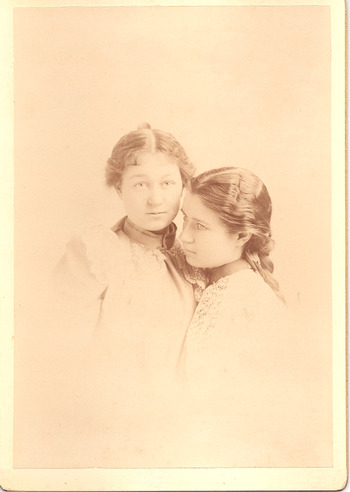
Portrait of a young Natalie Curtis with her sister Marian. Courtesy of the Natalie Curtis Burlin Archives, in the possession of Alfred and Virginia Bredenberg, Raleigh, NC.

Inspired by the idea of the New Woman, Natalie expressed her desire for independence as a woman and a musician. As Natalie undertook her musical studies she confided to Bessie:
I don't know myself, but I want to have a kind of profession just as a man would, so that I could be perfectly independent. Don't you think that it would be awful to feel as some girls do that they must marry? Just as though they were so many cows! And not only that, but as Clara Lincoln [a family friend] said, “What can you do if you don't marry? Why your life is blank! It is different with you though,” she added, “because you have your music, and if all your family died, even you wouldn't be lonely.” I think every girl ought to have something—study a sort of profession, as it were, even though she need never practice it, don't you?Footnote 9
Her belief that a young woman had the right, even the duty, to maintain an independent lifestyle emboldened her to pursue a rigorous course of study in music as an adolescent and to later maintain that independence through her writing and research on Native American and African American music.
Natalie pursued a broad course of musical training to fulfill her ambitions. She studied voice and music theory and participated in the city's choruses. Under William Semnacher she studied piano for several years before turning to German pianist Arthur Friedheim in the early 1890s. She devoted herself to an arduous practice schedule of six to seven hours per day and absorbed Friedheim's ideas about musical education. His assertion that “a musician nowadays must be an educated man” struck Natalie as particularly important. The two engaged in intellectual discussions, and Friedheim encouraged Natalie to read broadly. Inspired by her lessons, Natalie exclaimed to Bessie, “I feel that I am learning, learning, learning, and I am happy, happy, happy!”Footnote 10
Her ability to see herself as an artist with her own talents, ideas, and identity was further fostered by her next music teacher, Ferrucio Busoni.Footnote 11 Busoni became recognized as an important, if rather unconventional, music teacher. Between 1888 and 1924, “generations of rising pianists and composers passed through his hands, people of various nationalities and different mentalities, both men and women.” His students shared a powerful devotion to music and other arts. They were “musicians of very high intellectual standards, often conspicuously creative themselves, many of them scholars and writers whose accounts and reminiscences have considerable literary value.” To be a Busoni student, it was “not enough to play the piano exceedingly well or to be technically good at composition. One had to become an artist in his sense of the word.” Busoni students sought to achieve a unity of feeling for all aspects of art, music, and literature.Footnote 12
Busoni's focus on the intellectual and emotional aspects of music appealed to Curtis. Busoni taught, according to one biographer, because “teaching, more than any other professional activity, fulfilled a basic need to communicate.”Footnote 13 Busoni, who preferred independent students who would benefit from his emphasis on the abstract over the technical, must have appreciated a hardworking, intelligent pupil like Curtis. Later in their lives the two corresponded regularly on Curtis's work collecting Native American music, and Busoni composed Indianist compositions based on her collections, which he dedicated to his former student.
Although Curtis benefited from her musical training under Friedheim and Busoni, her participation in New York's musical world contributed to her ideas about her identity as a woman and an artist. Her formal training was enhanced, and often surpassed, by her enthusiastic participation in the city's musical scene. Here, through her response to Wagner's musical dramas and close relationships with New York's leading musicians, Natalie further developed her sense of self and found ways to use the language of music to contemplate important issues, particularly those related to gender and spirituality.
Curtis embraced the excitement and growth of New York's musical scene. She boldly sought out musicians performing in New York, often meeting with them after performances or visiting them with family members. These experiences allowed her to articulate a critical voice. Music provided her with a language with which she could assert authority as a musician and express her ideas as an artist. She took the study and critique of music seriously, carrying a blank notebook to concerts and operas to record her impressions during intermissions and between acts. She attended lectures delivered by the city's leading music critics and learned how to listen and discuss music in meaningful ways. These experiences allowed her to envision herself, perhaps in the near future, as a professional musician. Spending time with well-known artists nourished her feelings of artistic maturity.
Perhaps the most significant aspect of her musical development was her passion for Wagner's musical dramas and the conductors who brought them to the American public. Opera was central to young Natalie's musical enjoyment and became an important facet of New York's musical climate in the 1880s and 1890s. The influx of German immigrants, along with the rise of new outlets for opera financed by the “new money” of the city's industrial elite, made possible the popularity of German operas. In the late 1880s and early 1890s, New York City offered a feast to fans of Wagner. The Metropolitan Opera House began offering German operas in 1884 when Leopold Damrosch organized and recruited the most talented Wagnerian performers. His hard work favorably reversed the fortunes of the Metropolitan and brought a new audience of “musically knowledgeable, serious listeners” like young Natalie and Bessie.Footnote 14
Wagner's works and ideas were first introduced to Americans through print, in debates over his operatic theories, not through actual performances. Americans “identified Wagner with something profound,” according to John Dizikes. Americans related to Wagner's efforts to stake out new territory in the musical world.Footnote 15 Wagnerian operas also became popular because his works spoke to Americans undergoing rapid change and discontinuity in their society. Joseph Horowitz writes, “If Wagnerism had a core, it was a core of disillusionment with the status quo, with the industrial revolution and its legacy of science, technology, and allegedly sterile rationality.” He further argues that “custodians of culture” of the Gilded Age helped Americanize Wagner in such a way that he was not perceived, as he was in Europe, as “decadent, modernist, or politically risqué.” In the United States his music instead became “distinctively humanist, an antidote to materialism, scientism and urban anomie.”Footnote 16 This understanding of Wagner sheds light on his appeal to young Natalie, who later engaged in a similar search for antidotes to American modernism.
Natalie counted herself among the adherents of this new religion of Wagner and joined the audience of serious, knowledgeable opera goers who flocked to performances of his work. In America, women constituted a much larger proportion of audiences than in Europe. Women at Wagner performances sat “transfixed and transformed” as they partook of one of the few “intense experiences” available to them. In the darkened opera hall, the “bad effects of husband and bedroom were silenced by a musical-dramatic orgasm as explicit and complete as any mortal intercourse,” writes Horowitz. The ritual of attending a Wagnerian musical drama provided American women with a powerful emotional outlet denied them in other areas of their lives. The characters themselves seemed to speak directly to Wagner's female fans. Horowitz concludes, “Wagner's powerfully and compassionately drawn women—muses and helpmates, scourges and heroines, victims and saviors—conflate aspects of Romantic sentimentality with intimations of the new modernism.”Footnote 17 Gilded Age women sought to reconcile Victorian domestic ideology with the role of the New Woman. Wagner provided a language for young women like Natalie and Bessie to formulate their identities.
Natalie often mingled her passion for Wagner with her feelings toward Walter Damrosch, a conductor at the Metropolitan Opera House known for his handsome appearance and his appeal to female audiences. She and Bessie used “It,” as they secretly called him, as a way to discuss more forbidden topics. Natalie shared with Bessie one of her most treasured meetings with this “youthful Adonis.” “It” was “looking so handsome,” she told Bessie, and he had such “wonderful eyes.” During an encounter between them, Damrosch engaged Natalie in a serious conversation about music and the proper role of the artist in society, further enhancing her artistic identity and sense of self. Even so, Natalie told Bessie, “All I could see were those gleaming, almost glittering eyes fixed upon me.”Footnote 18 In her relationship with Damrosch, Natalie's young hormones intertwined with her sincere devotion to becoming a musical artist. Certainly, her reference to him as “It” carried sexual connotations. With Damrosch she found an acceptable way to blend her adolescent yearnings with her love of music.
Natalie and Bessie extended their infatuation with “It” to their responses to Wagner's works. Discussions of Wagner framed the two friends' deeper discussions of love, passion, friendship, and spirituality. Natalie shared moments of musical ecstasy and transport with her sympathetic friend. “I have just been playing, and weeping over Tristan,” she told Bessie. Wagner's musical drama about unrequited love left Natalie “nearly dead.” Writing to her friend late at night in her room, Natalie confessed that she “should simply love to go to Tristan tonight, and have my heart torn out of me. It is ready to be torn out—in fact it is pretty nearly out already.” Her emotions overwhelmed her as she wrote, “Oh! Lehmann! Tristan! Isolde! I am simply wild,” and concluded the letter with “I shall die!”Footnote 19
Wagner's musical dramas did not just provide Natalie with extreme emotional responses, but they also opened her mind to spiritual contemplation. As she and Bessie discussed their musical ideas they also ventured into discourses on their religious and ethical beliefs. In a letter to Bessie, Natalie asserted, “I shall never deny the truth—what I felt to be Truth—no matter if it made a social outcast of me.” She shared:
That there is a great cause, of which we are the effect, that there is great and universal good manifested thro' all Creation; that the Vital Power, the Life, the Cause, the Essence of all things is God—that we are all parts of one great whole which is God and that our nature is spiritual, unchanging, and eternal, being God. I accept the divinity of Christ in the sense that he is the fullest expression or rather manifestation of the divinity in man, and I think that it is possible for us all to attain that perfection—in fact we must attain it, if not in this state of consciousness, then in some future one. I think that the noblest thing in the world is Love of Good; for Good's sake, and a desire to be good, thro' love of Good. A wish for a reward, either here or hereafter, is utterly debasing to our higher nature.Footnote 20
Her family certainly influenced Natalie's somewhat unorthodox views of religion, which also reflects the influence of new spiritual ideas circulating at the end of the nineteenth century. Additionally, a family friend, the Spiritualist Charlotte Osgood Mason, influenced Natalie's thinking. Letters to Bessie mention Mason, who later became Natalie's patron for her studies of Native and African American music.Footnote 21
Many others joined Natalie and Bessie in their search for spirituality outside the bounds of established Christianity through movements such as Christian Science, New Thought, and Spiritualism.Footnote 22 Although Victorians looked to alternative spiritual paths, particularly in Asian religions, they did not fully reject the dominant values of their own society, as historian Thomas Tweed argues. Instead, they selected and adapted ideas and concepts that fit their needs best. Natalie identified with romantic adherents or supporters of Asian traditions. Tweed characterizes this group as “the intellectual descendants of German Romantics like Goethe and American Romantics like Emerson.” The aesthetic cultures of these religions enhanced their appeal. New spiritual movements, particularly Theosophy, helped popularize these ideas in the United States and attracted people like Natalie, who attended several Theosophist meetings with her mother.Footnote 23
Theosophy and Spiritualism further contributed to Natalie's identification with women's rights. Scholars have examined the links between Spiritualism and women, particularly the ways in which the religious movement fostered women's rights. “Not all feminists were Spiritualists,” writes historian Ann Braude, “but all Spiritualists advocated women's rights, and women were in fact equal to men within Spiritualist practice, polity, and ideology.”Footnote 24 Both Spiritualism and Theosophy asserted that individuals had direct access to divine truth, allowing women to participate equally with men in the movements. Theosophy probably appealed to Natalie as much for the role it accorded women as the spiritual insights it provided.
Natalie's interest in alternative spirituality reinforced her family's values. Her mother Augusta accompanied Natalie to these lectures and supported her unorthodox ideas. Furthermore, the prevalence of Transcendental ideas within her family opened Natalie to spiritual views outside the Western tradition. One historian comments, “That virtually all Transcendentalists were fascinated by Asian religions is without doubt.” Many believed that “Christ was not the only way to salvation, that Hinduism, Buddhism, and other world religions also were divine revelations.” Surely this openness to and even acceptance of non-Western worldviews made Natalie more willing to look to other cultures for answers to her own spiritual dilemmas. Non-Western people had something valuable to offer to her personally and to the world in general. This receptivity to, or perhaps even a preference for, ideas outside the American mainstream guided her later work and shaped her identity.Footnote 25
Curtis's spiritual development and music education were enhanced by her travels abroad. A family trip in 1891 to Bayreuth, Germany, the small town that had become a Mecca for Wagner enthusiasts, only whetted her appetite for more intense musical experiences. After additional years of instruction in the United States, Natalie pondered a longer, more intensive course of study in Europe. The encouragement of her instructors, plus the active support of her mother, led Natalie to Europe. After a period at the Paris Conservatory, Natalie traveled to Bayreuth in 1896 with Augusta, who recorded her reminiscences of the trip. The Wagner Festival drew thousands to Bayreuth every year for the annual cycle of operas. Wagner chose the somewhat isolated town to stage his musical dramas so that audiences would have nothing to distract them. Augusta affirmed, “To Wagner the theater was not to be the place where man should be diverted, but where he should be converted.”Footnote 26 The two Curtis women left Bayreuth enriched and inspired.
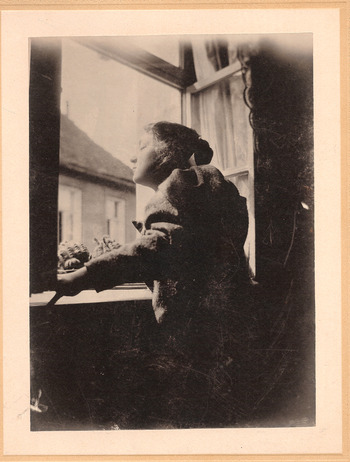
Natalie Curtis in Bayreuth in August, 1896, taken by her mother, Augusta. Courtesy of the Natalie Curtis Burlin Archives, in the possession of Alfred and Virginia Bredenberg, Raleigh, NC.

Natalie returned from her European training prepared to fully embrace her identity as a musician and artist. The New York musical scene continued to hold its allure for Natalie, but now no longer an adolescent, she began to consider her future. Eschewing marriage and a life of domesticity, Natalie desired a professional musical career, which for women at this time meant some professional opportunities, but their options remained limited.
Natalie must have pondered the best way to make use of her years of musical training and to fulfill the desire for independence she sought since her adolescence. Despite years of arduous practice on the piano and study under noted instructors, she decided not to pursue a career as a pianist. She lacked the temperament to teach piano, and it would have been difficult for her to limit her talents and enthusiasm to occasional participation in women's musical clubs. Composition, which she dabbled in as a teenager, offered her a chance to work as a professional musician and to express her artistic sensibilities.
Female composers, however, faced many challenges. In the 1890s a growing number of women wrote orchestral music, songs, and smaller works. Their efforts sparked a public controversy over the question, “Could or should women compose and could they ever equal the creative work of men?”Footnote 27 This debate and the social tensions it evoked shaped the conditions under which women composed and by which their work was judged.Footnote 28 The barriers erected against them, however, shaped the type of music they wrote. “With the parlor accessible and the concert stage forbidding,” women mainly composed songs, ballads, solo piano and ensemble pieces. This type of music, rarely performed in public settings, was considered appropriate for women but kept even the most talented female composers invisible.Footnote 29
Like other female composers, Curtis opted for songs rather than large-scale works. G. Schirmer published her Dearest, Where thy Shadow Falls, a song for voice and piano in 1898, Song from Pippa Passes in 1899, followed the next year by An den Fruehling (“Spring Song”). In 1902 the Wa-Wan Press issued her most substantial composition, Songs from a Child's Garden of Verses. These songs demonstrate the influence of her training, especially her study in Germany with its tradition of composing lieder, songs based on poetry in which the composer sought to blend together the words and music into a unified whole.
Nationalist musical movements also shaped Curtis as a composer. In the formative years of her training, musicians in the United States hotly debated the notion of an “American” music. Sparked by the visit of Czech composer Antonín Dvořák in the 1890s and his call for American composers to create a national music based on Native American and African American themes, musicians struggled to develop a distinctive national sound. Curtis studied in Europe at a time when rising nationalist concerns led many musicians to incorporate folk song and dance into art music. That she published with the Wa-Wan Press, which actively promoted the works of American composers, especially those who used Indian and African American motifs, suggests that Curtis sought to address these themes in her work. Her Dearest, where thy shadow falls probably best demonstrates her efforts to compose American music. This song, based on a poem by Ralph Waldo Emerson, reflected the strong influence Transcendental thought exerted on her from her family and from her appreciation of Romanticism. By choosing this poet, who also contended for the creation of an American art form and who appreciated the influence of nature on the nation's cultural life, Curtis attempted as a composer to contribute to the search for an American musical identity.Footnote 30
Curtis's search for a personal identity as a young female musician eventually blended with a larger cultural search for an American musical expression in her work with Native American and African American music and cultures. Although it is not clear when exactly Curtis decided to devote her career to these musical traditions, her formation as a young woman certainly prepared her to undertake this journey. The path she chose led her to sing a song from Wagner to a group of Navajo tourists in Pasadena in 1903 and to embark on a life devoted to music traditions outside the culture in which she came of age. Her turn to Native American and African American music was not, then, a departure from her earliest aspirations as a woman, a musician, and an American composer, but their fulfillment.