Introduction
Tympanostomy tube insertion is one of the most common paediatric surgical procedures performed.Reference Black1 Persistent otitis media with effusion, significant hearing loss (25 dB) lasting more than three months, chronic hypoventilation of the middle ear, and recurrent acute suppurative otitis media are the usual indications.Reference Schwartz and Linde2 Otorrhoea is a common post-operative complication, with a reported incidence of 15–74 per cent.Reference Gates, Avery and Prihoda3 Prompt post-operative diagnosis and treatment of this complication is prudent to avoid subsequent complications, including tube occlusion, persistent otorrhoea and early extrusion. At present, there is little guidance in the literature regarding ideal post-operative surveillance. Reviewing children following grommet insertion creates a significant workload for otolaryngology out-patient clinics. In addition, this patient group can be particularly difficult and time-consuming to manage.
The practice at the Freeman Hospital prior to August 2009 was for an ENT practitioner to review patients who have had short-term ventilation tube (grommet) insertion in the out-patient department three months post-operatively. However, recent evidence suggests that the vast majority of review appointments result in no subsequent clinical intervention.Reference Spielmann, McKee, Adamson, Thiel, Schenk and Hussain4 It is however important for patients who have had grommets inserted to have a post-operative age-appropriate hearing assessment.
We therefore devised a protocol in which appropriate paediatric patients who had undergone grommet insertion were reviewed by an audiologist post-operatively. The opportunity for referral back to an ENT practitioner was left to the discretion of the audiologist.
The aim of this audit was to ascertain if our change in practice was a viable and appropriate amendment to our existing practice of following-up paediatric grommets patients in an ENT clinic.
Materials and methods
Protocol
The ward staff responsible for arranging follow up for paediatric patients undergoing grommet insertion were instructed to request a review appointment with audiology for approximately six weeks after the operation date, unless otherwise stated in the operation notes. Surgeons were instructed that the default review appointment would be with audiology, unless the surgeon specifically requested review in an ENT clinic. It was left to the discretion of the operating surgeon to decide whether review in an ENT clinic was indicated, e.g. in the case of retraction of the tympanic membrane or coexisting problems. Our department's previous protocol had been to discharge all patients who failed to attend routine follow up with an otolaryngologist. Therefore, this was also the practice for our new protocol, in that patients were discharged if they failed to attend their review appointment with audiology. A letter was sent to each patient's general practitioner encouraging a re-referral should either they or the patient have any clinical concerns.
Because of the large geographical catchment area for patients operated on at the Freeman Hospital, a significant number of patients were listed from satellite clinics. It was felt that it would be unfair to make patients travel to the Freeman Hospital for their audiology review. Therefore, patients who were listed from satellite clinics were reviewed in the ENT clinic at the referring site.
Ethical considerations
Our study was registered with the audit department at the Freeman Hospital, Newcastle. At the time of designing the protocol, it was the authors' joint consensus that ethical approval was not required. There is currently little guidance in the literature regarding post-operative surveillance of patients following grommet insertion, and current evidence suggests that the majority of review appointments result in no subsequent intervention.Reference Spielmann, McKee, Adamson, Thiel, Schenk and Hussain4 Our protocol was designed to ensure an accurate assessment of hearing by a trained, qualified audiologist who had experience in recognising the complications associated with tympanostomy tube insertion. Access to an otological opinion was readily available if deemed necessary. Furthermore, in the event a patient did not attend their appointment, a letter was sent to both the patient and their general practitioner encouraging re-referral to an ENT consultant should there be any clinical concern. For this reason, we believe our protocol to be a viable, justified and appropriate alternative to the conventional practice of routine follow up with an otolaryngologist.
Methods
A retrospective audit was performed on all paediatric patients who had undergone grommet insertion during a three-month period (August to October 2009) at the Freeman Hospital. All patients less than 16 years old were included, as were those who underwent grommet insertion with concurrent procedures (e.g. adenoidectomy). AuditBase (a patient management system) was used to monitor which patients were reviewed by an audiologist, and the ultimate outcome of the consultation.
Medical notes were obtained for those patients not found on AuditBase, and those whose outcome was unclear. Information obtained from the notes included the hospital or department in which the patient was reviewed (i.e. audiology or ENT) the reasons for this, and the consultation outcome.
Results
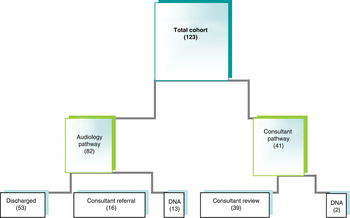
A total of 149 patients under the age of 16 years had grommets inserted during the three-month study period. Patients excluded (n = 21) comprised those followed up elsewhere (16), those in whom a bone-anchored hearing aid was installed (one) and those who underwent brainstem evoked response audiometry at the time of surgery (four). Medical notes obtained for five patients were not fully completed, and the method of follow up was not ascertained. The remaining cohort of 123 patients fitted the criteria for inclusion (Figure 1). Of these, 66 (51 per cent) were male, and the median age was five years.
Flow chart showing the breakdown of patients followed up by either the audiology or ENT out-patients department within a three-month period. DNA = did not attend.

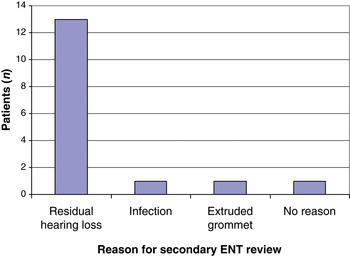
In total, 82 patients (67 per cent) were scheduled for follow up at six weeks by the audiologist, as stipulated by the new protocol. Of these, 13 patients (11 per cent) failed to attend their appointment, and were subsequently discharged; 53 patients (43 per cent) were discharged from audiology with normal hearing thresholds; and 16 patients (13 per cent) were referred back to a consultant for a variety of reasons (Figure 2).
Bar chart showing the reasons for secondary review by a consultant ENT surgeon, for patients initially reviewed by audiology.

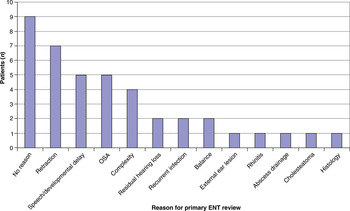
A total of 41 patients (33 per cent) were initially followed up at three months by a consultant. Of these, two patients failed to attend, and were subsequently discharged. The reasons for the primary medical review with an ENT surgeon are shown in Figure 3.
Bar chart showing the reasons for primary review by a consultant ENT surgeon, after myringotomy and grommet insertion. OSA = obstructive sleep apnoea.

Discussion
There are currently no nationally agreed guidelines for the follow up of patients undergoing tympanostomy tube insertion. Consequently, there is a large disparity in post-operative practice between trusts, hospitals, and often consultants within a single department. The routine review of this patient group is increasingly at odds with the current trend in healthcare policy that aims to optimise out-patient space and clinician time. Limited resources have provoked major reforms in the delivery of healthcare within the UK National Health Service over the last decade. Particular emphasis has been placed on promoting novel methods of care and more economical utilisation of resources, while simultaneously maintaining the high-quality service patients have come to expect. With this in mind, a variety of healthcare professionals, including audiologists, general practitioners and specialist nurses, have published encouraging results on the review of post-operative grommet patients.Reference Spielmann, McKee, Adamson, Thiel, Schenk and Hussain4–Reference Milford and Vinayak6
Our audit demonstrated that 43 per cent of patients were discharged from follow up after a single six-week post-operative review by an audiologist. Furthermore, 11 per cent of patients failed to attend their appointment with the audiologist and were subsequently discharged, leading to a 54 per cent overall reduction of patients followed up by ENT services. Although the outcome for these non-attending patients was not certain, our department ensured that a letter was sent to both the patient and their general practitioner encouraging re-referral should there be any objective or subjective clinical concern. It should be noted that this management algorithm was identical in most respects to our previous protocol, in which patients were followed up by an otolaryngologist. For the 13 per cent of patients identified as having hearing-related complications, ventilation tube blockage, extrusion or infection, rapid access to an otolaryngologist was available, allowing prompt and appropriate treatment. In our series, only one patient (0.8 per cent) suffered otorrhoea, a rate significantly lower than that quoted in the literature.Reference Gates, Avery and Prihoda3, Reference Kinsella, Fenton and Donnelly7, Reference Myer8
• Grommet insertion is a very common paediatric procedure
• Reviewing such children is a significant burden on otolaryngology out-patient clinics
• Most such reviews result in no clinical intervention
• In such patients, audiological review at six weeks is a viable alternative
• Re-referral to ENT services should be readily available for complications
A proportion of children (7 per cent) whose cases were seemingly uncomplicated post-operatively were initially followed up by an otolaryngologist. A retrospective study design confers a lack of clarity, and consequently this observation could not be fully explained. Possible explanations include insufficient documentation, parental request or simply the surgeon's preference. The remainder of consultant follow ups (32 per cent) were for valid reasons, as elicited from the patient's notes. These reasons included retraction pockets identified at the time of surgery, a history of recurrent infection, speech or developmental delay, or concurrent genetic or medical conditions of high complexity. Primary follow up by an audiologist may have been deemed less appropriate under these circumstances. This emphasises the point that the method of post-operative review should ultimately be determined by the consultant responsible for the patient. Our protocol was not designed to promote cost-effectiveness at the expense of patient care.
Our series is consistent with current data concerning post-operative grommet follow up by audiology.Reference Spielmann, McKee, Adamson, Thiel, Schenk and Hussain4 Initial review by an audiologist appears to be a viable alternative for this patient group; however, a prospective study with long-term follow up would be needed to demonstrate this more reliably.
The optimum time for primary review remains the subject of debate. There appears to be no advantage to early follow up, i.e. at one week.Reference Wallace and Newbegin9 We believe six weeks to be an appropriate time point, as at this stage the majority of tubes will still be patent and correctly sited, allowing for accurate hearing assessment.
Conclusion
Our data support the continued use of our new protocol. We recommend a six-week follow-up appointment by an audiologist, for patients who have undergone myringotomy and grommet insertion. The follow-up policy should allow for referral back to ENT services in the event of infection, poor hearing thresholds, early grommet extrusion or blockage. We have found this follow-up protocol to significantly reduce the demand on out-patient services, without compromising quality of care or redistributing the workload to primary care practitioners.