INTRODUCTION
Studies of plant reproductive phenology in the humid tropics have revealed a bewildering variety of patterns in many communities. In addition to the single discrete annual peaks of flowering and/or fruiting of most plants at higher latitudes or in tropical dry forests, some species of wet tropical forests may show multiple peaks or more or less continuous flowering or fruiting (Frankie et al. Reference FRANKIE, BAKER and OPLER1974, Newstrom et al. Reference NEWSTROM, FRANKIE, BAKER, COLWELL, McDade, Bawa, Hespenheide and Hartshorn1994, Opler et al. Reference OPLER, FRANKIE and BAKER1980). Variation in environmental conditions, particularly rainfall, between years may also produce variation in timing or extent of plant reproduction that would be missed in short-term studies, and a number of species apparently have cycles with periods longer than a single year (Foster Reference FOSTER, Leigh, Rand and Windsor1982, Newstrom et al. Reference NEWSTROM, FRANKIE, BAKER, COLWELL, McDade, Bawa, Hespenheide and Hartshorn1994). Because multiyear studies are required to demonstrate their existence, supra-annual cycles remain relatively poorly documented but may be frequent among some rain-forest plant groups and communities (Haugaasen & Peres Reference HAUGAASEN and PERES2005, Sakai et al. Reference SAKAI, MOMOSE, YUMOTO, NAGAMITSU, NAGAMASU, HAMID and NAKASHIZUKA1999). In this paper we discuss such a case: the milpesos palm, Oenocarpus bataua Martius.
The palms (Arecaceae) often constitute one of the most abundant and characteristic components of humid tropical forests (Kahn & de Granville Reference KAHN and DE GRANVILLE1992), and show an extraordinary variety of reproductive patterns (De Steven et al. Reference DE STEVEN, WINDSOR, PUTZ and LEÓN1987, Ibarra-Manríquez Reference IBARRA-MANRÍQUEZ1992, Peres Reference PERES1994, Sist Reference SIST1989). Despite their importance, palms have sometimes been excluded from phenological studies at the community level (Henderson et al. Reference HENDERSON, FISCHER, SCARIOT, WHITAKER and PARDINI2000a), or considered to require phenological analysis apart from other plants (Newstrom et al. Reference NEWSTROM, FRANKIE, BAKER, COLWELL, McDade, Bawa, Hespenheide and Hartshorn1994). Oenocarpus bataua is of particular interest here in that previous studies of its reproductive phenology have failed to show any consistent pattern, in part because short monitoring periods are inadequate to characterize its supra-annual cycle. The only long-term study of this palm (Ruiz & Alencar Reference RUIZ and ALENCAR2004) did not analyse differences between individuals or years within a cycle.
The relationship between environmental cues and plant reproductive activity may vary between years of such cycles, or the appropriate cues might not occur every year. A well-documented case of the latter sort is the mast fruiting of various species of Asian Dipterocarpaceae, stimulated by the occurrence of El Niño conditions (Sakai et al. Reference SAKAI, HARRISON, MOMOSE, KURAJI, NAGAMASU, YASUNARI, CHONG and NAKASHIZUKA2006). However, this explanation might not apply in cases where synchrony among individuals in the population is low and different individuals might respond differently to the same environmental conditions. Moreover, when the reproductive efforts of individuals of such populations are channelled into a few large, expensive and long-lived reproductive structures which in their turn are largely asynchronous, large samples of individuals will be required to document the patterns. Relatively few studies have focused on the variation of individuals within a population within or between years (Marquis Reference MARQUIS1988, Milton Reference MILTON1991) and samples of only 1–4 individuals per species (as in Newstrom et al. Reference NEWSTROM, FRANKIE, BAKER, COLWELL, McDade, Bawa, Hespenheide and Hartshorn1994, Sakai et al. Reference SAKAI, MOMOSE, YUMOTO, NAGAMITSU, NAGAMASU, HAMID and NAKASHIZUKA1999, Reference SAKAI, HARRISON, MOMOSE, KURAJI, NAGAMASU, YASUNARI, CHONG and NAKASHIZUKA2006) are insufficient to document such variation. This paper presents the results of a 4-y study of the reproductive phenology of O. bataua using a sample of over 100 individuals and attempts to integrate data at the individual and population levels.
We adopt as a working hypothesis the simplest case: that the apparent supra-annual cycle of O. bataua reflects the recurrence of a particular set of environmental conditions in some years but not others. The effects of such environmental factors may be either short-term or long-term: that is, one might obtain significant correlations for the occurrence of phenological events over the few months prior to the events, or over much longer periods. This hypothesis predicts mostly short-term correlations and a high degree of intrapopulation synchrony in phenological events. However, if the cycle is truly supra-annual (reflecting more the physiological rhythms or constraints of the plants), long-term correlations might predominate and intrapopulation asynchrony might be much more marked. In such cases we might also expect differences between short-term ‘triggering’ factors and long-term ‘preparatory’ factors for particular phenological events.
MATERIALS AND METHODS
Study species
Oenocarpus bataua is widespread in the lowlands and lower mountain slopes of tropical South America (Henderson et al. Reference HENDERSON, GALEANO and BERNAL1995). Attaining a height of 26 m, this palm is often a dominant element in the canopy and subcanopy of humid forests. It is monoecious with inflorescences that may reach 2 m in length, each producing up to several thousand large fruits which are an important resource for frugivorous mammals and birds. Oenocarpus bataua is also a widely used and economically promising species.
Study site
Our study was carried out between May 2003 and May 2007 in the middle Porce river basin in north-eastern Antioquia Department (6°46′N, 75°06′W) at elevations between 925 and 1100 m in Colombia's Central Andes. The study area is in premontane humid forest (bh-PM) in the life-zone system of Holdridge (Reference HOLDRIDGE1996); mean annual rainfall is 1915 mm, with a pronounced dry season between December and February and a rainy season between March and November with a moderate reduction in rainfall between June and August at the Los Mangos weather station, 7 km from the study area. This station is at a similar elevation, and beside similar forest; its location in a cleared area means that the climate data do not represent conditions inside the forest, but are more like the conditions experienced in the canopy by the crowns of adult O. bataua. The intensity of solar radiation (280–2800 nm) was measured daily with a digital pyranometer (®Licor). Average annual temperature was 22.7°C with monthly extremes between 21.3°C and 24.1°C. During the study period the mean monthly relative humidity varied between 77.9% and 100% and was only weakly correlated with monthly rainfall (r = 0.268, P = 0.068), while solar radiation varied between 181.5 and 256.8 W m−2, showing a strong inverse correlation with relative humidity (r = 0.452, P = 0.0011) but none with rainfall (r = 0.091, P > 0.50). Lack of correlation of these variables with rainfall probably reflects the frequent low cloud cover and fog during months of low rainfall. Soils are classified as Entisols and Inceptisols with low to very low natural fertility due to intense leaching (Jaramillo Reference JARAMILLO1989).
Field work
Prior to the study, RR and assistants numbered and marked with reflective tape 104 adult palms more than 6 m tall and showing evidence of past or current reproduction, along 5 km of trails. Phenological observations were taken with binoculars monthly between May 2003 and May 2007. The position (azimuth) of each reproductive structure on every palm was mapped and its development followed individually from its first appearance through the following phases: (1) closed bud, enclosed in a woody peduncular bract; (2) flowering, from when the bract cracks and falls releasing the inflorescence, until female flowers have been fertilized or fall; (3) green (ripening) fruits, from the end of flowering until (4) mature fruits, when the colour changes from green to purple and the fruits begin to drop or are knocked down by frugivores; and finally (5) the dry cluster (raceme), when all fruits have fallen. A given reproductive structure was considered successful if it produced ripe fruit, available for consumption and dispersal by frugivores; an unsuccessful structure terminated its development before achieving ripe fruit. For each palm we estimated its height, the height of each reproductive structure, the height of the surrounding forest canopy, and measured the slope at its base. Canopy cover around each palm was measured with a spherical densiometer. No field observations were made in January 2005, so the frequency data were interpolated from the values for the previous and following months.
Statistical analyses
To establish the type of frequency distribution of phenological phases in the population and the variables analysed for the palms, we used chi-square, Kolmogorov–Smirnov and Shapiro–Wilks tests. We tested for correlations between phenological events and climatic variables with Pearson's parametric correlation (r) or Spearman non-parametric correlation (rs), depending upon the number of months in the sample. We also used the former test between the characteristics of the palms and the production of reproductive structures of individuals, and between the development time for closed buds and the months of the reproductive pause (Statgraphics Plus 5.0). We tested for differences in the mean values and monthly distributions of rainfall, relative humidity and solar radiation between years of the study with Friedman's non-parametric two-way ANOVA for repeated measures (Statistix 7).
We calculated Pearson's correlations coefficient between phenological events (initiation of buds, initiation of flowering and initiation of fruit maturation) and environmental variables (monthly rainfall, mean relative humidity and mean radiation). We considered the latter variables as follows: the data for the current month of the phenological event (mo 0) and the sum of rainfall of mo 0 and from 1 to 12 mo prior to the event. For relative humidity and radiation, we used the mean values over these periods rather than simply seeking correlations with specific months prior to the event because this seemed more appropriate for such large plants with great capacity for water and nutrient storage and with such a large and long-term investment in each reproductive structure. We calculated these correlations over the entire observation period and for the periods of most frequent reproduction (i.e. leaving out the quiescent period from July 2004 to September 2005 when almost no reproduction occurred), except that for fruit maturation, we omitted the final 11 mo of the study when no green fruits were available to mature. We also calculated correlations of environmental variables and death of buds over the 4 y of the study. Calculating these correlations for up to 12 mo previous to the phenological events permitted us to detect long-term integration of environmental variables by the palms; use of only peak periods gave a better idea of proximate stimuli for initiation of events. Because most palms initiated two or more reproductive structures per year, often at intervals of several months, we felt that the initiation of events, rather than initiation of the first event of the year at the level of the individual, was the more appropriate for evaluating environmental correlations.
We compared the durations of the phenological phases in the period of maximum or peak reproduction (2003–2004 and 2006–2007) and the periods of low or non-peak reproduction (2005) using the Mann–Whitney test and compared the number of successful vs. unsuccessful reproductive structures in relation to the number of structures present simultaneously on a given palm with a chi-squared test.
RESULTS
Reproduction in the population
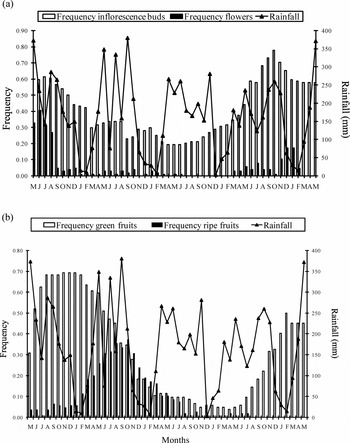
A major peak of reproduction was underway when observations began in May 2003. The peak of bud production had already passed, although the frequency of closed buds in the population remained high until November 2003. Production of new buds declined to low levels by late 2003, but a minor burst of bud initiation occurred in the second quarter of 2004. Only 15 new buds were produced between July 2004 and September 2005, but bud production began to rise again in October 2005 and reached a second major peak between August 2006 and January 2007. No new buds were produced between February and May 2007 (Figure 1a). There were two major peaks of flowering, between May and August 2003 and November 2006 and January 2007. However, the second peak was much smaller and a large proportion of the palms that had initiated buds in this peak had not yet flowered by the conclusion of observations in May 2007 and none had yet produced ripe fruit.
Frequency of palms Oenocarpus bataua presenting inflorescence buds and flowers with relation to rainfall between May 2003 and May 2007 (a). Frequency of palms presenting green and mature fruits with relation to rainfall between May 2003 and May 2007 (b).

Between August 2003 and February 2004 approximately two-thirds of the palms had ripening fruit, and a peak of mature fruit occurred in the latter half of 2004. However, by the middle of 2005 few palms were ripening fruit and although the frequency of green fruit in the population began to rise in late 2006, no ripe fruit was present during the final year of our observations (Figure 1b). Thus, only for flowering could we determine the interval between successive peaks; this interval was about 3.5 y. However, given the large number of buds present when observations were concluded, a second and perhaps larger peak of flowering probably occurred in mid-2007, thus increasing the interval between major flowering peaks to close to 4 y.
Influence of environmental variables on initiation of phenological events
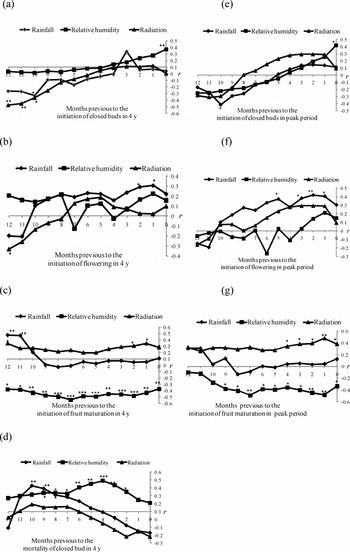
The appearance of closed buds showed a significant positive correlation only with relative humidity during the current month, with correlations declining when averaging relative humidity over progressively longer periods prior to the event; high relative humidity thus appears to trigger bud production. However, significant negative correlations with rainfall and radiation appeared 9–12 mo prior to the appearance of the buds (Figure 2a). Mortality of closed buds before they flowered was strongly correlated with a period of high relative humidity 2–6 mo previously and with high rainfall 8–10 mo earlier (Figure 2d).
Correlations between frequency of phenological events of Oenocarpus bataua (initiation of buds, initiation of flowering, initiation of fruit maturation and mortality of buds) and environmental variables (monthly rainfall, mean relative humidity and mean radiation). We considered the data for the current month of the phenological event (month 0) plus the sum of rainfall of month 0 and from 1 to 12 mo prior to the event; for relative humidity and solar radiation we used the mean values over the periods from month 0 through months 1 to 12. Correlations calculated over the entire observation period (a, b, c and d) or for the period of most frequent reproduction only (peak periods) (e, f and g). Statistical significance indicated as follows: *: P ≤ 0.05; **: P ≤ 0.01; ***: P ≤ 0.001.

Flowering was initiated mostly during periods of declining rainfall following a rainy period. Correlations with total rainfall increased for 1–2 mo prior to flowering, but were noted as much as 6 mo prior to the event; no significant correlations were noted with relative humidity or radiation for up to 1 y prior to flowering (Figure 2b). By contrast, fruit maturation showed highly significant negative correlations with relative humidity for up to 10 mo previously, and strong positive correlations with radiation averaged over the previous 2–4 mo (Figure 2c). We also detected significant positive correlations between fruit maturation and rainfall and radiation averaged over the preceding 11–12 mo. Rainfall per se showed little correlation with fruit maturation for up to 10 mo prior to the event (Figure 2c).
In general, environmental triggers of phenological events were best detected (that is, correlations were stronger over the months immediately preceding the event) when only periods of frequent reproduction were noted (initiation of closed bud, Figure 2e, flowering, Figure 2f, fruit maturation, Figure 2g) and ignoring long periods of little or no reproduction. However, this procedure tended to lose the longer-term correlations detected by considering the entire 4-y observation period. We found no significant correlations between phenology and climatic variables during the period of little or no reproduction (mid-2004 to mid-to-late 2005).
Considering the monthly distributions within years, only relative humidity showed a significant interyear difference (Friedman χ2 statistic = 9.22, P = 0.030), with relative humidity being highest eight out of 12 months in the final year of the study; however, these differences were small (less than 2.5% in most months). Rainfall and solar radiation showed no differences in monthly values between years (the respective Friedman χ2 statistics were 0.10, P > 0.99 and 0.70, P > 0.75; in all tests, df = 3). Thus, interyear variations in climate were relatively slight and the one difference found did not correspond neatly with either a reproductive peak or the reproductive pause.
Synchrony within and between individuals in the population
Although distinct peaks of flowering and fruiting were evident in the population, there was a notable lack of synchrony in reproductive events both between and within individuals. Different individuals initiated reproductive events as much as 1 y apart during the same peak period, and synchrony of events within the same individual was also notably low. Only two instances of simultaneous flowering of two structures on the same palm were noted in our entire study, and in each case the period required for fruit maturation differed by 3–4 months between structures. During the 4 y, only 23 cases occurred of an individual palm initiating two (20) or three (3) inflorescence buds in the same month. In most such cases, one structure flowered rapidly while the other took up to 6 mo more in the bud stage before flowering; often one or two structures failed to flower, and in 12 cases two or three structures on a single palm were still in the bud stage at the end of the observation period.
Development times for reproductive structures
On average, a successful reproductive event required nearly 2 y from the appearance of the closed bud to the dry raceme. Over half of this period was taken up by the period of fruit maturation (mean ± SD = 12.8 ± 3.1 mo, coefficient of variation (CV) = 24.5%, n = 74); next in duration was the period of development of the inflorescence, from closed bud to flowering (mean ± SD = 4.7 ± 2.7 mo, CV = 56.7%, n = 43). Flowering itself was comparatively rapid, averaging slightly over 1 mo in duration (mean ± SD = 1.3 ± 0.60 mo, CV = 46.2%, n = 96). Mature fruits were present on average around 4 mo (mean ± SD = 3.6 ± 2.1 mo, CV = 58%, n = 99). The coefficients of variation of the means were quite high, near or over 50% for most phases.
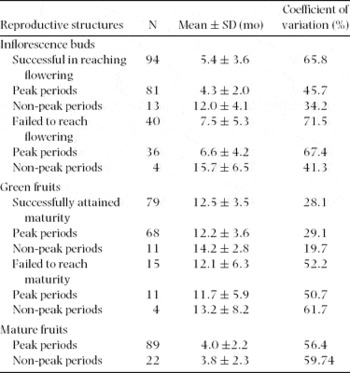
For flowering this is largely the result of the monthly sampling intervals: a given structure might complete flowering between one sample interval and the next giving an observed length of 0, or overlap two (very rarely three) sampling intervals, although for the majority of structures flowering was recorded in only one month. For the other phases, the degree of variation reflects both the degree of success of different phases and when the reproductive event occurred (particularly whether during a major peak of reproduction or during the off-peak period of few reproductive structures in the population). The mean duration of a closed bud was nearly three times as long in the off-peak period for buds that succeeded in producing flowers (U = 48, P < 0.001) and over twice as long for those that failed to reach flowering (U = 13, P = 0.008); unsuccessful buds lasted longer on average than successful ones (U = 1482, P = 0.053), sometimes going for 1 y or more enclosed in the bract with no apparent change then abruptly drying up and falling, while others failed relatively quickly (Table 1). The duration of flowering was similar in peak and non-peak periods and maturation time for green fruits was only slightly longer during peak periods (U = 237, P = .053), and for successful vs. unsuccessful racemes (U = 590, P = 0.98); the duration of mature fruits was similar in peak and non-peak periods (U = 936, P = 0.76) (Table 1).
Development times of inflorescence buds, green and mature fruits in peak periods, with greater production of reproductive structures, and in non-peak periods with few structures produced, in a population of the palm Oenocarpus bataua in the Colombian Andes.

Success of reproductive structures
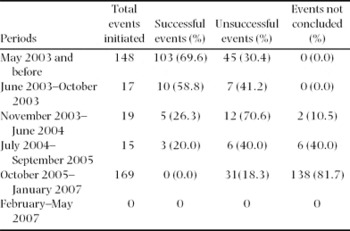
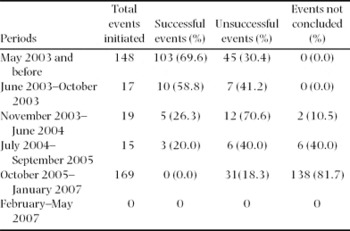
The 102 individuals surviving through the 4 y produced 368 reproductive structures, for a mean of 3.61 events per individual. For 222 events, the outcome was determined; 121 (56.0%) produced ripe fruit. At the start of observations, 148 reproductive events were already underway, 70% of which succeeded. The success declined progressively thereafter while the proportion of events still not concluded by the end of the observation period increased. The second reproductive peak included 146 events still in progress at the end of the observation period, while 31 had already failed (Table 2).
Outcomes of reproductive events initiated in different periods in a population of the palm Oenocarpus bataua in the Colombian Andes.
The greatest mortality occurred during the bud stage; all inflorescences that flowered set fruit, and the great majority of these succeeded in producing ripe fruit (Table 3). However, recorded success varied greatly depending upon conditions of observation. Of 68 reproductive events monitored from initiation to conclusion, only 18 (26.5%) succeeded in producing ripe fruit and over 60% of the buds failed to flower. Most of these failures occurred during the early part of the second peak; the observation period ended before any successful events could be recorded. By contrast, the high observed success of those events in progress at the start of observations reflects the fact that most structures had already passed through most or all of the bud stage; over 90% of the structures with flowers or fruit when first observed were eventually successful. Thus, the totals for complete events were biased towards failures and the partial events towards successes; combining all events probably gives the most representative idea of stage-specific success for the population. From these totals, we calculate that overall, 38% of the buds fail to flower; all structures that flower set fruit, but a further 16.2% fail before the fruit ripens such that overall, 51.7% of all reproductive structures succeed (Table 3); the proportion of successes is probably somewhat higher during major peaks than in off-peak periods (Table 2).
Success (S) and failure (F) of different stages of reproductive events in a population of the palm Oenocarpus bataua in the Colombian Andes. S = numbers and percentages of events in one stage that passed successfully (S) or failed to pass (F) to the next stage. Complete = events observed from initiation to successful or unsuccessful completion. Partial = totals for all stages observed that succeeded or failed to pass to next stage (includes events for which initiation or termination of the entire reproductive event were not observed).

Reproductive performance of individual palms
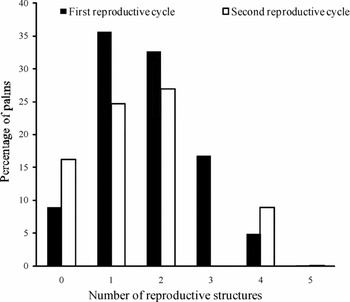
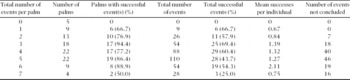
Of the 102 palms surviving throughout the observation period, five failed to reproduce and the others produced from one to seven structures over the 4 y. During a single reproductive peak, individual palms could have up to five reproductive structures present simultaneously (Figure 3); we noted a tendency for single structures to be more successful when they were the only ones present than when sharing a palm with one or more other structures (χ2 = 3.78, P = 0.054). Palms that produced three structures over the observation period had more such solo structures and higher per-individual success than those producing four or five structures, although the latter were more frequent in the population and produced slightly higher totals for successful structures (Table 4). Although the relatively few palms that produced six structures were notably successful, those producing seven were not. Thus, we were surprised to find that the length of the resting or quiescent period between peaks varied inversely with the number of structures produced during the first peak (r = −0.618, P < 0.001): those palms producing more reproductive structures during the first peak began reproduction in the second peak sooner than those producing few or no structures.
Percentages of individuals of Oenocarpus bataua with simultaneous (maximum) reproductive structures in the first (2003–2004) and second reproductive peaks (2006–2007).

Success of individual palms in relation to total numbers of reproductive events observed in a population of the palm Oenocarpus bataua in the Colombian Andes. Percentages are for numbers of completed events (excluding events not concluded by the end of observations)

No measured characteristic of the palms themselves was correlated significantly with either the number of structures produced or the number of successful structures. Of the site characteristics, only per cent canopy cover showed a significant but weak positive correlation, indicating that palms in closed-canopy forest tended to be more successful although still with much unexplained variation (coefficient of determination r2 ≈ .06) between individuals that probably reflects genetic differences, at least in part.
DISCUSSION
Population phenology
In many widespread tropical species, phenological behaviour varies across their geographic range, perhaps related to local climatic conditions (Newstrom et al. Reference NEWSTROM, FRANKIE, BAKER, COLWELL, McDade, Bawa, Hespenheide and Hartshorn1994), which might explain some of the differences between our results and those of other studies of O. bataua. However, other differences might reflect the lengths or conditions of particular studies. For instance, Collazos & Mejía (Reference COLLAZOS and MEJÍA1988), Henderson (Reference HENDERSON2002), Miller (Reference MILLER2002) and Sist (Reference SIST1989) argued that O. bataua has a bi-annual reproductive cycle based on studies of 1–3 y, perhaps insufficient to document two or more peaks in those populations. Also, some authors might have extrapolated from the length of a complete reproductive event, which at least Collazos & Mejía (Reference COLLAZOS and MEJÍA1988) also found to be about 2 y, to the periodicity of the population without realizing that a quiescent period of little or no reproduction also forms part of the cycle.
Virtually all phenological studies of O. bataua have reported a lack of synchrony among the individuals of the population, and most have noted that reproductive individuals are continuously present (Collazos & Mejía Reference COLLAZOS and MEJÍA1988, Henderson et al. Reference HENDERSON, FISCHER, SCARIOT, WHITAKER and PARDINI2000a, Reference HENDERSON, PARDINI, DOS SANTOS, VANIN and ALMEIDAb; Miller Reference MILLER2002, Núñez-Avellaneda & Rojas-Robles Reference NÚÑEZ-AVELLANEDA and ROJAS-ROBLES2008, Peres Reference PERES1994, Ruiz & Alencar Reference RUIZ and ALENCAR2004, Sist Reference SIST1989, Vélez Reference VÉLEZ1992) but without specifying the stage of the reproductive cycle in question. Since fruit maturation typically requires more than 1 y, some individuals will nearly always bear green fruit. Mature fruits are generally present for much shorter periods and the ephemeral nature of flowering implies that only asynchrony of structures within and between individuals could produce continuous flowering over a period of several months or more. The pattern of distinct peaks of flowering and long periods with few or no flowers present shown by our population could be obscured by averaging over long periods. Possibly this occurred in the 16-y study of Ruiz & Alencar (Reference RUIZ and ALENCAR2004), which reported a mean frequency of reproductive individuals of only 14% in Manaus, Brazil, not greatly different from the value of 6% we obtain averaging over all 4 y of our study. On the other hand, in less-seasonal environments the quiescent period might be less pronounced, perhaps the case in the Amazon basin. In any case, one lesson from our study is that years or phases of a multiyear cycle are best analysed separately.
A lack of synchrony between reproductive events in the same individual was also found in an Australian palm (Inkrot & Sattler Reference INKROT and SATTLER2007), and was interpreted as an adaptation for avoiding self-pollination and to promote outcrossing between populations. While the former is a likely factor in such asynchrony in O. bataua, especially given the short duration of female flowers in a reproductive cycle, this asynchrony seems more likely to facilitate intrapopulation gene flow during major flowering peaks.
Henderson et al. (Reference HENDERSON, PARDINI, DOS SANTOS, VANIN and ALMEIDA2000b) suggested that continuous flowering in O. bataua in the Brazilian Amazon was important in providing its pollinator, the beetle Phyllotrops sp., with a continuous food supply. In our study area, Núñez-Avellaneda & Rojas-Robles (Reference NÚÑEZ-AVELLANEDA and ROJAS-ROBLES2008) found that pollination of O. bataua depended on a limited number of beetle species that were different from those pollinating other sympatric palms, including the congeneric O. mapora. We do not know how the pollinators of O. bataua persist in the community during the lengthy periods of few or no flowers, since the life cycles of these beetles remain poorly known (Núñez-Avellaneda & Rojas-Robles Reference NÚÑEZ-AVELLANEDA and ROJAS-ROBLES2008). Regarding seed dispersal, we also documented a period of 11 mo with no ripe fruit of O. bataua available. However, because the reported seed dispersers of this palm are relatively long-lived generalist vertebrates, especially squirrels (RR, unpubl. data), their maintenance in the community is less problematic. A study of their reproductive cycles would be interesting, as they might show peaks of reproduction coinciding with peaks of ripe fruit of this palm.
Influence of climatic variables on phenology of Oenocarpus bataua
In interpreting the correlations of phenological events with environmental variables we found that it is important to keep in mind our study area's climate: the partial dissociation of rainfall and relative humidity (due to frequent fog and low clouds during the dry season), and the strong negative correlation between relative humidity and solar radiation (due to frequent sunny mornings in the rainy season). Largely because of these features, fluctuations of temperature through the year are minimal. Other studies of the reproductive phenology of O. bataua have considered only rainfall and in some cases, temperature but not relative humidity or solar radiation as factors influencing phenological events and do not distinguish clearly between initiation of events vs. frequency of events in the population.
We found little evidence of interyear difference in climatic variables: means of the three variables considered did not vary significantly between years, and only relative humidity averaged significantly higher, month for month, in the third year; this period coincided neatly neither with a reproductive peak nor the reproductive pause. Given that high relative humidity appeared important in triggering the appearance of buds and had a mainly long-term negative effect on fruit maturation, there is no clear relationship between this difference in relative humidity and the reproductive cycle. It thus appears that interyear differences in climatic variables are insufficient to explain the multiyear cycle of O. bataua.
Occurrence of phenological events is mediated through the physiological conditions of the plants, in particular their hydration status (Borchert Reference BORCHERT1983). Hydration status is often closely associated with the seasonal availability of water, but accumulation and storage of water in the stem can obscure this relationship (Borchert Reference BORCHERT1994, Reich Reference REICH1995). Certainly this seems likely to have occurred in the study population of O. bataua: for some events, certain climatic variables show highly significant correlations when integrated over periods of 9–12 mo previously but not over shorter periods. Moreover, the variables showing such long-term correlations are often not those showing high correlations 0–3 or 4 mo prior to a phenological event and thus apparently acting as triggers for its initiation. The three variables considered here (rainfall, relative humidity and solar radiation) often seem to act independently, and to have different effects upon the phenology of the palms. Also, their phenological effects appear to vary between years of the palms' cycles.
These results, plus the high degree of asynchrony within and between individuals, are incompatible with our hypothesis of direct causation of phenological events by environmental conditions not recurring every year, but not with the alternative hypothesis that the cycle is the result of longer-term physiological rhythms in the palm population. A corollary of this is that the general heading of supra-annual cycles includes at least two types of cycles differing in the relative importance of external cues and internal rhythms of the plants and in the degree of intrapopulation (and in some cases, intraindividual) synchrony.
Productivity and management
Relatively few studies have presented data on success of phenological phases in O. bataua. In Ecuador, Borgtoft & Balslev (Reference BORGTOFT and BALSLEV1993) found that 22% of the closed buds were damaged before producing flowers; Collazos & Mejía (Reference COLLAZOS and MEJÍA1988) attributed such damage to insects, especially the beetle Rhynchophorus palmarum (Curculionidae). Also in Ecuador, García (Reference GARCÍA1988) found that 14%–63% of the pistillate flowers were killed by ovule-eating larvae of the pollinating beetle Deremoline sp. (Curculionidae), which laid eggs in the flowers. However, García did not specify whether such damage was fatal to the entire structure or simply reduced fruit production. Quantifying damage to individual flowers was beyond the scope of our study, but it would be useful to determine if a particular level of damage to flowers might result in failure of the entire inflorescence. Clearly more long-term studies of this palm are needed, particularly those that monitor individual palms and their reproductive structures. One variable that might be illuminating in future studies is the size or approximate number of fruits produced on a given reproductive structure, as this might affect its success or maturation time. Generalizations to other species should be made with care; Inkrot & Sattler (Reference INKROT and SATTLER2007) found in an Australian palm that abortions were rare in the bud stage and most frequent following the female flowering phase, unlike what we observed in O. bataua.
In each of the two reproductive peaks we analysed, more than 95% of the palms presented between one and five reproductive structures, at least half of which were successful. Some palms reproduced through most of the observation period with very short reproductive pauses, and produced four or five structures – as opposed to the majority of individuals, with two structures and reproductive pauses of 2 or 3 y. The reasons for these differences in productivity are unclear: site variables (notably canopy cover) apparently influenced productivity but explained little of the variation between individuals. We did not study edaphic variables and these might be worthy of more attention. However, we suspect that much of the variation in productivity might reflect genetic differences between palms. It is worth emphasizing that O. bataua is a forest palm and we did not observe any individuals in open or second-growth areas adjacent to the study area. Attempts to cultivate this palm in plantations have failed, and remnant individuals in pastures in the Colombian llanos rarely if ever set fruit (E. Enciso, pers. comm.). Hence, future management and exploitation of this palm will depend largely upon conserving its forest habitat, in which it is often a dominant element. More long-term studies of reproduction in O. bataua, taking into account its supra-annual cycle, will likely be important in the designing of sustainable harvesting schemes (Miller Reference MILLER2002).
ACKNOWLEDGEMENTS
We thank División de Investigaciones Universidad Nacional de Colombia, Sede Medellín (DIME) for financing the project and the Departamento de Ciencias Forestales for granting the time to perform the research. We also thank the doctoral program of the Departamento de Biología-Instituto de Ciencias Naturales and the Instituto de Estudios Ambientales (IDEA) of the Universidad Nacional in Bogotá. We are grateful to Rodrigo Bernal and Mauro Galetti for their comments and suggestions regarding the draft version, to Luis Núñez for collaboration in the field and to Eduardo Enciso for sharing his experiences in managing this palm with us.