INTRODUCTION
Cochlear implantation is a well-established approach to restoring audition in children born deaf. Cochlear implants (CI) are especially beneficial for developing oral language, and these benefits are particularly clear if the period of auditory deprivation preceding the surgery is shorter than two or three years (e.g. Geers, Moog, Biedenstein, Brenner & Hayes, Reference Geers, Moog, Biedenstein, Brenner and Hayes2009; Colletti, Mandala, Zoccante, Shannon & Colletti, Reference Colletti, Mandala, Zoccante, Shannon and Colletti2011). This evidence seems to support the view that there is a short sensitive period for language development.
However, before we can conclude that there is a direct connection between the length of the auditory deprivation period and the language outcomes of these children, some important issues should be further analyzed. It is most relevant that the notion of sensitive period is applicable not only to language, but also to other lower-level cognitive skills supporting language (Knudsen, Reference Knudsen2004). Furthermore, it has been proposed that the sensitive periods for the neural circuits performing lower-level tasks end before the sensitive periods for higher-level circuits (Jones, Reference Jones2000; Knudsen, Reference Knudsen2004). Such a proposal is compatible with data from L2 acquisition showing that the sensitive period for speech articulation is shorter than the sensitive period for grammar (Huang, Reference Huang2014). Thus, it seems that language development in CI users might be constrained by at least two different sensitive periods: a short one for lower-level skills, and a long one for higher-level language skills.
The present study inquires whether the length of those sensitive periods was sufficiently long for optimal development in children fitted with a CI before their second birthday. The research was guided by a dual-stream neurolinguistic model (Hickok & Poeppel, Reference Hickok and Poeppel2004, Reference Hickok and Poeppel2007; Purvermuller, Reference Pulvermuller2005; Frederici, Reference Frederici2012; Hickok, Reference Hickok2012). The motivation for adopting this model is that it provides an adequate framework to explore the interactions among CI use, and lower- and higher-level skills (Moreno-Torres & Moruno-López, Reference Moreno-Torres and Moruno-López2014). According to the dual-stream model, the speech processing system in the brain has at least two segregated streams, one involved in auditory-motor integration (i.e. used for segmental lower-level processes; the dorsal stream), and another involved in auditory-conceptual processing (i.e. used for lexical-level processes; the ventral stream). The dorsal stream uses fine acoustic details to connect auditory input with motor patterns; such information might be crucial to developing efficient phonological processing skills, and hence for implicit learning and rapid language development (Hickok, Reference Hickok2012). In contrast, the ventral stream would use gross acoustic information to connect auditory input with semantic representations; the ventral stream would be crucial to store full lexical representations. Finally, general higher-level language skills would involve numerous brain networks, including the dorsal and the ventral streams.
Previous studies have suggested that CI children might struggle to develop lower-level skills, particularly those supported by the dorsal stream (see Lazard, Lee, Gaebler, Kell, Truy & Giraud, Reference Lazard, Lee, Gaebler, Kell, Truy and Giraud2010; Moreno-Torres & Moruno-López, Reference Moreno-Torres and Moruno-López2014). There is also evidence that at least some CI users struggle to develop higher-level language skills (e.g. Le Normand & Moreno-Torres, Reference Le Normand and Moreno-Torres2014). In the next two sections we analyze to what extent the existence of sensitive periods, alone or in combination with other factors, may explain the difficulties of CI users in developing lower- and higher-level skills. Note that throughout the text the expression ‘short sensitive period for X’ will be used as an abbreviation for ‘a period not long enough for children implanted before their second birthday to optimally develop skill X’. Similarly, the expression ‘long sensitive period for X’ will be used as an abbreviation for ‘a period sufficiently long to develop X’.
The development of lower-level skills in CI children
Many researchers have proposed that the window for developing lower-level speech perception skills is relatively long (e.g. Sharma, Dorman & Spahr, Reference Sharma, Dorman and Spahr2002; McConkey Robbins, Koch, Osberger, Zimmerman-Phillips & Kishon-Rabin, Reference McConkey Robbins, Koch, Osberger, Zimmerman-Phillips and Kishon-Rabin2004; Colletti et al., Reference Colletti, Mandala, Zoccante, Shannon and Colletti2011). For instance, Sharma et al. (Reference Sharma, Dorman and Spahr2002) concluded that the human central auditory system remains maximally plastic for over three years. Note that according to the dual-stream neurolinguistic model, this would imply that the development of speech production skills should also be typical.
However, evidence from perception and production studies indicates that the development of lower-level skills is not fully typical in young CI users. Bouton, Serniclaes, Bertoncini, and Cole (Reference Bouton, Serniclaes, Bertoncini and Cole2012) explored the categorical perception and the categorical precision of a group of children implanted during the first 3·5 years of life. Note that categorical perception is the ability to identify phonologically relevant sound contrasts (e.g. voicing, place of articulation, etc.) and is the result of top-down effects; categorical precision is the degree of accuracy when categorizing the actual sounds, and it depends on lower-level speech perception skills. The categorical perception skills of the CI children were comparable to those of normally hearing children. In contrast, categorical precision was significantly lower in the CI children compared to the controls. As for production, various studies have found that while early lexical development is relatively rapid (e.g. Ertmer & Mellon, Reference Ertmer and Mellon2001; Moreno-Torres, Reference Moreno-Torres2014), the actual productions tend to be phonetically imprecise (e.g. Ertmer & Mellon, Reference Ertmer and Mellon2001; Gillis, Schauwers & Govaerts, Reference Gillis, Schauwers and Govaerts2002) or unstable (Warner-Czyz, Davis & MacNeilage, Reference Warner-Czyz, Davis and MacNeilage2010; Moreno-Torres, Reference Moreno-Torres2014). Taken together, these results indicate that CI users struggle to develop lower-level skills (see also Lazard et al., Reference Lazard, Lee, Gaebler, Kell, Truy and Giraud2010).
Such data raise the following question: Which factors might cause the observed lower-level deficits? Two factors have been considered in the literature: the existence of a short temporal window to develop these skills, and the technical limitations of today's CIs. As for the former, it has been proposed that the period of auditory deprivation before cochlear implantation might affect various lower-level cognitive skills (Horn, Pisoni, Sanders & Miyamoto, Reference Horn, Pisoni, Sanders and Miyamoto2005; Houston & Miyamoto, Reference Houston and Miyamoto2010). One of these skills is motor sequencing, which is presumably most involved in speech articulation, and which has been shown to mediate the language delays in deaf children with CIs (Conway, Karpicke, Anaya, Henning, Kronenberger & Pisoni, 2010).
There is also evidence that the CI limitations contribute to the emergence of speech perception/articulation deficits post-implantation. Note that today's CIs seem to have two major limitations (Loizou, Reference Loizou and Moller2006). One is the poor robustness of the signal, which easily degrades in noisy conditions (Peters, Moore & Baer, Reference Peters, Moore and Baer1998). This may presumably reduce the amount of input received by CI users. Another is a failure to properly encode rapid temporal changes (i.e. the Temporal Fine Structure of the speech signal). The Temporal Fine Structure is crucial to identifying the place of articulation phonological feature (Rosen, Reference Rosen1992). Based on the evidence that CI children make frequent errors with the place of articulation feature, many researchers have concluded that there is a link between speech perception/production difficulties and the limitations of CIs (e.g. Tye-Murray, Spencer & Woodworth, Reference Tye-Murray, Spencer and Woodworth1995; Medina & Serniclaes, Reference Medina and Serniclaes2009; Moreno-Torres & Moruno-López, Reference Moreno-Torres and Moruno-López2014).
Altogether, the above data indicate that the speech perception/articulation deficits observed in many CI users might be due to the effect of plasticity reductions and to the poor quality of the input that they receive. Note that while the independent impact of these two factors has been explored in many studies, the combined effect of the two has received limited attention. For instance, it might be relevant to explore whether or not all the phonological features show identical plasticity effects; indeed, it is possible that the reason why CI users make increased errors with some features (i.e. poorly encoded ones) is because the window to learn from poor input is shorter than the window to learn from high-quality input. More studies are needed to clarify this issue.
The development of higher-level skills in CI children
As noted above, many studies have found that age at implantation is a good predictor of the language outcomes of these children (e.g. Geers et al., Reference Geers, Moog, Biedenstein, Brenner and Hayes2009). However, it remains unclear whether or not there are significant differences between children implanted in the first and second year of life. One illustrative example comes from two consecutive studies by Dettman, Pinder, Briggs, Dowell, and Leigh (Reference Dettman, Pinder, Briggs, Dowell and Leigh2007) and Leigh, Dettman, Dowell, and Briggs (Reference Leigh, Dettman, Dowell and Briggs2013). Using a relatively small sample, Dettman et al. (Reference Dettman, Pinder, Briggs, Dowell and Leigh2007) found that the language growth rate of children implanted before 12 months of age (N = 11) was significantly higher than that achieved by children implanted between 13 and 24 months of age (N = 30). Yet, when the same exploration was carried out in a larger sample including the children in Dettman et al.'s study, Leigh et al. (Reference Leigh, Dettman, Dowell and Briggs2013) did not find significant differences between the two groups. The authors hypothesized that Dettman et al.'s initial group of eleven children implanted by 12 months may have represented a high-performing subset of children with highly motivated and well-informed parents. This raises the possibility that the language outcomes of early implanted children are associated with factors other than age at implantation. Two factors seem most relevant: the cascading consequences of lower-level deficits and environmental conditions.
As regards the existence of cascading effects, it is important to note that as the dorsal stream plays a crucial role for phonological processing, it is possible that CI children struggle to develop those grammatical aspects which require efficient phonological processing skills, such as verbal morphology, clitics, etc. Data from studies in different languages seem to confirm this possibility. For instance, Szagun (Reference Szagun2004) explored a group of German-learning CI users. She observed that the CI children produced relatively frequent determiner agreement errors. The author did not find evidence of other grammatical errors (Szagun, personal communication). Moreno-Torres and Torres (Reference Moreno-Torres and Torres2008) analyzed the morphosyntactic development in a Spanish-learning child implanted at the age of 18 months. Similarly to Szagun's study, the authors found that the child's developmental process was mostly typical, with the following exceptions: a preference for periphrastic forms (e.g. Voy a comer ‘I am going to eat’) instead of inflected verb forms (e.g. comeré ‘I will eat’); and the presence of determiner agreement errors. In a study with Italian-learning children, Caselli, Rinaldi, Varuzza, Giuliani, and Burdo (Reference Caselli, Rinaldi, Varuzza, Giuliani and Burdo2012) found that CI children scored in many aspects close to their same-age peers. However, determiner omission was more frequent in the CI children than in the normal hearing controls. Finally, Hammer (Reference Hammer2010) explored the production of finite verbs and verbal agreement in forty-eight Dutch-learning children. The author found that the CI children were able to catch up with their normal hearing peers in Mean Length of Utterance (MLU) and finite verb production, but not in verbal agreement marking. Thus, it seems that lower-level deficits might have very specific consequences on language development. Finally, it has been noted that CI use may also slow down development (Le Normand & Moreno-Torres, Reference Le Normand and Moreno-Torres2014). This might be due to CI hearing reducing the amount of social participation (Punch & Hyde, Reference Punch and Hyde2011), which may reduce the amount of received input, and thus slow down language development. Taken together, these results indicate that lower-level deficits may impact negatively on language development.
It has been suggested that environmental conditions have increased impact in CI users as compared with typical children (Quittner, Cruz, Barker, Tobey, Eisenberg & Niparko, Reference Quittner, Cruz, Barker, Tobey, Eisenberg and Niparko2013). This has led researchers to explore which specific environmental factors may be most relevant. Moeller (Reference Moeller2001) examined the impact of Family Involvement (FI), which was defined as the quality/level of participation of the family in the intervention programme. Markman et al. (Reference Markman, Quittner, Eisenberg, Tobey, Thal, Niparko and Wang2011) explored Maternal Sensitivity, defined as the warmth, positive regard, and respect for autonomy in the parent–child relationship. Finally, Szagun and Stumper (Reference Szagun and Stumper2012) explored the use of expansions to facilitate language learning. The results of these studies have confirmed the positive impact of environmental conditions, which suggest that a stimulating environment might compensate for the limited input provided by the CIs. Furthermore, such results would support the view that language development is experience dependent (Szagun & Stumper, Reference Szagun and Stumper2012).
To summarize, it remains unclear whether the existence of a sensitive period may explain the language outcomes of young CI users. Two factors seem to be most relevant: the cascading consequences of lower-level deficits, which might reduce the amount of received input; and environmental conditions, which may potentially compensate for the reduced input effect. Note that while there is increasing evidence for the impact of environmental factors, it seems relevant to obtain further data from insufficiently explored languages / cultural contexts (such as Spanish/Spain).
This study
The main aim of this study was to analyze the extent to which the existence of sensitive periods for lower- and higher-level language skills might determine the development of language in young CI users. Based on previous evidence (e.g. Conway et al., Reference Conway, Karpicke, Anaya, Henning, Kronenberger and Pisoni2011; Le Normand & Moreno-Torres, Reference Le Normand and Moreno-Torres2014) it was hypothesized that: (1) the sensitive period for lower-level skills is too short for optimal development; and (2) the sensitive period for higher-level skills is long enough for optimal development. A secondary aim was to explore the impact of environmental factors in developing lower- and higher-level skills.
The data for this study are taken from a longitudinal database of Spanish CI children born deaf and implanted during the second year of life. Despite the limited age range, we assumed that if plasticity is drastically reduced during the second year of life, the impact of age at implantation might be observable in this group of children. The children lived in monolingual Spanish-speaking families from very different socio-cultural backgrounds. Data included several parental questionnaires (e.g. MacArthur and Family Involvement scale), repetition tests (non-words and sentences), and spontaneous speech samples obtained over a period of three years after surgery. Specifically, two questions guided this study:
1. Do age at implantation and environmental factors impact on the development of lower-level skills? We examined the correlation between various individual/environmental factors and four phonological measures. We followed the proposal of Moeller (Reference Moeller2001) to score the degree of Family Involvement in rehabilitation (see details in the ‘Method’ section). We selected two phonological measures to reflect the technical limitations of the CIs (i.e. the ratio of errors of the place of articulation feature, and the difference between the ratio of correct voiceless stops and fricatives); and two more to reflect the strengths of the CIs (i.e. the ratio of errors with the manner of articulation and with voicing features). One reason for including the errors with stops/fricatives was that a previous study found that typical children produced significantly more errors with fricatives than with stops, while in CI children the difference was not significant (Moreno-Torres & Moruno-López, Reference Moreno-Torres and Moruno-López2014). This was interpreted as evidence for atypical development. All four phonological measures were calculated based on the data from a non-word repetition task, as it is assumed that this type of task may reduce the confounding effect of lexical frequency. We predicted that age at implantation would correlate only with the measures describing poorly encoded input. We also predicted that the impact of environmental factors might be small (i.e. non-significant correlation).
2. Do age at implantation and environmental factors impact on the development of higher-level language skills? We calculated the correlation between various environmental/individual factors and high-level language measures. The language measures were selected to reflect crucial aspects of development in the first three years of CI use (Locke, Reference Locke1997): (i) the size of the productive lexicon 12 months post-implantation (LEX12); (ii) the score in a phonological task 24 months post-implantation (PHO24); and (iii) a measure of the language skills 36 months post-implantation (GRA36). In accordance with the main hypothesis of this study, we expected that the three high-level language measures (i.e. LEX12, PHO24, and GRAM36) would be more strongly associated with environmental factors (e.g. Family Involvement) than with age at implantation. We also compared the language scores of different subgroups of CI children (in terms of the degree of family implication) with scores of normally hearing children. We expected that the rate of development in children living in stimulating environments would be comparable with that of the controls, while children living in less stimulating contexts would develop very slowly.
METHOD
Participants
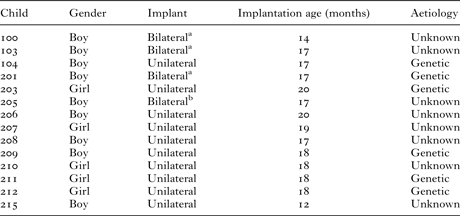
The data for this study come from a database of Spanish-learning children who received one or two CIs during the second year of life, and who had no impairments associated with deafness. Part of the material in this database has been previously described (see Moreno-Torres, Madrid-Cánovas & Moruno-López, Reference Moreno-Torres, Madrid-Cánovas and Moruno-López2013; Moreno-Torres, Reference Moreno-Torres2014; Moreno-Torres & Moruno-López, Reference Moreno-Torres and Moruno-López2014). For the present paper we selected data from fourteen children (see details in Table 1). All the children had profound bilateral deafness confirmed in the first three months of life. The mean age at implantation of the sample was 17·2 months (range = 12–20; SD = 2·2). After 12 months of CI use, they achieved a ceiling score in the LittlEars perception task (Coninx et al., Reference Coninx, Weichbold., Tsiakpini, Autrique, Bescond, Tamas and Brachmaier2009). The children were evaluated after 12, 24, and 36 months of CI use. Two groups of typically developing children (CT24 and CT36) participated as controls for the phonological task (24 months) and the sentence repetition task (36 months). The groups were similar in terms of auditory age (CI = 24·1 and 35·9 months; CT24 = 23·8 months; CT36 = 35·2 months) and Parental Education (CI = 1·9; CT24 = 2·1; CT36 = 1·7). Both groups had the same number of female participants. In order to locate the typical children we put up notices in a local kindergarten. We selected the first fourteen children who, according to the parents' and the kindergarten's reports, showed no evidence of atypical development.
Demographic data for the participants

notes:a Simultaneous implantation in both ears; b Sequential implantation. Second implant 18 months after the first implant.
Materials
Three datasets were used for this study: the Spanish version of the MacArthur parental questionnaire, a non-word repetition task (NWR), and a sentence repetition task. The MacArthur parental questionnaire (López-Ornat, Gallego, Gallo, Karousou, Mariscal & Martínez, Reference López-Ornat, Gallego, Gallo, Karousou, Mariscal and Martínez2005) was used to measure the size of the productive lexicon 12 months after surgery. The NWR task data were used to obtain four different measures of the phonological skills of the children after 24 months of CI use (see below). The task consists of thirty-four nonwords that were segmentally and suprasegmentally similar to the words and phrases produced by typical two-year-old Spanish children. In terms of the combinations of consonants (C) and vowels (V), items are VCV (6), CVV (4), CVCV (12), and laCVCV (12). The laCVCV group is identical to the CVCV group, except for the addition of la, which corresponds to the singular feminine form of the Spanish definite article. The items were balanced for stress pattern (17 iambic, 17 trochaic), and a selection of six non-labial occlusive and fricative consonants was used (apart from the lateral /l/): voiceless and voiced velar stops (/k/ /g/), voiceless and voiced alveolar stops (/t/ /d/), and voiceless coronal fricative (/s/) and voiced dorsal fricative (/ʝ/). The task was presented as a game, in which the participant was expected to build a tall tower. Before the evaluation proper, the researcher explained the repetition task to the child and produced several warm-up items (both words and nonwords). Only when it was clear that the child understood that he or she was expected to imitate the adult's productions did the researcher introduce the thirty-four items (in random order).
A sentence repetition task (PRO24) was used to obtain a quantitative measure of the general language skills of the participants 36 months post-implantation (Moreno-Torres et al., Reference Moreno-Torres, Madrid-Cánovas and Moruno-López2013). There were two motivations for using this task: (i) sentence repetition is a highly reliable clinical marker for language impairment (see Conti-Ramsden, Botting & Faragher, Reference Conti-Ramsden, Botting and Faragher2001); and (ii) in previous research with some of the participants in this study, we found that the score in this task was significantly correlated with MLU, which shows that it may provide a measure of general language skills.
Coding and language measures
For the NWR task, two trained research assistants produced a narrow phonological transcription including both segments and stress. Praat acoustic analysis software (Boersma & Weenink, Reference Boersma and Weenink2010) was used to confirm the perceptual judgements whenever it was considered necessary. For instance, oscillogram representations were used to confirm the presence of the burst of stop consonants, and spectrograms were helpful in confirming voicing and place of articulation. The transcriptions were entered into a PHON database to facilitate later phonological exploration (Rose, Hedlund, Byrne, Wareham & MacWhinney, Reference Rose, Hedlund, Byrne, Wareham and MacWhinney2007) Lexicalizations were rare (< 1%) and were excluded from these analyses. Based on this PHON database we obtained the following lower-level phonological measures: (i) the ratio of errors of place of articulation, manner of articulation, and voicing; and (ii) the stop–fricative contrast, which was calculated as the ratio of correct voiceless stops in the task (i.e. /t/, /k/) minus the ratio of correct fricatives in the task (/s/, /ʝ/).
In order to examine higher-level language skills, we obtained the following measures:
a. LEX12: The size of the productive lexicon (number of different word types) according to the Spanish version of the MacArthur inventory (12 months post-CI).
b. PHO24: The percentage of consonants produced correctly in the NWR task (24 months post-CI).
c. GRA36: The percentage of correctly produced items in the PRO24 task. We did not consider as incorrect those repetitions which were grammatically and lexically correct but which had phonological errors. For instance, all the following variants of the Spanish noun osito ‘little bear’ would be considered as correct: /o'sito/ (adult form), /o'tito/, /to'tito/, /'tito/, etc. Furthermore, additions which resulted in grammatically correct utterances were not considered as errors either (e.g. viene papa > viene el papa ‘dad is coming’ > ‘the dad is coming’).
Environmental and individual factors
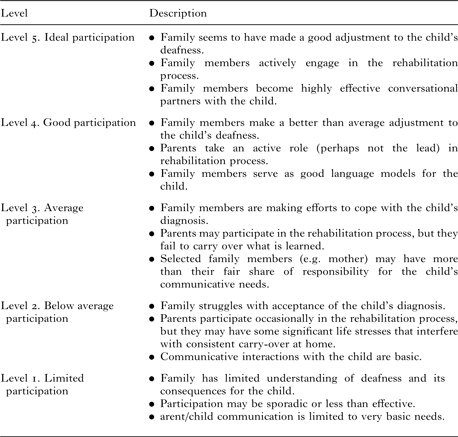
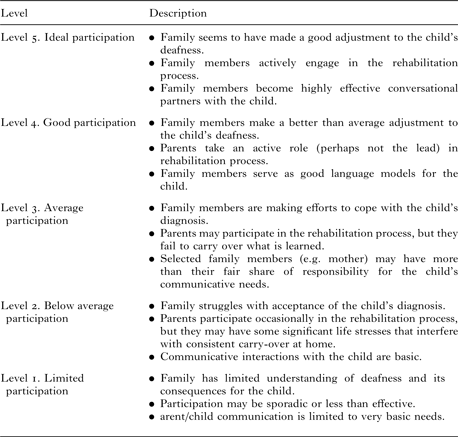
The following factors were explored: (i) age at implantation (AI), (ii) gender, (iii) Parental Education (PE), and (iv) Family Involvement (FI). For Parental Education we coded the families according to the parent who was the main carer: 1 (only obligatory education), 2 (professional not academic degree), 3 (academic degree at university level). In order to obtain a measure of FI, we adapted the proposal by Moeller (Reference Moeller2001) to the Spanish language. Two judges (research assistants) rated the families on a 1–5 scale. This scale considers the following factors: (i) understanding/acceptance of deafness; (ii) degree of participation in speech therapy; and (ii) quality of the communication model. In order to score the families, the judges used these sources of information: the spontaneous speech samples, two recorded interviews (one pre-CI and another 12 months post-CI), and three family questionnaires (pre-CI, 12, and 24 months post-CI). It was also helpful that in most cases (11/14) the research assistants had participated actively in the data collection process. In order to determine the quality of the communication model, the judges considered the following characteristics: (i) grammar and lexicon: whether it was correct and appropriate for the child language level; and (ii) pragmatics: appropriate use of conversational turn-taking and adaptation to the child's communicative needs. The questionnaires provided information about the degree of participation in speech therapy. To this end, the questionnaire included questions about various details of the speech therapy programme (e.g. specific activities carried out at the moment of filling in the questionnaire, etc.), and their understanding of deafness. Finally, in the interviews, parents were asked to describe among other things: whether deafness and CI use had had consequences for their daily lives; what, in their opinion, were the consequences of deafness for their child and for the family, etc. Such information was most valuable in determining the degree of understanding of deafness and its acceptance. To aid the rating process, the judges were provided with a description that represents each rating from one to five (see Table 2). On this continuum, a rating of 1 represents limited stimulation (far below average). A rating of 5 represents ideal stimulation. If the distance between the two judges was larger than 1 point, then a third judge (the first author) rated the family. In cases of disagreement between the judges, the score was the average of the two (or three) ratings.
Family involvement scale (adapted from Moeller, Reference Moeller2001)
Statistical analyses and reliability measures
SPSS 21 was used to analyse the data. The Shapiro–Wilk's test was used to test normality. Most of the variables did not follow a normal distribution. Consequently, Spearman's rank non-parametric correlation test was used to assess the associations among the different language measures and factors (e.g. PE, FI, and AI). Finally, we used the hierarchical cluster method to explore the differences among the CI children.
Reliability measures were obtained for the nonword repetition task, the sentence repetition task, and for the FI scale. For the nonword repetition task, 10% of the PHON database was re-coded by a third coder. Inter-judge agreement was obtained separately for segments and prosodic aspects. Cohen's kappa was 79% for segments. Disagreement in segments involved similar sound types (e.g. velar/dental stop, etc.) Point-to-point, intra-judge, and inter-judge agreements in the 80% to 90% range are considered acceptable for most research needs, agreement in the 70% range marginally acceptable, and agreement below 70% unacceptable (Shriberg et al., Reference Shriberg, Fourakis, Hall, Karlsson, Lohmeier, McSweeny and Wilson2010). Thus, we consider that 79% inter-judge agreement is acceptable for our purposes. For the sentence repetition task, we recoded 10% of the sentences, and analyzed the agreement in terms of correct/incorrect sentences. Cohen's kappa was 94%. For Family Involvement task, following Moeller (Reference Moeller2001), we analyzed complete and categorical agreement. Complete agreement was found when both raters assigned the same point score. Categorical agreement was found when raters accurately placed families into one of three categories (e.g. 1–2 = below average; 3 = average; 4–5 = above average). Cohen's kappa for exact agreement was 73%, slightly lower than the 80% obtained by Moeller (Reference Moeller2001). Cohen's kappa for exact agreement was 89% (88% in Moeller, Reference Moeller2001).
RESULTS
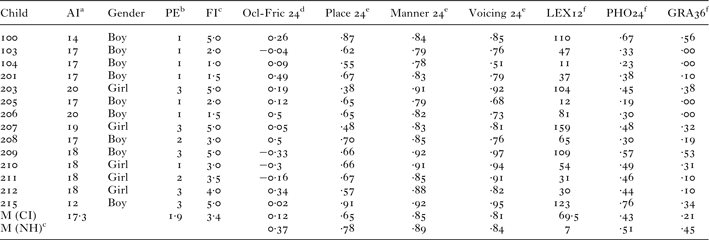
Table 3 summarizes the main scores for each child, including individual, environmental, and language measures. Regarding the environmental measures, it is relevant that the range was the largest possible, both for FI (i.e. 1–5) and PE (1–3). This makes the present sample appropriate for exploring the impact of the environmental factors.
Summary of individual, environmental, and language measures
notes:a Age at implantation; b Parental education; c Family involvement; d Ratio of correct voiceless stops minus ratio of correct fricatives in the NWR task; e Ratio of correct uses of the place articulation, manner of articulation, and voicing feature in the NWR task; f LEX12: Size of the productive lexicon (number of word types) according to the Spanish version of the MacArthur inventory (12 months post-CI); PHO24: Percentage of consonant produced correctly in the NWR task (24 months post-CI); GRA36: Percentage of correctly produced items in the PRO24 task.
Correlations with lower-level phonological measures
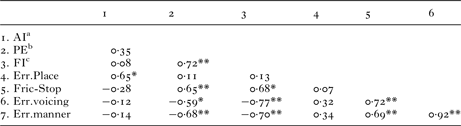
Table 4 shows the results of the Spearman correlation analyses between the different factors and the phonological measures (three phonological features, and the voiceless stops/fricatives contrast). Two sets of results are relevant. On the one hand, age at implantation was correlated exclusively with the place of articulation feature (r = –0·63; p = ·01). On the other hand, FI was significantly correlated with the three other phonological measures. Thus, contrary to our expectations, the stop/fricative contrast did not correlate with the AI, and the environmental factors did correlate with some of the phonological measures.
Spearman correlations for the phonological measures
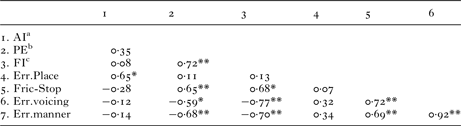
notes:a Age at implantation; b Parental education; c Family involvement; *p < .05, **p <.01.
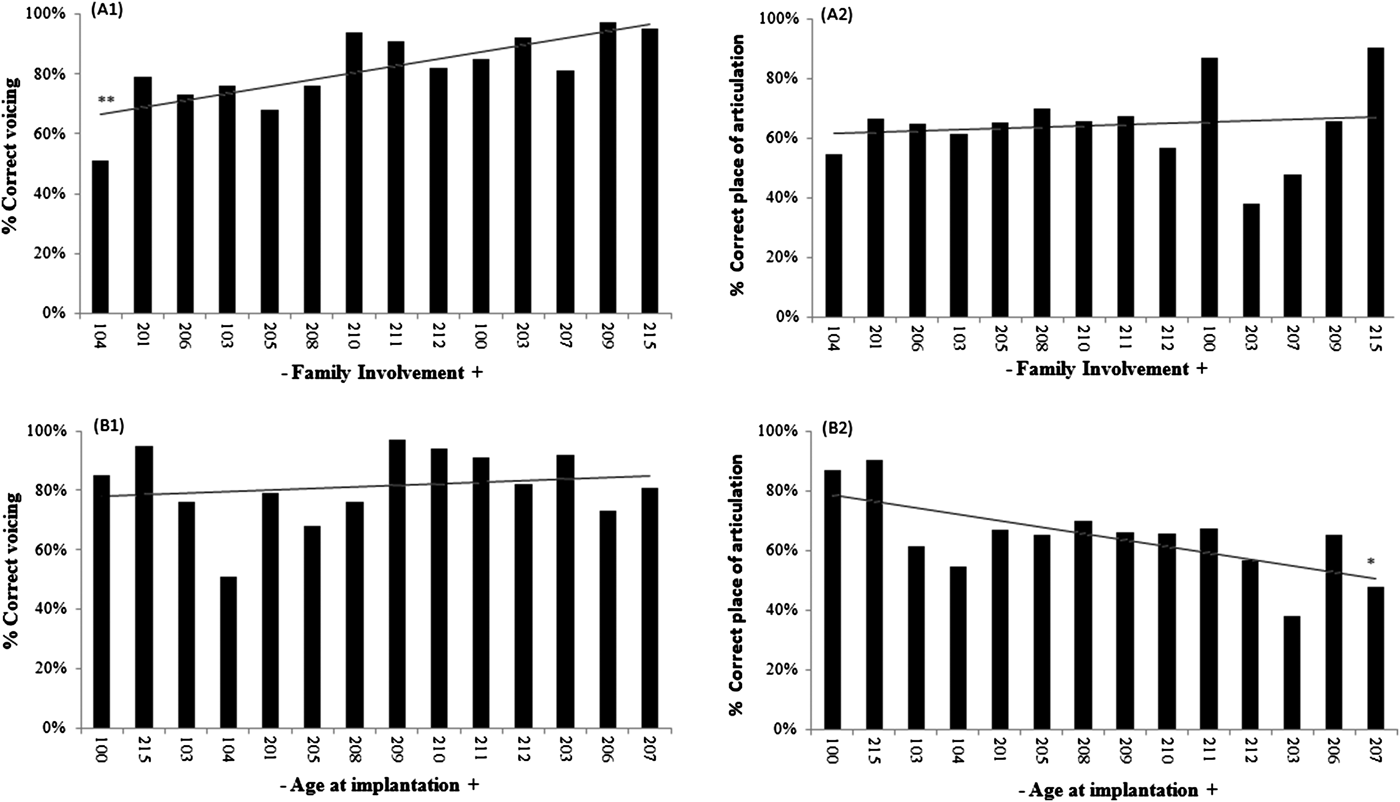
Figure 1 shows the individual scores for voicing and place of articulation. The scores are sorted according to the degree of FI (upper panels) and to the AI (lower panels). When children are sorted according to the degree of FI, the scores for voicing tend to increase (with FI), and the scores for place of articulation remain stable. In contrast, when the children are sorted according to age at implantation (lower panels), the associations are the opposite ones: the voicing scores remain stable, and the place of articulation scores tend to decrease with age at implantation.
Scores for voicing and place of articulation. In panels A1 and A2, children are sorted according to Family Involvement, from low to high. In panels B1 and B2 children are sorted according to age at implantation, from early to late implanted (*p < .05, **p <.01).
Correlations with higher-level language measures
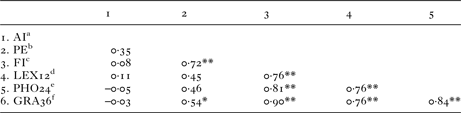
Table 5 shows the results of the Spearman correlation analyses between the different factors and the language measures (LEX12, PHO24, and GRA36). PE correlated only with GRA36 (p = ·045). The degree of FI was significantly correlated with the three language measures (p < ·01 in the three cases). As predicted, age at implantation was not correlated with any of the language measures.
Spearman correlations for the language variables
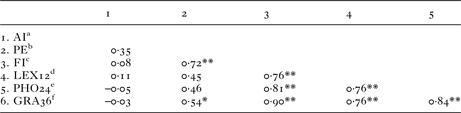
notes:a Age at implantation; b Parental education; c Family involvement; d Lexicon 12 m post-CI; e Phonology 24 m post-CI; f Sentence repetition 36 m post-CI; *p < .05, **p <.01.
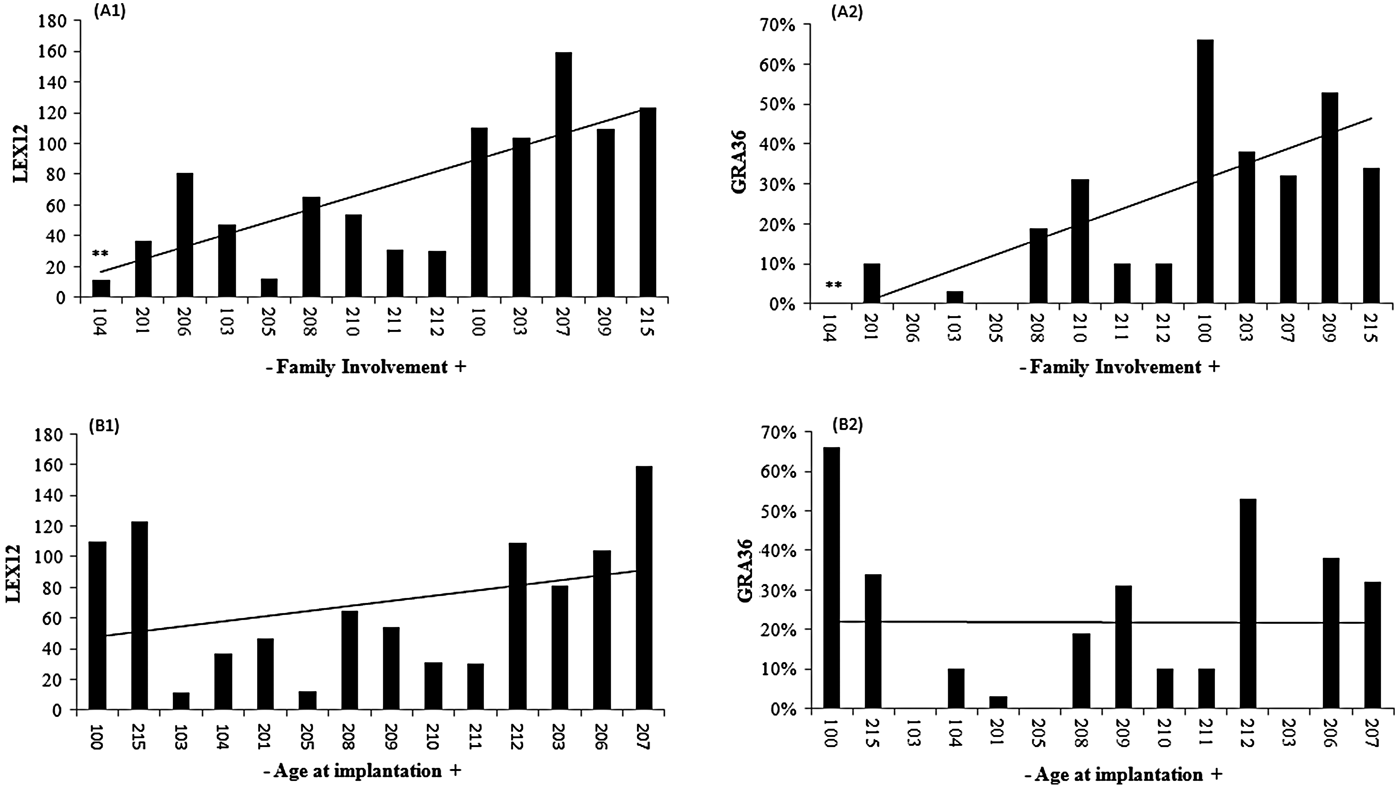
Figure 2 shows the individual scores for LEX12 and GRA36. The scores are sorted according to the degree of FI (upper panels) and to the AI (lower panels). When children are sorted according to the degree of FI, the language scores tend to increase with FI. In contrast, when the children are sorted according to AI, the language scores tend to remain stable.
Results for the lexical task 12 months post implantation, and the sentence repetition task, 36 months post implantation. In panels A1 and A2 the children are sorted according to Family Involvement, from low to high. In panels B1 and B2, the children are sorted according to age at implantation, from early to late implanted (**p < .01).
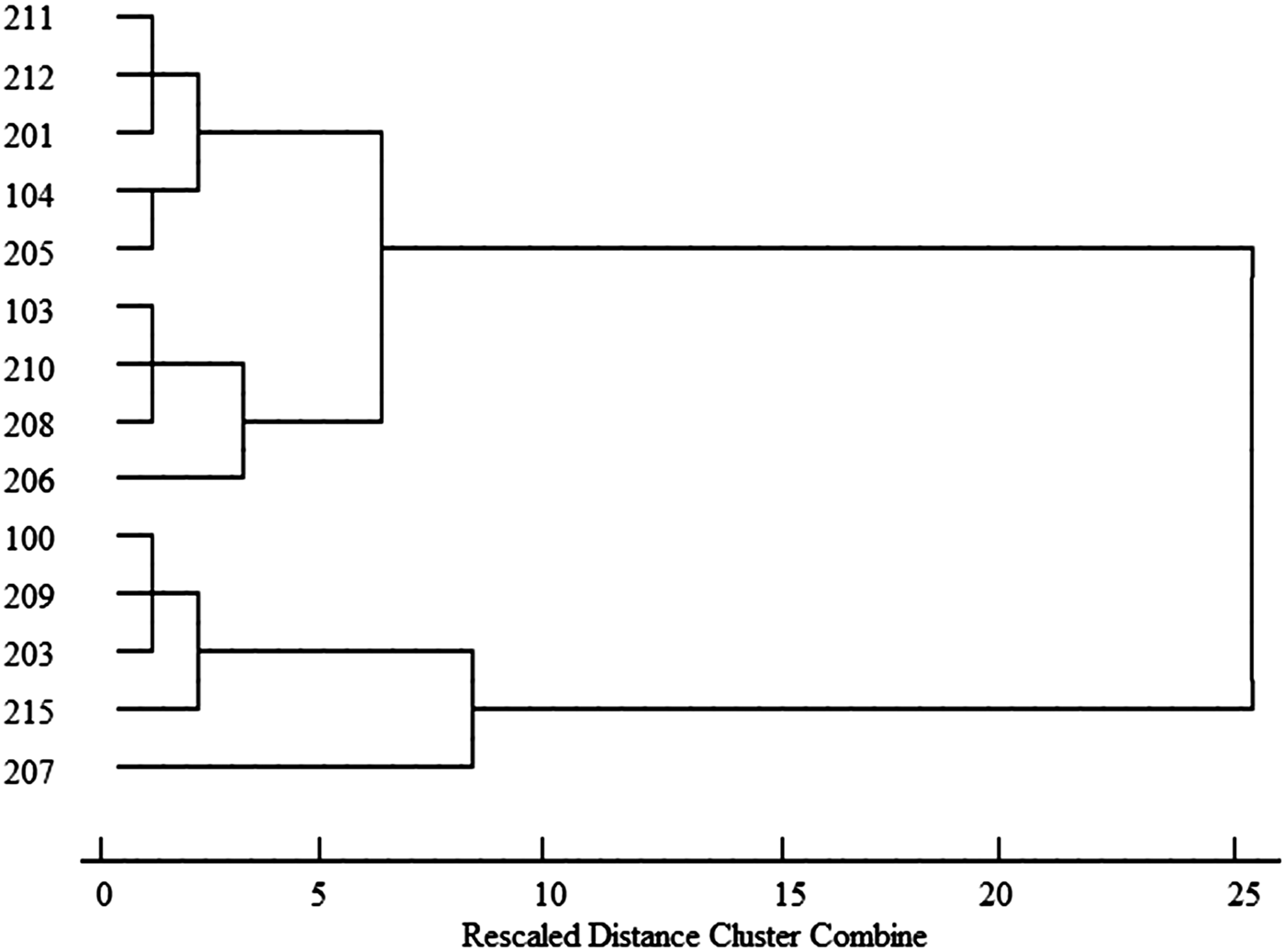
Next we used the hierarchical cluster method so as to have a better understanding of the impact of the different factors (Figure 3). For this analysis we included all the variables (i.e. AI, Gender, FI, PE, and the different phonological and language measures). The hierarchical cluster analysis identified two clusters within the CI children. The first cluster (N = 9) included all the children with FI lower than five. The second cluster (N = 5) included all the children with maximum FI (= 5). Further subdivisions within the first cluster were not clearly associated with FI or with any other variable. This suggests that there is a clear contrast between children with the highest FI and the remaining children, but that the contrast between the children with FI in the range 1–4 is not so clear.
Hierarchical cluster analysis using all the language, environmental, and individual variables.
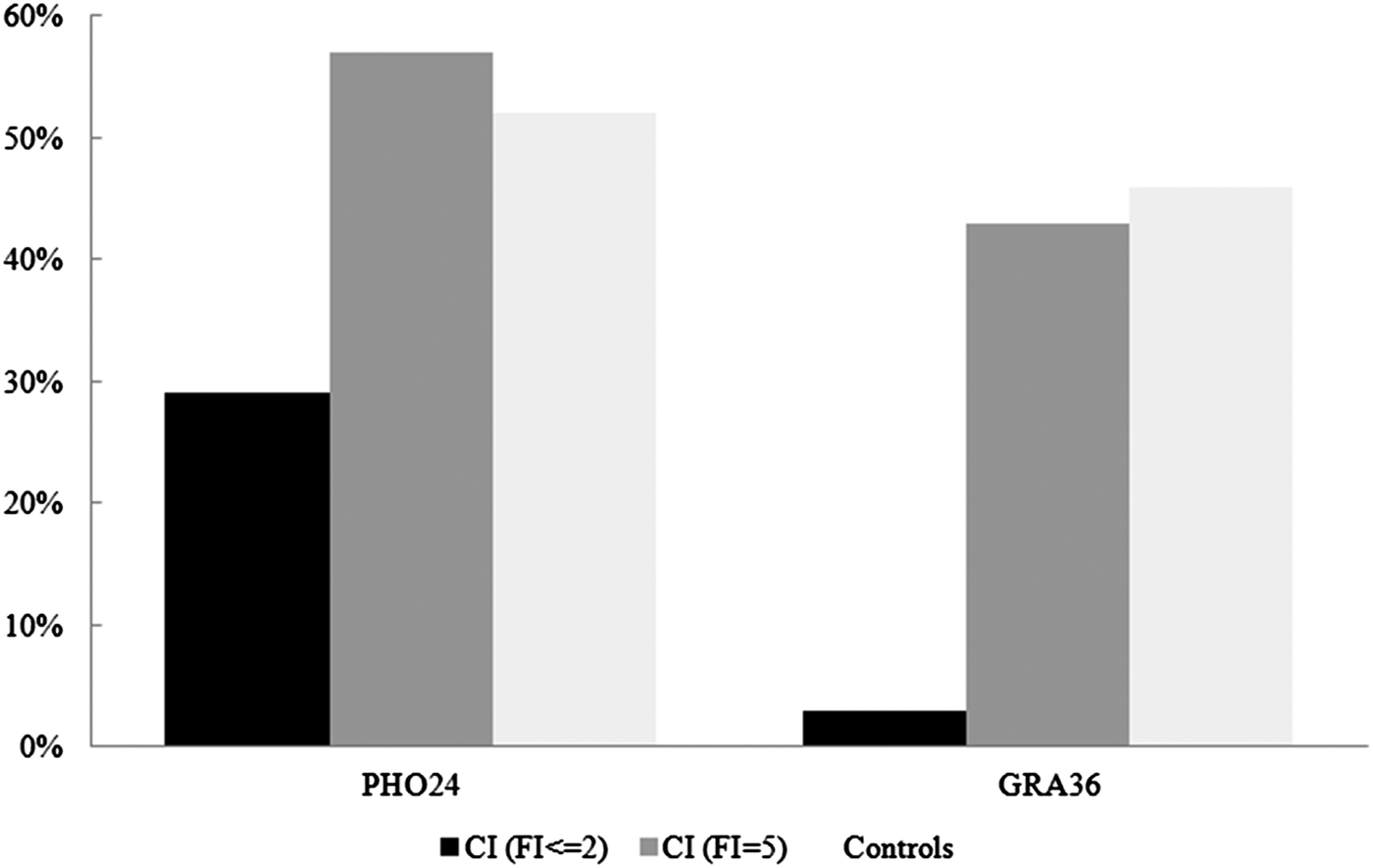
Figure 4 shows the scores in PHO24 and GRA36 for three subgroups of children: CI users with low FI (FI ≤ 2), CI users with very high FI (FI = 5), and the controls. Note that the children with very high FI score very close to the control children in both tasks. In contrast, for children with low FI the score is very poor in PHO24, and they show a floor effect in the sentence repetition task (GRA36). This indicates that the children living in highly stimulating contexts are developing language at a rate that is comparable to the rate of typical children. In contrast, the children living in less stimulating environments seem to increase the gap with their hearing peers.
Scores for the PHO24 and GRA36 tasks for the controls and CI children with low and high FI.
Some illustrative examples of the relationship between the levels of family involvement and language
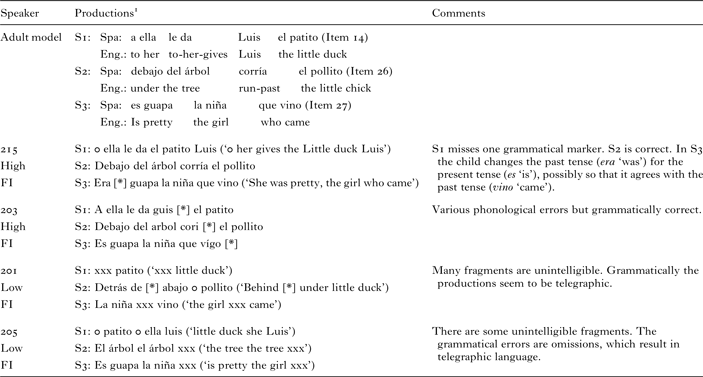
In order to help the reader to interpret the previous statistical results, we present some illustrative language extracts in this final section. The data come from four children, two of them living in highly stimulating environments (FI = 5), and two receiving very limited stimulation (FI ≤ 2). The extracts were obtained three and a half years post CI using the PRO24 sentence repetition task. The motivation to use this late sample was that it might help us to observe the differences among the four children.
In the case of the first two children (FI = 5), all the productions are clear and intelligible; they produce some minor phonological and morphological errors that can also be observed in typical children (see Moreno-Torres et al., Reference Moreno-Torres, Madrid-Cánovas and Moruno-López2013, for a description of the errors produced by typical Spanish children in sentence repetition). In the case of the other two children (FI ≤ 2), there are several non-intelligible fragments; this makes their speech clearly atypical, even for a child of their hearing age (3·5 years). From a grammatical perspective, productions seem to be telegraphic, which is characteristic of very young children.
DISCUSSION
With the aim of clarifying the impact of sensitive periods for language development in CI users, the present study addressed these two questions: (1) Do age at implantation and environmental factors impact on the development of lower-level skills? (2) Do age at implantation and environmental factors impact on the development of higher-level language skills?
The development of lower-level skills
These were the main results regarding lower-level skills: a significant correlation between age at implantation and the ratio of errors with the place of articulation; and a significant correlation between two environmental factors (i.e. Family Involvement and Parental Education) and three phonological measures (i.e. the ratios of errors with the manner and voicing features, and the fricative–stop difference). These results partially confirmed our prediction that age at implantation would correlate with the errors associated with the technical limitations of the CIs. The fact that the remaining phonological measures correlated with the environmental factors may be explained as follows. It is possible that these measures are associated with general language skills such as lexical development. This would imply that children having larger lexicons might score better for these measures; and, inasmuch as lexical development is strongly influenced by environmental conditions, these measures would also reflect the same influences.
Of special interest for the present study is the fact that age at implantation correlated with the place of articulation score but not with the scores for the other two features (i.e. voicing and manner of articulation). This result indicates that in the first two years of life plasticity reduction might be very small, or at least not sufficiently important to disturb the development of speech based in clear input. This might explain why the scores for the manner of articulation and voicing features, which are well encoded by the CI devices, do not correlate with age at implantation. However, there might be some degree in plasticity reduction that may reduce the ability of late-implanted children to learn to process poor input. This might explain the correlation between age at implantation and the scores for place of articulation, which is not well encoded by today's CIs.
In order to interpret such a result it is important to note that the brain is prepared not only to process clean input, but also to process degraded input. Processing degraded input is highly demanding and it requires increased cognitive effort (Hicks & Tharpe, Reference Hicks and Tharpe2002). It is also relevant that the pre-implant period of auditory deprivation might have negative consequences for the development of lower-level general cognitive skills (e.g. motor sequencing) that correlate with general language skills (Conway et al., Reference Conway, Karpicke, Anaya, Henning, Kronenberger and Pisoni2011). Thus, one interpretation of our results is that due to plasticity reductions CI users might have insufficient lower-level skills for efficient speech processing in highly demanding contexts. In sum, our results suggest that the difficulties in developing the perception/articulation system might be due to the combined effect of plasticity reductions affecting lower-level skills and the technical limitations of their devices.
The development of higher-level language skills
As regards the higher-level skills, the results confirmed that there was a significant correlation between the three language measures and two environmental factors (i.e. Parental Education and Family Involvement). As predicted, age at implantation was not correlated with any of the language measures. The degree of FI was the factor that had the strongest associations, which indicates that it might be a better predictor of language outcomes than PE. This result is not surprising. Having high academic achievement may help parents to understand the consequences of deafness, which seems a prerequisite to support a CI child. However, PE might be unrelated to socio-emotional aspects (e.g. accepting deafness, maternal sensitivity, etc.) that might be crucial to actually creating a stimulating environment (Markman et al., Reference Markman, Quittner, Eisenberg, Tobey, Thal, Niparko and Wang2011). In contrast, FI takes into account both the understanding/acceptance of deafness and success in adopting compensatory measures (e.g. adaptation to the child's communicative needs). This may explain why the FI score was associated with more language measures than PE. The hierarchical clustering analysis revealed a clear contrast between the children living in highly involved families and the remaining children. Altogether, these results provide further evidence that the environment exerts a considerable influence on the development of higher-level language skills in CI users (e.g. Quittner et al., Reference Quittner, Cruz, Barker, Tobey, Eisenberg and Niparko2013).
As regards the existence of a sensitive period for developing higher-level language skills, our results do not provide evidence of plasticity reductions. On the contrary, our results seem to support the alternative view, according to which the developmental process is guided by experience (Szagun & Stumper, Reference Szagun and Stumper2012). Evidence for this comes from the group of highly involved families. Our results indicate that the strategies adopted by their families may have compensated for the reduction in input characteristic of CI users. This would suggest that these children might have a linguistic experience comparable with that of typical children, which may explain why their rate of development is also comparable with that of the controls (see Figure 4). As for the children from less involved families, given that they are not receiving the required external support, it is not surprising that the developmental process is very slow. In sum, our data indicate that in children receiving a CI before the second birthday the development of higher-level language skills is experience-dependent.
Our results, together with the results from other studies, provide interesting clues to explaining the consequences of CI use and the increased impact of the environment on this population. As noted above, CI users may struggle to develop very specific aspects of the perception/articulation system (i.e. those supported by the dorsal stream). That these deficits are very specific is confirmed, among other things, by the contrast between the high LEX12 scores and the low PHO24 scores; this suggests that early in development they are more efficient at processing lexical-level (i.e. holistic) information than segmental-level (i.e. analytic) information (see also Ertmer & Mellon, Reference Ertmer and Mellon2001; Moreno-Torres, Reference Moreno-Torres2014). Such a contrast might be compatible with the proposal that CI users struggle to develop the dorsal stream, but succeed in developing the ventral stream. These selective deficits might have consequences for language development: by reducing phonological processing skills, and thereby their implicit learning skills (Hickok, Reference Hickok2012), this might slow down development (see Table 6). Furthermore, together with the difficulty of hearing, these potential deficits may produce further unwanted consequences in very diverse domains (e.g. social, academic, etc.)
Three sentences imitated by children living with high/low involvement families (42 months post-CI)1
notes:1 The following symbols are used: ‘0’ indicates that one or more words have been omitted; xxx stands for unintelligible material; [*] indicates a phonological or morphological error.
We propose that it is precisely because the core deficits of CI users are selective, and unrelated with higher-level skills, that the environment might be so influential. For instance, due to difficulties in hearing in a noisy context, CI users find themselves at a disadvantage in many social contexts (Punch & Hide, Reference Punch and Hyde2011), which may reduce the amount of social interaction (Vonen, Reference Vonen, Hyde and Hoie2007). Given the importance of social interaction for language development, reduced socialization might have further negative consequences for language. Thus, it is not surprising that specific social behaviours and strategies as measured by Maternal Sensitivity (Quittner et al., Reference Quittner, Cruz, Barker, Tobey, Eisenberg and Niparko2013) and Family Involvement (Moeller, Reference Moeller2001; this study) might be beneficial for avoiding social deficits and also for enhancing language development. A similar argument might be made in the case of linguistic input. Given that CI users may lose part of the input, parents who make an effort to provide children with a high-quality input (Szagun & Stumper, Reference Szagun and Stumper2012) may compensate for the speech processing deficits of their children and accelerate language development. In sum, it is precisely the very specific nature of the deficits of CI children that makes the environment so influential for their development.
To conclude, the results of this study support the hypothesis that there might be a short window to develop lower-level skills, and a long one to develop higher-level skills. As for the lower-level skills, the window might be too short for children implanted close to, or later than, their second birthday. However, it is relevant that plasticity reductions might be relatively small, and observable only for those acoustic aspects that are encoded poorly by today's CIs. As for higher-level language skills, plasticity reductions might not operate for children implanted in the first two years of life. However, as their devices do not give them access to all the linguistic input, particularly in social contexts, external support will be necessary to guarantee that they do receive sufficient input for optimal language development.
Given the small number of participants in this study, the present results must be taken as preliminary. Future studies should further explore how declines in plasticity might disturb the ability for speech processing under demanding situations, such as hearing in noise or hearing through a cochlear implant. Clinical and educational research should further analyze which strategies might be more effective for compensating for such limitations and for avoiding cascading effects on language development.