“Perhaps one of the highest priorities we have in the profession is to assure that the community of political science scholars is as inclusive as possible. This goal applies to the composition of the professoriate, the graduate student classroom, and to the practicing world of political science, as well as to the content of scholarship and approaches taken by the discipline”
(APSA Annual Report, 2005–06: Networking a World of Scholars, 2006, 14).
The American Political Science Association (APSA) has roughly 14,000 members. In fall 2002, APSA appointed a “Task Force on Inequality and American Democracy” (TFIAD). The group's 15 members represented various prestigious American universities, including, for example, Harvard, Stanford, Princeton, and the University of Illinois at Urbana-Champaign. TFIAD was tasked with assessing the relationship between economic inequality in America and changes in political participation rates in our representative democracy.
The group issued its findings in 2004. Their report (TFIAD 2004), titled American Democracy in an Age of Rising Inequality (ADARI), revealed that over the last 30 years a pronounced upward shift in the distribution of wealth and income in our nation has led to growing economic inequalities that have caused government officials to become much more responsive to the demands of the well-to-do at the expense of the rest of the population, especially those of low income and low education.
Among its various findings, TFIAD argued, “Disparities in wealth and income have recently grown more sharply in the United States than in Canada, France, Germany, Italy, and many other advanced industrial democracies” (2). The report further warned of “the growing concentration of the country's wealth and income in the hands of the few” (1). ADARI's comparison of longitudinal data on the income distribution among families in the U.S., Britain, and France finds that the percent of earnings going to the highest one-tenth of 1% of households in the three countries ran parallel through much of the twentieth century. From the end of World War I through the 1960s, these three countries adopted public policies meant to prevent large disparities in the distribution of income among their respective citizenries. However, starting in the mid-1970s, “the United States rapidly diverged from its two allies and became far more unequal” (3). By the late 1990s, the percent “of income held by the very rich was two or three times higher in the United States than in Britain and France” (3).
The report explains that Americans are willing to abide high levels of income disparities as long as “everyone has an equal chance to get ahead” (4). Yet, ADARI notes that upward social mobility in the United States has been gradually declining. Apparently, the “upward mobility of the few has not offset the economic disparities among the many.” The report bemoans that today Americans are working harder just to stay in place (to maintain their current economic standing), let alone get ahead.
Not surprisingly, the upward redistribution of wealth has meant that more affluent Americans have an easier time financing their children's education (11, 16). Meanwhile, it is becoming harder for poor and working class (hereafter simply “working class”) parents to pay their children's college expenses. The education horizons of youngsters from these homes have been further limited by other factors affecting school financing, such as reductions in the value of Pell Grants, declining support for race- and gender-based affirmative action, and cuts in state budgets for higher education (16, 18). Gerald and Haycock's (Reference Gerald and Haycock2006) Engines of Inequality: Diminishing Equity in the Nation's Premier Public Universities further buttresses the report's argument. This study shows that flagship public universities in most states are becoming ever less accessible to students from low-income families. These findings are especially revealing because “everyone has an equal chance to get ahead” (ADARI, 4) usually means that no matter what family circumstances they are born into, formal schooling presents all children the same opportunity to earn the credentials needed to gain high standing in life. For Americans, formal learning is the “great leveler” (Birdsall Reference Birdsall1998).
Because of the strong relationship between tertiary schooling and increased political participation (ADARI, 5, 8), TFIAD also considers these growing inequalities in educational opportunities a threat to our democracy. The authors describe the college campus as an “invaluable” (16) booster of interest in politics and political participation. Among other things, the report notes that higher learning “instills skills and values that encourage voting” (6) and that “Less advantaged Americans vote less because they lack the skills, motivation, and networks that the better advantaged pick up through formal education and occupational advancement”(7). In sum, ADARI argues that those with more formal education possess greater “confidence and abilities to speak and organize than do individuals who sweep floors, clean bedpans, or collect garbage” (8).
Ironically, this means Americans with the most to gain through political involvement are least inclined to engage in these activities. As the authors note, “Those Americans who would be most likely to raise issues about basic opportunities and needs—from escaping poverty to securing jobs, education, health care, and housing—tend to be the least likely to participate in politics” (11). Elsewhere, the report describes how in the past America was a leading force in democratizing higher education. According to ADARI:
The United States pioneered schooling for all, spending about as much or more than many advanced industrialized countries. Promotion of education has helped to open the door to opportunity for students who work hard, to propel the country's economy, and to lower economic disparities. It has also boosted participation in volunteer organizations and democratic life. (15)
Finally, the report speaks of the need for “broad efforts to spread opportunity and assure security for large numbers of Americans [because it] can also have the salutary side-effect of enhancing democratic citizenship” (19).
Problem Statement
ADARI recognizes the importance of race- and gender-based affirmative action in achieving egalitarian ends. Meanwhile, it laments that it is becoming more difficult for working class parents to send their children to college, a place where their progeny are likely to learn the important skills and values associated with participating in democratic government. Despite mentioning these topics, nowhere does ADARI specifically propose that colleges open their doors wider to those whose parents or guardians “sweep floors, clean bedpans, or collect garbage” (8). Nevertheless, given the report's tone, the publicity surrounding its distribution (Weissberg 2004–Reference Weissberg2005), its APSA sponsorship, its emphasis on egalitarian ends, and its mention of affirmative action, it seems only fair to question whether and how many of America's leading political science programs are using socioeconomic-based affirmative action to enroll more students of humble origins. Therefore, this study asks: If democratizing higher learning along socioeconomic lines is as important as ADARI implies, do most, if not all, of America's leading political science programs use socioeconomic-based affirmative action to ensure they are enrolling a diverse student body. If so, then these programs are practicing what TFIAD preaches about making America a more representative and democratic enterprise. If not, then it suggests that these programs are ignoring a major point of a report authored by several of the discipline's foremost figures representing many of its top-rated departments.
Finally, if the results show few, if any, of these premiere programs are pursuing the laudable egalitarian values TFIAD espouses, the discussion will close by proposing possible explanations for this oversight and ways to remedy the problem.
Methodology
Undergraduates have a great deal of control over their academic career, exemplified by their self-selection of an academic major during their sophomore or junior year. In contrast, faculty program committees exercise full control over graduate student admissions through reviews of individual application files. Given these disparities in control over student acceptances to a department, this project gauges whether the surveyed political science programs use socioeconomic-based affirmative action criteria for selecting among graduate applicants. First, I establish how many political science graduate programs gather information on the socioeconomic origins of students seeking admission. Next, I determine how many of the programs that collect these data weigh them when deciding acceptances. “Socioeconomic origins” is operationalized according to each applicant's parents' educations and occupations. This approach is consistent with how the University of Michigan Law School operationalizes “socioeconomic origins” (Application 2007) for affirmative action purposes.
Data for this research were gathered through a questionnaire distributed to 34 political science graduate programs in the United States. Poll participants were chosen according to two criteria. Twenty-eight schools were selected based on the 2007 edition of U.S. News and World Report's (hereinafter USNWR) yearly survey of “America's Best Graduate Schools” separated by academic discipline (USNWR 2006, 63). The other six participants represented institutions not on the USNWR list but with which the remaining TFIAD members were affiliated.
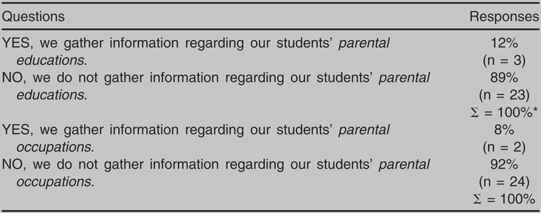
The survey packet included a cover letter that explained that the study was meant to determine which, if any, schools gathered data on the socioeconomic origins of their students. The wording of the possible responses appears in Table 1
Number of Political Science Graduate Programs Requesting Information about their Students' Social Class Origins

* The sum exceeds 100% due to rounding.
The questionnaire guaranteed all recipients anonymity. This same assurance was extended in all follow-up contacts with respondents. The survey was pre-tested in a single wave at 10 randomly selected schools offering graduate degrees in political science but not listed among the 34 colleges mentioned earlier. The final questionnaire was distributed in four waves during fall 2006. Twenty-six of the 34 schools replied, a 76% response rate.
Follow-up letters were sent to all programs that said they solicit this background information. These respondents were asked to elaborate on how they use the collected data when deciding admissions. They were also asked whether they maintain longitudinal information on student backgrounds to see if faculty admissions decisions in individual programs have been offsetting or reinforcing the antidemocratic trends noted in ADARI.
Findings
The survey results are presented in Table 1. Only four programs noted that they collect information about their students' socioeconomic origins. Approximately 12% (n = 3) of the respondents indicated that they gather data about parental education and roughly 8% (n = 2) replied that they gather information about parental occupation. The number of observations sums to five because one (3.9%) of the four responding programs solicits statistics about both parental education and parental occupation. These four responses were randomly scattered along the rankings spectrum. That is, programs in, say, roughly the top, middle, or bottom third of the rankings were not most likely to gather these background statistics. Likewise, there was no discernible pattern on the “Responded”/“Did Not Respond” dichotomy for returned questionnaires.
The four programs that returned surveys indicating that they collect parental education or occupation information were contacted via follow-up communications and asked how they weigh these data for admissions purposes and whether they maintain this information to use in measuring demographic trends in enrollment. The first respondent, whose program solicited information on both background factors, explained its faculty's data usage this way:
The … Admissions Committee does not take systematic notice of this information when deciding on an applicant's suitability for admission to our … program …
The only time parental education and occupation is [sic] relevant to our deliberations is if there is a possibility to nominate an applicant who is otherwise admissible for a Graduate School fellowship that can be awarded to a student who represents the first generation in her/his family to attend university. However, this is a very rare occurrence and none of us can recall a recent instance.
This respondent said that while his/her program maintains these background figures for one year, the Admissions Office keeps them on hand for several years. Thus, it would be possible to measure longitudinal trends in the socioeconomic composition of students enrolled in that political science department, although his/her program does not do this.
The second respondent noted that while his/her program gathers data on the applicants' parental occupations, these figures are seldom used in deciding admissions, plus the information is not kept in a database. He/she noted:
It is a very minor part of the application and only rarely relevant in making decisions. Unfortunately we do not store it, nor would we be able to access that information for future use.
The third respondent said that while his/her department's application form requests data on parental education, the program's admissions committee likely does not consider this information when deciding acceptances. He/she explained:
It's less clear whether and how it [parental education] affects admissions. We admit by committee, and each committee member looks at the whole person (as represented by the application file). Committee members consider all information in the file when looking at the whole person. How committee members weigh different aspects of an application is up to them. I do not personally know of a clear case where I could say that a person was admitted because of this information who would not otherwise have been admitted in its absence. It's just considered along with everything else.
Although it seems this program's admissions committee does not weigh parental education when determining acceptances, after granting applicants entry, family background details are used in soliciting financial assistance for those whose parents were high school graduates or less, or if the applicants are first generation graduate school. As this respondent explained:
It's [parental education] not so much an admissions'-based tool, but information mainly used for nominations for additional financial support. The university has a number of fellowships for which students can compete. Students who come from disadvantaged and/or diverse backgrounds—including the fact that an applicant might be the first in their [sic] families [sic] to go to college (or to get a graduate degree)—can be nominated for additional financial and other support. So I might mention that background along with other aspects of the applicant's personal history when nominating them [sic] for one of these awards.
This respondent said his/her program does not maintain longitudinal data on the parental education of individual students.
The fourth respondent's explanation of how these data are used closely followed that of respondents #1 and #3. As he/she noted:
While we do not use this [education] information for admissions decisions, it is used to determine eligibility for … Fellowships [open to, among others, first generation college students].
In response to the question of whether this program maintains longitudinal information about the demographic composition of its student cohorts, the fourth respondent explained:
Yes, [we have access to this information] back to the class that entered in 2003 easily. If you need additional years it will be a bit more difficult, but could be done.
In sum, only four of the responding programs collect socioeconomic background data from their applicants and, evidently, none uses this information for affirmative action purposes when deciding admissions. First-generation college students, for example, do not seem to receive special attention as part of an effort to assure greater student diversity. However, once students are admitted, three programs say they try to help them secure financial aid if they are first generation college, from a disadvantaged background, or, in one case (respondent #3), first generation graduate school. Although it might happen rarely, still, helping first-generation college admits gain financial backing is significant because usually these students know less about securing financial aid than do their higher socioeconomic status counterparts (Nettles and Millett Reference Nettles and Millett2006; Schmidt Reference Schmidt2007).
A check of the individual web sites finds that all 26 of the responding universities support “equal employment,” “affirmative action,” and “diversity.” In their accompanying commentaries about the importance of demographic diversity for improving educational outcomes, a few sites mention how students of different socioeconomic origins enhance the campus' learning climate. Likewise, a follow-up review of the “Personal Information” section from the individual application forms of these 26 universities showed that each surveys potential students for “race/ethnicity,” “age,” and “gender.” Thus, if researchers want to gauge the age, gender, or race/ethnicity composition of students enrolled in a program, they can, as each university collects and maintains these statistics, but does not, in most cases, collect data on socioeconomic origins.
Finally, the present findings are even more telling when weighed against statements presented in the APSA Task Force on Graduate Education (2004). On matters pertaining to the socioeconomic backgrounds of their students, these leading schools seemingly ignore the following Task Force comments: a) “all departments should seek to achieve appropriate demographic diversity of their facultyFootnote 1 and student populations” (5); b) “much remains to be done by all of us to achieve a profession more representative of America's, and ultimately the world's, population” (6); and c) there is need for “a broadly shared faculty willingness to mentor students who may come from less familiar educational and social backgrounds” (6).
Discussion
The evidence reveals that overall these leading political science programs are doing little to counteract the antidemocratic trends noted in ADARI. The vast majority of respondents invest little or no effort in enrolling more students from working class backgrounds. The survey results suggest socioeconomic diversity is unimportant to most of these programs, as an overwhelming number gather no information relevant to achieving this end, only two departments maintain this information beyond one year, and these data are not used for monitoring demographic trends. Perhaps future research will establish whether these general conditions are caused by a failure to weigh the matter (“Nobody ever raised the question”), or if it was formally decided to exclude considerations of socioeconomic origins from the schools' affirmative action efforts. Given the rising costs of college and the other, earlier-cited factors, if these student background data were available longitudinally, they may well show that by failing to recruit a more socioeconomic diverse cohort of students, the fields' leading departments are enhancing, versus offsetting, the antidemocratic trends noted in ADARI.
While some will say that inquiring about an applicant's socioeconomic origins is “intrusive” or a violation of privacy rights, this seems more an afterthought than a convincing rationale for the results reported here. The proof of this statement lies in the fact that various universities already gather this background information. These efforts range from the undergraduate level (West Virginia University) to law school (The University of Michigan) to graduate school (the few respondents noted herein) to most medical schools,Footnote 2 to name only a few examples. Certainly, numerous other educational support initiatives, such as Upward Bound and the Ron McNair Scholars Program, ask applicants about their socioeconomic origins. Kahlenberg's (Reference Kahlenberg1996) writings establish that such questions are clearly lawful. (More on Kahlenberg's analysis and findings shortly.)
If a program is worried about being “intrusive,” it could use the same approach school officials now employ for race/ethnicity questions. Namely, they can label these inquiries “Optional,” thereby allowing applicants to decide whether to record a response. Using this format means programs would only grant special attention to applicants who indicate they are of humble origins. For those worried about people providing false responses, the same rules about breach of contract would apply here as with any other questions listed on the application.
This general failure to consider such compensatory socioeconomic-based measures is puzzling for at least three reasons. First, the ADARI comments about the strong relationship between socioeconomic origins and academic achievement are hardly new. There is a longstanding and ever-growing body of published research on this point (see, for example, deLone Reference deLone1979; Golden Reference Golden2006; Kahlenberg Reference Kahlenberg1996; and Nettles and Millett Reference Nettles and Millett2006). Certainly one would expect most university faculty to know of these findings, if only broadly.
Second, the early empirical political science studies clearly demonstrated that socioeconomic standing and educational attainment significantly correlate with political participation levels (see, for example, the references cited in Milbrath and Goel Reference Milbrath and Goel1977, 92, 98–102). One would assume—by definition—that political science faculty, more than professors from most other fields, would appreciate the formidable link between resources and participation. This understanding, combined with the nation's roughly 30-year emphasis on supply-side economics (Gilder Reference Gilder1981), with its well-documented upward redistribution of wealth, means that those with ever-declining resources will inevitably find it harder to finance their children's higher learning. (For more specifics on the upward redistribution of wealth, see Phillips Reference Phillips2002.) These factors make this overall failure to collect data about students' socioeconomic backgrounds even more problematic.
Third, the recent writings, debates, discussion, and court decisions surrounding affirmative action have included frequent mention of using socioeconomic background considerations in deciding college admissions at all levels of education, including, as noted earlier, professional schools. In Gratz v. Bollinger, the U.S. Supreme Court's 2003 opinion on the constitutionality of the University of Michigan's diversity policies, University of Michigan administrators readily acknowledged that their admissions formula granted additional points to students from disadvantaged origins. Moreover, Kahlenberg's (Reference Kahlenberg1996) frequently mentioned and exhaustively researched The Remedy convincingly establishes that including socioeconomic criteria in an admissions formula is virtually immune to constitutional challenge; the U.S. Supreme Court has never rejected a law or rule effecting socioeconomic classifications. Meanwhile, the Court has overturned policies involving race (Gratz v. Bollinger 2003 and Brown v. Board of Education 1954) and gender (United States v. Virginia 1996) considerations. Even Justice Antonin Scalia (Reference Scalia1979), perhaps the U.S. Supreme Court's most ardent foe of race-oriented diversity plans, readily accepts socioeconomic-based affirmative action programs, even if they result in disproportionately high numbers of racial and ethnic minority beneficiaries. If anyone doubts the popularity of and support for “socioeconomic-based affirmative action,” a Google search using the phrase “class-based affirmative action” yields thousands of references. In other words, the arguments for this idea are hardly obscure.
In the last several years, referenda/initiative voters or public officials in California, Washington, Florida, and Michigan (Baldas Reference Baldas2006) have acted to eliminate all race- and gender-based affirmative action plans. Combined, these states represent 25% of the U.S. population (Kahlenberg Reference Kahlenberg2007. Also see Lewin Reference Lewin2007). None of these prohibitions forbid using socioeconomic considerations as part of an affirmative action effort. For example, as the web site for the recently passed Michigan referendum explains: “Proposal 2 also does not seek to ban socioeconomic affirmative action,” only race and gender considerations (Voter Guide n.d.). Further, a University of Michigan web site explains that although race- and gender-based programs are subject to Proposal 2 restrictions, “Socioeconomic status is already considered in our programs, including admissions and financial aid, and it continues to be a priority for us to make certain that opportunities are extended to all students regardless of their financial circumstances” (Diversity Matters n.d.). Surely most if not all faculty from the schools surveyed for this study knew, if only in passing, of the legitimacy and popularity of socioeconomically oriented student diversity policies.
The present situation is also perplexing in that many of these schools are signatories to the 1997 American Association of University's Diversity Statement on the Importance of Diversity in University Admissions (AAU 1997). Redundant title aside, this document includes idealistic declarations directly affecting the question raised in the present study. In particular, the Statement asserts:
“[AAU] expresses strong support for continued attention to diversity in university admissions,” 2) “we therefore want to express our strong conviction concerning the continuing need to take into account a wide range of [demographic] considerations,” 3) “We believe that our students benefit significantly from education that takes place within a diverse setting. In the course of their university education, our students encounter and learn from others who have backgrounds and characteristics very different from their own,” 4) “A very substantial portion of our curriculum is enhanced by the discourse made possible by the heterogeneous backgrounds of our students. Equally, a significant part of education in our institutions takes place outside the classroom, in extracurricular activities where students learn how to work together, as well as to compete; how to exercise leadership, as well as to build consensus,” and 5) “We therefore reaffirm our commitment to diversity as a value that is central to the very concept of education in our institutions”
(AAU 1997).Notwithstanding these idealistic ends, the present project shows there is no evidence that any of the 26 responding programs are taking proactive steps to ensure their student bodies represent a wide range of socioeconomic backgrounds.
Conclusion
It seems safe to assume that political scientists deal not just in theory but also in practice. But if this were the case, then ADARI would have prompted faculty at these premiere institutions to consider socioeconomic factors as an element in how their own programs function. The argument here is not that socioeconomic-affirmative action should replace all race and gender diversity plans. Rather, the point is, that consistent with the egalitarian ideals expressed in ADARI, socioeconomic factors should be included in the mix of admissions' criteria at these leading programs. Of course, if present judicial trends and legislative efforts continue, socioeconomic origins may be among the only acceptable diversity standards remaining in most jurisdictions. Notwithstanding what happens on other fronts, ADARI illustrates that ongoing student affirmative action endeavors can never reach full flower as long as being of working class origins is ignored in the selection process.
While certainly the findings about the field's leading programs will disappoint some, the results are maybe understandable when considered in light of perhaps this nation's most powerful myth. Ultimately, the question addressed here involves the touchy subject of social class, however the idea is defined for research or policy purposes and whatever terms are used to indicate relative standing. Various authors have commented on how Americans mostly downplay or ignore the importance of social class in everyday life. Perrucci and Wysong (Reference Perrucci and Wysong2003, 44), for example, say social class is American's “last taboo.” White (Reference White, Shepard, McMillan and Tate1998, 278) calls it the nation's “buried issue,” and Mikulak (Reference Mikulak1990, 114, citing Fussell) writes, “You can outrage people today simply by mentioning social class, very much the way, sipping tea among the aspidistras a century ago, you could silence a party by adverting too openly to sex.” Certainly, there are few public discussions about the consequences of inheritances, both cultural and economic, and especially about how these bequests profoundly affect social mobility and educational opportunity in America (Kahlenberg Reference Kahlenberg1996; Perrucci and Wysong Reference Perrucci and Wysong2003; and Wysong, Perrucci, and Wright Reference Wysong, Perrucci and Wright2002). Someone's failure to succeed is seldom blamed on having chosen the wrong parents, or if he or she succeeds, the right ones. Certainly, university instruction rarely entertains questions relating to these matters. As Lipsitz (Reference Lipsitz and Kumar1997, 20) notes, social class is generally “eras[ed]” from the higher education curriculum. According to hooks (Reference hooks1994, 177), “Class is rarely talked about in the United States; nowhere is there a more intense silence about the reality of class differences than in educational settings.” Significantly, class differences are ignored in classrooms (also see Hurst Reference Hurst1995, 308–10). By simply insisting we are a country without social classes, or if we have them, they do not matter much, or for long, the nation's folklore persists, notwithstanding an ever-growing body of empirical findings to the contrary. The mobility formula is simple: With enough Horatio Alger grit, determination, and (usually) formal education (the Great Leveler), anyone can get to the top, or for present purposes, find their way into a leading political science graduate school. One of ADARI's supporting documents further details this belief about the myth of individual responsibility (Schlozman et al. Reference Schlozman, Page, Verba and Fiorina2004, 8).
Despite the “science” in political science and numerous studies showing the strong connection among socioeconomic status, however defined, political participation, and college attendance, the present project suggests that while most professors in these leading programs would probably readily acknowledge the importance of social class in the abstract, they are generally unwilling to apply these lessons to their own, everyday work environments. Time will tell whether the present findings prompt more of these programs to include socioeconomic origins in their student admissions formula. It is hard to imagine a more effective way of helping faculty appreciate the relationship between student origins and educational attainment than by weighing these factors when deciding admissions. Meanwhile, given the availability of the survey results, the faculty in these programs should realize why these egalitarian efforts are worthwhile.
The popular view of college professors is that of forward-thinking individuals who willingly challenge conventional wisdom at every turn. Higher education is supposedly where students learn the value of doubt, critical analysis, and new ways of seeing the world. David Horowitz (Reference Horowitz2006) has made a living insisting American campuses are teeming with radical and revolutionary professors seeking to fill their students' heads with egalitarian propaganda. In this same spirit, Weissberg (2004–Reference Weissberg2005, 30) describes TFIAD as “APSA's Radical Egalitarian Task Force.”
Notwithstanding these depictions and popular stereotypes, the current findings suggest that on matters of socioeconomic origins, even two years after ADARI's release, most of the nation's leading political science programs have taken no actions to contradict the countless academic advantages privileged children—compared to their less fortunate working-class counterparts—inherit simply by accident of birth, or what might be called “the inhERITed part of mERIT.” In short, by failing to recruit a more socioeconomically diverse student body on their own campuses, almost all these schools are ignoring the spirit of a report “formed under the auspices” (ADARI, 1) of their discipline's leading organization.
On its face, this inaction will puzzle some readers, given it involves such highly experienced and educated individuals. One would think these political scientists, whatever their own philosophical leanings, would appreciate that the child of, say, two dentists (or any other college-credentialed “professionals”) inherits countless cultural and financial advantages that a youngster whose father is a single parent with a ninth-grade education and works full-time as a short-order cook in a fast food restaurant obviously lacks. In their groundbreaking study, Hart and Risley (Reference Hart and Risley1999) quantify the relationship between socioeconomic origins and the development of learning skills tied to later academic success. In a foreword to their book, Bloom offers an especially powerful summary of these researchers' findings. She (p. x) writes:
We have long known that children differ greatly in when they begin to learn language and how fast they learn once they begin. The children in this study did indeed differ. Some began to learn words with a learning trajectory that took off like a small rocket. But other children, who may even have begun to say words at about the same age, were much slower to get off the ground, and their trajectories were forever in the shadow of the other children. Why? That is the central question in this book.
In answering the question, Hart and Risley discovered that some things don't matter. For example, race/ethnicity doesn't matter; gender doesn't matter; whether a child is the first in the family or born later also doesn't matter. But what does matter, and it matters very much, is relative economic advantage.
Justice oftentimes requires compensatory actions. Instead of defining merit according to rigid standards, the academy should also assess how far individuals have traveled to qualify for review. Assume the child of the fast food worker is seeking entry into one of these leading political science programs. Faculty at these respective institutions should not only formally acknowledge both the great distance she has traveled to warrant their consideration and the countless lessons her long journey has taught her, but also that she will bring these ideas to her studies at their university. Certainly, everything concerning this expanded interpretation of qualifications comports with the ideals expressed in the earlier-cited AAU statements about valuing diversity. Of course, if university faculty do not first gather the necessary background information and then evaluate it accordingly, these benefits can never be realized.
On page 2, ADARI states:
But to counter current trends that undermine inclusion and fairness, we must work together for democratic renewal. Failure to take urgent and concerted steps to expand political participation and enhance democratic responsiveness—and failure to use democratic means creatively to temper rising social disparities—will surely endanger our longstanding democratic ideals at home and undermine our country's efforts to spread the hope of equal citizenship abroad.
By implication TFIAD is saying The Great Leveler Needs Leveling. As one of ADARI's supporting documents notes, a similar and successful attempt at democratizing higher education happened after World War II when the G. I. Bill allowed countless veterans to earn a college degree, something most of these men and women could not have afforded otherwise (Hacker et al. Reference Hacker, Mettler, Pinderhughes and Skocpol2004, 37–41). By opening their doors to more applicants whose parents or guardians “sweep floors, clean bedpans, or collect garbage” (8), these leading programs will prove their commitment to ADARI's insistence on making “[p]rogress toward realizing America's democratic promise.”