Introduction
Wood-fall communities are considered an evolutionary first step for shallow-water invertebrates in adapting to vent and seep sites (e.g., Distel et al., Reference Distel, Baco, Chuang, Morril, Cavanaugh and Smith2000; Lorion et al., Reference Lorion, Buge, Cruaud and Samadi2010). Therefore, it is essential to reconstruct the evolution of these communities over geological time, especially for so-called ‘Cenozoic type’ chemosynthetic communities, including the vesicomyids and bathymodiolines, which first appeared in the middle Eocene (Amano and Kiel, Reference Amano and Kiel2007; Kiel and Amano, Reference Kiel and Amano2013). Although many Cretaceous chemosynthetic communities have been recorded (e.g., Campbell, Reference Campbell2006), only two Paleocene chemosynthetic communities have been reported, from the Panoche Hills in California (Schwartz et al., Reference Schwartz, Sample, Weberling, Minisini and Moore2003) and Spitsbergen Island (Hryniewicz et al., Reference Hryniewicz, Bitner, Durska, Hagström, Hjálmarsdóttir, Jenkins, Little, Miyajima, Nakrem and Kaim2016). Neither of these communities contained vesicomyids or bathymodiolines.
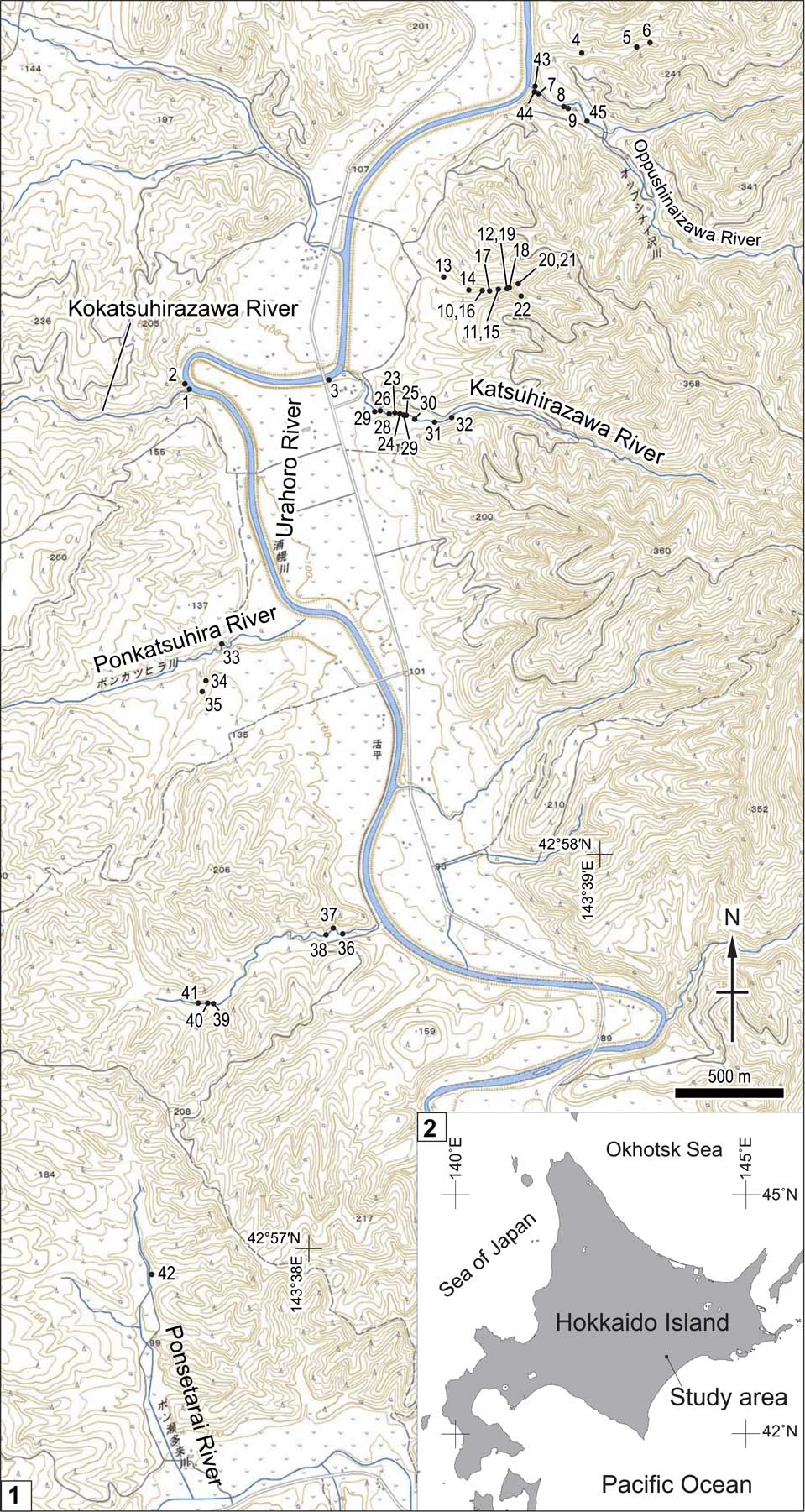
In Urahoro Town, eastern Hokkaido (Fig. 1), many species of deep-sea mollusks have been recovered from the Paleocene Katsuhira Formation around its type locality (Oda et al., Reference Oda, Nemoto and Uemura1959) by the authors and their colleagues (Amano and Jenkins, Reference Amano and Jenkins2014, Reference Amano and Jenkins2017; Amano and Oleinik, Reference Amano and Oleinik2014; Amano et al., Reference Amano, Jenkins and Nishida2015a, Reference Amano, Little, Campbell, Jenkins and Saetherb, Reference Amano, Oleinik and Jenkins2016b). These are defined as wood-fall communities because they include some chemosymbiotic species such as limpets, lucinids, and thyasririds, as well as an aporrhaid gastropod, a detritus feeder on plant fragments, deposit feeders such as protobranch bivalves, suspension feeders such as Bentharca Verrill & Bush, Reference Verrill and Bush1898, and predators such as buccinoideans and cancellariids (Amano et al., Reference Amano, Jenkins and Kiel2016a), adding to wood-boring bivalves such as Xylophaga? sp. Among the protobranchs, two species and two genera survived the end-Cretaceous mass extinction, but disappeared by the end of the Paleocene (Amano and Jenkins, Reference Amano and Jenkins2017). Moreover, it has been elucidated that Bentharca steffeni Amano, Jenkins, and Nishida, Reference Amano, Jenkins and Nishida2015a, Admete katsuhiraensis Amano, Oleinik, and Jenkins, Reference Amano, Oleinik and Jenkins2016b, and Tindaria paleocenica Amano and Jenkins, Reference Amano and Jenkins2017 are the oldest records of their genera worldwide. Thus, in the Paleocene, it is possible that the deep sea in the northwestern Pacific could have acted as a refuge from the end-Cretaceous extinction and as a place of origin of Cenozoic-type mollusks. To address this hypothesis, it is necessary to carry out detailed taxonomic research on the fauna of the Katsuhira Formation. In this paper, we describe some new species and Mesozoic-relict species from the formation in detail.
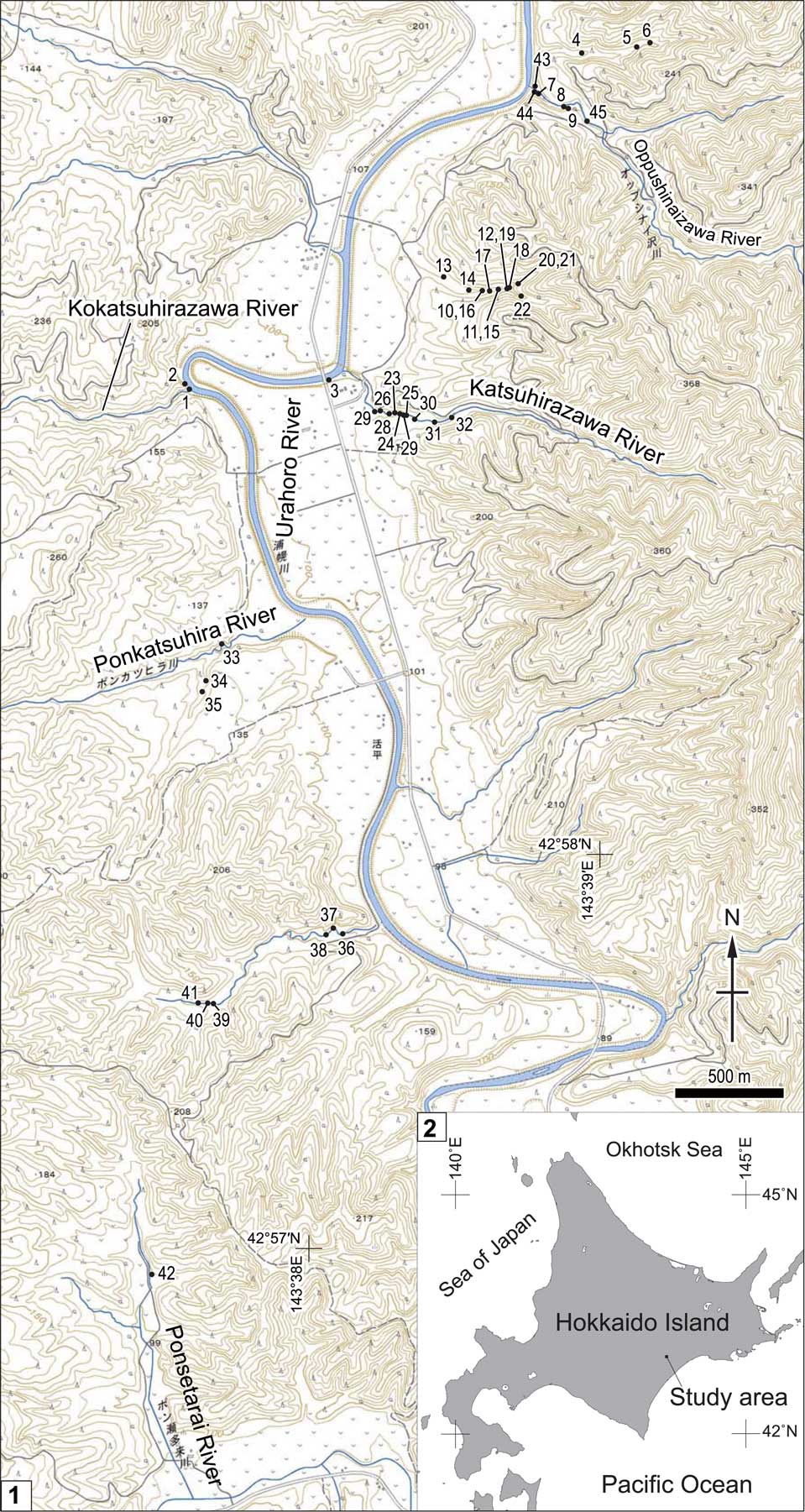
Map showing the fossil localities: (1) locality map of fossils (base map is from ‘Katsuhira,’ scale 1:25,000; topographical map published by the Geospatial Information Authority of Japan); (2) map showing the study area in eastern Hokkaido.
Geologic setting
Molluscan fossils were collected by the authors from 45 localities of the Katsuhira Formation (Fig. 1). Stratigraphically, use of the Katsuhira Formation by Kaiho (Reference Kaiho1984) has caused some confusion. In this paper, we use Katsuhira Formation (>600 m in thickness) according to the original definition by Oda et al. (Reference Oda, Nemoto and Uemura1959), which corresponds to the ‘Katsuhira Mudstone Member’ of the Tomikawa Formation by Nishijima (Reference Nishijima1964). The formation consists of dark gray mudstone frequently yielding calcareous concretions with plant debris (~30 cm in diameter).
The age of the Katsuhira Formation herein, near the boundary with the overlying Tokomuro Formation, was confirmed as Selandian by planktonic foraminifers, and the lower part of the formation also as Selandian by calcareous nannofossils (Kaiho, Reference Kaiho1984). However, as a result of our examination of many dinoflagellate cysts from the dark gray mudstone of the middle part of the formation at Loc. 1, from which many molluscan fossils have been collected, the following species were identified: Senegalinium microspinosum (Boltenhagen, Reference Boltenhagen1977), Palaeocystodinium golzowense Alberti, Reference Alberti1961, Eisenackia margarita (Harland, Reference Harland1979), Eisenackia sp., Glaphyrocysta spineta (Eaton, Reference Eaton1976), G. divaricata (Williams and Downie, Reference Williams and Downie1966), and Hystrichosphaeridium tubiferum (Ehrenberg, Reference Ehrenberg1838), as well as the acritarch species Paralecaniella indentata (Deflandre and Cookson, Reference Deflandre and Cookson1955). This association indicates that the sediments belong to the Palaeocystodinium golzowense Biozone and the Senegalinium microspinosum Biozone (Kurita, Reference Kurita2004), ranging from late Selandian to Thanetian (middle to late Paleocene) in age. Furthermore, Eisenackia margarita has a narrow stratigraphic range from the late Selandian to the earliest Thanetian (Luterbacher et al., Reference Luterbacher, Ali, Brinkhuis, Gradstein, Hooker, Monechi, Ogg, Powell, Röhl, Sanfilippo and Schmitz2004).
Material and methods
Most specimens were observed by stereoscopic microscope (Olympus SZ-2-W). Because astartid specimens are very small size but paleontologically important (as discussed below), we have observed and photographed them by scanning electron microscopy (JEOL model JSM-6010LV) at Kanazawa University. We also measured the specimens by digital calipers (Mitsutoyo Company, model CD-20) to the first decimal place.
Abbreviations used throughout the text include: AL/L=ratio of anterior length and shell length; D=shell diameter; H=shell height; H/L=ratio of shell height and shell length; L=shell length; SH=spire height; W=shell width; W/L=ratio of shell width and shell length.
Repositories and institutional abbreviations
Type, figured, and other specimens examined in this study are deposited in the following institutions: GMH=Institute of Geology and Mineralogy, Faculty of Science, Hokkaido University, Sapporo; IGPS=Institute of Geology and Paleontology, Faculty of Science, Tohoku University, Sendai; JUE=Joetsu University of Education, Joetsu.
Systematic paleontology
Class Bivalvia Linnaeus, Reference Linnaeus1758
Subclass Pteriomorphia Beurlen, Reference Beurlen1944
Order Pectinoida Gray, Reference Gray1854
Family Propeamussiidae Abbott, Reference Abbott1954
Genus Propeamussium de Gregorio, Reference de Gregorio1884
Type species
Pecten (Propeamussium) ceciliae de Gregorio, Reference de Gregorio1884 (by original designation); Miocene, Italy, Sicily, Terrebianche.
Propeamussium yubarense (Yabe and Nagao, Reference Yabe and Nagao1928)
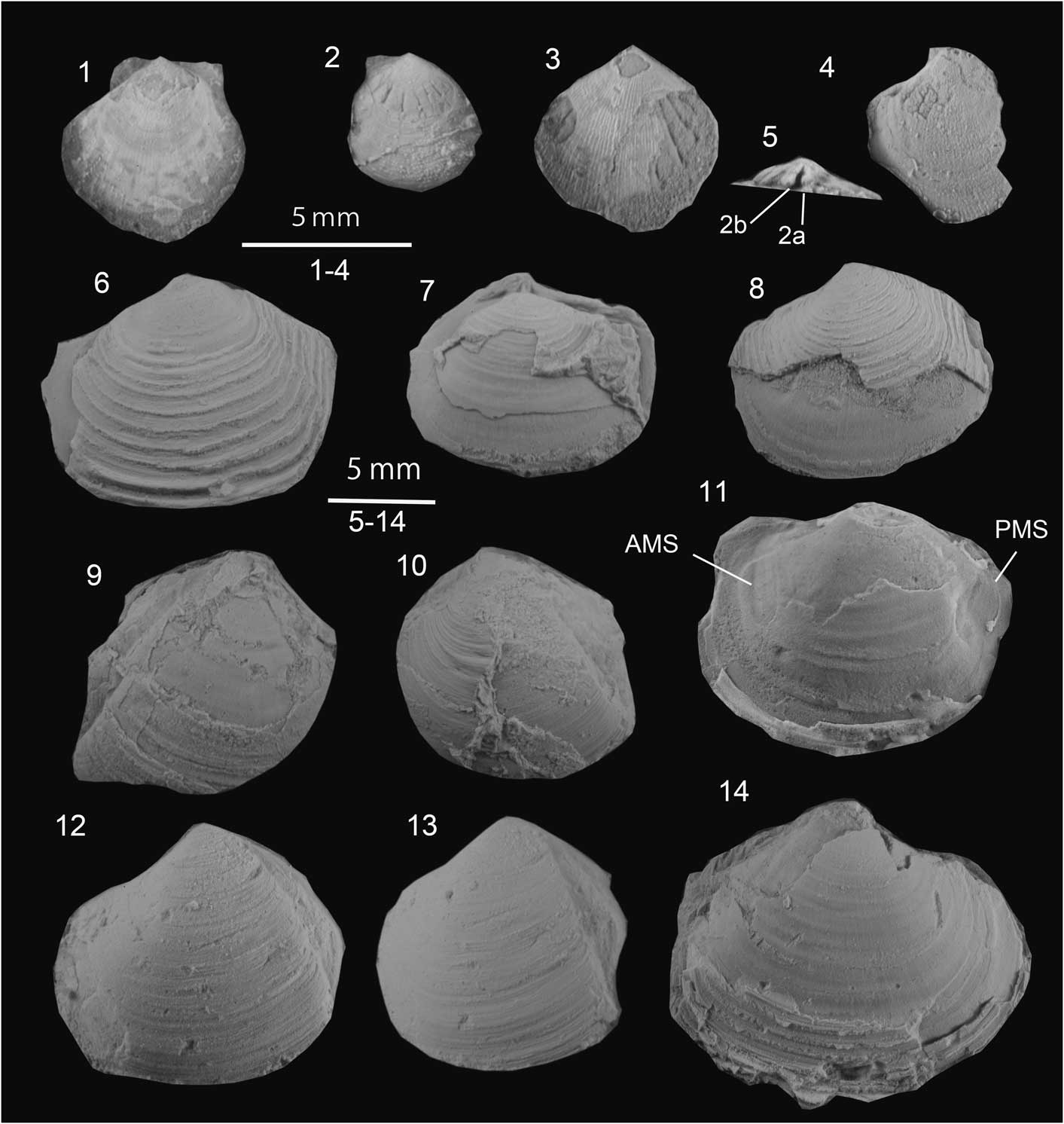
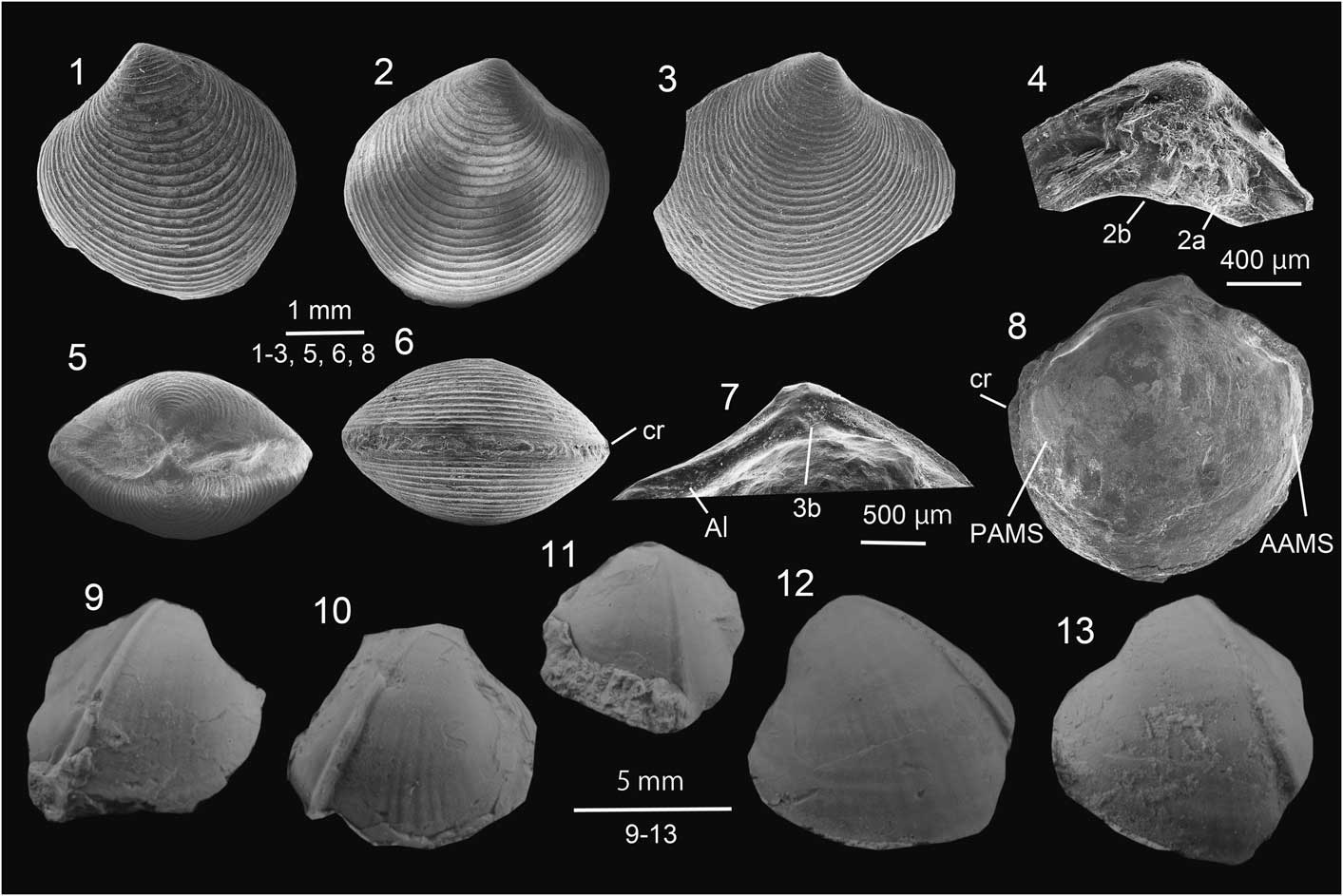
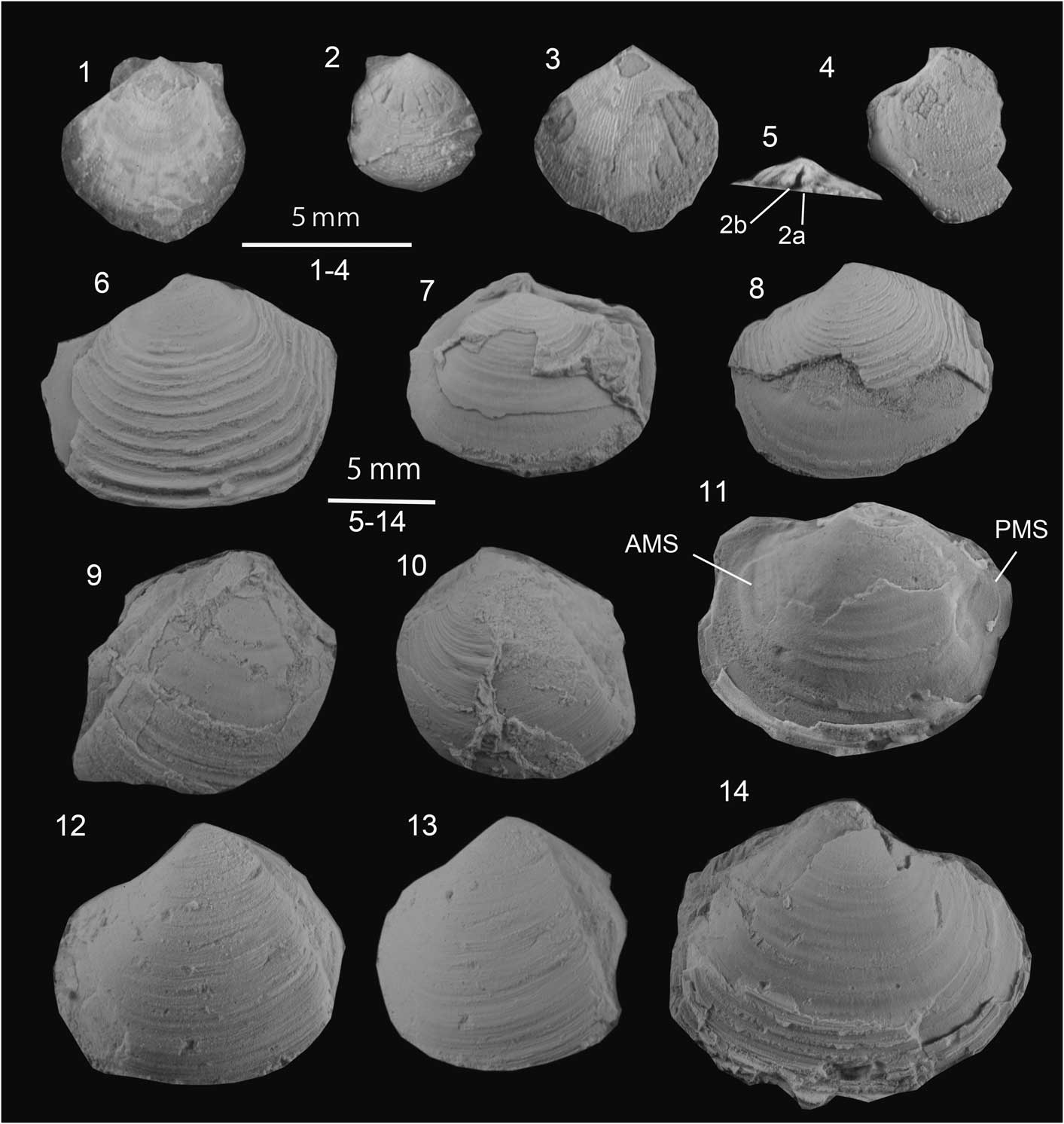
(1–4) Propeamussium yubarense (Yabe and Nagao, Reference Yabe and Nagao1928): (1) JUE 16009, frontal view of left valve, showing fine radial riblets; (2) JUE 16010, frontal view of right valve, showing distinct growth lines; (3) JUE 16013, frontal view of left valve, showing fine radial riblets; (4) JUE 16011, silicone rubber cast of left valve. (5–8, 11, 14) Myrtea ezoensis (Nagao, Reference Nagao1938): (5, 6) JUE 16001, left valve, with view of valve hinge (5) and frontal view (6) showing distinct commarginal ribs; (7, 8) JUE 16003, with right valve and hinge of left valve (7) and left valve (8); (11) JUE 16000-3, interior of the shell; (14) JUE 16000-2, frontal view of right valve. (9, 10, 12, 13) Thyasira (Thyasira) oliveri Amano and Jenkins, n. sp.: (9) JUE 15994-1, paratype, frontal view of right valve; (10) JUE 15994-2, paratype, frontal view of left valve; (12, 13) JUE 15993, holotype, left valve, in frontal (12) and oblique (13) views. 2a=anterior hinge tooth of left valve, 2b=posterior hinge tooth of left valve, AMS=anterior muscle scar, PMS=posterior muscle scar.
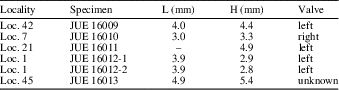
Measurements of Propeamussium yubarense (Yabe and Nagao, Reference Yabe and Nagao1928). H=height, L=length, –=not available.

1928 Pecten (Propeamisium) cowperi var. yubarensis Reference Yabe and NagaoYabe and Nagao, p. 88, pl. 16, figs. 17–19.
1932 Pecten (Propeamusium) cowperi var. yubarensis; Reference NagaoNagao, p. 38, pl. 6, figs. 7, 8, 12, 13.
1938 Pecten (Propeamusium) cowperi var. yubarensis; Reference NagaoNagao, p. 129, pl. 16, fig. 3.
1956 Pecten (Propeamisium) cowperi var. yubarensis; Reference AmanoAmano, p. 73, pl. 1, fig. 12.
1976 Parvamussium cowperi yubarensis; Reference TashiroTashiro, p. 52, pl. 4, figs. 20–24.
1992 Parvamussium yubarense; Reference TashiroTashiro, p. 112, pl. 32, fig. 1.
Type specimen
IGPS 22599.
Occurrence
Cenomanian to Campanian formations from Hokkaido to Kyushu; upper Selandian to lowermost Thanetian, Katsuhira Formation, eastern Hokkaido, Japan.
Original description
“Shell very compressed, small, suborbicular, nearly as high as long; subequivalve, almost equilateral, except for the ears; the dorsal third of the disc triangular, with the apical angle about 120°; remaining part of shell semicircular; antero-dorsal margin almost straight, the postero-dorsal faintly concave, scarcely longer than the anterior; posterior end bluntly angulated. Test thin. Right valve: Posterior ear shorter, with the outer angle slightly obtuse; anterior ear distinctly notched below, with an acute outer angle; both ears ornamented with lines of growth. External surface covered with numerous, fine, equally spaced, concentric lines and numerous very fine radial lines scarcely visible under a lens: inner surface bearing 7 strong, equally spaced round ribs, extending from umbo nearly to the main margin and abruptly truncated at their low ends. Left valve: Ears subequal, with the outer angles slightly obtuse. Outer surface ornamented with numerous, slightly raised, fine radial striae and lines of growth; inner surface bearing strong radial ribs of unknown number” (Yabe and Nagao, Reference Yabe and Nagao1928, p. 88).
Materials
Six specimens from the floor of Urahoro River at Katsuhira (JUE 16012-1, 16012-2, Loc. 1), Oppushinai-zawa (JUE 16010, Loc. 7; 16013, Loc. 45), Katsuhira-kita-zawa (JUE 16011, Loc. 21), and Ponsetarai-zawa (JUE 16009, Loc. 42); see Table 1 for dimensions.
Remarks
The Katsuhira specimens have a slightly inflated, small, thin shell, to 4.9 mm in length and eight internal radial ribs, not reaching the ventral margin. The shell surface is sculptured with very fine radial threads on the left valve and many distinct commarginal lines on the right valve. The left anterior auricle is slightly larger than the posterior one. From these characters, the Katsuhira species is identified as Propeamussium. Tashiro (Reference Tashiro1976, Reference Tashiro1992) allocated this species to Parvamussium Sacco, Reference Sacco1897, however, because P. yubarense has the inner ribs not reaching the ventral margin, nearly equal auricles, and no byssal notch, it can be safely included in the genus Propeamussium.
Propeamussium cowperi Waring, Reference Waring1917 from the Upper Cretaceous of California can be distinguished from P. yubarense by being larger (24 mm L) and having fewer internal ribs in the left valve (4–8). Propeamussium kusiroense (Takeda, Reference Takeda1953) from the Oligocene Nuibetsu Formation is also a closely similar species. However, the latter has a more compressed shell than P. yubarense.
Order Lucinida Gray, Reference Gray1854
Family Lucinidae Fleming, Reference Fleming1828
Subfamily Myrteinae Chavan, Reference Chavan1969
Genus Myrtea Turton, Reference Turton1822
Type species
Venus spinifera Montagu, Reference Montagu1803 (by original designation); Recent, British Islands.
Myrtea ezoensis (Nagao, Reference Nagao1938)
Figure 2.5–2.8, 2.11, 2.14, Table 2
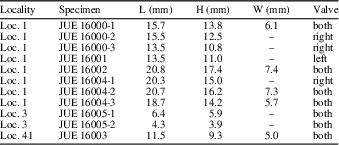
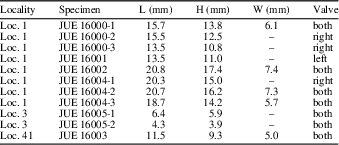
Measurements of Myrtea ezoensis (Nagao, Reference Nagao1938). H=height, L=length, W=width, –=not available.
1890 Lucina cf. fallax Forbes; Reference YokoyamaYokoyama, p. 176, pl. 18, fig. 9.
1938 Lucina (Myrtea) ezoensis Reference NagaoNagao, p. 136, figs. 4–6.
1962 Lucinoma ezoensis; Reference SaitoSaito, p. 70, pl. 2, fig. 6.
1976 Myrtea (sensu lato) ezoensis; Reference TashiroTashiro, p. 60, pl. 9, fig. 5.
Type specimen
GMH 8234.
Occurrence
Cenomanian to lower Campanian formations from Hokkaido to Kyushu; upper Selandian to lowermost Thanetian, Katsuhira Formation, eastern Hokkaido, Japan.
Original description
“Shell rather small, somewhat pentagonally ovate in outline, slightly longer than high, subequilateral, moderately convex from the umbo toward the ventral margin, compressed and attenuated both anteriorly and posteriorly; antero-dorsal margin nearly horizontal, slightly excavated beneath the umbo, convex in the anterior length; postero-dorsal margin straight, inclined backward and downward; ventral margin broadly and evenly curved, passing gradually into the anterior one, which is arcuate and slightly oblique; antero-dorsal end a little produced and rounded along the margin; posterior end vertically truncated by a straight and rather long margin that forms an obtuse angle with the ventral. Umbones small, subcentral, not prominent, with a round posterior umbonal angle running from it to the postero-ventral end, the surface behind this angle compressed and flattened; anterior umbonal angle not well defined, antero-dorsal area bordered by a distinct groove that originates from the umbo and runs to the antero-dorsal end. Lunule small, very short, deep, bounded by sharp ridges. Ligamental groove deeply depressed; escutcheon well defined. Test relatively thin. Surface with numerous, prominent and widely spaced concentric lamellae and flat interspaces in alternation, the latter having a few fine concentric lines. These lamellae prolonged on the ridge at the anterior margin of the escutcheon and also near the antero-dorsal margin. The lamellae and lines distinctly wavy on crossing the groove near the anterior margin. A few specimens have been examined. One from the Obirasibe district in the province of Tesio is well preserved and accordingly selected as the holotype. However, the inner features are not observable in it. One of the two specimens collected in the Abesinai district that are considered conspecific with the holotype, shows, some of the inner features impressed on a cast of the right valve. In this specimen, the lunule is very deeply impressed and very short and the hinge plate narrow, with a distinct and more or less elongated anterior lateral tooth. The posterior cardinal is narrow and slightly oblique backward. The socket in front of the posterior cardinal is also narrow and separates the latter from the anterior margin. The anterior cardinal is apparently obsolete. Anterior adductor muscle scar narrow, elongated, and the pallial line rather distant from the shell margin. The inner margins are smooth. The inner surface has numerous fine radial lines that are distinctly preserved on the cast” (Nagao, Reference Nagao1938, p. 136–137).
Materials
Eight specimens from the floor of Urahoro River at Katsuhira (JUE 16000-1–3, 16001, 16002, 16004-1–3, Loc. 1) and near the Asahi Bridge (JUE 16005-1, 2, Loc. 3), and one specimen from Ponkatsuhira-minami-sawa (JUE 16003, Loc. 41); see Table 2 for dimensions.
Remarks
The maximum size of the collected specimens is 20.8 mm in length. Their shells are longer than high (H/L=0.76–0.88; type specimens of M. ezoensis, 0.79–0.88), weakly inflated (W/L=0.30–0.39; holotype of M. ezoensis, 0.37), subquadrate or quadrate-ovate with a posterior blunt ridge and a subtruncated posterior margin. The beak is pointed and centrally or anteriorly located (AL/L= 0.37–0.57). The surface is sculptured with regular commarginal ribs with fine, weak interstitial riblets. The anterior adductor muscle scar is elongate-ovate in outline, detached from the entire pallial line and larger than the ovate posterior one. The lunule and escutcheon are narrow, sunken, and demarcated by a sharp ridge. In the left valve, the anterior tooth (2a) is thin and vertical whereas the posterior one (2b) is rather thick and inclined posteriorly. Based on these characters, the specimens from the Paleocene Katsuhira Formation can be safely identified as Myrtea ezoensis, which was described from the Yezo Group in northern and central Hokkaido and South Sakhalin.
Family Thyasiridae Dall, Reference Dall1900 (1895)
Genus Thyasira Lamarck, Reference Lamarck1818
Subgenus Thyasira Lamarck, Reference Lamarck1818
Type species
Tellina flexuosa Montagu, Reference Montagu1803 (by original designation); Recent, Britain and Ireland.
Thyasira (Thyasira) oliveri Amano and Jenkins, new species
urn:lsid:zoobank.org:act:1F5DB57D-6A94-45F3-808B-30551F18F70C
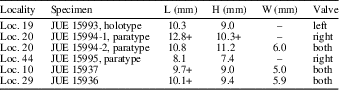
Figure 2.9, 2.10, 2.12, 2.13, Table 3
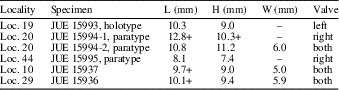
Measurements of Thyasira (Thyasira) oliveri Amano and Jenkins, n. sp. H=height, L=length, W=width, –=not available; +=dimension in slightly imperfect case.
2015b Thyasira sp.; Reference Amano, Little, Campbell, Jenkins and SaetherAmano et al., p. 47, figs. 16–17.
Type specimens
Holotype, JUE 15993, from 550 m upstream of Katsuhira-kita-zawa, Urahoro Town, Hokkaido (Loc. 19); Paratypes, JUE 15994-1–2, from 600 m upstream of Katsuhira-kita-zawa (Loc. 20); Paratype, JUE 15995, from 40 m upstream of Oppushini-zawa (Loc. 44). Type locality: 550 m upstream of Katsuhira-kita-zawa in Urahoro Town, Hokkaido, Japan, 42°59'26''N, 143°38'41''E; Paleocene.
Diagnosis
Small equilateral-ovate Thyasira with ridged second posterior fold, rather wide posterior sulcus, and narrow auricle.
Occurrence
Upper Selandian to lowermost Thanetian, Katsuhira Formation, eastern Hokkaido, Japan.
Description
Shell of moderate size (8.1–12.8 mm L), thin, equilateral-ovate, longer than high, rarely higher than long, well inflated (W/L=0.52–0.58). Anterodorsal margin nearly straight; anterior margin subcircular; ventral margin broadly arcuate. Second posterior fold distinct; posterior sulcus rather deep; first posterior fold wide and ridged; submarginal sulcus distinct; auricle narrow, short. No medial flattened area observed. Beak prosogyrate, centrally situated. Surface smooth except for irregular growth lines. Lunule narrow, slightly sunken. Cardinal tooth very weak. Anterior adductor muscle scar quadrate, large; posterior one unknown.
Etymology
Named after Dr. P. Graham Oliver (National Museum of Wales) who has made major contributions to the taxonomy of Recent thyasirids.
Materials
One specimen each from Locs. 10, 19, 29, and 44; two specimens from Loc. 20; see Table 3 for dimensions.
Remarks
Thyasira (Thyasira) oliveri n. sp. closely resembles the Cretaceous species T. (T.) tanabei Kiel, Amano, and Jenkins, Reference Kiel, Amano and Jenkins2008 in having a ridged first posterior fold. However, the new species differs in having a wider first posterior fold than T. (T.) tanabei. As discussed by Amano et al. (Reference Amano, Little, Campbell, Jenkins and Saether2015b), both T. (T.) baca Devjatilova in Devjatilova and Volobueva, Reference Devjatilova and Volobueva1981 from the Paleocene Getkilninskaya Formation of western Kamchatka (Devjatilova and Volobueva, Reference Devjatilova and Volobueva1981) and T. (T.) mironovi Kalishevich in Kalishevich et al., Reference Kalishevich, Zaklinskaya and Serova1981 from the lower Paleocene Sinegorsk Formation in South Sakhalin are distinguished from the new species in having triangular shells with a narrower posterior area and a wider first posterior fold with an angular ventral end.
Subclass Heterodonta Neumayr, Reference Neumayr1884
Order Carditoida Lamarck, Reference Lamarck1809
Family Astartidae d’Orbigny, Reference Orbigny1844 (1840)
Genus Astarte Sowerby, Reference Sowerby1816
Subgenus Astarte Sowerby, Reference Sowerby1816
Type species
Venus scotica Maton and Rackett, Reference Maton and Rackett1807 (by original designation)=Pectunculus sulcatus Da Costa, Reference Da Costa1778 var. scotica (Maton and Rackett, Reference Maton and Rackett1807); Recent, Britain and Ireland.
Astarte (Astarte) paleocenica Amano and Jenkins, new species
urn:lsid:zoobank.org:act: 8AAD8CF1-CC70-417C-8B96-278D39CBE47A
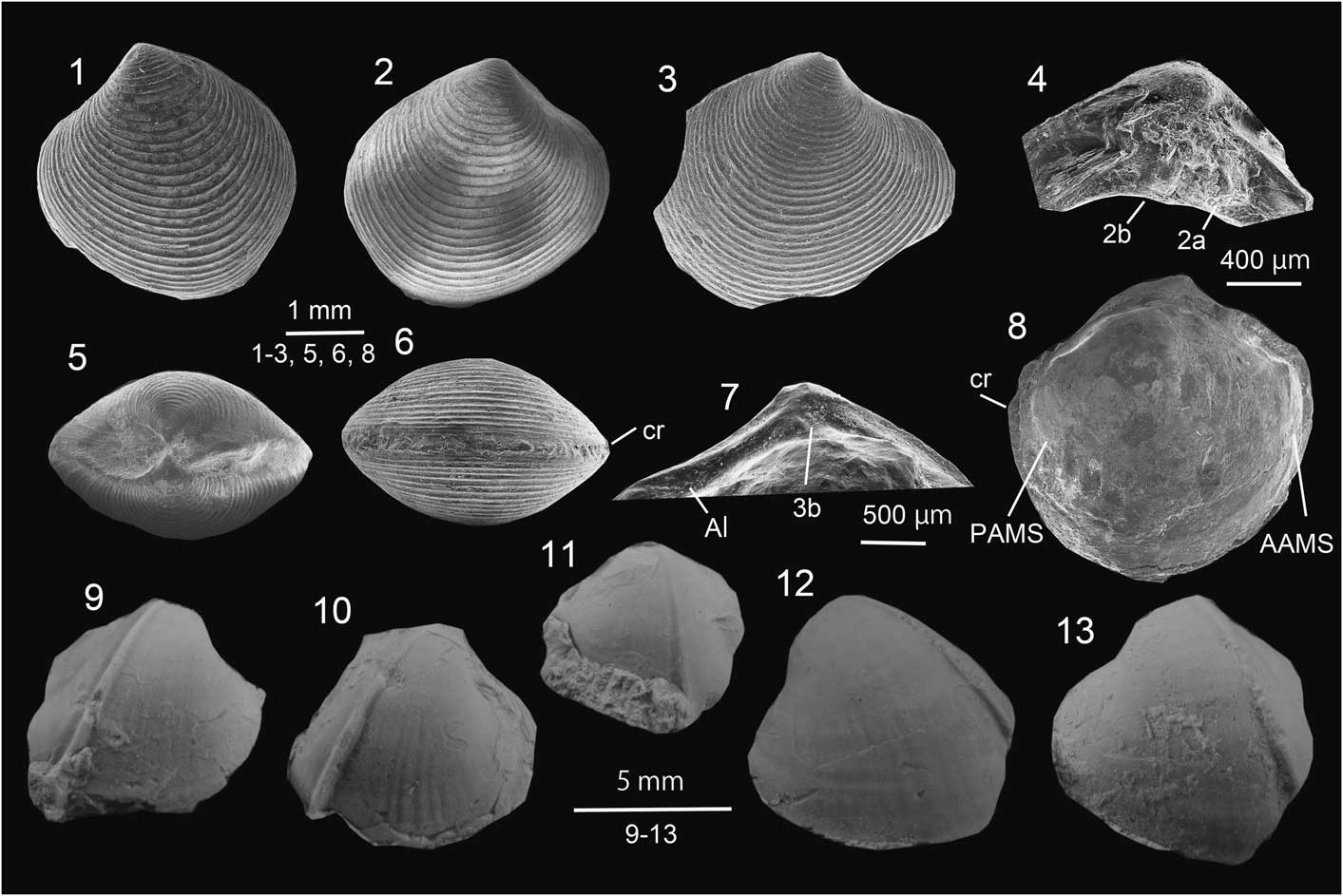
(1–8) Astarte (Astarte) paleocenica Amano and Jenkins, n. sp.: (1, 2, 5, 6) JUE 15996, holotype, with frontal views of left valve (1) and right valve (2), dorsal view (5) showing distinctly demarcated lunule and escutcheon, and ventral view (6); (3, 7, 8) JUE 15998, paratype, right valve, with frontal view (3), hinge (7), and inner surface (8); (4) JUE 15997-2, paratype, hinge of left valve. (9–13) Poromya katsuhiraensis Amano, and Jenkins, n. sp.: (9) JUE 16006, holotype, frontal view of right valve; (10) JUE 16007-1, paratype, frontal view of right valve; (11) JUE 16007-4, paratype, frontal view of left valve; (12, 13) JUE 16007-2, paratype, left valve, in oblique (12) and frontal (13) views. 2a=anterior hinge tooth of left valve, 2b=posterior hinge tooth of left valve, 3b=posterior cardinal tooth of right valve, AI=anterior lateral tooth of right valve, AAMS=anterior adductor muscle scar, cr=crenulations, PAMS=posterior adductor muscle scar.
Measurements of Astarte (Astarte) paleocenica Amano and Jenkins, n. sp. H=height, L=length, W=width, –= not available; +=dimension in slightly imperfect case.

Type specimens
Holotype, JUE 15996, from the bank of the Urahoro River at the mouth of Kokatsuhira-zawa, Katsuhira, Urahoro Town, Hokkaido (Loc.1); paratype, JUE 15997, from Loc. 1; paratype, JUE 15998, from 320 m upstream of Oppushini-zawa (Loc. 45). Type locality: river bank of the Urahoro River at the mouth of Kokatsuhira-zawa, Katsuhira in Urahoro Town, Hokkaido, Japan, 42°59’20”N, 143°38’04”E; Paleocene.
Diagnosis
Very small subquadrate Astarte with distinct fine commarginal ribs and a subtruncated posterior margin. Ventral margin finely crenulated. Lunule asymmetrical, narrow, and well demarcated.
Occurrence
Upper Selandian to lowermost Thanetian, Katsuhira Formation, eastern Hokkaido, Japan.
Description
Shell very small (3.3–4.2 mm L), thin, inequilateral, nearly equivalve, subquadrate, slightly longer than high, moderately inflated (W/L=0.63). Anterodorsal margin concave; anterior margin rounded; ventral margin broadly arcuate. Posterodorsal margin nearly straight, gently inclined; posterior margin truncated. Beak prosogyrate, anteriorly situated at two-fifths of shell length. Surface sculptured with regular, fine commarginal ribs. Lunule asymmetrical, left one wider than right, deeply sunken, demarcated by sharp ridge. Escutcheon narrow, flat. Anterior cardinal tooth of right valve (3a) indistinct; posterior cardinal tooth (3b) rather thick, inclined posteriorly; anterior lateral tooth thin. Anterior tooth (2a) of left valve rather thick, divided by groove, inclined anteriorly; posterior tooth (2b) also moderately thick, inclined posteriorly. Anterior adductor muscle scar small, semicircular; posterior adductor muscle scar pear-shaped, rather large. Pallial line entire. Inner ventral margin finely crenulated.
Etymology
Named after the age of this species.
Materials
Two specimens from the river bank at Katsuhira (Loc. 1); one specimen from 320 m upstream of Oppushinai-zawa (Loc. 45); one specimen (hinge part only) from Loc. 2 (JUE 15999) from the river bank, 100 m north of Loc. 1; see Table 4 for dimensions.
Remarks
Astarte (Astarte) paleocenica n. sp. closely resembles A. (A.) parvula Kalishevich in Kalishevich et al. (Reference Kalishevich, Zaklinskaya and Serova1981) from the Danian and lower Paleocene of southeastern Sakhalin in having a small shell and distinct commarginal ribs. However, the latter species was based on poorly preserved specimens. The new species is also similar to A. (A.) trigonula von Koenen, Reference von Koenen1885 from the Paleocene of Copenhagen, Denmark, in its small size (to 7 mm L) and in having distinct commarginal ribs. However, A. (A.) trigonula lacks a subtruncated posterior margin and has a centrally situated beak.
Order Pholadomyoida Newell, Reference Newell1965
Family Poromyidae Dall, Reference Dall1886
Genus Poromya Forbes, Reference Forbes1844
Type species
Poromya anatinoides Forbes, Reference Forbes1844 (by original designation)=Corbula granulata Nyst and Westendorp, Reference Nyst and Westendorp1839; Recent, Asia Minor and Cyclades.
Poromya katsuhiraensis Amano and Jenkins, new species urn:lsid:zoobank.org:act:9E236867-FDA1-4EEF-8C96-734328BA71EB
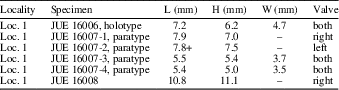
Measurements of Poromya katsuhiraensis Amano and Jenkins, n. sp. H=height, L=length, W=width, –= not available; +=dimension in slightly imperfect case.

Type specimens
Holotype, JUE 16006, from the bank of the Urahoro River at the mouth of Kokatsuhira-zawa, Katsuhira, Urahoro Town, Hokkaido (Loc. 1); paratypes, JUE 16007-1–4, from Loc. 1. Type locality: bank of the Urahoro River at the mouth of Kokatsuhira-zawa, Katsuhira in Urahoro Town, Hokkaido, Japan, 42°59’20”N, 143°38’04”E; Paleocene.
Diagnosis
Moderate-sized and subquadrate Poromya with posterior carina from beak to posteroventral corner and rather deep groove just before posterior adductor muscle scar. Inner surface nacreous, covered with fine radial grooves in anterior disc before carina. Right valve with one cardinal; left valve with one socket.
Occurrence
Upper Selandian to lowermost Thanetian, Katsuhira Formation, eastern Hokkaido, Japan.
Description
Shell of moderate size (to 10.8 mm L), rather thin, inequilateral, equivalve, subquadrate, slightly longer than high or higher than long (H/L= 0.86–1.03), moderately inflated (W/L=0.65–0.67). Anterodorsal margin concave; anterior margin subcircular; ventral margin broadly arcuated. Posterodorsal margin nearly straight and gently sloping; posterior margin truncated. Beak prosogyrate and anteriorly situated at one-third L. Distinct carina running from beak to posteroventral corner, separating anterior and posterior parts of shell. Rather deep groove just before posterior adductor muscle scar and forming strongly concave posteroventral margin. Outer surface poorly preserved; inner surface nacreous, sculptured by ~10 fine, weak radial grooves behind carina. One cardinal tooth of right valve small, inserting into socket of left valve. Pallial sinus very shallow, small, just before posterior adductor muscle scar. Anterior adductor muscle scar small, subovate; posterior adductor muscle scar of similar size and shape to anterior one.
Etymology
Named after the formation at the type locality.
Materials
Six specimens from the type locality, including one poorly preserved specimen (JUE 16008); see Table 5 for dimensions.
Remarks
Poromya katsuhiraensis n. sp. is the oldest species of Poromya in the world. It is closely similar to the Recent species P. carinata Lan, Reference Lan2000 from the Dongsha Islands of Taiwan in size (8.8 mm L in P. carinata) and in having a prominent carina. However, P. katsuhiraensis n. sp. can easily be distinguished from P. carinata by its rather deep groove just before the posterior adductor muscle scar, no groove before the carina, and a longer, truncated posterior margin. The prominent carina distinguishes the present species from the two fossil species P. osawanoensis Tsuda, Reference Tsuda1959, from the uppermost lower to lowermost middle Miocene Kurosedani Formation in Toyama Prefecture, and P. yasuokana Nomura and Hatai, Reference Nomura and Hatai1936 from the upper Miocene Kubota Formation in Fukushima Prefecture.
Class Gastropoda Cuvier, Reference Cuvier1795
Subclass Caenogastropoda Cox, Reference Cox1960
Order Littorinimorpha Golikov and Starobogatov, 1975
Family Naticidae Guilding, Reference Guilding1834
Subfamily Polinicinae Finlay and Marwick, Reference Finlay and Marwick1937
Genus Neverita Risso, Reference Risso1826
Type species
Neverita josephinia Risso, Reference Risso1826 (by original designation); Eocene to Holocene, Europe.
Neverita majimai Amano and Jenkins, new species
urn:lsid:zoobank.org:act:0EA3A33A-4B9F-4A14-A3D6-D13034D25993
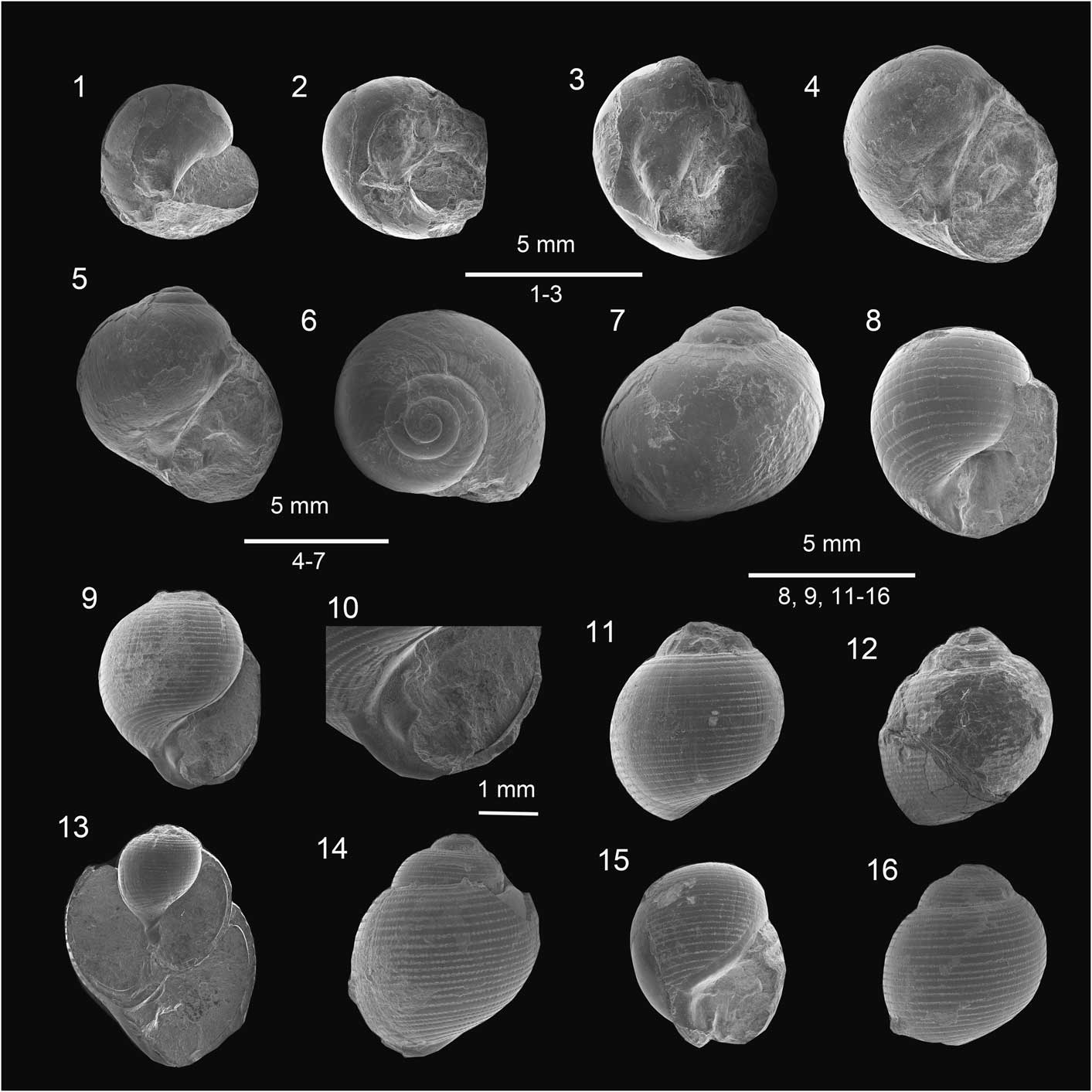
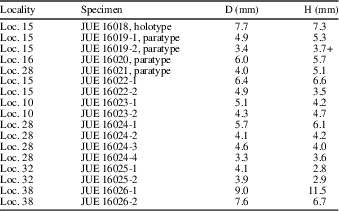
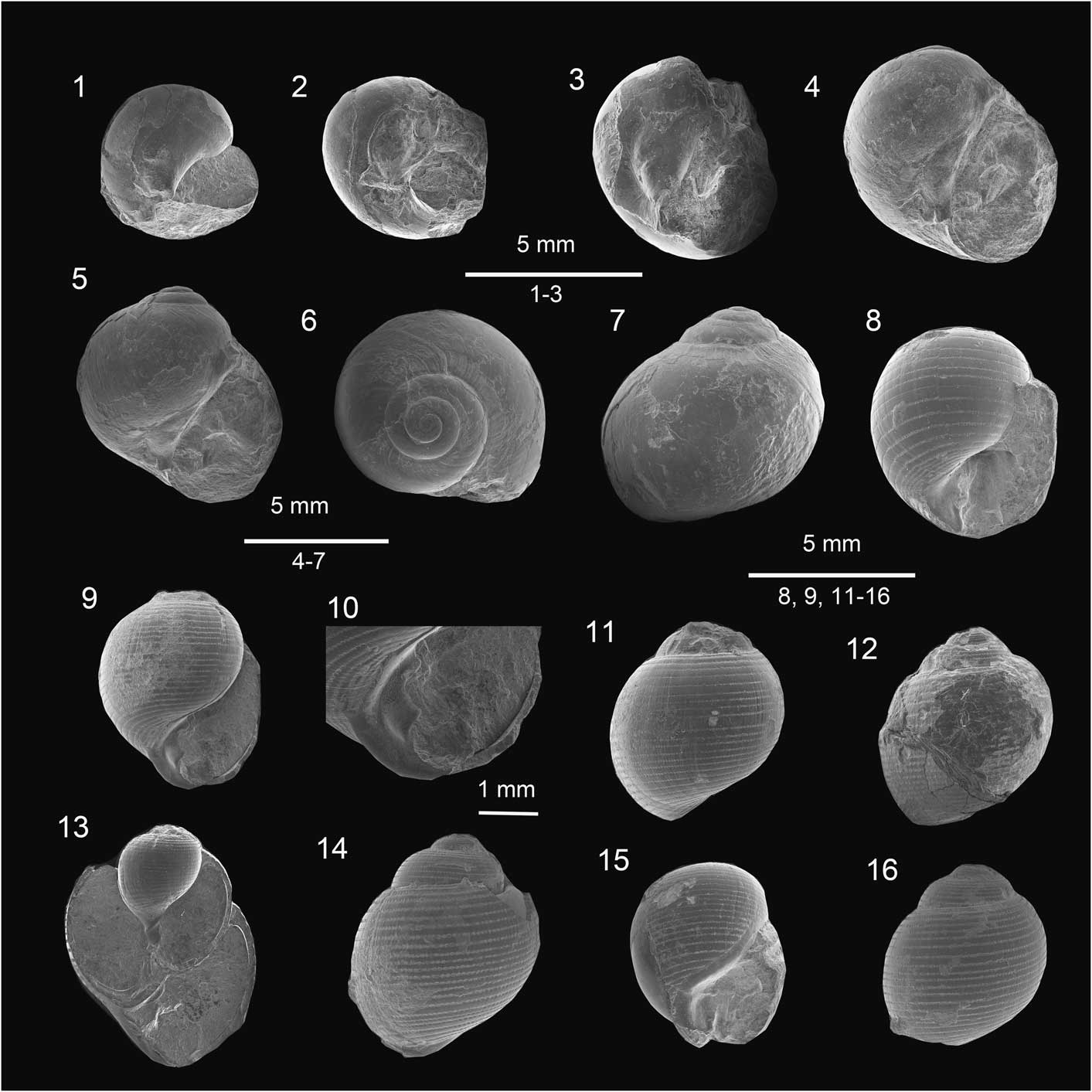
(1–7) Neverita majimai Amano and Jenkins, n. sp.: (1) JUE 16019-2, paratype, umbilical view; (2) JUE 16019-1, paratype, umbilical view; (3) JUE 16021, paratype, umbilical view; (4–7) JUE 16018, holotype, in umbilical (4), apertural (5), apical (6), and abapertural (7) views. (8–16) Biplica paleocenica Amano and Jenkins, n. sp.: (8) JUE 16028-1, paratype, apertural view; (9–11) JUE 16027, holotype, in apertural (9) and abapertural (11) views, plus enlargement of basal part of aperture (10); (12) JUE 16029-2, abapertural view; (13, 14) JUE 16028-3, paratype, in apertural (13) and abapertural (14) views; (15) JUE 16028-2, paratype, apertural view; (16) JUE 16029-3, abapertural view.
Measurements of Neverita majimai Amano and Jenkins, n. sp. D=diameter, H=height; +=dimension in slightly imperfect case.

Type specimens
Holotype, JUE 16018, from 500 m upstream of Katsuhira-kita-zawa, Urahoro Town, Hokkaido (Loc. 15); paratypes, JUE 16019-1–2, from the type locality; paratype, JUE 16020, from 480 m upstream of Katsuhira-kita-zawa (Loc. 16); paratype, JUE 16021, from 325 m upstream of Katsuhira-zawa (Loc. 28). Type locality: 500 m upstream of Katsuhira-kita-zawa, Urahoro Town, Hokkaido, Japan, 42°59'27''N, 143°38'43''E; Paleocene.
Diagnosis
Small globose Neverita with 4.5 whorls including 1.5 whorls of low-spired protoconch, low spire, and large, massive, semicircular umbilical callus, completely covering umbilicus. Umbilical callus sculptured with weak groove in central part and some very weak furrows on both sides of groove. Surface smooth except for weak axial wrinkles in weakly depressed subsutural area on last whorl.
Occurrence
Upper Selandian to lowermost Thanetian, Katsuhira Formation, eastern Hokkaido, Japan.
Description
Shell small for genus (to 11.5 mm H), globose, thin, with low spire; of 4.5 whorls including planispiral protoconch (1.6 mm D) of 1.5 whorls; suture shallow; subsutural area slightly depressed, with weak vertical growth wrinkles; shallow furrow separating substural depressed area on last whorl. Surface smooth except for subsutural wrinkles and growth lines. Parietal callus thin. Umbilicus completely covered with massive semicircular umbilical callus with one weak, central transverse groove; several very weak furrows on both sides of groove. Outer lip thin; interior lip moderately thick.
Etymology
Named after Prof. Ryuichi Majima (Yokoyama National University) who studied the taxonomy of Cenozoic naticids in Japan.
Materials
Five specimens from the type locality (Loc. 15); one specimen from 480 m upstream of Katsuhira-kita-zawa (Loc. 16); four specimens from 325 m upstream of Katsuhira-zawa (Loc. 28); two specimens from 450 m upstream of Katsuhira-kita-zawa (Loc. 10); two specimens from 575 m upstream of Katsuhira-zawa (Loc. 32); two specimens from 250 m upstream of Ponkatsuhira-minami-zawa (Loc. 38); see Table 6 for dimensions.
Remarks
Neverita majimai n. sp. is one of the oldest species of this genus. According to Marincovich (Reference Marincovich1977), N. globosa Gabb, Reference Gabb1869 occurs in the upper Paleocene Meganos Formation in California. However, Squires (Reference Squires2003) dated the ‘Meganos’ stage to the latest Paleocene to early Eocene. It is difficult to be sure whether the Katsuhira Formation or the Meganos Formation is older. Neverita majimai n. sp. is closely similar to N. eocenica (Nagao, Reference Nagao1928) from the lower Eocene Futagojima Formation in Kyushu in having a small globose shell with a massive umbilical callus. However, it differs from N. eocenica in having several very weak furrows on both sides of the transverse groove on the umbilical callus. Neverita globosa Gabb, Reference Gabb1869, from the upper Paleocene to upper Eocene in California, has a lower shell and a wider umbilical callus than the new species. Moreover, the transverse groove on the umbilical callus of the Californian species is sometimes recognized but very weak.
Subclass Heterobranchia Burmeister, Reference Burmeister1837
Family Ringiculidae Philippi, Reference Philippi1853
Genus Biplica Popenoe, Reference Popenoe1957
Type species
Biplica heteroplicata Popenoe, Reference Popenoe1957 (by original designation); early Senonian?Biplica paleocenica Amano and Jenkins, new species urn:lsid:zoobank.org:act:68D288A8-D9A4-4B8C-A01C-16147F2F9126 Figure 4.8–4.16, Table 7
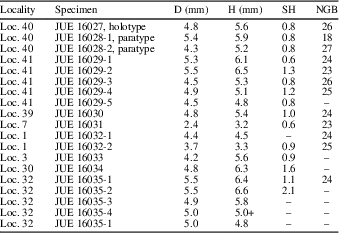
Measurements of Biplica paleocenica Amano and Jenkins, n. sp. D=diameter, H=shell height, NGB=number of grooves on body whorl, SH=spire height (mm), –=not available; +=dimension in slightly imperfect case.

Type specimens
Holotype, JUE 16027, from 900 m upstream of the small river, 1.5 km south to Ponkatsuhira-zawa, Urahoro Town, Hokkaido (Loc. 40; same as Amano and Olienik, 2014, loc. 1); paratypes, JUE 16028-1–2, from the type locality. Type locality: 900 m upstream of the small river, 1.5 km south to Ponkatsuhira-zawa, Urahoro Town, Hokkaido, Japan, 42°57'37''N, 143°37'41''E; Paleocene.
Diagnosis
Small to moderate-sized ringiculid with smooth interior of outer lip. Spire rather high for genus; suture rather deep. No varix observed at outer lip. Surface sculptured with 18–26 (commonly 23–24) punctate spiral grooves, forming flat-topped spiral ribs between grooves. Inner lip covered with thin callus and two columellar folds.
Occurrence
Upper Selandian to lowermost Thanetian, Katsuhira Formation, eastern Hokkaido, Japan.
Description
Shell small to moderate-sized for genus (to 6.6 mm H), elongate-ovate; spire rather high, occupying 0.10–0.32 of H. Suture rather deep, forming step between penultimate and last whorls. Shell of 3.5 whorls, including 1.5 whorls of smooth, low-spired protoconch. Surface sculptured by 18–26 spiral grooves (23–24 in most specimens) with small pits, separating flat-topped spiral ribs. Outer lip of most specimens thin, not dentate. Inner lip covered by thin callus, becoming thicker toward base, reaching posterior end of aperture. Two distinct columellar folds present near base.
Etymology
Named after the age of this species, pointing out that it is the single relict species of this genus from the Paleocene.
Materials
Six specimens from the type locality (Loc. 40); eight specimens from 50 m upstream of the type locality (Loc. 41); four specimens from 25 m downstream of the type locality (Loc. 39); one specimen from 50 m upstream of Oppushinai-zawa (Loc. 7); two specimens from the river bank near Katsuhira (Loc. 1); one specimen from the outcrop below the Asahi Bridge near Katsuhira (Loc. 3); one specimen from 360 m upstream of Katsuhira-zawa (Loc. 29); one specimen from 410 m upstream of Katsuhira-zawa (Loc. 30); six specimens from 575 m upstream of Katsuhira-zawa (Loc. 32) ; see Table 7 for dimensions of well-preserved specimens among the material.
Remarks
This new species can be distinguished from the Cretaceous species from Hokkaido, Biplica problematica (Nagao, Reference Nagao1932), which was originally described under the genus Avellana d’Orbigny, Reference Orbigny1842. After Biplica was established by Popenoe (Reference Popenoe1957), Poyarkova and Dzhalilov (Reference Poyarkova and Dzhalilov1985) allocated A. problematica to Biplica. At the same time, they synonymized B. ovoides Blank, Reference Blank1980 from the Maastrichtian deposits in the Koryak Upland with B. problematica. The type specimen of B. problematica has a very low spire and a very thick callus on the base, and is sculptured with 12 weak spiral grooves on the upper half of the last whorl. Biplica paleocenica n. sp. differs from B. osakaensis Kase, Reference Kase1990 from the lower Maastrichtian Shindachi Formation in Osaka Prefecture, Honshu, by having an elongate shell and a step between the last and penultimate whorls, no varix at the outer lip, a higher spire (SH/H=0.14–0.19 in B. osakaensis) although having a similar number of spiral grooves (24–27 in B. osakaensis). Biplica siberica Kaim and Beisel, Reference Kaim and Beisel2005 from the Maastrichtian Gankin Formation in western Siberia is similar to B. paleocenica n. sp. in having 24 spiral grooves. However, the lower spire, the outer lip with a varix, and the single columellar fold of B. siberica enable us to separate it from B. paleocenica n. sp. Biplica miniplicata Popenoe, Reference Popenoe1957 from the uppermost Cretaceous deposits of California can be easily separated from B. paleocenica n. sp. by its more numerous spiral grooves (~30) and single columellar fold.
Discussion
When Heinberg (Reference Heinberg1999) compared the Maastrichtian chalk fauna with the fauna from the Danian Cerithium Limestone at Stevens Clint in Denmark, he listed 24 common species among a total of 123 species in his table 2. Among these, only three species (12.5%) are protobranch bivalves. However, it is plausible that some Paleocene species might be reworked from the Maastrichtian chalk because, like the chalk, the Paleocene Cerithium Limestone was deposited under shallow-water conditions. In contrast, the Katsuhira fauna consists of wood-fall communities and might have lived in deep water during the late Selandian to earliest Thanetian, as mentioned above. Thus, it is very unlikely that any taxa in the Katsuhira Formation were derived from underlying Cretaceous deposits.
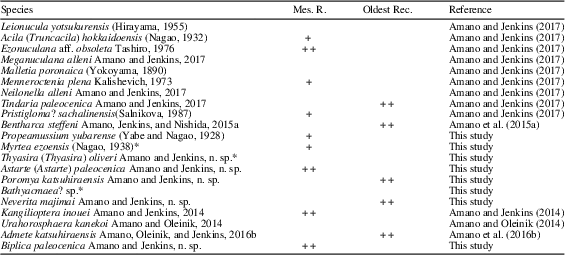
As the result of this study, the pectinoidean Propeamussium yubarense and the lucinid Myrtea ezoensis are newly recognized as surviving the end-Cretaceous mass extinction at the species level (Table 8), in addition to the two protobranchs Acila (Truncacila) hokkaidoensis (Nagao, Reference Nagao1932) (Table 8) and Pristigloma? sachalinensis (Salnikova, Reference Salnikova1987) pointed out by Amano and Jenkins (Reference Amano and Jenkins2017). At the genus level, Astarte Sowerby, Reference Sowerby1816 and Biplica Popenoe, Reference Popenoe1957 survived the event but became extinct before the Eocene, as did Ezonuculana Nagao, Reference Nagao1938 and Menneroctenia Kalishevich, Reference Kalishevich1973 (Amano and Jenkins, Reference Amano and Jenkins2017). Moreover, aporrhaid gastropods suffered a severe extinction at the end of the Cretaceous, as pointed out by Roy (Reference Roy1994, Reference Roy1996). In the northwestern Pacific, the following two aporrhaid species survived the end-Cretaceous extinction: Kangilioptera inouei Amano and Jenkins, Reference Amano and Jenkins2014 from the Katsuhira Formation, and Drepanocheilus grammi Kalishevich in Kalishevich et al., Reference Kalishevich, Zaklinskaya and Serova1981 from the Danian to early Paleocene Sinegorsk horizon in southeastern Sakhalin.
List of mollusks from the Katsuhira Formation, indicating Mesozoic-relict taxa (Mes. R.) and oldest records as genera and species (Oldest Rec.). *=chemosynthesis-based species, +=species level, ++=genus level.

Among these taxa, it is interesting to consider the evolution of astartids from a biogeographical point of view. Marincovich et al. (Reference Marincovich, Barinov and Oleinik2002) pointed out that the occurrence of Astarte parvula Kalishevich in Kalishevich et al., Reference Kalishevich, Zaklinskaya and Serova1981 from the Danian to lower Paleocene of Sakhalin is the last occurrence of astartids before they disappeared from the Pacific. They then reinvaded the North Pacific region after the opening of the Bering Strait during the latest Miocene (Ogasawara, Reference Ogasawara1986; Gladenkov et al., Reference Gladenkov, Barinov, Basilian and Cronin1991; Amano, Reference Amano1994; Marincovich and Gladenkov, Reference Marincovich and Gladenkov1999; Marincovich et al., Reference Marincovich, Barinov and Oleinik2002). The occurrence of A. paleocenica n. sp. newly described herein reveals that astartids continued to live until at least the late Selandian to earliest Thanetian in eastern Hokkaido.
Among the surviving species, the Cretaceous occurrence of Acila (Truncacila) hokkaidoensis, Propeamussium yubarense, and Myrtea ezoensis have wide occurrences from Kyushu to Hokkaido or from Hokkaido to the Koryak Upland. Such wide geographical distributions possibly helped these species to survive through the extinction event (Jablonski and Raup, Reference Jablonski and Raup1995; Jablonski and Hunt, Reference Jablonski and Hunt2006; Jablonski, Reference Jablonski2008; Robertson et al., Reference Robertson, Lewis, Sheehan and Toon2013; Landman et al., Reference Landman, Goolaerts, Jagt, Jagt-Yazykova, Machalski and Yacobucci2014).
Some authors have pointed out the low extinction rate of protobranchs or deposit feeders (Sheehan and Hansen, Reference Sheehan and Hansen1986; Jablonski and Raup, Reference Jablonski and Raup1995; Jablonski, Reference Jablonski1996; Levinton, Reference Levinton1996; Robertson et al., Reference Robertson, Lewis, Sheehan and Toon2013). This trend can be seen in the late Selandian to earliest Thaneetian Katsuhira fauna. Among the nine relict Mesozoic taxa described above, four are protobranchs. Although Jablonski and Raup (Reference Jablonski and Raup1995) denied the role of water depth as a cause of a low extinction rate, they only examined the depth range of taxa on the continental shelf, not on slopes or in basins. Based on the Recent bathymetric range of protobranchs, the Katsuhira Formation was deposited in an upper bathyal depth. The end-Cretaceous mass extinction by an asteroid impact is thought to have depended on climatic change (e.g., Kaiho et al., Reference Kaiho, Oshima, Adachi, Adachi, Mizukami, Fujibayashi and Saito2016). However, deep-sea benthic foraminifers show a lower extinction rate than shallow-water ones in the end-Cretaceous extinction because of little environmental change (Kaiho, Reference Kaiho1994). Consequently, the low extinction rate of protobranchs is attributed to their deposit feeding strategy and preference of dwelling in deep water (e.g., Dame, Reference Dame1996).
Five of the oldest fossil records of Recent molluscan genera have been found in the Katsuhira Formation: Tindaria Bellardi, Reference Bellardi1875, Bentharca, Poromya, Neverita, and Admete Krøyer in Möller, Reference Möller1842 (Amano et al., Reference Amano, Jenkins and Nishida2015a, Reference Amano, Oleinik and Jenkins2016b; Amano and Jenkins, Reference Amano and Jenkins2017; this study; Table 8). Moreover, Urahorosphaera kanekoi Amano and Oleinik, Reference Amano and Oleinik2014 is the one of the oldest records of buccinoids in the Paleocene (Amano and Oleinik, Reference Amano and Oleinik2014). Some Recent genera of deep-sea chemosynthetic bivalves also originated in the North Pacific after the middle Eocene: Vulcanidas Cosel and Marshall, Reference Cosel and Marshall2010, Bathymodiolus Kenk and Wilson, Reference Kenk and Wilson1985, Calyptogena Dall, Reference Dall1891, and Archivesica Dall, Reference Dall1908 (Kiel and Amano, Reference Kiel and Amano2010, Reference Kiel and Amano2013; Amano and Kiel, Reference Amano and Kiel2010; Amano et al., Reference Amano, Jenkins, Ohara and Kiel2014). It is interesting to note that species of these genera are epifaunal or very shallowly infaunal, regardless of feeding type. However, the exact reason why these Recent genera originated in the North Pacific is unknown. From these, although the Katsuhira fauna includes many Mesozoic-relict taxa as refugees, some Cenozoic species first appeared in this formation.
From the viewpoint of the evolution of wood-fall communities, the fauna of the Katsuhira Formation includes three chemosynthesis-based species: the limpet Bathyacmaea? sp., the lucinid Myrtea ezoensis, and the thyasirid Thyasira oliveri n. sp. Consequently, the Paleocene wood-fall communities from the Katsuhira Formation in Hokkaido and the Basilika Formation in Spitsbergen have no provannid gastropods and no small mussels, compared to the first appearance of provannids in the Upper Cretaceous wood-fall communities (Kiel et al., Reference Kiel, Amano, Hikida and Jenkins2009). Based on the protobranch species from the Katsuhira Formation (Amano and Jenkins, Reference Amano and Jenkins2017), the paleobathymetry of the formation can be estimated to be between 200 and 500 m in depth. According to Hryniewicz et al. (Reference Hryniewicz, Bitner, Durska, Hagström, Hjálmarsdóttir, Jenkins, Little, Miyajima, Nakrem and Kaim2016), the Basilika Formation was deposited in an offshore prodelta. On the other hand, most Recent species of Provanna Dall, Reference Dall1918 live deeper than 500 m (see Amano and Little, Reference Amano and Little2014, table 1). Because the Paleocene wood-fall communities lived in shallower water than the habitat of provannids, they lack provannid gastropods. On the other hand, despite the fact that small mussels can live in shallower water (e.g., Lorion et al., Reference Lorion, Buge, Cruaud and Samadi2010), they have not been found in the Paleocene sites and even in the early to middle Eocene wood-fall communities from Washington State in the US (Kiel, Reference Kiel2008). The oldest record of small mussels from the wood-fall communities has been found from the upper Eocene part of the Lincoln Creek Formation (Kiel and Goedert, Reference Kiel and Goedert2006). Adding to the previous Paleocene fossil records, this study also confirms that small bathymodioline mussels in the chemosynthetic communities did not appear in the Paleocene.
Acknowledgments
We thank A.G. Beu (GNS Science) for his critical reading of the manuscript and useful suggestions. We also thank K. Inoue (Obihiro City) for kindly offering his collection, and H. Nishi and J. Nemoto (Tohoku University), Y. Kobayashi (Hokkaido University), and T. Haga (National Museum of Nature and Science, Tokyo) for their help to examine the type material. We also thank A. Kaim (Institute of Paleobiology, Polish Academy of Sciences) and A. Oleinik (Florida Atlantic University) for their review of this paper and many useful comments. This study was partly supported by a Grant-in-aid for Scientific Research from the Japan Society for the Promotion of Science (C, 26400500, 2014−2016; C, 17K05691, 2017−2019) to KA and RGJ, and a Grant for Program to Disseminate Tenure Tracking System (JST) to RGJ.