The Corporation as a Model
Modern society is broadly characterized by organized collaboration.Reference Brunsson and Sahlin-Andersson1 In order to carry out actions that cannot readily be performed by individuals, various types of organizations are created. Among these organizations, the corporation occupies an especially strong position. This is seen, not least, in the mass media. Daily news reports include a multiplicity of stories that focus on corporations, mainly giant, multinational, often manufacturing groups. They are in focus especially because of their importance in terms of citizens’ future pensions and employment opportunities but also because of the performance and compensation levels of their leaders. In this way the large corporation has come to characterize the public view of how human activities should be organized and governed. The theory in economics regarding the owner (principal) who has to employ corporate executives (agents) to look after the interests of the owner has gained wide currency.Reference Alchian and Demsetz2, Reference Jensen and Meckling3 In recent years the corporate structure has also spread to activities that used to be organized in another way. This includes both public activities and non-profit organizations. Creating corporations has thus come to be used as a solution for municipalities and sports associations. The corporate model, with its CEO, has even made inroads in the academic world. At one of the Swedish University Colleges (Jönköping), the president oversees four corporations, each with their own CEOs instead of faculties or colleges with deans. But even ancient universities have developmental corporations closely associated with them (for instance, Uppsala University Holding).
Against the above background, one might wonder whether the corporation and its governance mechanisms is truly the ultimate organizational form for all types of operations. This can be questioned not least regarding academic activities. The intention in this paper is therefore to point out differences between the corporation and academic institutions (for the sake of simplicity, the latter will be referred to as universities). The next section will present a number of major differences, followed by a discussion of the tendency that, despite these differences, the corporation is often regarded as a model for the organization and governance of universities. It will be noted that a number of the examples in the paper are taken from Sweden. However, the tendencies they illustrate appear to be part of more general tendencies in the twenty-first century.
Differences between Corporations and Universities
Traditional studies of organizations treated them as homogeneous phenomena. In the 1960s and 1970s a number of scholars nuanced this picture by formulating what came to be called ‘the contingency approach’.Reference Lawrence and Lorsch4–Reference Thompson6 This means that they pointed out that, in adopting an organizational structure, attention should be paid to differences in a number of different contingencies. Among the most important variables mentioned were the organization’s (a) history, (b) products, (c) objectives, and (d) principals.
History
Comparing corporations and universities, we find that the former have a considerably shorter history than universities have. Although the corporation is the dominant form of organization today, it is still less than 200 years old. It is a product of nineteenth-century industrialization, with its need to supply venture capital for major investments in new operations, with limited liability for financiers. Political decisions about corporation legislation in various countries have been of critical importance. Since then, through organic growth and through acquisitions and mergers, successful companies have been transformed into extremely large entities. This in turn has led to a variety of organizational structures, often first through functional organization followed by a divisional structure with units for different products or different geographical markets.
Universities, which, like corporations, have undergone considerable growth since the end of the Second World War, have a history that is completely different from that of corporations. Their origin is medieval, and some European universities, such as Bologna (1088), Paris (~1150) and Oxford (1209), have existed for more than eight centuries. With time, many others have followed. At the same time they have proven to be remarkably stable. Carnegie Policy Studies reported in 1980 that of the 66 institutions that existed in 1530 and still existed in the late 1970s, 62 were universities.7 This indicates that, whatever might be said about their inertia, universities have historically had a capacity to cope with changes in their surroundings. They were once founded to train the clergy, but with time they have successively changed through the addition of other professional training, such as law, medicine, engineering and business. They have also complemented their education with robust research, especially in medicine and science.
Products
The picture of the corporation seems to be dominated by the manufacturing company. Manufacturing companies purchase various raw materials that their employees put together into a finished product, which is then sold via wholesalers and retailers. For many of these companies, the knowledge content of their products has successively grown larger, with many types of peripheral services for the customer. At the same time, there has been a large increase in the number of corporations that do not manufacture products but rather provide services. What all these corporations have in common is that they sell goods and services that we can get a relatively good idea of in advance. If we are truly satisfied, we can also buy a good or service again, or even over and over again. In this respect, universities differ considerably from corporations.
The main mission of universities was originally education. With advances in science in the eighteenth century, university professors became increasingly involved in research. Wilhelm von Humboldt emphasized this dual mission of educating and pursuing research in the founding of the University of Berlin in 1810. Thereafter, students came to be involved in research, thereby expanding its scope.
If we limit ourselves to the university’s original missions of education and research, we can establish that both are associated with great uncertainty for prospective students and research financiers. By definition, students are largely in the dark when they choose their education. To start with, they cannot have much knowledge of the content of an education that they have not yet gone through. If they did have this knowledge, then there would hardly be any point in their choosing that education. Secondly, no matter how much they like their education, they do not repeat it. Thirdly, only in exceptional cases do they ever hear anything negative about the education they chose, as graduates are eager to have their education perceived by the job market as good. Moreover, it can often take some time before students can know whether their education was good or not. Indeed, surveys of student perceptions of components of their education show that they change over time. Elements that got rave reviews in course evaluations tend to be less appreciated after a period of work experience, and vice versa.Reference Hägg and Johansson8
The uncertainty associated with research is, if possible, even greater than that surrounding education. On the one hand, universities must steer clear of anything unscientific by constantly reviewing research presented to ensure that it follows the established rules. On the other hand, research is expected to produce breakthroughs and present new, preferably pioneering, research findings, which entails a break with the established thinking. This is the tension that defines the cutting edge of science. Answers can never be regarded as definitive. To use Karl Popper’s argument: even though all swans have always been white, one day a black swan might appear.
Objectives
Just as we could establish differences in the products between corporations and universities, we can see differences in the objectives of the two types of organizations. Even though it can be questioned whether the primary goal of companies is to generate the highest possible profits, it is obvious that the profit motive is strong in corporations.Reference Baumol9, Reference Cyert and March10 Owners of corporations, who in today’s economies consist to a large extent of pension funds, mutual funds, and similar institutions with broad involvement among the populace, are looking for good value growth and robust dividends.
Unlike corporations, universities are not for profit. State universities are not even allowed to run up noticeable surpluses. Against this background, we can say that, instead of being profit-seeking, universities strive to achieve prestige. This ties in with the fact that, as pointed out above, their products are so uncertain. To survive and develop, they must be respected in order to attract qualified researchers, teachers, and students, as well as research funding. The higher their status, the greater their capacity to attract both cultural and financial capital.
Principals
Regarding principals, ownership is exercised in the corporation by various actors with major or minor shares of the corporation’s stock. Their risks and liabilities are limited to the size of their holdings. At the same time, of course, a corporation facing financial difficulties may ask its owners to inject new capital to rescue its operations. The owners can always refrain from doing so, and whenever they wish, especially in the case of publicly traded corporations, owners can consider selling their shares.
Who the principals of universities are is more complicated. Regarding private universities, which are more common in some countries like the US, it is a matter of bringing in resources through donations from major benefactors and alumni and by charging students tuition fees. It should be stressed that none of these sources require financial dividends. Once donations are made and fees are paid, they are irreversible in principle. What is demanded, again, is prestige, which for major benefactors is generated when the object of their donation bears their name. Usually the name of the donor lives on in the title of an endowed professorship, on a plaque, or in the name of a lecture hall or even whole buildings. In the US in recent years it has even become common for entire parts of universities to bear the names of benefactors. Many North American business schools are named after major donors: Kellogg at Northwestern University, Stern at New York University, Schulich at University of York, etc. Of course, entire universities have long borne the name of a donor: Stanford and Johns Hopkins, for instance.
By not demanding financial dividends and by not being able to take back the donations they have made, donors occupy a position very different from that of shareholders. The same applies to alumni, who are very important in funding operations, especially at North American universities. They also play an extremely significant role in that they actively work to enhance the prestige of their own education. Thereby, in countries with differentiated tuition fees, they can help to attract more resources, which further increases the universities’ prestige and drawing power.
Private universities are uncommon in Europe. Most are public institutions with considerable allocations from the state budget. But the state does not expect a financial dividend from universities. Instead it requires production in the form of students graduated and research findings. These demands have intensified apace with the ever-growing belief in the importance of universities for the competitiveness and future economic growth of nations. It might even be claimed that many countries have reprioritized their defence so that in future foreign countries will be fought with superior knowledge rather than weapons.Reference Engwall11 With the advent of international rankings, the notion has emerged that all universities in the world are competing with each other not only in research but also for students. All ministers of education and research strive to have their universities attain world-class quality and preferably be among the finest in the world. They also want as large a proportion of their population as possible to complete academic education so that their country will have a competitive edge in the knowledge-based society of today and tomorrow. Thereby, in most countries, a budget problem has arisen, namely deciding how much a country should invest in higher education and research. This in turn has led to the introduction of tuition fees in more and more countries. For example, as of 2011, Sweden no longer educates students from outside the European Economic Area for free. Domestic students are concerned that this may be the first step towards tuition fees for everyone.
The fees now being introduced can be said to be a further feature of market mechanisms in the Swedish system. As early as 1993, undergraduate student funding began to be allocated on the basis of the number of students registered and the proportion completing their studies. The production of students has thereby become a concept in the university world. This in turn has led to various ways of monitoring the quality of programmes offered and of students graduating. Thus, evaluations have become nearly as regular for universities as vehicle inspections for auto owners. However, they target not only education but also research, which has more and more become the subject of formal assessments. In these assessments, publications in journals with high citation figures have become increasingly important in evaluating both individual researchers and whole departments. However, whether this leads to greater creativity and more growth-promoting breakthroughs remains to be seen.
Next to the evaluation of research results, modern universities have been tied to another market mechanism in that direct allocation of funding for research to universities has declined. It has increasingly been replaced by financing through allocations to individual researchers or research groups following application for project funding. This means that modern researchers spend a considerable amount of time writing applications. The flood of such applications has thereby become so voluminous that most research financiers feel they must focus on major funding and stop bothering with less comprehensive applications. It hardly needs to be pointed out that this constitutes a problem for junior researchers.
The above shows that universities do not have principals of the same sort as corporations. Instead, they can be said to have supporters, who for various reasons (competitiveness, their own prestige, and pressure within alumni circles) back the activities. For universities that charge fees, there is also support from future alumni in the form of tuition payments.
Summing Up
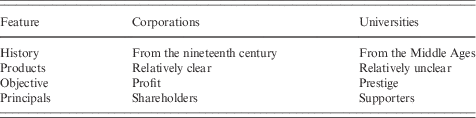
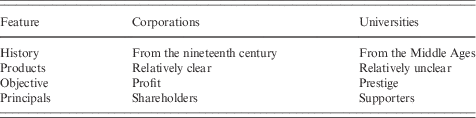
In summary, the above reasoning points to considerable differences between corporations and universities (Table 1). Universities are older and offer products that to outsiders, before an education has been chosen and research findings have become established truth, are relatively uncertain. This latter fact entails that prestige rather than generating profit is their operational objective, and that their principals are various kinds of supporters instead of shareholders seeking monetary gain.
A comparison between corporations and universities.
The Corporation as a Model for Universities
An important part of organization research analyses how different forces tend to make organizations more and more similar to each other. For universities this can entail that, despite the differences outlined above, they will assume characteristics that are associated rather with corporations. This neo-institutional view maintains that organizations are influenced in the direction of homogeneity by three kinds of forces: by decree (laws, ordinances, regulations, etc.), by norms, and by models.Reference DiMaggio and Powell12 These three forces are associated with political systems, norm-governed systems, and markets, respectively. In political systems, the state, authorities, municipalities, and so on, establish what the constraints are and also have the authority to impose sanctions on those who violate the rules. In norm-governed systems, including professions such as medicine, law and accounting, for instance, norms are developed that members should follow. In the market, the most dominant and most visible actors constitute models, and they spur others to emulate them.
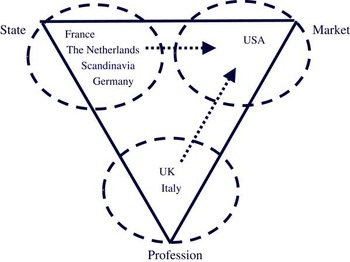
Organizations such as universities are exposed to a mixture of all three of these forces. This mixture varies across countries. According to the well-known American higher-education scholar Burton Clark,Reference Clark13 the systems in France, the Netherlands, Germany, and Scandinavia have traditionally been characterized by a predominance of state governance, whereas in Italy and the United Kingdom they have largely been controlled by the profession (Figure 1). Meanwhile, the university system in the United States has long had a stronger market orientation. However, in recent years, as mentioned, European systems have taken on more and more market features. Micromanagement by the state has been jettisoned, as US universities have increasingly become models. This has had an impact on the management and governance of European universities, which can be seen, for instance, in the changes in the recruitment of university rectors in recent years.
University systems: state, profession, and market.

Up to the late 1840s, the post of rector at Uppsala University circulated every academic term among the university’s professors, and thereafter annually up to 1876, when the rector was elected for longer periods by his colleagues. The principle underlying this leadership position was always for one of the professors to be primus inter pares and to lead the university by dint of the trust he enjoyed among his fellows. As a result of the ever-greater spread of the corporation and its thereby serving as a model for many other organizations in society, this order of things has come to be increasingly called into question. It has become more and more common to maintain that universities need to change and that it is therefore not appropriate for them to appoint leaders who are already part of the organization. In Sweden this tendency was reinforced by the new order introduced in 1997, namely that rectors would no longer chair their university boards. After the ministry and the Higher Education Agency summoned the chairpersons of all universities and university colleges for deliberations, it appears that the chairpersons of the latter types of institutions came to influence their colleagues at universities in their recruitment of rectors. As university colleges often lacked internal candidates for such a post, and their chairpersons were in the majority, they came to disseminate the view that rectors should be recruited externally and that recruitment consultants should be used in the selection process. This view came to be widespread, entailing that a job market for rectors has emerged.Reference Engwall14, Reference Engwall15 Also contributing to this phenomenon is the fact that the job of university rector has become ever more demanding. To an ever-greater extent those recruited to these posts have thereby had to face the prospect of completely abandoning their own research.
The notion that it is beneficial to seek out leaders from the outside and that organizational change is always a good thing is widespread in the corporate world. To be sure, there are a number of companies, such as Handelsbanken and Scania in Sweden, that are informed by other thinking, but the view that the organization needs to be shaken up seems to be deeply rooted. There is even a perception that leadership characteristics are general; that a good leader can succeed in all types of operations. Such a point of view can be questioned, considering that it is essential for a leader to be thoroughly familiar with what goes on in an organization and moreover to have strategic contacts in the field in question. This suggests that caution is called for when it comes to leaders switching from one sphere to another.
Advocates of external recruitment for rectors usually claim that this is necessary to bring about change. This can be countered by pointing out that external recruits first lose a great deal of time getting up to speed in the organization and thereafter find it difficult to implement organizational change owing to poor knowledge of the organization. Regarding this difficulty, there is a saying that it is just as hard to change a university as it is to move a cemetery – you do not get much help from those under you! This may true, but there is also considerable truth in the response to this saying from Håkan Westling, former rector of Lund University: ‘Perhaps it is equally true that just as you should not move cemeteries, you should not change a university from the top.’ The gist of this comment is that universities are in a constant state of flux from below. Few institutions in our society have such a steady flow of young people who impact operations in various ways. Few institutions have such a mission of producing new thinking and advancing science. In both cases, change resides down below in the organization among teachers and researchers. Thereby, rectors do not have the same possibilities as corporate executives to control operations. This difference stands out all the more clearly if we consider the changes in research funding discussed above. As state research allocations are replaced by project funding, the influence of rectors over the cash flow becomes more and more constrained. The research grants have been allocated to Professor A, Reader B, Senior Lecturer C, etc., and they are to be used for the projects stipulated in the application. While it is true that some of the funding covers joint overhead costs, which benefits the central leadership to some extent, the bulk of the funding is beyond the rector’s control.
However, it is not only changes in research financing that constrain the influence of rectors. A further fundamental difference in the comparison with corporations is the principle of academic freedom, that is, teachers and researchers should be free to shape their teaching and choose their areas of research. The basis for this principle is the idea that university employees must not be censored in practising their profession and must be able to present controversial research findings without outside interference. This is why tenure has become a key feature of academic activity. However, in recent years this principle has begun to be questioned at US universities and international business schools.
If rectors, then, have limited control over activities, the question arises whether they can influence activities at all. The answer seems to be linked to the objectives of universities and the wishes of their principals in terms of prestige. The same is true for university leaders. They need the trust of the organization, as Bo Sundqvist commented when he had been elected rector of Uppsala University by a wide margin: ‘It is good to have this support at your back when the storms hit.’ The truth is that most leaders at a university have to face criticism. This was recently summed up by a British dean as follows: ‘My faculty is split into two factions: those who feel that someone else could do my job better than I do and those who feel that they could do it better themselves.’
Final Words
The purpose of this article is to draw attention to certain key and fundamental differences between the modern corporation and universities. It does not constitute a plea for universities to be left alone, unaffected by societal developments. Instead, it is an appeal that we recognize the special nature of universities when modern management methods are being considered for these institutions. I hope I have shown that it should be borne in mind that researchers and teachers constitute an invaluable resource for the development of universities if they are allowed and stimulated to devote themselves to their favourite interests of research and teaching. Together, they can then achieve the most amazing feats. It is not readily apparent that the currently proliferating evaluations and measurements of achievement lead in this direction. There is a risk, rather, that there will be a standardization of academic achievement, guided more by formal criteria than by creativity. This has implications not only for researchers and teachers who are currently in the system but also for the young people who are considering whether or not to devote their lives to research and teaching. If we fail to get the best of them to regard university life as attractive, we will face a problematic future.
Lars Engwall is professor emeritus of management at Uppsala University, Sweden. His research has been directed towards institutional change as well as the production and diffusion of management knowledge. Among his recent publications are the edited volumes, Reconfiguring Knowledge Production (2010, with Richard Whitley and Jochen Gläser), Scholars in Action: Past-Present-Future (2012), Trust in Universities (2013 with Peter Scott), and Bibliometrics: Use and Abuse in the Review of Research Performance (2014 with Wim Blockmans and Denis Weaire). He is an elected member of a number of learned societies, among them Academia Europaea, and has received honorary degrees from Åbo Akademi University and Stockholm School of Economics.