Introduction
Anorexia nervosa (AN) is a life-threatening and often chronic disorder with a major impact on those caring for the sufferer. Anxiety, depression, guilt, frustration, loneliness and isolation are common in these carers (Kamerling & Smith, Reference Kamerling, Smith, Treasure, Schmidt and Macdonald2010). Additionally, many lack the skills and support necessary to assist the sufferer effectively (Haigh & Treasure, Reference Haigh and Treasure2003). Often, attempts to help may result in the carer becoming unintentionally involved in ways that can actually worsen or maintain the illness through their emotional and behavioural responses. Common examples include increased levels of expressed emotion (EE) (i.e. criticism or emotional over-involvement), the adoption of care practices that accommodate and enable the AN and do not reflect age-appropriate relationship roles/boundaries or the carers' subjugation of their own needs (de la Rie et al. Reference de la Rie, van Furth, Koning, Noordenbos and Donker2005; Highet et al. Reference Highet, Thompson and King2005; Kyriacou et al. Reference Kyriacou, Treasure and Schmidt2008; Sepulveda et al. Reference Sepulveda, Kyriacou and Treasure2009; Treasure et al. Reference Treasure, Sepulveda, MacDonald, Whitaker, Lopez, Zabala, Kyriacou and Todd2008). Carers are often very motivated to assist in the sufferer's treatment (Treasure & Schmidt, Reference Treasure and Schmidt2001; Kamerling & Smith, Reference Kamerling, Smith, Treasure, Schmidt and Macdonald2010), provided that they are given the tools and guidance to do this effectively.
Professionals, service users and carers have worked together to construct a model of eating disorder carers' distress (Treasure et al. Reference Treasure, Whitaker, Whitney and Schmidt2005, Reference Treasure, Sepulveda, MacDonald, Whitaker, Lopez, Zabala, Kyriacou and Todd2008; Winn et al. Reference Winn, Perkins, Walwyn, Schmidt, Eisler, Treasure, Berelowitz, Dodge, Frost, Jenkins, Johnson-Sabine, Keville, Murphy, Robinson and Yi2007; Kyriacou et al. Reference Kyriacou, Treasure and Schmidt2008). Our group and others have developed and piloted a range of interventions to facilitate carers' understanding of AN and to provide them with skills in helping the sufferer to combat the illness. These include a video/DVD and manual-based meal support training intervention (Cairns et al. Reference Cairns, Styles and Leichner2007), carers' skills workshops (Sepulveda et al. Reference Sepulveda, Lopez, Macdonald and Treasure2008a, Reference Sepulveda, Lopez, Todd, Whitaker and Treasureb) and an intervention combining a skills-training manual and DVDs (Treasure et al. Reference Treasure, Smith and Crane2007). The latter was evaluated in a randomized controlled trial (RCT), with or without telephone coaching, with significant improvements in carer outcomes over time, but no effect of coaching (Goddard et al. Reference Goddard, Macdonald, Sepulveda, Naumann, Landau, Schmidt and Treasurein press). In this RCT, changes in caregiving self-efficacy, EE and accommodation/enabling behaviours mediated improvements in carer distress and perceived level of functioning of the individual with the eating disorder.
We have now developed a web-based intervention for carers of people with AN [overcoming anorexia online (OAO), Schmidt et al. Reference Schmidt, Williams, Eisler, Fairbairn, McCloskey, Smith and Treasure2007]. This intervention is novel as it uses a multi-media format to deliver a formulation-based, systemic cognitive-behavioural (CBT) intervention (Williams, Reference Williams2001, Reference Williams2009; Dummett, Reference Dummett2006). The systemic CBT approach enables the participants to formulate and understand the effects of their behaviour on the thoughts, feelings and behaviours of others and vice versa. Moreover, the intervention is highly interactive in its approach, requiring participants to apply the information and skills to their own particular situation as opposed to the somewhat more passive activity of watching the demonstration of skills via a DVD. They are able to respond to questions, repeatedly self-rate their progress and view specific relevant information identified by their responses. An uncontrolled pilot study showed significant reductions in levels of carer anxiety and depression, burden and EE at post-treatment with gains largely maintained at follow-up (Grover et al. Reference Grover, Williams, Eisler, Fairbairn, McCloskey, Smith, Treasure and Schmidt2010).
What has yet to be investigated is whether this kind of structured intervention contributes anything over and above existing informal resources for carers. The aim of the present study is to investigate this. Beat (formerly the Eating Disorders Association), the UK's leading charitable organization for people with eating disorders and their carers, has for many years provided ad-hoc support for sufferers and carers via telephone hotlines and other media. The main hypothesis of the study is that the web-based intervention will reduce carer distress (anxiety and depression) and burden to a significantly greater degree than ad-hoc support. The subsidiary hypothesis is that the web intervention will also improve other cognitive, emotional and behavioural manifestations of carer burden (including reducing negative experiences associated with care-giving, reducing EE and reducing the accommodation of symptoms and enabling behaviour associated with caring for a person with AN) more than the control intervention.
Method
Participants
Carers of people with AN (n=67) were recruited via online advertisement (on the Beat website and our own website, www.eatingresearch.com) and via carers' groups and clinical departments between February 2008 and April 2009. Ethical approval for the study was obtained from the Institute of Psychiatry/South London and Maudsley Foundation National Health Service (NHS) Trust's Joint Research Ethics Committee, reference number 05/Q0706/214. Three potential participants did not return the pre-intervention questionnaires and therefore 64 participants were randomized. One of these was excluded from the analysis because they dropped out of contact and could not be informed of the outcome of randomization, leaving a final sample of 63 carers. Carers (relatives, partners or friends) of people with broadly defined AN (including patients with symptom levels indicative of AN but not meeting the full DSM-IV criteria) were eligible to take part in the study. Diagnosis of the sufferer and the potential participant's position as carer were discussed with the researcher at the time of enrolment into the study. The exclusion criteria, identified via a screening questionnaire, were as follows: caring for a person with an eating disorder other than AN (e.g. normal weight bulimia nervosa); major mental health problems in the carer (e.g. psychosis, severe depression, alcohol or substance dependence, active eating disorder); inability of the carer to read and understand English. No carers were excluded from the study based on these criteria. Only one carer from each family was recruited. Those families with more than one carer were asked to identify the main carer as the participant for the study. The majority of participants (n=60) were from the British Isles.
Interventions
OAO
OAO is an interactive, multi-media web-based intervention for carers of people with AN (Schmidt et al. Reference Schmidt, Williams, Eisler, Fairbairn, McCloskey, Smith and Treasure2007), intended to provide information, promote self-monitoring and teach skills to identify, understand and manage symptoms of AN. It also aims to help carers to understand and meet their own needs. The intervention uses a CBT (Williams, Reference Williams2001, Reference Williams2009) and systemic framework (Dummett, Reference Dummett2006). It comprises eight modules designed for carers of people with AN at any age and illness stage. The intervention was developed by a team of experts, including a carer and a person who has recovered from AN. Modules 1–3 are considered core components. They provide essential information about AN, including an understanding of why people value their AN (Schmidt & Treasure, Reference Schmidt and Treasure2006) and the implications this has for their willingness to engage with treatment and change. Carers are introduced to the systemic CBT approach underpinning the intervention. The five-areas approach to CBT (Williams, Reference Williams2001) is used to teach carers to formulate their own and their loved one's difficulties and to assess how these different formulations impact on each other, usually conspiring to ‘keep the anorexia going’, and how to develop a plan to break out of these interrelating vicious cycles in a manner that is appropriate to the developmental and illness stage of the sufferer. The CBT model is communicated in an everyday language (Martinez et al. Reference Martinez, Whitfield, Dafters and Williams2008). Carers are also taught how to communicate more effectively with their loved one about the anorexia and its impact on the family, using the principles of motivational interviewing (Miller & Rollnick, Reference Miller and Rollnick2002). Modules 4–7 are used more flexibly, teaching relevant skills, e.g. how to give support at meal times, how to assess and manage medical risk in AN, how to manage problem behaviours and how to look after carers' own needs. Module 8 gives additional information on treatment and services.
Further details of the content of the intervention can be found elsewhere (Grover et al. Reference Grover, Williams, Eisler, Fairbairn, McCloskey, Smith, Treasure and Schmidt2010). The intervention is designed to be used with a low level of clinician guidance to encourage use and application. Workbooks and other materials can be downloaded from the intervention website. Support from other carers is available via moderated message boards.
Clinician guidance
All participants randomized to OAO were offered guidance from a clinician, as it is known from the literature on self-care interventions for patients that such guidance improves outcomes (Perkins et al. Reference Perkins, Murphy, Schmidt and Williams2006). Guidance was provided by a psychologist and a psychotherapist, both of whom had CBT skills and expertise in working with people with AN and their carers. Guidance ‘sessions’ were up to 20 min per week for the duration of the intervention (4 months). Carers were free to choose telephone or email guidance. The clinicians had written guidelines on how to provide the guidance. The aim was for this to be tailored to the carer's individual needs in areas such as helping carers to conceptualize difficult situations and use this to understand and formulate a plan of action, directing carers to elements of the program that the clinician felt were particularly useful to the carer and/or to give the carer motivational feedback and support. The program itself then delivered the appropriate intervention. Telephone guidance was arranged on an appointment system, whereas carers using email guidance made email contact each week and were sent an email reply within the same week. If no email contact was made by a carer, then a reminder email was sent each week by the clinician.
Telephone guidance sessions were audio-recorded and copies of email guidance were retained and used to ensure that guidance was both motivational and CBT in orientation. The clinicians were also given supervision by a consultant psychiatrist (U.S.).
Beat support
Beat's existing support services were used as a control intervention for the study. As previously mentioned, Beat is the UK's leading charity devoted to the support of people with eating disorders and their carers. Beat services include a telephone hotline open 6 days per week, an email support service, support groups (in some geographical areas), a moderated message board and SMS messaging (for the under 25s). Beat's helpline services provide someone to listen without judgement, give information about eating disorders and about help available but they do not make referrals to services themselves, give counselling or instruction in what callers should do about the problem. Support is accessed on an ad-hoc basis as required by the carer for the duration of the intervention period. The staff giving support are all comprehensively trained by Beat to give advice and support. Carers using Beat's services will not necessarily speak with the same member of staff each time they contact.
Participants allocated to Beat support were given access to the OAO intervention after the end of the trial.
Assessments and measures
Assessments were conducted via questionnaires at three time points: baseline; 4 months (end of treatment); 6 months (follow-up).
Primary outcome
Hospital Anxiety and Depression Scale (HADS; Zigmond & Snaith, Reference Zigmond and Snaith1983)
This is a 14-item questionnaire to identify key symptoms of depression and anxiety. The measure consists of two subscales, each containing seven items. Each question rates a score of 0–3 (with 0 indicating absence of the symptom and 3 indicating highest levels), with a maximum score of 21 for each subscale. A score >11 on each subscale indicates ‘caseness’, whereas a score of 8–10 suggests difficulties and a score of 0–7 is considered within the non-clinical range.
Secondary outcomes
Experience of Care Giving Inventory (ECI; Szmukler et al. Reference Szmukler, Burgess, Herrman and Benson1996)
This is a 66-item questionnaire measuring two different dimensions of caring – negative and positive experiences of the caregiving role. Each item is scored between 0 (indicating ‘never’) and 4 (indicating ‘nearly always’). The negative subscale contains 52 items (with a total score between 0 and 208) relating to areas including difficult behaviours, stigma, problems with service and levels of dependency. The positive subscale contains 14 items (with a total score between 0 and 56) and relates to areas such as the carer finding positive experiences in caring and the quality of the relationship with the person being cared for.
The Eating Disorder Symptom Impact Scale (EDSIS; Sepulveda et al. Reference Szmukler, Burgess, Herrman and Benson2008c)
This is a 24 item questionnaire (with a total score between 0 and 96) that addresses the effect of sufferers' eating disordered behaviour on their carers. It consists of four subscales: impact of starvation; guilt; social isolation; dysregulated behaviours. Higher scores indicate a more negative impact of the behaviour.
Level of Expressed Emotion Scale (LEE; Cole & Kazarian, Reference Cole and Kazarian1993)
This is a 60-item questionnaire with a total score that falls between 0 and 60. Any score that falls above the median score of the group is then rated as ‘high EE’. LEE measures levels of EE across four dimensions: high intrusiveness; high emotional response; negative attitudes to illness; low tolerance and high expectation. The LEE was used here by parents to rate their own level of EE.
Accommodation and Enabling Scale for Eating Disorders (AESED; Sepulveda et al. Reference Sepulveda, Kyriacou and Treasure2009)
This is a 33-item questionnaire that measures the degree to which the family/carers tolerate or allow eating disorder behaviours to continue within the home or family milieu. It derives a total score falling between 0 and 132. A higher score indicates higher levels of accommodation of the eating disorder symptoms by the family/carers. The AESED consists of five subscales: avoidance and modifying routine; reassurance seeking; meal ritual; control of family; ‘turning a blind eye’.
Service utilization and feedback questionnaire
Feedback questionnaires asking carers their views on the OAO and Beat interventions, assessing frequency and duration of use, were designed for the study and sent to participants at the 4-months (post-treatment) assessment. Participants were asked to rate the intervention overall on a scale of 1–5, in terms of how interesting it was to them, how enjoyable, the level of new information it gave them and whether it was useful to them, with 1 indicating the lowest score and 5 indicating the highest score.
Proposed sample size
A power calculation was conducted and indicated that a sample size of n=28 carers per group would be sufficient to provide 80% power at α=0.05 to detect a 30% difference between groups in the proportion of patients with a HADS score above cut-off for abnormal anxiety and/or depression after the intervention, allowing for 10% drop-out.
Randomization, blinding and protection against bias
Randomization codes for the study were generated by an independent researcher using a computerized randomization system allocating people to one of the two groups at a ratio of 50:50. Randomization codes were contained in consecutively numbered sealed opaque envelopes. Following recruitment and completion of baseline assessment by the research assessor, the next available randomization envelope was opened by the clinician, who would contact the carer via a standard letter informing them of the outcome of randomization and how to access the intervention (OAO or Beat support). This allowed the research assessor to remain blind.
Those carers randomized to OAO were given a username and password to access the intervention and were given the contact details of the clinician providing guidance and asked to make contact with them as soon as possible. They were also informed that the clinician would contact them directly within 1 week if they had not initiated contact themselves.
Statistical analysis
Data were analysed in Stata Statistics Software, 2009 (StataCorp, USA).
Linear mixed model approach
We employed a linear mixed model approach (Pinheiro & Bates, Reference Pinheiro and Bates2000) to compare the effects of the two randomized treatments (Beat support or OAO), on the outcomes HADS, ECI negative, ECI positive, EDSIS, LEE and AESED. The linear mixed model approach allows us to simultaneously model both post-randomization time points to describe the time course in the two treatment groups and evaluate resulting treatment differences.
Two outcomes, LEE and EDSIS, were not normally distributed and these outcomes were therefore transformed using a log transformation for LEE and a square root transformation for EDSIS.
The outcomes at post-randomization time points constitute the dependent variable and the fixed part of the model contains the pre-randomization values and a group variable (coded 0=Beat support, 1=OAO) to measure the difference in improvement between the two groups at post treatment.
Further explanatory variables forming the fixed part are the time variable (coded 0=post-treatment, 1=follow-up), which models the further improvement of the Beat group between post-treatment and follow-up and an interaction between time and group to model the additional difference of the OAO compared with the Beat group between post-treatment and follow-up (coded 0=Beat support at post/follow-up; OAO at post-treatment, 1=OAO group at follow-up).
We include random intercepts in the model to describe the mechanism that leads to the correlations between the measures at different times.
The described mixed model was fitted using maximum likelihood methods and is valid under the assumption of missing data being missing at random (MAR). The MAR assumptions relate to the variables included in the model, i.e. to allow for a variable predicting missingness this variable needs to feature either as one of the dependent or explanatory variables of the longitudinal model. We did not find any demographic or clinical baseline variables to be predictive of missingness; therefore, none of these is included as further covariates in the mixed model.
Results
Patient flow
Fig. 1 shows the CONSORT diagram, describing the flow of participants through the study.
CONSORT diagram. OAO, overcoming anorexia online.

Baseline demographic and clinical characteristics
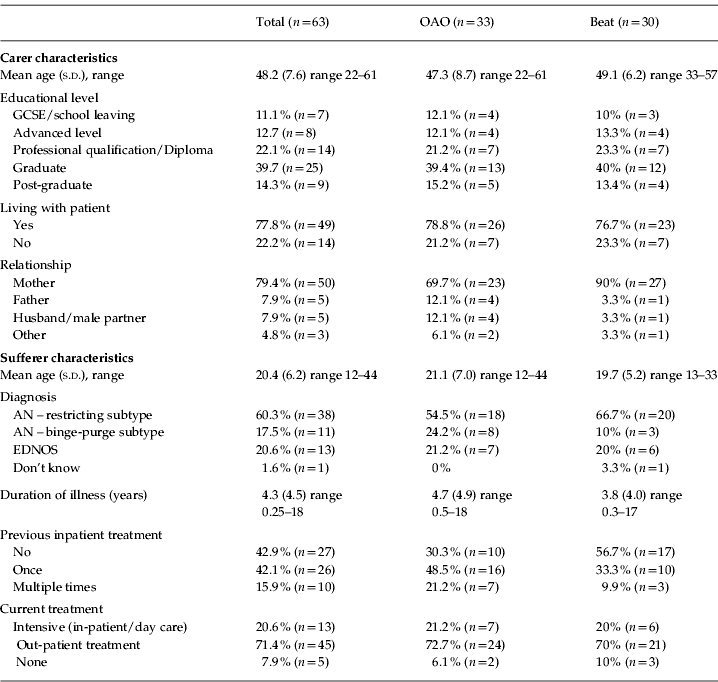
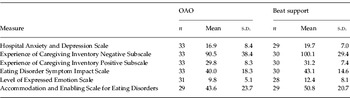
Carers and sufferers' characteristics are shown in Table 1. Table 2 shows carers' baseline questionnaire scores.
Carer and sufferer characteristics
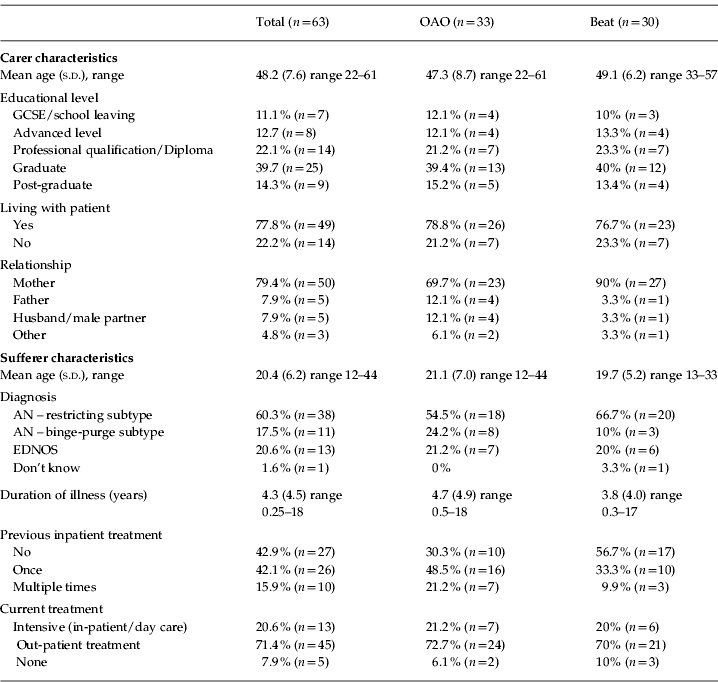
OAO, overcoming anorexia online; AN, anorexia nervosa; EDNOS, eating disorder not otherwise specified.
Baseline data

OAO, Overcoming anorexia online.
Treatment adherence and feedback from the intervention
This is described separately by treatment group.
OAO participants
Website records of log-in details suggest that all OAO participants logged in to the website at least once. Of the 33 carers randomized to the OAO treatment, 78.8% (n=26) requested email support as part of the package and 21.2% (n=7) requested telephone support. All people receiving telephone support engaged with the intervention and answered calls. Three people who had requested email support did not respond to support emails and reminders. The mean amount of support given throughout the trial and follow-up period was 93.4 (range 36–253) min. Analysis of the telephone and email support given throughout the intervention indicates that most of the participants completed much of, if not all of, the online intervention.
In total, 58% (n=19) of participants in the OAO group completed and returned the feedback questionnaire and, of these, 90% (n=17) completed the entire OAO intervention. Altogether, 5% (n=1) completed more than half the intervention and 5% (n=1) completed less than half the intervention. The mean scores given by the respondents in terms of level of interest was 4.5, 4.2 for enjoyment, 4.1 for new information and 4.3 for whether the intervention was useful to them (maximum possible score=5.0). Respondents also rated each of the modules individually on a scale of 0–7 for how useful they found each module. Mean scores indicated that respondents found the module based on effective communication the most useful module (mean score 5.8) and the module addressing problems such as bingeing, purging and other difficult behaviours as least useful to them (mean score 4.6). This module is, however, only likely to be of benefit to those carers whose relative with AN has the binge-purge subtype and therefore may be highly useful to a proportion of carers but less relevant to others.
Beat participants
Altogether, 37% (n=11) of participants in the Beat group completed the feedback questionnaire, 45% of these (n=5) had made contact with Beat services less than weekly and 55% did not make contact at all (n=6). No information is available on the service utilization of those who did not complete the feedback questionnaire. Participants in the Beat group also rated the support they received for the duration of the study in relation to level of interest, enjoyment, new information and whether the support was useful to them. Level of interest, enjoyment and new information all received a mean score of 3.4 and participants rated whether the support was useful to them at a mean score of 2.7.
Although the response rate for the feedback questionnaires was lower in the Beat group than the OAO group, the feedback indicates that overall the participants in the OAO group found the intervention more useful across the areas measured.
Treatment outcomes
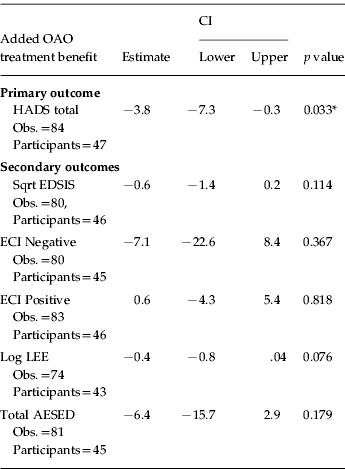
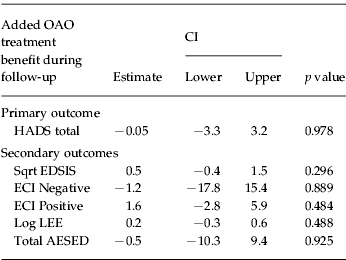
Tables 3 and 4 show the main results from the linear mixed model analyses. Displayed are the differences between the two treatment groups (Beat support and OAO) regarding their improvement between baseline and post-treatment (Table 1) and between post-treatment and follow-up (Table 2). The latter shows whether the difference in the two groups was maintained to follow-up.
Estimated differences between overcoming anorexia online (OAO) intervention and Beat support at post-treatment (i.e. treatment difference from pre- to post-treatment)
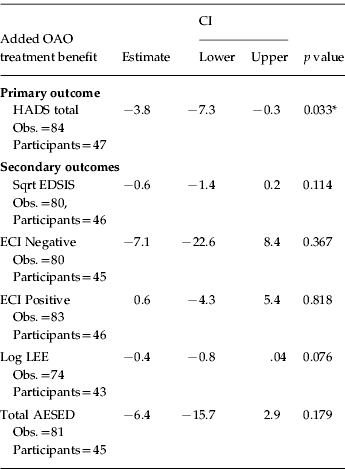
CI, Confidence interval; HADS, Hospital Anxiety and Depression Scale; Obs., observations; Sqrt, square root; EDSIS, Eating Disorder Symptom Impact Scale; ECI, Experience of Care Giving Inventory; LEE, Level of Expressed Emotion Scale; AESED, Accommodation and Enabling Scale for Eating Disorders.
Estimated difference of overcoming anorexia online (OAO) treatment and Beat support at follow-up (treatment difference from post to follow-up)
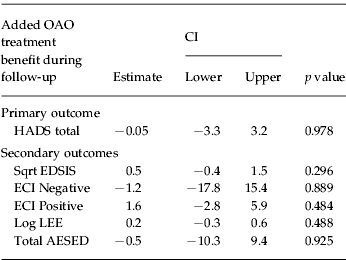
CI, Confidence interval; HADS, Hospital Anxiety and Depression Scale; Sqrt, square root; EDSIS, Eating Disorder Symptom Impact Scale; ECI, Experience of Care Giving Inventory; LEE, Level of Expressed Emotion Scale; AESED, Accommodation and Enabling Scale for Eating Disorders.
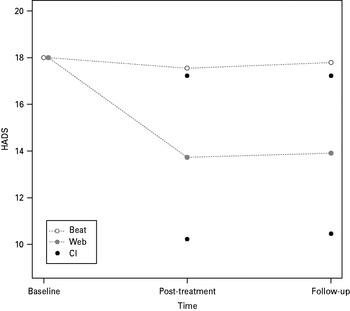
Table 1 shows that the additional benefits of the OAO treatment reduced the HADS significantly by –3.8 points compared with the Beat active treatment control. There was a small additional advantage of the OAO treatment from post-treatment until follow-up, which was not significant. Fig. 2 illustrates carers' predicted HADS at baseline, post-treatment and follow-up for the two groups and shows confidence intervals for the differences in changes over time.
Predicted total Hospital Anxiety and Depression Scale (HADS) score for web-based (OAO) and Beat intervention. The distance between the upper black dot and the white dot corresponds to the lower confidence interval (CI) value for the difference between the Beat and the web group and the distance between the lower black dot and the white dot corresponds to the larger confidence boundary for the difference between the Beat and the web group, both at post-treatment and follow-up.

For all other outcomes, there were greater reductions of symptoms in the OAO group compared with the Beat support group; however, these were not significant.
On average, there was no significant change between baseline and post-treatment and between post-treatment and follow-up in the Beat group.
Sensitivity analyses
We performed two sensitivity analyses to explore whether specific inconsistencies had an effect on our estimation results. First, one of the carers allocated to the OAO group, who had initially shown very little anxiety or depression, suddenly had a very high HADS score at follow-up. She noted on her questionnaire that this high score resulted from her being depressed and anxious due to personal circumstances completely distinct from her daughter's illness. Second, one of the carers allocated to Beat support insisted on having OAO and was offered this. We therefore performed two sensitivity analyses, one where we excluded the first case from the analysis and another where the second case was analysed with the OAO group, according to the treatment she had received. Overall, the estimated effects did not change. Details can be obtained on request from the authors.
Moderator analyses
Moderator variables change the direction or strength of the relationship between an independent variable and an outcome (Baron & Kenny, Reference Baron and Kenny1986). This study was not powered to detect moderators. However, we carried out an exploratory analysis with the aim of establishing some possible moderator hypotheses for future investigation. We did not carry out any subgroup analyses, but extended our model to allow exploratory investigation of whether the treatment effect on HADS was moderated by carers' psychological profile or by characteristics of the person they cared for. Treatment moderator effects were tested by including an interaction between the potential moderators and the treatment effect in the model, after allowing for main effects for both the potential moderator and the treatment effect.
Potential moderators that were investigated included carers' EE at baseline, whether the sufferer had previously been an in-patient and whether the sufferer had previously received any treatment. We only investigated the data at baseline and post-treatment in this analysis, ignoring the follow-up data. No moderator effects were found (further details can be obtained from the authors).
Discussion
Main findings
The aims of this study were to examine whether a structured web-based support intervention provided with limited clinician guidance (OAO) was superior to ad-hoc usual support provided by the voluntary sector (Beat) in reducing carer distress and the burden of caregiving. The main finding of this pilot RCT was that the web-based treatment had a significantly greater positive impact on carers' levels of anxiety and depression than the control intervention (Beat support). A similar pattern of reduction in outcome measures was seen over time across both groups from all measures, although there was no significant difference between groups.
It is possible that the lack of significant differences in the secondary outcome measures across treatments is due to a lack of power to detect these. No moderators of outcome were found.
Our main hypothesis of reduced carer distress following OAO was supported, with partial support for our subsidiary hypothesis. These findings are in line with those from an earlier (uncontrolled) pilot study examining the materials used within OAO as an off-line intervention (Grover et al. Reference Grover, Williams, Eisler, Fairbairn, McCloskey, Smith, Treasure and Schmidt2010).
Using the Internet: access and acceptability
This is the first RCT to use an Internet-based multi-media intervention in carers of people with an eating disorder. Feedback from OAO participants suggests that they perceived this as an acceptable and useful intervention. Online interventions have the advantage of being accessible at any time without having to make appointments or to spend time travelling. The fact that the majority of participants chose email support underscores that many carers wanted to maximize the flexibility of an entirely electronic intervention.
Clinician guidance
The study design does not allow us to separate the effects of the online intervention from those of clinician guidance. Previous studies on computerized CBT in patients with anxiety and depressive disorders (Gega et al. Reference Gega, Marks and Mataix-Cols2004;Gellatly et al. Reference Gellatly, Bower, Hennessy, Richards, Gilbody and Lovell2007) have shown that clinician guidance improves outcomes. However, a recent trial from our group in carers of people with eating disorders, comparing ‘pure’ self-help (using a written and DVD-based self-help package) or the same package with additional telephone guidance, did not yield any additional benefits associated with the guidance element of the package (Goddard et al. Reference Goddard, Macdonald, Sepulveda, Naumann, Landau, Schmidt and Treasurein press). While in the present study guidance was given by highly experienced clinicians with expertise in eating disorders, working with families and CBT, the earlier trial used coaches with more varied levels of expertise and training; therefore, perhaps, diluting the effect of supportive guidance. An alternative possibility is that perhaps clinician guidance is more important when treating people who struggle with poor motivation or other obstacles to successful self-help. However, carers are usually highly motivated to work on their difficulties and may therefore need less in the way of personal guidance to do so. The questions of who should provide guidance to carer packages, in what way and how much, is an interesting area for future research. A key will be to explore actual use and application of the self-help approach in the person's life and to see what factors moderate this.
Of note, the time investment needed to support the package, on average, was only about 1.5 h. This is comparable with that found in other studies of clinician-guided, Internet-based packages.
Implications for future delivery of carer support
This study provides preliminary support for the efficacy of an Internet-based package of carer support. This can be easily integrated into clinical care and offered by eating disorder services as an adjunct to the treatment of AN. There is also a possibility that the package could be delivered early in the treatment, perhaps with guidance from a non-specialist; however, this needs to be examined further in research trials.
Strengths and limitations
The study is limited by its small sample size and level of research drop-out, in particular in carers receiving the Beat intervention. Low research follow-up rates are likely to be due to the fact that the active intervention (OAO) was a distance-learning intervention with very minimal personal contact and the control intervention (Beat) involved no personal contact with carers. Moreover, we were not able to remunerate carers for their time in completing questionnaires and this may be a strategy to use in future studies to increase follow-up.
A further limitation is the fact that we only studied carer outcomes, rather than attempting to get direct information from the person they cared for in terms of the impact of the intervention on carer/sufferer relationship and sufferers' symptom levels.
Self-help approaches with or without guidance have been widely used in patients with eating disorders and other psychological disorders. A key strength of the present study is that, for the first time, it applies the principles of guided self-help via an interactive electronic medium to a carer population. Carers, rather than patients, may be a particularly appropriate audience for the use of such approaches, given they are highly motivated to work on their difficulties.
Future research
Replication of these findings in a larger sample is needed. This might also allow the outcomes of different types of carers (e.g. parent versus partner) with this intervention to be looked at. Other important questions to address are whether the intervention would work as well with or without clinician guidance and whether it might be possible for non-clinicians, i.e. such as expert carers, to provide the guidance. Future studies could explore the amount, content and frequency of support offered, as well as the modality of how it is delivered. Computerized CBT also allows the use of ‘intelligent’ emails that include data on package use and symptom trajectory to individualize content. It would also be important to know whether the intervention might be particularly useful at certain stages of the illness, as many carers commented that they would have found the intervention particularly useful when the illness first started.
Acknowledgements
This work was supported by a grant from the South London and Maudsley Research and Development Fund. It was also supported by the Biomedical Research Centre for Mental Health, South London and Maudsley NHS Foundation Trust and Institute of Psychiatry, King's College London, by a National Institute of Health Research (NIHR) Programme Grant for Applied Research (Reference number RP-PG-0606–1043; ARIADNE – Applied Research into Anorexia Nervosa and Not Otherwise Specified Eating Disorders) and by the Marie Curie Research Training Network INTACT (MRTN-CT-2006–035988). The views expressed herein are those of the authors and not necessarily those of the NHS, NIHR or the Department of Health. (Trial Registration: ISRCTN10099376.)
Declaration of Interest
Ulrike Schmidt, Ivan Eisler, Chris Williams and Janet Treasure are authors of Overcoming Anorexia Online.