Implications
Taking advantage of the diversity of animal resources and their interactions within livestock systems is a key driver for increasing their sustainability and resilience. However, the design and implementation of livestock systems based on animal resource diversity require more knowledge about their performances and their management. In this study, we provide initial insights on the multi-performances and management of dairy cattle herds that combine two kinds of breeds with contrasting features. These results can be used to support discussions with farmers and advisors about the role of interbreeding and animal variability within dairy cattle herds.
Introduction
In Europe and North America, agricultural intensification has entailed the specialisation of livestock production management, domestic crop varieties and livestock breeds (Brussaard et al., Reference Brussaard, Caron, Campbell, Lipper, Mainka, Rabbinge, Babin and Pulleman2010). This specialisation is particularly significant in dairy cattle systems that predominantly use the Holstein breed, often in zero-grazing production systems, to produce high milk yields based on external inputs (Hoffmann, Reference Hoffmann2010). However, this model of agricultural development has significant drawbacks. First, it has contributed to the decline in biodiversity of cultivated crops and domestic animals (Jackson et al., Reference Jackson, Pascual and Hodgkin2007). Second, animal breeding programmes based on improving one single target criteria of selection (e.g. milk yield) in controlled environments has increased animal productivity, but often to the detriment of fitness traits such as reproduction (Mackey et al., Reference Mackey, Gordon, McCoy, Verner and Mayne2007; Sørensen et al., Reference Sørensen, Norberg, Pedersen and Christensen2008), longevity in dairy herds (Knaus, Reference Knaus2009) and disease resistance, such as to mastitis (Oltenacu and Broom, Reference Oltenacu and Broom2010). Such selected animals, because of their high feed requirements throughout lactation, are also more sensitive to restricted diets (Delaby et al., Reference Delaby, Faverdin, Michel, Disenhaus and Peyraud2009) and to climate change (e.g. higher temperatures, water scarcity) (Gauly et al., Reference Gauly, Bollwein, Breves, Brügemann, Dänicke, Daş, Demeler, Hansen, Isselstein, König, Lohölter, Martinsohn, Meyer, Potthoff, Sanker, Schröder, Wrage, Meibaum, von Samson-Himmelstjerna, Stinshoff and Wrenzycki2013). Conversely, dual-purpose breeds, and more generally animals selected for more diverse target criteria, often have lower milk-production potential but better fitness traits (Delaby et al., Reference Delaby, Faverdin, Michel, Disenhaus and Peyraud2009).
Interactions between agricultural system components and differences in animals’ individual abilities in a herd are considered as one of the key factors in developing sustainable livestock systems (Dumont et al., Reference Dumont, Fortun-Lamothe, Jouven, Thomas and Tichit2013). At the herd scale, three types of research have been conducted to explore these factors. The first type studies benefits and disadvantages to animal production of combining different species in a livestock system (Celaya et al., Reference Celaya, Benavides, García, Ferreira, Ferre, Martínez, Ortega-Mora and Osoro2008; D’Alexis et al., Reference D’Alexis, Periacarpin, Jackson and Boval2014). The second one explores benefits of using individual variability in response to herd management to improve or stabilise overall herd production (Tichit et al., Reference Tichit, Puillet, Sabatier and Teillard2011; Dumont et al., Reference Dumont, Thomas, Ducrot, Dourmad and Tichit2014). The third one identifies which breeds or genotypes are best adapted to a range of stable or variable production environments (Blanc et al., Reference Blanc, Bocquier, Agabriel, D’hour and Chilliard2006; Delaby et al., Reference Delaby, Faverdin, Michel, Disenhaus and Peyraud2009). To our knowledge, few published studies have addressed the benefits of combining cow breeds with contrasting features into a dairy herd, although such herds actually exist. Moreover, most previous studies simulate the performances of herds based on interactions between different types of animals but ignore real farmers’ herd-management practices and their interactions with herd performances.
The aim of this study is to assess performances of multi-breed dairy herds (MDH) and to characterise their management. Such herds are composed of two breeds of dairy cows, one milk ‘specialist’ breed (Holstein) and one ‘generalist’ breed (Montbeliarde, Simmental, Normande or Brown Swiss). We assume that the specialist breed performs well in milk yield at the expense of milk fat and protein contents and fitness traits, and that the inverse occurs for the generalist breed. In a MDH, neither of the two types of breeds accounts for >80% of the number of cows in the herd. After detailing the research protocol, we describe the results. We then discuss how they contribute to the field of research that addresses the management of diversified livestock systems.
Material and methods
Case study: multi-breed dairy farms in a highly specialised region
The study was conducted in Aveyron, a semi-mountainous region in southern France, in 2010. After many years of agricultural specialisation (Wampfler, Reference Wampfler1997), 88% of farms practice animal husbandry, of which 16% have dairy cattle (Agreste, 2010). In dairy cattle, Holstein is the predominant breed, representing 68% of dairy cows recorded in Aveyron Dairy Herd Improvement records in 2010. Montbeliarde, Simmental, Brown Swiss and Normande breeds represent 12.4%, 9.1%, 7.1% and 0.9% of dairy cows, respectively, and cross-bred cows represent 2%. Due to livestock specialisation, the area of silage maize increased from 30% to 40% of the usable agricultural area from 1990 to 2009, whereas grazing areas decreased from 27% to 20% during the same period (Perguet P., Aveyron Chamber of Agriculture, personal communication). In 2010, 69% of dairy farms and 76% of the dairy cow population in the region were recorded. The sample included 1003 dairy herds, of which 158 were MDH. The average recorded farm covered 65 ha and had 46 dairy cows that produced 6500 kg milk per year (sold at 306 €/1000 kg). While the total number of dairy herds decreased by 24% since 2000, MDH decreased by only 14%.
Data sources
Herd performances from the entire milk-record database
Herd performances and characteristics of all recorded dairy cattle herds in 2010, regardless of breed-type composition were gathered to compare herd performances according to breed-type composition. Farms with missing and atypical data were removed. The final database counted 605 dairy farms that were divided into three categories according to breed-type composition: specialist dairy herds (SDH), composed of only Holstein cows (405 herds); generalist dairy herds (GDH), composed of cows of one generalist breed among Montbeliarde, Simmental, Brown Swiss or Normande (117 herds); and MDH (83 herds).
Data gathered from a sample of MDH
Sampling aimed to explore the diversity of MDH functioning to characterise farmers’ herd-management practices and analyse individual performances of each breed type within herds. We chose farms specialised in dairy production with at least 30 dairy cows to have a sufficient number of cows of each breed type in the herd. We then selected a subsample of farms with MDH for at least 5 years to interview farmers with actual experience of such herds. We also chose MDH with different percentages of specialist cows in 2010, to account for their potential influence on herd performance and management. The final sample included 22 multi-breed farms. Compared to the averages of the overall population of MDH, the sampled farms had slightly higher milk yields per cow and per year (+500 kg), lower somatic cell counts (SCC, −35 000 cells/ml) and shorter calving intervals (CI, −9 days), and higher prices (+12 €/1000 kg) (Supplementary Table S1). Semi-directed interviews were conducted to learn ‘how and why’ farmers manage such MDH. They contained (i) a description of the farm; (ii) its trajectory, with a focus on the period of transition to the MDH; (iii) the farmer’s practices for managing the diverse breed types; and (iv) the farmer’s viewpoints about the advantages and disadvantages of raising two types of breeds. Interviews were conducted from May to June 2011, generally lasted 90 min each, and were recorded.
Individual milk performances of all cows recorded from the 22 sampled MDH (i.e. 10 682 cows in 2010) were also gathered to analyse how breed type within a herd contributed to its overall performances.
Data processing and statistical analyses
Analyses of variance of herd performances according to breed-type composition
To compare MDH, GDH and SDH performances, one-way ANOVA were performed, followed by Tukey’s honestly significant difference tests. Eighteen variables were compared. Four concerned herd and farm structure: number of cows per herd, age at first calving, surface area and stocking rate. Four represented milk-production performances: herd milk yield, milk yield/cow per year, and milk protein and fat contents. One focussed on udder health performance: SCC. Seven focussed on herd reproduction performances: CI, days to first service after calving (DFS), days to last service after calving (DLS), conception rate at first service (%) (CR1) and number of services for conception (NS). Three variables represented technical and economic performances: milk price, herd dependence on concentrate (i.e. quantity of concentrate used/cow per year), and concentrate-conversion efficiency (i.e. quantity of concentrate used to produce 1 kg of milk). Differences were considered statistically significant at P<0.05. Statistical analyses were performed using R software (version 2.1.1.1).
Analyses of variance of individual cow milk performances within the sample of MDH
To compare milk performances of cows according to their breed type within MDH, we analysed the responses of five milk performances, that is milk yield (in kg/cow per year), milk fat and protein contents (in g/kg), lactation rank (in year) and lactation length (in day), to breed type regardless of farm management. For each milk performance, we performed an ANOVA with breed type as a fixed effect and farm as a random effect. Differences were considered statistically significant at P<0.05. Statistical analyses were performed using R software (version 2.1.1.1).
Analysis of farmers’ interviews
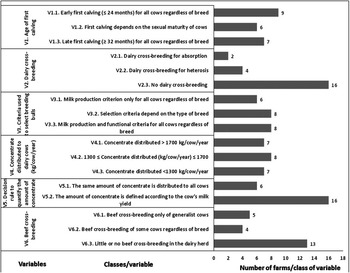
Each of the 22 recorded interviews was summarised in a template to standardise representation of the collected data. Based on these templates we used a method of data abstraction based on knowledge engineering (Girard et al., Reference Girard, Duru, Hazard and Magda2008) to create key variables divided into classes to characterise the diversity of farmers’ practices concerning MDH management. Six variables were constructed: three characterise practices for configuring the breeding herd (V1, V2 and V3), two concern feeding practices (V4 and V5), and one concerns practices that enhance the value of animal products (V6) (Figure 1). A multiple correspondence analysis (MCA) was performed on the 6×22 database (6 variables and 22 MDH) to discriminate factorial axis structuring of the observed variability in MDH management. Ascending hierarchical classification was then performed for clustering farmers according to their MDH management. Finally, we tested the differences in performances among the groups with a Kruskal–Wallis test, followed by two-by-two Wilcoxon’s tests between groups according to herd performances (milk production, reproduction and economic performances) and farm characteristics (farm size, number of cows, breed composition, percentage of specialist v. generalist breed cows). Analyses were performed with R software (version 2.1.1.1, package Rcmdr).
Six variables (Vi, i=1 to 6) and their classes (Vij, i=1 to 6 and jj=1 to 3) defined to characterise multi-breed dairy farmers’ management practices. Histograms represent the number of farms per class.

Results
Characterisation of the performances of MDH
Performance trade-offs of MDH compared with single-breed herds
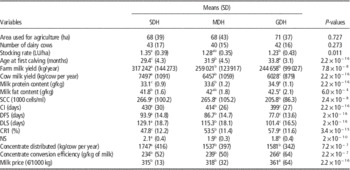
ANOVA of MDH and single-breed dairy herds (composed of either specialist or generalist breed cows) from the 605 recorded dairy farms highlight the significant strengths and weaknesses of MDH compared to the two other types (Table 1). Compared with SDH and GDH, MDH had intermediate levels of performances for all studied parameters, except for dependence on concentrate, which was the lowest among the three types of herds. Compared with SDH, MDH produced significantly less milk, either at the farm level (−58 221 kg/year) or per cow (−1040 kg/year) and had significantly higher protein content (33.6 v. 33.1 g/kg, respectively). They also had significantly less dependence on concentrate (−210 kg/cow per year) than SDH; therefore, both had the same concentrate-conversion efficiency: ca. 230 g/kg. MDH had significantly better reproductive performances than SDH, with shorter CI (414 v. 434 days, respectively), DFS (86.7 v. 93.9 days, respectively), DLS (115.3 v. 129.1 days, respectively) and NS (1.9 v. 2.1, respectively), and higher CR1 (53.5% v. 47.8%, respectively). Conversely, no significant differences were observed for SCC and milk prices between MDH and SDH. Compared to GDH, MDH had significantly higher milk yields per cow (+429 kg/year) with significantly lower protein contents (−1.3 g/kg), while distributing the same amount of concentrates. They had significantly better concentrate-conversion efficiency: 232 v. 268 g/kg for MDH and GDH, respectively. Conversely, MDH cows had significantly worse reproductive performances than GDH, except for NS. The former had longer CI (+15 days), DFS (+9.7 days) and DLS (+13.9 days) and lower CR1 (−4.4%) than the latter. MDH were also worse than GDH in terms of udder health, with a significantly higher SCC (265 800 v. 205 800 cells/1000 ml, respectively) and in terms of milk prices (318 € v. 361 €/1000 kg of milk, respectively). These results show that MDH had a better performance trade-off among milk yield, milk protein contents, reproductive performances and concentrate-conversion efficiency than single-breed dairy herds. Conversely, they did not offer advantages in terms of milk prices and udder health compared to SDH and GDH.
Key characteristics and performances of multi-breed dairy herds (MDH) and single-breed herds, whether composed of specialist breed cows (SDH) or generalist breed cows (GDH)

LU=livestock units; SCC=somatic cell counts; CI=calving interval; DFS=days to first service after calving; DLS=days to last service after calving; CR1=conception rate at first service; NS=number of services per conception.
a,b,cValues within a row with different superscripts differ significantly at P<0.05.
Complementarity of breed type performances within MDH
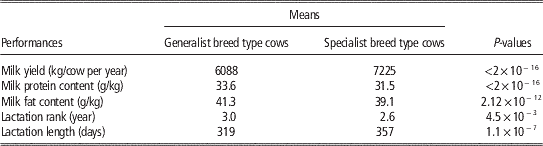
One-way ANOVA with the farm as the random effect showed that within MDH, breed type had a significant influence on the five tested milk performances (Table 2). Specialist breed cows produced more milk (+1137 kg/year) for a longer lactation length (+38 days) than generalist breed cows. Conversely, the latter produced milk with higher protein (+2.1 g/kg) and fat contents (+2.2 g/kg) and had a slightly longer lactation rank (+5 months) than the former.
Means of milk performances for all generalist and specialist breed cows in the 22 multi-breed herds

Characterisation of MDH management
Two main guidelines for managing MDH
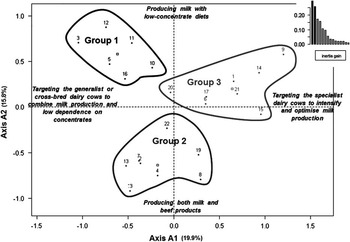
The first two MCA axes explained 36% of the variability among individuals and were retained as guidelines to characterise farmers’ management strategies for MDH (Figure 2; Supplementary Table S2). The first axis (19.9% of total inertia) is mainly determined by concentrate distribution and age at first calving (Figure 2; Supplementary Table S2). The selection criteria are secondary. This axis is related to the level of production intensification and to the renewal options used by farmers. Several farmers targeted specialist dairy cows to intensify and optimise milk production of the entire herd. They distributed larger quantities of concentrates and canalised (decreased) inter-breed type variability using dairy cross-breeding for absorption. Other farmers targeted generalist or cross-bred dairy cows to combine milk production and low dependence on concentrates. They used smaller quantities of concentrates and amplified (increased) inter-breed type variability using dairy cross-breeding for heterosis. The second axis explained 15.8% of total inertia. It is determined by concentrate distribution, beef cross-breeding and the age of first calving. This axis is related to the purposes farmers have for dairy herd production (milk v. milk/meat) and for using the two types of breeds and how they enhanced the value of the dairy herd. Management is not focussed on milk production but on dual-purpose milk-meat production of dairy farms. Farmers produced milk with low-concentrate diets and practiced late calving for all cows to use dairy heifers to graze local resources. In this way, using two types of breeds is an option that strikes a balance between milk production (yields and fat and protein contents) and feed costs. The farmers addressed the balance between milk and meat production by differentiating and adapting practices (concentrate feeding, first calving and beef cross-breeding) to breed types. In this way, using two types of breeds is an option to increase the value of milk and meat products.
Three groups of farmers differentiated according to their ways of managing multi-breed dairy herds using Multiple Correspondence Analysis (MCA) followed by Ascending Hierarchical Classification: Group 1 ‘Amplifying breed-type diversity to combine milk production and low dependence on concentrates’, Group 2: ‘Segmenting breed-type diversity to promote milk and beef products’, and Group 3: ‘Canalising breed-type diversity to maximise milk yield’. Interpretation of each factorial axis (in italics) was based on the coordinates and contributions of the classes of variables discriminated by the MCA and defined in Figure 1.

Three strategies for managing MDH
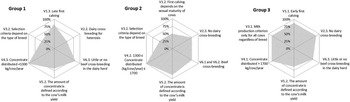
The clustering process using the coordinates from these two axes identified three groups of farmers according to their management strategies of MDH (Figure 2). See Figure 3 for the main characteristics of each group.
Profile of multi-breed dairy herd management practices for the farmers in each of the three groups identified by multivariate analysis. The most frequent practices in a group were identified and estimated as the corresponding percentage of the farms. Group 1 ‘Amplifying breed-type diversity to combine milk production and low dependence on concentrates’; Group 2: ‘Segmenting breed-type diversity to promote milk and beef products’; Group 3: ‘Canalising breed-type diversity to maximise milk yield’.

Group 1: ‘Amplifying breed-type diversity to combine milk production and low dependence on concentrates’. These six farmers used and combined the potential strengths of each breed to manage trade-offs among milk yield, milk fat and protein contents and concentrate-conversion efficiency. These farms were predominantly based on a specialist breed. The generalist breeds were Simmental (two farms), Normande (two farms) and Montbeliarde (two farms). Half of the group targeted herd management of the generalist breed for its fitness traits (mainly its lower feed requirements) and its milk fat and protein contents while selecting a specialist breed for higher milk yields. The other half used the heterosis effect by cross-breeding 22% to 27% of the cows. These farmers amplified animal diversity by creating a new genotype that integrated the features of the two breed types, while the former played on the complementary of the features of specialist and generalist breed cows (i.e. milk yield and low requirements, respectively) at the herd level. Reproductive practices were targeted for the generalist breed. The first calving was at around 32 months regardless of breed. Rather than reducing heifers’ unproductive periods, these farmers reduced the herd feed cost by optimising use of the remotest and poorest grassland. These farmers also distributed <1300 kg of concentrate/cow per year, which was the lowest level of the three groups. Calving periods were grouped in autumn to limit workloads during summer (no milking during summer) and to match animals’ low feed requirements with low summer forage.
Group 2: ‘Segmenting breed-type diversity to promote milk and beef products’. These eight farmers in this group managed MDH to optimise the dual purpose of production. They produced milk with specialist breed cows and meat with generalist breed cows. Five farms in this group had predominantly specialist cows, and three had a balance between specialist breeds and generalist breeds. Generalist breeds were Montbeliarde (four), Brown Swiss (two), Simmental (one), and Normande (one). To benefit from the dual purpose of the MDH, farmers differentiated their breeding practices according to breed type. On each of these farms, a mean of 30% of generalist breed cows (range=15% to 53%) were crossed with beef bulls. In contrast, beef cross-breeding occurred less with specialist dairy cows, concerning a mean of 10% of them (range=2% to 40%). According to these farmers, such practices help increase the value of meat products associated with dairy herds. Cross-bred calves have better growth performance and higher-quality carcasses than pure-bred animals. These practices were also a way to regulate the headcount of each breed in the herd. The farmers segmented reproductive practices according to breed type. They managed heifers’ first calving according to sexual maturity. Specialist breed cows first calved at 24 months, on average, while generalist cows calved at >32 months. This management practice optimised the productive period of Holsteins without damaging the growth of the generalist breed cows, which matured later. Half the group differentiated the criteria for sire selection according to breed. Specialist breed cows were mated with sires to improve milk protein content, while generalist cows were mated with sires to improve milk yield. The other half chose sires to improve milk yield for all cows. In terms of feeding management, these farmers distributed 1300 to 1700 kg of concentrate/cow per year according to the cow’s milk production.
Group 3: ‘Canalising breed-type diversity to maximise milk yield’. These eight farmers targeted their management practices for the specialist cows to intensify and optimise milk production. They thus reduced (canalised) the diversity of breed type. Most of these farms (6/8) had at least 60% specialist cows. Generalist breeds included Montbeliarde (seven herds) and Brown Swiss (one). Reproductive practices were based on early first calving (>24 months) for all heifers regardless of breed (7/8 herds). For these farmers, this management practice reduced cows’ unproductive periods and prevented the fattening of generalist cows, which can increase health and reproductive problems. These farmers used >1700 kg of concentrates/cow per year (1995 kg/cow per year, on average), which was the highest level of the three groups. Five farmers distributed concentrates according to milk production, while three farmers provided the same quantity regardless of breed. All of these farmers focussed on milk production, and their herds had high milk yields. One farmer practiced cross-breeding to absorb the generalist breed cows into the Holstein breed. The criteria for selecting sires were the same for all cows regardless of breed. Therefore, most farmers (5/8) used only sires with the best genetic index on milk production, while the others (3/8) combined this index with more functional and morphological criteria.
Relation between the three management strategies and herd performances
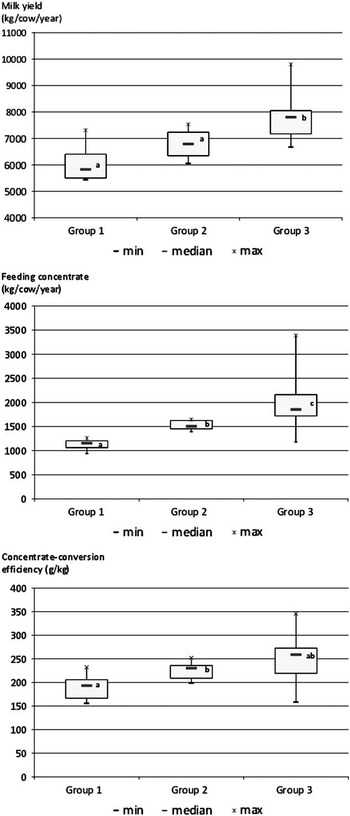
Performances of the three groups of farmers highlight significant differences in milk yield (kg/cow per year), concentrate feeding (kg/cow per year) and concentrate-conversion efficiency (Figure 4). Group 3 had a median milk yield significantly higher (7803 kg/cow per year) than those of Groups 1 (5839 kg/cow per year) and 2 (6791 kg/cow per year) (Figure 4a). Groups 1 and 2 were similar. Concentrate feeding differed significantly between the three groups (1154, 1504 and 1852 kg/cow per year for Groups 1, 2 and 3, respectively) (Figure 4b). The medians of concentrate-conversion efficiency differed significantly between Group 1 (193 g/kg) and Group 2 (230 g/kg), but no difference was observed with Group 3 (259 g/kg) (Figure 4c). All other performances and farm characteristics were not significantly different (Supplementary Table S3). It is worth noting that Group 1 had the worst reproductive and upper health performances of the three groups even if differences were not significant.
Differences in (a) milk yields, (b) concentrate feeding per cow per year and (c) concentrate-conversion efficiency (g/kg) in the multi-breed dairy herds of the three farm groups from multivariate analysis. Group 1 ‘Amplifying breed-type diversity to combine milk production and low dependence on concentrates’; Group 2: ‘Segmenting breed-type diversity to promote milk and beef products’; Group 3: ‘Canalising breed-type diversity to maximise milk yield’. Differences among groups were tested by a Kruskal–Wallis test and were significant at P<0.05. Letters at medians indicate significant two-by-two differences between groups tested by the Wilcoxon test at P<0.016.

Discussion
Advantages of combining specialist and generalist breed cows in a dairy herd: the issue of analysing herd performance trade-offs
In the literature, interactions between agricultural system components and differences in individual animal abilities in a herd are considered key mechanisms for maintaining or improving the overall performance of livestock systems (Tichit et al., Reference Tichit, Puillet, Sabatier and Teillard2011; Dumont et al., Reference Dumont, Thomas, Ducrot, Dourmad and Tichit2014). To our knowledge, our findings provide initial insights on the performances of dairy herds combining two breed with contrasting features. Previous studies addressed the influence of breed, cross-breeding and animal species on the performances of herds (Dumont et al., Reference Dumont, Fortun-Lamothe, Jouven, Thomas and Tichit2013).
Our results demonstrated that MDH had an interesting performance trade-off among milk yield, milk protein contents, reproductive performances and concentrate-conversion efficiency compared to single-breed dairy herds, regardless of whether the latter were based on specialist or generalist breeds. Conversely, they had no advantages in terms of milk prices or udder health compared to SDH and GDH. These findings challenge what is called ‘the overall herd performance’ in the literature and how to analyse performance trade-offs. No single profile of performance trade-offs seems best, but several profiles have advantages or disadvantages compared to the others. The main advantages of the performance trade-off profile of MDH are its low concentrate use and high concentrate conversion-efficiency. This global tendency, which was also found at the individual level, reflected the dilution of fixed biological costs (maintenance requirements) by increased production (Puillet et al., Reference Puillet, Martin, Sauvant and Tichit2011). The advantages of MDH compared to SDH are the former’s better reproductive and milk fat and protein contents performances, and compared to GDH, its higher milk yield. These results are in accordance with the well-known negative correlation between high milk yield and fertility traits (Oltenacu and Broom, Reference Oltenacu and Broom2010). However, the advantages of MDH are debatable because udder health and milk prices of MDH were equal to those of SDH and were significantly worse than those of GDH. As for udder health, one explanation is that in MDH, the low concentrate use could force specialist breed cows to compensate with their own body reserves, creating the risk of a negative energy balance. In such a situation, specialist breed cows could express a life function trade-off in favour of milk yield and fertility and at the expense of (udder) heath (Jorritsma et al., Reference Jorritsma, Wensing, Kruip, Vos and Noordhuizen2003). The gap in milk prices between MDH and GDH, is relative. Among the 117 GDH, 97 were based on the Simmental breed producing milk for the laguiole cheese Protected Designation of Origin label, which provides higher milk prices (Charroin et al., Reference Charroin, Veysset, Devienne, Palazon, Ferrand and Sup2012). As shown with the MCA, strategies for managing MDH are also related to farmers’ reasons for rearing dairy cattle: milk production only v. milk/meat production. In our study, no data about beef production of MDH were available. It would be interesting to extend analysis of MDH performances to include beef production performances. Further studies should also include the aspect of selling breeding stock. Besides beef revenues, different breeds in dairy herds may result in different revenues for heifers or cows in milk. This is particularly true for MDH that practice cross-breeding, which may be beneficial for its heterosis effect but may lead to lower income due to offspring which cannot be sold as breeding animals. Studies are also necessary to compare economic performances of MDH and single-breed dairy herds to identify if the observed differences in technical performances generate differences in economic performances and whether these differences favour diversified herds. It would be useful to perform longitudinal analyses of performance trade-offs of MDH compared to those of SDH and GDH to test if combining two types of breeds in dairy herds improves the resilience of herd performance.
Using inter-breed variability: which breed and how to manage it
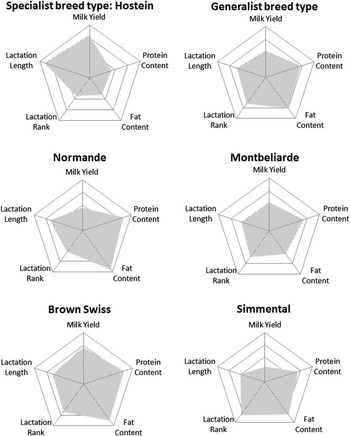
Our results demonstrated that within MDH, specialist and generalist breed cows differed significantly in milk yield, milk fat and protein contents, lactation rank and lactation length. The milk performance profiles of the two breed types indicated that they were complementary (Figure 5). Generalist breed cows had better milk fat and protein contents and lactation rank, while specialist breed cows had better milk yields and lactation length. Several studies have shown that Holsteins have higher milk yields than less milk-specialised cow breeds (Delaby et al., Reference Delaby, Faverdin, Michel, Disenhaus and Peyraud2009; Vance et al., Reference Vance, Ferris, Elliott, Hartley and Kilpatrick2013). This result partially agrees with our assumptions about specialist v. generalist breeds: the performance profile of the former favours milk yield at the expense of milk fat and protein contents and fitness traits, while the opposite occurs for the latter. Data about individual fertility traits of MDH are required to completely test this assumption. We grouped several breeds in the generalist breed type: Montbeliarde, Normande, Brown Swiss and Simmental. The milk performance profiles of these four breeds (Figure 5) indicate that they have the same strengths (milk fat and protein contents and lactation rank) as the generalist breed type to which they belong. Analysing milk performance profiles at the breed scale is useful to identify which breed within the generalist type is worth combining in a herd or to cross-breed to improve specific milk performance. The Normande is well-adapted to improve milk fat and protein contents, the Simmental to improve lactation rank and, to a lesser extent, milk fat and protein contents. The Brown Swiss has a milk performance profile in favour of milk fat and protein contents without compromising milk yield. The milk performance profile of the Montbeliarde suggests that this breed does not have real strengths or weaknesses. According to Ollion (Reference Ollion2015), breed alone is not sufficient to predict the diverse expression of dairy cow trade-offs when studying cows’ metabolic functions or responses to challenges. It would be interesting to extend analysis to the individual level to better characterise individuals’ performance profiles and analyse whether breed is a key driver of these profiles.
Profile of milk performances of specialist breed cows, generalist breed cows and each of the four breeds grouped into the generalist breed type. For breed i, graphs were built using each milk performance P, the ratio ((Mean of P)i–(minimum of the regional P for all dairy breeds))/(maximum of the regional P for all dairy breeds)−(minimum of the regional P for all dairy breeds)). Ranges of each milk performance in the region: milk yield in kg/cow per year (4000; 9000), protein content in g/kg (28; 38), fat content in g/kg (36; 46), lactation rank in months (2; 4) and lactation length in days (250; 400).

Our findings also focus on farmers’ real management of MDH, which is fundamental to herd performances. We first emphasise that different strategies exist for managing MDH. The three strategies identified primarily differentiate farmers according to their animal-selection practices in relation to their production objectives: farmers who concentrate on breed diversity focus more on the type of animal to rear with low-feed inputs, whereas farmers who canalise breed diversity focus on milk yield traits to intensify milk production. The three groups of MDH farmers significantly differed in terms of milk yield and concentrate dependence. The second management guideline reflects the purpose farmers have for livestock production: milk v. milk/meat production. The same two management guidelines were previously identified by Nauta et al. (Reference Nauta, Groen, Veerkamp, Roep and Baars2005) to characterise the diverse changes in breeding practices of farmers moving from conventional towards organic farming.
Characterizing the three groups of MDH farmers’ management strategies revealed that herd performances emerge from complex interactions between biological resources (particularly breed composition) and the decisional component (Puillet et al., Reference Puillet, Martin, Sauvant and Tichit2010). Farmers in Group 1 seek a combination of animals or an animal (through cross-breeding) that provides a win-win situation between milk yields and low concentrate dependency. For them, generalist breed cows are interesting for their fitness traits. This is in accordance with the milk performance trade-off profiles of their chosen breeds: Simmental, Brown Swiss or Normande. They adopt reproductive and feeding practices targeted to such generalist breeds but adapt selection criteria according to the type of breed, particularly milk yield for specialist breed cows. This can explain why this group of farmers had the lowest milk yield and concentrate dependency, but also the highest gap in milk production between generalist and specialist breed cows and the worst reproductive and udder heath performances (Supplementary Table S3), even though the three latter performances were not significantly different from those of farmers in the other two groups. The low concentrate use could force specialist breed cows to compensate with their own body reserves at the expense of fertility and/or (udder) health performances (Jorritsma et al., Reference Jorritsma, Wensing, Kruip, Vos and Noordhuizen2003). For Group 2 farmers, generalist breed cows are sought for their dual-purpose features, which correspond with the farmers’ objective of milk/meat production. This group is characterised by management practices that are adapted to the breed type. Such management practices are associated with relatively ‘better’ herd performances than those of the two other groups and with a smaller gap in milk performances between generalist and specialist breed cows. This is explained by the fact that the most common generalist breeds in this group were Montbeliarde and Brown Swiss, which have a milk yield most similar to that of Holsteins. As suggested by Puillet et al. (Reference Puillet, Martin, Sauvant and Tichit2011), more studies are needed to better understand the influence of different herd-management practices on animal performances at both individual and herd levels. Group 3 farmers intensify milk production and target management practices on specialist breed cows. All but one farmer in this group chose the Montbeliarde generalist breed. This can explain the lowest gap in milk performances between generalist and specialist breed cows and that milk yield was the highest of the three groups without compromising reproductive and udder health performances. Individual variability in such herds seems more important than inter-breed variability (Ollion, Reference Ollion2015).
Conclusion
The aim of this study was to better understand the performances and management of dairy cattle herds that combined two breeds with contrasting features, which we categorised as specialist v. generalist breed types. Our results indicate that such herds, called MDH, have better performance trade-offs among milk production, animal reproduction and concentrate-conversion efficiency than single-breed herds. We showed that within a herd, complementarity exists between lactation performances of the two types of breed. We also characterised three strategies for managing breed-type diversity within a dairy herd, from which emerge performances of the entire herd. Our findings contribute to a better understanding of the functioning of diversified livestock systems.
Supplementary material
For supplementary material/s referred to in this article, please visit http://dx.doi.org/doi:10.1017/S1751731115002840
Acknowledgements
This work was funded by the French ANR SYSTERRA program within the O2LA (ANR-09-STRA-09) project. The authors want to thank the French Livestock Institute (Idele) and the Aveyron milk recording organisation for providing herd and individual data used in this study. They also wish to thank all the multi-breed dairy cattle farmers for their welcome.