Introduction
Bipolar disorder (BD) includes different chronic, often comorbid, and highly disabling conditions that are responsible, in the most severe cases, for a high burden of morbidity and mortality, often related to suicidal behavior. In this respect, the International Society for Bipolar Disorder Task Force, in a recent systematic review of studies from 1980 to 2014, reported a pooled suicide rate for bipolar patients of 164 per 100.000 person-years,Reference Schaffer, Isometsä and Tondo 1 a rate 10- to 30-fold higher compared to the general population.Reference Pompili, Gonda and Serafini 2
In a previous study of 176.347 patients with varying psychiatric diseases who were referred for secondary mental health services, the absolute risk of suicide in BD patients was approximately 8% for men and 5% for women over a median of 18 years of follow-up.Reference Nordentoft, Mortensen and Pedersen 3
With respect to suicide attempts in BD, studies have reported that 20%–50% of patients suffering from BD had a prior suicide attempt (PSA),Reference Simon, Hunkeler, Fireman, Lee and Savarino 4 – Reference Dell’Osso, Dobrea and Cremaschi 7 with risk being higher in younger patients and during the first years after diagnosis.Reference Jamison 8
Recognizing risk factors associated with suicide and, therefore, being able to adopt proper strategies to predict it are of particular importance for clinicians involved in the management of bipolar patients. In a recent report from our group, BD patients with depressive versus elevated polarity at onset more frequently had PSA.Reference Undurraga, Baldessarini, Valenti, Pacchiarotti and Vieta 9 Several additional risk factors have been previously linked to suicide in the bipolar population, but PSA in particular is consistently reported to be one of the main risk factors implicated in suicidal behavior.Reference Novick, Swartz and Frank 10 – Reference Schaffer, Isometsä and Azorin 12 Of note, death by suicide was predicted by PSA in at least 50% of the cases.Reference Dennehy, Marangell, Allen, Chessick, Wisniewski and Thase 13
Other factors associated with PSA in BD patients include early age at onsetReference Dennehy, Marangell, Allen, Chessick, Wisniewski and Thase 13 – Reference Goffin, Dell’Osso and Miller 16 ; long duration of illnessReference Bellivier, Yon and Luquiens 15 , Reference Goffin, Dell’Osso and Miller 16 ; long duration of untreated illness (DUI)Reference Goffin, Dell’Osso and Miller 16 , Reference Altamura, Dell’Osso, Berlin, Buoli, Bassetti and Mundo 17 ; positive family history for suicideReference Antypa, Souery and Tomasini 14 , Reference Parmentier, Etain and Yon 18 – Reference Sánchez-Gistau, Colom, Mané, Romero, Sugranyes and Vieta 20 ; higher lifetime number of hospitalizationsReference Jiménez, Arias and Mitjans 21 ; comorbid alcohol/substance useReference Simon, Hunkeler, Fireman, Lee and Savarino 4 , Reference Bellivier, Yon and Luquiens 15 , Reference Goffin, Dell’Osso and Miller 16 ; eating,Reference Goffin, Dell’Osso and Miller 16 anxiety,Reference Simon, Hunkeler, Fireman, Lee and Savarino 4 and personality (particularly Cluster B) disordersReference Sánchez-Gistau, Colom, Mané, Romero, Sugranyes and Vieta 20 ; presence of complex psychopharmacological therapy; and absence of treatment.Reference Schaffer, Isometsä and Azorin 11 Among sociodemographic variables, female genderReference Simon, Hunkeler, Fireman, Lee and Savarino 4 , Reference Bellivier, Yon and Luquiens 15 , Reference Goffin, Dell’Osso and Miller 16 , Reference Undurraga, Baldessarini, Valenti, Pacchiarotti and Vieta 22 and single marital status in bipolar disorder I (BD-I) patientsReference Azorin, Kaladjian and Adida 23 were associated with PSA.
Despite the above-mentioned findings, suicidal behavior remains very difficult to predict.Reference O’Connor, Gaynes, Burda, Soh and Whitlock 24 The causes are complex and multiple, and each factor adds only a small amount to overall risk, particularly in light of the correlation between genetic and environmental factors.Reference Neves, Malloy-Diniz and Corrêa 25 Moreover, it is difficult to determine whether a single factor is associated with a higher suicidal risk per se or due to the presence of BD, since some features of PSA among bipolar patients partially overlap with those of PSA observed in patients who suffer from other psychiatric disorders and in the general population.Reference Schaffer, Isometsä and Azorin 11
In the present study, we assessed sociodemographic and clinical variables in Italian BD patients with versus without PSA, with the aim of better characterizing suicidal behavior in the BD population.
Methods
The study included 362 bipolar patients, who were recruited at the University Department of Mental Health at the Fondazione IRCCS Ca’ Granda, Ospedale Maggiore Policlinico in Milan, Italy. In order to depict a better representation of the phenomenology of Italian BD patients living in the Milan metropolitan area, patients referred by community-based psychiatric services were also included. Written informed consent was obtained from all participants, after the description of the study, in order to have their clinical charts reviewed for research purposes.
The Structured Clinical Interviews for Diagnostic and Statistical Manual of Mental Disorders, Fourth Edition, Text Revision (SCID I and II),Reference First, Gibbon, Spitzer, Williams and Benjamin 26 – 28 were administered to all participants by psychiatrists or residents in psychiatry with a specific training in mood disorders in order to confirm Axis I/II diagnoses and detect any comorbid psychiatric condition(s). To increase diagnostic specificity, only individuals with BD-I or bipolar disorder II (BD-II) and not those with BD Not Otherwise Specified were included in the study sample. In case of comorbidity with another psychiatric disorder, BD had to be the primary diagnosis affecting patient’s everyday functioning and being mostly responsible for its impact on quality of life and for help-seeking. Patients with evidence of mental retardation, neurological disorders, organic mental illnesses, or other disabling medical conditions were excluded.
Sociodemographic variables included age, gender, education, employment, cohabitation, and marital status. Clinical variables included: diagnosis; age at onset (AAO, ie, age of first mood episode of any polarity), with a categorical distinction between childhood/adolescent onset (<18 years old) and adult onset (≥18 years old); duration of illness; DUI; polarity of first episode [depressed or elevated (manic, hypomanic, or mixed)]; duration of most recent episode; lifetime number of psychiatric hospitalizations and involuntary commitments; presence of psychiatric disorders in the family (first- and second-degree relatives); presence of lifetime psychosis; current subthreshold symptoms; stressful life events before onset; cross-sectional and lifetime psychiatric and medical comorbidity; and history of psychosocial rehabilitation (ie, community-based interventions aimed at improving patients’ social/working skills, reducing functional disability, and improving quality of life).Reference Barbato 29 In order to evaluate patients’ current level of global functioning, the Global Assessment of Functioning (GAF)Reference Hall 30 was administered after the resolution of the last syndromic mood episode in order to exclude potential current mood state-related bias.
Data related to lifetime number, methods used (eg, self-poisoning, cutting, jumping, or others), and severity of PSA were collected. PSAs were considered clinically serious if a medical or surgical intervention was necessary and if PSAs would have been potentially lethal without a proper medical intervention; otherwise PSAs were considered mild.
Current pharmacological treatment, if any, was recorded, and we considered the use of lithium, mood stabilizers, antipsychotics, and antidepressants as primary and adequate treatment for BD, either in mono- or polytherapy. In addition, the presence of polypharmacotherapy, defined by current use of>3 psychotropic compounds, was assessed.
All patients were then divided into 2 groups according to the lifetime occurrence of at least 1 PSA: PSA patients and non-PSA patients.
Statistical analyses were performed using the Statistical Package for the Social Sciences (SPSS), version 22. Multivariate analysis of variance (MANOVA) was used to compare the 2 subgroups for continuous variables. The MANOVA model proved to be valid (Wilks lambda test, p<.001). Chi-square tests were used to compare categorical variables, with Bonferroni post-hoc analysis. A 2-tailed significance threshold was set at p<.05.
Results
Sociodemographic and clinical variables of the entire sample and related subgroups are shown in Tables 1 and 2, respectively.
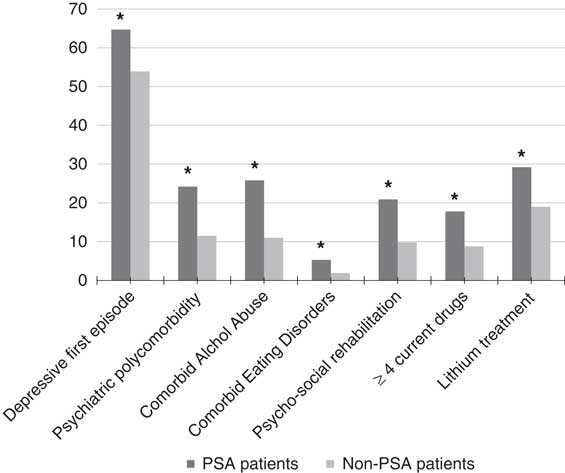
Continuous clinical variables found to be statistically different between patients with and without prior suicide attempt (PSA). All data are expressed in percentage. *p<.05.

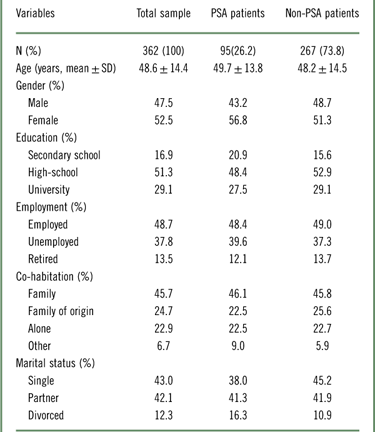
Socio-demographic variables of the total sample and patients with and without prior suicide attempt (PSA)

Values for categorical and continuous variables are expressed in percentages and mean±SD, respectively.
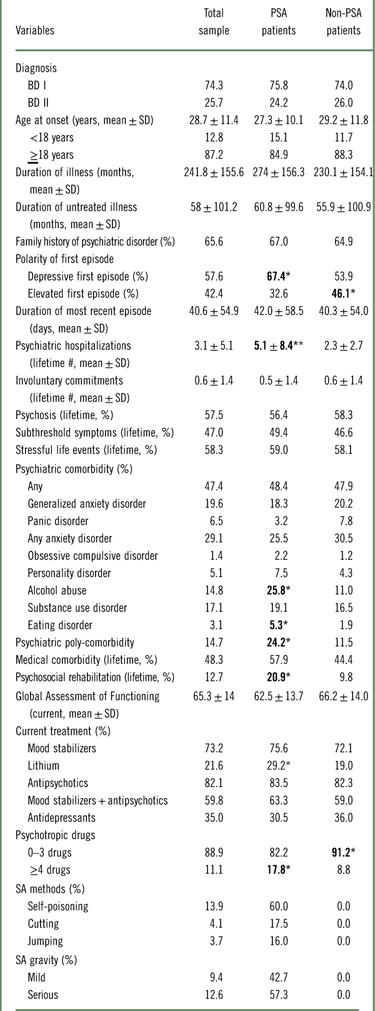
Clinical variables of the total sample and patients with and without prior suicide attempt (PSA)

Values for categorical and continuous variables are expressed in percentages and mean±SD, respectively. Boldface indicates parameters with significant differences between the 2 subgroups. *p<.05, **p<.001.
In our sample, 95 patients had PSAs, slightly above one-quarter of the total sample (26.2%), with all patients having survived their PSA. Reported methods were self-poisoning (60%), followed by cutting (17.5%), jumping (16%), and other modalities (eg, hanging, gas inhalation, voluntary car accident, frostbite, electrocution). More than half of patients with PSA had at least 1 serious PSA (57.3%). Patients with more than 1 PSA comprised 7.9% of the entire sample, and almost one-third (31.8%) of the PSA subgroup.
The PSA and non-PSA subgroups were similar in respect to sociodemographic variables, with no statistically significant difference in terms of gender, education, marital status, employment, or cohabitation.
With respect to clinical variables (Figure 1), patients with versus without PSA more frequently had depressive polarity at their first mood episode (67.4 vs 53.9%; χ2=8.5, df=3; p=.03).
The number of lifetime psychiatric hospitalizations was higher in patients with versus without PSA (5.1 ± 8.4 vs 2.3±2.7; F=78.8, p<.001). However, these subgroups did not have any statistically significant difference in terms of involuntary commitment.
The PSA and non-PSA subgroups did not show a statistically significant difference regarding general psychiatric comorbidity, even though PSA patients reported to suffer more frequently from psychiatric poly-comorbidity (24.2% vs 11.5%; χ2=8.6, df=1; p=.004). Additionally, the PSA group more frequently reported comorbid alcohol abuse disorder, either current or lifetime (25.8% vs 11.0%; χ2=11.4, df=1; p=.001), and eating disorders (5.3% vs 1.9%; p<.05).
Focusing on psychiatric treatment, polypharmacotherapy was more commonly present in PSA vs non-PSA patients (17.8% vs 8.8%; χ2=5.4, df=1; p=.03). Moreover, the use of lithium as mood stabilizer was higher in PSA compared with non-PSA patients (29.2 vs 19.0; χ2=4.0, df=1; p=.05). There was no other statistically significant pharmacotherapy difference in patients with versus without PSA.
Finally, patients with versus without PSA more frequently needed, in their lifetime, psychosocial rehabilitation (20.9% vs 9.8%; χ2=7.3, df=1; p=.007).
In contrast, patients with versus without PSA did not significantly differ in terms of BD subtype, age at onset, duration of illness, DUI, psychiatric family history, duration of last mood episode, stressful life events, subthreshold symptoms, or GAF score.
Discussion
In our sample, more than 1 in 4 BD patients (26.2%) had PSA. This finding is consistent with prior reportsReference Schaffer, Isometsä and Tondo 1 , Reference Merikangas, Jin and He 31 , Reference Sala, Goldstein, Morcillo, Liu, Castellanos and Blanco 32 and highlights the strong association between BD and PSA. Some studies, such as the Systematic Treatment Enhancement Program for Bipolar Disorder (STEP-BD) (PSA prevalence of 36%)Reference Dennehy, Marangell, Allen, Chessick, Wisniewski and Thase 13 and a previous collaborative investigation of our group, which was conducted on an American sample (PSA rate of 30%),Reference Dell’Osso, Holtzman and Goffin 6 showed higher frequencies. On the other hand, a lower PSA frequency emerged in some studies, such as a Korean investigation that reported a PSA rate of 13.1% in BD inpatients.Reference Ryu, Jon and Cho 33 Novick et alReference Novick, Swartz and Frank 10 conducted a meta-analysis of 24 prospective studies with a follow-up period ranging from 18 months to 44 years, and observed a mean suicide attempt frequency of 23.8% in BD-I and 19.8% in BD-II patients. In our sample, a similar rate of PSA in BD-I and BD-II subjects emerged, as previously reported in collaborative studies of our groupReference Dell’Osso, Holtzman and Goffin 6 , Reference Dell’Osso, Dobrea and Cremaschi 7 , Reference Dell’Osso, Shah and Do 34 and in other reports.Reference Simon, Hunkeler, Fireman, Lee and Savarino 4 , Reference Novick, Swartz and Frank 10 , Reference Dennehy, Marangell, Allen, Chessick, Wisniewski and Thase 13 , Reference Sánchez-Gistau, Colom, Mané, Romero, Sugranyes and Vieta 20 , Reference Merikangas, Jin and He 31 , Reference Chen, Liu and Zheng 35 – Reference Valtonen, Suominen, Mantere, Leppämäki, Arvilommi and Isometsä 40 However, some studies have variably reported PSA rates in relation to BD subtype, with a higher PSA rate in BD-IReference Parker, Fletcher, McCraw, Futeran and Hong 41 – Reference Bega, Schaffer, Goldstein and Levitt 43 or BD-II.Reference Ryu, Jon and Cho 33 , Reference Song, Yu and Kim 44
According to the above-mentioned results, self-poisoning (ie, overdose) represented the most common PSA method (60%), which is consistent with most prior studies. For instance, Schaffer et al,Reference Schaffer, Isometsä and Tondo 1 in the International Society for Bipolar Disorders (ISBD) Task Force report, found self-poisoning being used in an overall wide range (29.8%–80.1%), with studies documenting lower rates in AsiansReference Ryu, Jon and Cho 33 , Reference Ruengorn, Sanichwankul, Niwatananun, Mahatnirunkul, Pumpaisalchai and Patumanond 45 and higher rates in patients from other countries.Reference D’Ambrosio, Salvi, Bogetto and Maina 46 , Reference Sublette, Carballo and Moreno 47 According to the same authors, the next most used PSA methods were as follows: cutting (5.6%–22.7%), hanging (0.7%–26.3%), jumping (4.8%–13.2%), drowning (0.2%–16.7%), gas inhalation (2.8%–5.7%), shooting (1.4%–4.2%), self-immolation (1.3%–2.1%), and intentional car accident (1.4%).Reference Schaffer, Isometsä and Tondo 1 In our study, cutting and jumping were the second and third most used PSA methods, with rates of 17.5% and 16%, respectively. Comparing these results with literature data, our observed rates of cutting seemed to be consistent with available studies, while rates of jumping were overrepresented.
In our study, approximately one-third (31.8%) of patients with PSA had more than 1 PSA. This result is similar to the STEP-BD report,Reference Dennehy, Marangell, Allen, Chessick, Wisniewski and Thase 13 but lower compared to the study by Michaelis et al,Reference Michaelis, Goldberg, Singer, Garno, Ernst and Davis 48 which reported two-thirds of PSA patients having multiple PSAs.
Over the past several years, several clinical characteristics have been extensively studied to find an association between BD and suicidal behavior. For instance, prior studies found depressive polarity at first mood episode was more frequently related to PSA,Reference Bellivier, Yon and Luquiens 15 , Reference Goffin, Dell’Osso and Miller 16 , Reference Sánchez-Gistau, Colom, Mané, Romero, Sugranyes and Vieta 20 , Reference Undurraga, Baldessarini, Valenti, Pacchiarotti and Vieta 22 , Reference Azorin, Kaladjian and Adida 23 , Reference Ryu, Jon and Cho 33 , Reference Finseth, Morken, Andreassen, Malt and Vaaler 37 , Reference Valtonen, Suominen, Mantere, Leppämäki, Arvilommi and Isometsä 40 and this finding was confirmed in the present sample. In addition, in a recent study from our group that analyzed the same sample divided into 2 subgroups in relation to the polarity at onset, it emerged that bipolar patients with a depressive versus elevated polarity at onset had a 2-fold risk of PSA.Reference Undurraga, Baldessarini, Valenti, Pacchiarotti and Vieta 9 On the other hand, patients with a manic episode at onset were found to show a lower risk in other studies,Reference Dalton, Cate-Carter, Mundo, Parikh and Kennedy 36 , Reference Keks, Hill and Sundram 49 , Reference Valtonen, Suominen, Mantere, Leppämäki, Arvilommi and Isometsä 50 even though they more frequently adopted violent PSA methods.Reference Neves, Malloy-Diniz and Corrêa 51
To our knowledge, this is the first study that has specifically analyzed the burden of psychiatric polycomorbidity in relation to PSA, and this variable emerged to be more frequently encountered in patients with PSA. Such patients might suffer from a more severe form of BD due to higher comorbidity burden, which could contribute to increasing the PSA risk. Focusing on specific comorbidities, in fact, higher PSA risk has been previously associated with current and lifetime substance use disorder.Reference Simon, Hunkeler, Fireman, Lee and Savarino 4 , Reference Azorin, Kaladjian and Adida 23 , Reference Finseth, Morken, Andreassen, Malt and Vaaler 37 , Reference Valtonen, Suominen, Mantere, Leppämäki, Arvilommi and Isometsä 40 , Reference Neves, Malloy-Diniz and Corrêa 51 , Reference Oquendo, Currier, Liu, Hasin, Grant and Blanco 52 One report linked PSA risk with alcohol or substance abuse only.Reference Sublette, Carballo and Moreno 47 In this respect, a statistically significant correlation between PSA and alcohol use disorder (but not substance use disorder) emerged in our sample.
Anxiety disorder comorbidity has been strongly associated with higher PSA risk.Reference Simon, Hunkeler, Fireman, Lee and Savarino 4 , Reference Sánchez-Gistau, Colom, Mané, Romero, Sugranyes and Vieta 20 , Reference Sala, Goldstein, Morcillo, Liu, Castellanos and Blanco 32 , Reference Neves, Malloy-Diniz and Corrêa 51 , Reference Moor, Crowe, Luty, Carter and Joyce 53 Nonetheless, this was not confirmed in our report; our sample showed similar rates between PSA and non-PSA patients, or approximately 1 out of 2 patients.
Confirming what emerged in the present sample, previous studies highlighted a correlation between eating disorder comorbidity and PSA in BD.Reference Tidemalm, Haglund, Karanti, Landén and Runeson 12 , Reference Goffin, Dell’Osso and Miller 16 , Reference Moor, Crowe, Luty, Carter and Joyce 53 Indeed, eating disorders represent a risk factor per se for suicidal behaviors,Reference Swanson, Crow, Le Grange, Swendsen and Merikangas 54 with the BD comorbidity possibly increasing this risk.
One important goal of proper pharmacological treatments is to prevent suicide. 55 In our study, patients with versus without PSA were more frequently treated with lithium. This finding may seem to be in contrast with the compound’s well established protective effect toward suicidal behavior.Reference Baldessarini and Tondo 56 – Reference Cipriani, Hawton, Stockton and Geddes 58 The result, however, should be interpreted as a consequence of the retrospective nature of the study, and, therefore, lithium treatment could have been prescribed following a PSA as a preventive strategy.
In relation to antidepressant drugs, our study did not show any difference between patients with versus without PSA, in contrast with some prior reports, where PSA occurred more often in bipolar patients taking versus not taking antidepressants.Reference Goffin, Dell’Osso and Miller 16 , Reference Song, Yu and Kim 44
Our findings showed that complex pharmacotherapy (>3 drugs/day at assessment) was more commonly received by PSA patients, as reported in a recent study.Reference Goffin, Dell’Osso and Miller 16 This result might depend on the more frequent poly-comorbidity observed in such patients. Additionally, the occurrence of a PSA might have been the reason to add another pharmacological treatment (eg, lithium).
In our sample, patients with versus without PSA reported a higher lifetime number of psychiatric hospitalizations. Prior studies are discordant on this topic, with some authors confirmingReference Pompili, Gonda and Serafini 2 and others not confirmingReference Goffin, Dell’Osso and Miller 16 , Reference Jiménez, Arias and Mitjans 21 our finding. The higher occurrence of psychiatric hospitalizations might be explained by the association between predominant depressive polarity and PSA, which was not evident in our sample but has been reported in other studies,Reference Carvalho, McIntyre and Dimelis 59 – Reference Popovic, Torrent and Goikolea 61 in light of the reported correlation between predominant depressive polarity and increased number of hospitalizations.Reference González-Pinto, Alberich and Barbeito 62
To our knowledge, ours is the first report to show that patients with versus without PSA more often had psychosocial rehabilitation. Since no difference between PSA versus non-PSA patients in relation to current subthreshold symptoms or GAF score emerged in our sample, a PSA might be considered an independent clinical reason to suggest the initiation of a psychosocial rehabilitation program. Alternatively, PSA patients might have a higher need for rehabilitation in light of the greater disease burden (eg, due to the more frequently associated comorbidities, as observed in our sample).
In our sample, other clinical variables did not show any statistically significant difference between patients with versus without PSA, in contrast with prior reports, such as, for instance, an earlier AAO,Reference Tidemalm, Haglund, Karanti, Landén and Runeson 12 – Reference Antypa, Souery and Tomasini 14 , Reference Goffin, Dell’Osso and Miller 16 , Reference Parmentier, Etain and Yon 18 , Reference Ryu, Jon and Cho 33 , Reference Azorin, Bellivier and Kaladjian 63 a longer duration of disease,Reference Bellivier, Yon and Luquiens 15 , Reference Goffin, Dell’Osso and Miller 16 and a longer DUI,Reference Altamura, Dell’Osso, Berlin, Buoli, Bassetti and Mundo 17 , Reference Nery-Fernandes, Quarantini and Guimarães 64 which were more commonly related to patients with PSA.
Our PSA and non-PSA subgroups did not have any statistically significant difference in sociodemographic variables. Prior studies found that PSA patients were more frequently of female gender,Reference Tidemalm, Haglund, Karanti, Landén and Runeson 12 , Reference Bellivier, Yon and Luquiens 15 , Reference Goffin, Dell’Osso and Miller 16 , Reference Undurraga, Baldessarini, Valenti, Pacchiarotti and Vieta 22 , Reference Antypa, Souery and Tomasini 42 even though death by suicide was associated with male genderReference Nordentoft, Mortensen and Pedersen 3 , Reference Schaffer, Sinyor, Reis, Goldstein and Levitt 5 and use of more violent methods.Reference Perroud, Baud and Preisig 39
In the interpretation of the aforementioned results, the following methodological limitations should be taken into consideration. First, due the nature of the study, all collected variables were obtained retrospectively and, therefore, are susceptible to recall bias. Additionally, the severity of suicide attempts was assessed by clinicians through a descriptive criterion, and not through a specific standardized scale. Moreover, the nature of episodes in which PSA occurred was not collected for all patients. A further limitation is that the present study was based on a cross-sectional analysis, with a longitudinal assessment being potentially more beneficial for evaluation of further suicidal behaviors. In relation to statistical analysis, we did not perform a multivariate analysis of covariance because clinically relevant variables, such as BD subtypes, age at onset, and DUI, did not show any difference between PSA subgroups. Finally, our sample mostly attended a university clinic, and this may limit the generalizability of our findings due to referral bias. Therefore, further investigation with a wider sample size is deemed necessary to confirm our results.