Hurricane Sandy caused record-breaking storm surges in New York City (NYC),Reference Hall and Sobel 1 resulting in critical infrastructure breakdowns with massive consequences for human health and safety.Reference Redlener and Reilly 2 Although the immediate impacts of extreme events like Hurricane Sandy, such as loss of life and property, are easier to quantify and often receive the most attention, they are often only a precursor to long-term physical and mental health impacts that are experienced by individuals and communities for many years.Reference Cutter, Emrich and Mitchell 3 , Reference Manuel 4 Individuals exposed to large-scale and complex disaster events such as Hurricane Sandy may suffer from long-term mental health problems including post-traumatic stress disorder and depression as a result of displacement and loss of income and property.Reference Abramson, Van Alst, Merdjanoff, Piltch-Loeb, Beedasy, Findley, Peek, Mordy, Moroso, Ocasio, Park, Sury and Tobin-Gurley 5 Additionally, factors such as severity of exposure, prior mental health problems, and female gender have been found to influence the likelihood that an individual within a community that has experienced a disaster will develop lasting mental health problems.Reference Norris and Elrod 6 Mental health problems among exposed individuals can coexist with and be exacerbated by environmental health impacts that inevitably occur in the aftermath of such events. In particular, exposure to flood-related mold can lead to various respiratory and asthma-related health problems. As reported in the literature, in the aftermath of Hurricane Sandy, exposure to mold was associated with both asthma and with mental health.Reference Abramson, Van Alst, Merdjanoff, Piltch-Loeb, Beedasy, Findley, Peek, Mordy, Moroso, Ocasio, Park, Sury and Tobin-Gurley 5
Although extreme events affect individuals indiscriminately, they have most devastating impacts on the already vulnerable. Yet, long-term recovery from such events is not well characterized. Here, we report findings regarding the range of factors influencing the recovery of NYC residents affected by Hurricane Sandy. This work was carried out as a part of a larger survey study focused on mold mitigation, assessment of the environmental health impacts of Hurricane Sandy, and evaluation of the effectiveness of a NYC Department of Health and Mental Hygiene worker safety training program. The study questionnaire, administered between December 2014 and December 2015, asked participants to assess the status of their recovery from Hurricane Sandy. The findings presented here provide valuable insight into the factors, such as income and home displacement, that are influencing recovery among NYC residents and can inform current recovery efforts in the affected communities as well as preparedness planning across the United States.
METHODS
A total of 435 surveys were administered in the context of this larger study. Population characteristics are displayed in Supplementary Table 1 in the online data supplement. The mean age of the participants was 59 years; 60.2% were female, 54.9% were married or living with a partner, 64.6% were white, 59.1% had some level of postsecondary education, and 42.3% had a middle household income (defined as between $20,000 and $75,000).
The study questionnaire contained 71 questions covering various thematic areas such as housing, housing damage, mold exposure, demographics, health, and recovery. In this report, we aimed to investigate which factors have influenced long-term recovery from Hurricane Sandy. To address this question, we performed a series of logistic regressions to analyze self-reported recovery status as the outcome of interest. Survey respondents were asked the following: “How would you rate your overall recovery from Hurricane Sandy? Would you say you have: (1) completely recovered, (2) mostly recovered, (3) somewhat recovered, (4) not recovered at all, (5) or were you not affected by Hurricane Sandy and (6) DK/NA/refused” (where DK is don’t know and NA is not applicable). Respondents who reported not being affected by Hurricane Sandy or answered “DK/NA/refused” were excluded from the analysis. A total of 375 responses remained in the sample. All “completely recovered,” “mostly recovered,” and “somewhat recovered” responses were aggregated and recovery status was analyzed as a binary variable.
The logistic regression model was used to analyze the relationship between the outcome of interest (recovery status from Hurricane Sandy as a binary variable) and prognostic factors. There were 36 covariates as potential predictors of the response. We used the stepwise method with an entry level of 0.05 and a stay level of 0.1. The final stepwise model included 5 categorical variables (health status, total household income, income after Hurricane Sandy, Build it Back program assistance, and Federal Emergency Management Agency [FEMA] aid) and 1 continuous variable (displacement from home in months). The model was also run including all possible combinations of two-way interactions to check whether any of the interactions were significant. All analyses were carried out in SAS version 9.4.
RESULTS
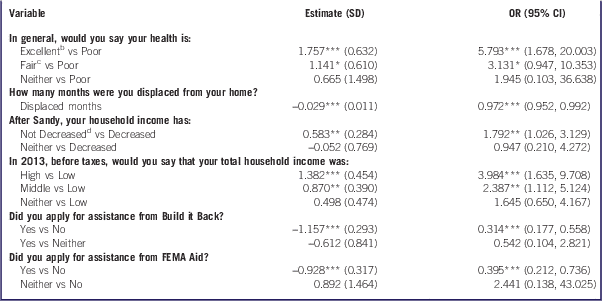
Results from the logistic regression are presented in Table 1. Most of the predictors were significant with P values less than the significance level (α=0.01, 0.05, or 0.10, respectively). We found no significant interaction effects. Although comparing “neither” with its associated reference was not significant in most questions, we observed significant results for the informative answers (eg, yes vs no, excellent vs poor, or high vs low).
Logistic Regression of Covariates on Recovery After Hurricane SandyFootnote a

a Abbreviations: FEMA, Federal Emergency Management Agency; OR, odds ratio. Two-tailed tests: *P<0.10; **P<0.05; ***P<0.01.
b Excellent and very good.
c Good and fair.
d Increased and remained.
Health status, displacement from home, and household income had a substantial influence on recovery. Individuals with excellent health were much more likely to have recovered than were individuals with poor health (odds ratio [OR]=5.8, 95% CI: 1.67-20; P<0.01). Individuals who reported fair health were also more likely to have recovered than were those with poor health (OR=3.13, 95% CI: 0.95-10.35; P<0.1). Individuals with high and middle income were more likely to have recovered than were those with low income (OR [high vs low]=3.98, 95% CI: 1.64-9.71 [P<0.01]; OR [middle vs low]=2.39, 95% CI: 1.11-5.12 [P<0.1]). High household income was defined as $75,000 or more, middle income was defined as between $20,000 and $75,000, and low income was defined as less than $20,000 annually. Furthermore, individuals who had not experienced a decrease in household income following Hurricane Sandy had an odds of recovery that was 1.79 times the odds for those with decreased income (95% CI: 1.026-3.129; P<0.05). Displacement from home (being displaced for every additional month) decreased the odds of recovery (OR=0.97, 95% CI: 0.95-0.99; P<0.01).
We also explored the impact of applying for assistance from the Build it Back program and FEMA on recovery. The NYC Build it Back program provides construction funds to rebuild eligible damaged homes in NYC that were affected by Hurricane Sandy. 7 In order for a home to qualify for assistance, it must “have suffered damage as a result of Sandy” and also “act as primary residence.” 7 FEMA has also provided funding to households for construction, temporary housing, and other Hurricane Sandy–related expenses not covered by insurance. 8 Individuals who applied for assistance from Build it Back and FEMA had a lower odds of recovering than did those who did not apply for assistance. The recovery ORs for applicants versus nonapplicants were as follows: OR [Build it Back]=0.31, 95% CI: 0.18-0.56 (P<0.01), and OR [FEMA]=0.4, 95% CI: 0.21-0.74 (P<0.01). Our data did not allow us to quantify and compare the specific conditions and outcomes for each case because we did not collect qualitative data. For those who applied for the assistance program, the overall conditions could have been worse than for those who did not, which could have led to the smaller odds of recovery.
DISCUSSION
We have reported on perceived long-term recovery status. Although long-term recovery is an important issue, it has received very little attention in the literature. By shedding light on related vulnerabilities and information gaps, the findings from this study can have important implications for public health policy and preparedness. In particular, our findings highlight the importance of better documenting the long-term effects on health and well-being of similar events in the future. Our findings also point to the importance of providing more comprehensive assessment and tracking of population needs in the aftermath of disasters.
First, the presented findings demonstrate that many NYC residents affected by Hurricane Sandy have not recovered from the economic, health, and social impacts of the storm nearly 3 years later. Recovery is multidimensional and is perceived and experienced differently by different subgroups or individuals within a community. Recovery has traditionally been equated with a return to a pre-disaster situation. The multidimensional aspect of recovery, however, points to the fact that physical and social impacts, resiliency, and short- and longer-term recovery over time can vary considerably across entities, communities, and individuals. The literature suggests that barriers to recovery experienced by people affected by storms are related to individual and household-level factors such as preexisting health conditions, displacement, and chronic stressors including poverty.Reference Lane, Charles-Guzman and Wheeler 9 Our results also highlight the critical role of health and socioeconomic status in long-term disaster recovery. Traditionally disadvantaged populations are more likely to suffer from the long-term impacts of disasters such as Hurricane Sandy. In New Jersey, for example, the elderly were more likely to be displaced for 3 or more months than were younger residents due to Hurricane Sandy.Reference Abramson, Van Alst, Merdjanoff, Piltch-Loeb, Beedasy, Findley, Peek, Mordy, Moroso, Ocasio, Park, Sury and Tobin-Gurley 10 Displacement is a traumatic experience that can lead to exacerbation of chronic health conditions. Therefore, characterization of the long-term effects on health and well-being of future events, including those associated with poor access to health care, medications, and critical medical equipment, as well as larger social and bureaucratic barriers experienced by participants such as access to social services, and longitudinal examination of recovery will allow a better understanding of how processes unfold over time and enhance the planning of post-disaster services.
Second, the magnitude of the unmet needs among Sandy survivors is difficult to quantify. For instance, according to data from the Build it Back program, 1837 homes had started construction and 5272 had received reimbursement checks by the second anniversary of the storm. 7 We were unable to identify accurate estimates of how many families still have not returned to their homes. Children are especially vulnerable in emergency situations and their performance in school and learning ability may be severely affected as a result of homelessness and abrupt relocation. Thus, an important area of future work would be deriving a comprehensive assessment of the impact of displacement on children’s physical and mental health, as well as school performance. Also, although we were unable to quantify the extent of the impacts experienced by each of the study participants, we found that those who have applied for recovery assistance funding from FEMA and Build it Back were not more likely to report recovery. More research is needed to assess the effectiveness of state and federal assistance programs, particularly among disadvantaged populations, and to develop better measures to track the progress of such programs. For instance, because eligibility for the Build it Back program was primarily determined by home damage rather than individual vulnerability (eg, income), it is unclear whether the program is successfully addressing the needs of the most vulnerable. Thus, setting up mechanisms for a more comprehensive assessment and tracking of population needs in the aftermath of disasters can be beneficial, particularly for the most vulnerable populations.
CONCLUSIONS
The findings of this study provide evidence that many NYC residents affected by Hurricane Sandy have not been able to recover nearly 3 years after the storm. The presented results also highlight the critical importance of health and socioeconomic factors in long-term disaster recovery. Individuals in poor health and with low income, as well as those who have been displaced from home for longer, are more likely to struggle with recovering from the consequences of the storm. These findings can reinforce our understanding that although extreme events affect individuals indiscriminately, they have most devastating impacts on the already vulnerable. Therefore, an increased consideration of those factors and vulnerabilities can be of critical importance in both ongoing post-disaster interventions and recovery monitoring and future disaster preparedness planning efforts. Further research is needed to better characterize the long-term health effects and recovery from coastal storms and to assess the effectiveness of state and federal assistance programs, particularly among disadvantaged populations.
Acknowledgments
The authors thank Dr David Abramson from the College of Global Public Health at New York University, as well as Scott Mahoney and Sheila Pande, who were part of the study team at the National Center for Disaster Preparedness at Columbia University. Their insights and expertise greatly assisted the study, although they may not agree with all of the interpretations or conclusions of this paper. The content is solely the responsibility of the authors and does not necessarily represent the official views of the National Institutes of Health.
Funding
This work was funded by a National Institute for Occupational Safety and Health (NIOSH) grant (Project Title: Impact of Health Department Worker Safety Training on Health Impacts after Sandy, Project # 1U01OH010625-01).
Supplementary material
To view supplementary material for this article, please visit https://doi.org/10.1017/dmp.2017.57