How do countries adjust to the costs imposed by economic sanctions, and what are the tangible outcomes of such adjustments? Economic sanctions are a coercive policy instrument used by one country (or a group of countries) with the objective of altering another country’s behavior. The sanctioner (the sender) seeks to threaten or impose economic costs on the opponent (the target) to reduce the value of the opponent’s reversion outcome. This, in turn, should make resistance a less attractive choice for the target and increase the likelihood of concessions. One of the key sanction mechanisms, then, is the sender’s ability to reduce the target’s economic capacity. This does not mean that economic losses are imposed on the target country as a whole, and distributed equally throughout the economy and/or society. The economic costs are usually distributed unevenly: previous research suggests that certain groups in target countries tend to suffer more from the implementation of sanctions (for example, Allen and Lektzian Reference Allen and Lektzian2013; Drury and Peksen Reference Drury and Peksen2014; Peksen Reference Peksen2009; Peksen Reference Peksen2011). The unequal distribution of costs suggests that governments may seek to protect some groups from the damage, often at the expense of the most vulnerable and politically weak groups in the population.
To identify the tangible outcomes of such redistribution, we focus on sanctioned governments’ spending. Sanctions reduce target countries’ revenues, thereby forcing governments to make choices regarding their spending priorities. We argue that, instead of reducing spending at the same rate across the board, sanctioned governments shield some spending categories from budget cuts, and reallocate increasingly scarce resources away from other policy areas. We expect spending cuts to occur in budget categories characterized by their low visibility to the population and low political salience, including environmental protection, education, research funding and disaster preparedness.
We test these observable implications using sanctions data and information on government spending in different policy areas. First, we show that sanctions are associated with reduced government revenues. Secondly, we provide evidence of budget reallocation: while important spending categories remain intact under sanctions, categories that are less visible and salient experience spending cuts. Finally, we focus on one low-priority category – disaster preparedness and mitigation – to show that the reallocation of resources resulting from sanctions has a tangible negative effect on policy outcomes. Sanctioned countries appear to be less prepared for natural disasters: they have higher levels of disaster-related economic damage and adversely affected people. While this adverse impact may not be large in absolute terms across all target countries, the relative effect is substantial: our estimates suggest that target countries experience disaster-related costs that are more than twice as high as those in countries without sanctions.
These results hold when we aggregate losses from all disasters (floods, earthquakes, storms, droughts, landslides and volcanoes) and in most models when we disaggregate our analyses by disaster type. In addition, models that rely on disaggregated sanction measures indicate that the main impact of sanctions is linked to revenue-reducing sanction types, which underscores the importance of tighter budget constraints. These results highlight the domestic distributive effects of economic coercion and link them to target governments’ strategy to adjust to sanction costs and mitigate the impact of economic losses.
Sanction Costs and Target Adjustment
What impact do economic sanctions have on target countries? Existing research evaluates the direct losses and, more recently, the indirect costs imposed on targeted societies. Most studies conceptualize sanction costs as direct economic losses and measure them using broad economic indicators reflecting how much the target’s economy shrinks as a result of sanctions. While sanctions do impose severe economic costs in some cases, large-N studies suggest that direct losses are, on average, not significant enough to coerce target countries to make policy concessions. Hufbauer et al. identify ‘few cases in which sanctions inflicted a heavy cost relative to national income – only 14 episodes involved costs that reached double digits as a share of GNP’ (Reference Hufbauer2008, 105). Overall, only a quarter of all sanction cases resulted in losses of two per cent of the target’s annual GNP, or more. More recent studies measure the indirect effects of sanctions that result from the varying vulnerability of societal groups to sanction costs and/or the reallocation of reduced resources within the society. This new strand of sanction research challenges the conclusion that sanctions are generally not costly.
An increasing number of studies recognize the government’s role in exacerbating or mitigating the negative effects of sanctions. For example, Marinov notes that ‘economic pressure works at least in one respect: it destabilizes the leaders it targets’ (Reference Marinov2005, 564). While this finding focuses on sanctions’ political costs imposed on the target leadership, the study also highlights the significance of a government’s ability to adjust under pressure. Marinov’s study highlights a foreign policy adjustment in the form of concessions to the sender as the target’s approach to addressing sanctions’ impact. Yet such adjustments can also happen as a result of domestic policy choices.
The outcomes of such domestic adjustment strategies have been identified in various issue areas. McLean et al. (Reference McLean2018) suggest that the duration of terrorist campaigns tends to increase in sanctioned countries because sanctions force target governments to reduce their budget allocations for counterterrorism programs. Other studies show that government responses to sanctions lead to deteriorating social conditions in areas such as public health (Lopez and Cortright Reference Lopez and Cortright1997; Marks Reference Marks1999; Peksen Reference Peksen2011), human rights and state repression (Drury and Peksen Reference Drury and Peksen2009; Reinisch Reference Reinisch2001; Wood Reference Wood2008), the treatment of minority groups, including women (Drury and Peksen Reference Drury and Peksen2014), foreign aid (Early and Jadoon Reference Early and Jadoon2016), and subnational conflict (McLean et al. Reference McLean2018; Regan and Aydin Reference Regan and Aydin2006). For example, Wood (Reference Wood2008) argues that sanctions contribute to an increase in human rights abuses, such as physical repression, in target countries, and that personalist non-democracies resort to the most violent repression (Escribà-Folch Reference Escribà-Folch2012). Peksen (Reference Peksen2011) shows that public health conditions tend to deteriorate in the target country during sanctions episodes. The same logic of target adjustment explains these diverse findings: sanctions pressure the target’s incumbent leaders to shift existing resources to maintain their hold on power by any means necessary, including increased spending on repression of their citizens, or greater benefits distributed among supporters to maintain their loyalty (Escribà-Folch Reference Escribà-Folch2012).
These studies acknowledge target governments’ role in mitigating or exacerbating the effects of sanctions on target countries. However, few studies have sought to explain how sanction costs force governments to adjust. We address this shortcoming by developing a decision-theoretic approach with a focus on a key policy instrument – government spending. In this context, we view sanctions ‘as an effort to have a direct effect on the environment in which the target makes its decision’ (Morgan Reference Morgan2015, 751). The key driving force in our approach is the target government’s efforts to overcome the budgetary constraints imposed by sanctions. Unless the target receives financial support from so-called black knight countries or sender countries choose not to enforce sanctions, the target government’s revenues are likely to decline under sanctions. Consequently, the government has to choose between cutting all spending proportionally or adjusting its spending plan so that key priorities receive full funding, while other areas bear the brunt of resource reductions. We argue that target governments prefer the latter strategy because it minimizes their political costs. We then provide empirical evidence of this pattern of budget reallocation: government spending on less visible or important sectors, such as disaster preparedness, declines during sanction episodes, while spending on other, more critical sectors, such as national security, remains unaffected. To show that such resource reallocation has significant consequences in areas where spending declines, and that policy implementation in fact suffers noticeably as a result of reduced spending, we focus on disaster preparedness as an example of a low-priority area and show that sanctions not only lead to budget reallocation, but also produce a tangible deterioration in policy outputs (that is, greater disaster-related losses).
Economic Sanctions and Government Spending
When countries impose economic sanctions, they disrupt links between their economies and the economies of their opponents. While the overall costs generated by such disruptions may be low, the key effect of sanctions is to reduce the resources available to a target government at least temporarily. Depending on the level of the target’s dependence on the economic relationship with the sender, specific sanction instruments and enforcement strength, resource reductions can be severe and far reaching. If the government has to make budget allocation decisions in the context of such externally generated resource shocks, policy makers may be forced to abandon their preferred allocation plans due a resource shortage. The government must therefore either reduce all spending proportionally across all categories, or reallocate resources so that some categories receive full funding at the expense of significant reductions in other categories. We argue that the latter option helps policy makers minimize their political costs and increase their odds of political survival.
The 1990 sanctions against Iraq illustrate the spending choices target governments have to make under sanctions. Gordon describes the devastating effect of the sanctions on Iraqi government resources: ‘One of the central goals of the sanctions was to deprive the Iraqi state of income by blocking oil exports […] Because Iraq’s social services and infrastructure were operated by the state, its impoverishment impacted all of Iraq’s economy and public services’ (Reference Gordon2010, 135). Yet, the government did not reduce all spending equally. When Max van der Stoel, special rapporteur of the UN Commission on Human Rights, studied the situation in Iraq, he concluded that the government’s resource reallocation had led to a significant deterioration of social services:
The obvious imbalance between military expenditure and resources allocated to the fields of health care and nutrition continues to illustrate clearly the priorities of the Government of Iraq. Most recently, the Government somehow mustered the overall resources to transport tens of thousands of heavily armed troops up and down the country towards the border with Kuwait. Yet, the Special Rapporteur regularly receives information detailing, e.g., how difficult it is to obtain spare parts for vehicles to transport fresh water to communities in the southern governorates’ (United Nations 1994).
The Iraqi government clearly prioritized some spending categories (such as the military) over others (such as public services), and sought to protect resources allocated for the former at the expense of the latter.
Governments experience political costs of reduced budget allocations when their duration in office declines. Since we assume that politicians’ decision making is primarily driven by their desire to remain in office, we need to consider how budget allocation decisions affect political survival under sanctions.Footnote 1 If a government implements proportional spending cuts across all categories, corresponding to the decline in government revenues, two types of political costs may emerge.
On the one hand, sanctions are an economic shock that results from an international dispute, and their imposition indicates an escalation of the dispute, which presents a security threat to the target country. Previous research shows that sanction imposition is associated with ‘a significantly increased probability that a militarized dispute will also occur’ (Lektzian and Sprecher Reference Lektzian and Sprecher2007, 415). The target’s leaders bear direct political, and even personal, costs if the target loses in a conflict with the sender: such an outcome increases the likelihood of leadership turnover, especially through irregular means (Chiozza and Goemans Reference Chiozza and Goemans2004; Goemans Reference Goemans2008). Therefore, the target government has strong incentives to maintain its security-related spending under sanctions.
On the other hand, reduced government spending jeopardizes the provision of public and/or private goods to government supporters. Such a loss can decrease the probability that these supporters will prefer keeping incumbent politicians in office, rather than switching their support to a rival. Since this switch of loyalties increases the decision makers’ probability of losing office, it represents another type of political cost, which the incumbents will seek to avoid.
The government can minimize the two types of political costs by prioritizing spending to shield itself from international and domestic political threats. However, when the overall budget shrinks as a result of sanctions, the government can only maintain high-priority security spending if it generates savings elsewhere, that is, by implementing significant reductions in other spending categories. An important question, then, is which categories target governments will choose to underfund.
Two characteristics of government-provided goods help to explain how the target government will prioritize its spending: salience and visibility. High-salience goods have a more powerful effect on support for the government and, hence, its political survival. Goods are more visible when it is easier to assess the government’s contribution to their provision based on observed policy outcomes.Footnote 2 Political benefits for policy makers tend to be higher when they deliver highly salient and visible goods. On the flip side, this suggests that target governments can minimize their political costs under sanctions by limiting spending cuts to low-visibility and low-salience spending categories.
When sanctions force target governments to adjust to economic hardship, we expect governments to shield national security spending from budget reductions as one of the most salient categories. Target leaders will seek to maintain this spending category to strengthen their position in the international dispute that led to the imposition of sanctions, since losing the dispute could mean the loss of office. In addition, governments can expand military spending as a way of providing benefits to their domestic supporters (Escribà-Folch Reference Escribà-Folch2012; Whitten and Williams Reference Whitten and Williams2011).
To maintain military funding, target governments will look for savings in low-priority policy areas, including environmental protection and research. This trade-off takes place even in democratic countries: Abou-Chadi and Kayser (Reference Abou-Chadi and Kayser2017, 201) show that categories of research spending and environmental protection are viewed as ‘luxury goods’ by voters in democratic countries and, as a result, become underfunded during economic downturns. Another low-priority spending area is disaster preparedness. Previous research suggests that disaster preparedness and mitigation have low visibility and salience for citizens, even in democracies, despite significant losses inflicted by disasters.Footnote 3 In particular, Healy and Malhotra (Reference Healy and Malhotra2009) show that citizens of democratic countries behave myopically by holding politicians accountable for actions taken in the aftermath of a disaster, rather than prior to it. In autocratic countries, citizens similarly expect post-disaster assistance, while overlooking governments’ disaster preparedness efforts.
The low salience and visibility of disaster preparedness is magnified by expectations of international post-disaster relief, which may unintentionally reduce the perception of the importance of disaster preparedness measures. In addition, disaster occurrence and costliness are hard to predict, which makes disaster preparedness spending appear to be less critical. The implementation of disaster preparedness policies can also suffer from citizens’ distrust of government planning efforts and the difficulty of measuring disaster risk (Waugh and Hy Reference Waugh and Hy1990). As a result, citizens are often skeptical of spending on disasters prior to their occurrence, thereby incentivizing policy makers to treat disaster preparedness programs as a low-priority spending category (Neumayer, Plümper and Barthel Reference Neumayer, Plümper and Barthel2014).
From the perspective of policy outcomes, this treatment of disaster preparedness as a low-priority area is likely to result in worse outcomes under sanctions because government spending in this area is highly correlated with policy outcomes. Economic and human losses from natural disasters, such as floods or earthquakes, tend to increase as government spending on disaster preparedness and mitigation declines (Anbarci, Escaleras and Register Reference Anbarci, Escaleras and Register2005; Escaleras, Anbarci and Register Reference Escaleras, Anbarci and Register2007; Kahn Reference Kahn2005; Keefer, Neumayer and Plümper Reference Keefer, Neumayer and Plümper2011; Mendelsohn and Saher Reference Mendelsohn and Saher2011; Neumayer and Plümper Reference Neumayer and Plümper2007; Plümper and Neumayer Reference Plümper and Neumayer2009; Schumacher and Strobl Reference Schumacher and Strobl2011). In general, of the three commonly accepted factors that determine the size of human and economic losses – the scale of the natural event that triggered a disaster, the wealth level of the affected area, and the existence of protection and mitigation measures such as appropriately designed infrastructure – government policies and spending can have the most immediate and profound impact on the third factor. For instance, a study of the US Federal Emergency Management Agency’s Pre-Disaster Mitigation program reports that ‘on average, future losses are reduced by about $3 (measured in discounted present value) for each $1 spent on those projects’ (CBO 2007, vii).
We expect sanctions’ negative effect on governments’ revenue and resulting resource reallocations to produce worsening policy outcomes. This effect will be stronger in less developed countries, which are particularly vulnerable to reductions in their fungible resources. Sanctions also reduce the sender–target transfer of technologies relevant for disaster preparedness (Toya and Skidmore Reference Toya and Skidmore2007). Finally, the government’s role in disaster preparedness includes issuing new regulations (building codes, zoning, etc.) and verifying compliance. However, new regulations may be costly to individuals and businesses, while monitoring and punishment of non-compliance is costly for governments. Hence, policy makers may choose not to impose new regulations, or even scale back the enforcement of existing regulations, especially when the state of the economy is rapidly deteriorating.
In sum, our key theoretical expectations are twofold. First, since sanctions represent an economic shock to target countries, they affect target governments’ decision-making environment, forcing them to adjust strategically by reallocating government spending. We expect target governments to reduce spending for low-priority policy areas (for example, disaster preparedness), while maintaining funding for high-priority areas (such as national defense). Secondly, spending reductions should be associated with changes in policy outputs. Specifically, sanctions should lead to the underprovision of public goods and worse policy outcomes in low-priority areas.Footnote 4 Statistical analyses in the next section test the following hypotheses and auxiliary expectations:
Hypothesis 1: Sanctions decrease government spending in low-priority areas.
Auxiliary Expectation 1-1: Sanctions do not decrease government spending in high-priority areas.
Hypothesis 2: Sanctions decrease public good provision in low-priority areas.
Auxiliary Expectation 2-1: Sanctions increase disaster-related losses.
Data, Variables and Method
Data
Our dataset consists of three main types of data (McLean and Whang Reference McLean and Whang2019). First, we collected data on all economic sanctions imposed between 1945 and 2005 that are included in the Threat and Imposition of Economic Sanctions (TIES) dataset (Morgan, Bapat and Kobayashi Reference Morgan, Bapat and Kobayashi2014).Footnote 5 Secondly, we used International Monetary Fund (IMF) Government Finance Statistics for information on government spending. Thirdly, we used information on disaster events for all countries from 1900 to 2015 from the International Disaster Database EM-DAT (Guha-Sapir, Below and Hoyois Reference Guha-Sapir, Below and Hoyois2015).Footnote 6 Finally, we added several control variables. Consequently, our dataset covers the period between 1945 and 2005, and has 3,009 country-year observations, although the number of observations for models of government spending is much lower (239 and 115) due to missing observations for the IMF’s expenditure variables.
Dependent Variables
For the first set of tests, we use dependent variables that correspond to high-priority and low-priority spending categories. We rely on two expenditure measures from the IMF’s Government Finance Statistics: government defense expenditures (a high-priority category) and disaster preparedness expenditures (a low-priority category). Disaster preparedness and protection is part of the social protection expenditure category and is reported under ‘Social protection n.e.c’. Both measures are divided by countries’ GDP and logged.Footnote 7
To test Hypothesis 2 and the related auxiliary expectation, we collect information on policy outcomes in a low-priority area (that is, disaster preparedness). We use the losses generated by natural disasters as an indicator of public goods (under)provision. The first set of variables calculates disasters’ adverse effects on country residents. These variables aggregate losses from all disaster types that take place in a given country: floods, earthquakes, storms, droughts, landslides and volcanoes. The first aggregate measure, Affected per Disaster, adds the number of individuals who required immediate post-disaster assistance, such as medical help or shelter, and divides the total by the annual number of disasters. The maximum number of affected individuals per disaster was recorded in India in 1972, when almost forty-one million people required post-disaster relief, on average, after each of the five disasters that struck the country. In our empirical tests, we use the natural logarithm of this variable.
For economic losses (Damage per Disaster), we rely on information regarding the economic damage caused by disasters. We create an aggregate measure of estimated annual economic costs (in thousands of US dollars), which is divided by the number of disasters and then logged.Footnote 8 During the period under study, Japan suffered the highest level of disaster-related economic costs: in 1995, it experienced seven disasters, including earthquakes, floods and storms, which resulted in total losses of over 100 billion USD, or an average of 14 billion USD per disaster.
Main Independent Variables
We use two variables to gauge the effect of sanction imposition on government spending and policy outcomes. The first is a binary indicator, Ongoing Sanctions, which takes a value of 1 for ongoing sanctions episodes, and 0 otherwise. The second is also a binary variable, but it equals 1 only in years when a new sanction was imposed, and 0 otherwise (Sanction Onset). We lag the onset variable to allow for the effect of sanction initiation to be reflected in budget reallocation and policy outcomes.
Control Variables
Our empirical models also include several regressors that control for various socioeconomic and political characteristics of countries and their international environment that may affect governments’ capacity levels and, consequently, their spending choices and policy outputs. We include Democracy to capture varying levels of political pressure on governments to deliver effective public policy. This variable takes a value of 1 for regimes with a Polity score of at least 7, and a value of 0 for non-democratic governments. The source of the data is the Polity IV dataset (Marshall, Gurr and Jaggers Reference Marshall, Robert Gurr and Jaggers2013). We also use two conflict variables to capture the effects of militarized intrastate and interstate conflicts on countries’ spending patterns and public goods provision. A binary variable for international conflicts, MID, takes a value of 1 if the Militarized Interstate Dispute dataset reports that a given country was involved in a MID during that year, and 0 otherwise (Ghosn, Palmer and Bremer Reference Ghosn, Palmer and Bremer2004). At the subnational level, we include another conflict variable, Civil War, which equals 1 if a country experienced an intrastate conflict in a given year, and 0 otherwise. We use the UCDP/PRIO Armed Conflict Dataset for our data on subnational conflicts (Gleditsch et al. Reference Gleditsch2002).
For data on socioeconomic country characteristics, including population, GDP per capita and GDP growth, we use the Penn World Tables. More affluent and rapidly growing economies have a higher capacity to fund various spending programs; more populous countries, however, may have a lower capacity because they need to deliver public goods to more people.Footnote 9 We also include an aggregate indicator of national material capabilities – Composite Index of National Capabilities (CINC) scores (Singer Reference Singer1987; Singer, Bremer and Stuckey Reference Singer, Bremer and Stuckey1972). Finally, we use trade data from the Correlates of War International Trade Dataset (Barbieri, Keshk and Pollins Reference Barbieri, Keshk and Pollins2009) to construct the variable Trade Openness by dividing the volume of each country’s monadic trade by its GDP. This regressor controls for the country’s level of dependence on international trade and, hence, vulnerability to economic sanctions.
Method
We have two dependent variables of government expenditures, and two dependent variables that measure the human and economic costs of natural disasters. Since the dependent variables (the natural log of military and disaster preparedness spending as shares of GDP, and the natural log of the number of affected people and economic damage, divided by the number of disasters in a given year) are all continuous, we use a linear regression to estimate the effects of sanctions on disaster-related human and economic losses. In particular, we use a mixed effects approach that incorporates both fixed and random effects in a unified model. Bell and Jones (Reference Bell and Jones2015) argue that random effects models have an advantage over fixed effects models because the former are more flexible and generalizable than the latter. To deal with heterogeneity bias, which usually motivates the use of fixed effects models, they propose multilevel mixed effects models as an alternative, which allows researchers to include time-invariant covariates, as well as covariates that show very low levels of variation.Footnote 10 However, our main results remain unchanged if we use fixed effects estimation.Footnote 11
Statistical Analysis
In this section, we discuss two sets of results that provide evidence in support of Hypotheses 1 and 2, as well as the auxiliary expectations. First, we show that sanctions are in fact associated with reduced government revenues, and that in response, target governments reallocate their budget resources by shielding high-priority areas and cutting spending in low-priority categories. Secondly, we test whether sanctions lead to public goods underprovision in one low-priority category (disaster preparedness), measured as human and economic losses in target countries struck by natural disasters.
Sanctions’ Effect on Government Revenues
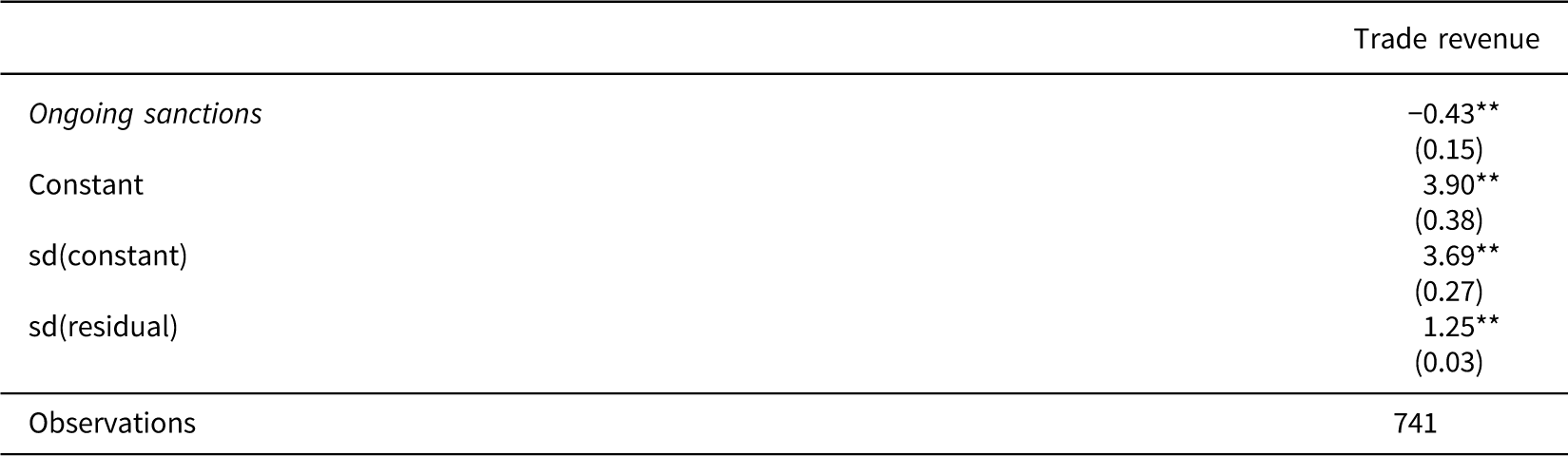
One important part of the causal mechanism underpinning Hypothesis 1 and Auxiliary Expectation 1-1 is that sanctions reduce target governments’ resources, which in turn forces governments to reallocate their budgets in predictable ways. To probe the direction and size of sanctions’ effects on targets’ resources, we use government revenue data from the IMF’s World Revenue Longitudinal Data. The dependent variable is the target government’s trade revenue as a share of GDP, and the independent variable is Ongoing Sanctions. Regardless of the technique used, we find that governments’ trade revenues decline when sanctions are imposed. Using a pairwise mean comparison between average levels of targets’ trade revenues with and without sanctions, we find that the contrast value is negative (−1.53) and significant with a 95 per cent confidence interval of [−2.16, −0.90]. This indicates that trade revenues tend to be lower under sanctions. We also run a bivariate mixed effects regression model to estimate the effect of ongoing sanctions on the target’s trade revenue: Table 1 shows that sanctions are associated with a decline in the target government’s trade revenues, and this result is statistically significant.Footnote 12 The predicted value of governments’ trade revenues equals 3.49 per cent of GDP without sanctions, but only 2.95 per cent during sanction episodes.
Effect of ongoing sanctions on target’s trade revenue

Note: mixed effects model. DV=Government’s trade revenue as a share of GDP. *p < 0.10, ** p < 0.05
Sanctions’ Effect on Budget Resource Allocation
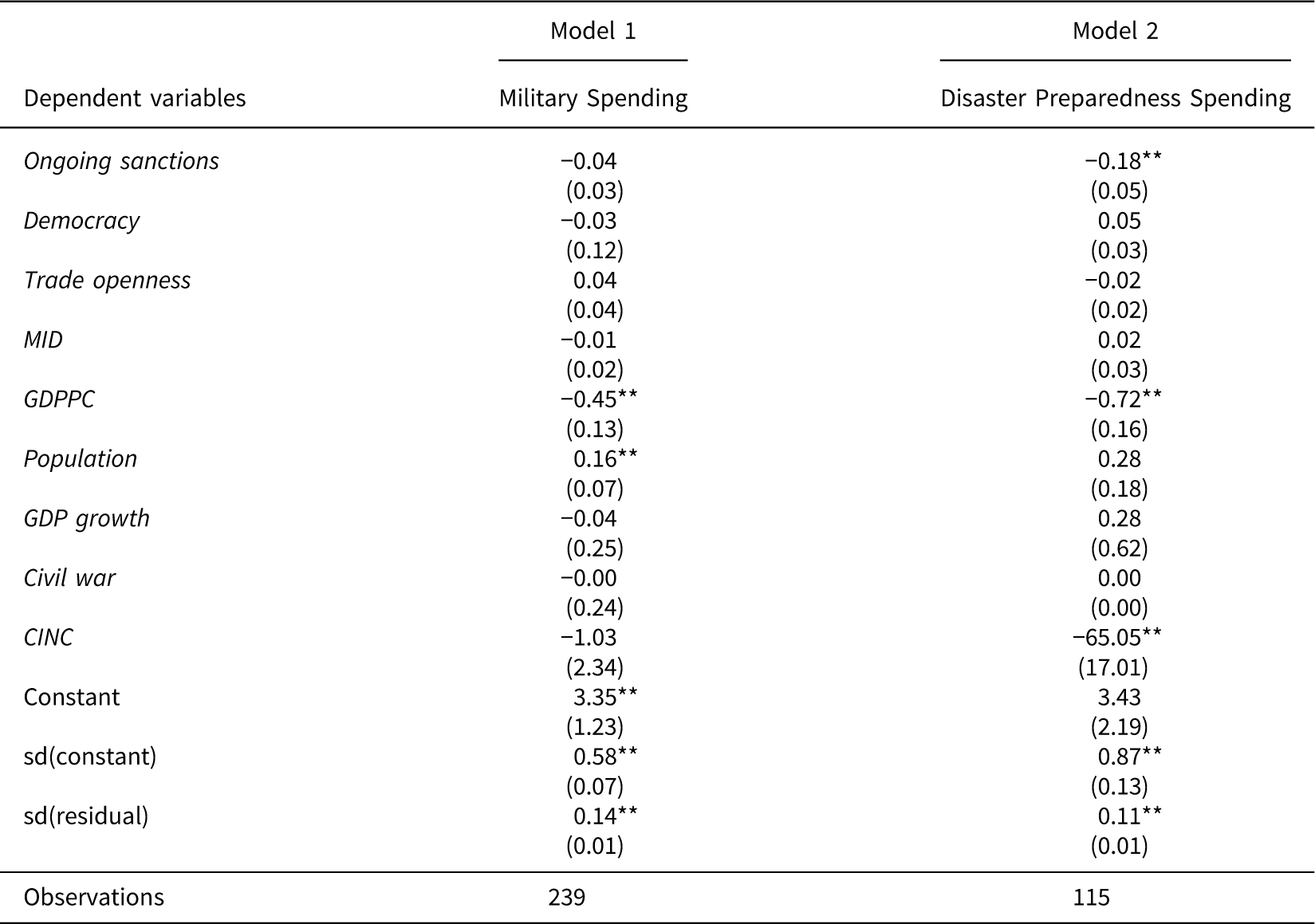
While Table 1 provides evidence of declining trade revenues during sanctions, the models in Table 2 test one of our main theoretical expectations: that once revenues shrink due to sanctions, governments are forced to reallocate their increasingly scarce budget resources.Footnote 13 This reallocation of resources should result in diverging spending patterns for high- and low-priority categories.
Effect of sanctions on military and disaster preparedness spending

Note: mixed effects model. DV=ln(spending as share of GDP). *p < 0.10, ** p < 0.05
First, highly salient and visible spending areas, such as national security, should maintain their previous funding levels. Secondly, categories of low salience and visibility, such as disaster preparedness, should experience a significant decline, as governments should restrict spending in low-priority areas to shift resources towards high-priority categories. We use information on two types of government expenditures, military and disaster preparedness spending (as a share of GDP), to probe the redistributive effect of sanctions. We expect military spending to experience no reductions during sanctions, while disaster preparedness spending should decline if governments in fact do shift resources consistently with our expectations. Table 2 reports results in line with Hypothesis 1 and Auxiliary Expectation 1-1: ongoing sanctions have no statistically significant association with military spending, while disaster preparedness spending declines significantly.Footnote 14 We calculate predicted margins using estimates from Model 2, which indicate that disaster preparedness spending is 12.3 per cent lower in sanctioned countries than in countries without sanctions.
Anecdotal evidence suggests that disaster preparedness is indeed viewed as a low-priority category of government spending, and is one of the first to experience funding cuts during sanctions. A recent (and hence out of sample) example of sanctions offers some insights into the decision-making processes in the targeted country, as well as evidence of the government’s growing budget constraints and resulting redistribution of resources. Specifically, the US and EU (later supported by other countries, including Japan and Canada) imposed sanctions against Russia for its annexation of Crimea in March–April of 2014. The scope of sanctions increased subsequently, and additional sanctions were imposed for Russia’s role in the subnational conflict in the eastern part of Ukraine, as well as its actions related to the 2016 US presidential election.
What was the Russian government’s response to sanctions in terms of government spending? Two spending categories stand out as opposites in their priority for the Russian government during this period. Military spending is a high-priority area, as the Russian government has been modernizing and strengthening its national defense forces: ‘Defense and the related category of national security and law enforcement now eat up 34 per cent of the budget, more than double the ratio in 2010.’Footnote 15 Social protection spending, by contrast, has not been viewed as equally important. Based on budget allocation data available from the Russian government’s website, it appears that while defense spending did not experience a decline in 2014–15, once the US and European sanctions were imposed, resources allocated for social protection, which includes disaster preparedness, declined significantly.Footnote 16
In addition, the Ministry of Emergency Situations, which is the government agency in charge of disaster preparedness and emergency response, announced in 2015 that it would lay off about 10 per cent of its senior staff and terminate some of its emergency assistance groups. This announcement came after the government cut its financing of the program that aimed to create a single emergency number (similar to 9-1-1 in the United States) from 40 billion rubles to just 25.Footnote 17 According to Russian Prime Minister Medvedev, budget adjustments for the year 2015 were the result of an economic slowdown, which was compounded by the introduction of ‘anti-Russian sanctions’.Footnote 18 In sum, the Russian government acted in ways that are consistent with our argument: when constrained by economic costs as a result of sanctions, the government chose to continue funding defense expansion and modernization, while reducing support for other areas, such as emergency preparedness and response programs.
Sanctions’ Effect on Policy Outcomes in Low-Priority Areas
We now turn to our tests of Hypothesis 2 and the related auxiliary expectation. We focus on the link between economic sanctions and public goods provision in the low-priority area of disaster preparedness. We expect to find a positive relationship between sanctions and disaster-related losses, since governments underinvest in safety when they are subject to sanctions. Our results lend support to this hypothesis: countries that experience economic sanctions show lower levels of disaster preparedness, as demonstrated by their higher levels of disaster-related economic damage, and higher numbers of people adversely affected by disasters.
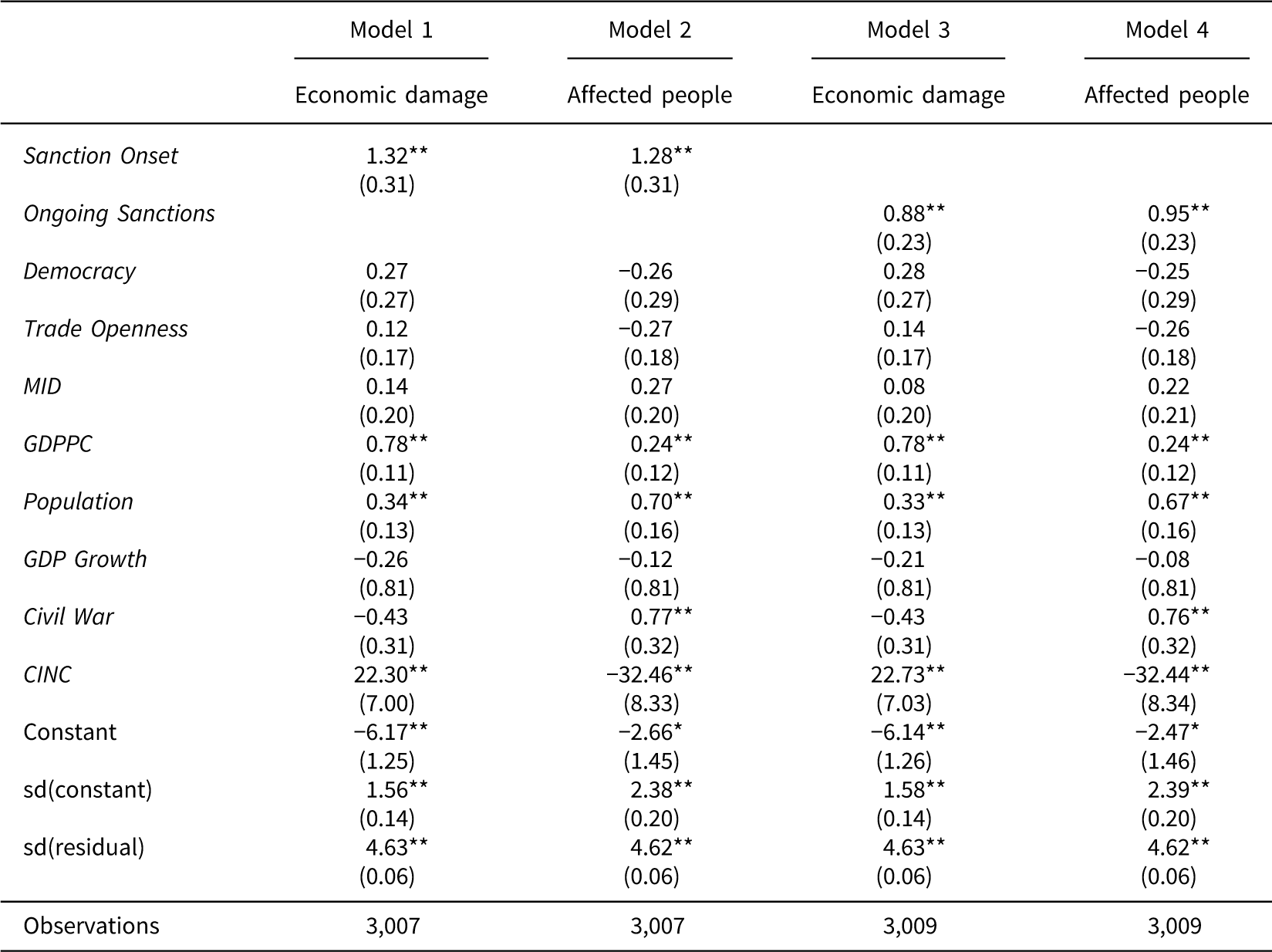
Table 3 displays models evaluating the effects of sanction imposition on the scale of economic damage and the number of affected people. Model 1 in this table suggests that Sanction Onset is positively and significantly associated with the magnitude of economic damage that the target country incurs due to natural disasters. When sanctions are imposed, economic losses tend to increase substantially. Similarly, as Model 2 shows, sanction imposition significantly increases the magnitude of human costs, measured as the number of people adversely affected.Footnote 19 These results indicate that countries targeted by sanctions are more susceptible to the harmful effects of disasters, and this points to underinvestment in disaster mitigation and preparedness programs in these countries. The observable outcome of this underinvestment problem is, then, greater economic damage and higher numbers of victims when disasters strike.
Effect of sanctions on disaster-related losses

Note: mixed effects model. DV=ln(number of affected people or economic damage per disaster). *p < 0.10, ** p < 0.05
Our models also produce significant results for some of the control variables. Specifically, Model 1 of Table 3 shows that the target’s GDP per capita and its capability measure (CINC) are positively and significantly related to economic damage from disasters. This implies that natural disasters are more costly in economic terms for countries with greater economic capabilities. Such countries have more to lose – more extensive physical infrastructure, such as buildings, highways and industrial facilities – and hence experience more disaster damage, especially during rapid-onset disasters, such as floods and earthquakes, as previous disaster studies show (Anbarci, Escaleras and Register Reference Anbarci, Escaleras and Register2005; Escaleras, Anbarci and Register Reference Escaleras, Anbarci and Register2007; Kahn Reference Kahn2005; Keefer, Neumayer and Plümper Reference Keefer, Neumayer and Plümper2011; Mendelsohn and Saher Reference Mendelsohn and Saher2011; Neumayer and Plümper Reference Neumayer and Plümper2007; Plümper and Neumayer Reference Plümper and Neumayer2009; Schumacher and Strobl Reference Schumacher and Strobl2011).
Greater material capabilities appear to have the opposite effect on the human costs of disasters. In particular, as Model 2 of Table 3 shows, greater capabilities are associated with lower numbers of people adversely affected by natural disasters. Therefore, high-capability countries are in a better position to protect their residents than countries with low resource levels. Controlling for economic capabilities, GDP per capita has a positive association with the number of affected individuals. We attribute this finding to the operationalization of the human cost variable: populations of more affluent countries may experience greater disruptions of their lifestyles when infrastructure and homes are destroyed. Finally, we find no evidence of democratic institutions’ advantage in helping target countries overcome the problem of disaster preparedness underinvestment. In fact, Democracy appears to have no statistically significant effect on human or economic cost measures (see Table 3).Footnote 20
Models 3 and 4 of Table 3 report our empirical findings based on the same models of disaster costs, with one modification: Ongoing Sanctions replaces Sanction Onset as the independent variable of primary theoretical interest. This modification leaves our results essentially unaffected. In particular, we find that ongoing sanctions increase the negative impacts of natural disasters in target countries. Target countries suffer greater disaster-related economic losses during sanction episodes, and more residents of these countries are adversely affected by disasters.Footnote 21 Overall, this evidence is consistent with the hypothesized positive effect of sanctions on disaster costs, especially when target countries experience rapid-onset disasters. Finally, the results for Democracy, GDPPC and CINC are similar to those reported in Models 1 and 2.
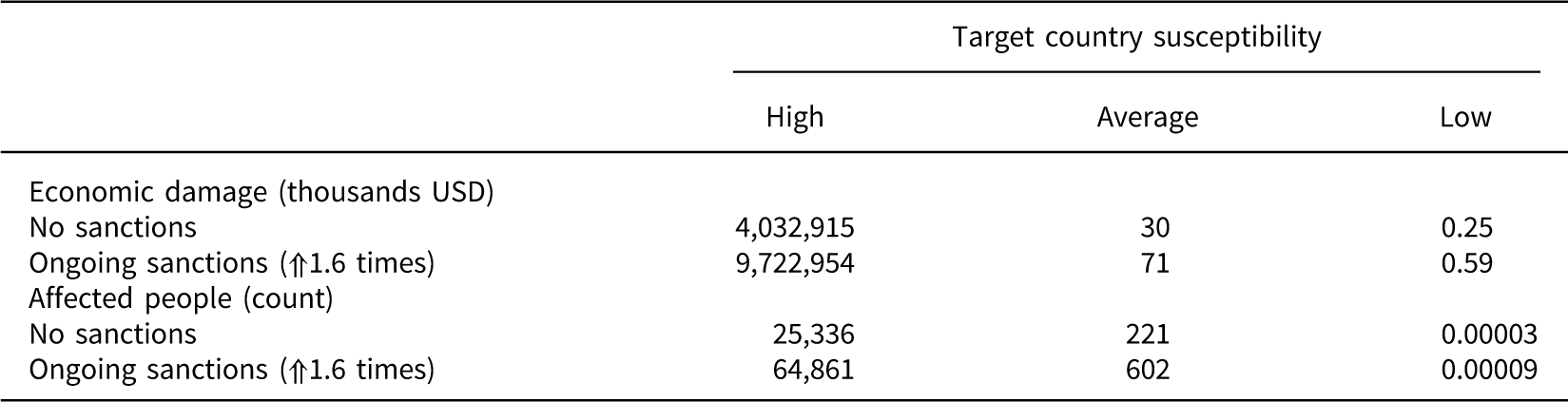
Next, we calculate the substantive effects of ongoing sanctions on total economic damage and the number of affected people (see Table 4). To illustrate the scale of sanctions’ impact on the target’s disaster preparedness, we rely on three scenarios, in which the level of the target’s susceptibility to disaster losses is high, average and low, based on our estimation results. Estimates from Model 3 of Table 3 suggest that countries with high levels of susceptibility to economic damage are affluent, populous and have greater capabilities; hence, we set GDPPC, Population and CINC at their maximum values. We fix remaining control variables that fail to reach statistical significance (such as Democracy, Openness, MID, GDP Growth and Civil War) at their means. For these targets, sanctions result in severe costs in the wake of natural disasters. The predicted economic damage in this scenario is 9.7 billion USD per disaster during sanction years, which represents an increase of 5.7 billion USD from periods without sanctions. For countries with average susceptibility levels, we find that sanctions increase economic losses by approximately 41,000 USD per disaster.
Substantive effects of ongoing sanctions on economic damage and affected people per disaster

Similarly, sanctions are associated with a significant increase in the number of people harmed by natural disasters. Our results indicate that approximately 602 people are negatively affected, on average, per disaster during sanctions episodes. When we compare this prediction with the value from observations without sanctions (221 people per disaster), we find that sanctions lead to an increase of 381 affected individuals per disaster.
Now consider the scenario of a country that is highly susceptible to the impact of natural disasters: for such a country, an increase in the predicted human toll is much more substantial. Based on Model 4 in Table 3, countries with high levels of susceptibility tend to be developed economies with larger populations, but they also have lower national capabilities and experience civil conflicts. Therefore, we set GDPPC, Population and Civil War at their maximum values, CINC at its minimum, and the remaining control variables that do not reach statistical significance at their means. Under these parameters, the number of affected individuals is approximately 65,000 per disaster during sanctions episodes. Without sanctions, the number of affected people would decline to a little over 25,000 per disaster, which indicates that sanction implementation explains the addition of 40,000 to the estimated human toll for each disaster experienced by highly susceptible targets.
In sum, the findings reported in Tables 3 and 4 lend substantial empirical support to our theoretical expectation regarding public goods underprovision in a low-priority policy area. Sanctions are associated with greater economic and human losses in the wake of natural disasters. The substantive significance of these effects is particularly prominent in countries that are highly susceptible to disaster impacts. We attribute the increases in levels of economic damage and human toll to reduced spending on disaster preparedness and mitigation as a consequence of sanctions.
Robustness Checks
Our theoretical argument suggests that sanctions force budget reallocations because they reduce the resources available to governments. Therefore, we expect to see a positive relationship between revenue-reducing sanction types and disaster-related losses. Table A17 shows that import restrictions (the most commonly used sanction type) reduce target countries’ ability to prepare for natural disasters. This means that when senders restrict imports of goods from target countries, targets experience a loss of export revenue, which in turn leads to resource redistribution away from low-priority areas, including disaster preparedness and mitigation programs. Reduced disaster spending leaves target countries’ residents and physical infrastructure more vulnerable to disaster impacts, which is reflected in their greater economic and human costs. Similarly, we consider the link between sanction costs, on the one hand, and government spending and policy outcomes, on the other. We re-run our spending and disaster losses models using Sanction Cost, which is an ordinal variable available in the TIES dataset. The variable takes a value from 0 (no sanctions) to 3 (severe costs). Table A26 shows that more costly sanctions result in lower disaster preparedness spending, but do not change military spending levels. Models in Table A27 demonstrate that sanction costs are positively and significantly associated with disaster-related losses. Therefore, more costly sanctions are more damaging from the perspective of public safety.
To ensure that our results are not affected by specification or endogeneity issues, we conduct additional robustness checks. We summarize our main findings here, and include the full results in the Appendix due to space constraints. First, we re-run our models using alternative measures of disaster-related human costs. Table A15 shows that the number of homeless people increases during sanctions, but this does not apply to disaster fatalities. Since sanctions result in greater numbers of adversely affected and homeless people but not more fatalities, we can conclude that target countries primarily reduce their investments in enhancing the resilience of physical infrastructure, while warning mechanisms, disaster shelters and other systems that protect lives remain largely unaffected during sanction episodes.
Another set of robustness checks probes differences between democratic and non-democratic targets. Table A6 reports estimation results based on the same model specifications as in Table 3, but the sample is split into democracies and non-democracies. Previous research indicates that disaster-related losses may lead to significant political costs for governments, but disasters’ specific consequences for governments are conditional on domestic political institutions (Cohen and Werker Reference Cohen and Werker2008; Raschky Reference Raschky2008). Therefore, democratic and non-democratic targets may pursue different adjustment strategies related to disaster preparedness spending. The positive and statistically significant coefficients on the sanction variable in Models 1–3 in Table A6 indicate that sanctions are associated with greater disaster-related losses in both types of targets. Only in Model 4 does the relationship between sanctions and human costs fail to reach statistical significance, which means that in non-democratic targets sanctions do not increase citizens’ vulnerability when disasters strike. This is likely due to the fact that non-democratic states generally tend to have lower disaster preparedness levels (Quiroz Flores and Smith Reference Quiroz Flores and Smith2013); hence, this spending category does not offer significant resources that could be reallocated elsewhere. Finally, models in Tables A18 and A19 explore differences in spending patterns, while controlling for types of authoritarian regimes and governments’ ideology. These results suggest that conservative governments tend to have higher levels of military spending, while our main findings remain unaffected.
Next, we focus on the robustness of the causal link underpinning our findings. Specifically, we evaluate the possibility that the association between sanctions and disaster-related losses may weaken if sanctions play an intervening, rather than a direct, role. In this case, other factors, such as state capacity (Lin Reference Lin2014) or exposure to natural disasters, could explain losses from disasters, and our sanction measures would not be significant. Alternatively, one could argue that certain types of governments tend to engage in two types of behavior by virtue of their political preferences: they spend less to prepare for disasters, and adopt controversial policies that result in sanction imposition. In this case, the relationship between sanctions and disaster-related losses could be spurious.
We start by re-running our models using a measure of government capacity. This indicator is drawn from the relative political reach index (Kugler and Tammen Reference Kugler and Tammen2012) and gauges a state’s capacity to mobilize its own population. Effective governments can mobilize resources to implement their policy agenda, while ineffective governments cannot (Arbetman-Rabinowitz et al. Reference Arbetman-Rabinowitz2013). Tables A14 and A25 show that government capacity has no effect on disaster preparedness spending or human losses, but reduces economic damage from natural disasters. At the same time, our main findings remain robust to the inclusion of government capacity.
We then modify our specifications by including various disaster measures as controls to model variation in the underlying propensity to experience disasters and state vulnerability. Specifically, we include the number of disasters experienced in a given year (Table A9), a disaster risk indicator from the Socioeconomic Data and Applications Center (Table A10) and six risk scores for different disaster types (Table A22). We find that most of the individual risks, the average disaster risk, and the disaster frequency are positively and significantly associated with disaster-related losses; at the same time, our main results remain unchanged. In the next round of checks, we control for the lagged dependent variable in the models of disaster-related losses (Table A12). The lagged dependent variable has a positive and statistically significant relationship with the dependent variable, and our main findings remain the same. We then estimate disaster costs models using a different control – slow-onset disasters. Our dataset contains only one disaster type that can be qualified as such: droughts. Table A11 shows that droughts result in greater losses, while our main results do not change.
Next, we estimate models of sanction imposition to see whether countries that experience disasters also have a greater propensity to experience sanctions. Table A13 reports three models of sanction imposition: Model 1 for all sanction types, Model 2 for multilateral sanctions and Model 3 for sanctions backed by international organizations. The explanatory variable of interest in these models is a binary disaster variable. We find no evidence that experiencing a disaster in the previous period makes a country more (or less) likely to experience sanctions.
Finally, we estimate a two-stage model linking sanctions to disaster preparedness spending and then spending to disaster policy outcomes to offer a more unified test of our causal mechanism. Table A24 shows that sanctions reduce disaster preparedness spending, and that predicted spending has a negative effect on disaster-related losses. We also report models in which we replace sanction dummies with a measure of sanction duration; these show that sanctions have long-term effects on government spending (Appendix Tables A20 and A30). Taken together, these additional models demonstrate the robustness of our empirical findings.
Conclusion
We have argued in this article that economic sanctions can generate costs to target countries that extend beyond direct economic losses experienced by targets’ governments and the private sector. Specifically, shrinking resources in target countries force governments to reallocate their budgets: high-priority spending categories are shielded from the negative impact of sanctions on the overall budget, at the expense of other areas, such as disaster preparedness and mitigation. Therefore, target countries should experience public goods underprovision in these low-priority areas. A key observable implication that arises from this argument in the case of disaster preparedness is that target countries should be less prepared to weather natural disasters, and hence there should be a positive association between sanctions and disaster-related costs.
Our findings offer robust empirical evidence in support of our argument. Sanctions tend to reduce government revenues. We also show that, although high-priority military expenditures remain unaffected, disaster preparedness programs in targeted countries experience spending cuts as a consequence of their low visibility and salience. This implies that the negative impact of sanctions may not be distributed equally throughout target countries: in particular, the resulting increase in disaster-related economic and human losses will be naturally concentrated in targets’ disaster-prone areas. We also find that these negative effects increase as sanctions last longer; therefore, disaster preparedness continues to deteriorate until sanctions are lifted. We leave the question of whether sanctions’ detrimental effects can be quickly reversed once sanctions are lifted for future research.
This study suggests a policy implication for sanction design and implementation. If sanctions are imposed against disaster-prone countries, senders should expect disaster preparedness programs to be negatively affected. Can these unintended consequences be mitigated? One mitigation mechanism is linked to the choice of sanction instrument: senders may minimize the negative consequences for disaster-related losses in target countries by choosing sanction instruments that are not associated with such losses, such as export restrictions, or sanctions with lower economic costs for the target (McLean and Whang Reference McLean and Whang2014). When this is not possible, and given that target governments cannot be forced to allocate their resources in a particular way, senders and international organizations can prepare disaster assistance and humanitarian relief programs to deal with the aftermath of disasters in target countries.
Although we find that the number of killed people does not change when sanctions are imposed, our results indicate that the scale of damage to the physical infrastructure and the number of adversely affected people (in particular, people who lose their homes) rise as a result of sanctions. Therefore, disaster relief programs should focus on the immediate needs of disaster-affected populations, such as shelter, and plan for significant challenges in delivering such assistance due to greater damage to the infrastructure.
Supplementary material
Data replication sets can be found in Harvard Dataverse at: https://doi.org/10.7910/DVN/YZSZFY and online appendices at: https://doi.org/10.1017/S0007123418000613
Acknowledgements
Alphabetical ordering indicates equal contributions. Support for this research was provided by the Ministry of Education of the Republic of Korea and the National Research Foundation of Korea (NRF-2016S1A3A2925085).