Introduction
A strange change. When I practise at home I find it's much more successful than it used to be. (James in his second interview)
It has been observed that when mature adults choose how they approach their music learning they are able to develop themselves musically and achieve self-fulfilment (Taylor, Reference TAYLOR2010, Reference TAYLOR2011a, Reference TAYLOR2011b; Taylor & Hallam, Reference TAYLOR and HALLAM2008). When they do so, they appear to enjoy their learning, achieve their goals and increase their self-confidence. Such findings about the meaning of music in their lives extend those of Hays and Minichiello (Reference HAYS and MINICHIELLO2005) with 52 people of retirement age in the Australian community. A recent study with 350 mature-age participants in the UK (Hallam et al., Reference HALLAM, CREECH, GAUNT, PINCAS, VARVARIGOU and MCQUEEN2010) verifies the importance of community musical participation and learning for quality of life and supports the view that musical development is possible for adult musical beginners as well as those with prior experience in music. Whilst there is evidence that adult instrumental beginners shift their musical goals when they acquire new skills (Wristen, Reference WRISTEN2006) and can experience changes in musical understanding during their learning which enable them to reframe their musical identities (Taylor & Hallam, Reference TAYLOR and HALLAM2008), there are few studies which closely investigate their musical development over time.
This article discusses the case of 73-year-old James as an example of someone who chose to embrace more than one musical culture for his instrumental learning at a later stage in life. There were changes as well as evidence of stability in his attitude to musical skills and tasks as he transformed himself from a music listener into a musical performer and reconstructed himself as an amateur musician. Repertory grids (rating tables) facilitated the focused conversation and sharing of meaning (Thomas & Harri-Augstein, Reference THOMAS and HARRI-AUGSTEIN1985, ch. 10; Taylor & Hallam, Reference TAYLOR and HALLAM2008) needed to explore his musical development over a two-year period. This article aims to offer insights into adult musical understanding in the context of lifelong music learning.
Using repertory grid methodology
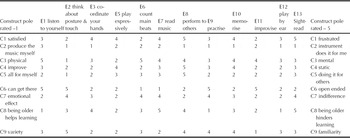
A repertory grid is a rating table which attempts to record meaning in words and numbers (see Table 1). It can be regarded as a snapshot of the thoughts and feelings of the person who made it at a particular point in time, and it is the outcome of a procedure which puts into practice Kelly's personal construct theory (Bannister & Fransella, Reference BANNISTER and FRANSELLA1986; Kelly, Reference KELLY1955/1991). Personal construct theory (PCT) with its emphasis on individuality suggests that each of us acts like a personal scientist when construing or making judgements about our experiences in order to make sense of them. These judgements form the basis of personal constructs or filters through which the world is viewed that are reinforced or modified by current experiences. It follows that no two people would make the same judgement about any given experience. Although the use of repertory grids is appropriate for exploring individual differences in ascribing meaning to learning (Candy et al., Reference CANDY, HARRI-AUGSTEIN, THOMAS, Boud, Keogh and Walker1985), there are few examples in music education research, those of note being Hewitt (Reference HEWITT2005), Maidlow (Reference MAIDLOW1998), Mellor (Reference MELLOR1999) and Taylor and Hallam (Reference TAYLOR and HALLAM2008). What is interesting is that by taking advantage of the flexibility of this research tool (Pope & Denicolo, Reference POPE and DENICOLO1993), each one of these music studies successfully used repertory grid methodology in different ways. (For a critical evaluation of repertory grid methodology for education research see Cohen et al., Reference COHEN, MANION and MORRISON2000, ch. 19).
The grid constructed in conversation with James in 2005

Notes:
• C6 – James explained open-ended as being, ‘You never really do quite get there . . . something that hasn't got a finite end.’
• C8 – Construct supplied by researcher about which James said, ‘That's an interesting one.’
• C9 – James explained, ‘I like variety and familiarity almost equally. Variety because there's always something else, and familiarity because it guarantees enjoyment. You know you can do it. Variety is what you're doing, there's always something else – you're basically doing the same thing [i.e. the skill] but what you're hearing is different.’
• E4 ‘select style and expression’ is not featured on the grid because James regarded it as irrelevant as he used the electronic keyboard like a piano.
I constructed repertory grids in interviews with James on two occasions, Spring 2005 and Spring 2007, to learn how he used musical skills and tasks to motivate himself to continue with learning a keyboard instrument. I also wanted to discover the complexity of his attitudes towards his skills and to explore how musical meaning changed for him during his learning. Our conversation during construct elicitation and skill rating yielded valuable insights in connection with these issues.
The use of a second repertory grid with James extends an earlier study in which repertory grids were used as a tool for semi-structured interviewing to make it easier for the participants to focus in detail on their musical skills and tasks when we discussed their motivation for learning their instruments (Taylor & Hallam, Reference TAYLOR and HALLAM2008). In the earlier study, James was one of eight respondents over the age of 60 who constructed and reflected on repertory grids in conversation with me. We gathered very rich data in a democratic and exploratory way, repertory grids being used effectively in the study to ensure the participant agency which is central to humanist constructivist research (Pope & Keen, Reference POPE and KEEN1981; Pope & Denicolo, Reference POPE and DENICOLO1993). The study supports the notion that repertory grid methodology is based on a mixture of experiential, social constructionist and experimental perspectives (Tindall, Reference TINDALL, Miell and Wetherell1998).
The key finding to emerge from that study was that when mature-age adults have some measure of control over their learning and can satisfy their need for achievement, enjoyment and self-confidence, they can use music learning to construct their musical identity and achieve personal growth and self-fulfilment. James was the only one of the respondents in that study who was still learning a keyboard instrument in class two years later and who was available for a second interview. An extension of the study was therefore possible to explore the meaning of his music learning further.
At the time of his first interview in 2005, James was in his second year of learning the electronic keyboard in my college workshop class where he treated the instrument like a piano rather than use its electronic facilities. He had also just taken up the Appalachian dulcimer, a simple plucking folk instrument, which he had made himself. He played the instrument supporting it on his knees, and was learning it informally in the local folk group which he had co-founded. This was in parallel and in contrast to the relative formality of learning in the keyboard workshop. At the time of his second interview two years later, he was attending my piano workshop class at the college which had been set up after the keyboard class closed 18 months earlier. He was still playing the Appalachian dulcimer with his friends and raising money for charity with them.
Data collection and analysis
James, and the other keyboard learners participating in the first study chose 13 music skills and tasks as elements or items of experience for construct elicitation and grid construction several weeks before it began. They were: ‘listen to yourself’; ‘think about posture and touch’; ‘co-ordinate your hands’; ‘select style and registration’; ‘play expressively’; ‘count the main beats’; ‘read music’; ‘perform to others’; ‘practise’; ‘memorise’; improvise; ‘play by ear’; and ‘sight-read’. However, James engaged with 12 of them only, arguing that ‘select style and registration’ was not relevant for someone using the electronic keyboard like a piano.
He elicited his first seven constructs in conversation with me during his first interview which lasted nearly two hours (1 h 57 min). This was mainly using a triadic procedure in which I showed him a set of three element cards (triad) representing three musical skills and tasks such as ‘listen to yourself’, ‘perform to others’, and ‘sight-read’. I then asked him to select one of these which was different or opposite in some way from the other two. His explanation or judgement of why it was different prompted his own labelling of a construct which was then entered on the grid. Because the constructs were to be bi-polar, I asked him to suggest an opposite for each construct before moving onto the next. James sometimes supplied two explanations, the second of which became the basis of another construct in conversation without further use of cards. I supplied an eighth construct about music learning and ageing with his permission, because I wanted to explore that issue with him. Finally, James supplied a ninth construct without any discussion beforehand (see Table 1).
Using the same constructs in both interviews, James rated his skills on a scale from 1 to 5 which represented the construct continuum ranging from the construct label or similarity pole on the left of the grid through to its opposite, the difference pole on the right. Ratings of 1 and 2 represented the similarity pole, 1 being more extreme than 2, and ratings of 5 or 4 were for the difference pole, 5 being more extreme than 4. A rating of 3 meant any of the following: no strong feelings either way; mixed feelings which could either represent both poles at the same time or different feelings about the skill at different times; the construct was not relevant/could not be applied. Discussion with James about what his music learning meant to him took place before, during and after rating and completing the grid. This conversation was regarded as being more important and relevant than a quantitative analysis of his ratings (Pope & Keen, Reference POPE and KEEN1981; Pope & Denicolo, 1983).
Because meaning cannot be precisely quantified, for example no two participants will conceptualise their ratings and the gaps between them in the same way (Yorke, Reference YORKE1978), the ratings were viewed as evidence of general trends rather than numerical measurement of meaning. In other words, the rating numbers functioned purely as summaries of James’ judgements made through the filters of the constructs which he had labelled himself. For example, in 2005, he said that he felt that he couldn't achieve what he wanted when he practised. His rating of 5 for practising on his 6th construct ‘can get there vs. open ended’ expressed his view of practising in the language of the construct as being very much ‘open ended’, which he said meant that ‘you never do get there’ (see Table 1). In 2007, he told me that he felt more able to achieve what he wanted in his practising, and his rating of 2 in terms of the same construct indicated that he could now ‘get there’. Constructing the grids enabled James to focus on the many skills and tasks he needed for learning a musical instrument and to express his thoughts and feelings about them clearly.
James, who was very enthusiastic about the study, agreed not to remind himself of his earlier ratings before his second interview so as not to be influenced by it in any way and contaminate the data. The conversation in his second grid interview which lasted about an hour and three-quarters (1 h 41 min) was different from his first. In the earlier interview in 2005, we explored musical motivation and identity issues widely, using the grid as a springboard for much of the discussion (see Appendix 1 for first interview schedule). Two years later, using the grid in a similar way (see Appendix 2 for second interview schedule), we focused on how James’ learning in the piano workshop and in the folk group had affected his musical skills and attitudes since his first interview. James now decided to rate some of the skills for the dulcimer as well as for the piano because the dulcimer had become important to him and certain skills and attitudes were different in relation to it.
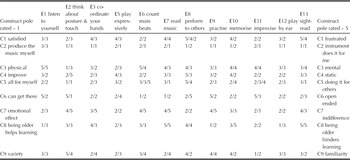
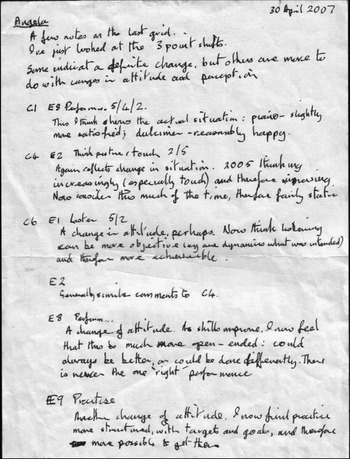
After both interviews, I sent James a copy of his grid with a verbatim transcription of his interviews and further interpretations of the data. I also sent him a grid which showed ratings from both interviews to make it easy for him to reflect on similarities and differences between them after his second interview (see Table 2). I contacted him by phone after both interviews to check that he was happy with the way he was being represented, and took his comments into consideration. These member checks increased data reliability (Cresswell, Reference CRESSWELL2003). James subsequently posted me a set of written comments about changes in his skills and attitudes without being asked to do so (see Figure 1 for facsimile). The transcripts, evolving data categories and interpretations of both interviews were validated by a disinterested researcher as part of a clear audit trail of research (Smith, Reference SMITH and Smith2003).
A comparison of the grids constructed in conversation with James in 2005 and 2007

Notes:
• The number on the left in each cell is from James’ grid dated 03.03.2005.
• The number(s) on the right in each cell is from James’ grid dated 26.03.2007.
• Where there are three numbers, the one in the middle is the 2007 rating for piano and the one on the far right is the rating for Appalachian dulcimer.
• For notes on C6, C8, C9 and the absence of E4 see Table 1.
James’ written comments on changes in his grid ratings

I analysed the qualitative data thematically using Interpretative Phenomenological Analysis (IPA). IPA, suitable for constructivist research, is a two-stage interpretation process or double hermeneutic: that of the participant trying to make sense of their world, and the researcher trying to make sense of what they say (Smith & Osborn, Reference SMITH, OSBORN and Smith2003). The first stage requires empathy and the second, critical questioning. See Taylor (Reference TAYLOR2011b) for more discussion about IPA. Simple visual clustering (Pope & Keen, Reference POPE and KEEN1981), made possible by colouring James’ ratings of 1 and 2 for the left pole red, his ratings of 4 and 5 for the right pole blue, and his ratings of 3 black, made it easier to read and analyse the grid data with him in his interviews.
What follows is an exploration of James’ musical skills, attitudes and related musical identity construction over two years with reference to the main thematic categories which emerged from analysis. They are as follows: enjoyment from achievement; choice; learning as a mature-aged adult; musical and social collaboration; the interaction of two music cultures; musical identity; and major changes in musical skills and attitude. The presence of overlaps between the categories mirrors the complexity of the interaction of music learning with musical motivation and identity construction. Source material includes qualitative data gathered during both interviews and afterwards with data from the grids. Data from another interview were used for peer appraisal of James alongside data from personal observation of his playing. All names except my own have been changed to ensure anonymity.
The case of James
Enjoyment from achievement
The main thing is enjoyment and feeling good when it works. . . . It comes from things working right and being happy with them.
Music listener James derived much of his enjoyment, the most important thing about learning an instrument for him, from the satisfaction of mastering things that were new and difficult:
When I get enthusiastical [sic] about something, there's no stopping me . . . I love the idea of just setting off to do something new, and trying to find out about it, and trying to get on top of it . . . and in any case, although I'm not getting very far in some ways, there's an immense amount of satisfaction from it as well . . . partly this immense satisfaction at being able to learn, to actually do something, in itself. But the other thing is the satisfaction at being able to make some music as well. . . . It's mainly, all the little bits of achievement, which really make me feel good.
Whilst James acknowledged that his progress was limited, it is clear that much of his satisfaction came from his pleasure at the new experience of learning to make music for himself as an adult. Although he did not label any of his nine constructs ‘enjoyment’, per se, three of them were about his achievement which related closely to it. They were: C1 ‘satisfied vs. frustrated’, C4 ‘improve vs. static’, and C6 ‘can get there vs. open ended’. Reflecting on his progress, James commented that:
It's a combination of being pleased; in other ways there's plateaus and nothing happens and then I go back to the things I did before and I think that didn't happen so it makes me think that I've made some progress . . . I'm still more determined to carry on because of that than not.
His discovery that he could play pieces that used to be too difficult for him motivated him to carry on engaging with an instrument that was very challenging for him, and which interestingly, he had found boring as a child (see Taylor, Reference TAYLOR2011a). Despite his view of himself as someone ‘struggling to master the instrument’, he was regarded as an old timer by his peer Pat in the electronic keyboard workshop (see Wenger, Reference WENGER1998). She saw him as ‘someone who can just pick anything up, and they know all about music’, and she listened to his playing when practising in class.
Choice
James was a keen jazz fan, and for him the attraction of jazz was individuality and agency. He needed to be ‘able to hear things clearly . . . it's very much about sound . . . what one person makes one instrument sound like’. This might explain why he wanted to play the piano rather than make use of the mechanical features of his electronic keyboard. He wanted to be ‘pressing the keys and actually doing things with the instrument itself in a very positive personal way’. He labelled his second construct, ‘produce the music myself vs. instrument does it for me’, and the high degree of stability in his ratings (where the rating scores on the two grids were identical or one value apart) for that construct and for the skill ‘play expressively’ on all his constructs verified that this musical preference had not changed during that time (see Table 2). This was clear evidence of how important performer agency was to him. Yet when James reflected on what his music learning was doing for him as a person in his first interview, he told me that the extent to which ‘how important doing music for myself was’ had come as a surprise to him.
Learning as a mature-aged adult
Having chosen not to make things easier for himself by using the electronic facilities of the keyboard, because ‘having an instrument I want to do my own thing if you like, to make all the music from it . . . it's to do with making things from whatever’, James had to accept early on in his learning that now he was older he had some age-related difficulties with motor skills and it took longer to pick up new things (see Gembris, Reference GEMBRIS, Daubney, Longhi, Lamont and Hargreaves2008). He might not therefore be able to achieve the sophisticated end results he would have liked straightaway. His advice to others thinking of starting an instrument at a similar age to him was to:
Keep an open mind about, where you're going to go and the progress you're going to make, and your own expectations . . . I'm a great believer in having realistic expectations.
He accepted that whilst skills such as E3 ‘co-ordinate hands’ and E7 ‘read music’ had ‘moved on a bit, improved a bit’, they had not improved as much as he would have liked. This affected his ability to play expressively which he said, ‘has improved, but it hasn't’. He explained that although ‘it's improved if things are relatively easy to play’, he still could not play fast passages in the expressive way that he would have liked.
James did not foreground himself as a mature-age music learner though, despite having had a heart attack some years earlier which had made him think, ‘Well if I can possibly, I'll do it now, tomorrow isn't there forever’. Nevertheless, he did take into account age-related health issues such as arthritis ‘my thumb joints are beginning to wear out’ (see Gembris, Reference GEMBRIS, Daubney, Longhi, Lamont and Hargreaves2008), and the fact that he worried more about things than he used to:
Being older hinders you because you're more bothered about getting it right, unlike when you're eight. On the other hand you don't care and I can do things I wouldn't have dreamed of doing.
Growing older was also advantageous because he could enjoy the attendant sense of freedom and possibility that comes with greater self-confidence and from choosing how to organise himself (see Freund et al., Reference FREUND, LI, BALTES, Brandtstädter and Lerner1999). With his strong musical resilience James had a generally positive attitude towards learning as an older person:
I quite like being older, [chuckles] actually, it's quite nice . . . being older helps because you've got the time, there's no children there so you can [practise] and you've absolutely chosen it because you want to, you haven't lots of other pressures.
Musical and social collaboration
James also enjoyed the company of his peers in the workshop:
Mark I get on like a house on fire with, and in the main, everyone like, seems to like the same sort of music that I do as well, I think, as far as you can tell, and we're in general, much of an age, and, much of a stage and approach alike. It's just nice to come each week, and see a few folks and chat . . . Some have progressed more than others or have been doing it more than others, but it never seems to cause any tension, or friction, or anything else to me . . . you're hardly conscious of it and rather nice, I think.
James valued the social side of learning a keyboard instrument in the workshop when he could share his enthusiasm for music with others without being in competition with anyone.
Similarly, he played the Appalachian dulcimer in a folk group which he co-founded, making music informally with others much as he had done on the harmonica with his friends in his early teens (see Taylor, Reference TAYLOR2011a). A core of five people, ‘but other people come in and out’, met every week and James found that with his Appalachian dulcimer:
It's a whole new dimension having an instrument you've actually made yourself, and people actually, listen to it, and . . . the other thing as well, which it has brought to me that I never even thought of when I started, it is playing with other people as well.
He could express his musical individuality in another music learning culture in a way that was completely new for him. This, together with the realisation that his playing was valued by co-performers and audiences alike, strongly motivated him to carry on with the group, and he went on to raise money for charities on a regular basis as well as playing for pleasure in it. Creating a musical role for himself in the community in this way enabled James to construct a social musical identity as well as a personal one, which enhanced his musical self-belief.
James enjoyed making music with his friends in the folk group which gave him a sense of well-being (see Coffman & Adamek, Reference COFFMAN and ADAMEK1999). He found it easy to pick out the song melodies around which the more experienced players in the group wove their improvisations, and more seemed musically possible for him than with the piano:
This thing of playing with other people, that you've never played with, and you can't really do that from music you can only do it by listening to everyone else . . . you just glance at each other . . . we all sort of know when it's going to end at the end of the next sort of phrase and kind of thing . . . it's great, is this, it's a bit like sort of organised thought mind reading, it's rather nice [laughs].
He found that playing with his friends improved his musical memory, and after two years performing with others had become easier and less frustrating for him: ‘That's improved yes, that's just doing more of it . . . that's all memorised really, acoustic music by tradition’. With more experience he now felt satisfied with what he could do. And he expressed that satisfaction in his ratings which shifted over two years from 4 (frustrated) in 2005 to 2 (satisfied) in 2007 along C1 ‘satisfied vs. frustrated’, even though it was ‘fairly obvious’ that he also found memorising harder to do now that he was older (see Pascual-Leone, Reference PASCUAL-LEONE, Peretz and Zatorre2003 about brain plasticity in adults).
James also felt that his improvising had improved over the two years, and on the dulcimer he was willing to try new things:
Making up tunes I've improvised, that's definitely improved enormously . . . what I've just been doing recently, when somebody else is playing, is try not to play a melody at all, and just to play either a counter melody or a series of sort of harmonizy [sic] notes.
Clearly, his participation in the group stimulated his creativity and developed his musical skills. He found himself able ‘to get a good tune that everyone wants to play and it's great. That's definitely thinking of others’. There was a shift in his ratings for that skill from 2 (all for myself) in 2005 for the piano to 4 (doing it for others) for the dulcimer in 2007 along C5 ‘all for myself vs. ‘doing it for others’. Recognising the importance of musical collaboration was a sign of James’ increasing musical maturity.
The interaction of two music cultures
James was able to communicate musically with his co-performers in the folk group in an enjoyable way that was different from with his peers in the college workshop. Unexpectedly, yet critically, this creative musical communication (see Seddon, Reference SEDDON2005) seemed to fire him with the determination to achieve what he wanted with his relatively formal piano learning.
His goal for his first term in the new piano workshop, as someone too nervous to play his piece all the way through to the keyboard workshop group the previous summer, had been to perform ‘a party piece’ to the others. Well over 18 months later, three months after his second interview, he finally achieved his goal of realising a possible musical self as entertainer (see Cross & Markus, Reference CROSS and MARKUS1991) when he played a piece from memory to the class, straight from his two-week holiday in Greece. As he crouched over the piano staring at the keyboard during his playing, I felt that he looked like very much like a small child. He seemed to be what Biggs (Reference BIGGS1999) describes metaphorically as an expression of youthful potential trapped in an ageing container where the ageing body masks a youthful self. It could be that he was using his music learning to reconnect with his youthful musical self as well as to express his musical identity as a mature adult learner.
After his performance, James commented that having got used to picking up his dulcimer ‘for two minutes a dozen times a day’ at home, he now found himself doing something very similar on the piano when he knew that he was going to perform in the workshop. In a sort of reversal, which he described in his second interview, he also used the piano to help him to work out tunes for the dulcimer to play on Monday evenings:
I'm up and waiting and I think oh it's Monday and I can play this tune and see what people think . . . I quite often use the piano just quickly, see what things more or less sound like, and work out rhythms. . . . My dulcimer's tuned in G, and if you get music in C it frequently doesn't work, so you learn it in C on a piano but then play it in G on my dulcimer.
James clearly benefited as a musician from being able to integrate the two different learning cultures he had chosen. Furthermore, because he felt that ‘particularly with the dulcimer again, it might help to know more about music to think about sort of harmonies and countermelodies and things’, he joined a music theory class where ‘George [his tutor] quite likes people trying to do their own thing’. However, when the class became too expensive for him, even though he felt that he had learned a lot, he left a year later after passing his Grade 2 ABRSM theory exam. It is tempting to speculate how James might have developed as a musician if he had been able to remain in this class where he was also learning to write his ‘own tunes’.
Musical identity
For James ‘music ha[d] been a significant part of all my life’ and when I asked him at his first interview whether he would call himself a musician, he told me that:
I've never thought about myself as a musician at all . . . I think musicians are people who perform for other people . . . [but] in the sense of whatever level, just making music, and enjoying it, if that's a musician, the answer's definitely, yes, I am.
His musical self-belief appeared to be undiminished by the difficulties of learning a keyboard instrument at the early stages. Two years later, he had moved on from being ‘a wildly enthusiastic listener, at first’, and he was now ‘a budding player. Four or five years ago I didn't have any of this’. More seemed musically possible now. Whilst his wife and daughters were ‘intrigued’ by the substantial increase in his involvement with music over the years, ‘Penny [his wife] says it's getting better and better . . . she seems to think I'm getting on further with it than I do, I think’, James’ musician friends voiced no opinion of him and his music because, he explained, they were all so involved with playing music themselves. This suggests that they saw him as one of them, a performing musician, much as James himself now did. ‘I have no qualms about playing it, I mean you get odd professional musicians turn up, and you just you know play along with them’, he said. James had been able to realise a desired possible self as a musical performer who enjoyed what he was doing and was now recognised as such by others after more than 50 years of jazz appreciation as a listener (see Macintyre et al., Reference MACINTYRE, SCHNARE and DOUCETTE2012). He had reconstructed and empowered himself as a musician.
Major changes in musical skills and attitude
Some [3 point shifts] indicat[e] a definite change, but others are more to do with c[h]anges in attitude and perception[.] (Fig. 1).
Whilst in 2005, James had been diffident about his progress as a performer, reflecting that ‘I'm not getting much better at it’, two years later he was more confident, and performing was one of the three skills most important to him. However, the most positive change in his feelings towards performing appeared to be for the Appalachian dulcimer rather than the piano. He felt satisfied with his performance skills on the dulcimer in 2007 ‘because it's a much easier instrument’ and rated it 2 (satisfied) for C1 ‘satisfied vs. frustrated’. This was in contrast to the piano where ‘there've been odd leaps forward, but it seems to keep stopping’, which he rated 4 (frustrated) for the same construct. This came as a surprise to me as his piano teacher, because I had not known that he had been playing the Appalachian dulcimer so much since I last interviewed him. Referring to the piano, James felt that his negative rating for ‘perform to others’ might have had something to do with not having played very well in a class concert just before his interview. It may well have been different if his second grid had been constructed three months later after he had performed his ‘party piece’ so well.
His perception of the performing process had become more sophisticated as a result of his music learning:
Playing to others I think hasn't got an objective goal overall, you can get very good at it, but whoever you are you could always think ‘Well I could have done that better’. You're never quite, I would think ever quite there whatever you do. You could think ‘Well I could have done it differently if not better’.
He explained the shift in his rating for performing to others from 2 (can get there) in 2005 to 5 (open ended) in 2007 along C6 ‘can get there vs. open ended’ in writing (see Figure 1) as being:
A change of attitude. As skills improve I now feel that this is so much more open-ended: could always be better, or could be done differently. There is never the one ‘right’ performance.
With experience he now had insights into performing that he did not have as an adult when he was a keen music listener who did not play an instrument, and he had consequently matured as a musician. This was also shown in a clear shift in his rating for playing expressively, ‘another one that's very similar’, from 2 (can get there) in 2005 to 4 (open ended) in 2007 along the same construct, C6. Likewise, he felt that his self-evaluation during performance had improved in that he was ‘just probably getting more, steadily more self-critical there’. His ratings for listening to himself had shifted from 3 in 2005 to 2 (improved) in 2007 along C4 ‘improve vs. static’, and from 5 (open ended) in 2005 to 2 (can get there) in 2007 along C6 ‘can get there vs. open ended’. He wrote that he had ‘a change in attitude perhaps. Now think listening can be more objective (e.g. are dynamics what was intended) and therefore more achievable.’ He was becoming aware of the many judgements that performers need to make which he had not thought about before learning to perform himself.
James’ perception of practising had matured as well. Although in 2005 his advice to others starting out on an instrument at his age was to ‘be very determined, and I think, do everything that is, to get some methodical means of trying to play a bit, every day’, he reflected about his own practising that ‘sometimes the time is not very organised, you know and I sometimes wonder, is this the most useful way of spending the time?’ However, in 2007 his practising, one of the three skills he felt that he had learned most about, the others being performing to others and listening to himself play, had improved:
It's more purposeful I think, when I set off, I usually, have something very definite in mind these days, so, in that sense I regard that as an improvement of, how I go about it . . . It's much more successful than it used to be. I'm much more organised than at one time. I get my fingers going with something easy which puts me in a good mood.
James explained in writing that for practising he now had ‘Another change of attitude. I now find practice more structured, with targets and goals, and therefore more possible to get there.’ This was expressed in a clear shift for practising from 5 (open ended) in 2005 to 2 (can get there) in 2007 along C6 ‘can get there vs. open ended’, which endorses findings by Lehmann and Ericsson (Reference LEHMANN and ERICSSON1997) that structured practice is conducive for success in amateur players. Once again there was evidence in James of increasing musical maturity alongside skill acquisition as a result of his learning.
To sum up, James was an adult who had come to his learning with a high degree of musical self-belief and a musical sophistication borne out of a lifetime of jazz appreciation. His musical self-confidence was expressed in his love of music, his determination to learn and in his strong musical resilience. Over several years he learned to perform with and to other people successfully on both the piano and the Appalachian dulcimer, his progress strengthening his musical identity in a cycle of musical self-reciprocation. He chose to engage with music in two learning environments for the enjoyment which he got from music itself together with the satisfaction of being able to achieve something new in the company of others. Learning music informally in the folk group as well as formally in the college workshops had a highly positive impact on his musical skills, his musical motivation, his self-concept as a performer, his social musical identity and his musical maturity. By choosing musical participation and learning as a new leisure skill which brought intense pleasure and meaning into his life as a retired person (see Thompson, Reference THOMPSON1992), James was able to replace the work and parental roles he had lost and use music to frame a new identity as a retired person in his community (see Jarvis, Reference JARVIS2001, ch. 6). The empowerment gained from such musical reconstruction and self-regeneration was a critical factor in his well-being and self-fulfilment as a mature-age adult.
Concluding issues and implications for music education
Findings from the case of James support the grounded theory that personal growth and self-fulfilment from musical participation and learning as a mature adult can be thought of as being an outcome of the interaction and interdependence of music learning, musical motivation and musical identity construction (Taylor, Reference TAYLOR2011b). Music tutors who work with adults learning for self-fulfilment need to provide an environment which will facilitate the dynamic interaction of these three factors. Allowing adult learners a high degree of choice in approach towards their study to make it enjoyable is a prerequisite. Also necessary is a thorough exploration and acceptance of their musical preferences and interests in friendly discussion where all contributions and life experiences are valued. Encouraging them to learn informally as well as formally in the company of others in more than one musical culture can make it possible for mature adults to transfer their musical skills from one to the other and enrich their learning. Providing them with opportunities, whether in the community or online, to share musical interests or use music for the good of others, can likewise broaden their musical horizons and enhance their learning. When they take their music into the community, for example by singing and playing in care-homes or by raising money for charities, they are able to see the value of their musical skills even at the early stages of learning. Such positive feedback can further motivate them for music and reinforce their musical self-belief.
A strong musical self-belief underpins the musical resilience which is needed to overcome setbacks and achieve musical goals. Adult beginners can develop their musical self-belief if they are frequently reminded of their musicality. They also need to be reassured that they can overcome their difficulties which are perfectly normal and often age related, if they work hard and set themselves realistic goals. They need to know that if they have a genuine passion for music they can learn new things successfully so long as they have a systematic approach to practising and lots of patience with themselves. They can help themselves further in their practising by recording their lessons electronically and giving themselves useful reminders and performance models.
Constructing repertory grids with adult learners and encouraging them to construct grids on their own at regular intervals can make it easier for them to monitor and reflect on changes in their musical skills and attitudes, and to assess their progress in discussion with peers and tutors. The use of repertory grids can also allow tutors to learn more about adult motivation for music.
Acknowledgements
I should like to thank James for taking part in my research so enthusiastically, and the two anonymous reviewers for their helpful comments on an earlier version of this article.
Appendix 1. Schedule for James’ first interview
• Researcher demonstrates how repertory grid construction works using driving skills as elements.
• James reflects on and defines music skills and tasks.
• Researcher presents elements as triads or groups of three, and elicits constructs with and without cards as prompts, rates skills and completes grid with the participant.
• Questions before studying grid together:
○ Which musical skills are the most important to you?
○ Which of your constructs or ways of regarding music learning seem to fit your personality most or are the most important to you?
• James and researcher study grid together.
• James and researcher reflect further on music learning together with the following prompts:
○ Which of your music skills (elements) are the most important to you?
○ Thinking about the ways in which you regard your music learning (constructs), what do you feel is the most important thing that your music learning/participation/playing does for you as well as help you to acquire the skills you need for mastering your instrument?
○ Is there any other reason why you have chosen the [named instrument]?
○ What do you find easy to do? Second prompt: Can you tell me why?
○ What do you find difficult to do?
○ What do you enjoy doing?
○ What do you not enjoy doing?
○ Is there anything you feel you ought to do for any reason?
○ Is there anything you can't see the point of doing?
○ What's your main target or goal in your learning/playing?
○ How are you feeling about the progress you've made or what you can do now?
○ What will you do next?
○ What would you really like to be able to do with your instrument?
○ What would it mean to you to be able to do it?
• James evaluates this way of reflecting on music learning with the following prompts:
○ What do you feel about having taken part in this study?
○ Have you learned anything about yourself and your music learning and playing?
○ Have there been any surprises for you? prompt: about your feelings about acquiring or using these music skills/about the way that things seem to go together
○ Can you now see anything new or different to aim at in your music learning or participation?
Appendix 2. Schedule for James’ second interview
• How do you think learning in the piano workshop has affected this skill?
• What do you feel about that?
• How do you think your playing in the folk group on your Appalachian dulcimer has affected this skill?
• What do you feel about that?
• How do the Appalachian dulcimer and piano differ for a named skill for which you supplied more than one rating (e.g. performance)?
• How does learning music theory and being in George's class feed into your skills?
• Which of your skills are the most important to you?