Introduction
Rhizocarpon Ramond ex DC. 1805 is a crustose genus of lichen-forming fungi, currently with c. 200 recognized species growing predominantly on siliceous rocks in temperate, alpine and polar habitats (e.g. Runemark Reference Runemark1956a , Reference Runemark b ; Poelt Reference Poelt1988; Thomson Reference Thomson1997; Foucard Reference Foucard2001; Ihlen Reference Ihlen2004; Matwiejuk Reference Matwiejuk2008; Fletcher et al. Reference Fletcher, Gilbert, Clayden and Fryday2009). The genus is included in Rhizocarpaceae, together with Catolechia, Epilichen and Poeltinula (Hafellner Reference Hafellner1984; Lumbsch & Huhndorf Reference Lumbsch and Huhndorf2010). Rhizocarpon is generally divided into two groups, one for species with a yellow-green thallus containing rhizocarpic acid (subgenus Rhizocarpon) and the other for those with thalli of a different colour lacking this substance (subgenus Phaeothallus) (e.g. Thomson Reference Thomson1967). Subgenus Rhizocarpon traditionally includes four complexes or groups of species, each of them sharing several morphological characters such as ascospore septation, the presence or not of blackish granules in the epithecium, and medullary reactions to Lugol’s iodine (I) and paraphenylendiamine (Pd) (Runemark Reference Runemark1956a ; Poelt Reference Poelt1988).
Molecular studies have established that the yellow species of Rhizocarpon constitute a polyphyletic group, and the subgenera Rhizocarpon and Phaeothallus are also artificial (Ihlen & Ekman Reference Ihlen and Ekman2002; Roca-Valiente Reference Roca-Valiente2013; Miądlikowska et al. Reference Miądlikowska, Kauff, Högnabba, Oliver, Molnár, Fraker, Gaya, Hafellner, Hofstetter and Gueidan2014). The interspecific and infraspecific variation in the R. geographicum group has not been clearly resolved by morphological studies. Clayden (Reference Clayden2004) concluded, after studying the yellow species of Rhizocarpon in North Wales, that molecular techniques were necessary to clarify the systematics of the complex. Timdal & Holtan-Hartwig (Reference Timdal and Holtan-Hartwig1988) proposed the synonymy of various R. geographicum group species, based mainly on chemical characters, 1-septate spores (yellow and non-yellow species) and dark and muriform spores (non-yellow species). The R. geographicum group was not studied in detail in these works, and the taxonomy of that group was not revised. Ihlen & Ekman (Reference Ihlen and Ekman2002) subsequently applied a molecular approach to some species of the group, which showed that the anatomical and chemical characters used to delimit the subgenera, such as the presence of rhizocarpic or stictic acid and spore septation, had changed several times over the course of the evolution of the lichens; they concluded that the genus was polyphyletic and questioned the validity of the traditionally used characters in formulating a sound systematics for the group. In deciding what names are available for use in any new phylogenetic system, it is necessary to critically examine the pertinent type specimens. This contribution reports on the characters of the type material of the species in the R. geographicum group, which now must be taken together with new molecular data and morphological analyses (Roca-Valiente Reference Roca-Valiente2013) to provide a new basis for a re-evaluation of the taxonomy and systematics of the group.
The type species of the genus is Rhizocarpon geographicum, which entered formal nomenclature as Lichen geographicus (Linnaeus Reference Linnaeus1753). There have been numerous attempts to recognize the morphological variation within the taxon, and the binominal Rhizocarpon geographicum appears in 95 validly published infraspecific names (Index Fungorum, http://www.indexfungorum.org). The yellow-green pigmented group in Rhizocarpon is currently recognized as containing 26 species, defined by the I+ blue-bright violet reacting medulla, an epithecium without blackish granules, and muriform ascospores. The taxonomy of the group has only undergone minor changes during almost 60 years but has remained controversial (Poelt Reference Poelt1988), with specialists frequently recognizing that the group needed a thorough revision (Thomson Reference Thomson1967; Feuerer Reference Feuerer1978; Poelt Reference Poelt1988; Clayden Reference Clayden2004; Roca-Valiente Reference Roca-Valiente2013). One of the most problematic aspects is that descriptions and taxonomic concepts differ between authors, making confident identification often either very difficult or impossible with existing keys.
This situation is especially unfortunate as the yellow-green Rhizocarpon species are not only of interest to systematics. These species are widely known because they largely cover surfaces of rocks and moraines of the high mountains of many regions, characterizing and colouring the landscape. In particular, they have proved of great utility to glaciologists in the dating of exposed rock surfaces, such as moraines in glacier and glacier-scoured rocky forelands, and are the foundation of the subject of lichenometry (e.g. Innes Reference Innes1986; Bradwell & Armstrong Reference Bradwell and Armstrong2007; Trenbirth & Matthews Reference Trenbirth and Matthews2010; Sancho et al. Reference Sancho, Palacios, Green, Vivas and Pintado2011; Osborn et al. Reference Osborn, McCarthy, LaBrie and Burke2015). Thus, a re-evaluation of their taxonomy (and nomenclature) is essential to provide a sound foundation for lichenometric dating studies as different species could be expected to have different growth rates when growing under identical conditions.
In order to complement and contribute to the interpretation of recent molecular and morphological studies (Roca-Valiente Reference Roca-Valiente2013), it was necessary to confirm the morphological and chemical characters reported for the species names introduced in the complex. Here we report the results of our examination of the most common and widely distributed species names used in the R. geographicum group (Runemark Reference Runemark1956a , Reference Runemark b ; Poelt Reference Poelt1988), and compare the results with the information presented in the original descriptions.
Materials and Methods
Type specimens examined
We studied the type specimens from 15 taxa (see below) of the Rhizocarpon geographicum group, but unfortunately R. tinei (syn. Lecidea tinei Tornab. 1848) in the Catania Herbarium (CAT) was not available. The designated epitype of Lichen geographicus itself, preserved in OXF, was not available for loan but it was examined there and some notes on its features were available from earlier studies, including some by DLH.
Anatomical, morphological and chemical studies
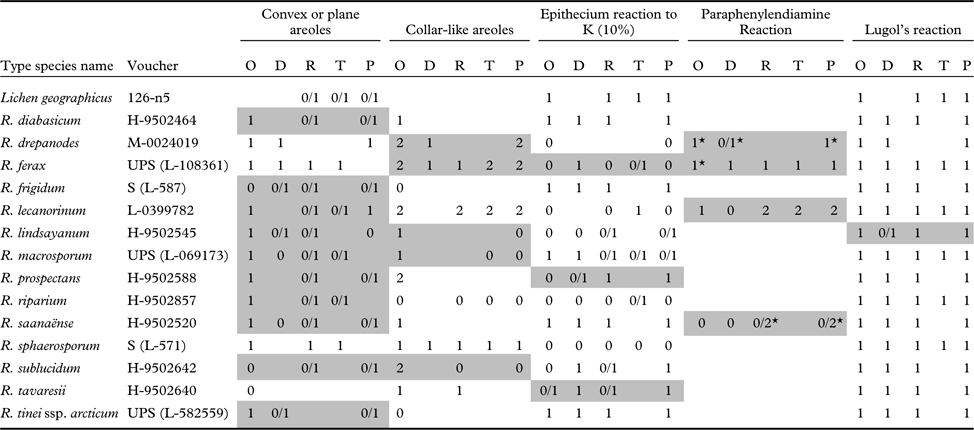
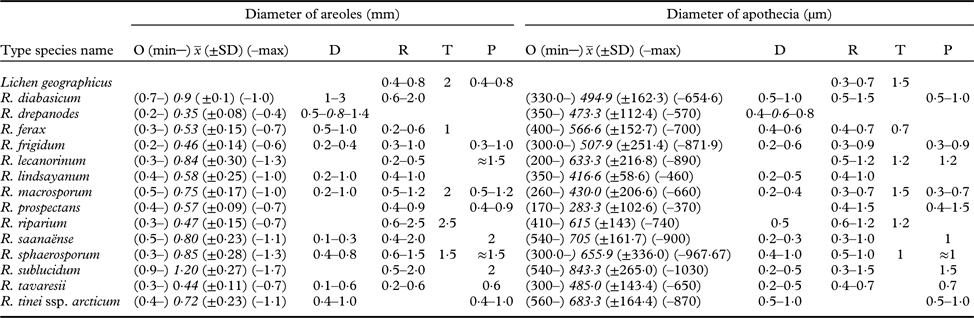
The characters we examined and report on here are those used by previous authors, in order to assess their taxonomic significance. The characters (Tables 1 and 2) were morphological, anatomical, and chemical; whenever possible 10 measurements were taken for each anatomical and morphological character in each specimen.
A comparison of the morphological characters of the Rhizocarpon geographicum group from different authors

O=authors own observations; D=observations of different authors for each species in the original descriptions; R=Runemark (Reference Runemark1956a ); T=Thomson (Reference Thomson1967); P=Poelt (Reference Poelt1988). Authors’ discordant observations are in grey. Key: convex or plane areoles, 0=plane, 1=convex; collar-like areoles, 0=none, 1=any, 2=all; epithecium reaction to K (10%), 0=negative, 1=positive red-violet; paraphenylendiamine reaction, 0=negative, 1=positive yellow, 1*=positive orange, 2=positive red-orange, 2*=positive reddish-violet; Lugol’s reaction, 0=negative, 1=positive blue-violet.
Continued

O=authors own observations; D=observations of different authors for each species in the original descriptions; R=Runemark (Reference Runemark1956a ); T=Thomson (Reference Thomson1967); P=Poelt (Reference Poelt1988).
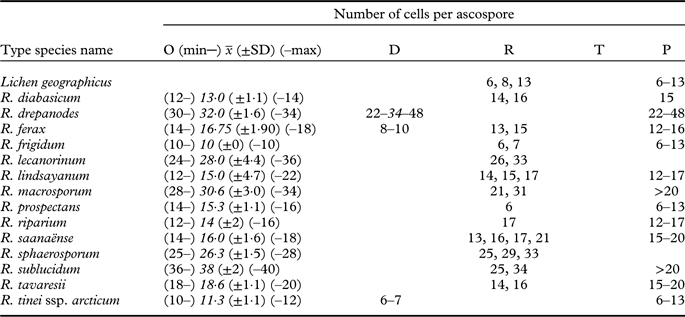
A comparison of the number of cells per ascospore of the Rhizocarpon geographicum group from different authors

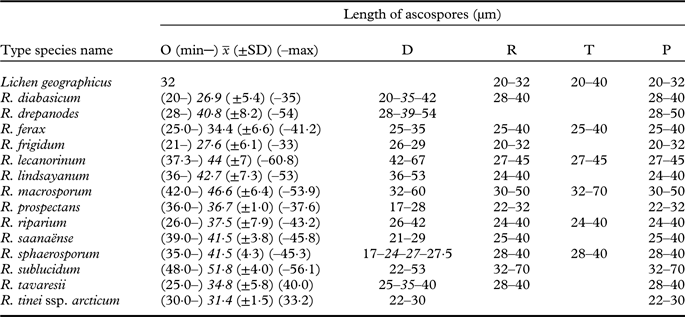
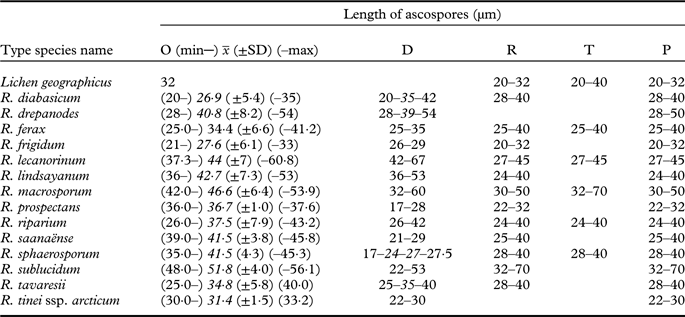
A comparison of the length of ascopores of the Rhizocarpon geographicum group from different authors
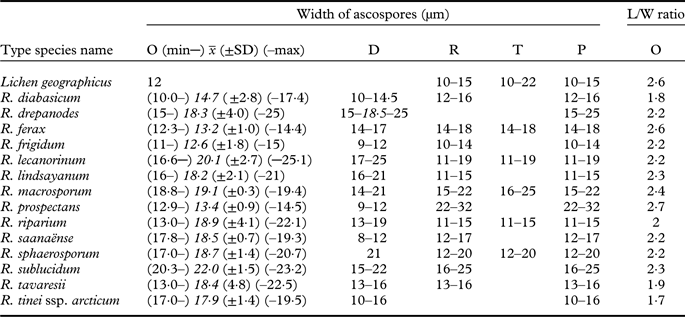
A comparison of the width of ascospores of the Rhizocarpon geographicum group from different authors together with their length/ width (L/W) ratio

For tables 2A, 2B, and 2C, O=authors own observations; D=observations of different authors for each species in the original descriptions; R=Runemark (Reference Runemark1956a ); T=Thomson (Reference Thomson1967); P=Poelt (Reference Poelt1988). Voucher identification as in Table 1.
Areole diameter and shape, convex or plane or collar-like areoles, and apothecium diameter were measured and recorded under a Nikon SMZ-2T stereomicroscope. Collar-like areoles were recorded as present when the apothecium was embraced by an arc of thalline tissue within an areole. Rimose areolation resulting from fissuring of the thallus was not recorded as collar-like. A minimum of ten measurements for areole diameter and three for apothecium diameter were taken. Anatomical characters were studied and photographed using a Nikon Eclipse 80i microscope and a Nikon DS-F1l camera. Vertical sections of apothecia were hand-cut under a binocular microscope and examined in both water and 10% K. The number of cells per ascospore as well as their length and width were measured on material mounted in water at ×1000 with a Nikon Digital Sight DS-L2. Whenever possible, a minimum of ten measurements were taken for each preparation. Sections were made from three different apothecia on a thallus, and the size of ascospores, areoles, and apothecia are given as a mean (±standard deviation), with minimum and maximum values given in brackets. We also provide length/width ratios to give an indication of ascospore shape. The number of cells per ascospore was determined by focusing in different optical sections for each ascospore; as Runemark (Reference Runemark1956a ) did not state how many cells were present in his descriptions, the number he observed is taken from the line drawings in his monograph.
When chemical tests were required, these were limited to reagent spot tests used in previous systems, that is I (Lugol’s solution) and Pd (alcoholic preparation). Additional tests were not carried out in order to minimize damage to the type materials. The Pd medullary test was only used in R. lecanorinum, R. drepanodes, and R. ferax. The colour of the thallus was not considered appropriate for scoring due to the varied age of the specimens, as thalli tend to become more yellowish in long-term storage, and all types examined were more than 30 years old. We did not carry out thin-layer chromatographic (TLC) analyses as: 1) TLC data had not been used in earlier revisions of the R. geographicum group; 2) our studies had shown that TLC does not add data of taxonomic value in this group (Roca-Valiente Reference Roca-Valiente2013); and 3) we did not wish to damage historic type collections unnecessarily.
Typifications
The names are treated here in alphabetical sequence according to the generally accepted current taxonomy.
Rhizocarpon drepanodes Feuerer
Ber. Bayer. Bot. Ges. 49: 67 (1978); type: France, Pyrenees, Haute-Garonne, alt. 1500 m, 14 August 1977, T. Feuerer (M-0024019—holotype).
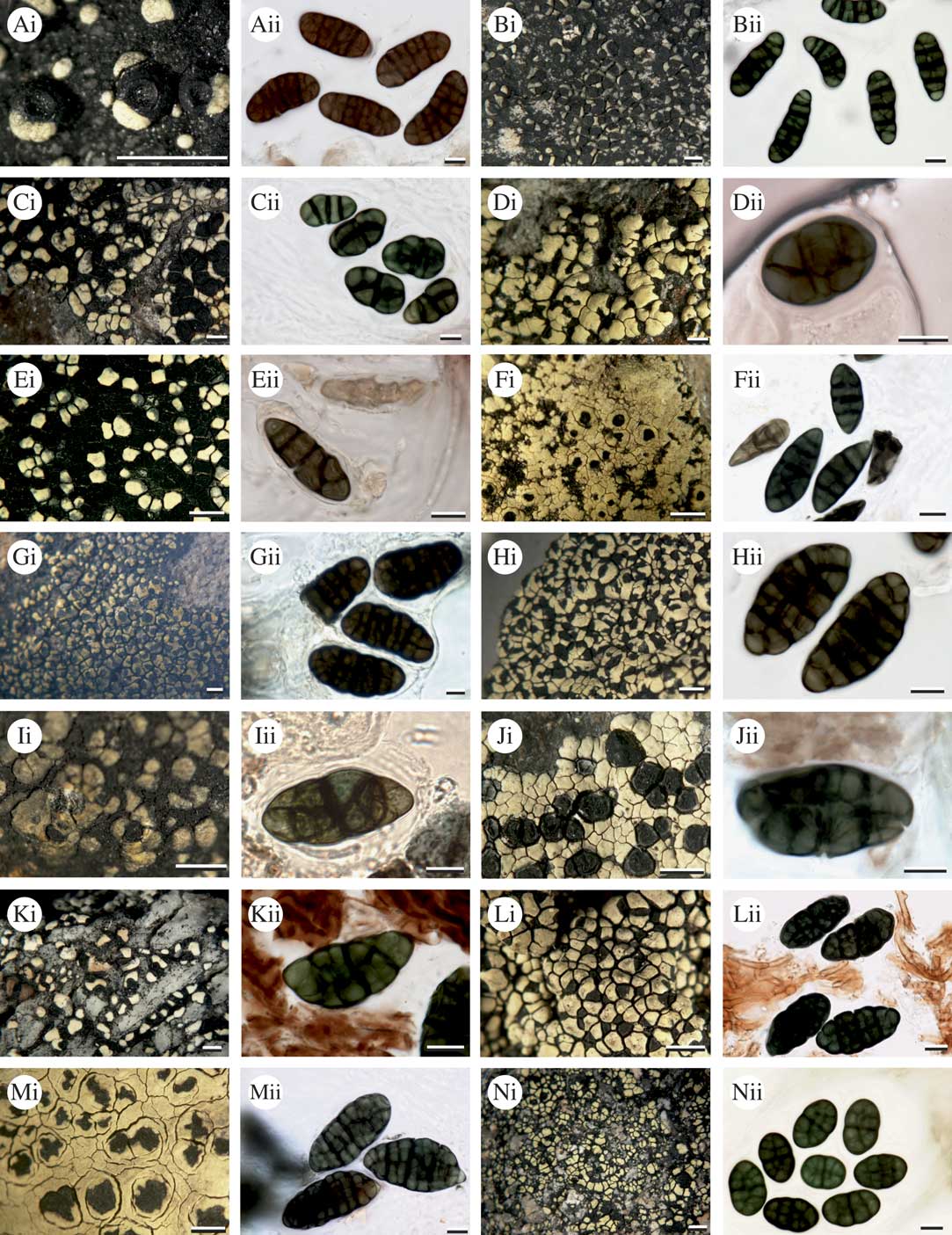
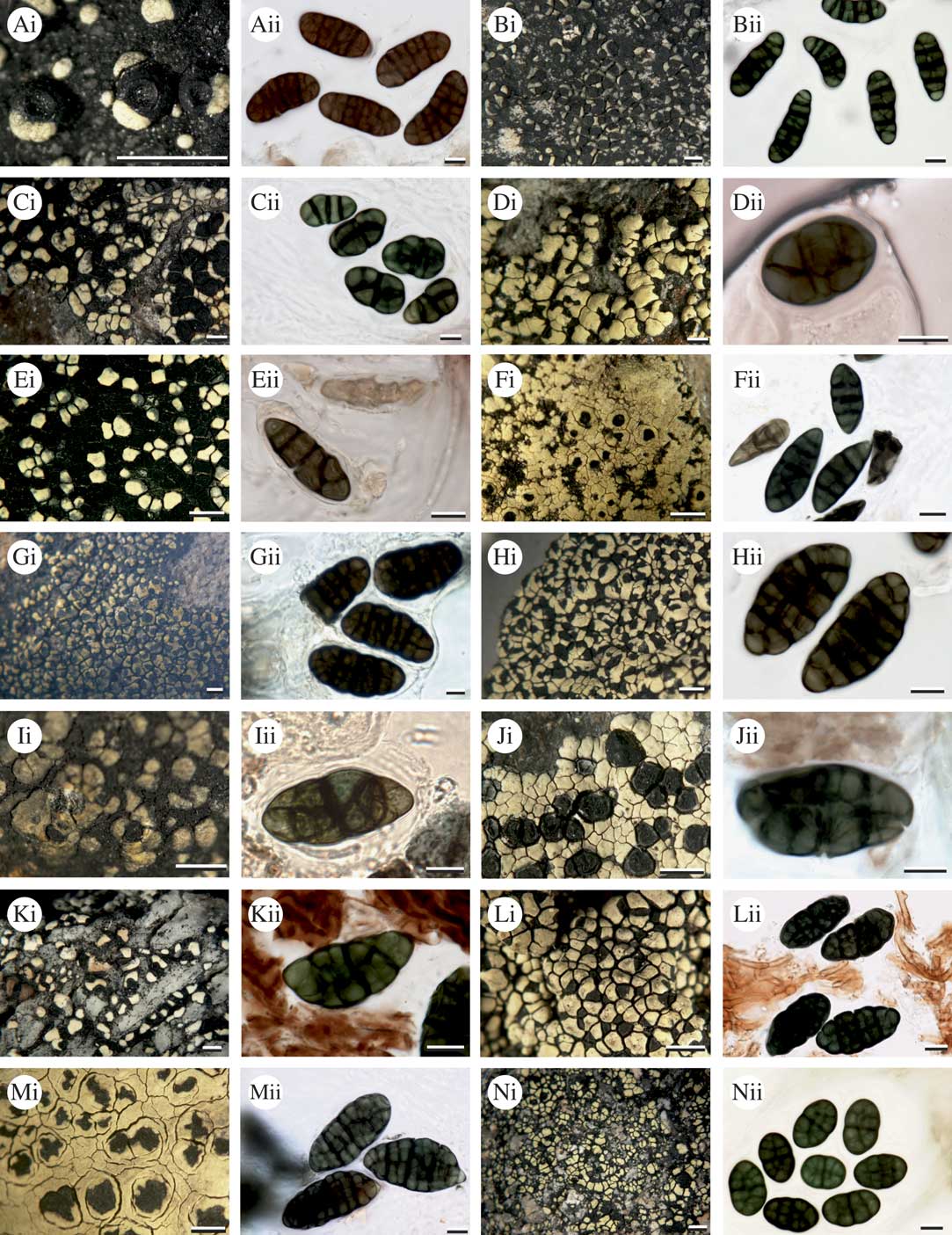
Type specimens of the Rhizocarpon geographicum group. Thallus habits are shown in the left hand panels (i) and ascospores are shown in the right hand panels (ii). Ai & ii, R. drepanodes (M-0024019); Bi & ii, R. ferax (UPS L-108361); Ci & ii, R. tinei subsp. arcticum (UPS L-582559); Di & ii, R. diabasicum (H-9502464); Ei & ii, R. frigidum (S L-587); Fi & ii, R. prospectans (H-9502588); Gi & ii, R. lecanorinum (L-0399782); Hi & ii, R. macrosporum (UPS L-069173); Ii & ii, R. lindsayanum (H-9502545); Ji & ii, R. riparium (H-9502857); Ki & ii, R. saanaënse (H-9502520); Li & ii, R. sphaerosporum (S L-571); Mi & ii, R. sublucidum (H-9502642); Ni & ii, R. tavaresii (H-9502640). Scales: i=1mm; ii=10 µm.
Rhizocarpon ferax H. Magn.
Bot. Not. 101: 405 (1948); type: Sweden, Härjedalen, Tännäs par., on top of Ramundberget, alt. 950 m, 23 March 1948, B. Magnusson (UPS L-108361—holotype).
Rhizocarpon geographicum ssp. arcticum (Runemark) Hertel
Mitt. Bot. Staassamml. München 12: 493 (1976).
Basionym: Rhizocarpon tinei ssp. arcticum Runemark, Opera Bot. 2(1): 125 (1956); type: Sweden, Härjedalen, Tännäs par., on top of Rössvålen. 26 March 1948, B. Magnusson (UPS L-582559—holotype, as “Rhizocarpon geographicum var. atrovirens”).
Rhizocarpon geographicum ssp. diabasicum (Räsänen) Poelt & Vĕzda
in Hawksworth et al., Lichenologist 12: 107 (1980).
Basionym: Rhizocarpon diabasicum Räsänen, Ann. Bot. Soc. Zool.-Bot. Fenn. “Vanamo” 16 (not. bot. 12): 59 (1942); type: Finland, Kemi, Kivalot, Keskipenikka, 22 August 1942, V. Räsänen (H-9502464—holotype).
Rhizocarpon geographicum ssp. frigidum (Räsänen) Hertel
Mitt. Bot. Staatssamml. München 12: 492 (1976).
Basionym: Rhizocarpon frigidum Räsänen, Ann. Bot. Soc. Zool.-Bot. Fenn. “Vanamo” 19 (not.): 9 (1944); type: Russia, Siberia, Guv. Jenisejsk, Dudinka [Swedish Expedition to Jenisej flum.]. Lat. 69º35'N, 29 July 1876, M. Brenner (S L-587—holotype, as “Rhizocarpon geographicum”).
Rhizocarpon geographicum (L.) DC.
in Lamarck & De Candolle, Fl. Fr. (Edn. 3) 2: 365 (1805).
Basionym: Lichen geographicus L., Sp. Plant. 2: 1140 (1753); type: Dillenius, Hist. Musc.: pl. 18 fig. 5 (1742) [“1741”] (lectotype—designated by Jørgensen et al., Bot. J. Linn. Soc. 115: 318, 1994, as “Lichenoides nigro-flavum, tabulae Geographicae instar pictum”); sine loc. (OXF Herb. Hist. Musc. Sheet 54 no. 5—epitype designated by Hawksworth & Sowter, Trans. Leicester. Lit. Phil. Soc. 63: 58, 1969, as “lectotype”).
(Fig. 2)
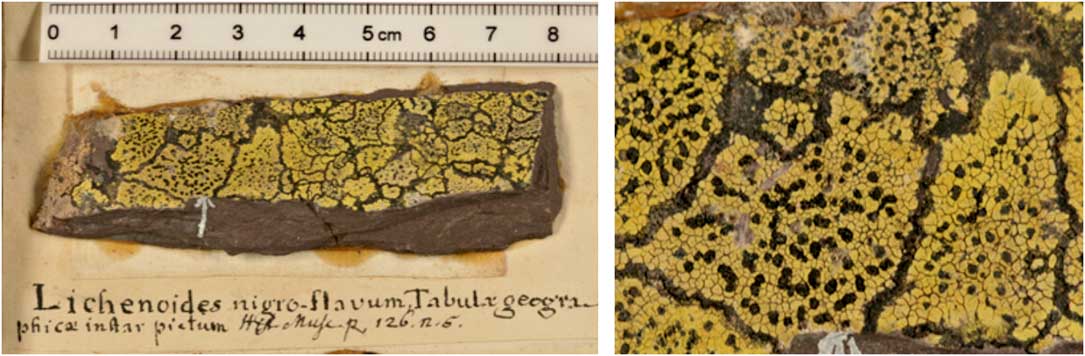
Rhizocarpon geographicum. Epitype of Lichen geographicus (OXF – Herb. Musc. Sheet 54, no. 5). The white arrow indicates the thallus from which apothecia and chemical products were analyzed by DLH in 1969. Photograph courtesy of S. Marner.
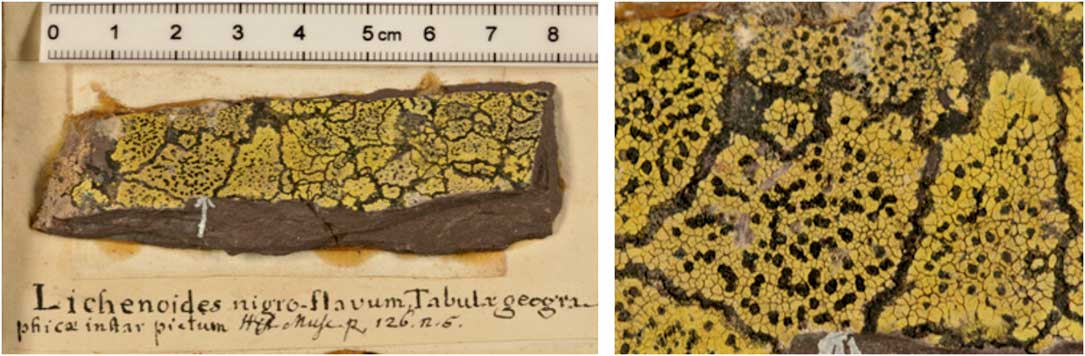
As there is no material eligible as a possible lectotype for Linnaeus’s name in his herbarium (LINN), and Linnaeus (Reference Linnaeus1753) cited the illustration of Dillenius (Reference Dillenius1742), the illustration serves as original material and has to be designated as a lectotype under Art. 9.12 of the current Code (McNeill et al. Reference McNeill, Barrie, Burdet, Demoulin, Greuter, Hawksworth, Herendeen, Knapp, Marhold and Prado2012). Jørgensen et al. (Reference Jørgensen, James and Jarvis1994) were therefore correct in their choice of the illustration, and in stating that the lectotype selected by Hawksworth & Sowter (Reference Hawksworth and Sowter1969) has to be treated as an epitype for the Linnean name under Art. 9.9. The specimen is not localized, but Dillenius (Reference Dillenius1742) cites occurrences in Germany (Hangestein) and the UK (Stiperstones, Shropshire; around Bangor and “Pentirum”, Caernarvonshire) so it could be from those or an uncited locality.
The Dillenian material would have been a candidate for lectotypification if it could have been established that it was personally examined by Linnaeus when he visited Oxford in 1736. The issues surrounding that visit, and whether or not specimens were then examined by Linnaeus, are reviewed elsewhere (Stadler et al. Reference Stadler, Hawksworth and Fournier2014). In the present case, as Dillenius’s work did not appear until six years later, and the labels in the hand of Dillenius are the final plate and figure numbers in his work, it is unlikely that the specimen sheets in OXF had already been prepared as now preserved.
In view of the historical importance of the Dillenian collections, they are not available for loan. DLH did, however, have the opportunity to examine the specimens in more detail in February 1969, and the results are recorded in a label attached to the sheet in OXF. Rhizocarpic and psoromic acids were detected by microcrystal tests, the thallus and medulla reacted I+ blue-green (Melzer’s solution), the hymenium was colourless, the asci 95–120 µm tall, and the ascospores brown, muriform, 8-celled, and 32×12 µm with a 3 µm thick colourless outer layer (within the asci). The epithecium was mentioned as K+ wine red in Hawksworth & Sowter (Reference Hawksworth and Sowter1969), but that information was not entered on the label. The spore measurements of the specimen given in Jørgensen et al. (Reference Jørgensen, James and Jarvis1994) were identical to those on DLH’s label, and they also examined the material by TLC, detecting 2’-O-demethylpsoromic acid in addition to psoromic and rhizocarpic acids.
In the event that the epitype cannot be interpreted unambiguously in the context of any new phylogenetic classification of the complex, it may then become necessary to fix the application with a conserved type, which could be a modern sequenced collection. Such action does not, however, appear necessary at present.
Rhizocarpon geographicum ssp. prospectans (Räsänen) D. Hawksw. & Sowter
Trans. Leicester Lit. Phil. Soc. 63: 58 (1969).
Basionym: Rhizocarpon prospectans Räsänen, Ann. Bot. Soc. Zool.-Bot. Fenn. “Vanamo” 19 (not.): 8 (1944); type: France, Nantes, Sant Maixent (Deux Sévres), 1873, J. Richard (H-9502588—holotype, as “Lecidea geographica var. prospectans Herb. Nyl. 10257”).
Rhizocarpon lecanorinum Anders
Hedwigia 64: 261 (1923); as “lecanoricum (Flk., Körb. Syst. p. 203 [sic!])”.
Lecidea atrovirens δ. [var.] lecanora Flörke, Deutsch. Lich. 4: 4 (1819).
Rhizocarpon geographicum γ. [var.] lecanorum Massal., Ric. Lich. Crost.: 101 (1852); nom. illegit. (Art. 52.1).
Rhizocarpon geographicum β. [var.] lecanorinum Körb., Syst. Lich. Germ.: 263 (1855); as “Flk.”.; nom. illegit. (Art. 52.1); type: Germany, Sachsen, Quedlinburg, Flörke [Deutsch. Lich. Exs. no. 63] (L-0399782—lectotype selected by Runemark Reference Runemark1956a : 102).
The nomenclature of this taxon is confusing because of the use of several very similar epithets: lecanora, lecanoricum, lecanorinum, and lecanorum. Flörke (Reference Flörke1819: 4) described his variety “lecanora” from sandstone rocks around “Quedlingburg nach Westerhausen bei Blankenburg”; there can be little doubt that material distributed in the accompanying exsiccate is original material as the number 63 is given in Flörke’s publication; the example of this exsiccate in L is therefore an appropriate lectotype. Massalongo (Reference Massalongo1852: 101) gave Flörke’s name as a synonym of his epithet lecanorum, rendering that superfluous and so illegitimate, and to be typified by the type of Flörke’s name (Art. 7.5); he also indicated that he had studied the exsiccate. Similarly, Körber (1855: 263, not “203” as given by Anders Reference Anders1923) attributed his “lecanorinum” to Flörke, citing Flörke’s name as a synonym on the authority of Flotow, and so also making his name illegitimate.
In raising the taxon to species rank, Anders evidently intended to make a new combination based on Flörke and Körber’s names. There would have been no obstacle to him using “lecanora” in a new combination, as the rank was being changed; Anders could have used any species epithet he wished that would not be a homonym and which would be treated as new (Art. 58.1), and perhaps his spelling “lecanoricum” should have been adopted by all subsequent workers. We chose not to do that here as all later works seem to have regarded “lecanoricum” as a misspelling of “lecanorinum”, and to make any correction now would further complicate this messy situation.
We also examined material of Anders (Czech Republic, Bohemia, Česka Leipa, Röhrsdort, 3 Aug. 1920, J. Anders, PRM-160822) from one of the localities he cited (Anders Reference Anders1923: 261) which has been labelled as type of his name, but that has no formal nomenclatural status as his name is automatically typified by Flörke’s material, as pointed out above.
Rhizocarpon macrosporum Räsänen
Feddes Repert. Spec. Nov. Regni Veg. 52: 139 (1943); type: Switzerland, Graubünden, Sant Moriz, 1853, P. Hepp (UPS L-069173—holotype, “as Lecidea geographica var. atrovirens”).
Rhizocarpon riparium ssp. lindsayanum (Räsänen) Thomson
Nova Hedwigia 14: 456 (1967).
Basionym: Rhizocarpon lindsayanum Räsänen, Revista Sudamer. Bot. 7: 87 (1942); type: Great Britain, Perthshire, Dunkeld, Birnam Hill, April 1856, W. L. Lindsay (H-9502545—as “Lecidea geographica”).
Rhizocarpon riparium Räsänen
Ann. Bot. Soc. Zool.-Bot. Fenn. “Vanamo” 16 (not. bot. 12): 60 (1942); type: Russia, Vaitolahti, 10 June 1931, V. Räsänen (H-9502857—isotype, as “Rhizocarpon riparium var. typica, Rhizocarpon lindsayanum ssp. kittilense, Rhizocarpon geographicum ssp. kittilense”).
Rhizocarpon saanaënse Räsänen
Ann. Bot. Soc. Zool.-Bot. Fenn. “Vanamo” 16 (not. bot. 12): 61 (1942); type: Finland, Enontekiö Saanavaara, 1867, J. P. Norrlin (H-9502520—holotype, as “Lecidea geographica”).
Rhizocarpon sphaerosporum Räsänen
Ann. Bot. Soc. Zool.-Bot. Fenn. “Vanamo” 19 (not.): 6 (1944); type: Sweden, Uppsala, Gottsunda, 1893, E. Pärsson (S L-571—isotype, as “Rhizocarpon lecanorinum var. cyclica, Rhizocarpon geographicum”).
Rhizocarpon sublucidum Räsänen
Ann. Bot. Soc. Zool.-Bot. Fenn. “Vanamo” 21 (not. 16): 3 (1947); type: Switzerland, Les Mosses, 1882, E. A. Vainio (H-9502642—isotype).
Rhizocarpon tavaresii Räsänen
Arch. Bot. Soc. Zool.-Bot. Fenn. “Vanamo” 3: 85 (1949); type: Portugal, Minho, Serra do Gerez-Outeiro Moço, 19 June 1947, C. N. Tavares (H-9502641—holotype).
Results
Our analyses and observations on the type collections examined are presented in Tables 1 and 2. In the case of Rhizocarpon frigidum, R. lindsayanum, and R. riparium, the ascospores were unfortunately not in a good condition, and in those cases we included measurements from published descriptions and any notes associated with the type specimens. The observations by different authors in the original descriptions and in keys to the R. geographicum group of the morphological characters analyzed here are also incorporated into Tables 1 and 2. It was not possible to provide mean (±SD) measurements for the epitype of Lichen geographicus, and the available information on the microscopic features in that material is noted above. In the case of R. tinei ssp. arcticum, the original description was provided by Runemark (Reference Runemark1956a ), so all observations are given in the original description column. Runemark (Reference Runemark1956a ) treated R. riparium as a synonym of R. lindsayanum ssp. kittilense, so we present the observations of Runemark under that name for R. riparium in Tables 1 and 2.
In general, Thomson (Reference Thomson1967) and Poelt (Reference Poelt1988) seem to have taken data from Runemark (Reference Runemark1956a ) and not presented their own observations (Tables 1 and 2). When a species was not studied by Runemark (Reference Runemark1956a ), Poelt followed the original description, as for R. drepanodes. Räsänen (Reference Räsänen1942a , Reference Räsänen b , Reference Räsänen1943, 1944, Reference Räsänen1947, 1949) and Anders (Reference Anders1923) in their original descriptions, and Thomson (Reference Thomson1967) in his key, did not indicate the number of cells in the ascospores.
Our study of apothecia and ascospores revealed minimal deviations (slight differences in the size ranges and shape of ascospores) between the type collections and descriptions. In the case of some chemical and morphological characters, however, we found contrasting differences between the specimens and the original descriptions; examples are the epithecium K reaction in R. ferax, R. prospectans and R. tavaresii, and the medullary Pd reaction in R. ferax, R. lecanorinum and R. saanaënse. Other classic diagnostic morphological characters in the group, such as collar-like areoles partly enclosing apothecia, were also discordant. The other characters studied, notably areole diameter, areole form and the I+ blue-violet reaction of the medulla were largely in accordance with published descriptions.
Discussion
Among 26 taxa currently accepted within the Rhizocarpon geographicum group, the type material of 15 has been included in our analysis, mostly described by Räsänen. The features in common are: the crustose saxicolous thallus growing mainly on siliceous or other non-calcareous rocks; green-yellow thallus areoles which can be plane to convex, collar-like or not,; a well-developed blackish prothallus usually evident between the areoles and at the thallus margins. The medulla is always I+ blue-violet. The concave, plane or convex apothecia are lecideine (i.e. with a true exciple and not a thalline exciple) and are mostly located between or surrounded by the areoles. Apothecia are rounded or angular, and with asci which are clavate, bitunicate in structure, of the Rhizocarpon type (Honegger Reference Honegger1979, Reference Honegger1980), and usually 8-spored. The hymenium is hyaline to green, mucilaginous, with net-like anastomosed interascal filaments with swollen apical cells which are clavate and not pigmented. The ascospores are muriform, with 2–4 transverse septa to strongly multicellular, with a distinct halo (at least when young), and colourless to green-brown (Roca-Valiente Reference Roca-Valiente2013).
Although we found four characters to be in agreement with previous publications, six chemical-anatomical characters were not, which could lead to errors in identification: these are the epithecium K reaction, medulla Pd reaction, collar-like areoles, the number of cells per ascospore, ascospore length, and ascospore width.
Chemical characters
The I+ reaction was reported in the original descriptions and keys for all species studied, apart from Lichen geographicus (see above) which reacted positively. Rhizocarpon lindsayanum was, however, indicated to be I+ or I− by Räsänen (Reference Räsänen1942b ).
The K reaction of the epithecium in R. ferax, R. prospectans and R. tavaresii did not match the original descriptions of the taxa. Rhizocarpon prospectans was originally reported as K− or + slightly violet (Räsänen Reference Räsänen1944), but Poelt (Reference Poelt1988) refers to it only as K+; however, we tested three different apothecia from the type which were consistently K−. Magnusson (Reference Magnusson1948) described R. ferax with an “epithecium bluish green or greenish brown, in K pale olive or sometimes faintly purple”; we found that in K the olive colour of the epithecium and hymenium was intensified but never K+ faintly purple as indicated by Runemark (Reference Runemark1956a ) and Poelt (Reference Poelt1988). In the type specimen of R. tavaresii, we detected two apothecia with a K− epithecium, and one which was K+. Räsänen (Reference Räsänen1949) had characterized R. tavaresii as a species with an “epithecium K+ aeruginosum”, and both Runemark (Reference Runemark1956a ) and Poelt (Reference Poelt1988) have it as K+ or K−.
A positive medullary reaction with Pd has been used for differentiating three species: R. drepanodes, R. ferax, and R. lecanorinum. Rhizocarpon lecanorinum is Pd− according to Anders (Reference Anders1923), but we obtained a Pd+ yellow reaction. Poelt (Reference Poelt1988) and Runemark (Reference Runemark1956a ) also cite R. lecanorinum as Pd+ red, and use that to distinguish the species from R. drepanodes and R. ferax, both of which have been stated to be Pd+ yellow. We found the type specimens of both R. drepanodes and R. ferax to be Pd+ intense yellow-orange. Rhizocarpon drepanodes was described as Pd+ yellow (Feuerer Reference Feuerer1978), and R. ferax as Pd− (Magnusson Reference Magnusson1948). We also checked the Pd reaction in the type of R. saanaënse, which Räsänen (Reference Räsänen1942b ) described as Pd−, while Poelt (Reference Poelt1988) and Runemark (Reference Runemark1956a ) give it as Pd+ red-violet or −. We found the type specimen of R. saanaënse to be Pd− as originally described. This character has not been considered important for the separation of other species in the complex.
We conclude that chemical reactions of the medulla to Pd, and of the epithecium to K, are unreliable and inconsistent characters for separating members of the R. geographicum group (see also Roca-Valiente Reference Roca-Valiente2013).
Morphological characters
Ascospore septation, size and shape (length:width, L/W ratios) showed little discordance between our examination of types, and those in original descriptions and the interpretation of different authors (e.g. Anders Reference Anders1923; Räsänen Reference Räsänen1942a , Reference Räsänen b , Reference Räsänen1943, 1944, Reference Räsänen1947, 1949; Runemark Reference Runemark1956a ; Feuerer Reference Feuerer1978; Poelt Reference Poelt1988); however, the value of these features as taxonomically informative characters needs to be assessed from larger data sets based on many more collections.
The collar-like areoles clasping apothecia have been considered a particularly important character in the R. geographicum group (e.g. Runemark Reference Runemark1956a ; Thomson Reference Thomson1967; Feuerer Reference Feuerer1978; Poelt Reference Poelt1988). We saw these structures in the type collections of R. diabasicum, R. drepanodes, R. ferax, R. lecanorinum, R. lindsayanum, R. macrosporum, R. prospectans, R. saanaënse, R. sphaerosporum, R. sublucidum, and R. tavaresii. However, this character was not mentioned in the original descriptions of R. diabasicum, R. lecanorinum, R. lindsayanum, R. macrosporum, R. prospectans, R. saanaënse, R. sublucidum, or R. tavaresii (Anders Reference Anders1923; Räsänen Reference Räsänen1942a , Reference Räsänen b , Reference Räsänen1943, Reference Räsänen1947, 1949). Indeed, it was mentioned only in the original descriptions of R. drepanodes, R. ferax, and R. sphaerosporum (Räsänen Reference Räsänen1944; Magnusson Reference Magnusson1948; Feuerer Reference Feuerer1978), but keys almost universally treat this character as being of particular importance (Runemark Reference Runemark1956a ; Poelt Reference Poelt1988). It was not indicated as present in other species, notably R. diabasicum, R. prospectans, R. tavaresii and R. saanaënse, in spite of the common occurrence of this areole type in the thalli, making the identification of species using this character problematic.
Thomson (Reference Thomson1967) studied just eight species: R. atroflavescens, R. intermediellum, R. ferax, R. geographicum, R. lecanorinum, R. macrosporum, R. sphaerosporum, and R. riparium. He did not cite the number of cells in each ascospore, which is a significant character. In contrast, Poelt (Reference Poelt1988) included most species accepted today and used all relevant spore characters. Øvstedal & Smith (Reference Øvstedal and Smith2001) included R. geographicum species from Antarctic regions (e.g. R. nidificum) and used spore characters, particularly the number of cells per spore, for identification.
Conclusions
This study is presented as a first step towards resolving the current taxonomic confusions and problems of species concepts and recognition within the Rhizocarpon geographicum group, and will be essential in the interpretation of forthcoming molecular phylogenetic data. We have endeavoured to unravel uncertainties caused by different interpretations of taxonomic concepts and by the high level of plasticity inherent in the group by verifying characters in the type materials and comparing them with the original and other published descriptions, especially in major regional treatments. We conclude that minor but relevant differences cited in the literature regarding the actual characters in the type materials have contributed to the current uncertainties in the group.
In particular, in some species of the R. geographicum complex, some important and widely emphasized characters such as the presence of collar-like areoles or chemical reactions, are not congruent between the original descriptions and what can be seen in the type specimens. Runemark (Reference Runemark1956a ) stated that the R. geographicum group “has earlier been treated only as a polymorphic species, R. geographicum”. The validity or not of that earlier view now requires revisiting and testing by a rigorous in-depth study using numerous specimens in which morphological and chemical data are compared with the results of molecular phylogenetic analysis.
We are indebted to the curators of the collections in H, L, M, MAF, PRM, S and UPS for sending material on loan, and to Serena Marner (University of Oxford) for photographs of the Dillenian material. Maria Kossowska kindly searched for additional pertinent material amongst the Körber collections in WRSL, following advice from Mark R. D. Seaward. This contribution was completed while BR-V was in receipt of funding from the Spanish Ministerio de Ciencia e Innovación project POL 2006-08405 and some complementary data were produced from CGL2010-21646, CTM2012-38222-467 C01-01 and CGL2013-42498-P. At the start of the study, DLH was in receipt of funding from the Spanish Ministerio de Ciencia e Innovación project CGL2011-25003. SPO is supported by the grant CTM2012-38222-467 C02-02 from the Spanish Ministerio de Economía y Competitividad.