INTRODUCTION
The deep sea is the largest, the least known and one of the least studied environments on the planet. It contains extremely large habitats, and millions of square kilometres of continental slopes and abyssal plains. Considering our modest knowledge of deep-sea biodiversity, it is likely that more species occur in the deep sea than anywhere else on Earth. In many taxa, far more than 90% of the species collected in a typical abyssal sediment sample are new to science, and many of these are rare (Brandt et al., Reference Brandt, De Broyer, De Mesel, Ellingsen, Gooday, Hilbig, Linse, Thomson and Tyler2007). The species richness of these communities, especially the high diversity of marine nematodes, has exceeded all scientific expectations (Miljutin et al., Reference Miljutin, Gad, Miljutina, Mokievsky, Fonsêca-Genevois and Esteves2010).
Ecological studies on marine nematodes have recorded members of the family Desmodoridae in deep-sea sediments, but always in low numbers, with their relative abundance reaching a maximum of 1% of the total mass (Soetaert & Heip, Reference Soetaert and Heip1995). The family contains a large number of species, of which only a very few have been described (Vermeeren et al., Reference Vermeeren, Vanreusel and Vanhove2004).
The Campos Basin oil field is the largest oil-prospecting and production area in Brazil, with an average output of 1 million barrels per day (Rezende et al., Reference Rezende, Lacerda, Ovalle, Souza and Gobo2002). Considering that more than 50% of Brazilian offshore exploration blocks are in water depths over 400 m, characterization of the deep-water ecological communities is a primary concern. The present report is part of the multidisciplinary environmental research project ‘Campos Basin Environmental Heterogeneity—Habitats’ sponsored by the Brazilian petroleum company PETROBRAS, in the deep-water oil exploration and production area of the basin. The main objective of the Habitats project is to characterize physically, chemically and biologically the different environments on the continental shelf and slope of the Campos Basin.
According to Gourbault & Vincx (Reference Gourbault and Vincx1990), intersexuality is rare in marine nematodes; usually only a few intersex individuals appear in marine communities. This phenomenon is not well understood, and therefore it is important to add new finds to the known data.
This paper describes four new species of desmodorids from the south-east Atlantic Ocean, and also a case of intersexuality in one of these species.
MATERIALS AND METHODS
Study area
The continental slope of the Campos Basin is adjacent to the continental shelf of the State of Rio de Janeiro, Brazil, between 23o30′S and 21°30′W. The lowest limit of the slope is between 2400 and 3000 m deep. Hydrodynamic processes in this region are controlled by the Brazil Current, which reaches a depth of 200 m. The slope is covered by fine continental sediment and sand, composed mainly of foraminiferans (Soares-Gomes et al., Reference Soares-Gomes, Abreu, Absher and Figueiredo1999).
Sampling and sample processing
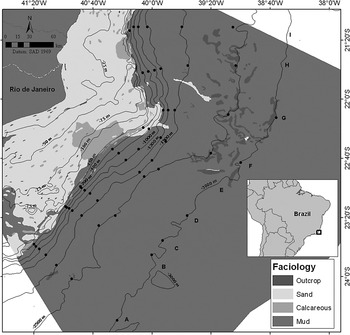
Sampling was carried out during the cruises of the Habitats project (May 2008). A total of nine transects at seven depths (400, 700, 1000, 1300, 1900, 2500 and 3000 m) were sampled on the continental slope of the Campos Basin (Figure 1). On-board the RV ‘GYRE’, samples were taken with a box corer covering 0.25 m2 of sediment, subdivided into 25 subsamples. Each sample was transferred to a 1 l plastic flask and fixed in 10% formalin buffered with borax.
Sampling area and locations of stations in the Campos Basin off Rio de Janeiro, Brazil.

Nematodes were gently picked out with a stainless-steel stylet, fixed with 4% formaldehyde, and gradually transferred to glycerin (Seinhorst, Reference Seinhorst1959). Drawings were made on an Olympus CX 31 optical microscope, with the aid of a camera lucida. Photographs were taken with an Olympus C-5050Zoom digital camera. The holotype and a female paratype of each species are deposited in the National Museum of Rio de Janeiro (MNRJ), Brazil. The remaining paratypes are deposited in the Laboratório de Meiofauna, Departamento de Zoologia, Universidade Federal de Pernambuco (LMZOO-UFPE), Brazil.
Abbreviations used in the text
- abd:
anal body diameter;
- amph:
amphid diameter (maximum width);
- Amph%:
percentage of the amphid diameter in relation to head diameter;
- Amph:
distance of the amphids from the anterior end of the nematode;
- annul (hd, mid, t):
distance between the annulations in the anterior, middle, and caudal regions, respectively;
- bulb:
pharyngeal bulb diameter;
- cc:
head capsule;
- cdb:
corresponding body diameter;
- cs:
length of cephalic setae;
- gub:
gubernaculum length;
- L:
total body length;
- mbd:
maximum body diameter;
- nr:
percentage of nerve ring in relation to anterior end;
- ph:
pharynx length;
- spic:
spiculum length;
- ss (A, B, C):
length of somatic setae in the anterior, middle, and caudal regions, respectively;
- t:
tail length;
- v:
distance of the vulva from the anterior end;
- V%:
distance of the vulva from anterior end as a percentage of total body;
- a, b, c, c′:
ratios of De Man (Reference De Man1880);
- a:
L/mbd;
- b:
L/ph;
- c:
L/t;
- c′:
t/abd.
Nomenclature of body regions is according to Coomans (Reference Coomans1979).
All measurements are in microns (μm).
RESULTS
SYSTEMATICS
Taxonomic classification, according to Decraemer & Smol (Reference Decraemer, Smol, Eyualem-Abebe and Traunspurger2006)
Class CHROMADOREA Inglis, 1983
Subclass CHROMODORIA Pearse, 1942
Order DESMODORIDA De Coninck, 1965
Suborder DESMODORINA De Coninck, 1965
Superfamily DESMODOROIDEA Filipjev, 1922
Family DESMODORIDAE Filipjev, 1922
Subfamily Desmodorinae Filipjev, 1922, according to Decraemer & Smol (Reference Decraemer, Smol, Eyualem-Abebe and Traunspurger2006)
DIAGNOSIS
Cuticle with transverse annuli except in head region. Head region with thickened cuticle except in lip region, and set off as a conspicuous head capsule or helmet. Fovea amphidialis in general not surrounded by annuli; may be located on a cuticularized plate. Buccal cavity in most cases with distinct teeth. Pharyngeal bulb round to elongated.
Genus Desmodora de Man, Reference De Man1989, according to Decraemer & Smol (Reference Decraemer, Smol, Eyualem-Abebe and Traunspurger2006)
Syn. Mastodex Steiner, 1921; Amphispira Cobb, Reference Cobb1920
Body cuticle with annuli extending from the pharyngeal region to the non-annulated tail-end, no special ornamentation or appendages. Short thin somatic setae arranged in six or eight longitudinal rows. Well-developed head capsule with differentiated lip region, and a main part with thickened basal zone of cuticle and provided with amphideal fovea and subcephalic setae, when present; the head capsule can either be smooth or partly to entirely ornamented with small vacuoles (inner cuticle). Cephalic setae either on lip region or on main part of head capsule, and inserted in front or at level of anterior edge of fovea amphidialis. Fovea amphidialis cryptospiral to multispiral (1–2 turns), loop-shaped. Buccal cavity with large dorsal tooth and two (rarely one) ventrosublateral teeth. Cylindrical pharynx with end bulb. Tail short and conical to long and conico-cylindrical. Male monorchic; short arched spicules; pore-like pre-cloacal supplements may be present. Female didelphic–amphidelphic with reflexed ovaries (Verschelde et al., Reference Verschelde, Gourbault and Vincx1998). Marine.
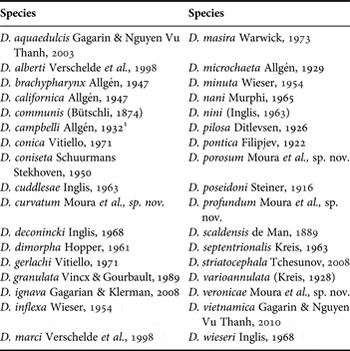
In the most recent revision of the genus, Verschelde et al., (Reference Verschelde, Gourbault and Vincx1998) listed 25 valid species, one incertae sedis, and 34 species inquirendae. Here, we update the list of valid species for the genus Desmodora (Table 1).
Species: Desmodora porosum sp. nov.
(Figures 2, 3, 4, 5; Table 2)
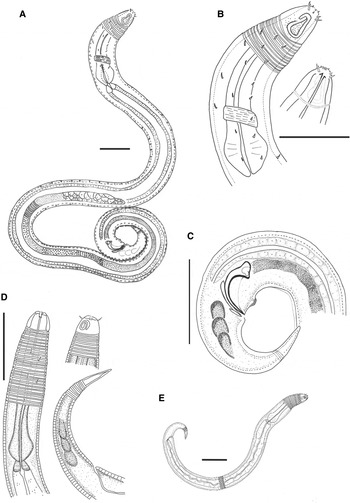
Desmodora porosum sp. nov.: (A) holotype, total body; (B) pharyngeal region, amphid, teeth; (C) posterior region, spicule and gubernaculum; (D) paratype juvenile, anterior and posterior region; (E) paratype juvenile, total body. Scale bars: 50 µm.

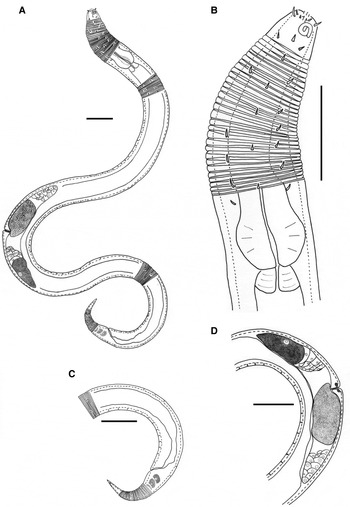
Desmodora porosum sp. nov.: (A) allotype female, total body; (B) pharyngeal region and amphid; (C) tail; (D) vulva region. Scale bars: 50 µm.

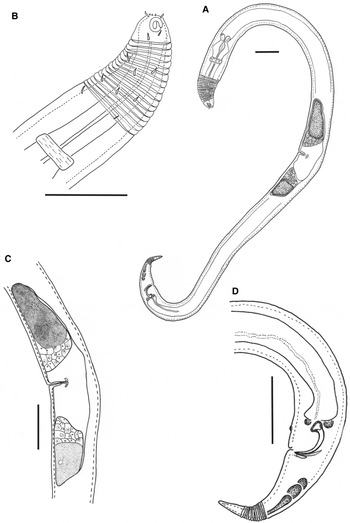
Desmodora porosum sp. nov.: (A) paratype intersex, total body; (B) anterior region and amphid; (C) vulva region; (D) tail and spicule. Scale bars: 50 µm.

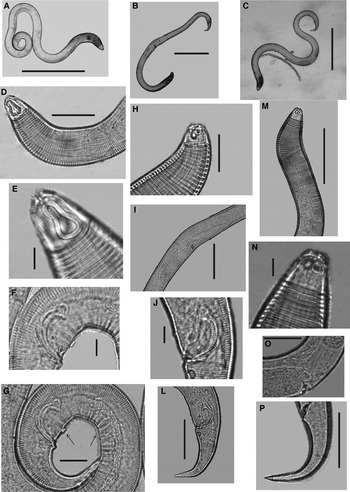
Desmodora porosum sp. nov.: (A) holotype, total body; (B) paratype intersex, total body; (C) allotype female, total body; (D) pharyngeal region of male; (E) head and amphid of holotype; (F) posterior region showing spicule and gubernaculum; (G) tail of holotype showing papilla and ventral ala; (H) anterior region of allotype female showing amphid; (I) vulva region of intersex; (J) spicule and gubernaculum of intersex; (L) tail of intersex; (M) anterior region of allotype female; (N) amphid of allotype female; (O) vulva region of female; (P) tail of female. Scale bars: A–C, 300 µm; D, H, L, O, P, 50 µm; E, F, J, N, 10 µm; G, 20 µm; I, M, 100 µm.

List of valid species of Desmodora, based on Verschelde et al. (Reference Verschelde, Gourbault and Vincx1998) and the NeMys database (Deprez et al., Reference Deprez2005).

1, designated species incertae by Pastor de Ward (Reference Pastor de Ward1988), Verschelde et al. (Reference Verschelde, Gourbault and Vincx1998) and Ingels et al. (Reference Ingels, Vanhove, De Mese and Vanreusel2006).
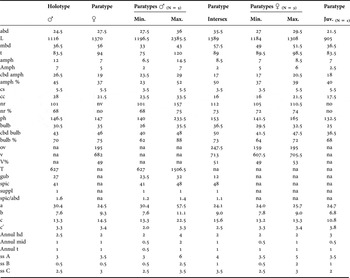
Morphometric measurements (µm) of Desmodora porosum sp. nov. na, not applicable; no, not observed.

MATERIAL EXAMINED
6 males, 4 females, 1 intersex and 1 juvenile.
TYPE SPECIMENS
Holotype male (MNRJ 361); allotype female (MNRJ 362); other paratypes: 5 males (349–353 NM LMZOO-UFPE), 3 females (354–356 NM LMZOO-UFPE), 1 intersex (357 NM LMZOO-UFPE) and 1 juvenile (358 NM LMZOO-UFPE).
TYPE LOCALITY
Campos Basin (Rio de Janeiro, Brazil), 23°35′24′′S 39°52′43′′W. Depth 400 m, collected with a box corer, in the 0–2 cm fraction. May 2008.
ETYMOLOGY
From the Latin porosus, meaning ‘with many pores’, referring to pores on the head capsule.
TYPE MATERIAL
Holotype: adult male. Body cylindrical and robust. Cuticle distinctly striated, wide spaces between body annuli in the pharyngeal region. Striations at level of beginning of intestine become more regular toward the tail. Lateral differentiation absent. Six longitudinal rows of sensilla, distributed symmetrically along body and irregularly in caudal region. These sensilla range from seta length (in anterior and posterior regions) to papilla length (in midbody). Setae in anterior region longer than on rest of body, 3 µm long. Papillae at level of beginning of intestine (0.5 µm) can be confused with cuticular pores; at the tail the papillae increase in length, to 2.5 µm. Mean distance between pairs of setae or papillae 12 µm. Sclerotized head capsule 33.5 µm long. Amphids closed loop-shaped, surrounded by irregularly arranged pores. Closed loop-shaped fovea amphidialis, extending the entire length of the head capsule, occupying 52% of corresponding body diameter. Apertura amphidialis smaller than fovea amphidialis. Amphids with posterior end wider than anterior region (Figure 2B). Six internal labial setae (difficult to observe), six external labial setae anterior to amphid, and four cephalic setae. Subcephalic setae absent. Buccal cavity with one dorsal tooth and smaller subventral tooth. Pharynx muscular and cylindrical with developed endbulb. Nerve ring at 69% of total pharynx length from anterior end. Short cardia, 6 µm long, trapezoid. Monorchic reproductive system, located ventrally to intestine. Globular sperm cell, 3 µm in diameter. Arched spicules with developed capitulum and broad velum. Laminar gubernaculum, without apophysis, and corpus composed of two parts of unequal sizes (25 µm and 9.5 µm long). Ventral ala (Figure 5G), length 112 µm, present in pre-cloacal region. One papilliform pre-cloacal supplement at distance of 12 µm from cloaca (Figure 2C). Tail conico-cylindrical with three caudal glands extending dorsally and a spinneret, non-annulated tail tip without perforations.
Allotype: adult female. Main region of the head capsule bears one circle of subcephalic setae located posterior to the amphids, with six subcephalic setae. Similar to male except for sexual dimorphism in shape of multispiral fovea amphidialis (1.25 turns), occupying 37% of corresponding body diameter; absence of pores on head capsule; and presence of subcephalic setae. Reproductive system didelphic, amphidelphic, ventral to intestine. Cuticularized vagina vera and vagina uterina with sphincter muscle. Vulva a broad, transverse slit at 49% of total length from anterior end, with prominent muscles. Uterus with two eggs. Characteristic globular sperm within the spermatheca, with same measurements as in males. Tail conical, with terminal spinneret.
Paratype juvenile: only two juveniles of one stage were found. Because of the lack of further comparative material and the lack of differences in external morphology, we were not able to determine the exact stage of these specimens. The two juveniles may be in the first stage, because of the absence of the genital primordium.
Body shape, body annuli and pattern of cephalic setae similar to adults, but with few somatic setae. No subcephalic setae. Amphid shape similar to female, with the exception of small morphometric differences (Table 2).
Head capsule without pores. Buccal cavity with developed dorsal tooth and one tiny subventral tooth. Primordial testis of a young male is not present, nor are primordial spicules and gubernaculum. Ventral ala and papilliform pre-cloacal supplement absent. Tail conical with three caudal glands, extending below the rectum.
Paratype intersex: Figure 4. Similar in all respects to paratype female, except for the male copulatory apparatus. Female reproductive system didelphic, amphidelphic occupies 17% of body (Table 2; Figure 4C) with normal development and gravid uterus. Uterus situated ventrally to intestine. Spermatheca with sperm cells. It also shows the same characteristics of the male reproductive system, with gubernaculum and smaller spicules than in the males (Figure 4D), however without velum and testis. Papilliform pre-cloacal supplement present. Non-annulated tail tip, with three caudal glands, ending in a spinneret.
DIAGNOSIS
Desmodora porosum sp. nov. is characterized by the cylindrical body, and developed pores on the head capsule around the amphid in males. Six longitudinal rows of somatic setae, with lengths ranging from papilliform to setiform. Amphids sexually dimorphic: males with closed loop-shaped amphids, multispiral in female. No subcephalic setae in males; present in females. Buccal cavity with one dorsal and one ventral tooth. Male monorchic, spicules short and curved, and gubernaculum without apophysis. Ventral ala present in males. Females with reproductive system didelphic, amphidelphic, with reflexed ovaries. Short conical tail, non-annulated tail tip, not perforated and terminal spinneret.
DIFFERENTIAL DIAGNOSIS
The general habitus of Desmodora porosum sp. nov. resembles that of the genus Croconema Cobb, Reference Cobb1920, but it can easily be distinguished from this genus by the absence of perforations in the non-annulated tail tip (present in Croconema) and the presence of the ventral ala in D. porosum sp. nov. Therefore the species is placed in Desmodora.
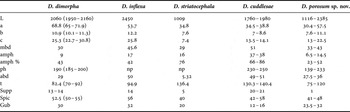
Desmodora porosum sp. nov. resembles D. inflexa Wieser, Reference Wieser1954, D. dimorpha Hopper, Reference Hopper1961, D. cuddlesae Inglis, Reference Inglis1963 and D. striatocephala Tchesunov, Reference Tchesunov2008 in the general shape of the body and in the ventral ala of D. porosum sp. nov., which resembles the ventral cuticular thickening present in the species listed (Table 3). However, the combination of some features of the new species is markedly different, including the large number of pores surrounding the amphid in the head capsule, the pattern of lengths and shapes of the somatic setae, loop-shaped amphids broader posteriorly than anteriorly, and a papilliform pre-cloacal supplement.
Measurements (µm) of Desmodora porosum sp. nov., compared with similar species; np, not provided.

Desmodora inflexa differs from the new species by having subcephalic setae, in the greater length of the somatic setae (14 µm vs 3 µm in D. porosum sp. nov.), the shape of the bulb and the number of protoplasmatic disruptions, the length of the spicules (56 µm vs 47 µm in D. porosum sp. nov.), the shape of the gubernaculum with latero-anterior apophysis, and the number of supplements (14).
Desmodora porosum sp. nov. differs from D. dimorpha in that the latter has a lobed and narrower bulb (18 µm vs 30.5 µm), circular amphid, and longer cephalic setae (8–9 µm vs 5.5 µm in D. porosum sp. nov.). Desmodora dimorpha has a thicker cuticle in the tail region and the head capsule without pores.
The new species also differs from D. cuddlesae. Desmodora porosum sp. nov. has the upper and lower ends of the amphid closed loop-shaped, and of different widths. In D. cuddlesae the spicules do not show a capitulum, and in D. porosum sp. nov. the capitulum is well defined. Desmodora cuddlesae has 20–21 supplements located on the ventrally thickened cuticle, while D. porosum sp. nov. shows only one, a papilliform pre-anal supplement.
The new species differs from D. striatocephala in the absence of striations on the head capsule, and in having one (rather than five) pre-cloacal supplements on the thickened ventral cuticle. In D. striatocephala the amphid occupies 76% of the cbd, but only 52% in D. porosum sp. nov. The tail of D. porosum sp. nov. is longer: 13–22.5 µm vs 7.4 µm.
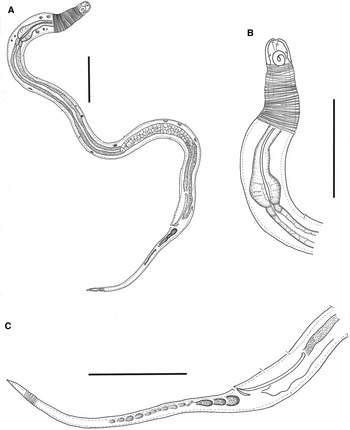
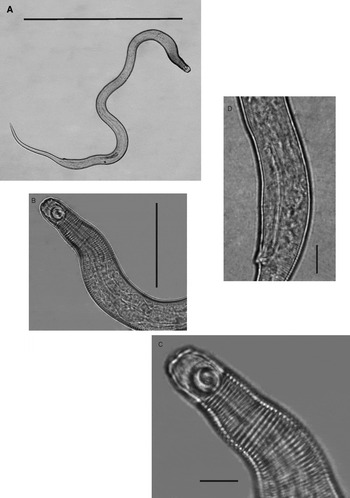
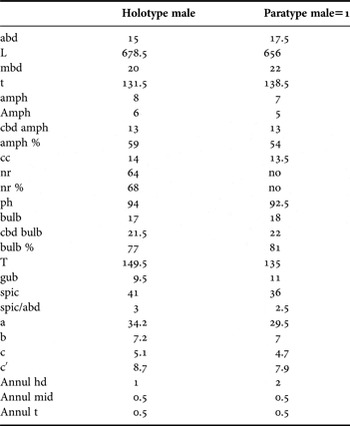
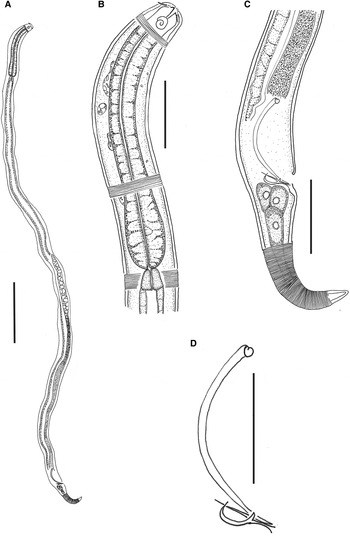
Desmodora profundum sp. nov.
(Figures 6, 7; Table 4)
Desmodora profundum sp. nov.: (A) holotype, total body; (B) pharyngeal region showing amphid; (C) tail, spicule, gubernaculum and caudal glands. Scale bars: 50 µm.

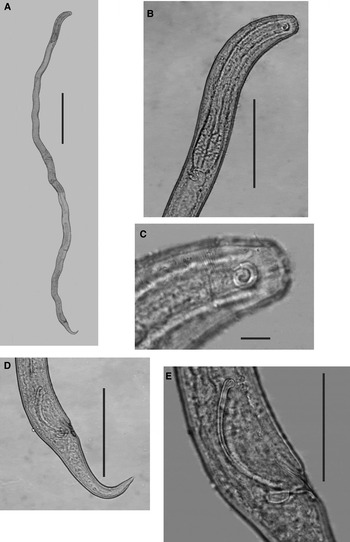
Desmodora profundum sp. nov.: (A) holotype, total body; (B) head and pharynx; (C) amphid; (D) spicule. Scale bars: A, 300 µm; B, 50 µm; C, D, 10 µm.

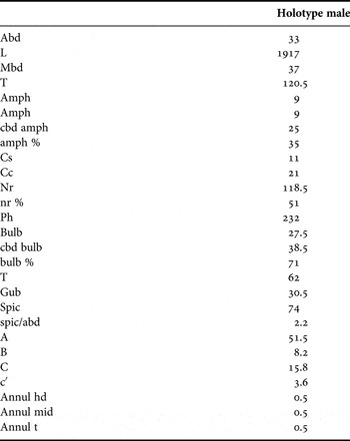
Measurements (µm) of Desmodora profundum sp. nov. no, not observed.

MATERIAL EXAMINED
2 males.
TYPE SPECIMENS
Holotype male (MNRJ 363), one paratype (359 NM LMZOO-UFPE).
TYPE LOCALITY
Campos Basin (Rio de Janeiro, Brazil), 23°35′24′′S 39°52′43′′W. Deep sea at 3000 m depth, collected with a box corer, in the 0–2 cm fraction. May 2008.
ETYMOLOGY
The species name profundum (Latin: profundus, deep) refers to the great depth at which the species was found.
TYPE MATERIAL
Holotype: adult male. Cylindrical body with rounded head capsule and cylindrical tail. Body annuli narrow, slightly broader in pharyngeal region (1 µm) than along rest of body (0.5 μm). The two circles of labial setae (internal and external) are difficult to observe; only the bases of the four cephalic setae above the amphid could be seen. Head capsule simple, unornamented. Subcephalic setae absent. Six rows of somatic setae, 2.5 µm long, 9 µm apart in pharynx region and more widely spaced on remainder of body. Broad cryptospiral (1.15–1.2 turns) fovea amphidialis (Figure 6B), 8 µm in diameter (59% cbd), located in central part of head capsule, and more slender apertura amphidialis. Buccal cavity with small dorsal tooth and small ventral tooth. Cylindrical pharynx with rounded endbulb. Nerve ring located at 98% of total pharynx length. Excretory pore not observed. Reproductive system monorchic, located ventrally, to right of intestine. Globular sperm cells. Slender spicules, with small capitulum and no velum (Figure 6C). Gubernaculum with two conjoined blade-shaped parts. No precloacal or postcloacal supplements. Long slender tail. Three caudal glands ending in spinneret.
Female and juvenile: not found.
DIAGNOSIS
Desmodora profundum sp. nov. is characterized by slender spicules with a (very) small capitulum; body annuli more widely spaced on the neck region compared to the rest of the body; subcephalic setae absent; buccal cavity with one small dorsal and one small ventral tooth; and a cylindrical tail ending in a spinneret.
DIFFERENTIAL DIAGNOSIS
In the habitus, Desmodora profundum sp. nov. somewhat resembles the genus Bolbonema Cobb, Reference Cobb1920, but can easily be distinguished from it by the location of the cephalic setae anterior to the amphids vs posterior to the amphids in Bolbonema, and by the absence of the long somatic setae that are present in Bolbonema.
Desmodora profundum sp. nov. is similar to D. poseidoni Steiner, Reference Steiner1916, D. scaldensis De Man, Reference De Man1889 and D. alberti Verschelde et al. Reference Verschelde, Gourbault and Vincx1998, but has conspicuous distinguishing characteristics. Desmodora profundum sp. nov. and D. poseidoni are similar in lacking cephalic setae and in the tail length. However, in D. poseidoni the total length is considerably greater (1757 vs 678.5 µm), and the two species also differ in the shape and length of the spicule, the length of the pharynx and the De Man index a and c.
Desmodora profundum sp. nov. is also similar to D. scaldensis De Man, Reference De Man1889 in the more widely spaced body annuli in the anterior region of the body, the absence of pre-cloacal or postcloacal supplements, and the presence of the capitulum. It differs from D. scaldensisin the tail length (266 µm in D. scaldensis vs 131.5 µm in D. profundum sp. nov.), spicule shape and length (62 µm in D. scaldensis vs 41 µm in D. profundum sp. nov.), bulb with two protoplasmatic interruptions, and the total body length (D. profundum sp. nov. is shorter, with a length of 678.5 µm).
Desmodora profundum sp. nov. is similar to D. alberti Verschelde et al., Reference Verschelde, Gourbault and Vincx1998, in the body annuli, absence of subcephalic setae, large cryptospiral fovea amphidialis, and in the shape of the tail. On the other hand, Desmodora profundum differs from D. alberti in the total body length (678.5 µm in D. profundum sp. nov. vs 1211 µm in D. alberti), the bipartite cuticular valves in the terminal bulb of the pharynx (present in D. alberti) spicule shape (slender in D. profundum sp. nov. vs arched in D. alberti), broad velum and simple, short gubernaculum (in D. alberti).
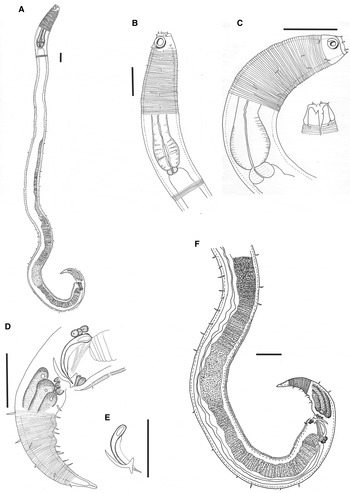
Desmodora veronicae sp. nov.
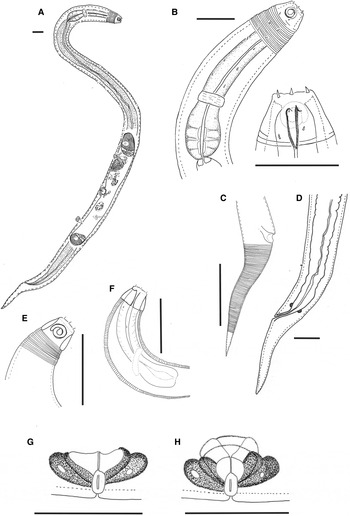
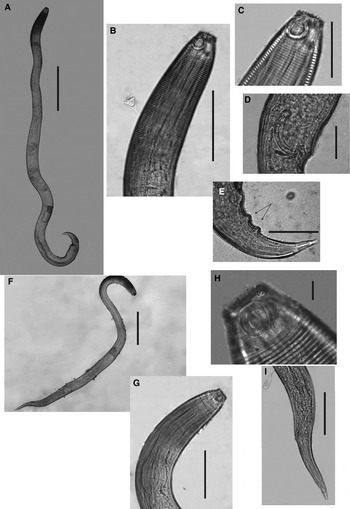
(Figures 8, 9, 10; Table 5)
Desmodora veronicae sp. nov.: (A) holotype, total body; (B) pharyngeal region and amphid; (C) paratype juvenile showing anterior region and teeth; (D) tail, spicule, gubernaculum, caudal glands; (E) spicule and gubernaculum; (F) posterior body region showing ventral ala. Scale bars: 50 µm.

Desmodora veronicae sp. nov.: (A) allotype female, total body; (B) anterior region, amphid and teeth; (C) paratype juvenile, tail; (D) allotype female, tail; (E, F) paratype juvenile, anterior region; (G, H) vulva showing glands and muscles. Scale bars: 50 µm.

Desmodora veronicae sp. nov.: (A) holotype, total body; (B) anterior region of holotype; (C) head and amphid of holotype; (D) spicule and gubernaculum; (E) tail and cuticular protuberances; (F) allotype female, total body; (G) anterior region of female; (H) amphid of female; (I) tail of female. Scale bars: A, F, 300 µm; B, G, I, 100 µm; C–E, 50 µm; H, 10 µm.

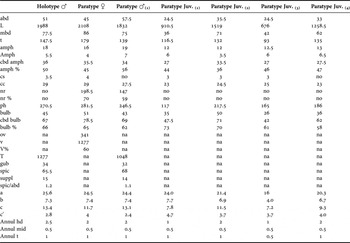
Measurements (µm) of Desmodora veronicae sp. nov. na, not applicable; no, not observed.

MATERIAL EXAMINED
2 males, 1 female and 4 juveniles.
TYPE SPECIMENS
Holotype male (MNRJ 364); paratype females (MNRJ 365); other paratypes: 1 male (360 NM LMZOO-UFPE), and 4 juveniles (361–364 LMZOO-UFPE).
TYPE LOCALITY
Campos Basin (Rio de Janeiro, Brazil), deep-sea at 400 m; collected with box corer in the 0–2 cm fraction, 22°59′2′′S 40°48′27′′W. May 2008.
ETYMOLOGY
The species name honours Professor Dr Verônica Gomes da Fonsêca-Genevois for her leadership of the nematologist group of the Universidade Federal de Pernambuco.
TYPE MATERIAL
Holotype: adult male. Cylindrical body tapered toward both ends. Body annuli distinct, with ornamentation consisting of rows of setae. Striations more widely separated on pharynx and tail than on midbody. Head rounded; smooth head capsule. Cephalic sensilla arranged in three separate circles: six internal labial papillae (difficult to observe), six external labial papillae, and four cephalic setae at edge of head. Large cryptospiral fovea amphidialis (1.1–1.5 turns) and narrower apertura amphidialis. Cuticle with six rows of somatic setae: one ventral, one dorsal, and four lateral. Setae 9 µm long, spaced 24 µm from each other. Buccal cavity with well-developed dorsal tooth and two smaller ventrosublateral teeth. Excretory pore not observed. Pharynx cylindrical and muscular, expanding around buccal cavity, basal bulb divided into two lobes. Cardia trapezoid. Nerve ring at 59% of total length of pharynx, from anterior end. Monorchic reproductive system with outstretched testis, ventrally to intestine. Arched spicules with developed capitulum and velum (Figure 8D, E). Gubernaculum laminar, sclerotized. Globular sperm cell with evident nucleus. Conico-cylindrical tail with three glands and spinneret. Ventral ala present, length 474 µm from cloaca to anterior region. Below the epidermis, 14 tubular pre-cloacal supplements connect to the glands. Supplements arranged unevenly, in two groups: an anterior group with ten supplements averaging 15 µm apart, and a posterior group with four organs (next to the cloaca) averaging 7 µm apart. A stout ventral pre-cloacal seta (4 µm long) is present in the male, 21 µm from cloaca. Post-cloacal ventral region with two papilliform cuticular protruberances.
Allotype: female similar to male, but lacks post-cloacal cuticular prominences, and also shows some minor differences in body length, tail size, and amphid dimensions (Table 5). Reproductive system didelphic and amphidelphic with reflexed ovaries, but is difficult to observe because of the large number of cuticular glands in the midbody region. Vulva sclerotized and muscular, located at 60% of total length from anterior end. Vulva (Figure 9G, H) consists of a sclerotized plate interrupted by a sphincter muscle and two ancillary parts, with two associated pairs of glands. Vagina vera short with thick cuticle, vagina uterina with large sphincter muscle. Epizoic Suctoria specimens attached to the cuticle (Figure 9A), measuring up to 35 µm in length and 21 µm in width.
Paratype juvenile: four juveniles of the same stage were found. All juveniles are likely in the first stage, because of the absence of a genital primordium.
All morphological characteristics similar to female, including arrangement of cephalic setae, body shape, body annuli, amphid shape, and pattern of the cuticle; with only morphometric differences (Table 5).
No subcephalic setae; buccal cavity with developed dorsal tooth and one tiny subventral tooth. Bulb less developed than adults. Primordial testis of a young male is not present, nor are primordial spicules and a gubernaculum. The specimens lack the ventral ala and post-cloacal cuticular prominences. Tail conical with three caudal glands, extending below the rectum.
DIAGNOSIS
Desmodora veronicae sp. nov. is characterized by the cryptospiral amphid in the head capsule, which is free of cuticular striations. Body annuli more widely spaced in neck region. Buccal cavity armed with one dorsal tooth and two smaller ventral teeth. No subcephalic setae. Ventral pre-cloacal ala, with 14 tubular supplements and two ventral cuticular prominences present in post-cloacal region. Spicules with curved capitulum and velum.
DIFFERENTIAL DIAGNOSIS
The habitus of Desmodora veronicae sp. nov. somewhat resembles that of species of the genus Croconema, but D. veronicae sp. nov. does not have a perforated tail end and also lacks the numerous subcephalic setae arranged in three (or more) circles on the head capsule that are present in Croconema. Therefore this species is placed in Desmodora.
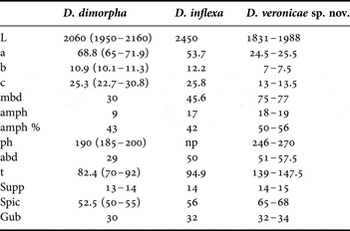
Although D. veronicae sp. nov. appears to have ventral alae, it resembles D. dimorpha Hopper, Reference Hopper1961 in the thick ventral cuticle, in which are inserted 14 tubular supplements. However, the two species differ morphometrically (Table 6). Desmodora veronicae sp. nov. has no subcephalic setae, and has a longer tail and two ventral cuticular protuberances on the tail.
Measurements (µm) of Desmodora veronicae sp. nov., compared to similar species; np, not provided.

Desmodora veronicae sp. nov. is also similar to D. inflexa Wieser, Reference Wieser1954 in having bipartite cuticular valves in the terminal bulb, as well as a ventral ala with 14 supplements; and in the shape of the amphid. The new species differs in morphology (Table 6), the shorter total body length, a morphologically different spicule with a velum present, and the gubernaculum without an apophysis.
Desmodora curvatum sp. nov.
(Figures 11, 12; Table 7)
Desmodora curvatum sp. nov.: (A) holotype, total body (B) pharyngeal region, amphid; (C) tail, spicule, gubernaculum and caudal glands; (D) spicule and gubernaculum. Scale bars: 50 µm.

Desmodora curvatum sp. nov.: (A) holotype, total body; (B) head and pharynx; (C) amphid; (D) tail; (E) spicule and gubernaculum. Scale bars: A, 300 µm; B, D, 100 µm; C, 10 µm; E, 50 µm.

Measurements (µm) of Desmodora curvatum sp. nov.

TYPE MATERIAL
Holotype male (MNRJ 366).
TYPE LOCALITY
Campos Basin (Rio de Janeiro, Brazil), 23°3′36″S 40°41′56′′ W. Deep sea at 1300 m depth, collected with a box corer, in the 5–10 cm fraction. May 2008.
ETYMOLOGY
From the Latin curvatus, referring to the curved sickle shape of the gubernaculum.
TYPE MATERIAL
Holotype: adult male. Round head and cylindrico-conical tail. Cuticle finely striated in same pattern along body. Internal and external labial papillae were not observed, only a circle of four cephalic setae. Amphids with multispiral (1.5 turns) fovea amphidialis located in central area of head capsule. Subcephalic and somatic setae absent. Buccal cavity with well-developed dorsal tooth and smaller ventrosublateral tooth. Excretory pore not observed. Muscular pharynx without well-defined muscular endbulb, occupying 71% of corresponding body diameter. One testis, extending to right of intestine. Slender and ventrally curved spicules, with small rounded capitulum. Complex gubernaculum, without apophyses, curved dorsally with second, semicircular accessory piece (shaped like a sickle; Figure 11D). Tail conical.
Female and juvenile: not found.
DIAGNOSIS
Desmodora curvatum sp. nov. is characterized by the cuticle with fine body annuli, evenly distributed on the body. Sub-cephalic and somatic setae absent. Multispiral amphid. Spicules slender and arched, capitulum reduced. Gubernaculum without apophysis, dorsally curved, with second, semicircular accessory piece. Conical tail.
The new species has some of the main features of the genus Desmodora, including: body with distinct body annuli, head capsule definite with multispiral amphid, buccal cavity with a dorsal tooth, male monorchic with arched spicules, and conical tail. Although the description of D. curvatum sp. nov. is based on a single specimen, some morphological characteristics are sufficient to establish a new species, including the absence of somatic setae and of a dorsally curved gubernaculum. The sickle shape of the gubernaculum is quite unique for the genus.
DISCUSSION
The new species
According to Miljutin et al. (Reference Miljutin, Gad, Miljutina, Mokievsky, Fonsêca-Genevois and Esteves2010), the deep-sea bottom contains a surprisingly diverse community of nematodes, and at present it is impossible to judge the true extent of their species diversity. Furthermore, it is quite difficult to select enough specimens of the same species for species descriptions: although several hundred unknown species can be found in a sample of 1000 nematodes, most of them may be represented by only a few or even one specimen.
One of the main differential characteristics of Desmodora porosum sp. nov. is the pores in the head capsule. Pores restricted to the anterior region in D. porosum sp. nov. were also observed in D. masira Warwick, Reference Warwick1973; D. alberti Verschelde et al., Reference Verschelde, Gourbault and Vincx1998; and Desmodora marci Verschelde et al., Reference Verschelde, Gourbault and Vincx1998; however, the amphid of D. porosum sp. nov. differs from all these species. For the family Desmodoridae, conspicuous pores restricted to the head capsule were recorded in Pseudochromadora Daday, 1889, Psammonema Verschelde & Vincx, Reference Verschelde and Vincx1995 and in Desmodorella by Cobb (1933). Specifically, such pores can be seen in Desmodorella balteata Verschelde et al., Reference Verschelde, Gourbault and Vincx1998; Pseudochromadora galeata Verschelde et al., Reference Verschelde, Nicholas and Vincx2006; Pseudochromadora securis Verschelde et al., Reference Verschelde, Nicholas and Vincx2006; Pseudochromadora buccobulbosa Verschelde & Vincx, Reference Verschelde and Vincx1995; and Psammonema ovisetosum Verschelde & Vincx, Reference Verschelde and Vincx1995. Pores in the head capsule also occur in other orders of nematodes, such as in Ceramonematidae: Ceramonema Cobb, Reference Cobb1920 and Pselionema Cobb, 1933, members of the order Plectida Malakhov, 1982. Although they are now in different orders (Desmodoridae and Ceramonematidae), according to the latest rankings proposed by De Ley & Blaxter (Reference De Ley, Blaxter and Lee2002) and De Ley et al. (Reference De Ley, Decraemer, Eyualem-Abebe and Traunspurger2006), these genera were formerly included in the same order Chromadorida Chitwood, 1933; based on Lorenzen (Reference Lorenzen1981), they share similarities in the arrangement of the cuticle (deep annulations), glands in the epidermis, and amphid shape. Probably these pores are channels that connect the surface of the cuticle (which is very thick, a characteristic found in two orders) to setae or glands of the epidermis, which in turn is slightly permeable (Bird & Bird Reference Bird and Bird1991). Another important feature is related to the sexual dimorphism of Desmodora amphids. In this new species the dimorphism is quite clear: in males the amphid extends longitudinally, while in females it is a spiral with a simple turn. This same feature has been observed previously in other genera of marine Desmodoridae: Onyx Cobb, 1891; Pseudochromadora Daday, 1899; Chromaspirina Filipjev, 1918; Croconema Cobb, Reference Cobb1920; Leptonemella Cobb, Reference Cobb1920; Zalonema Cobb, 1922; Spirinia Gerlach, Reference Gerlach1963; Echinodesmodora Blome, 1982; and Psammonema Verschelde & Vincx, Reference Verschelde and Vincx1995.
The presence of longitudinal alae in Desmodorinae has been reported for Psammonema Verschelde & Vincx, Reference Verschelde and Vincx1995, Pseudochromadora Daday, 1889 and Sibayinema Swart & Heyns, 1991, according to Verschelde et al. (Reference Verschelde, Nicholas and Vincx2006). For the genus Desmodora, D. vietnamica Gagarin & Vu Thahn Nguyen, Reference Gagarin and Nguyen2010, also shows two lateral alae. Desmodora inflexa Wieser, Reference Wieser1954, D. cuddlesae Inglis, Reference Inglis1963, D. dimorpha Hopper, Reference Hopper1961 and D. striatocephala Tchesunov, Reference Tchesunov2008 show a similar structure to D. veronicae sp. nov. and D. porosum sp. nov., but the authors describe it as a ‘cuticular thickening’. It would be desirable to reach a consensus for the definitions of ‘ventral/longitudinal alae’ and ‘cuticular thickening’.
Intersexuality in marine nematodes
An intersex specimen was found among the material of D. porosum sp. nov. This represents more a case of an intersex for the family Desmodoridae. Intersex specimens of a desmodorid species were also found in samples from Zanzibar–Tanzania (unpublished data, oral communication from D. Verschelde). Nigon (Reference Nigon and Grassé1965) reviewed all cases of intersexuality in nematodes known to that date. For the family Comesomatidae, De Bovée (Reference De Bovée1975) reported on Dorylaimopsis mediterranea Grimaldi de Zio, 1968. Gourbault & Vincx (Reference Gourbault and Vincx1990) recorded intersexuality in two species of Comesomatidae Filipjev, 1918: Sabatieria maboyae and Dorylaimopsis pellucidum (Cobb, Reference Cobb1920); also, Gourbalt & Vincx (Reference Gourbault and Vincx1990) observed the same phenomenon for the family Microlaimidae in the description of Spirobolbolaimus boucherorum. Tupeenniemi (Reference Tupeenniemi1997) recorded an intersex for Sphaerolaimus gracilis De Man, 1876 (Sphaerolaimidae). Fonsêca-Genevois et al. (Reference Fonsêca-Genevois, Smol, Decraemer and Venekey2009) reported a new case of intersex in marine nematodes, in describing Bernardius lineatus (Enchelidiidae). Miljutina & Miljutin (Reference Miljutina and Miljutin2011) recorded intersexuality for Acantholaimus angustus Bussau, 1993 and in the description of Acantholaimus barbatus (Chromadoridae).
Allgén (Reference Allgén1953) described Desmodora greenpatchi based on an intersex individual; however, Gerlach (Reference Gerlach1963) designated this taxon as species inquirendae because of a lack of sufficient data in the original description. Females of D. porosum sp. nov. are similar morphologically to D. greenpatchi. However, the material described here is a different species from that described by Allgén because the vulva is located posterior to the midbody, with only the anterior ovary functional; and there is only one dorsal tooth. The spicules of D. greenpatchi are less curved, and the mbd ratio is higher (57.5 μm vs 70 μm).
ACKNOWLEDGEMENTS
The authors express their gratitude to ‘Habitats Project—Campos Basin Environmental Heterogeneity’ of CENPES/PETROBRAS for collecting the samples and providing the opportunity to study them. We also thank Dr Patrícia Neres and MSc Rita de Cássia (UFPE) for help with descriptions of the new species, Dr Tatiana Fabricio Maria (University of Ghent) for help with the bibliography and Dr Janet W. Reid, JWR Associates, for her critical revision of the English text. Our special thanks to Dr Dominick Verschelde (Zoology Museum, University of Ghent) for his suggestions/comments that hugely improved the quality of this manuscript.
FINANCIAL SUPPORT
The first author is the recipient of a scholarship, and this study was partly funded by the Conselho Nacional de Desenvolvimento Científico e Tecnológico (CNPq) (Process No. 479638/2010-1).