Introduction
Inachoidinae Dana, Reference Dana1851, was resurrected by Drach and Guinot (Reference Drach and Guinot1983) and given full familial status. The family is supported by a series of unambiguous synapomorphies (Santana, Reference Santana2008; Guinot and Van Bakel, Reference Guinot and Van Bakel2020a), the most obvious of which is exposure of the latero-external portions of the thoracic pleurites V–VIII (gymnopleurity), which are commonly calcified and ornamented in a pattern that is similar to the lateral walls of the carapace (Drach and Guinot, Reference Drach and Guinot1982; Santana, Reference Santana2008; Guinot et al., Reference Guinot, Tavares and Castro2013; Guinot and Van Bakel, Reference Guinot and Van Bakel2020a).
Recent Inachoididae currently amount to 45 species in 14 genera from the Atlantic and Pacific coasts of the Americas (Ng et al., Reference Ng, Guinot and Davie2008; Santana, Reference Santana2008; Guinot, Reference Guinot2012, Reference Guinot2019). Pyromaia tuberculata (Lockington, Reference Lockington1877) has been recorded from several distant regions, such as Japan, Korea, Australia, and New Zealand, as an invasive species (Tavares, Reference Tavares2011, and references therein), and in association with a jellyfish species in the Tagus estuary (Portugal) (Martins et al., Reference Martins, Bartilotti and Calado2020). Santana (Reference Santana2008) found as many as nine synapomorphies uniting Stenorhynchus Lamark, Reference Lamarck1818, to the Inachoididae. Guinot (Reference Guinot2012) tentatively transferred Stenorhynchus from Inachidae to Inachoididae in a separate subfamily, Stenorhynchinae Dana, Reference Dana1851, mainly based on the presence of the main characters that differentiate both families. The inclusion of Stenorhynchus in the Inachoididae extends the distribution of the family to the eastern Atlantic.
Ten fossil species in eight genera have been attributed to the Inachoididae to date (see below under systematic paleontology). Here we describe one new genus and new species from the Miocene of northern Brazil and one new species in Paradasygyius Garth, Reference Garth1958, from the Miocene of Venezuela. Additionally, Eoinachoides senni Van Straelen, Reference Van Straelen1933 (late Oligocene–early Miocene of Venezuela) is redescribed based on photographs of the holotype, and the diagnosis of Eoinachoides latispinosus Carriol, Muizon, and Secretan, Reference Carriol, Muizon and Secretan1987 (late Miocene of Peru) is emended, also on the basis of photographs of the holotype. The Tethyan background for the current amphi-American Inachoididae and the effects resulting from the shoaling and final closure of the Central American Seaway in the evolution and diversification of the inachoidids are discussed as well.
Geological setting
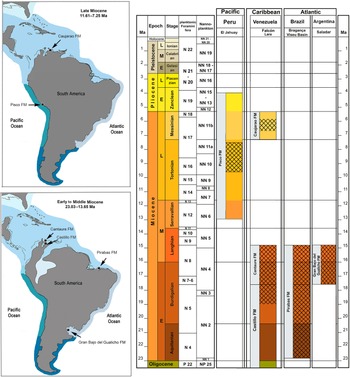
The American Inachoididae are known from the Pisco Formation (Peru); Caujarao, Castillo, and Cantaure formations (Venezuela); Pirabas Formation (Brazil); and Gran Bajo del Gualicho Formation (Argentina), located both in the eastern Pacific and western Atlantic shallow marine paleoenvironments (Fig. 1). Planktonic Foraminifera (N and P zones) and Nannoplankton (NN Zones) biozones (Fig. 1.3) were defined and enumerated according Aguilera et al. (Reference Aguilera, Schwarzhans and Béarez2016).
(1, 2) Paleogeographic reconstructions and (3) stratigraphic correlation chart of the main formations addressed in this study. (1) Late Miocene (11.61–7.25 Ma), Pisco and Caujarao formations; (2) early–middle Miocene (23.03–13,65 Ma), Cantaure, Castillo, Pirabas, and Gran Bajo del Gualicho formations. Paleogeographic reconstructions and the stratigraphic correlation chart are primarily based on Aguilera et al. (Reference Aguilera, Schwarzhans and Béarez2016, Reference Aguilera, Lopes, Rodriguez, dos Santos, Rodrigues-Almeida, Almeida, Machado and Moretti2020c).

Castillo, Cantaure, and Caujarao formations
The Castillo Formation is late Oligocene (P22 Zone) to early Miocene and early Aquitanian to late Burdigalian age (N4–N5 zones). The stratotype is situated in the western Falcón Basin of northwestern Lara State, Venezuela. The formation, which is exposed at Cerro La Cruz near La Mesa Town on the southern flank of the Serranía La Baragua, consists of marls, sandstones, and claystones (Wheeler, Reference Wheeler1960, Reference Wheeler1963; Ministerio de Energía y Minas, 1997). The paleoenvironment is interpreted as nearshore marine with diverse assemblages of coral reefs, mollusks, decapod crustaceans, teleostean and elasmobranch fishes, turtles, crocodiles, and marine cetaceans (Sánchez-Villagra et al., Reference Sánchez-Villagra, Burnham, Campbell, Feldmann, Gaffney, Kay, Lozsán, Purdy and Thewissen2000, Reference Sánchez-Villagra, Asher, Rincón, Carlini, Meylan and Purdy2004; Johnson et al., Reference Johnson, Sánchez-Villagra and Aguilera2009; Aguilera et al., Reference Aguilera, Rodrigues de Aguilera, Vega, Sánchez-Villagra, Sánchez-Villagra, Aguilera and Carlini2010, Reference Aguilera, Moraes-Santos, Costa, Ohe, Jaramillo and Nogueira2013b, Reference Aguilera, Schwarzhans and Béarez2016; Núñez-Flores et al., Reference Núñez-Flores, Rincón, Solórzano, Sánchez and Cáceres2017; Solórzano et al., Reference Solórzano, Rincón, Cidade, Núñez-Flores and Sánchez2018), including a thick section of sediments deposited in a marginal marine and freshwater environment with serrasalmine fishes (Dahdul, Reference Dahdul2004), Chelus Duméril, Reference Duméril1806, turtles (Rincón et al., Reference Rincón, Solórzano, Benammi, Vignaud and McDonald2014), and terrestrial environments that include Xenarthra Cope, Reference Cope1889, Notoungulata Roth, Reference Roth1903, and Litopterna Ameghino, Reference Ameghino1889, mammal assemblages (Rincón et al., Reference Rincón, Solórzano and McDonald2010, Reference Rincón, Solórzano, Benammi, Vignaud and McDonald2014).
The Cantaure Formation (Hunter and Bartok, Reference Hunter and Bartok1974) is of late early Miocene, late Burdigalian to early Langhian age (NN 4-5, N 7-8) (Díaz de Gamero, Reference Díaz de Gamero1974; Rey, Reference Rey1996; Griffiths et al., Reference Griffiths, Müller, Johnson and Aguilera2013). Its stratotype is located ~10 km west of Pueblo Nuevo on the Paraguaná Peninsula, Falcón State, Venezuela. Outcrops of the formation are found west of Casa Cantaure and are composed of silty shales interbedded with thin algal limestones and shell beds (Hunter and Bartok, Reference Hunter and Bartok1974). There is an unexposed unit of Cantaure Formation that is 48 m thick and was accessed by a local artisan well. The section consists mainly of silty to medium-grained sandstone, intercalated with massive mudstone. Research results of planktonic foraminifera, calcareous nannofossils, and Sr isotopes have revealed a late Burdigalian to early Langhian age (Diaz de Gamero, Reference Díaz de Gamero1974; Rey, Reference Rey1996; Griffiths et al., Reference Griffiths, Müller, Johnson and Aguilera2013). A diverse fossil fauna rich in mollusks, corals, crustacean decapods, fishes, and cetaceans has been described, the composition of which is indicative of a tropical-marine, clear, near-shore neritic environment of normal marine salinity, probably not far from open marine environments (Jung, Reference Jung1965; Thomas and Macdonald, Reference Thomas and MacDonald1970; Nolf and Aguilera, Reference Nolf and Aguilera1998; Cozzuol and Aguilera, Reference Cozzuol and Aguilera2008; Aguilera, Reference Aguilera2010; Aguilera and Lundberg, Reference Aguilera, Lundberg, Sánchez-Villagra, Aguilera and Carlini2010; Aguilera and Marceniuk, Reference Aguilera and Marceniuk2012; Aguilera et al., Reference Aguilera, Moraes-Santos, Costa, Ohe, Jaramillo and Nogueira2013b; Griffiths et al., Reference Griffiths, Müller, Johnson and Aguilera2013; Carrillo-Briceño et al., Reference Carrillo-Briceño, Aguilera, De Gracia, Aguirre-Fernández, Kindlimann and Sánchez-Villagra2016; Landau et al., Reference Landau, Da Silva, Heitz and Jansen2016; Wiedenmayer, Reference Wiedenmayer2016). The baseline of mollusk assemblages from the Cantaure Formation supports the early stage of the Gatunian Province (Landau et al., Reference Landau, Vermeij and Marques da Silva2008).
The Caujarao Formation (Wiedenmayer, Reference Wiedenmayer1937), late Miocene northwestern Venezuela, includes three members: (1) the Muaco Member—lower, mainly clayey, organogenic limestones and interbedded fossiliferous marls and some friable fine grained sands; (2) the Mataruca Member—intermediate, characterized by three or more layers of prominent nodular marly and fossiliferous limestones interbedded with fossiliferous shales and calcareous marls and sands; and (3) the Taratara Member—higher prevalence of clays and micro-fossiliferous shales. The specimens of Paradasygyius rodriguezi n. sp. have been collected from the middle Mataruca Member, which is considered to be of late Tortonian age. The paleoenvironment from the Mataruca Member is interpreted as nearshore marine with diverse assemblages of mollusks and teleostean fishes (Aguilera et al., Reference Aguilera, Schwarzhans and Béarez2016; Wiedenmayer, Reference Wiedenmayer2016).
Pisco Formation
The Pisco Formation (Muizon and DeVries, Reference Muizon and DeVries1985) in the Sacaco Basin, Peru, is of late Miocene to early Pliocene age and consists of tuffaceous, diatomaceous, and bioclastic sandstone, siltstone, and phosphorite. The specimens of Eoinachoides latispinosus Carriol, Muizon, and Secretan, Reference Carriol, Muizon and Secretan1987, were collected from El Jahuay (Carriol et al., Reference Carriol, Muizon and Secretan1987), which is the lowermost section of the Pisco Formation in the Sacaco area (Muizon and DeVries, Reference Muizon and DeVries1985) and considered to be of Tortonian age. The paleoenvironment from El Jahuay is interpreted as clear nearshore neritic environment of normal marine salinity, not far from open marine environments, and is characterized by the occurrence of mollusks, sharks, and cetaceans (Ehret et al., Reference Ehret, Macfadden, Jones, Devries, Foster and Salas-Gismondi2012; Lambert and Muizon, Reference Lambert and Muizon2013).
Pirabas Formation
The Pirabas Formation (Maury, Reference Maury1925), which is of early Miocene, Aquitanian to early Burdigalian, N4 to N5 to middle Miocene, Langhian N8-N9 plankton foraminiferal biozones (Blow, Reference Blow1969) (Aguilera et al., Reference Aguilera, de Araújo, Hendy, Nogueira and Nogueira2020a, Reference Aguilera, Bencomo, de Araújo, Dias, Coletti, Lima, Silva-Caminha, Polck, Alves-Martin, Jaramillo, Kutter and Lopesb and references therein), consists of carbonate to mixed siliciclastic-carbonate deposits associated to shallow-water coastal settings (grainstone and consolidated packstone, stratified wackestone to packstone, and laminated mudstone) (Rossetti et al., Reference Rossetti, Bezerra and Dominguez2013 and references therein). In addition, littoral facies (shoreface/foreshore), marginal lagoons, restricted platform environments (gray to olive mudstone and conglomeratic sandstone), and mangrove estuarine lagoons (dark mudstone, massive or laminated) have been recorded (Lima et al., Reference Lima, Tavares, Lopes, de Araújo and Aguilera2020a, Reference Lima, Anker, Hyžný, Kroh and Aguilerab). A diverse fossil fauna that is rich in microfossils (foraminifera, ostracodes) and macrofossils (mollusks, bryozoans, corals, echinoderms, decapods, fishes, cetaceans, and sirenids has been described (Aguilera et al., Reference Aguilera, de Araújo, Hendy, Nogueira and Nogueira2020a, Reference Aguilera, Bencomo, de Araújo, Dias, Coletti, Lima, Silva-Caminha, Polck, Alves-Martin, Jaramillo, Kutter and Lopesb; Lima et al., Reference Lima, Tavares, Lopes, de Araújo and Aguilera2020a, Reference Lima, Anker, Hyžný, Kroh and Aguilerab). The specimen of Willinachoides santanai n. gen. n. sp. was collected at Atalaia outcrop, the uppermost section of Pirabas Formation, middle Miocene age (14.2–12.7 Ma) (Aguilera et al., Reference Aguilera, de Araújo, Hendy, Nogueira and Nogueira2020a).
Gran Bajo del Gualicho Formation
The Gran Bajo del Gualicho Formation (Lizuain and Sepúlveda, Reference Lizuain and Sepúlveda1978), which is early to middle Miocene in Argentina, includes two members (Reichler, Reference Reichler2010): (1) the Saladar Member—lower, mainly bioclastic sandstones, coquina, pelites and gypsum; and (2) the Arriola Member—upper, characterized by the dominance of sandstone and friable tuff. The specimens of Eoinachoides cf. E. senni (sensu Aguirre-Urreta, Reference Aguirre-Urreta1990) have been collected from the Saladar Member (Puesto Picavea location; see Aguirre-Urreta, Reference Aguirre-Urreta1990, fig. 1, and Reichler, Reference Reichler2010, fig. 5, for further details), which is considered to be of Burdigalian–Langhian age. The paleoenvironment from the Saladar Member is interpreted as transgressive deposits of nearshore, shallow marine, with diverse assemblages of mollusks, echinoderms, crustaceans, and fish (Aguirre-Urreta, Reference Aguirre-Urreta1990; Reichler, Reference Reichler2010; Bogan and Agnolin, Reference Bogan and Agnolin2011).
Materials and methods
The present diagnosis of Eoinachoides senni Van Straelen, Reference Van Straelen1933, was based on the photographs of the male holotype as well as on the photographs and description of the male studied by Feldmannn and Schweitzer (Reference Feldmann and Schweitzer2004). The present emended diagnosis of E. latispinosus, given herein, was based on a photograph of the holotype. The photographs of E. senni and E. latispinosus were also used for the present diagnosis of Eoinachoides Van Straelen, Reference Van Straelen1933.
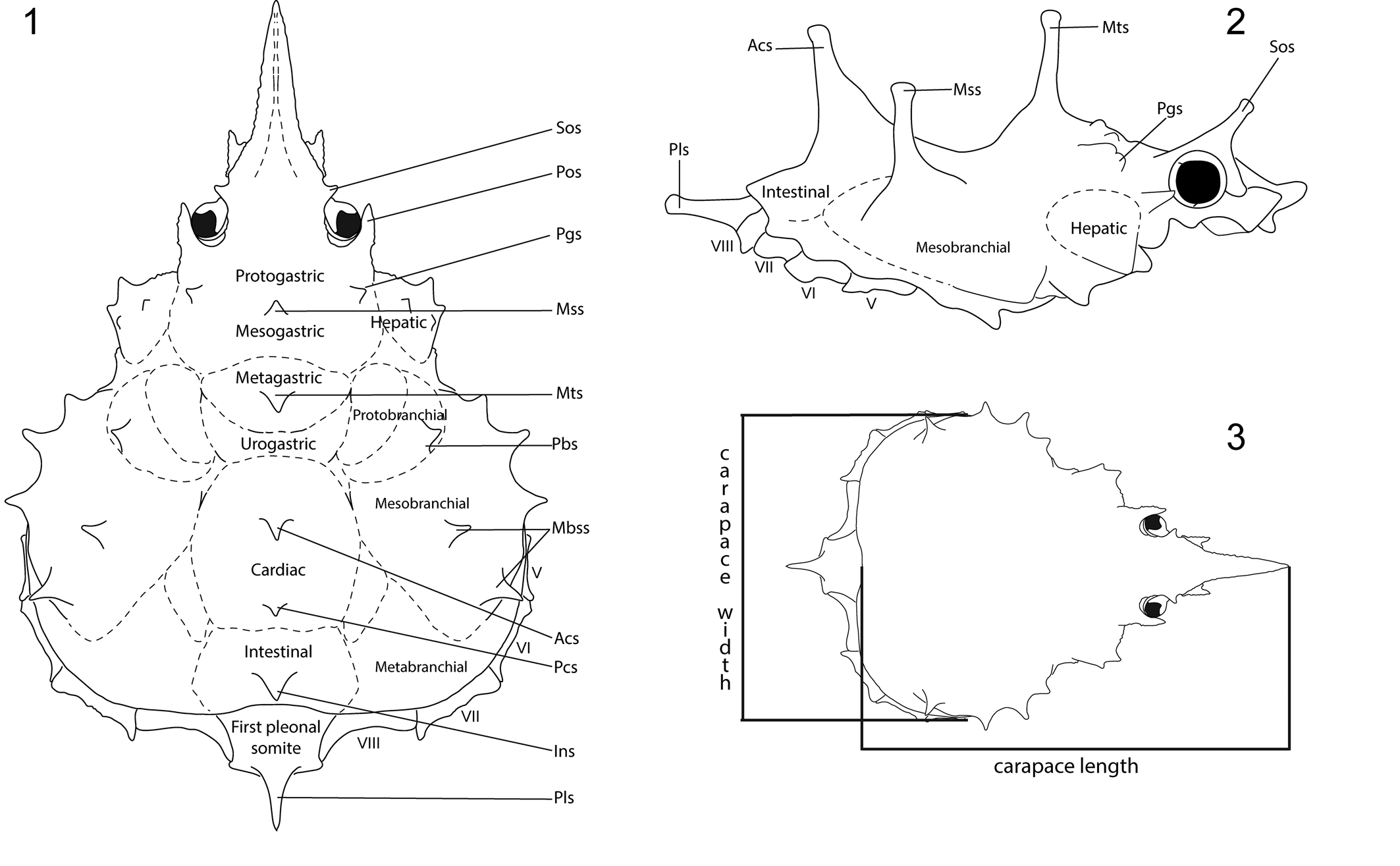
Material used in the taxonomic and comparative studies of the extant species is deposited in the carcinological collections of the MZUSP, Brazil. The descriptive terminology essentially follows that of Santana (Reference Santana2008) (Fig. 2). Classification and nomenclature essentially follow Ng et al. (Reference Ng, Guinot and Davie2008) and Schweitzer et al. (Reference Schweitzer, Feldmann, Garassino, Karasawa and Schweigert2010). The synonym list is essentially restricted to the paleontological literature. Throughout the text, when the family and/or genus within a family contains fossil and extant species, the name of the taxon is followed by a dagger (†). When the taxon is represented only by extinct forms, it is denotated by a double dagger (††). Absence of the dagger symbol reflects a taxon known only from extant forms. The abbreviations used include: coll., collector; EP, eastern Pacific; s.s., sensu stricto; stn, station; WA, western Atlantic. The dates are written in the format day.month.year, with months in lowercase Roman numerals. The measurements (in mm) include cl, carapace length; and cw, carapace width. The carapace frontal region is broken in the fossil of Willinachoides santanai n. gen. n. sp., and, therefore, only the carapace width is given.
(1–3) Schematic representation of a general Inachoididae. (1) Carapace dorsal and (2) lateral views; (3) carapace measures. V–VIII, fifth to eighth thoracic pleurites; Acs, anterior cardiac spine; Ins, intestinal spine; Mbss, mesobranchial spines; Mss, mesogastric spine; Mts, metagastric spine; Pbs, protobranchial spine; Pcs, posterior cardiac spine; Pgs, protogastric spine; Pls, pleonal spine; Pos, postorbital spine; Sos, supraorbital spine. Line drawing by D. Lima, modified from Santana (Reference Santana2008).

Comparative Recent material examined: Anasimus fugax A. Milne-Edwards, Reference Milne-Edwards1880—1 male (MZUSP 3618), 0.8 mm, Brazil, “Almirante Saldanha,” stn 1565ª, G.A.S. Melo det.; Anasimus latus Rathbun, Reference Rathbun1894—1 male (MZUSP 6545), 1.4 mm, Brazil, Amapá, Cabo Caciporé, “Almirante Saldanha,” stn 1793BII, 04°13.5′N, 50°26.0′W, 18.xi.1967, P.A. Coelho det., 75 m; Collodes rostratus A. Milne-Edwards, Reference Milne-Edwards1879—1 male (MZUSP 17470), 1.4 mm, Brazil, W. Santana det.; Collodes trispinosus Stimpson, Reference Stimpson1871—1 male (MZUSP 21996), 1.2 mm, Brazil, SS AF 02, 03.iii.1998, W. Santana det. i.2014; Euprognatha gracilipes A. Milne-Edwards, Reference Milne-Edwards1878 in A. Milne-Edwards, Reference Milne-Edwards1873–1880—1 male (MZUSP 3479), 0.7 mm, Brazil, Rio de Janeiro, Cabo de São Tomé, “Prof. W. Besnard,” stn II, 22°15′5″S, 40°54′5″W, G.A.S. Melo det.; Euprognatha rastellifera Stimpson, Reference Stimpson1871—1 male (MZUSP 17346), 0.5 mm, Martinique, Campagne IGMAR 3, stn 431, 14°23.01′N, 60°53.47′W, IFREMER, 290 m, 18.ix.1994; Inachoides laevis Stimpson, Reference Stimpson1860—1 male (MZUSP 6593), Brazil, Pernambuco, Itamaracá, R. Paripe, 22.xi.1969, P.A. Coelho det.; Paradasygyius depressus (Bell, Reference Bell1835)—1 male (MZUSP 19261), 2.4 mm, Costa Rica, Gulf Nycoia, 200 m, 13.ii.2004, F.C. Faria det. xii.2008; Paulita tuberculata (Lemos de Castro, Reference Lemos de Castro1949)—7 males (MZUSP 22543), Brazil, Foz do Rio das Conchas, Rio Grande do Norte, stn 23, 3–6 m, 05°02.078′S, 36°46.028′W–05°01.407′S, 36°46.073′W, Tavares, Santana, Faria and Braga coll., 24.xi.2009; Pyromaia tuberculata (Lockington, Reference Lockington1877)—1 male (MZUSP 21372), 1.1 mm, Brazil, BIOPLAT-BG, Campanha III, i.2001.
Additional details on the type locality of Paradasygyius rodriguezi n. sp. can be found in Smith et al. (Reference Smith, Collins, Jaramillo and Quiroz2010, fig. 2) and Aguilera et al. (Reference Aguilera, Moraes-Santos, Costa, Ohe, Jaramillo and Nogueira2013b, fig. 2b).
Repositories and institutional abbreviations
IRSNB, Institut royal des Sciences naturelles de Belgique (Belgium); MPB, Museo Paleontológico Bariloche (Argentina); MNHN, Muséum national d'Histoire naturelle, Paris (France); MPEG, Museu Paraense Emílio Goeldi (Brazil); MZUSP, Museu de Zoologia da Universidade de São Paulo (Brazil); NMB, Natural History Museum Basel (Swiss); UNEFM, Universidad Nacional Experimental Francisco de Miranda (Venezuela).
Systematic paleontology
Superfamily Majoidea† Samouelle, Reference Samouelle1819
Family Inachoididae† Dana, Reference Dana1851
Fossil species
Inachoididae currently consists of ten species in eight genera as follow: Collodes cumarebensis Schweitzer, Hyžný, and Feldmann, Reference Schweitzer, Hyžný and Feldmann2021 (late Miocene of Falcón, Venezuela); Eoinachoides bretoni Garassino, Pasini, and Clements, Reference Garassino, Pasini and Clements2021 (middle Eocene of North Carolina, USA); E. latispinosus Carriol et al., Reference Carriol, Muizon and Secretan1987 (late Miocene of Sacaco, Peru); E. senni Van Straelen, Reference Van Straelen1933 (late Eocene of Falcón, Venezuela); Euprognatha ricei Blow, Reference Blow2003 (late Pliocene of Virginia, USA); Leurocyclus primigenius Aguirre-Urreta, Reference Aguirre-Urreta1990 (late Oligocene–early Miocene of Estancia Tolosa, Argentina); Paradasygyius rodriguezi n. sp. (early–late Miocene of Falcón, Venezuela); Pyromaia inflata Collins and Morris, Reference Collins and Morris1978 (early Eocene of Punjab, Pakistan); Vicetiulita granulata De Angeli and Ceccon, Reference De Angeli and Ceccon2015 (early Eocene of Vicenza, Italy); Willinachoides santanai n. gen. n. sp. (early–middle Miocene of Pará, Brazil).
Remarks
Inachoidids synapomorphically possess the thoracic pleurites of the somites V to VIII partially exposed (gymnopleurity), visible around the posterior lateral margins of the carapace (Fig. 2). However, because this characteristic cannot be recognized in almost all fossil species known so far, assignment to this family generally has been based on the general shape of the carapace (Van Straelen, Reference Van Straelen1933; Collins and Morris, Reference Collins and Morris1978; Carriol et al., Reference Carriol, Muizon and Secretan1987; Blow, Reference Blow2003; De Angeli and Ceccon, Reference De Angeli and Ceccon2015; Garassino et al., Reference Garassino, Pasini and Clements2021). In the fossil record, this condition is only recognizable in Paradasygyius rodriguezi n. sp. (see below) and Leurocyclus primigenius (Aguirre-Urreta, Reference Aguirre-Urreta1990, fig. 1d).
Genus Eoinachoides†† Van Straelen, Reference Van Straelen1933
Type species
Eoinachoides senni Van Straelen, Reference Van Straelen1933 from Castillo Formation, late Oligocene to the early Miocene, Falcón central, Venezuela; by monotypy and original designation.
Other species
Eoinachoides bretoni Garassino, Pasini, and Clements, Reference Garassino, Pasini and Clements2021; E. latispinosus Carriol, Muizon, and Secretan, Reference Carriol, Muizon and Secretan1987.
Emended diagnosis
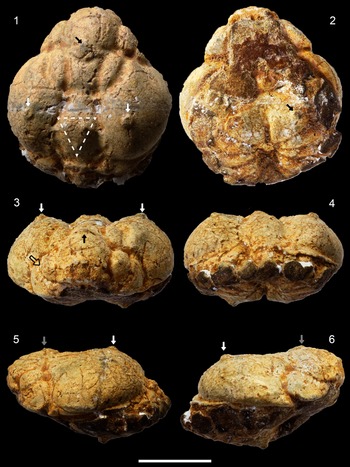
Carapace (Fig. 3.1) pyriform in outline. Gastric regions swollen, fused together without traces of furrows, except for a faint, incomplete line between the meso- and metagastric regions. Proto- and mesogastric regions circular in outline; metagastric region gently narrowed posteriorly. Metagastric region with one tubercle. Hepatic and subhepatic regions distinctly separated by a deep furrow (not confirmed in E. latispinosus due to preservation). Urogastric region distinctly longer than wide. Cardiac region moderately swollen, higher than the remaining carapace regions, bearing three tubercles arranged in a V-shaped pattern. Cardiac region delimitated laterally by a deep, smooth furrow provided with a single, distinct tubercle (not confirmed in E. latispinosus due to preservation). Meso- and metabranchial regions very large, strongly swollen. Mesobranchial region with one prominent tubercle. Thoracic-sternum wide. Sternite IV largest, bearing a large rounded protuberance (Fig. 3.2). Sterno-pleonal cavity rather deep, formed by sternites IV–VIII. Episternal projections V–VII distinct. First pleonal somite smooth, with a prominent transverse ridge (see Feldmann and Schweitzer, Reference Feldmann and Schweitzer2004, fig. 2); pleonal protuberance on first pleonal somite absent (not confirmed in E. latispinosus due to preservation).
(1–6) Eoinachoides senni Van Straelen, Reference Van Straelen1933, male holotype, cl 12.1 mm, cw 12.2 mm (NMB F1287). (1) Carapace dorsal view (white arrows: mesobranchial prominent tubercle; black arrow: metagastric strong tubercle; white triangle: cardiac region with tubercles in a V-shaped pattern); (2) ventral view (black arrow: IV sternite tubercle); (3) frontal view (white arrows: mesobranchial prominent tubercle; black arrow: metagastric strong tubercle; empty black arrow: oblique deep furrow between hepatic and subhepatic regions); (4) posterior view; (5) left and (6) right lateral views (white arrows: mesobranchial prominent tubercle; gray arrows: metagastric strong tubercle). Scale bar = 5 mm. Photos by W. Etter.

Remarks
Eoinachoides was originally included in Inachinae (formerly a subfamily of Majidae) by Van Straelen (Reference Van Straelen1933). Glaessner (Reference Glaessner and Moore1969) maintained Eoinachoides in the Inachinae and was followed by Carriol et al. (Reference Carriol, Muizon and Secretan1987) and Feldmann and Schweitzer (Reference Feldmann and Schweitzer2004), who included E. latispinosus and E. senni in the Inachinae and Inachidae, respectively. De Grave et al. (Reference De Grave, Pentcheff, Ahyong, Chan and Crandall2009), Schweitzer et al. (Reference Schweitzer, Feldmann, Garassino, Karasawa and Schweigert2010, Reference Schweitzer, Feldmann and Karasawa2020), Luque et al. (Reference Luque, Schweitzer, Santana, Portell, Vega and Klompmaker2017), and Garassino et al. (Reference Garassino, Pasini and Clements2021) listed Eoinachoides among the Epialtidae without any justification. Guinot et al. (Reference Guinot, Carbot-Chanona and Vega2019), based on a figure of Eoinachoides sp. provided by Aguilera et al. (Reference Aguilera, Rodrigues de Aguilera, Vega, Sánchez-Villagra, Sánchez-Villagra, Aguilera and Carlini2010, fig. 6.3.5), argued that Eoinachoides has exposed thoracic pleurites and therefore is a true Inachoididae—an interpretation with which we agree (see below under Paradasygyius rodriguezi n. sp.).
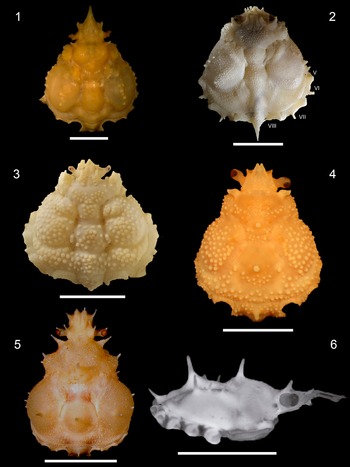
Van Straelen (Reference Van Straelen1933) pointed out that among the inachoidids (as Inachinae), Eoinachoides is most similar to the Recent genus Inachoides H. Milne Edwards and Lucas, Reference Milne Edwards and Lucas1842 (type species Inachus lambriformis De Haan, Reference De Haan1839), but never commented on the differences between the two genera. According to Van Straelen's description, the cardiac region is provided with two “spines” placed side by side in Eoinachoides. However, it is clear from the photograph of the holotype that the cardiac region actually bears three low tubercles arranged in V-shaped pattern in Eoinachoides (Fig. 3.1), whereas Inachoides differs in that its cardiac region bears only a single, low tubercle (Fig. 4.1). Eoinachoides additionally differs from Inachoides in having: (1) the urogastric region distinctly elongated, whereas in Inachoides it is wider than long; (2) the meso- and metabranchial regions subcircular and smooth (scattered granulated in I. latispinosus) (versus meso- and metabranchial regions remarkably oblong and provided with a longitudinal field of strong tubercles dorsally and laterally in I. lambriformis; lines of tubercles absent in I. laevis); and (3) in the possession of one strong mesobranchial protuberance, which is absent in Inachoides.
Recent Inachoididae. (1) Inachoides lambriformis (De Haan, Reference De Haan1839), male, cl 15.4 mm, cw 12.0 mm (MCZ 1837); (2) Paradasygyius depressus (Bell, Reference Bell1835), male, cl 26 mm, cw 21.2 mm (MZUSP 19261); (3) Paulita tuberculata (Lemos de Castro, Reference Lemos de Castro1949), cl 19 mm, cw 17.2 mm (MZUSP 22543); (4) Collodes granosus Stimpson, Reference Stimpson1860, ovigerous female, cl 9.8 mm, cw 8.6 mm (USNM 55766); (5) Euprognatha rastellifera Rathbun, Reference Rathbun1894, male holotype, cl 9.9 mm, cw 7.4 mm (USNM 18108); (6) Euprognatha limatula Santana and Tavares, Reference Santana and Tavares2008, male holotype, cl 8.5 mm, cw 7.0 mm (MZUSP 16940). V–VIII, fifth to eighth thoracic pleurites. Scale bars = 5 mm (1, 4–6), or 10 mm (2, 3). Photos by W. Santana (1, 4–6) and D. Lima (2, 3).

Eoinachoides bretoni from the Eocene (Bartonian) of the Castle Hayne Formation, North Carolina, was based on a single specimen and tentatively assigned to Eoinachoides on the basis of the general shape of the carapace (Garassino et al., Reference Garassino, Pasini and Clements2021). Eoinachoides bretoni differs from Eoinachoides s.s. by having: (1) one median large tubercle on the protogastric region (versus protogastric region smooth in Eoinachoides) and (2) one protobranchial tubercle (versus protobranchial region smooth in Eoinachoides). The presence of tubercles on both the protogastric and protobranchial regions can be found in some Inachoididea genera (e.g., Euprognatha; Pyromaia Stimpson, Reference Stimpson1871; Anasimus; and Leurocyclus Rathbun, Reference Rathbun1897).
Eoinachoides senni Van Straelen, Reference Van Straelen1933
Figure 3
- Reference Van Straelen1933
Eoinachoides senni Van Straelen, p. 5, fig. 3.
- Reference Collins and Morris1978
Eoinachoides senni; Collins and Morris, p. 966.
- Reference Carriol, Muizon and Secretan1987
Eoinachoides senni; Carriol et al., p. 146.
- non Reference Aguirre-Urreta1990
Eoinachoides cf. E. senni; Aguirre-Urreta, p. 151, fig. 1c.
- Reference Feldmann and Schweitzer2004
Eoinachoides senni; Feldmann and Schweitzer, p. 13, fig. 2.
- Reference Casadío, Feldmann, Parras and Schweitzer2005
Eoinachoides senni; Casadío et al., p. 160.
- Reference Artal, Van Bakel and Onetti2014
Eoinachoides senni; Artal et al., p. 157.
- Reference Guinot, Carbot-Chanona and Vega2019
Eoinachoides senni; Guinot et al., p. 302.
- Reference Guinot and Van Bakel2020a
Eoinachoides senni; Guinot and Van Bakel, p. 120.
- Reference Schweitzer, Feldmann and Karasawa2020
Eoinachoides senni; Schweitzer et al., p. 3 [in part].
- non Reference Schweitzer, Feldmann and Karasawa2020
Eoinachoides senni; Schweitzer et al., p. 4, fig. 2.3.
- Reference Garassino, Pasini and Clements2021
Eoinachoides senni; Garassino et al., p. 2.
Holotype
Fossil male specimen (NMB F1287), south of the great route Coro-Barquisimeto, to the west of Cerro Cometa, Falcón central, Castillo Formation, late Oligocene to early Miocene (see Van Straelen, Reference Van Straelen1933).
Materials
Photographs of the male holotype (NMB F1287), cl 12.1 mm, cw 12.2 mm, west of Cerro Cometa, Falcón Central, Venezuela, H.G. Kugler and A. Senn coll.; photograph of male paratype (IRSNB CTC 6019), locality the same as for the genus; damaged carapace (MZUSP 41424), San José de Cocodite, Península de Paranaguá, Falcón state, Venezuela, Cantaure Formation, early Miocene, PPP2925, O. Aguilera coll., 02.vii.1997.
Redescription
The following redescription, which based on photographs of the holotype, is in addition to Van Straelen's description and Feldmann and Schweitzer (Reference Feldmann and Schweitzer2004) observations on the paratype. Carapace pyriform in outline, slightly longer than wide (cl 12.1 × cw 12.2 mm, front excluded [not preserved]); regions well defined, swollen, separated from one another by well-marked furrows. Proto- and mesogastric regions circular, indistinct, strongly swollen, fused together without traces of furrows. Meso- and metagastric regions separated by a faint, incomplete oblique line. Metagastric region surmounted with single strong tubercle. Urogastric region much longer than wide, moderately swollen. Hepatic region swollen, smooth, with an oblique deep furrow between hepatic and subhepatic regions. Cardiac region moderately swollen, higher than the remaining carapace regions, bearing three tubercles arranged in a V-shaped pattern. Cardiac region delimitated laterally by a deep, smooth furrow provided with a single, distinct tubercle posteriorly. Proto- and mesobranchial regions clearly divided by a visible, deep furrow. Protobranchial region swollen, smooth. Meso- and metabranchial regions very large, strongly swollen, smooth. Mesobranchial region with one large prominent tubercle. Intestinal and cardiac regions separated by a shallow furrow; intestinal region weakly delimitated, smooth. Pleonal protuberance on first pleonal somite absent. Sternites I–III narrow, apparently parallel-sided; sternites IV large, with a large tubercle laterally, in each side; sternites V–VIII decreasing in size posteriorly and smoothly convex; posterolateral corner of each sternite terminates in episternal projections.
Remarks
The original description of the Castillo Formation (Wheeler, Reference Wheeler1960) was based on outcrops at Cerro Castillo, located ~27 km to the southwest of Dabajuro, Buchivacoa Municipality, Falcón State. We assumed here that the locality mentioned by Van Straelen (Reference Van Straelen1933, p. 7) such as “Little south of the great route Coro-Barquisimeto, to the west of Cerro Cometa, Falcón central” could be a lateral outcrop related to Cerro La Cruz near La Mesa Town, on the southern flank of the Serranía La Baragua, Lara State. Van Straelen (Reference Van Straelen1933, p. 6), while describing E. senni, noted that it “représenté parmi les matériaux recueillis, par des moulages internes du céphalothorax… ,” meaning, therefore, that he had more than one specimen at hand. Van Straelen also mentioned that the types were housed at the Natural History Museum Basel, while at least some “cotypes” were at the Musée royal d'Histoire naturelle de Belgique (currently Institut royal des Sciences naturelles de Belgique). Carriol et al. (Reference Carriol, Muizon and Secretan1987, p. 146) mentioned that E. senni was based on several, poorly preserved specimens. The holotype of E. senni (Fig. 3) is indeed in Basel. The male specimen (IRSNB CTC 6019) located by Feldmann and Schweitzer (Reference Feldmann and Schweitzer2004, fig. 2) at the IRSNB is probably a paratype of E. senni. The ventral surface of the male holotype of E. senni (Fig. 3.2) agrees with the description provided by Feldmann and Schweitzer (Reference Feldmann and Schweitzer2004) for the male paratype.
Our interpretation of the gastric region is quite different from Van Straelen's (Reference Van Straelen1933) description. The large spiniform tubercle on the mesogastric region and the urogastric region wider than long pointed by Van Straelen (Reference Van Straelen1933) is now interpreted as a large single tubercle on the metagastric region and the urogastric region is longer than wide. These characteristics can be clearly observed in the holotype (Fig. 3.1) and the paratype (Feldmann and Schweitzer, Reference Feldmann and Schweitzer2004, fig. 2a).
The specimen referred by Aguilera et al. (Reference Aguilera, Rodrigues de Aguilera, Vega, Sánchez-Villagra, Sánchez-Villagra, Aguilera and Carlini2010, fig. 6.3.4) as E. senni actually belong to a different inachoidid taxon (see Paradasygyius rodriguezi n. sp.). The specimen referred by Aguirre-Urreta (Reference Aguirre-Urreta1990) as Eoinachoides cf. senni (Oligocene–middle Miocene of Bajo del Gualicho, Argentina) probably does not belong to Eoinachoides sensu stricto (see Willinachoides n. gen.).
Eoinachoides latispinosus Carriol, Muizon, and Secretan, Reference Carriol, Muizon and Secretan1987
Figure 5.1, 5.2
- Reference Carriol, Muizon and Secretan1987
Eoinachoides latispinosa Carriol, Muizon, and Secretan, p. 143, fig. 3, plate II, fig. 1.
- Reference Schweitzer, Feldmann, Garassino, Karasawa and Schweigert2010
Eoinachoides latispinosa; Schweitzer et al., p. 92.
- Reference Luque, Schweitzer, Santana, Portell, Vega and Klompmaker2017
Eoinachoides latispinosa; Luque et al., p. 23, fig. 9c.
- Reference Garassino, Pasini and Clements2021
Eoinachoides latispinosa; Garassino et al., p. 6.
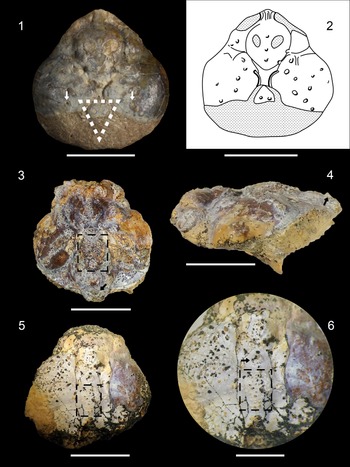
Fossil Inachoididae. (1, 2) Eoinachoides latispinosus Carriol, Muizon and Secretan, Reference Carriol, Muizon and Secretan1987, holotype (MNHN.F.R07743); (1) carapace dorsal view; (2) line drawing of dorsal view. (3–6) Paradasygyius rodriguezi n. sp.; (3, 4) paratype, cl 13 mm, cw 15 mm, carapace dorsal and lateral views (UNEFM CF.07); (5, 6) paratype (broken carapace), cw 18 mm (MZUSP 41423), dorsal view; (6) detail of dorsal view. White arrows: mesobranchial prominent tubercle; black arrow: dorsal strong protuberance on first pleonal segment; white triangle: cardiac region with tubercles in a V-shaped pattern; black rectangle: cardiac region covered with prominent, rather spiny tubercles. Scale bars = 5 mm (4, 6), or 7.5 mm (3), or 10 mm (1, 2, 5). Photos by J. Falconnet (1) and D. Lima (3–6).

Holotype
Fossil specimen (MNHN.F.R07743), cl 20 mm, cw 18.8 mm, incomplete carapace, undetermined sex from El Jahuay level of the Pisco Formation, late Miocene (Tortonian), El Jahuay, Sacaco Basin, southern coast of Peru.
Emended diagnosis
Carapace pyriform, slightly longer than wide, narrowing anteriorly (see Carriol et al., Reference Carriol, Muizon and Secretan1987, for rostrum). Proto-, meso-, and metagastric regions with one tubercle each, aligned longitudinally. Proto- and mesobranchial regions faintly separated. Meso- and metabranchial regions very large, strongly swollen; mesobranchial region with one prominent tubercle, covered by scattered large tubercles. Lateral carapace surface with prominent tubercles.
Remarks
Carriol et al. (Reference Carriol, Muizon and Secretan1987, p. 146) assigned E. latispinosus to Eoinachoides because “le contour de leur carapace est identique.” Additionally, they mentioned that “Elles [E. latispinosus and E. senni] portent l'une comme l'autre, deux tubercules placés de front sur la région cardiaque et leurs sillons cardiaques en arc de cercle sont semblables et également profonds.” Eoinachoides latispinosus is herein confirmed in Eoinachoides, whose diagnostic characters (see the generic diagnosis above) are well recognized in E. latispinosus, including: metagastric region with one tubercle; urogastric region distinctly longer than wide; cardiac region moderately swollen, higher than the remaining carapace regions, bearing three tubercles arranged in a V-shaped pattern (only the two anteriormost tubercles preserved); meso- and metabranchial regions very large, strongly swollen; mesobranchial region with one prominent tubercle.
Eoinachoides latispinosus superficially resembles E. senni in the outline of the carapace and in having a strong protuberance on each side of the mesobranchial regions. However, E. latispinosus differs in that its branchial region is covered with scattered small tubercles (mainly in the proto- and mesobranchial regions), whereas the branchial region is smooth in E. senni. Eoinachoides latispinosus further differs: (1) in possessing the proto-, meso-, and metagastric regions with one tubercle each aligned longitudinally, whereas the proto- and mesogastric tubercles are absent in E. senni; and in that (2) the proto- and mesobranchial regions are faintly separated in E. latispinosus, whereas these regions are separated by a deep furrow in E. senni.
Van Straelen (Reference Van Straelen1933) established Eoinachoides as a compound genus-group name (Aeon, eon, Latin for age + Inachoides), whose suffix “oides” is to be treated as masculine, unless otherwise stated by the author when establishing the name (ICZN, 1999, Art. 30.1.4.4). Therefore, the Latin adjective “latispinosa” (one provided with lateral spines) must agree in gender with the generic name, therefore E. latispinosus (ICZN, 1999, Art. 30.1.4.4 and 31.2).
Genus Paradasygyius† Garth, Reference Garth1958
Type species
Microrhynchus depressus Bell, Reference Bell1835, by original designation.
Other species
Paradasygyius rodriguezi n. sp.
Remarks
The genus Paradasygyius consisted of two Recent species, one at each side of the Americas, namely P. depressus (EP) and P. tuberculatus (Lemos de Castro, Reference Lemos de Castro1949) (WA), until Guinot (Reference Guinot2012) established the monotypic genus Paulita for the western Atlantic species. Guinot and Van Bakel (Reference Guinot and Van Bakel2020b) erected the subfamily Paradasygyiinae for the monotypic genus Paradasygyius.
Paradasygyius rodriguezi new species
Figures 5.3–5.6, 6, 7
- Reference Aguilera, Rodrigues de Aguilera, Vega, Sánchez-Villagra, Sánchez-Villagra, Aguilera and Carlini2010
Eoinachoides sp.; Aguilera et al., p. 110, fig. 6.3.5, 6.3.6.
- Reference Aguilera, Rodrigues de Aguilera, Vega, Sánchez-Villagra, Sánchez-Villagra, Aguilera and Carlini2010
Eoinachoides senni Van Straelen; Aguilera et al., p. 110, fig. 6.3.4.
- Reference Artal, Van Bakel and Onetti2014
Eoinachoides sp.; Artal et al., p. 158.
- Reference Artal, Van Bakel and Onetti2014
Eoinachoides senni; Artal et al., p. 158.
- Reference Luque, Schweitzer, Santana, Portell, Vega and Klompmaker2017
Eoinachoides sp.; Luque et al., p. 26.
- Reference Luque, Schweitzer, Santana, Portell, Vega and Klompmaker2017
Eoinachoides senni; Luque et al., p. 26.
- Reference Guinot, Carbot-Chanona and Vega2019
Eoinachoides sp.; Guinot et al., p. 302, 304.
- Reference Guinot and Van Bakel2020a
Eoinachoides sp.; Guinot and Van Bakel, p. 120.
- Reference Guinot and Van Bakel2020a
Eoinachoides senni; Guinot and Van Bakel, p. 120.
Type material
Holotype: female, cl 18 mm cw 16 mm (MZUSP 41421), Cementerio de Carrizal, Muaco, Falcón state, Venezuela, Caujarao Formation, Mataruca Member, late Miocene, PPP2534, O. Aguilera coll., 06.vii.1995. Paratypes: one specimen, cl 13 mm, cw 15 mm (UNEFM CF.07), one broken carapace, cw 18 mm (MZUSP 41423), same data as holotype.
Diagnosis
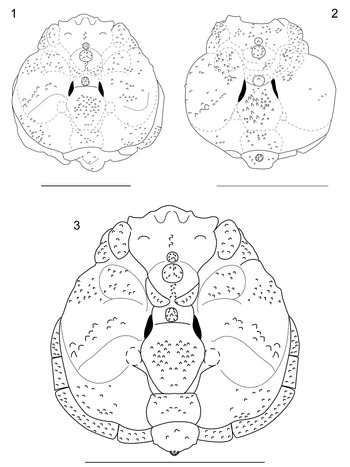
Carapace subcircular in outline, flattened. Dorsal surface covered with prominent tubercles and few, scattered, short spines. A longitudinal, finely granulated carina extending from proto- to metagastric region. Protogastric region with two large, low tubercles laterally, one at each side. Mesogastric region with a large tubercle. Metagastric region surmounted with a cluster of small granulated tubercles. Cardiac region elongated, surmounted by large granulated tubercles anteriorly; swollen posteriorly, as high as mesobranchial region, covered with prominent, rather spiny tubercles. Meso- and metabranchial regions separated by a steep slope. Thoracic pleurites V–VIII partially exposed, covered with small granules. First pleonal segment with dorsal strong protuberance.
Occurrence
Caujarao Formation, Mataruca Member, late Miocene Cementerio de Carrizal, Muaco, Falcón state, Venezuela.
Description
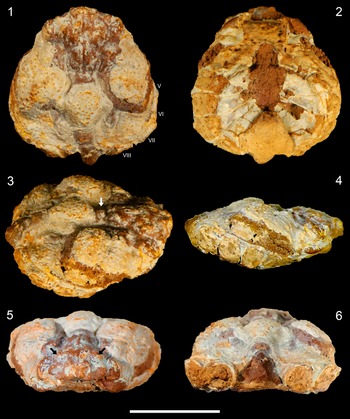
Carapace subcircular in outline, flattened, slightly longer than wide (18 mm × 16 mm, rostrum excluded [not preserved]), gently narrowing anteriorly. Frontal region, between postorbital spines slightly depressed; orbit shallow. Carapace with well-defined, swollen, regions separated from one another by shallow furrows; dorsal surface covered with prominent tubercles and few, scattered, short spines. A longitudinal, finely granulated carina extending from proto- to metagastric region. Proto- and mesogastric regions rounded, slightly swollen, fused together without traces of furrows. Protogastric region with two large, low tubercles laterally, one at each side. Mesogastric region with a large tubercle; meso- and metagastric regions separated by deep, incomplete furrow. Metagastric region surmounted by a cluster of small granulated tubercles. Cervical groove well marked. Urogastric region straight, wider than long, blow-tie-shaped. Hepatic region strongly swollen, densely covered with tubercles. Cardiac region elongated, surmounted by large granulated tubercle anteriorly; swollen posteriorly, as high as mesobranchial region, covered with prominent, rather spiny tubercles. Cardiac region delimitated laterally by a deep, smooth furrow bearing a single, large, rounded tubercle posteriorly. Proto-, meso-, and mesobranchial regions densely covered by large prominent tubercles and blunt spines. Proto- and mesobranchial regions swollen, clearly divided by a deep furrow. Mesobranchial region weakly inflated laterally. Meso- and metabranchial regions separated by a steep slope. Metabranchial region strongly flattened, with few tubercles laterally; metabranchial lobe distinct, inflated. Cardiac and intestinal regions separated by shallow furrow. Intestinal region low, densely covered with tubercles. Thoracic pleurites V–VIII partially exposed, covered with small granules. Female thoracic sternum subcircular, remarkably wide. Sterno-pleonal cavity remarkably shallow, formed by sternites IV–VIII. First pleonal tergite densely covered with small tubercles and a strong, mid-dorsal protuberance.
Etymology
In honor of Gilberto Domingo Rodríguez Ramírez (May 12, 1929–May 16, 2004), a pioneer Venezuelan carcinologist, in recognition of his accomplishments on the study of decapod crustaceans.
Remarks
Paradasygyius rodriguezi n. sp. is herein assigned to Paradasygyius based on the following characters: carapace flattened, covered with tubercles uniformly distributed; absence of spines on the gastric, cardiac, branchial and intestinal regions; metabranchial lobe distinct, inflated; hepatic region markedly inflated; meso- and metagastric regions separated by a deep furrow; proto- and mesobranchial regions well distinct; meso- and metabranchial regions well defined, separated by a steep slope. A strong pleonal protuberance (sharp spine in P. depressus, Fig. 4.2) on the first pleonal somite. The new species lacks the deep, transversal, parallel grooves on the dorsal surface of the carapace so typical of Paulita (Figure 4.4). Guinot and Van Bakel (Reference Guinot and Van Bakel2020a, p. 120), based on a photograph provided by Aguilera et al. (Reference Aguilera, Rodrigues de Aguilera, Vega, Sánchez-Villagra, Sánchez-Villagra, Aguilera and Carlini2010, fig. 6.3.4), commented that the “general of the carapace and the eye in a postocular cup” in their Eoinachoides senni (=P. rodriguezi n. sp.) resembles that of Paradasygyius. In the holotype (MZUSP 41421), the supraorbital eave and the basal part of the postorbital spine, as well as the very shallow orbit (the latter in frontal view only), are still recognizable (Fig. 6.1, 6.5).
(1–6) Paradasygyius rodriguezi n. sp., female holotype, cl 18 mm, cw 16 mm (MZUSP 41421). (1) Dorsal view; (2) ventral view; (3, 4) lateral views; (5) frontal view; (6) posterior view. White arrow: cardiac granulated tubercle; black arrows: protogastric tubercles; V–VIII, thoracic pleurites (gymnopleure condition). Scale bar = 10 mm. Photos by D. Lima.

Paradasygyius rodriguezi n. sp. mainly differs from P. depressus in having the cardiac region covered with prominent, rather spiny tubercles (versus cardiac regions covered with rather fine granulations and scattered larger tubercles in P. depressus); the anterolateral margin of the mesobranchial region devoid of a longitudinal row of prominent, blunt tubercles (versus row of such tubercles present in P. depressus); and in having a large, strong tubercle on the anterior portion of the cardiac region (versus such a large tubercle absent in P. depressus).
In P. rodriguezi n. sp., the thoracic pleurites V–VIII are partially exposed (gymnopleure condition), and visible around the posterior and lateral margins of the carapace (Fig. 6.1, 6.3, 6.6) (see also Guinot et al., Reference Guinot, Carbot-Chanona and Vega2019, based on a photograph of Eoinachoides sp. provided by Aguilera et al., Reference Aguilera, Rodrigues de Aguilera, Vega, Sánchez-Villagra, Sánchez-Villagra, Aguilera and Carlini2010, fig. 6.3.5). In P. rodriguezi n. sp., the exposed pleurite VII is ornamented in a similar fashion to that of the carapace (Fig. 6.6).
Schweitzer et al. (Reference Schweitzer, Hyžný and Feldmann2021) described Collodes cumarebensis from the Cumarebo #1, core 430–450m, Zamora District, Falcón State, Venezuela, while mentioning that the section in the Cumarebo core is equivalent to the previously called Damsite Formation (Hodson, Reference Hodson1926) and subsequently assigned to the Caujarao Formation (Liddle, Reference Liddle1928, Reference Liddle1946). Accordingly, they attributed C. cumarebensis to Tortonian–Messinian age based on interpretations of the Caujarao Formation by Wozniak and Wozniak (Reference Wozniak and Wozniak1987) and Albert-Villanueva et al. (Reference Albert-Villanueva, González, Bover-Arnal, Ferràndez-Cañadell, Esteban, Fernández-Carmona, Calvo and Salas2017). However, the accurate depositional age remains uncertain because neither data associated with the Cumarebo #1 core nor stratigraphic and geochronological information were presented by Schweitzer et al. (Reference Schweitzer, Hyžný and Feldmann2021) to support an accurate provenance of the material. Moreover, it should be noted that the older denomination, Damsite Formation, at the Cumarebo section was reviewed and assigned to the Caujarao Formation by González de Juana (Reference González de Juana1937) and González de Juana et al. (Reference González de Juana, Iturralde de Arozena and Picard1980), who proposed subdivision of the Caujarao Formation into three members: El Muaco (Tortonian–Messinian), Mataruca, and Taratara (Messinian) (Ministerio de Energía y Minas, 1997). Therefore, based on the basic information provided by Schweitzer et al. (Reference Schweitzer, Hyžný and Feldmann2021), is not possible to correlate the specimen with any of the members of the Caujarao Formation and determine its age.
Paradasygyius rodriguezi n. sp. resembles Collodes cumarebensis in general outline of the carapace; absence of spines on the gastric, branchial, and cardiac regions; and in the flattened metabranchial region. However, P. rodriguezi n. sp. and C. cumarebensis can be distinguished from each other by (characters for C. cumarebensis within parentheses): (1) the protogastric region with two large, low tubercles laterally, one at each side (versus protogastric region devoid of such tubercles); (2) a longitudinal, finely granulated carina extending from proto- to metagastric region (versus longitudinal carina absent); (3) the metagastric region surmounted by a cluster of small granulated tubercles (versus metagastric region covered by scattered coarse tubercles); (4) mesobranchial region with an oblique row of large tubercles (versus mesobranchial region covered by coarse and evenly spaced tubercles); and (5) mesobranchial region small, weakly inflated laterally, reaching to about the half the length of the cardiac region (versus mesobranchial region large, moderately inflated laterally, reaching the posterior margin of the cardiac region). Although the postorbital spines are poorly preserved in P. rodriguezi n. sp., their basal parts are recognizable (Figs. 6.1, 6.3, 7) and seem not as developed as in C. cumarebensis. Schweitzer et al. (Reference Schweitzer, Hyžný and Feldmann2021) referred C. cumarebensis to Collodes Stimpson, Reference Stimpson1860, on the basis of a notch between the postorbital spine and the supraorbital margin. This notch is not recognizable in P. rodriguezi n. sp.
Paradasygyius rodriguezi n. sp. (1) Female holotype, cl 18 mm, cw 16 mm (MZUSP 41421); (2) paratype, cl 13 mm, cw 15 mm (UNEFM CF.07); (1, 2) line drawing of dorsal view; (3) line drawing reconstruction. Scale bars = 10 mm. Line drawing by D. Lima.

Genus Willinachoides†† new genus
Type species
Willinachoides santanai n. gen. n. sp. by monotypy and original designation. Gender masculine.
Diagnosis
As for the type species.
Occurrence
Early–middle Miocene, Pirabas Formation, Atalaia outcrop, Atalaia beach, Salinópolis, Pará, Brazil.
Etymology
In honor of William Santana for his contributions to the taxonomy and systematics of spider crabs, especially the Inachoididae.
Remarks
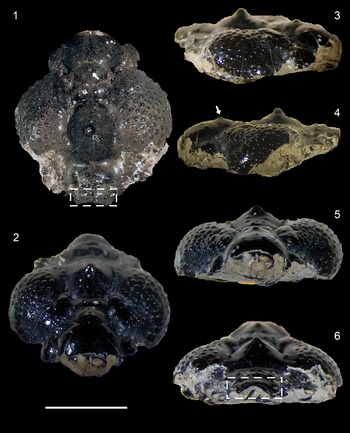
The gymnopleure condition is not recognizable in Willinachoides n. gen. As most fossil species, assignment of Willinachoides n. gen. to Inachoididae is based mainly on the general shape of the carapace (Van Straelen, Reference Van Straelen1933; Collins and Morris, Reference Collins and Morris1978; Carriol et al., Reference Carriol, Muizon and Secretan1987; Blow, Reference Blow2003; De Angeli and Ceccon, Reference De Angeli and Ceccon2015; Garassino et al., Reference Garassino, Pasini and Clements2021). Willinachoides n. gen. superficially resembles Eoinachoides in the development and outline of the branchial region. However, the two genera significantly differ in that the cardiac region is much higher than the branchial regions and has a strong, rounded tip protuberance in Willinachoides n. gen. (versus cardiac and branchial regions about the same height and bearing three low cardiac tubercles arranged in V-shaped pattern in Eoinachoides). The boundary between the hepatic and subhepatic regions is indistinct in Willinachoides n. gen. (versus hepatic and subhepatic regions separated by a deep furrow in Eoinachoides [such furrow not recognizable in the poorly preserved E. latispinosus]). Willinachoides n. gen. and Eoinachoides strongly differ from each other in the aspect of the branchial region. The meso- and metabranchial regions are very large, strongly swollen, covered with large, rounded, similarly sized, regularly spaced, low tubercles in Willinachoides n. gen., whereas these regions are smooth and have one strong mesobranchial protuberance each in E. senni. In E. latispinosus, the meso- and metabranchial regions bear a few scattered tubercles in addition to the mesobranchial protuberances.
Willinachoides n. gen. differs from Inachoides (type species I. lambriformis [De Haan, Reference De Haan1839]) (Fig. 8.1) in that the limit between the hepatic and subhepatic regions is indistinct (versus hepatic and subhepatic regions separated by a deep furrow in I. lambriformis); the lack of a mesogastric tubercle (present in I. lambriformis); the cardiac region much higher and having with a much stronger protuberance; in having a deep, smooth furrow delimiting the cardiac region laterally, which has a distinct tubercle (such tubercle absent in Inachoides); in that the branchial region is subcircular and covered with large, rounded, similarly sized, regularly spaced, low tubercles (versus branchial region remarkably oblong and having a longitudinal field of strong tubercles dorsally and laterally in I. lambriformis; such lines of tubercles absent in I. laevis).
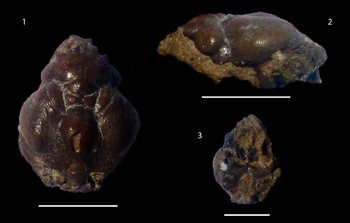
(1–6) Willinachoides santanai n. gen., n. sp., male holotype, cw 0.9 mm (MPEG-2613-I). Carapace (1) dorsal, (2, 5) frontal, (3, 4) lateral, and (6) posterior views. Filled white arrows: metagastric region surmounted with single strong tubercle; empty white arrow: cardiac strong, rounded tip protuberance; white rectangle: first pleonal segment, with few scattered low tubercles. Scale bar = 5 mm. Photos by D. Lima.

Collodes (type species C. granosus Stimpson, Reference Stimpson1860) (Fig. 4.4) differs from Willinachoides n. gen. mainly in that the entire carapace is covered with strong tubercles (less so in the gastric and cardiac regions) and in the branchial region being oblong and remarkably less swollen. Aepinus Rathbun, Reference Rathbun1897 (type species Apocremnus septemspinosus A. Milne-Edwards, Reference Milne-Edwards1878), Anasimus A. Milne-Edwards, Reference Milne-Edwards1880 (type species A. fugax A. Milne-Edwards, Reference Milne-Edwards1880), and Euprognatha Stimpson, Reference Stimpson1871 (type species E. rastellifera Stimpson, Reference Stimpson1871), stand apart in the possession of a strong pleonal spine (less commonly a prominent tubercle) on the first pleonal somite. Unfortunately, the pleon was not preserved in the material of Euprognatha ricei Blow, Reference Blow2003, from the late Pliocene of southeastern Virginia, USA (see also the original description provided by Blow, Reference Blow2003). And yet, Guinot and Van Bakel (Reference Guinot and Van Bakel2020a) expressed the opinion that the intestinal spine in E. ricei may actually be a pleonal spine. Euprognatha (e.g., E. rastellifera and E. limatula Santana and Tavares, Reference Santana and Tavares2008; Fig. 4.5, 4.6) further differs from Willinachoides n. gen. in having a prominent spine on the mesobranchial and intestinal regions in some of its species, both of such spines absent in Willinachoides n. gen., and in the absence of a distinct tubercle in the furrow that delimits the cardiac region laterally (present in E. ricei).
Willinachoides santanai new species
Figure 8
Holotype
Male, cw 9 mm (MPEG-2613-I), O. Aguilera coll., 02.x.2012, Early–middle Miocene, Pirabas Formation, Atalaia outcrop, Atalaia beach, Salinópolis, Pará, Brazil.
Diagnosis
Carapace subcircular in outline. Proto-, meso-, and metagastric regions circular in outline, strongly swollen, fused together without traces of furrows, except for a faint, incomplete oblique line between the meso- and metagastric regions. Cervical groove well marked. Boundary between the hepatic and subhepatic regions indistinct. Cardiac region remarkably swollen, much higher than the remaining carapace regions, bearing a strong, rounded tip protuberance and a few dispersed tubercles, otherwise shining smooth. Cardiac region delimitated laterally by a deep, smooth furrow with a single, large, rounded tip tubercle posteriorly. Meso- and metabranchial regions very large, strongly swollen, covered with large, rounded, similarly sized, regularly spaced, low tubercles. First pleonal segment smooth, shining, except for a few scattered low tubercles.
Occurrence
Same as for the genus.
Description
Carapace subcircular in outline, as long as wide (9 mm × 9 mm, front excluded [not preserved]); carapace surface punctate, noticeably in the gastric, cardiac, and intestinal regions; regions well defined, strongly swollen, separated from one another by well-marked smooth, shining furrows. Proto-, meso-, and metagastric regions circular, strongly swollen, fused together without traces of furrows, except for a faint, incomplete oblique line between the meso- and metagastric regions. Metagastric region surmounted with single strong tubercle. Gastric pits well discernible, close to each other at the base of the metagastric region. Cervical groove well marked. Urogastric region wider than longer, moderately swollen, with scattered tubercles. Hepatic region strongly swollen, with scattered tubercles. Cardiac region remarkably swollen, bearing a strong, rounded tip protuberance and a few dispersed tubercles, otherwise smooth. Cardiac region remarkably swollen, much higher than the remaining carapace regions, bearing a strong, rounded tip protuberance and a few dispersed tubercles, otherwise shining smooth. Cardiac region delimitated laterally by a deep, smooth furrow, with a single, large, rounded tip tubercle posteriorly. Proto- and mesobranchial regions clearly divided by a deep furrow. Protobranchial region swollen, scantily covered with low tubercles. Meso- and metabranchial regions very large, strongly swollen, covered with large, rounded, similarly sized, regularly spaced, low tubercles. Intestinal region low, with a few scattered tubercles, otherwise smooth, separated from the cardiac region by a smooth depression. First pleonal segment smooth, shining, except for a few scattered low tubercles.
Etymology
Same as for the genus. Named in honor of William Santana for his contributions to the taxonomy and systematics of spider crabs, especially the Inachoididae.
Remarks
Willinachoides santanai n. gen. n. sp. is the first fossil species of Inachoididae recorded from Brazil. It can be quickly separated from all other fossil inachoidids by having the meso- and metabranchial regions of the carapace very large, strongly swollen, covered with large, rounded, similarly sized, regularly spaced, low tubercles (Fig. 8). The new species superficially resembles Eoinachoides senni from the Oligocene–early Miocene Castillo Formation, Venezuela, from which it can be readily separated by the aforementioned characteristics of the meso- and metabranchial regions of the carapace as well as by the cardiac region being much higher than the branchial regions and having with a strong, rounded tip protuberance (versus cardiac and branchial regions about the same height and bearing three low cardiac tubercles arranged in V-shaped pattern in E. senni).
Eoinachoides cf. E. senni (Oligocene–middle Miocene of Bajo del Gualicho, Argentina) clearly does not belong to Eoinachoides s.s. as suggested by Aguirre-Urreta (Reference Aguirre-Urreta1990) (see also Schweitzer et al., Reference Schweitzer, Feldmann and Karasawa2020, as E. senni, fig. 2.3). The Argentinean specimen (Fig. 9) lacks the characteristic strong protuberance on the mesobranchial region (Fig. 3.1, 3.3–3.6), and the cardiac and branchial regions about the same height, bearing three low cardiac tubercles arranged in a V-shaped pattern. Eoinachoides cf. E. senni resembles W. santanai n. gen. n. sp. in that the cardiac region is much higher than the branchial regions; topped by a strong prominence in Willinachoides n. gen. (Fig. 8). However, the cardiac prominence is missing in Eoinachoides cf. E. senni, probably because the cardiac region is partially broken (Fig. 9.1).
(1–3) Eoinachoides cf. E. senni, cw 15 mm (BAR 2437-26). Carapace (1) dorsal and (2) lateral views; (3) ventral view. Scale bars = 10 mm. Photos by A. Paulina-Carabajal.

Discussion
The Tethys Sea is widely recognized as an important dispersal pathway for many marine groups throughout most of the Mesozoic and Cenozoic, including numerous decapod crustacean taxa (Schweitzer et al., Reference Schweitzer, Feldmann, González-Barba and Vega2002; Feldmann and Schweitzer, Reference Feldmann and Schweitzer2006). Currently, the Inachoididae are amphi-American in distribution, except for the invasive Pyromaia tuberculata. However, information on the past distribution points to a Tethyan background for the family, with the oldest fossil species known from the early Eocene Tethyan regions of Pakistan and Italy, and from more recent records from the late Eocene–late Pliocene of the Americas as well.
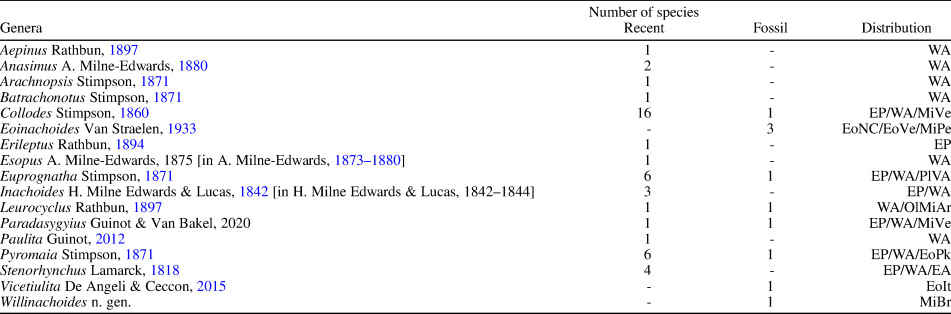
Eight of 17 inachoidid genera are monotypic (Table 1). The proportionally high number of monotypic genera could be the result of rapid dispersion followed by diversification. The dispersal events were probably facilitated by eustatic sea level changes (Haq et al., Reference Haq, Hardenbol and Vail1987; Kominz et al., Reference Kominz, Browning, Miller, Sugarman, Mizintseva and Scotese2008), the Mi-1 Oligocene-Miocene boundary global cooling (Stewart et al., Reference Stewart, James, Anand and Wilson2017), the global warming period of the Middle Miocene Climate maximum (You et al., Reference You, Huber, Müller, Poulsen and Ribbe2009; Goldner et al., Reference Goldner, Herold and Huber2014), and the spread of warm water both northward and southward from the tropics (Casadío et al., Reference Casadío, Feldmann, Parras and Schweitzer2005; Feldmann and Schweitzer, Reference Feldmann and Schweitzer2006). Diversification and extinction of marine organisms during the Neogene of tropical Americas were probably enhanced by events with potential to split ancestral ranges into smaller isolated ones, such as closure of the Panama Isthmus (Coates et al., Reference Coates, Collins, Aubry and Berggren2004; Lessios, Reference Lessios2008; O'Dea et al., Reference O'Dea, Lessios, Coates, Eytan and Restrepo-Moreno2016; Jaramillo, Reference Jaramillo, Hoorn, Perrigo and Antonelli2018), marine incursions into the Amazon basin (Hoorn et al., Reference Hoorn, Bogotá, Romero-Baez, Lammertsma, Flantua, Dantas, Dino, do Carmo and Chemale2017; Jaramillo et al., Reference Jaramillo, Romero, D'Apolito, Bayona and Duarte2017), collapse of the carbonate platform in the equatorial margin of South America (Aguilera et al., Reference Aguilera, Guimarães and Moraes-Santos2013a, Reference Aguilera, de Araújo, Hendy, Nogueira and Nogueira2020a, Reference Aguilera, Bencomo, de Araújo, Dias, Coletti, Lima, Silva-Caminha, Polck, Alves-Martin, Jaramillo, Kutter and Lopesb), and onset of the transcontinental Amazonas River (Figueiredo et al., Reference Figueiredo, Hoorn, Van der Vem and Soares2009).
Recent and fossil genera currently assigned to the Inachoididae, with their respective number of species and gross distribution. EA, Eastern Atlantic; EoIt, early Eocene of Vicenza, Italy; EoNC, middle Eocene of North Carolina, USA; EoPk, early Eocene of Punjab, Pakistan; EoVe, late Eocene of Falcón, Venezuela; EP, Eastern Pacific; PlVA, late Pliocene of Virginia, USA; MiBr, early–middle Miocene of Pará, Brazil; MiPe, late Miocene of Sacaco, Peru; MiVe, early–late Miocene of Falcón, Venezuela; OlMiAr, late Oligocene–early Miocene, of Estancia Tolosa, Argentina; WA, Western Atlantic.

EA, Eastern Atlantic; EoIt, early Eocene of Vicenza, Italy; EoNC, middle Eocene of North Carolina, USA; EoPk, early Eocene of Punjab, Pakistan; EoVe, late Eocene of Falcón, Venezuela; EP, Eastern Pacific; PlVA, late Pliocene of Virginia, USA; MiBr, early-middle Miocene of Pará, Brazil; MiPe, late Miocene of Sacaco, Peru; MiVe, early-late Miocene of Falcón, Venezuela; OlMiAr, late Oligocene–early Miocene, of Estancia Tolosa, Argentina; WA, Western Atlantic.
Such events could be responsible, on one hand, for the extinction of Eoinachoides, which was present at least until the late Tortonian (11.6–7.2 Ma) Pisco Formation, Peru, and Willinachoides n. gen. from the middle Miocene (14.2–12.7 Ma) Pirabas Formation, Brazil, and, on the other hand, for the presence of closely related species on each side of the Isthmus of Panama. Paradasygyius, with an extant species in the eastern Pacific (P. depressus) and a fossil counterpart in the late Tortonian (11.6–7.2 Ma) in the western Atlantic (P. rodriguezi n. sp.), serves to exemplify both extinction and occurrence of species pairs separated by closure of the Central American Seaway. Patterns of distribution of closely related species on each side of the Americas also are known in the inachoidid Collodes, Eoinachoides, Euprognatha, Inachoides, Pyromaia, and Stenorhynchus (Santana, Reference Santana2008; Colavite et al., Reference Colavite, Windsor and Santana2019).
The effects driven by the shoaling and final closure of the Central American Seaway in the late Pliocene are thought to have critically affected the evolution of the inachoidids and shaped today's distribution patterns, which are strongly marked by closely related species on each side of the Americas, whether they be fossil or Recent species.
Acknowledgments
We would like to express our sincere gratitude to persons and institutions for all the help provided throughout this study. To M.I. Feijó for granting access to the fossil crustacean collections and loan of specimens from the MPEG. H. Moraes-Santos (MPEG) for collaboration and support during the field trip to Atalaia fossil site. J. Reyes, R. Sánchez, J. Carrillo, R. Lozán, D. Rodrigues de Aguilera, and M. Sánchez-Villagra for their help during multiple fieldtrips to Venezuelan sedimentary marine basins and collections. A. Paulina-Carabajal (MPB) and W. Etter (NMB) for kindly shared information and photos of E. cf. E. senni and E. senni holotype, respectively, even with severe restrictions imposed by the COVID-19 pandemic. B. Aguirre-Urreta from the Universidad de Buenos Aires (UBA) who generously shared information on fossil crabs from Patagonia Tertiary. To W. Santana for exchanging ideas about of Inachoididae and allowing us to use his photographs. To J. Falconnet for providing images of fossil specimens from the MNHN collections. S. Bogan (Fundación Azara) and T. Peraza provided stratigraphic information about the Gran Bajo del Gualicho and Caujarao formations, respectively. To Associated Editor J. Luque and reviewers D. Guinot (MNHN) and S. Charbonnier (MNHN) for their valuable comments that enriched the final version of the manuscript. This study was funded by the Conselho Nacional de Desenvolvimento Científico e Tecnológico (CNPq) (grant 404937/2018-7; productivity fellowships 305269/2017-8 to OA and 309488/2020-6 to MT), Coordenação de Aperfeiçoamento de Pessoal de Nível Superior—Brasil (CAPES) (grant PBMAC-UFF, finance code 001 to DL, 88882.306162/2018-01), Programa de Pós-graduação em Biologia Marinha e Ambientes Costeiros, Universidade Federal Fluminense (PBMAC-UFF internal grant).