Introduction
‘Man's nature at birth is good’ (Confucian philosopher Mencius)
‘For in your sight no man is free from sin, not even a child who has lived only one day on earth’ (Augustine)
In Western religion, sin in humans is nature, whereas in Chinese Confucianism, human nature is originally good, and it is nurture that causes bad acts. In the psychological literature, sin or bad acts are considered aspects of ‘externalizing behavior’ (Ext), which refers to behavioral problems manifested as outward conduct and reflects acting negatively on the external environment (Eisenberg et al. Reference Eisenberg, Cumberland, Spinrad, Fabes, Shepard, Reiser and Guthrie2001). Adolescent Ext are common worldwide and often predict adult crime (Brook et al. Reference Brook, Lee, Finch, Brown and Brook2013). Empirical research in Western culture has demonstrated moderate genetic, non-shared environmental and modest shared environmental influence on adolescent Ext (Burt, Reference Burt2009b ; Tuvblad & Beaver, Reference Tuvblad and Beaver2013). However, research on externalizing in Chinese adolescents is scarce.
The bioecological model (Bronfenbrenner & Ceci, Reference Bronfenbrenner and Ceci1994) proposes that heritability measures the proportion of variation in individual differences attributable to actualized genetic potential, thus the heritability of Ext may vary across social contexts (Burt, Reference Burt2011; Shanahan & Hofer, Reference Shanahan and Hofer2005). Specifically, tempting or unstructured social contexts (i.e. deviant peer affiliation, negative parenting) can amplify genetic risk for adolescent Ext (Boutwell et al. Reference Boutwell, Beaver, Barnes and Vaske2012; Hicks et al. Reference Hicks, South, DiRago, Iacono and McGue2009), whereas controlled or structured social contexts [i.e. parental monitoring, lower acceptability of aggression (AGG)] can suppress genetic influence on adolescent Ext (Brendgen et al. Reference Brendgen, Girard, Vitaro, Dionne and Boivin2013; Burt & Klump, Reference Burt and Klump2014).
The Chinese culture stands as one of the prototypical collectivistic cultures, and is heavily influenced by Confucianism (Oyserman et al. Reference Oyserman, Coon and Kemmelmeier2002). Both collectivism and Confucianism value inter-dependence and social harmony, emphasize behavioral regulation, and perceive AGG as a threat to group harmony (Xu & Zhang, Reference Xu and Zhang2008). Therefore, compared to Western culture, children's AGG in Chinese culture might be more likely to be rejected by peers (Li et al. Reference Li, Xie and Shi2012), and disapproved of by teachers and parents (Chen et al. Reference Chen, Rubin and Li1995). Furthermore, Chinese parents and teachers are highly involved in monitoring children's friend selection, which may decrease their affiliation with deviant peers (Pyrooz & Decker, Reference Pyrooz and Decker2013). These protective social contexts embedded in Chinese culture may account for the lower prevalence of Ext among Chinese youths compared to their Western peers (Bergeron & Schneider, Reference Bergeron and Schneider2005; Bergmüller, Reference Bergmüller2013). However, whether Chinese cultural context can attenuate genetic potential to adolescent Ext remains unknown. Therefore, the first aim of this study was to investigate genetic and environmental influences on Chinese adolescents’ Ext, and compare them to the findings in Western samples.
Our second aim was to investigate the etiological heterogeneity of Chinese adolescents’ Ext, which comprise a broad range of actions and attitudes violating societal norms and others’ rights. Although generally conceptualized as a unitary construct, accumulating research has begun to illuminate meaningful distinctions within the broader externalizing domain. One etiologically driven distinction pertains to ‘overt’ or aggressive (AGG) v. ‘covert’ or rule breaking (RB) behavior. One meta-analysis (Burt, Reference Burt2009a ) of mainly Western samples revealed that the heritability of AGG (65% of the variance) was higher than that of RB (48%). Furthermore, Burt's (Reference Burt2013) meta-analysis of Western samples demonstrated that only 38.4% of genetic and 10.2% of non-shared environmental influences on AGG overlapped with those on RB, suggesting largely distinct etiologies. However, little is known about the etiological heterogeneity of Ext in Chinese adolescents.
As discussed earlier, the heritability of Ext – actualized genetic potential – may vary across social and cultural contexts. Compared to the covert RB, overt AGG causes more salient and direct interpersonal conflicts, and hence receives more sanctions in the Chinese context. Thus, we hypothesize that the heritability of Ext, especially AGG, would be smaller in Chinese adolescents than suggested by previous data in Western samples. Furthermore, we hypothesize that, the higher restriction of overt AGG compared to covert RB in the Chinese context will result in an increase in the genetic influence on AGG that is shared with RB, but a decrease in the genetic influence on AGG that is independent of RB, and thus result in larger genetic correlations between AGG and RB. We aimed to test these hypotheses using a large multiple-informant (child, parent, teacher) twin sample as previous research suggested that multiple raters can provide useful but different information about the child's problems in multiple contexts (Achenbach, Reference Achenbach2006; De Los Reyes et al. Reference De Los Reyes, Thomas, Goodman and Kundey2013).
Method
Participants
This study was based on data from the Beijing Twin Study (BeTwiSt), a longitudinal twin study examining genetic and environmental influence on psychological development and mental health among Chinese adolescents. Approximately 1400 pairs of twins aged 10–19 years were recruited from 620 elementary and secondary schools that were randomly selected from all 18 counties or districts in the Beijing municipality. Detailed information about the recruitment and assessment procedures have been described in a prior study (Chen et al. Reference Chen, Li, Zhang, Natsuaki, Leve, Harold and Zhang2013). The sample for the current study included 908 pairs of same-sex twins, among which 661 pairs were monozygotic (MZ) twins and 247 pairs were dizygotic (DZ) twins. The age of participants ranged from 10 to 18 years (mean = 13.53 years, s.d. = 2.26). Fifty-three percent of participants were females. All participants were of Han ethnicity. Regarding fathers’ highest educational attainment, 6.8% had a primary school degree, 32.8% had a junior high-school degree, 31.8% had a senior high-school degree, 26.1% had a college degree, and 2.5% had a graduate degree. The corresponding percentage of the mothers’ highest educational attainment were 5.4%, 35.3%, 29.5%, 25.2%, and 4.6%, respectively. The relatively higher socioeconomic status and non-rural sample characteristics endow the present study a strength when comparing with Western populations that mostly consist of middle-class urban samples as well.
Measures
Externalizing behaviors
Adolescent Ext was assessed with the Achenbach System of Empirically Based Assessment (Achenbach & Rescorla, Reference Achenbach and Rescorla2001), which consists of three parallel questionnaires: the Child Behavior Checklist (CBCL) using parents as informants, the Teacher Report Form (TRF), and the Youth Self-Report (YSR). Two subscales measuring AGG and RB were used in this study. The total Ext were computed by summing the AGG and RB subscale scores. Twins, one of the parents (65% mother), and each twin’ teachers (85% of the teachers were the same for both members of the pair) were instructed to rate the extent to which current or past behavior (within the past 6 months) matched the questionnaire items, using a 3-point scale (0 = never to 2 = often/mostly true). The Chinese versions of CBCL, TRF, and YSR that have been demonstrated to be valid and reliable (Leung et al. Reference Leung, Kwong, Tang, Ho, Hung, Lee and Liu2006) were used in this study. The reliabilities of scales in this sample ranged from 0.77 to 0.93.
Zygosity determination
The twins’ zygosity was determined by a validated method combining DNA analysis (89.5% of twins) and questionnaire (10.5% of twins) (Chen et al. Reference Chen, Li, Chen, Yang, Zhang, Duan and Ge2010). For the DNA analyses, nine short tandem repeat loci highly heterogeneous in the Chinese population were used. Same-sex twins with at least one different genetic marker were classified as DZ twins; otherwise, the twins were classified as MZ twins. The posterior probability of being MZ for same-sex twins with the same genotype in all nine loci was estimated to be 99.99%. The validity of the zygosity determination questionnaire was examined by comparing it with the results of the DNA analyses. The predictive accuracy of the questionnaire method used in this study reached 91%.
Assessment procedure
All twins and their parents signed informed consents before participation. We arranged for the twins to complete the survey in their classrooms after school. After describing the purpose and procedures of the study, trained research assistants distributed the questionnaires to the twins and instructed them to complete the questionnaires independently. Research assistants were present to answer any questions that the participants may have. Participants were assured of the confidentiality of their responses and the voluntary nature of their participation. The teachers completed the questionnaires in their offices. The parents finished the questionnaires at home and asked their children to return them at school. All procedures were approved by the Institutional Review Board of the Institute of Psychology, Chinese Academy of Sciences.
Data analyses
Univariate genetic analyses
The twin design relies on different levels of genetic similarity between MZ twins who are genetically identical, and DZ twins who share one half of their additive genetic effects. This difference was used to estimate the contribution of additive genetic (A), shared environmental (C), and non-shared environmental (E) factors to the individual differences in the phenotype. The structural equation modeling package Mx (www.vcu.edu/mx/) that utilizes a maximum-likelihood estimation method on raw data was used to estimate the variance components (A, C, E) for each measure.
Bivariate genetic analyses
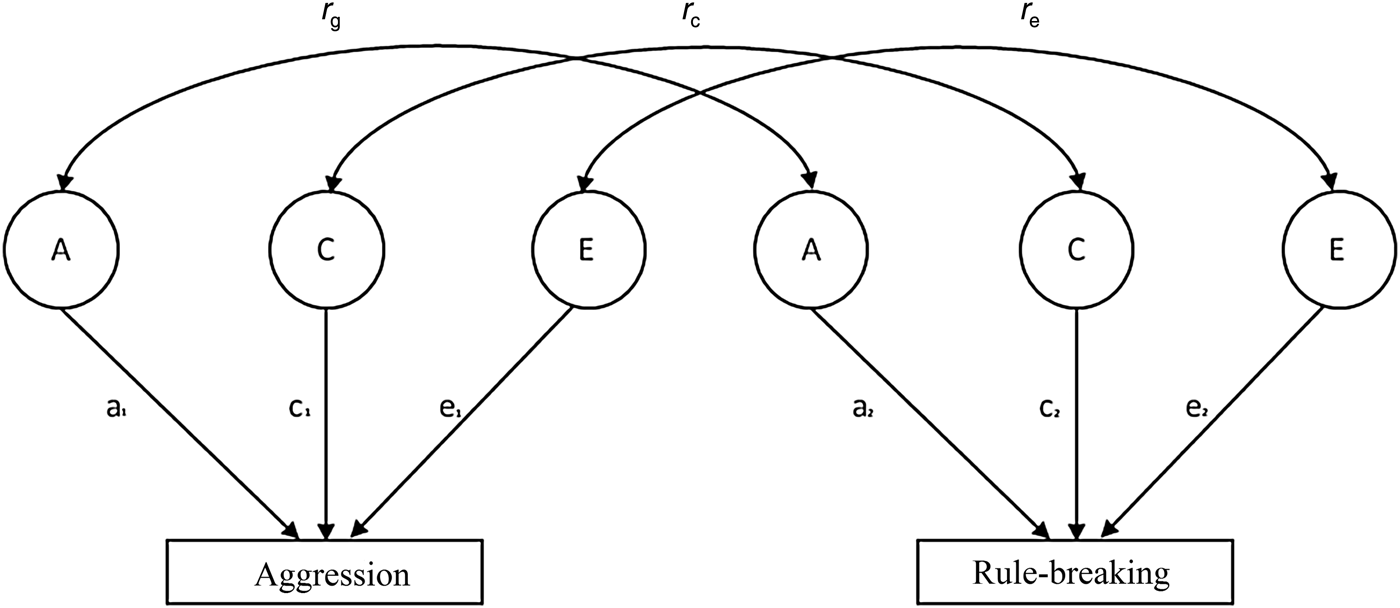
The genetic and environmental correlations of AGG and RB were estimated using the correlated factors model (Fig. 1). Each path from a genetic factor to a variable is the square root of the heritability of that variable, and the correlated path between the genetic factors gives the genetic correlation (r g). The same rule applies to shared and non-shared environmental factors. These correlations correspond to the strength of the association between genetic, and shared and non-shared environmental influences on each variable.
The correlated factors model for aggression and rule breaking. A, Additive genetic influences; C, shared environmental influences; E, non-shared environmental influences; r g, genetic correlation; r c, shared environmental correlation; r e, non-shared environmental correlation.

Multiple rater model
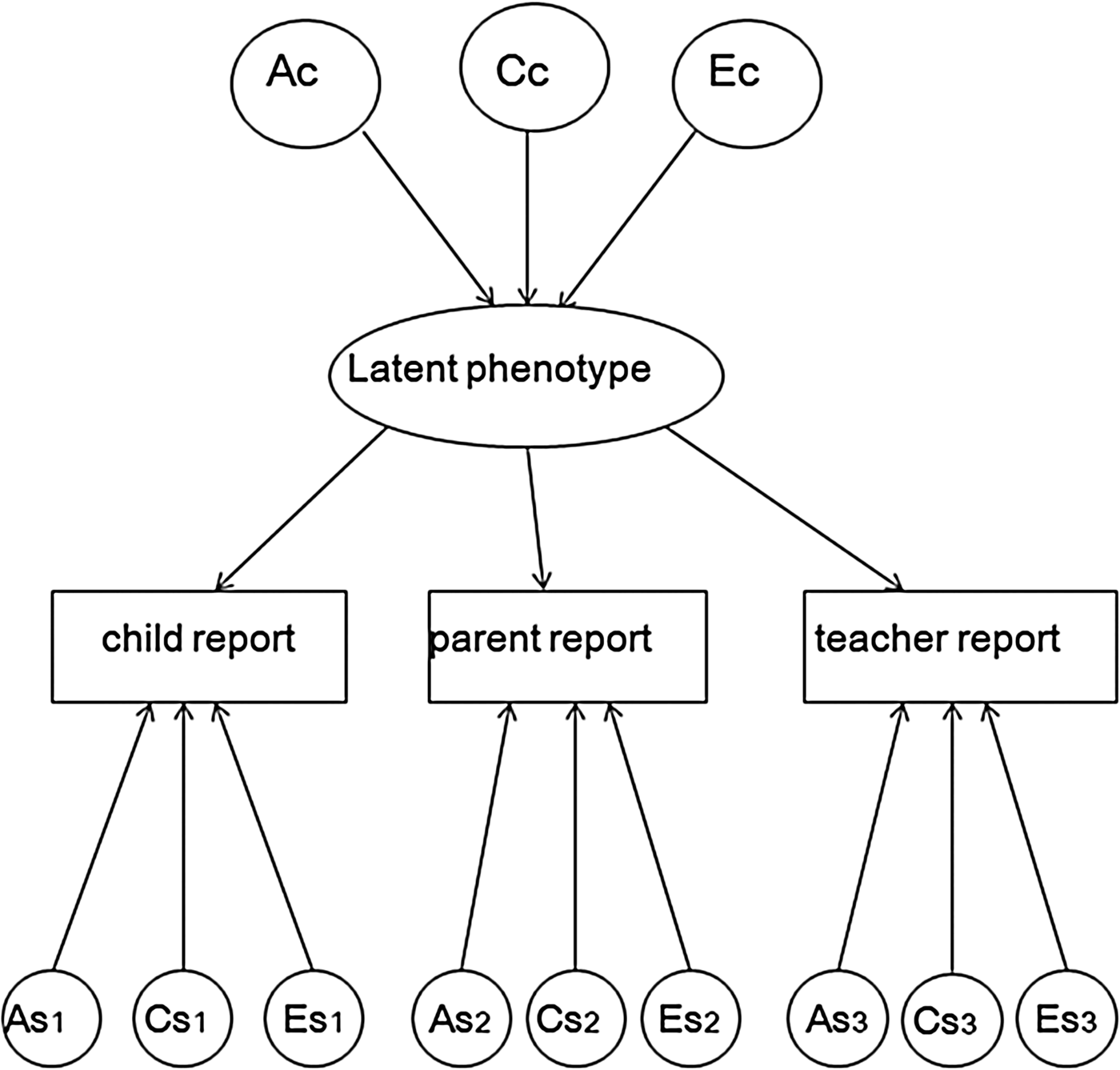
As we collected child's behaviors from three raters (child, parent, teacher), we fitted the psychometric model (Fig. 2) to estimate the influences of common A, C, and E on the latent phenotype indicated by the three informant measures. Rater-specific effects of A, C, and E on each informant data were also estimated.
The psychometric model for child-, parent-, and teacher-reported child's behaviors. Child's, parent's, and teacher's ratings are linear functions of the latent phenotypes and rater-specific variance. Latent phenotypes are influenced by common genetic factors (Ac), common shared environment (Cc), and common non-shared environment (Ec). Rater-specific variance is made up of rater-specific genetic factor (As), rater-specific shared environment (Cs), and rater-specific non-shared environment and measurement error (Es).

Results
Preliminary analyses
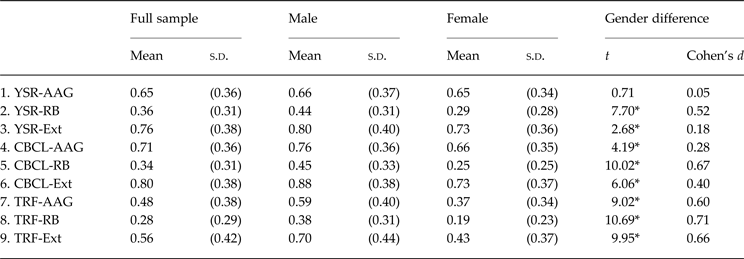
Because the distributions of the behavior scales were positively skewed, a log transformation [lg(x + 1)] was applied to approximate normality. Gender differences on the transformed data are shown in Table 1. Except for self-reported AGG, boys displayed higher scores than girls in all other measures. Self-reported AGG, RB, and total Ext significantly increased with age (r = 0.10–0.17, p < 0.01), whereas parent-reported AGG and Ext significantly decreased with age (r = −0.09 to −0.10, p < 0.05). Paired t tests showed that parent-reported AGG was significantly higher than child reports (t = 4.07, p < 0.001), which was in turn significantly higher than teacher reports (t = 12.53, p < 0.001). For RB, parent reports and child reports were comparable (t = 1.70, p = 0.09), but were both significantly higher than teacher reports (parent: t = 6.93, p < 0.001; child: t = 9.20, p < 0.001). Results for total Ext were similar to AGG.
Descriptive statistics and gender differences of study variables

AGG, Aggression; CBCL, Child Behavior Checklist; Ext, externalizing; d, effect size for gender differences on the study variables; RB, rule breaking; TRF, Teacher Report Form; YSR, Youth Self-Report.
The mean (s.d.) values are based on transformed data [lg(x + 1)].
* p < 0.01.
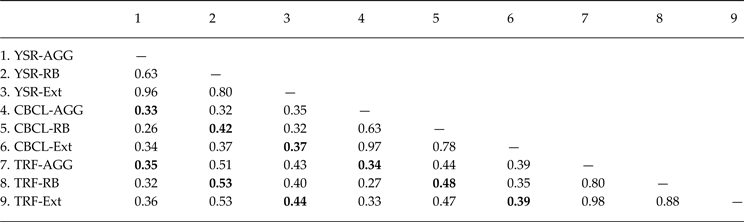
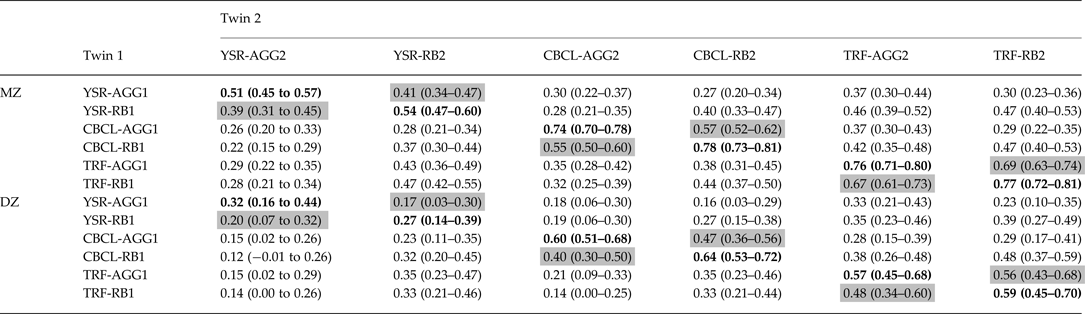
Correlations among the study variables for the full sample are presented in Table 2. The cross-informant reports on AGG, RB, and Ext were moderately to highly correlated (0.33–0.53), indicating the convergent validity of the three constructs. The cross-twin correlations for the same traits of AGG and RB (bold numbers on the diagonal) and the cross-twin cross-trait correlations (numbers highlighted in gray) are shown in Table 3. For these correlations, the MZ correlations were greater than the DZ correlations, but not by more than a factor of 2, suggesting additive genetic, shared, and non-shared environmental influences on adolescent behaviors and cross-domain correlations in this sample (i.e. ACE model).
Correlations among child-, parent-, and teacher-reported AGG, RB, and Ext scores

AGG, Aggression; CBCL, Child Behavior Checklist; Ext, externalizing; RB, rule breaking; TRF, Teacher Report Form; YSR, Youth Self-Report.
Bold numbers represent cross-informant correlations of AGG, RB, and Ext.
All correlation coefficients were significant at p = 0.01.
Within-domain and cross-domain correlation coefficients with 95% confidence intervals within monozygotic (MZ) and dizygotic (DZ) twin pairs

AGG, Aggression; CBCL, Child Behavior Checklist; Ext, externalizing; RB, rule breaking; TRF, Teacher Report Form; YSR, Youth Self-Report.
Bold numbers represent cross-twin correlations for the same traits of AGG and RB. Numbers in gray represent cross-twin cross-trait correlations.
All correlation coefficients are significant at p = 0.01.
Genetic and environmental etiologies
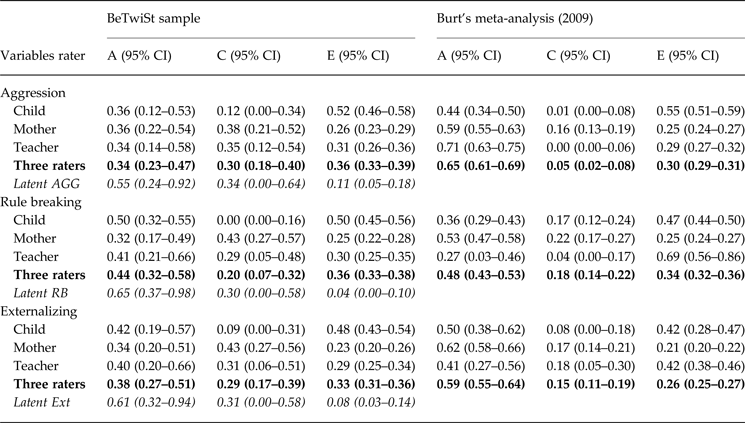
The residuals after regressing out the effects of sex and age were used in subsequent model fitting (McGue & Bouchard, Reference McGue and Bouchard1984). The parameter estimates of A, C, E on AGG, RB and Ext are shown in Table 4. There were moderate genetic and non-shared environmental effects across three raters’ reports. The shared environmental effects were moderate for parent and teacher reports, but small in child reports. The estimates between raters were significantly different (Δχ2 6 = 124.66–150.19, p values < 0.001). To reduce the measurement error in single-rater data, we further fitted the psychometric model to estimate the influences of common A, C, and E on the latent phenotypes indicated by three informant measures (italicized numbers in Table 4). The heritability estimates of latent phenotypes were larger than those of single measure.
Parameter estimates and 95% confidence intervals (CI) of A, C, E in the present study and Burt's meta-analysis

A, Additive genetic influences; C, shared environmental influences; E, non-shared environmental influences.
AGG, Aggression; CBCL, Child Behavior Checklist; Ext, externalizing; RB, rule breaking; TRF, Teacher Report Form; YSR, Youth Self-Report.
Parameters of latent phenotype were estimated from the psychometric model.
Parameters of three raters were estimated from the general univariate model with the three raters' reports as input.
The parameter estimates of AGG and RB are from Burt's meta-analysis published in Clinical Psychological Review, 29, 2009, 163–178. The parameter estimates of Ext are from Burt's meta-analysis published in Psychological Bulletin, 2009, 135, 608–637.
For comparison, the results of Burt's meta-analysis (2009a, b) were added to Table 4. Furthermore, the A, C, E influences on the three raters’ reports of Chinese adolescents’ behavior (three raters’ reports as input for univariate model-fitting) were also estimated (bold numbers in Table 4). We then statistically tested the differences of A, C, E estimates of the three raters’ reports from the current sample with the estimates reported in Burt's meta-analysis. Equating the A, C, E estimates of our sample to those reported in Burt's meta-analyses resulted significant reductions in model-fitting for AGG (Δχ2 3 = 16.73, p < 0.01), and Ext (Δχ2 3 = 13.15, p < 0.01), but not for RB (Δχ2 3 = 0.90, p = 0.82). These findings indicated that the genetic influences on Chinese adolescents’ Ext, especially AGG, were smaller than suggested by previous data in Western peers.
Etiological correlations
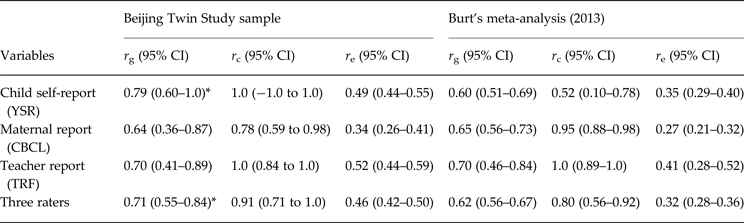
The results of bivariate genetic analyses are shown in Table 5. The genetic correlations (0.64–0.79) and shared environmental correlations (0.78–1.0) were large. The non-shared environmental correlations were moderate, ranging from 0.34 to 0.52. For comparison, the results of Burt's meta-analysis (2013) are also included in Table 5. Compared to the estimates in Western peers, we found larger genetic correlation (r g) using child reports (Z = 10.51, p < 0.01) and using the three raters’ reports (Z = 4.50, p < 0.01). The genetic correlations (r g) estimated from parent and teacher reports were similar to previous findings in Western peers.
Correlations of genetic, shared environmental and non-shared environmental influences on aggression and rule breaking in the present study and Burt's meta-analysis (2013)

CI, confidence interval; CBCL, Child Behavior Checklist; TRF, Teacher Report Form; YSR, Youth Self-Report.
The parameter estimates of r g, r c, r e are from Burt's meta-analysis published in Psychological Medicine, 2013, 43, 1801–1812.
* p < 0.01 for testing significant difference of etiological correlations.
Discussion
According to the statistics from the Sixth National Census in China, the total younger population aged 10–19 years is 174.8 million. Even calculated with a conservative prevalence rate of 5%, the number of Chinese adolescents with externalizing problems will be 8.74 million. Given the scarce etiological research in this population, it is crucial to better understand the etiological mechanism underlying Chinese adolescents’ Ext for effective prevention and intervention to be in place. The present study investigated genetic and environmental influences on Ext among Chinese adolescents using a large sample with multiple-informant twin design. We also investigated the etiological heterogeneity of AGG and RB behavior among Chinese adolescents.
Genetic and environmental influences
The heritability estimates of Ext reported by child, parents, and teachers ranged from 34% to 42%. The heritability estimate using three raters’ data was 38%, which was significantly smaller than those reported in the meta-analysis of Western samples (59% in Burt, Reference Burt2009b ). More salient cultural difference was indicated by the heritability of AGG: the heritability of Chinese adolescents’ AGG using the three raters’ data was 34%, which was significantly smaller than those reported in Burt's (Reference Burt2009a ) meta-analysis (65%).
These findings are consistent with the bioecological model, showing that genetic influences on adolescent Ext vary across cultural context. As we hypothesized, the genetic influence on Chinese adolescents’ Ext, especially AGG, was smaller than those reported in Western samples. As AGG is a salient threat to group harmony and interpersonal relationships, Chinese children with AGG are often punished by teachers and parents, and excluded by peers (Chen et al. Reference Chen, Rubin and Li1995; Li et al. Reference Li, Xie and Shi2012). To adapt to this controlled context, we hypothesize that Chinese children are socialized to suppress their genetic potential to be aggressive. Therefore, the actualized genetic potential (i.e. heritability) of AGG is smaller in Chinese culture than in Western culture.
Other than genetic influences, we also found moderate shared environmental effects on parent- and teacher-reported adolescent Ext. The moderate shared environmental effect may partially reflect rater effects inherent in parent and teacher informant reports (i.e. one adult reports on both siblings). Nonetheless, it likely partially represents true shared environmental effects exerted in the family or at school. Both Chinese collectivistic culture and Confucianism value the role of family (parents) and school (teachers) in child development. Studies show that poverty and parental divorce are significant risks for Chinese children's Ext (Chen, Reference Chen1994; Liu et al. Reference Liu, Guo, Okawa, Zhai, Li, Uchiyama and Kurita2000). A lack of involvement in teachers monitoring of students’ activities at school is also an important predictor of adolescent Ext (Huang et al. Reference Huang, Hong and Espelage2013).
Etiological heterogeneity
We found that genetic correlations between AGG and RB ranged from 0.64 to 0.79 across the three informants. The estimates of genetic overlap are larger than the results of the meta-analysis of prior Western samples (Burt, Reference Burt2013). The relatively larger genetic overlap between AGG and RB in Chinese adolescents may be due to the tolerance of expressing shared genetic predisposition between AGG and RB, but restriction of expressing AGG's unique genetic predisposition.
Although the genetic correlation between AGG and RB in our sample was slightly larger than in Western samples, there were still large residual genetic contributions to AGG (one minus the squared the genetic correlations: 38–59%) that were independent of those contributed to RB. Furthermore, the non-shared environmental correlations between AGG and RB ranged from 0.34 to 0.52 across the three informants, indicating small to moderate overlap. Together with findings in Western samples (Burt, Reference Burt2013), our results suggest that AGG and RB constitute etiologically distinct dimensions within the broader construct of Ext. Future studies should examine the genetic and social risk factors that specifically or uniquely cause AGG and RB.
Limitations
There are some limitations in the current study. First, the twin participants were general youths in schools residing in the metropolis of Beijing. The educational levels of the adolescents’ parents were relatively higher. Thus, caution should be exercised in generalizing our findings to youths living in less economically developed areas, or youths living in disadvantaged social contexts such as children left behind by their migrant parents in rural areas of China (Wen & Lin, Reference Wen and Lin2012). Second, we measured two dimensions of Ext – physical AGG and RB – in this study, future studies can explore other subtypes of AGG such as proactive and reactive AGG (Dodge & Coie, Reference Dodge and Coie1987), and relational AGG (Crick, Reference Crick1995). Third, the comparisons were conducted between estimates in one collectivistic sample and results of meta-analyses in Western samples, future collaborative research employing two samples with similar demographic characteristics from the two cultures (collectivistic v. individualistic ones) is needed to verify our findings.
Implications
Despite these limitations, this study provides new knowledge about genetic and environmental contributions to adolescents’ Ext in a collectivistic culture. The moderate genetic influences on Chinese adolescents’ Ext refuted Mencius’ doctrine – ‘Man's nature at birth is good’. Comparison of our findings with previous findings in Western samples suggest that the collectivistic cultural values and Confucianism philosophy seem to be able to attenuate genetic potential in Ext, especially physical AGG. Confucian philosophers believe that nurturing or cultivating good virtues such as ‘Ren’ (benevolence), ‘Li’ (courtesy), ‘Yi’ (righteousness) and ‘Xiao’ (filial), can reduce humans’ bad actions and enhance good conduct. Although substantial empirical evidence is needed, these findings imply the potential usefulness of the collectivistic cultural values and Confucianism philosophy in the prevention and intervention of adolescent Ext.
Acknowledgements
This study was supported by the National Natural Science Foundation of China (31300841) and the BeTwiSt of Institute of Psychology, Chinese Academy of Sciences. We are grateful to the participating twin families and schools.
Declaration of Interest
None.