



‘As psychosis developed, I began to experience the world as intensely meaningful, as if I could perceive what others could not. Patterns seemed to appear everywhere: songs aligned with my thoughts, numbers repeated, coincidences felt like messages. A strength in autistic pattern recognition became a vulnerability; if something happened twice, it felt like proof and conclusions felt logical. In sensory overloaded environments, hallucinations and delusional interpretations often spiked; a flicker, echo, or lots of background noise could tip into hearing voices or feeling that messages were aimed specifically at me. For many autistic people with psychosis, safety is not only about symptoms; it is about environments, relationships, and support systems.’
Terri (pseudonym)For autistic people with psychosis, like Terri, traits and symptoms are tightly interwoven, with autistic cognitive styles, sensory processing differences and environmental stressors shaping the development, expression and interpretation of psychotic experiences. Although co-occurrence of autism and psychosis is not uncommon in clinical practice, research on this co-occurrence remains limited and estimates of prevalence vary considerably. Reference Ferrara, Curtarello, Simonelli, Yoviene Sykes, Fusar-Poli and Folesani1,Reference Kincaid, Doris, Shannon and Mulholland2 A reasonable estimate is that approximately 1 in 20 individuals with psychosis have co-occurring autism, although we await definitive studies. Despite this, psychiatric services remain poorly configured to detect and treat this overlap, and outcomes are poorer than for individuals with either condition alone.
Autistic people who develop psychosis experience higher rates of delayed or missed diagnosis, longer durations of untreated psychosis, increased risk of treatment discontinuation, greater exposure to adverse medication effects and more fragmented patterns of care. Reference Strålin and Hetta3 Despite these disparities, the intersection of autism and psychosis continues to be framed implicitly as a specialist or ‘complex case’ issue. We recommend a shift towards recognition of the experience of psychosis by autistic people as a predictable clinical reality that requires routine system-level adaptation.
The conceptual challenge of co-occurrence
Historically, autism was closely linked to psychosis in psychiatric classification: early diagnostic systems placed what would now be diagnosed as autism spectrum disorder within the category of childhood psychoses. Later developmental research led to autism being conceptualised as a distinct neurodevelopmental condition with early-life onset, separate from psychotic disorders that typically emerge in adolescence or adulthood.
The broader psychiatric literature has long recognised conceptual problems in how co-occurrence is understood. Reference Nordgaard, Nielsen, Rasmussen and Henriksen4 The steady increase in recorded co-occurring diagnoses partly reflects growing recognition of clinical complexity but also highlights limitations of classification systems that treat disorders as discrete entities even when developmental trajectories, mechanisms and presentations overlap. When diagnostic frameworks emphasise categorical distinctions without sufficient flexibility for contextual or longitudinal variation, apparent co-occurrence may reflect the structure of the diagnostic system as much as independent clinical or neurodevelopmental processes. These conceptual challenges are particularly relevant to autism and psychosis, in which neurodevelopmental genetic and environmental differences, trauma exposure, and evolving symptom expression interact over time in ways that are not easily captured by cross-sectional diagnostic criteria. Reference Jutla, Foss-Feig and Veenstra-VanderWeele5
Diagnostic uncertainty, overshadowing and interaction
Challenges arise in distinguishing autism and psychosis owing to shared phenomenological features, including social withdrawal, reduced reciprocity, atypical affect, cognitive and executive functioning differences, sensory processing changes, and elevated rates of anxiety, depression and functional impairment. Distinguishing positive symptoms is equally challenging, with autistic fantastical inner worlds or overvalued ideas often intensifying under stress, mimicking new-onset delusions as an apparent change from baseline.
Diagnostic hierarchies can shape clinical reasoning, such that certain diagnoses are not considered when more severe difficulties are present. Consequently, the presence of one diagnosis inadvertently reduces attention to the possibility of another, contributing to diagnostic overshadowing in both directions. Psychotic symptoms may be seen through the lens of neurodivergence and attributed to autism-related sensory or perceptual differences, communication styles or atypical social interpretation, whereas autistic traits may be interpreted as negative symptoms, delusional beliefs or longstanding consequences of severe mental illness. Such processes delay recognition of emerging psychosis or prevent identification of underlying neurodevelopmental differences that would meaningfully influence care planning. Thus, there is a need for phenomenological training across the clinical workforce and psychiatric curricula.
Important differentiating features can remain clinically informative. Autistic characteristics are typically lifelong, trait-based and evident from early development, often including restricted interests, repetitive behaviours and stable sensory profiles. By contrast, psychotic disorders are marked by a change from baseline, with emergence of new hallucinations and delusional beliefs, progressive functional decline or new disturbances in thought organisation, most commonly arising during adolescence or early adulthood. Reference Ribolsi, Fiori Nastro, Pelle, Medici, Sacchetto and Lisi6 However, we now know that autism and psychosis can co-occur.
Autistic people with psychosis may experience distinct challenges and trajectories compared with non-autistic people. Studies indicate lower rates of classic schizophrenia diagnoses, more frequent atypical or psychosis not otherwise specified presentations, and differing profiles of negative and cognitive symptoms. Reference Larson, Wagner, Jones, Tantam, Lai and Baron-Cohen7 Persistence of persecutory delusions through recovery stages, higher rates of treatment resistance and adverse medication effects are common. Autistic people with psychosis are more likely to meet criteria for a comorbid anxiety disorder and experience greater social and functional difficulties. Reference Treise, Simmons, Marshall, Painter and Perez8 Co-occurring autism may therefore shape the phenomenology and clinical trajectory of psychotic illness, reinforcing the need for assessment approaches that consider neurodevelopmental needs by attending to developmental history, baseline functioning and changes over time.
Structural barriers within clinical systems
The organisation of services frequently compounds diagnostic challenges. In many health systems, autism and psychosis services operate along separate pathways, each with distinct eligibility thresholds and professional expertise. Autism services often exclude individuals with acute psychosis because their needs are considered to be primarily psychiatric, whereas psychosis services may lack training to conduct neurodevelopmental assessments and adapt psychological interventions. Individuals fall through the gaps in services, being labelled ‘too complicated’, and this has a detrimental impact on help-seeking behaviour. Fragmented pathways reduce opportunities for early detection of change from baseline functioning – an especially critical clinical task when working with autistic individuals, whose presentations may differ from neurotypical patterns.
Once autistic people access services for psychosis, barriers remain; these include masking of autistic traits and interoception and communication differences. Services are frequently characterised by unpredictability, inflexibility and highly stimulating environments, which can trigger distress, dysregulation and sensory overload for autistic people. These difficulties are predictable consequences of services designed for an implicitly assumed neurotypical user.
Treatment inadequacies
Antipsychotic medications remain central to psychosis management, yet autistic individuals are less likely to benefit from these and report heightened sensitivity to side-effects, including sedation, metabolic changes, extrapyramidal symptoms or cognitive dulling. Communication differences may make it more difficult for patients to describe emerging adverse effects, leading to delays in dose adjustment or medication review. In the absence of structured monitoring approaches that account for neurodevelopmental differences, prescribing practices may unintentionally contribute to reduced adherence and poorer long-term outcomes. A neurodevelopmentally informed prescribing approach emphasising gradual titration, clear explanation of expected effects, proactive side-effect monitoring and collaborative decision-making is needed to significantly improve treatment tolerability and engagement.
Psychosocial interventions for psychosis lack an evidence base for autistic people. Adaptation of therapies for autistic cognitive, sensory and communication profiles is recommended, but limitations in knowledge, confidence and training impede implementation. Psychological therapies for psychosis, which involve discussion of internal experiences, and ‘neurotypical’ cognitive restructuring may be less accessible when communication, interoception and executive functioning differences are not accommodated. Psychoeducation materials, which are frequently reliant on figurative language and neurotypical presentations, may also be difficult to process without modification. When treatment is not calibrated to patient needs, disengagement, reduced adherence and limited therapeutic benefit are unsurprising. In such contexts, difficulties described as ‘treatment resistance‘ may reflect insufficiently adapted care rather than intrinsic lack of responsiveness.
Moving to system-wide clinical capability
Autistic people with psychosis are underserved. Recognition of this as a system-level issue necessitates improvements to the design of diagnostic processes, service pathways and treatment approaches. As things stand, ‘specialist third services’ or pathways supporting these are so rare as to be effectively non-existent for people with co-occurring psychosis and autism. In line with NHS England guidance, addressing these gaps requires recalibration of mainstream psychosis pathways rather than new services.
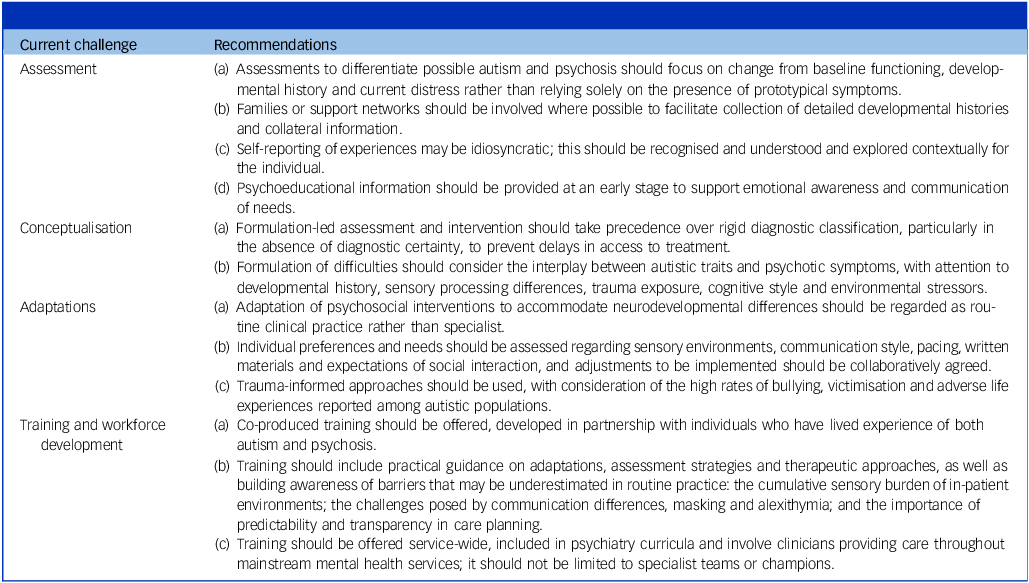
Examples from other areas of psychiatry demonstrate that meaningful pathway reform is achievable when co-occurring conditions are recognised as common rather than exceptional. Autism-adapted eating disorder pathways, in which sensory, communication and therapeutic modifications are embedded within routine service delivery, illustrate how systematic adaptation can improve engagement and treatment retention when neurodevelopmental differences are anticipated at a pathway level. Reference Tchanturia, Smith, Glennon and Burhouse9 Comparable system-level adaptation is needed within psychosis services. Embedding neurodevelopmentally informed assessment processes, creating joint autism–psychosis consultation pathways, and ensuring routine environmental and therapeutic adjustments would represent practical steps towards more inclusive care. Several clinical principles that can support this transition are detailed in Table 1.
Current challenges and recommendations

Table 1 Long description
The table is divided into four main sections: Assessment, Conceptualization, Adaptations, and Training and workforce development. Each section lists current challenges and corresponding recommendations. The Assessment section includes recommendations on focusing on baseline functioning, involving support networks, recognizing idiosyncratic self-reporting, and providing psychoeducation. The Conceptualization section emphasizes formulation-led assessment, considering the interplay between autistic traits and psychotic symptoms, and avoiding rigid diagnostic classification. The Adaptations section recommends routine adaptation of psychosocial interventions, assessing individual preferences and needs, and using trauma-informed approaches. The Training and workforce development section suggests co-produced training, practical guidance on adaptations, and offering training service-wide.
Research and future directions
Although the literature describing the prevalence and phenomenology of autism–psychosis co-occurrence has expanded considerably, there is limited high-quality evidence on the experiences of autistic people of psychosis services and treatment. Furthermore, the roles of service design in outcomes such as duration of untreated psychosis, engagement with services, treatment tolerability and long-term recovery are unknown. Implementation science approaches should be used to evaluate pathway redesign, staff training models and environmental adaptations, and to provide evidence to guide service improvements. Without such research, disparities in outcomes may continue to be attributed to patient characteristics rather than to modifiable system factors.
Autistic people who develop psychosis experience condition-specific and intersectional challenges, compounded by the structural limitations of current psychiatric systems. When diagnostic systems and service pathways are poorly aligned with their needs, inequities in care are amplified, contributing to preventable morbidity and prolonged distress. Recognising the co-occurrence of autism and psychosis as a common and clinically significant intersection (one shaped as much by system design as by individual pathology) offers psychiatry an opportunity to move beyond the notion of ‘complex cases’ towards routinely inclusive practice.
We have both an individual and system-level responsibility to embed neurodevelopmentally informed approaches within mainstream psychosis services, prioritise formulation and symptom-led assessment, and systematically adapt interventions. In this way, psychiatric systems can begin to reduce diagnostic delay, improve treatment engagement and deliver more equitable outcomes for a historically underserved and doubly stigmatised population.
Data availability
Data availability is not applicable to this article as no new data were created or analysed in this study.
Author contributions
A.J.W., D.T., K.M.T. and V.B. contributed to the conceptualisation of this editorial. A.J.W. was responsible for the primary draft, with critical review and editing by D.T., K.M.T. and V.B. All authors approved the final version.
Funding
A.J.W. receives funding from the King’s Health Partners Centre for Translational Medicine. The views expressed are those of the authors and not necessarily those of King’s Health Partners.
Declaration of interest
None.



eLetters
No eLetters have been published for this article.