Introduction
Mosquito-borne infectious diseases are a public health concern in tropical countries, and an emerging problem in temperate areas (Becker et al. Reference Becker, Petriæ, Zgomba, Boase, Dahl, Madon and Kaiser2010). The main mosquito vectors, which may transmit pathogens during their blood meals, belong to three main genera, namely Aedes, Culex and Anopheles (Becker et al. Reference Becker, Petriæ, Zgomba, Boase, Dahl, Madon and Kaiser2010). Aedes spp. mosquitoes are vectors for several arboviruses including the Yellow Fever, Dengue, Chikungunya and Zika viruses, which have come to the world's attention in recent years (Gardner and Ryman, Reference Gardner and Ryman2010; Vasilakis et al. Reference Vasilakis, Cardosa, Hanley, Holmes and Weaver2011; Caglioti et al. Reference Caglioti, Lalle, Castilletti, Carletti, Capobianchi and Bordi2013). Culex mosquitoes are responsible for West Nile Virus (WNV) and Japanese encephalitis virus transmission around the world (Komar, Reference Komar2003; Anosike et al. Reference Anosike, Nwoke, Ajayi, Onwuliri, Okoro, Oku, Asor, Amajuoyi, Ikpeama, Ogbusu and Meribe2005; de Wispelaere et al. Reference de Wispelaere, Despres and Choumet2017). Anopheles mosquitoes are the primary vectors of malaria. Female Anopheles mosquitoes are able to transmit six species of Plasmodium to humans: P. falciparum, P. vivax, P. malariae, P. ovale wallikeri, P. ovale curtisi, P. knowlesi and P. simium (WHO, 2016; Brasil et al. Reference Brasil, Zalis, de Pina-Costa, Siqueira, Junior, Silva, Areas, Pelajo-Machado, de Alvarenga, da Silva Santelli, Albuquerque, Cravo, Santos de Abreu, Peterka, Zanini, Suarez Mutis, Pissinatti, Lourenco-de-Oliveira, de Brito, de Fatima Ferreira-da-Cruz, Culleton and Daniel-Ribeiro2017). Malarial transmission remains high in Africa, with 117 886 deaths in 2015 (WHO, 2016). In Mali, West Africa, 1544 deaths were recorded as being attributable to malaria in 2015 (WHO, 2016). It is reasonable to assume that the number of malaria-associated deaths remains underestimated.
The precise identification of mosquito fauna is essential in entomological surveys, and in order to plan control measures and monitor their impact (Bass et al. Reference Bass, Williamson, Wilding, Donnelly and Field2007). Furthermore, the identification of mosquito blood meal sources is essential to understanding the biting behaviour of mosquito vectors (anthropophilic or zoophilic) (Muturi et al. Reference Muturi, Mwangangi, Beier, Blackshear, Wauna, Sang and Mukabana2013).
Mosquitoes are most frequently identified at the genus and species levels by morphological characteristics and using molecular tools. Morphological identification requires well-trained entomologists using dichotomous identification keys (Gillies MT Reference Gillies and Coetzee1987). Morphological identification continues to be the standard approach for arthropod studies. However, it presents some limits in terms of discriminating cryptic or sibling species. In recent years, molecular tools have emerged and can identify mosquitoes by amplifying different target genes. The target gene, such as the cytochrome c oxidase (COI), internal transcribed spacer 2, IGS regions of rDNA, has been used to satisfactorily identify mosquitoes up to sibling species with great specificity and sensitivity (Folmer et al. Reference Folmer, Black, Hoeh, Lutz and Vrijenhoek1994).
Several approaches have been developed to identify the host vertebrate blood source of mosquito meals. The main tools include a serological approach which involves precipitin tests and enzyme-linked immunosorbent assays (ELISA) (Fyodorova et al. Reference Fyodorova, Savage, Lopatina, Bulgakova, Ivanitsky, Platonova and Platonov2006; Gomes et al. Reference Gomes, Sousa, Vicente, Pinho, Calderon, Arez, Almeida, Donnelly and Pinto2013). However, these techniques present several limitations, including the availability of specific antisera against a broad diversity of host species and the cross-reactivity of antibodies for close species. To this end, molecular methods have also been developed to identify mosquito blood meal sources, such as mammalian blood and avian blood from Culex pipiens complex (Gomes et al. Reference Gomes, Sousa, Vicente, Pinho, Calderon, Arez, Almeida, Donnelly and Pinto2013). However, molecular methods also present several constraints, such as their cost, the time they take and the need for bulky equipment.
Matrix-assisted laser desorption/ionization time-of-flight mass spectrometry (MALDI-TOF MS) has recently been used as an alternative tool for rapid arthropod identification. The mass spectrum from a new sample, generated using MALDI-TOF MS, is compared with a library of spectra from a reference database. In our laboratory, the MALDI-TOF MS approach has been routinely used to identify arthropods such as ticks (using their legs) (Yssouf et al. Reference Yssouf, Socolovschi, Flaudrops, Ndiath, Sougoufara, Dehecq, Lacour, Berenger, Sokhna, Raoult and Parola2013, Reference Yssouf, Almeras, Berenger, Laroche, Raoult and Parola2015; Kumsa et al. Reference Kumsa, Laroche, Almeras, Mediannikov, Raoult and Parola2016), fleas (bodies of fleas without the abdomen) (Yssouf et al. Reference Yssouf, Socolovschi, Leulmi, Kernif, Bitam, Audoly, Almeras, Raoult and Parola2014b), sand flies (using their thoraces, wings and legs) (Lafri et al. Reference Lafri, Almeras, Bitam, Caputo, Yssouf, Forestier, Izri, Raoult and Parola2016), adult mosquitoes (using their legs) (Yssouf et al. Reference Yssouf, Socolovschi, Flaudrops, Ndiath, Sougoufara, Dehecq, Lacour, Berenger, Sokhna, Raoult and Parola2013, Reference Yssouf, Parola, Lindstrom, Lilja, L'Ambert, Bondesson, Berenger, Raoult and Almeras2014a) and mosquito larvae (using whole mosquitoes) (Dieme et al. Reference Dieme, Yssouf, Vega-Rua, Berenger, Failloux, Raoult, Parola and Almeras2014). Preliminary studies have also reported that MALDI-TOF MS may be used for mosquito blood meal identification. When the MS spectra obtained from the abdomen of mosquitoes which had been experimentally engorged on different blood meals source were tested, the MS protein profiles were clearly distinct according to the origin of the mosquito blood meals, up to 24 h post-feeding (Niare et al. Reference Niare, Berenger, Dieme, Doumbo, Raoult, Parola and Almeras2016). During entomological surveys, it may be difficult to preserve samples, and entomologists frequently use Whatman filter papers (WFPs) to preserve mosquito blood meals in the field by crushing the engorged abdomens onto WFPs.
In this study, the goal was to use the proteomic MALDI-TOF MS approach to identify mosquitoes collected in Mali and determine the sources of their blood meals. For this purpose, mosquitoes were collected in different ecological areas of Mali and tested by MALDI-TOF MS in Marseille, France. The abdomens of engorged female mosquitoes were crushed onto WFP to determine the blood meal sources using MALDI-TOF MS.
Materials and methods
Ethics statement
Consent was obtained from the heads of families where the mosquitoes were collected. Ethical approval for the collection of mosquito was granted by authorities from the National Malaria Control Program (NMCP) and approved by the Faculty of Medicine Ethical Committee, Bamako, Mali (N°2016/113/CE/FMPOS). The mosquito samples were processed and stored in line with the World Health Organization (WHO) Good Laboratory Practices guidance and documents on mosquito sampling handling procedures.
Collection sites
This study was conducted in three different localities in Mali, namely Donéguébougou, Bougoula-hameau and Bamako. In Bamako, the collection was performed in the three semi-urban areas of Sotuba, Yirimadio and Missabougou. The geo-positions of each collection site are as follows: Bougoula-hameau (−5°66′13.1′′, 11°30′95.2′′E); Donéguébougou (−7°98′39.8′′N, 12°80′44.9′′E) and the semi-urban areas of Bamako, Sotuba (−9°18′65.7′N, 8°23′07.4′E), Yirimadio (−9°18′56.5 ′N, 6°23′01.8′′E) and Missabougou (−9°18′77.5′′N, 8°23′03.9′′E).
Mosquito collection
Mosquitoes were collected from the various sites during the middle of the rainy season between July and August 2016 (WHO, 1992). The peak densities and consequentially of anopheline mosquitoes in Mali occur in August (Sogoba et al. Reference Sogoba, Doumbia, Vounatsou, Baber, Keita, Maiga, Traore, Toure, Dolo, Smith and Ribeiro2007). Mosquitoes were collected over three consecutive days per week. On each day, mosquitoes were aspirated from 10 houses using a mouth aspirator (Model 612, John W Hock, Gainesville, Florida, USA). All mosquitoes were collected indoors in the morning between 8 am and noon. The mosquito specimens were identified using morphological criteria (Gillies MT Reference Gillies and Coetzee1987). After being collected, mosquito specimens were kept at room temperature (RT) between 2 and 4 h during the female abdomens crushed process and then were stored at −20 °C. Each mosquito specimen was then individually transferred to a 1.5 mL Eppendorf tube labelled with a reference number, the gender of the specimen, the date and site of collection.
Mosquito abdomens with visible blood meals were crushed on WFPs (Whatman International Ltd., Maidstone, England, approved by BSI). Following the entomological stage, all samples were transported to Aix-Marseille University for mosquito and blood meal identification using MALDI-TOF MS in September and October 2016.
Preparation of samples for MALDI-TOF MS analysis
Mosquito identification
The legs of the specimens were cleaned in 70% (v/v) ethanol for between one to two minutes, then rinsed in high performance liquid chromatography (HPLC) grade water. The legs from each mosquito were individually placed in 1.5 mL Eppendorf tubes with glass powder (Sigma, Lyon, France), 15 µL of 70% (v/v) formic acid (Sigma, Lyon, France), and 15 µL of 50% (v/v) acetonitrile (Fluka, Buchs, Switzerland). The samples were crushed using a TissueLyser device (Qiagen, Hilden, Germany) over three cycles of 30 m s−1 for 60 s (Nebbak et al. Reference Nebbak, Willcox, Bitam, Raoult, Parola and Almeras2016). The samples were centrifuged at 200 g for one minute, and 1.5 µL of supernatant of each homogenate was deposited on the MALDI-TOF target plate in quadruplicate (Bruker Daltonics, Wissembourg, France) and covered with 1.5 µL of CHCA matrix solution composed of saturated α-cyano-4-hydroxycynnamic acid (Sigma, Lyon, France), 50% acetonitrile (v/v), 2.5% trifluoroacetic acid (v/v) (Aldrich, Dorset, UK), and HPLC grade water (Yssouf et al. Reference Yssouf, Socolovschi, Flaudrops, Ndiath, Sougoufara, Dehecq, Lacour, Berenger, Sokhna, Raoult and Parola2013; Nebbak et al. Reference Nebbak, Willcox, Bitam, Raoult, Parola and Almeras2016). The target plate was dried for several minutes at RT and placed in the Microflex LT MALDI-TOF Mass Spectrometer (Bruker Daltonics, Wissembourg, France) for analysis (Yssouf et al. Reference Yssouf, Socolovschi, Flaudrops, Ndiath, Sougoufara, Dehecq, Lacour, Berenger, Sokhna, Raoult and Parola2013, Reference Yssouf, Almeras, Raoult and Parola2016; Nebbak et al. Reference Nebbak, Willcox, Bitam, Raoult, Parola and Almeras2016).
Bloody Whatman filter papers (BWFPs)
A piece of the WFPs (i.e. about 1 mm2) containing crushed abdomens from engorged mosquitoes was individually cut using a sterile scalpel and transferred to a new 1.5 mL Eppendorf tube (Niare et al. Reference Niare, Almeras, Tandina, Yssouf, Bacar, Toilibou, Doumbo, Raoult and Parola2017). For each piece of WFPs, 20 µL of formic acid (70%, v/v) plus 20 µL of acetonitrile (50% v/v) (Fluka, Buchs, Switzerland) was added and incubated for 10 min at RT. After a fast spin (i.e. 10 000 rpm for 20 s), 1 µL of the supernatant of each sample was loaded onto the MALDI-TOF target plate in quadruplicate and covered with 1 µL of CHCA matrix (Niare et al. Reference Niare, Berenger, Dieme, Doumbo, Raoult, Parola and Almeras2016). After drying for several minutes at RT, the MALDI-TOF target plate was placed in the Microflex LT MALDI-TOF Mass Spectrometer (Bruker Daltonics, Bremen, Germany) for analysis. To control loading on mass spectra steel, matrix quality and MALDI-TOF apparatus performance, the matrix solution was loaded in duplicate onto each MALDI-TOF plate with or without a bacterial test standard (Bruker protein Calibration Standard I) (Niare et al. Reference Niare, Berenger, Dieme, Doumbo, Raoult, Parola and Almeras2016).
Spectral analysis
Protein mass profiles were acquired using a Microflex LT MALDI-TOF Mass Spectrometer, with detection in the linear positive-ion mode at a laser frequency of 50 Hz within a mass range of 2-20 kDa. The acceleration voltage was 20 kV, and the extraction delay time was 200 ns. Each spectrum corresponded to ions obtained from 240 laser shots performed in six regions of the same spot and automatically acquired using the AutoXecute of the Flex Control v.2.4 software (Bruker Daltonics, Bremen, Germany). The spectrum profiles obtained from mosquito legs and bloody WFPs were visualized with Flex analysis v.3.3 software and were exported to ClinProTools version v.2.2 (Bruker Daltonics, Bremen, Germany) and MALDI-Biotyper v.3.0. (Bruker Daltonics, Bremen, Germany) for data processing (smoothing, baseline subtraction, peak picking) and evaluated using cluster analysis. Spectra of low quality were excluded from the study.
MALDI-TOF identification of mosquitoes
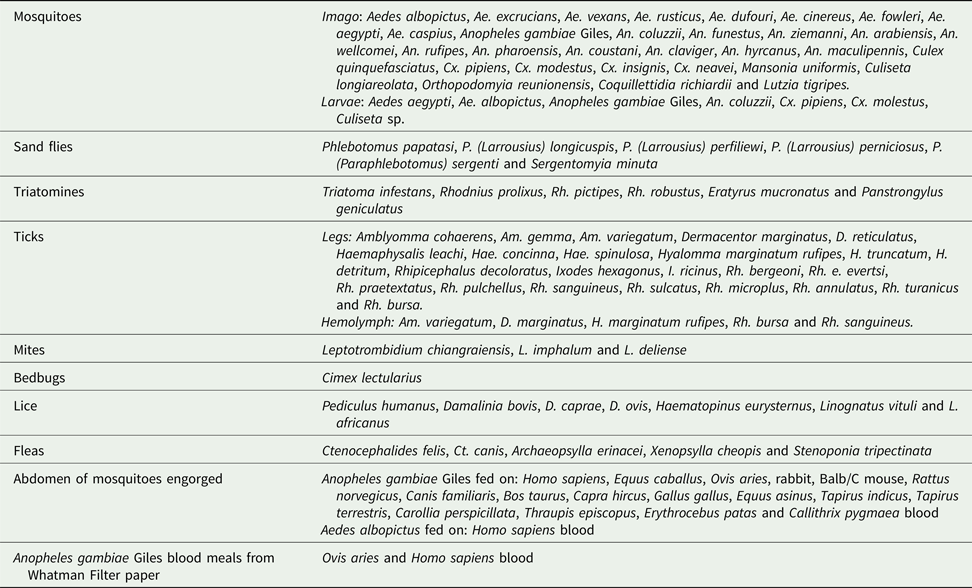
We used our in-lab arthropod MALDI-TOF database, which includes spectra obtained from various arthropods listed in Table 1. The database was upgraded with the spectra of three Culex quinquefasciatus mosquitoes and one Culex neavei mosquito collected and molecularly identified during this study. A comparison of the spectrum of each specimen of mosquito legs from Mali was evaluated against the home-made MS reference spectra database using the MALDI-Biotyper software v3.0. tool (Bruker Daltonics, Bremen, Germany). The level of significance was determined using the log score values (LSVs) provided by the MALDI-Biotyper software v.3.3. corresponding to a matched degree of signal intensities of mass spectra of the query and the reference spectra. LSVs ranged from zero to three. To determine the origin of blood meals, MALDI-TOF MS spectra from the abdominal proteins of engorged mosquitoes crushed on WFPs were also blindly queried against the database. A sample was considered to be correctly and significantly identified at the species level when the queried spectrum had a log score value (LSV) ⩾1.8 (Niare et al. Reference Niare, Berenger, Dieme, Doumbo, Raoult, Parola and Almeras2016).
List of the arthropod species present in our home-made MALDI-TOF MSa database.

a MALDI-TOF MS, matrix-assisted laser desorption/ionization time-of-flight mass spectrometry.
Cluster analysis
Cluster analysis on MSP (MSP, Main Spectrum Profile) spectra was performed and the comparison of the main spectra given by the MALDI-Biotyper software was clustered according to protein mass profile (i.e. their mass signals and intensities). We performed hierarchical clustering of the mass spectra of two specimens per mosquito species using the MSP dendrogram function. The clustering analyses were performed to visualize the homogeneity level of MS spectra from specimens belonging to the same species level. The resulting MSP dendrogram shows how samples are related to one another.
Molecular identification
A molecular tool was used to confirm MALDI-TOF MS identification in randomly selected mosquitoes. Molecular identification was also conducted for specimens whose spectra did not match with any mosquito spectrum in our database. When it was demonstrated that a high quality spectrum had been obtained from a mosquito species missing from our database, this new spectrum was added to the database. DNA extractions from individual mosquito heads and thorax samples were performed using the EZ1 DNA Tissue Kit (Qiagen, Hilden, Germany) according to the manufacturer's recommendations. A set of primers specifically amplifying a fragment of 710 bp of the mosquito's cytochrome c oxidase I gene (mCOI) was used (LCO1490 (forward): 5’-GGTCAACAAATCATAAGATATTGG-3’; HC02198 (reverse): 5’-TAAACTTCAGGGTGACCAAAAAATCA-3’ (Folmer et al. Reference Folmer, Black, Hoeh, Lutz and Vrijenhoek1994). We used gene Acetylcholinesterase-2 to amplify a fragment of 610 bp of Culex pipiens and a fragment of 274 bp of Cx. quinquefasciatus. The primers set were ACEquin (forward): 5′-CCTTCTTGAATGGCTGTGGCA-3′, ACEpip (forward): 5′-GGAAACAACGACGTATGTACT-3′, B1246s (reverse): 5′-TGGAGCCTCCTCTTCACGGC-3′ (Smith and Fonseca, Reference Smith and Fonseca2004).
A set of primers specifically amplifying a fragment of 310 bp of the Anopheles gambiae mosquito complex Acomplex_28S_MBF 5′-AGCKCGTCTTGGTCTGGGG-3′ and Acomplex_28S_MBR 5′-GCCGACAAGCTCAYTAGTGT-3′ was designed in our laboratory based on the work by Fanello et al. and PCR reactions were processed as described (Fanello et al. Reference Fanello, Santolamazza and della2002). Molecular identification of the blood was carried out on the bloody WFPs from 41 specimens randomly selected from the Malian samples, as previously described (Niare et al. Reference Niare, Berenger, Dieme, Doumbo, Raoult, Parola and Almeras2016). Positive PCR products were then purified and sequenced using the same primers with the BigDye version 1-1 Cycle Sequencing Ready Reaction Mix (Applied Biosystems, Foster City, CA) and an ABI 3100 automated sequencer (Applied Biosystems, Foster City, CA). The sequences were assembled and analyzed using the ChromasPro software (version 1.34) (Technelysium Pty. Ltd., Tewantin, Australia) and the NCBI BLAST website (http://blast.ncbi.nlm.nih.gov).
Results
Identification of the mosquitoes by MALDI-TOF MS
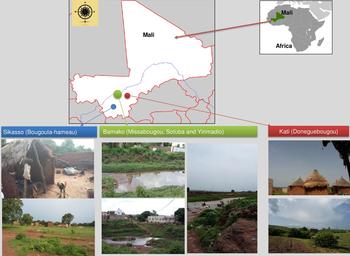
A total of 865 mosquitoes were captured by aspiration in Mali from various collection sites, including 257 in Bougoula-hameau, 168 in Donéguébougou, 230 in Sotuba, 125 in Missabougou and 85 in the Yirimadio semi-urban zones of Bamako (Fig. 1). All specimens collected were morphologically identified to genus level as Anopheles spp. (287/865; 33.18%), Culex spp. (573/865; 66.24%) and Aedes spp. (5/865; 0.58%).
Ecological patterns and geographic distribution of mosquito collection in Mali. Sikasso: Bougoula-hameau (rural area), Bamako: Sotuba (peri-urban area), Missabougou, Yirimadio (urban areas) and Kati: Doneguebougou (rural area).

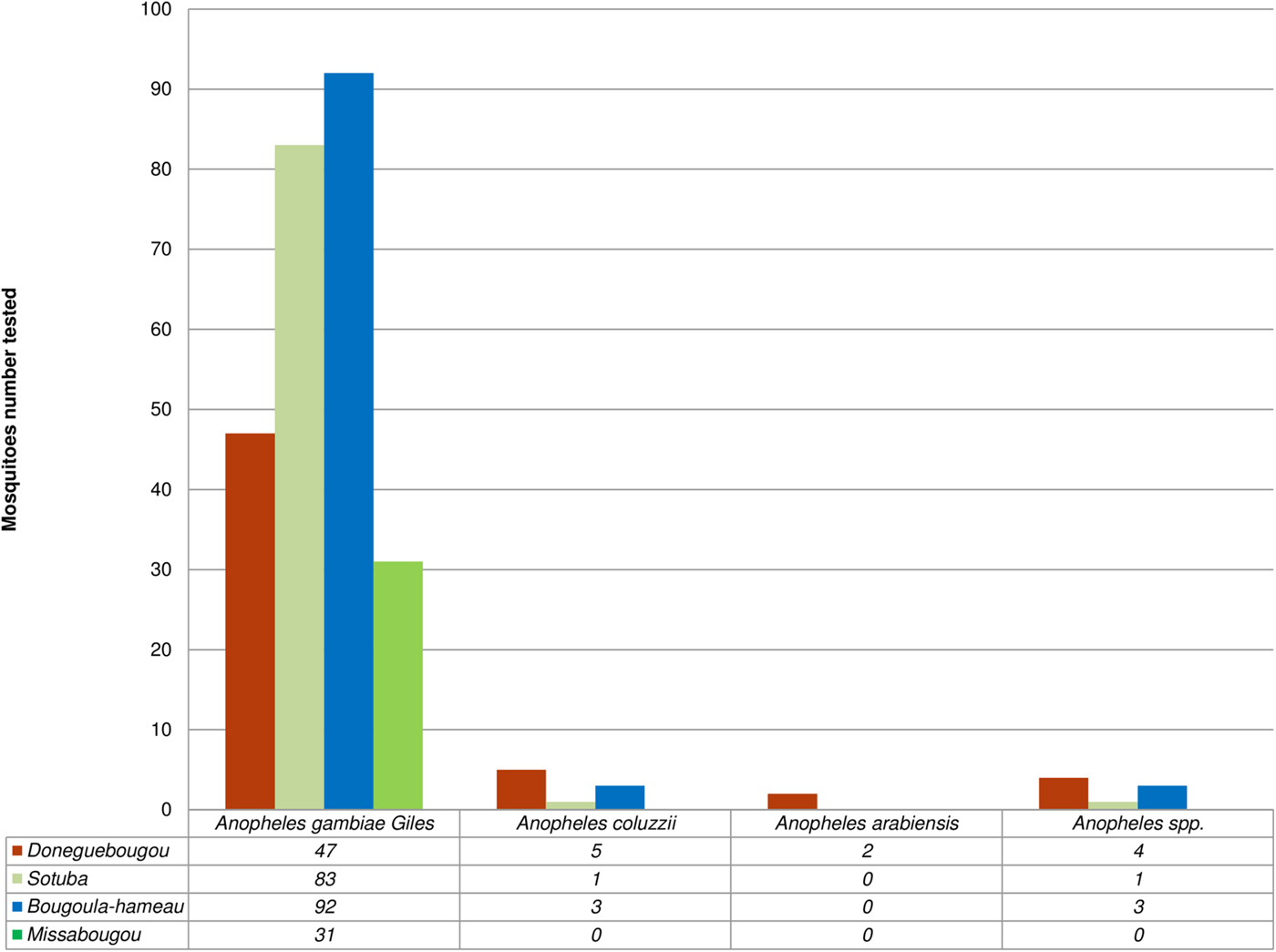
For MALDI-TOF analysis, MS spectra of good quality were obtained from 272 legs of Anopheles spp. Of these 272 Anopheles spp. tested against the arthropod MS database, 97% (n = 264/272) were identified with a log score value (LSV) ranging between 1.70 and 2.575. These 264 Anopheles specimens were identified as Anopheles gambiae Giles (95.80%, n = 253/264), Anopheles coluzzii (3.40%, n = 9/264) and Anopheles arabiensis (0.80%, n = 2/264) (Fig. 2) by MALDI TOF MS. The remaining eight Anopheles spp. were subjected to molecular identification.
MALDI-TOF MS Identification of 272 Anopheles spp. collected in Mali.

We tested the MS spectra from the legs of 549 Culex spp. against our arthropod database.
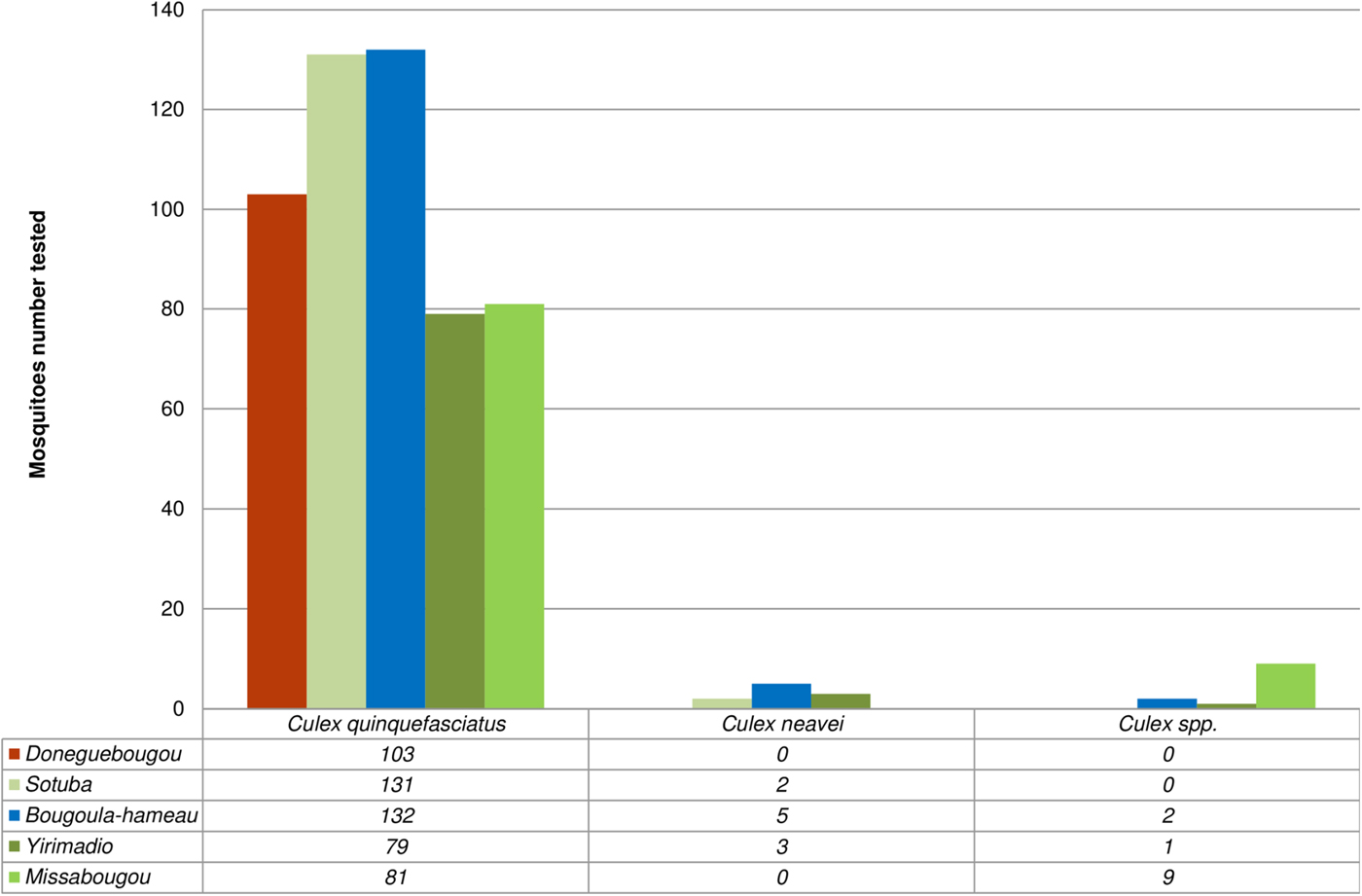
Of these 549 Culex spp. high-quality spectra, 98% (n = 537/549) were identified as species contained in our database. The 537 Culex specimens were identified by MALDI-TOF MS as Cx. quinquefasciatus (98%, n = 527/537) and Cx. neavei (2%, n = 10/537) from Mali (Fig. 3). These 537 Culex obtained LSVs ranging from 1.713 to 2.611. The remaining twelve Culex spp. were subjected to molecular identification.
MALDI-TOF MS Identification of 549 Culex spp. captured in Mali.

The five Aedes specimens were identified by MALDI-TOF MS as Aedes fowleri (n = 4) and Aedes aegypti (n = 1), with log score values ranging between 2.128 and 2.418.
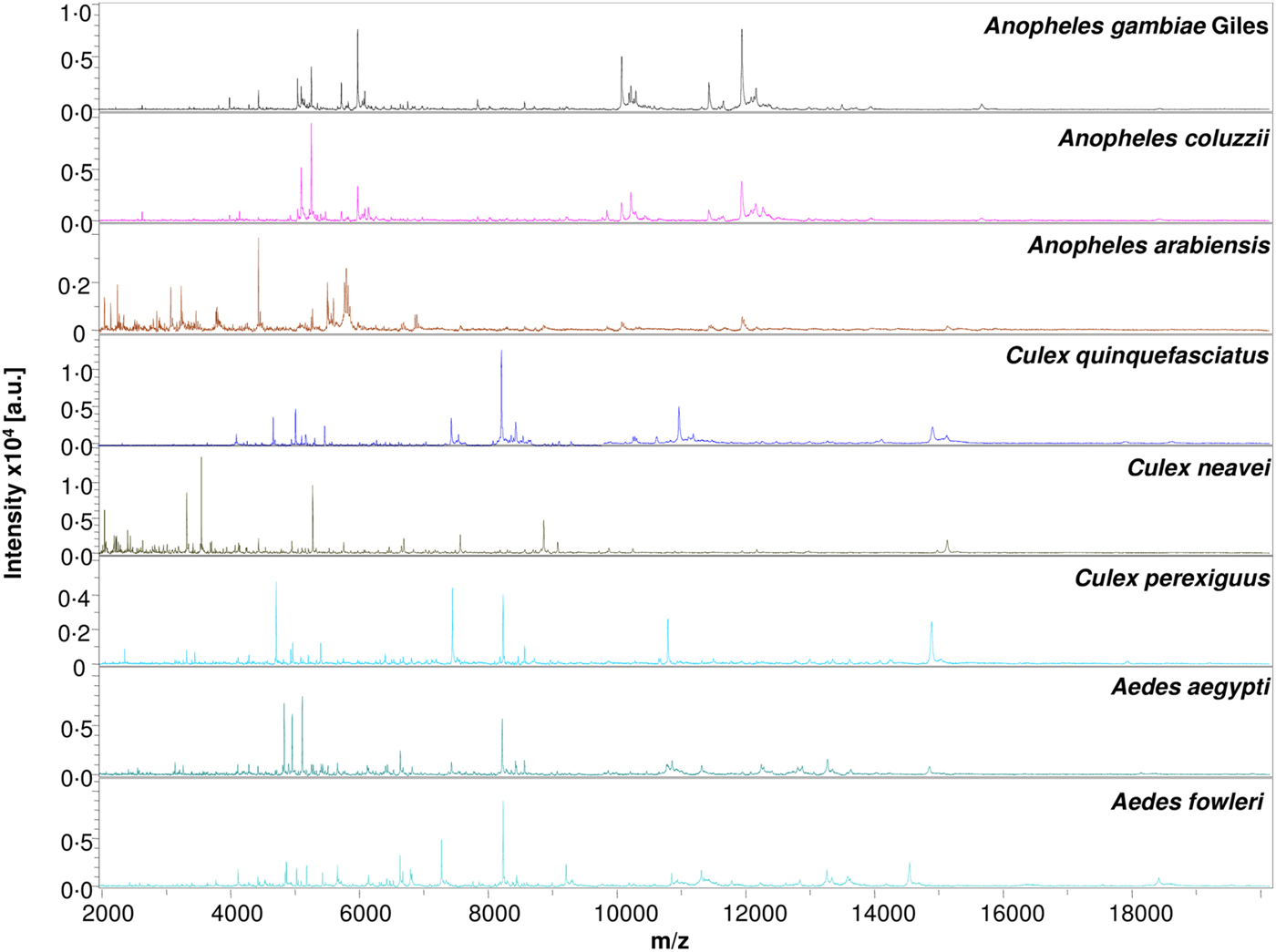
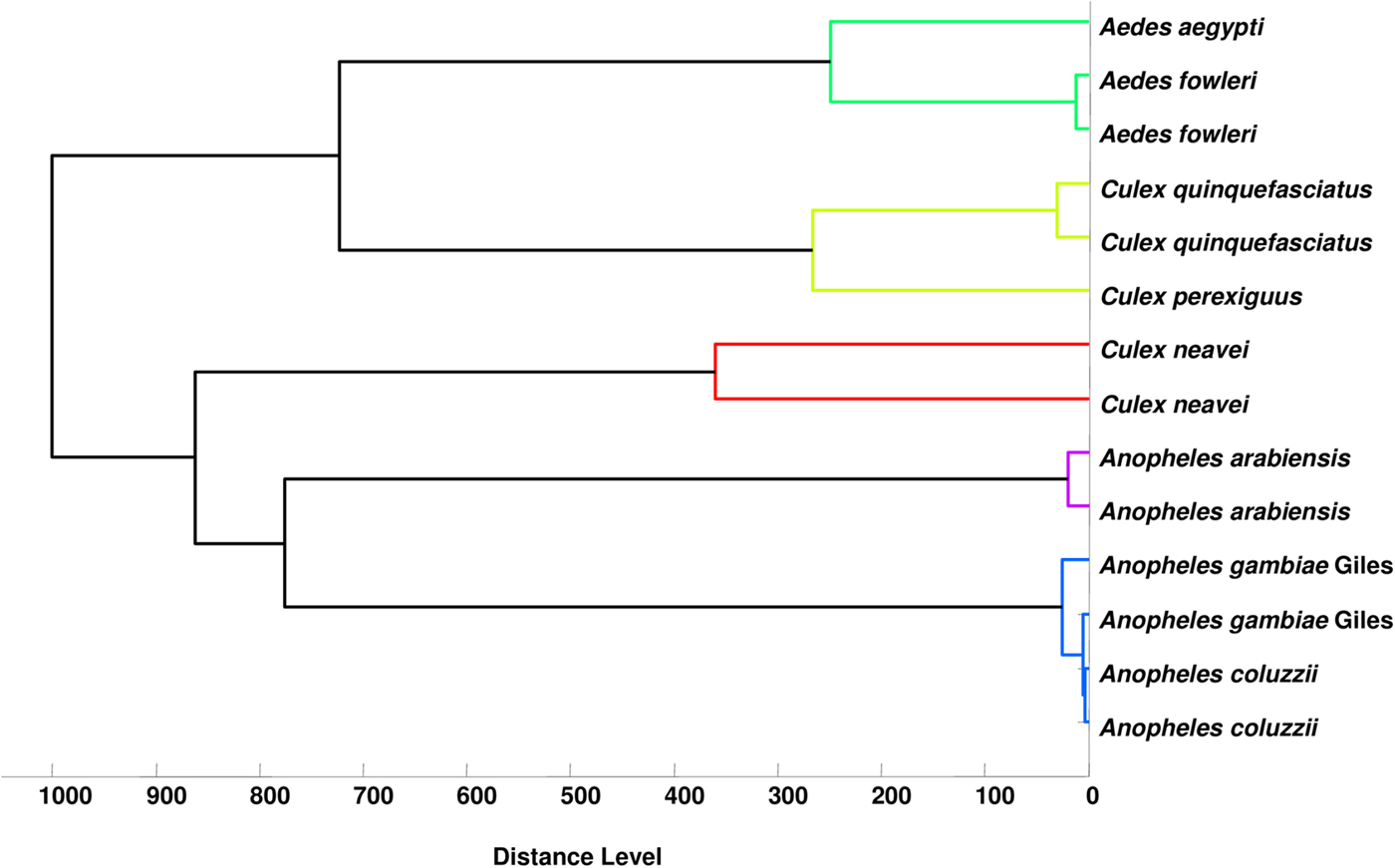
The MS spectra comparison from different mosquito species with Flex analysis software revealed an intra-species reproducibility and an inter-species specificity (Fig. 4). Visually, the signals and intensity of mosquito species’ protein profiles (Fig. 4) were consistent for MALDI-TOF identification and revealed eight different species, namely Anopheles gambiae Giles, An. coluzzii, An. arabiensis, Cx. quinquefasciatus, Cx. neavei, Culex perexiguus, Ae. fowleri and Ae. aegypti. Clustering analysis of MSP spectra from two specimens per mosquito species was used to generate a dendrogram. Clustering analysis revealed a gathering on distinct branches, following the eight species which were loaded (Anopheles gambiae Giles, An. coluzzii, An. arabiensis, Cx. quinquefasciatus, Cx. neavei, Cx. perexiguus, Ae. fowleri and Ae. aegypti) (Fig. 5). The clusters formed were consistent with the intra-species reproducibility and inter-species specificity visually observed on protein profiles.
Comparison of MALDI-TOF MS profiles of eight mosquito species collected in Mali. Spectra analysis was performed using Flex analysis 3.3 software. Abbreviations: a.u., arbitrary units; m/z, mass-to-charge ratio.

MSP (Main Spectrum Profile) dendrograms of MALDI-TOF MS spectra of eight mosquito species collected in Mali. Clustering analysis was performed using MALDI Biotyper software. Distance unit corresponds to the relative similarity calculated from the distance matrix.

Molecular identification of mosquitoes collected in Mali
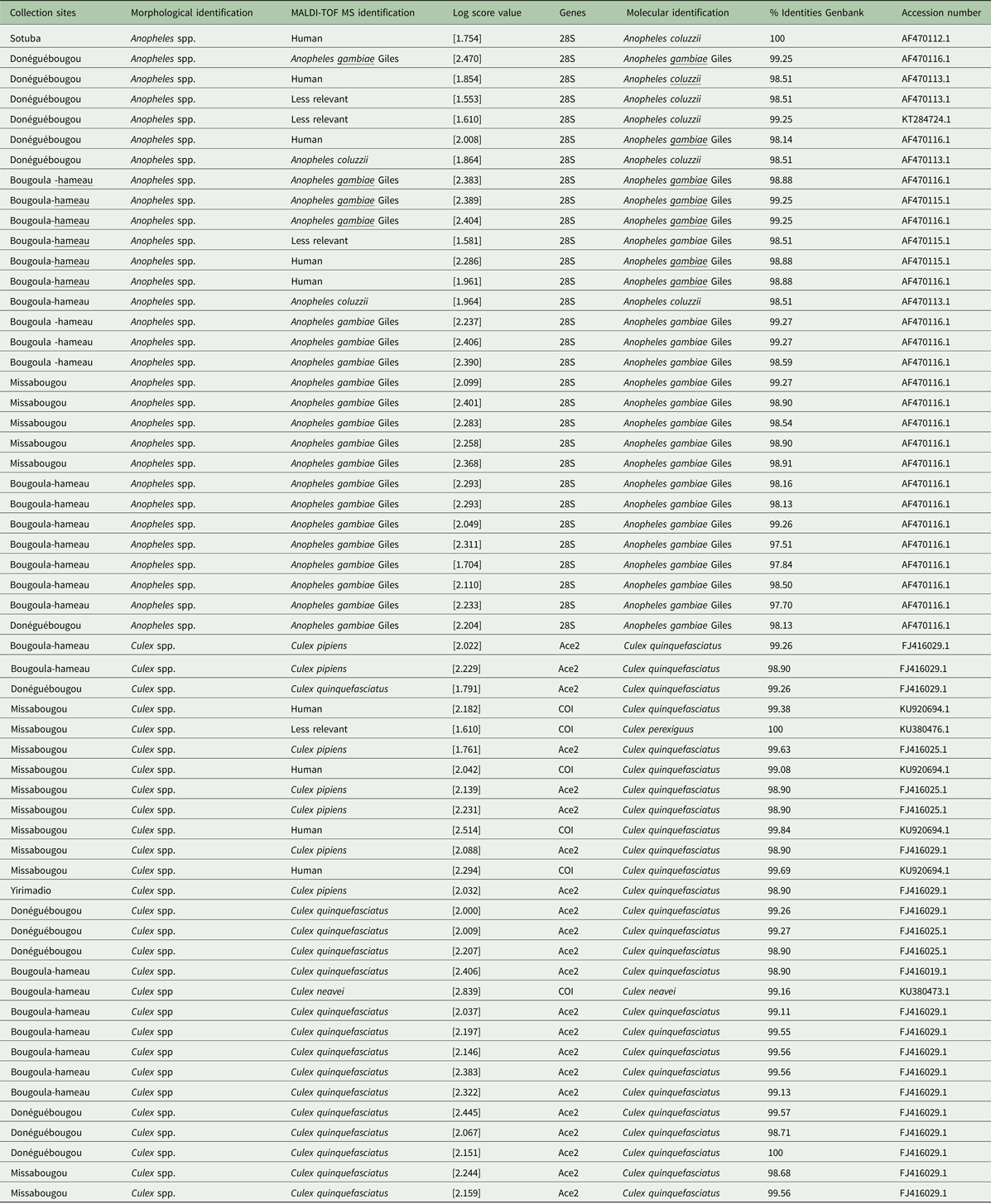
Molecular biology was performed to confirm the mosquito identification resulting from the MALDI-TOF MS analyses. For this purpose, we randomly selected 20/253 An. gambiae Giles, 2/9 An. coluzzii, 15/527 Cx. quinquefasciatus, 1/10 Cx. neavei for sequencing. The 28S gene sequencing of Anopheles corroborated the MALDI-TOF MS identification in all cases, with between 97.51 and 99.27% identity with Genbank sequences (Table 2).
Molecular identification of mosquitoes collected in Mali

MALDI-TOF MS, matrix-assisted laser desorption/ionization time-of-flight mass spectrometry; Ace 2: acetylcholinesterase-2; COI: the cytochrome c oxidase; %, per cent.
The acetylcholinesterase-2 and COI genes were used to identify the Culex species. Sixteen specimens of Cx. quinquefasciatus (n = 15) and Cx. neavei (n = 1) were randomly selected for sequencing. The molecular results were found to be highly consistent with the MALDI-TOF MS identification. Sequences obtained from Cx. quinquefasciatus and Cx. neavei were shown to share between 98.90 and 100% identity with Genbank (Table 2).
Molecular biology was also carried out on the mosquitoes that were not identified by MALDI-TOF MS (low scores), including the eight Anopheles spp. and 12 Culex spp. Sequencing of the 28S gene was performed to identify the eight Anopheles spp. (3%, n = 8/264). The matching sequences corresponded to Anopheles gambiae Giles (n = 4) and An. coluzzii (n = 4), which were shown to share between 98.52 and 100% identity with Genbank (Table 2).
The acetylcholinesterase-2 and COI genes were amplified to identify the 12 Culex spp. which were misidentified (2%, n = 12/549) by MALDI-TOF MS. The sequences obtained correspond to the Cx. quinquefasciatus (n = 11) which were shown to share between 98.90 and 100% identity with Genbank and 100% identity with Cx. perexiguus (n = 1) (Table 2).
Identification of the bloody WFPs sources by MALDI-TOF MS
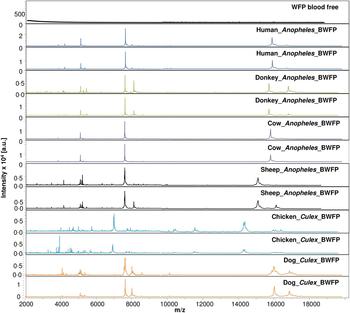
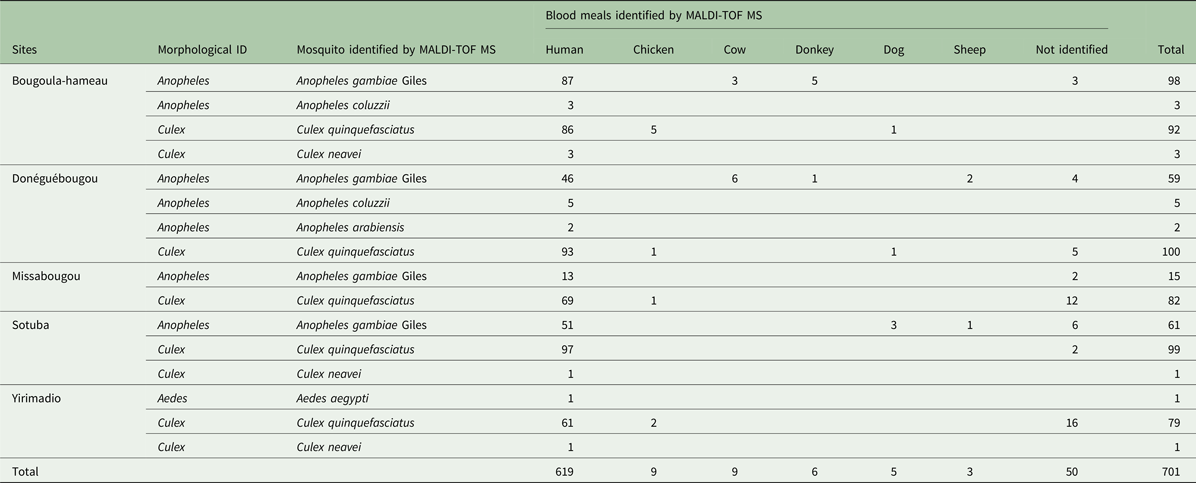
A total 701 abdomens of engorged mosquitoes were crushed in WFPs in the field in Mali. The 701 bloody BWFPs were submitted for MALDI-TOF MS analysis in Marseille one month after sampling. Of the 701 BWFPs, 651 (93%) high-quality spectra were obtained. The 651 BWFPs MS high-quality spectra were queried against our blood source MALDI-TOF MS database for identification. They matched with spectra from our database, including those of mosquito abdomens engorged with human blood (n = 619), chicken blood (n = 9), cow blood (n = 9), donkey blood (n = 6), dog blood (n = 5) and sheep blood (n = 3) (Table 3). These blood meals were identified using MALDI-TOF MS with log score values (LSVs) ranging from 1.707 to 2.731. The MS spectra comparison of different host blood revealed an intra-species reproducibility and an inter-species specificity by Flex analysis (Fig. 6).
The MS spectrum alignment from mosquito abdomen engorged on vertebrate host bloods and then crushed on Whatman filters. All bloody WFPs (BWFPs) were obtained from the field mosquitoes collected in Mali and crushed on WFPs. The MS spectrum alignment was performed by Flex analysis 3.3 software. The WFP blood free corresponds to the MS profiles of WFPs where no mosquito blood meal was released. The representative MS spectra from abdominal protein corresponds to Anopheles gambiae Giles abdomens BWFPs feed on human, donkey, cow and sheep blood, and Culex quinquefasciatus abdomens feed on chicken and dog blood. a.u. arbitrary units; m/z mass-to-charge ratio.

Identification of the blood meals of mosquitoes collected in distinct ecological areas in Mali

ID, Identification; MALDI-TOF MS, matrix-assisted laser desorption/ionization time-of-flight mass spectrometry.
Molecular identification of the bloody mosquito WFPs
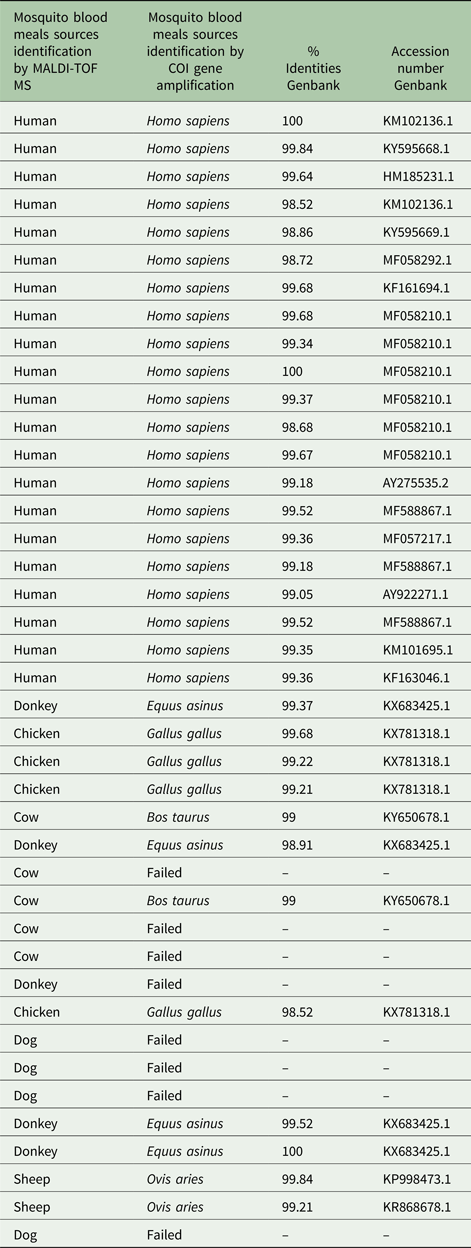
A total of 41 bloody WFPs identified by MALDI-TOF MS as mosquito abdomens engorged with human blood (n = 21), donkey blood (n = 5), chicken blood (n = 4), cow blood (n = 5), dog blood (n = 4) and sheep blood (n = 2) were randomly selected for sequencing by COI gene amplification. Thirty-three bloody WFPs sequences were obtained which confirmed the accuracy of the MS identification. However, for eight bloody WFPs, no quality sequences could be obtained. The results of the PCR based on bloody WFP sequencing highly correlated with the results of MALDI TOF MS identification (Table 4). The sequences obtained from seventeen bloody WFPs had identities between 98.52 and 100% against Genbank NCBI (Table 4).
Molecular identification of the blood from mosquito's abdomens crushed on Whatman filter papers

MALDI-TOF MS, matrix-assisted laser desorption/ionization time-of-flight mass spectrometry; COI, the cytochrome c oxidase; %, per cent.
Discussion
The goal of this work was not to provide precise data on the presence and abundance of various mosquito species in specific areas in Mali. Indeed, these data vary according to the type of climate and the seasons. However, we did want to test the usefulness of MALDI-TOF MS using mosquitoes collected in the field, as most preliminary studies have used laboratory specimens.
The use of MALDI-TOF MS has recently emerged in medical entomology, including for the identification of arthropods, their blood meals and the detection of potential microorganisms (Schaffner et al. Reference Schaffner, Kaufmann, Pfluger and Mathis2014; Yssouf et al. Reference Yssouf, Almeras, Raoult and Parola2016). The choice of the arthropod body part is critical for specimen identification by MALDI-TOF MS (Yssouf et al. Reference Yssouf, Almeras, Raoult and Parola2016). For example, the legs from adult mosquitoes have been shown to be sufficient for identification, whereas whole specimens have been used for aquatic stages (larvae) (Nebbak et al. Reference Nebbak, Koumare, Willcox, Raoult, Almeras and Parola2017).
Here, the MS spectra from mosquito legs collected in Mali, including 264 Anopheles, 549 Culex and five Aedes, permitted MALDI-TOF MS identification. The MS spectrum analyses from the mosquito legs revealed an intra-species reproducibility and inter-species specificity consistent with molecular validation (Fig. 5). Accurate identification of mosquitoes queried against the home-made MS database corresponded to 100% concordance with molecular identification results (Table 2). The consistent identification between molecular biology and MALDI-TOF MS was validated by the choice of the 28S gene for Anopheles species identification, and the acetylcholinesterase-2 and COI genes for Culex species identification. As shown in previous studies, the choice of these genes was highly relevant to discriminate and assess the phylogenetic relation between different mosquito species (Folmer et al. Reference Folmer, Black, Hoeh, Lutz and Vrijenhoek1994; Fanello et al. Reference Fanello, Santolamazza and della2002; Smith and Fonseca, Reference Smith and Fonseca2004). Here, the quality of spectra was a very important element for identification, as more than 98% of the good quality spectra were identified with LSVs >1.8. The MALDI-TOF MS reference database has been updated with other mosquito species. It is necessary to create a reference database, which could subsequently be shared, and open access could be provided for routine arthropod identification. In this study, Aedes mosquitoes collected in Mali were correctly identified as Ae. fowleri using a database containing reference spectra of this species collected from La Reunion Island only, which is located in the Pacific Ocean. Therefore MALDI-TOF MS appears as an efficient tool for the identification of arthropods collected from distant geographical areas.
For Raharimalala et al. (Reference Raharimalala, Andrianinarivomanana, Rakotondrasoa, Collard and Boyer2017), the usefulness and accuracy of MALDI-TOF MS as a tool to identify vector mosquito species requires the creation of an international database (Raharimalala et al. Reference Raharimalala, Andrianinarivomanana, Rakotondrasoa, Collard and Boyer2017). In this study, 2.40% of inconsistent MS leg results were attributed to low-quality MS spectra for identification. The MS spectra of some legs (n = 9) (Table 2) that matched with reference spectra of mosquito abdomens engorged with human blood were attributed to traces of blood on the legs during the abdomen crushing process onto WFPs. This phenomenon of low-quality spectra, leading to lower identification rates have been reported in arthropod identification such as at the aquatic mosquito stage (Dieme et al. Reference Dieme, Yssouf, Vega-Rua, Berenger, Failloux, Raoult, Parola and Almeras2014). According to the reproducibility of MS spectra, the hierarchical clustering showed that all specimens from the same species were grouped in the same branch. These results are similar to previous studies supporting inter-species reproducibility for mosquito identification (Yssouf et al. Reference Yssouf, Socolovschi, Flaudrops, Ndiath, Sougoufara, Dehecq, Lacour, Berenger, Sokhna, Raoult and Parola2013). Additionally, we stress that MS cannot yet be considered a reliable tool for the phylogenetic study of mosquito species (Yssouf et al. Reference Yssouf, Socolovschi, Flaudrops, Ndiath, Sougoufara, Dehecq, Lacour, Berenger, Sokhna, Raoult and Parola2013).
Our results showed that 95% of the collected mosquitoes had fed on human blood. This result is not surprising because all mosquitoes were collected inside homes. The advantage of our MALDI-TOF approach is its rapidity, effectiveness and reliability in determining bloody WFPs, since more than 100 bloody WFPs specimens were processed per day. Previously, the authors had demonstrated that the profiles of abdominal spectra of mosquito females engorged on human blood are the same, regardless of whether they were crushed or not crushed on WFPs (Niare et al. Reference Niare, Almeras, Tandina, Yssouf, Bacar, Toilibou, Doumbo, Raoult and Parola2017). Indeed, the home-made database contains filter papers with Anopheles gambiae engorged blood such as human blood and sheep blood. These authors tested WFP either with the crushed abdomen of a non-engorged mosquito or simply as a control (Niare et al. Reference Niare, Almeras, Tandina, Yssouf, Bacar, Toilibou, Doumbo, Raoult and Parola2017). These results suggest that MALDI-TOF MS is not time-consuming in comparison with molecular tools and serological techniques. The eight bloody WFPs which failed molecular biology identification may be attributed to blood meal digestion. As previously reported, the time of the host blood digestion in the mosquito has an impact upon blood meal identification by MALDI-TOF MS and molecular biology (Niare et al. Reference Niare, Berenger, Dieme, Doumbo, Raoult, Parola and Almeras2016). Moreover, the molecular biology results of the seventeen BWFPs sequences obtained by COI gene amplification corroborated the MALDI-TOF MS identification (Table 4).
Interestingly, as we have recently found that MALDI-TOF may also recognize mixed blood meals (unpublished), we did not find any mixed blood meals either by molecular tools nor by MALDI-TOF. The authors experimentally engorged An. gambiae Giles mosquitoes with a mixture of blood from distinct vertebrate hosts, such as human, sheep and dogs. Their results demonstrate that mixed mosquito blood meals can be successfully identified, depending on the concentration ratio (unpublished). Recently, some authors have also used the proteomic approach to identify the sources of tick mixed blood meals (Onder et al. Reference Onder, Shao, Kemps, Lam and Brisson2013).
Of the mosquitoes identified by MALDI-TOF MS, A. gambiae Giles and Cx. quinquefasciatus were widely distributed across all collection sites. Our work enabled Cx. neavei and Cx. perexiguus to be detected for the first time in Mali. Currently, few studies have been carried out on the Culex species in Mali, particularly on their abundance, ecology and the infectious pathogens transmitted by these vectors. Culex species are widely distributed in West Africa and are found in any type of breeding sites (clear and polluted water), whereas the Anopheles species colonizes sunny, fresh water (Becker et al. Reference Becker, Petriæ, Zgomba, Boase, Dahl, Madon and Kaiser2010). There is an abundant literature on these mosquitoes, the well-known distribution of Cx. neavei and Cx. perexiguus in sub-Saharan Africa and their implication in the transmission of many arboviruses (Jupp et al. Reference Jupp, McIntosh and Blackburn1986; Fyodorova et al. Reference Fyodorova, Savage, Lopatina, Bulgakova, Ivanitsky, Platonova and Platonov2006; Nikolay et al. Reference Nikolay, Diallo, Faye, Boye and Sall2012; Fall et al. Reference Fall, Diallo, Loucoubar, Faye and Sall2014; Gould et al. Reference Gould, Pettersson, Higgs, Charrel and de Lamballerie2017). The presence of these potential vectors in Mali might be of epidemiological importance.
Our study is the first to use MALDI-TOF MS as a tool for monitoring field mosquitoes in Africa, particularly in Mali, an endemic malarial area. Moreover, when the MALDI-TOF MS device is bought for clinical microbiology purposes, it can also be used for medical entomology at no additional cost. For example, at the Dakar hospital in Senegal, the MALDI-TOF MS equipment that was initially bought for clinical microbiology has been used for field entomology surveys and has successfully identified Culicoides (Sambou et al. Reference Sambou, Aubadie-Ladrix, Fenollar, Fall, Bassene, Almeras, Sambe-Ba, Perrot, Chatellier, Faye, Parola, Wade, Raoult and Mediannikov2015). In Senegal, the acquisition of MALDI-TOF MS equipment has revolutionized bacteriology laboratories and clinical microbiology domains, suggesting that this technique can be used as a front-line tool in tropical countries (Lo et al. Reference Lo, Fall, Sambe-Ba, Diawara, Gueye, Mediannikov, Sokhna, Faye, Dieme, Wade, Raoult and Fenollar2015).
Although the time period for blood meal source determination by MALDI-TOF MS was shorter than that of molecular biology or ELISA, the rapidity and low cost of the reagents made this proteomic method a financial and reliable competitive strategy. However, the relatively high cost of the machine could be an impediment to implementation of this innovative tool in laboratories. The cost of purchasing the MALDI-TOF MS equipment in under-developed countries such as Mali (sub-Saharan Africa) could be a limitation to estimating the local vector-borne risk. However, when the device is bought by a microbiology lab it can be used in medical entomology at no additional cost.
Concluding remarks
The present study successfully identified field mosquitoes and the sources of their blood meals using MALDI-TOF MS. The mosquitoes collected in Mali were correctly identified based on reproducibility and specificity from the protein profiles of leg extracts. The innovative MALDI-TOF MS tool enabled the rapid identification of eight mosquito species in Mali during entomological surveys. The challenge is to maintain and develop collaboration between north and south to facilitate the acquisition of the MALDI-TOF MS equipment.
Acknowledgements
We thank all members of the various MRTC sites where mosquitoes were collected. We would also like to acknowledge all the residents of the various concessions where we captured mosquitoes.
Competing interests
The authors declare that they have no competing interests.
Author contributions
PP, TF and NS designed and developed the protocol. TF and NS performed the protocol. PP, TF, NS and ML analysed the data. KKA, DZA, OA, BMJ, OD and RD contributed reagents/materials/analysis tools. PP, TF and NS wrote the paper. OD and RD contributed to editing the paper. All authors agreed to publication.
Financial support
The project has received funding from the Excellence Initiative of Aix-Marseille University – A*MIDEX, a French ‘Investissements d'Avenir’ program (No. ANR-11-IDEX-0001-02) and grants from the Malian Minister of Health, the Foundation Mérieux, UMI3189, and the Malian Research and Training Center (MRTC) for the field specimen collection.