INTRODUCTION
Galicia, a region of northwestern Spain, has a long tradition of winemaking. The red cultivar Caiño Tinto is one of the most appreciated in the most important Appellation d'Origine Contrôlée (AOC) areas of the region (Rías Baixas and Ribeiro), although presently it is not grown in great quantity. The cultivars Caiño Bravo and Caiño Longo are also traditional red cultivars of the region (Santiago et al. Reference Santiago, Boso, Martín, Ortiz and Martínez2005); however, they appear in the Lista de Variedades Comerciales y Portainjertos de Vid (Ministerio de Agricultura Reference Ministerio2002) as ‘provisional inscriptions’. They will become ‘definitive inscriptions’ when more information becomes available on their ampelographic and oenological characteristics. For a variety to be officially cultivated in any Spanish winemaking region, or for it to be introduced into an AOC area as an authorized or preferred variety, its name must appear as a definitive inscription in the above list.
The volatile compounds responsible for the primary or ‘grape-derived’ aroma of wines are of great importance in the current effort to differentiate wines on the basis of the grape variety used and the production area (Arrhenius et al. Reference Arrhenius, McCloskey and Sylvan1996). These volatile compounds are mainly terpenes and C13-norisoprenoids, which supply fruity or floral notes to the aroma (Ong & Acree Reference Ong and Acree1999). They are formed during the ripening of the grape (Bayonove & Cordonnier Reference Bayonove and Cordonnier1971; Marais Reference Marais1983; Marais & Van Wyck Reference Marais and Van Wyck1986; Carballeira et al. Reference Carballeira, Cortés, Gil and Fernández2001) and their concentration is strongly influenced by the cultivar, the soil, climate and viticultural practices (Jackson & Lombard Reference Jackson and Lombard1993; Razungles et al. Reference Razungles, Gunata, Pinatel, Baumes and Bayonove1993, Reference Ribereau-Gayon, Glories, Maujean and Dubourdieu1998; Agosin et al. Reference Agosin, Belancic, Ibacache, Baumes, Bordeu, Crawford and Bayonove2000).
These aromatic compounds exist either in a free or glycosidically bound state (Williams et al. Reference Williams, Strauss and Wilson1981; Sefton et al. Reference Sefton, Francis and Williams1993; Skouroumounis & Winterhalter Reference Skouroumounis and Winterhalter1994; Skouroumounis et al. Reference Skouroumounis, Massy-Westropp, Sefton and Williams1995; Diéguez et al. Reference Diéguez, Lois, Gómez and De La Peña2003) and are found in the skin (especially) and pulp (Wilson et al. Reference Wilson, Strauss and Williams1986; Park et al. Reference Park, Morrison, Adams and Noble1991; Gómez et al. Reference Gómez, Martínez and Laencina1994). Certain winemaking techniques, such as skin contact, can increase the aromatic content of a wine (Lanaridis et al. Reference Lanaridis, Salaha, Tzourou, Tsoutsouras and Karagiannis2002). According to Di Stefano (Reference Di Stefano1989), although these compounds pass directly into the wine, they can become modified over time depending on the pH of the wine and storage temperature. In aromatic grape varieties, the bound fraction of aromatic compounds is usually the more abundant (Dimitriadis & Williams Reference Dimitriadis and Williams1984; Gunata et al. Reference Gunata, Bayonove, Baumes and Cordonnier1985; Rocha et al. Reference Rocha, Coutinho, Barros, Coimbra, Delgadillo and Cardoso2000). The contribution of these compounds to the final aroma depends on whether their concentration in the wine is above the perception threshold. According to Di Stefano et al. (Reference Di Stefano, Borsa, Maggiorotto and Corino1995), the main aromatic differences between grape varieties are more quantitative than qualitative. The ratios established between the different aromatic compounds are also important. The presence and concentration of grape-derived aromatic compounds have been used by several authors for varietal differentiation and characterization (Williams et al. Reference Williams, Strauss and Wilson1981; Gunata et al. Reference Gunata, Bayonove, Baumes and Cordonnier1985; Marais & Van Wyck Reference Marais and Van Wyck1986; Razungles et al. Reference Razungles, Gunata, Pinatel, Baumes and Bayonove1993; Sefton et al. Reference Sefton, Francis and Williams1993; Diéguez et al. Reference Diéguez, Lois, Gómez and De La Peña2003).
In aromatic varieties, the concentrations of free volatile compounds are usually above their perception thresholds. In more neutral wines, the release of the bound forms by chemical or enzymatic hydrolysis (Williams et al. Reference Williams, Strauss and Wilson1981; Gunata et al. Reference Gunata, Bayonove, Baumes and Cordonnier1986; Marais & Van Wyck Reference Marais and Van Wyck1986; Wilson et al. Reference Wilson, Strauss and Williams1986; Rapp Reference Rapp1998; Ollat et al. Reference Ollat, Diakou-Verdin, Carde, Barrieu, Gaudillere and Moing2002) can notably increase the aroma. Among the compounds responsible for grape-derived aroma, linalool, citronellol and geraniol stand out, with floral and citrus aromas and very low perception thresholds (Francis & Newton Reference Francis and Newton2005). In any event, the presence of these compounds in a wine can be detected by their synergistic effects: the presence of one tends to potentiate the perception of the rest.
The present work reports the concentration of the major aromatic compounds (both in the free and bound form) responsible for the primary or grape-derived aroma of the wines produced from cv. Caiño Tinto, Caiño Longo and Caiño Bravo grapes. The study forms part of a wider project to differentiate and classify the minority red grape varieties of Galicia.
MATERIALS AND METHODS
Reagents
Methanol, distilled azeotropic dichloromethane–pentane (1:2 v/v) and ethanol were all of analytical grade and supplied by Merck (Germany). Acetate buffer (acetic acid 0·0595 mol/l) pH 5 was made with analytical grade reagents from Probus (Spain). The corporate governance (CG) standards used were from Aldrich Chemical (Switzerland).
Grape juice
The vine strains used in the present study belonged to the collection of the Misión Biológica de Galicia (CSIC) at Salcedo (Pontevedra), which was also home to a meteorological station. The mean annual temperature of this region is 14·4°C and the mean annual rainfall is 1586 mm. The soil where the grape cultivars were grown is a sandy loam with 80 g organic material/kg soil. All the studied plants (10 replicates per cultivar) were of the same age, had 110-Richter rootstocks, were grown en espalier, were subjected to Sylvoz pruning and received identical crop protection treatments. Manual weeding was performed several times per year.
Fermentation
The wines investigated were made from Caiño Blanco, Caiño Tinto and Caiño Longo grapes harvested in two different seasons (2002 and 2003). After removing the leaves, stalks, etc., the grapes were crushed by hand to prevent the breakage of the seeds. SO2 was added at 50 mg/l. Spontaneous fermentations were performed in 16 litre glass vessels containing 10 litres of grape juice of each variety; these were allowed to proceed at 18°C for 15 days. Sugar density was measured daily. When fermentation was finished, the wine was separated from the skins. The latter were then pressed to extract any wine they contained. All of the samples were racked and the free SO2 content adjusted to 50 mg/l. After bottling, 1 litre of each wine was conserved at 10°C until analysis. The wines were analysed 3 months after the completion of primary fermentation. All analyses were performed in triplicate.
Sample preparation
Free and bound terpenes were fractionated by selective retention on SepPak Vac C-18 (1 g, purchased from Waters), according to the procedure described by Di Stefano (Reference Di Stefano1991) with some modifications (Carballeira et al. Reference Carballeira, Cortés, Gil and Fernández2001). The cartridges were sequentially conditioned with methanol (5 ml) and distilled water (10 ml). A sample of 100 ml of centrifuged wine diluted with 100 ml of distilled water and containing 1 ml of internal standard (3-octanol at 10 ppm in ethanol) was passed through the cartridge; the residue was washed with 25 ml of distilled water. The free fraction was eluted with 10 ml of pentane–dichloromethane (2:1) and the solution was dried over anhydrous sodium sulphate and, prior to gas chromatography (GC) analysis, concentrated to 0·5 ml by evaporation under a nitrogen stream. The bound fraction was eluted with 10 ml of methanol and concentrated to dryness in a rotary evaporator before dissolution in 5 ml of citrate-phosphate buffer (pH 5·0). Enzyme solution 200 μl of with β-glycosidase activity (0·5 g of AR-2000 (Gist Brocades, France) in 5 ml of the same buffer) was added and the mixture was incubated at 40°C for 18 h to accomplish enzymatic hydrolysis. After the addition of the same internal standard (3-octanol), the aglycons were extracted on SepPak Vac C-18 (1 g), according to the procedure described previously, to the free forms. Before GC analysis, the organic phase was dried with sodium sulphate and concentrated to 0·5 ml by evaporation with a stream of nitrogen.
Chromatographic analysis
To determine the identities and amounts of free and bound aromatic compounds present, the extracts were analysed by GC.
The analyses were carried out using a Hewlett Packard 5890 Series II Gas-Chromatograph equipped with an HP 6890 Automatic Injector and a Flame Ionization Detector (hydrogen, 40 ml/min; air, 400 ml/min). The compounds were separated on a CHROMPACK CP-WAX 57CB (polyethylene glycol stationary phase; 50 m×0·25 mm id with 0·25 μm film thickness) fused-silica capillary column.
The instrumental conditions were: column temperature, 60°C for 5 min, rising to 200°C at 3°C/min, then 200°C for 25 min; injector temperature: 250°C; detector temperature: 260°C; make-up gas: nitrogen 25 ml/min; injection mode, Splitless (30 s); volume injected, 1·0 μl; carrier gas: helium at 1·07 ml/min.
Identification and quantification
Aromatic compounds were identified by comparison of their retention times with those of pure standards. An internal standard (3-octanol) was used for quantitative purposes.
Statistical analyses
Differences among the wines with respect to their aromatic compound contents were assessed by one-way analysis of variance (ANOVA). Principal component analysis (PCA) was performed using SAS Software v8.1 (SAS Institute, Cary, NC).
RESULTS
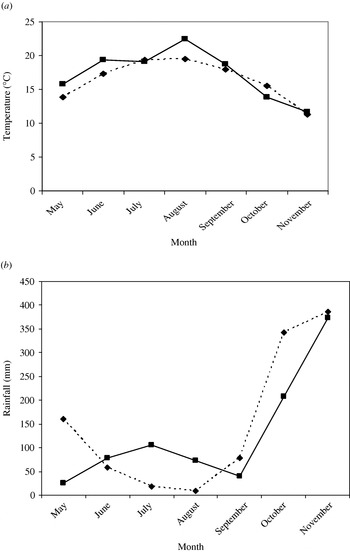
Figure 1 shows climate data for the 2002 and 2003 growth periods (temperature and total rainfall). Mean temperature and rainfall were higher during the July–August ripening period of 2003 than in 2002.
Climate data for the 2002 and 2003 growth periods. (a) Temperature and (b) total rainfall. - - - -◆- - - -, Year 2002;––––■––––, year 2003.

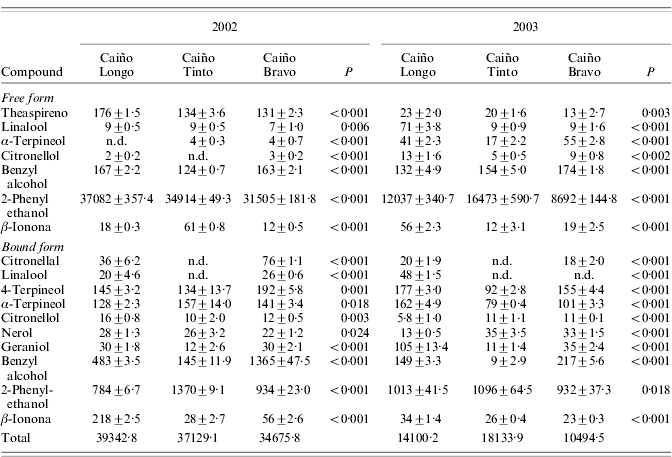
To assess the aromatic composition of Caiño Longo, Caiño Tinto and Caiño Bravo wines, the concentration of free and bound aroma compounds was determined. Mean concentration and standard deviation of free and bound compounds in Caiño Tinto, Caiño Longo and Caiño Bravo wines in 2002 and 2003 are shown in Table 1. Significant differences were found among wines in the mean concentrations of all aromatic compounds in both vintages. The total content of compounds varied from 34675·83 to 39342·77 μg/l in 2002 vintage and 10494·54 to 18133·93 μg/l in 2003 vintage (Table 1).
Mean concentration (μ) and standard deviation of free and bound volatile compounds in Caiño Tinto, Caiño Longo and Caiño Bravo wines in 2002 and 2003 vintages
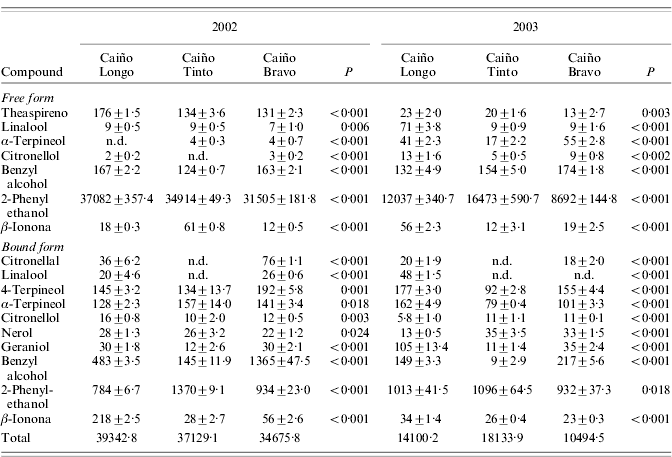
The data are the mean of three values±standard deviation; n.d.: not detected.
Free forms
The highest concentrations of free volatile compounds were found in the Caiño Longo wines, followed by the Caiño Tinto wines. Caiño Bravo wines had the lowest concentrations of free terpenes. In the wines made from all three cultivars, the most abundant free aromatic compound was 2-phenylethanol, with levels well over the perception threshold (10 000 μg/l) (Swiegers et al. Reference Swiegers, Bartowsky, Henschke and Pretorius2005).
In the Caiño Bravo wines from 2003, α-terpineol was the most abundant monoterpene, although it was never above the perception threshold (330 μg/l) (Escudero et al. Reference Escudero, Gogorza, Melús, Ortín, Cacho and Ferreira2004; Table 1). Of the terpene alcohols, linalool was the most abundant monoterpene in the Caiño Longo wine from 2003, with a concentration above the perception threshold (25 μg/l; Francis & Newton Reference Francis and Newton2005). Apart from the benzene alcohols, theaspirene was the compound with the highest concentration in the wines of all three varieties in 2003 vintage. The results of statistical analysis show significant differences among varieties in the two vintages.
The Caiño Longo wines were those with the highest concentrations of most of the free compounds with floral notes, linalool and 2-phenylethanol.
Bound forms
Table 1 shows bound aromatic compounds in Caiño Longo, Caiño Tinto and Caiño Bravo in the 2002 and 2003 vintages. Citronellal was also present, although it did not form part of the initial composition of the aroma of any wine.
The bound form of 2-phenylethanol was the most abundant bound aromatic compound in all the wines, although its concentration was much lower than that of its free form.
The Caiño Longo wines had the highest concentrations of bound linalool in the 2003 vintage, again above the perception threshold. The levels of geraniol and β-ionone in the Caiño Longo wines were much higher than in the other two types of wine. Geraniol, which did not appear in the free form, may contribute directly to the aroma of Caiño Longo and Caiño Bravo wines since the concentration is above the perception threshold (30 μg/l; Francis & Newton Reference Francis and Newton2005).
The bound benzyl alcohol content of Caiño Bravo wines from 2002 was very much higher than that of the free form and well above its perception threshold (620 μg/l). It therefore may contribute to the aroma with notes of blackberry (Latrasse Reference Latrasse and Maarse1991). Caiño Tinto from 2003 had the least quantity of this bound compound.
Bound α-terpineol was found in much greater concentration than in its free form. However, even if it were all released it would never rise above the perception threshold (0·4 mg/l; Ribereau-Gayon et al. Reference Ribereau-Gayon, Glories, Maujean and Dubourdieu1998). Similarly, the release of all the bound citronellol would not allow the free form concentration to surpass the perception threshold (100 μg/l; Ribereau-Gayon et al. Reference Ribereau-Gayon, Glories, Maujean and Dubourdieu1998).
Of the two benzenoid compounds detected, 2-phenylethanol predominated in its free form while benzyl alcohol was most abundant in its bound form.
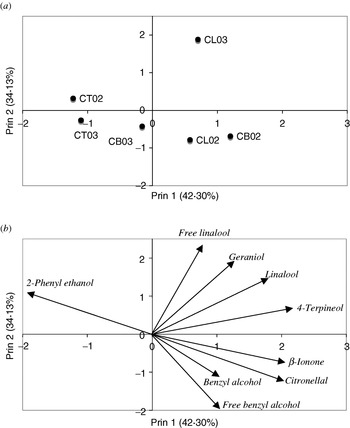
Figure 2 shows the PCA results. This analysis identified the compounds that best discriminate between the wines made from the different grape varieties. The first two axes accounted for 0·76 of the variability (0·42 and 0·34, respectively). The first axis (Prin 1) was characterized by bound citronellal, bound linalool and bound 4-terpineol having positive loadings. In the second axis, free linalool and bound geraniol had positive loadings while free benzyl alcohol had a negative loading.
PCA of aromatic compounds in Caiño Tinto (CT), Caiño Longo (CL) and Caiño Bravo (CB) wines from 2002 and 2003 vintages (a) wine samples and (b) volatile compounds. Prin 1 and Prin 2 are the first and second principal components respectively and the percentage of variation each accounts for is given in parentheses.

DISCUSSION
The present paper studies the major aromatic compounds, free and bound, responsible for the primary or grape-derived aroma of the wines produced from Vitis vinifera cv. Caiño Tinto, Caiño Longo and Caiño Bravo grapes. The wines studied from Galician varieties showed a different volatile profile and all volatile compounds showed significant differences in two consecutive vintages. The high number of significant differences of the aromatic compounds studied reflects the influence of cultivar and vintage. Since the grapes were all collected from the same experimental plot and treated in the same way in both years, the differences of vintage must be due to climate.
A total of seven free volatile compounds were identified in Caiño Longo, Caiño Tinto and Caiño Bravo wines in 2002 and 2003 vintage. Free 2-phenyl-ethanol was the most abundant compound in the three varieties and in the two vintages. Similar results are found of red wines of V. vinifera cv. Öküzgözü and Bogazkere grown in Turkey (Cabaroglu et al. Reference Cabaroglu, Canbas, Lepoudre and Gunata2002). This compound seems to be related to the maturation index and it has a rose odour. Its level in wine is also related to the grape variety and to the yeast metabolism (Gomez Plaza et al. Reference Gomez Plaza, Gil-Muñoz, Carreno-Espin, Fernandez-Lopez and Martínez-Cutillas1999). The concentrations of linalool and α-terpineol are always correlated since the latter is obtained from the former by cyclical reactions in acidic environments (Arrhenius et al. Reference Arrhenius, McCloskey and Sylvan1996). In all cases, the concentration of β-ionone, with notes of violet (Francis & Newton Reference Francis and Newton2005), was above the perception threshold (0·09 μg/l).
Table 1 also shows a total of ten bound volatile compounds identified. The concentration of bound compounds in Caiño Longo, Caiño Tinto and Caiño Bravo wines were higher in the 2002 vintage than in the 2003 vintage. The high levels of non-monoterpenes indicate that these varieties are neutral cultivars. Quantitatively, differences in bound compounds were found when the variety and the year were considered. The total bound composition was higher in 2002 vintage than in 2003 vintage. Citronellal, 4-terpineol, nerol and geraniol have been present only in bound form. The perception threshold of citronellal is unknown; its contribution to the aroma of these wines after its full hydrolytic release cannot be predicted. The concentration of bound β-ionone was high in Caiño Longo from 2002 vintage.
CA was performed on the complete data set. When a two-dimensional plot (Fig. 2) was drawn, a good distinction between the wines made from the different grape varieties and in different years was achieved. The first two principal components accounted for 0·76 of total sensory variability (0·42 and 0·34 respectively). Caiño Tinto from 2002 and 2003 were characterized by 2-phenylethanol, and Caiño Bravo from 2002 and 2003 were characterized by free benzyl alcohol, bound citronellal and bound 4-terpineol. Caiño Longo was more heterogenic: benzyl alcohol content characterized the 2002 vintage and linalool and geraniol contents the 2003.
The main conclusions from the present work are that several volatile compounds can distinguish the red wines obtained from Caiño Tinto, Caiño Longo and Caiño Bravo. Significant differences were found in the levels of all aroma compounds studied in the wines analysed in two consecutive vintages. Many factors were found to influence the levels of varietal volatile compounds in wine as cultivar and vintage. The influence of vintage on volatile composition profile would seem to indicate the degree of grape maturity. Non-terpenyl compounds were the most abundant aroma substances in the considered varieties. Caiño Longo was richest in varietal aroma.
This work was supported by the Ministry of Science and Technology (VIN00-036-C6-3, HP2000-0032, RF02-004-C5-2), Diputación Provincial of Pontevedra and Xunta de Galicia (Spain). Mar Vilanova was supported by an I3P contract financed by the CSIC-European Social Fund.