


Introduction
The importance of human goals has been widely established in terms of educational outcomes in school settings (Deci & Ryan, Reference Deci and Ryan2000) and as a means of influencing productivity in organizational and industrial settings (Locke & Latham, Reference Locke and Latham2002). The endorsement of clear and valued goals has generally been found to be related to positive psychological functioning (Emmons, Reference Emmons1992; Brunstein, Reference Brunstein1993; Sheldon & Elliot, Reference Sheldon and Elliot1999). Goals and goal formulation are also important aspects of psychological treatments, as they guide the treatment focus, the criteria for evaluating progress and a process of goal collaboration that may have a therapeutic effect in itself (Grosse Holtforth & Castonguay, Reference Grosse Holtforth and Castonguay2005).
Tryon & Winograd (Reference Tryon, Winograd and Norcross2002, Reference Tryon and Winograd2011) reported an average medium effect size on treatment outcome from two goal-related aspects in psychotherapy, goal consensus and goal collaboration. Better outcomes can be expected when there is a consensus between patient and therapist regarding therapeutic goals and when patient and therapist are actively involved in a collaborative effort to formulate the goals of treatment.
One study found that patients rated the treatment as more meaningful when the goals were perceived as clearly specified (Goldstein et al. Reference Goldstein, Cohen, Lewis and Struening1988). Explicit discussion of treatment goals has been identified as one of the factors associated with client satisfaction with assessment interviews (Eisenthal et al. Reference Eisenthal, Koopman and Lazare1983). Furthermore, in a study (Hoyt, Reference Hoyt1980) where quality of therapy was assessed by independent raters, those sessions in which the goals of the treatment were explicitly addressed by the patient and the therapist tended to be rated as ‘good therapy’. Process issues in psychological treatments have also been found to be related to goal formulations. Michalak et al. (Reference Michalak, Heidenreich, Hoyer, Cox and Klinger2004) reported that conflicting personal goals correlate negatively with therapeutic cooperation, but positively with resistance and treatment dropout. Different goals and goal categories have also been found to vary in the likelihood of treatment success, even when controlling for variables, such as level of problem severity and motivation for change (Berking et al. Reference Berking, Grosse Holtforth, Jacobi and Kröner-Herwig2005). Taken together, these studies underscore not only the importance of goal formulation with respect to the patient's perception of the treatment, but also the collaborative nature of the goal formulation.
In the cognitive behavioural therapy (CBT) tradition, clear and tangible goals are often advocated as a prerequisite for treatment that should be agreed upon and formulated at the start of treatment (e.g. Shafran et al. Reference Shafran, Brosan and Cooper2013). To give a clinical example, one could easily imagine a depressed patient, where goals may be formulated within areas related to distinctive features of depression, like ‘becoming more socially active’ or ‘involving oneself in enjoyable activities’, but goals such as ‘actively looking for a new job’ or ‘being more engaged in the relationship with my partner’ may equally well be formulated. Goals that pertain to a broader context that may have little connection to specific disorders may nevertheless be of central concern for the individual seeking treatment.
Even though goal formulation may be considered a vital part of psychological treatments, these goals are rarely assessed or evaluated in a well-structured manner, neither in clinical practice nor in research. A key factor in this situation is likely the lack of validated and readily available procedures for assessing individual treatment goals and their attainment. An instrument that specifically addresses the goal dimension in treatment is the Bern Inventory of Treatment Goals (BIT; Grosse Holtforth & Grawe, Reference Grosse Holtforth and Grawe2002). This inventory is available in different versions: a taxonomy for assessing patient goals from interview data, a format for examining the formal qualities of treatment goals, and a checklist format (BIT-C) used to aid in the process of formulating treatment goals. When the BIT was tested in clinical settings for treatment planning and outcome evaluation for psychiatric inpatients (Grosse Holtforth et al. Reference Grosse Holtforth, Reubi, Ruckstuhl, Berking and Grawe2004), it was found not only that the inventory was reliable and exhaustive, but also that the distributions of the goal themes were partially associated with the diagnoses. The themes of patients’ treatment goals predicted both goal-related improvements and length of hospital stay.
Hasler et al. (Reference Hasler, Moergeli and Schnyder2004b ) used a modified version of the BIT-C with patients to assess changes in goal-related areas 1 year after treatment. The patients reported changes in a wide range of goal areas. Changes in depressive and anxiety symptoms were rated as particularly important, but the changes also included a broader area of goals related to the patients’ interpersonal domain, their self-concept and existential issues. Patient satisfaction with treatment was particularly related to reported changes in the interpersonal domain. Another study (Hasler et al. Reference Hasler, Moergeli, Bachmann, Lambreva, Buddeberg and Schnyder2004a ) reported that progress in goal areas (rated retrospectively on the BIT-C) pertaining to symptomatic improvement was associated with client satisfaction among male clients, whereas changes within the interpersonal domain were more strongly correlated with satisfaction in female patients.
The goals in the BIT-C are organized in three levels: 64 specific goals forming 28 goal categories that are, in turn, divided into five goal types (problem/symptom oriented, interpersonal, wellbeing/functioning, existential, personal growth). In each category, the patient has the option of formulating other goals than those provided if he/she wishes to endorse a goal in a given category but does not find one that matches his/her specific personal goals. From this checklist, a minimum of one goal and a maximum of five goals are chosen to be the priority for treatment, and these goals are then rated on attainment. In one examination of a Swedish version of the BIT-C, it was found that the goal category items in the questionnaire demonstrated moderate to substantial test–retest reliability over a 2-week period (Ramnerö & Jansson, Reference Ramnerö and Jansson2015), and also that the instruments discriminated clinical from non-clinical subjects, as indexed by the goal categories chosen and also on the perceived proximity to the desired state (Jansson et al. Reference Jansson, Tham and Ramnerö2015).
The purpose of the present work was to study the sensitivity to change in subjective assessment of goal attainment in prioritized goals, as assessed by the BIT-C. Contrary to the previously mentioned studies that used the BIT-C for treatment evaluation, we used a design where goals were assessed prior to treatment and reassessed at a later point when treatment gains could be expected. In the present study, it was expected that there would be substantial differences in the perceived attainment of prioritized goals between the two assessment points and that goal attainment of the patients’ prioritized treatment goals would predict the changes on standard clinical outcome measures.
Method
Participants
The participant sample in this study consisted of 118 individuals (81 women, 37 men) who were candidates for psychological treatment within primary-care settings (mean age 42.46 years, s.d. = 9.53). Patients were offered the possibility of participating by the therapist responsible for the assessment interview. The decision to participate was voluntary and had no impact on the treatment offered. All subjects were given a leaflet with information on the study and signed an informed consent form. Data were collected between June 2009 and April 2011 by therapists who had volunteered to participate in the project. The study participants were fairly well educated in that 60% of them had some form of higher education (university or similar). The majority of the psychotherapy patients participating in the study suffered from anxiety, depression, or stress-related disorders, as assessed by their therapist or referring physician. However, no standardized diagnostic procedure was used. Only those who provided data on goal attainment on prioritized goals at both assessment points were retained for the analyses. Thus, the final sample consisted of 95 individuals (67 women, 28 men) with a mean age of 42.81 years (s.d. = 9.59).
Instruments
Treatment goals
A Swedish version of the Bern Inventory of Treatment Goals – Checklist (BIT-C; Grosse Holtforth & Grawe, Reference Grosse Holtforth and Grawe2002) was used. This instrument contains 87 goal statements where the patients put a checkmark on those that they endorse. These goals are organized in predetermined goal categories and goal types. The patients were further asked to select at least one goal and up to a maximum of five goals deemed as being priority goals. These goals could then be specified and individually formulated to better express the patients’ objectives and to then be used as treatment goals. In the case that more than one goal was selected, the participant was asked to rank the goals according to their importance. The participants were then presented with a visual analogue scale consisting of a 10-cm-long line, where they were instructed to put a checkmark representing their perceived attainment of that particular goal, with the left end representing ‘not at all’ and the right end representing ‘fully attained’. Goal attainment was then coded on each goal from 0 to 10, according to the position of the checkmark. For the present study, goal types (not the specific goals) were used in the analyses, since we were mainly interested in the broader picture of problem/symptom-oriented goals vs. other goal types.
Anxiety and depression
The Hospital Anxiety and Depression Scale (HADS; Zigmond & Snaith, Reference Zigmond and Snaith1983) is mainly intended for use in somatic care and contains 14 items (seven anxiety, seven depression) where the patient rates to what degree they have experienced a certain symptom in the preceding week on a scale from 0 to 3. The instrument has been validated in Swedish samples (Lisspers et al. Reference Lisspers, Nygren and Söderman1997).
Quality of life
The EuroQol Quality of Life Questionnaire (EQ-5D; EuroQol Group, 1990) is a standardized questionnaire for measuring health-related quality of life in patients. It consists of five items representing different aspects of health, rated from 1, indicating no concerns, to 3, indicating grave concerns. An index is calculated, ranging from 1.00 (full health) to 0 (no health). The instrument has been well validated in Swedish samples (Burstrom et al. Reference Burstrom, Johannesson and Diderichsen2001).
Procedure
Patients received questionnaires to complete immediately after the initial session. In cases where patients had not completed the questionnaires before the second session, the forms were completed during the second session. At pre-treatment (first measurement point), all questionnaires were completed, including the procedure where the patients prioritized a maximum of five chosen goals that they considered to be particularly important for treatment. The perceived attainment of these goals was rated on a separate page on the visual analogue scale.
The therapists were all licensed psychologists trained in CBT, and the treatments delivered were assumed to follow a standard CBT format, and also to be individually tailored and adapted to the presenting problem. No data were collected on the content of the delivered treatments. The second measurement point was set at approximately 12 weeks (maximum 15 weeks) after pre-treatment, since the length of the treatments was expected to vary considerably, but with some treatment effects likely to be observed after this period. With the expected variation in treatment duration, a fixed 12-week measurement point was set to represent a point that approximated the point of termination for the majority of the patients. A minimum requirement was that at least five treatment sessions had taken place. The therapist kept a photocopy of the page from the BIT-C where the prioritized goals had been recorded, and presented the list of goals to the patient at the second measurement point. The patient (who was not shown his/her previous ratings) again rated the perceived attainment of these goals on the visual analogue scale, and also completed the HADS and the EQ-5D a second time. For some patients, this second measurement point coincided with treatment termination or a follow-up visit. For others, the treatment continued beyond the second measurement point.
The therapists were free to tailor the treatment for the individual patient, and the study procedures did not interfere with this process. The procedures were minimally invasive, and our impression was that they were well received by both the patients and the therapists. This work was carried out in accordance with the appropriate ethical standards.
Data analytical procedures
First, to explore whether the content of prioritized goals could be explained by pre- or post-levels of quality of life, anxiety and depression, a logistic regression analysis was conducted to predict group membership (symptom-oriented goals vs. non-symptom-oriented goals). Then, to investigate whether the levels of attainment for the five prioritized goals differed between assessment points and if the levels of goal attainment were dependent on the ranking sequence of the prioritized goals, a mixed ANOVA with goals (5: goal priorities 1–5) and time (2: pre vs. post) as within factors was conducted.
Paired t tests were conducted to evaluate changes across pre-treatment and post-treatment scores and thereby identify whether treatment outcome variables had shifted in a significant manner across the time periods. Finally, residualized change scores were computed to index each individual's changes in perceived proximity to the most prioritized goal from pre-treatment to post-treatment. After calculating the change scores, hierarchical multiple regression analyses were conducted on each of the three outcome variables (quality of life, depression, anxiety) in order to test if increased perceived proximity to the prioritized goals from pre-treatment to post-treatment (step 2) is predictive of the post-treatment outcome after controlling for pre-treatment levels for the respective outcome variable (step 1).
Results
Priority of goals
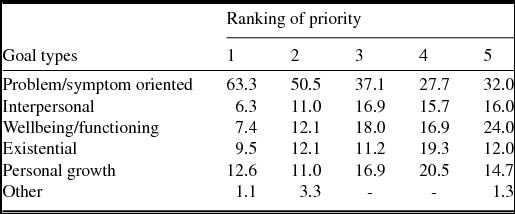
As shown in Table 1, the patients predominately favoured categories from goal types concerned with problem/symptom-oriented goals, and this tendency was particularly the case for the most prioritized goals. Based on the distribution of the most prioritized goals, two groups were created in order to explore if pre- or post-levels of quality of life, anxiety, and depression differed more among those who favoured symptom-oriented goals (n = 60) as the most prioritized goals than among those who favoured other goals (n = 35). The logistic regression analysis found no significant effects of the predictors (χ2 = 3.25, p = 0.77, Nagelkerke's R 2 = 0.05), indicating that the patients’ clinical status was not related to the content of the most prioritized goals.
Frequency (percentage) of prioritized goals

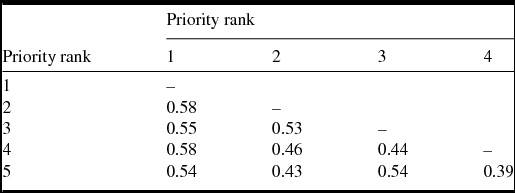
Correlational analyses between levels of attainment for the five prioritized goals at pre-treatment showed that all the goals were relatively highly associated (see Table 2). The ANOVA used to examine the levels of attainment of the prioritized goals found a main effect of time (F 1,72 = 302.45, p<0.0001) owing to a significant change between the first and second assessment points for the patients’ perceived proximity to the prioritized goals (estimated marginal means 2.47 vs. 5.90), indicating increased proximity to the prioritized goals following treatment. Furthermore, there was no significant main effect of goal priority or interaction effect between time and goal priority (p>0.081), indicating no effects of the ranking sequence of the prioritized goals. Consequently, only the most prioritized goals at pre-treatment and post-treatment (mean = 2.30, s.d. = 1.79 vs. mean = 6.21, s.d. = 2.18; t = 15.68, p<0.0001, d = 1.97) were used in order to predict treatment outcome (see below).
Correlations between prioritized goals (pre-treatment)

Treatment outcome
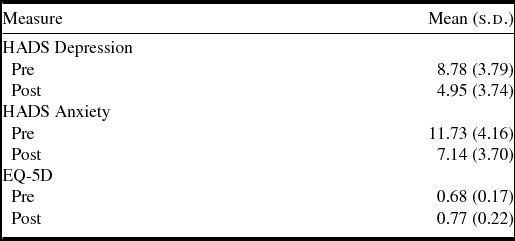
There were significant changes between the first and second assessment points for depression (t = 9.76, p<0.0001, d = 1.02), for anxiety (t = 10.28, p<0.0001, d = 1.17) and for quality of life (t = 4.29, p<0.0001, d = 0.45), indicating reduction in clinical status (see Table 3 for descriptive data).
Descriptive data for treatment outcome variables

The multiple hierarchical regression analyses that were conducted on each of the three outcome variables (quality of life, depression, anxiety) in order to test if increased perceived proximity to the prioritized goals (from pre-treatment to post-treatment) is predictive of post-treatment outcome showed that increased proximity to prioritized goals was associated with decreased levels of anxiety (β = -0.44, p<0.0001, ∆R 2 = 0.19) and depression (β = -0.33, p<0.0001, ∆R 2 = 0.10), and increased levels of quality of life (β = 0.33, p<0.0001, ∆R 2 = 0.10).
Additional analyses
Despite the non-associations between the content of the patients’ most prioritized goals and pre- or post-levels of quality of life, anxiety, and depression, the effect of increased proximity to prioritized goals on post-treatment outcome could still be moderated by the content of the patients’ most prioritized goals. Consequently, the three regression analyses reported above were repeated, but this time with group (symptom-oriented goals vs. non-symptom-oriented goals) entered in step 3, and the interaction terms (cross-product) of group and changes in perceived proximity to the most prioritized goal (centred scores) entered in step 4. However, these explorative analyses revealed no significant increment in explained variance owing to the inclusion of the interaction term (all p>0.15), indicating that the content of the most prioritized goals did not moderate the effects.
Discussion
The purpose of the present study was to study the sensitivity to change using an instrument for subjective assessment of goal attainment in prioritized treatment goals. Kazdin (Reference Kazdin1999) called for the inclusion of the patients’ goals as an aspect of clinically meaningful change – an aspect of special relevance for the patient. From our reading of the literature, this is the first study using a structured self-rating format of therapeutic goals, both in the assessment prior to treatment and in the evaluation of treatment effects.
In the present study, the treatments were found to be generally effective with respect to levels of anxiety, depression and quality of life. The obtained effect sizes on these indices were generally satisfactory, even though the second measurement point occurred before termination of treatment for some of the participants. More importantly, the patients reported increased proximity to the prioritized goals following treatment, and this increment in proximity to the stated treatment goals was clearly associated with clinical improvements following treatment. Since the sensitivity to change was of special interest in this study, it should be noted that the effect size on goal attainment was substantially larger than the effect sizes on the other clinical variables.
The patients tended to favour categories from the goal type concerned with problem/symptom-oriented goals when asked to prioritize goals for treatment, and this tendency was particularly true for the most prioritized goals. However, many patients tended to prioritize non-symptom-oriented goals, and this tendency increased as the order of priority decreased. This finding is in accordance with earlier studies (Grosse Holtforth et al. Reference Grosse Holtforth, Reubi, Ruckstuhl, Berking and Grawe2004; Hasler et al. Reference Hasler, Moergeli and Schnyder2004b ). Patients do acknowledge a broader range of goals as important for their treatment, and not only the alleviation of symptom- or disorder-related concerns that may have been the reason for the patients presenting themselves for treatment.
It should be noted that all the prioritized goals were highly correlated and that the levels of goal attainment were not affected by the ranking sequence of the prioritized goals. Furthermore, while we can expect that symptom-oriented goals might be more strongly associated with anxiety and depression (as measured with the HADS), there is a possibility that goals related to wellbeing/functioning are more strongly associated with the EQ-5D. However, the analyses showed that the patients’ clinical status were not related to the content of the most prioritized goals, and more importantly, that the predictive effect of perceived proximity to the prioritized goals on the post-treatment outcome measures (HADS and EQ-5D) was not moderated by the content of the prioritized goals.
One important aspect of treatment goals is, of course, that they should be diverse and individually specific in order to be clinically meaningful. The BIT-C offers an empirically derived way of measuring and categorizing them in subtypes while still retaining diversity over areas. Collapsing them into a single variable (goal attainment) may seem like a rather unorthodox approach to measurement. On the other hand, it is also a way of approaching a dimension that may well be of central concern to the individual seeking therapy, and to use that dimension as an outcome at the group level. Notwithstanding, the present study showed that these goals were related in a meaningful way to other indices of clinical change.
This study has several caveats. There was no standardized diagnostic evaluation to ensure consistency in diagnosis among the participant sample. The sample was in a clinical range where severe dysfunctions were uncommon (as indicated by the EQ-5D). Thus, the data collected did not allow for any thorough analysis of relationships between the treatments given, patient characteristics, goal formulations and goal attainment. Future studies should therefore benefit from examining the relationships between diagnoses and goal formulations and goal attainment. Ratings of goal attainment were not blind to the therapist, which may have influenced the patient to rate the outcome of treatment more favourably on this variable. On the other hand, as some patients rated their goal attainment prior to treatment termination, we can expect that the goals were not fully attained for those patients at that time. No demands were put on therapists or patients to explicitly use the goals assessed by the BIT-C as key targets for treatment. Neither did we make any records of those aspects. However, it is reasonable to assume that the procedure did influence how the treatments were tailored. Spontaneous comments from the therapists who were involved did indicate that the BIT-C was an attractive and easy-to-administer procedure for assessing goals and goal attainment in psychological treatment. In our view, the BIT-C as a procedure carries clinical potential for assessing the relative importance of a broad range of potential treatment goals, specifying them in a clinically and individually meaningful manner while still allowing for comparison, not only at the individual level but also at the group level.
Future research should examine the clinical utility of the procedure in a wider sample of patients, representing a broader range of types of problem and also taking disorder- and treatment-specific characteristics into account. We also recommend investigating an approach where structured formats, such as the BIT-C, are used explicitly to guide goal collaboration in the treatment process and the establishment of goal consensus between the therapist and the patient.
Summary of key points
-
• The goal dimension is rarely assessed or evaluated in a structured manner, not even in psychological treatments that explicitly stress the importance of goal statements.
-
• A self-administered checklist version of the BIT-C showed promise as a structured approach to goal assessment as a part of clinical assessment and treatment evaluation.
-
• Attainment of prioritized treatment goals was clearly related to clinical improvement, but did only partially correspond to disorder-specific concerns.
Ethical standards
The procedures were performed in accordance with the Declaration of Helsinki of 1975 as revised in 2008. The current project has previously been ethically approved at the Department of Psychology, Stockholm University, as a part of a diploma degree thesis.
Acknowledgements
The contributions of licensed psychologists Daniela Lambert, Jessica Neijlind and Åsa Norrman is gratefully acknowledged. This research received no specific grant from any funding agency or from any organization in the commercial and not-for-profit sectors.
Declaration of Interest
None.
After reading this paper the reader will have an understanding of:
-
• The importance of formulating explicit goals as an aspect of behavioural change in psychological treatments and elsewhere.
-
• How a checklist format for treatment goals can be used at pre-treatment assessment and for evaluation of goal attainment at post-treatment.
-
• How attainment of treatment goals can be related to clinical improvement, and that structured goal assessment can be used as an auxiliary tool for clinical assessment and evaluation.



Comments
No Comments have been published for this article.