[It is not Ottavia who sheds her tears, exiled, exposed on foamy sands; it is a monster which, with high and low notes, goes to augment the Sirens' flock. It is Anna who comes here, you azure shores, to conquer with her beauty your goddess of love; having set the world on fire with her beautiful eyes, now it befits her to burn the region of the waves to ashes. Write, Destiny, in your eternal annals that Anna's soft beloved harmonies rival [those of] the Immortals in delighting us. Who ever saw rarer wonders? Fair angels set foot on fragile fir wood; heaven's melody has come down to the sea.]Footnote 2
Benedetto Ferrari describes the performance of the Roman singer Anna Renzi who in the Carnival of 1643 created the role of Empress Ottavia, ‘repudiated and entrusted to the waves on a skiff’, in Gian Francesco Busenello's and Claudio Monteverdi's opera L'incoronazione di Poppea, at the Teatro SS Giovanni e Paolo in Venice.Footnote 3 The sonnet was among the eulogies published by Giulio Strozzi the following year in Le glorie della signora Anna Re nzi romana: the treasury of information about seventeenth-century opera performance on the basis of which Ellen Rosand observed that Renzi was the kind of singing actress who ‘imposed her own personality on the roles she sang’ and thus ‘almost certainly would have appealed to Monteverdi, notorious for his concern with singers' interpretation of his roles’.Footnote 4 Rosand's view was later challenged by Wendy Heller who pointed out that Ferrari emphatically differentiates Renzi from Ottavia in his poem; she described the response of the audience as ‘a highly idiosyncratic way of hearing the character against the singer's persona’.Footnote 5 Heller concluded that Ferrari's praise of Renzi – and perhaps criticism of Monteverdi's setting of Act III scene 6 – ‘consists here in the singer's ability not to embody the features of the character as provided by composer and librettist, but rather to transcend them’,Footnote 6 thus giving the audience ‘an Ottavia with an oddly unnatural and inhuman voice: a “monster” linked to the company of the Sirens, whose wordless cries lured men to their deaths’.Footnote 7 Taking account of Heller's reading, Rosand seems, more recently, to have revised her view of Renzi, omitting the claim that she identified with Ottavia while still maintaining that she must have remained faithful to the human character apparently envisioned by the composer. ‘Surely’, she says, ‘a singing actress with such great natural sensitivity, range, subtlety, intelligence, and dramatic skill would have excelled in conveying the human emotions that Monteverdi sought to communicate in his works’.Footnote 8 Rosand quotes another sonnet, by one G. B. V.,Footnote 9 which shows that Renzi's performance of Ottavia's last lament ‘did not fail to stimulate tears of sympathy in her listeners’:Footnote 10
[O countenance and voice of heavenly spirit, fair Siren of paradise alone who, repudiated by Nero, forms on stage a harmonious mixture, both sweet and very cruel. Your soul, quite filled with harmony, now with a quaver, now slowly, now with a swift flight and pause, grows troubled and then becomes serene, so that although it stings our hearts, it does no harm. When in exile you give your tears to the sea, the wave stays still, and the wind falls silent, to gather up your pearls and your sweet song. Anna, I see heaven itself, a lover attentive to your grieving accents, dissolving into dew at the sound of your lament.]
While Ferrari perceived Renzi in Poppea as a monster and as herself rather than as Ottavia, according to G. B. V. it was, nevertheless, as Ottavia that she stung the hearts of the auditors and moved them to tears. I will try to show in the following that this seeming paradox is better explained in light of seventeenth-century theatricality than in light of the debate about performers' relative ‘fidelity to the work’, inseparable from nineteenth- and twentieth-century work concepts.Footnote 12 Reminding ourselves of the principles of seventeenth-century dramatic aesthetics will help us to understand Renzi's role in Poppea, and hence aspects of the opera that have troubled scholars. Ferrari's and G. B. V.'s views of Renzi as Ottavia only contradict each other if we presuppose the theatricality of modern stage realism and its concomitant ideal of the performer's identification with her character. Yet actresses of the mid-seventeenth century were not realists. In fact, artists and theorists of the period tended to devalue the Aristotelian tenets of verisimilitude, as John Picchione has argued, in favour of the poetics of the ‘miraculous’ (il meraviglioso) that promoted effects of surprise and wonder.Footnote 13 Hence Ferrari claims that he never saw rarer ‘wonders’ (meraviglie) than Renzi's performance of her last lament, and Strozzi's introduction to his Renzi volume also gives the impression of an actress admired less for the verisimilitude than for the magic of her performances: ‘as she was all in all a miracle [miracolo], she created wonder [meraviglie] and amazement, forcing our tongues not just to the mere final shouts of applause, but to numerous acclamations, and almost forcing our knees to kneel before the goddess of theatre’.Footnote 14
As exemplified by G. B. V.'s sonnet, seventeenth-century performers were valued according to their command of emotional expression,Footnote 15 and the obvious way to display such control and create the desired sense of wonder was to effect what Joseph Roach describes as ‘sudden, highly visible transitions between passions in the length of a speech or even a single line’; playwrights demanded that actors ‘depict the passions as sudden and violent metamorphoses’.Footnote 16 Such affective transformations were, by all accounts, central to Renzi's art, the most famous example being her Deidamia, the title role of Strozzi's and Francesco Sacrati's La finta pazza, in which she made her Venetian debut at the Teatro Novissimo in 1641. Feigning madness, Deidamia pretends, in turn, to be a warrior, Helen of Troy, a huntress, a sleepwalker, and so on, changing between these ‘characters’ with miraculous swiftness and jokingly comparing herself to the stage designer Giacomo Torelli, the celebrated master of Baroque illusionism:
[What melodies are these? Tell me, what brand new theatres, what numerous scenes are being prepared in Skyros? I, too, would like to be part of the effort, since I possess the art of creating a hundred different scenes by a single whistle, of counterfeiting seas, erecting mountains [and beautiful monsters], and making beautiful heavens and stars, and opening up Hell, too, on whose Tartarean shores I can form the Styx and Cocytus.]Footnote 17
The simile is not pure madness. As implied by the pun in ‘cento variar scenici aspetti’, Renzi's ability to change between ‘a hundred scenic countenances’ was the histrionic equivalent of the hundred scene changes of Torelli,Footnote 18 who ‘in the twinkling of an eye’ would turn a maritime scene into a royal courtyard and ‘all of a sudden’ a palace into a frightful hell filled with monsters.Footnote 19 While feigned madness offered a popular occasion for corresponding transformations of character, it is important to stress that all Renzi's characters involve rapid changes and extreme emotional contrasts, just as all the operas in which she appeared involved scenic transformations like Torelli's.
The only, and striking, exception to Renzi's repertoire of mercurial characters is Ottavia, who knows only grief, jealousy and fury. But if Ottavia represents a behavioural oddity amongst Renzi's roles, it is even stranger that the part is half the size of any other part she is known to have sung. The reason behind these anomalies is the subject of this article. I will suggest that the tragic Empress was only half of the role Renzi sang, the opera still displaying her characteristic versatility as an actress because she also sang the comic role of Drusilla. The doubling of these two extremely different characters would have occasioned the kind of affective display in which Renzi excelled while highlighting each character's illusoriness. This might in turn explain both why Ferrari did not see the singer as Ottavia the last time she appeared on stage, but as a theatrical ‘monster’, and why G. B. V. described her performance as ‘a harmonious mixture, both sweet and very cruel’. As I will show, the doubling would also provide the production with what the first theorist of seventeenth-century concettismo, Matteo Peregrini, described as a legamento (‘connection’) between two statements, an invitation to explore the allegorical meanings of a work of art.Footnote 20
To support this new claim, I will attempt to reconstruct the doubling plan for the premiere of L'incoronazione di Poppea. Alan Curtis has discussed doubling possibilities in Poppea with a view to modern productions,Footnote 21 while Tim Carter, recognising the widespread use of role doubling in Venetian opera at this time, has outlined a doubling plan for the 1643 production, primarily by examining vocal ranges and identifying the characters as belonging to characteristic voice-types.Footnote 22 In line with my emphasis on historically appropriate performance aesthetics, however, I think it will be more revealing to establish a chart on the basis of a close examination of the convention in Venetian opera houses. General cast sizes, the number of women in contemporary productions, company hierarchy, lines of roles, seventeenth-century vocal categories, references to doubling in the libretto, artistic and aesthetic functions of the doubling practice, as well as our knowledge of the concrete cast must all be taken into consideration.
Doubling in Venetian opera houses
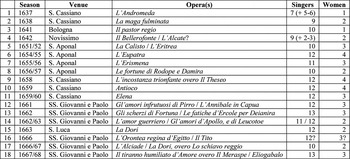
The 17 surviving cast lists from the first three decades of Venetian opera (Fig. 1) show that productions in the 1650s and 1660s featured 10 to 13 singers, including 2 to 4 women.Footnote 23 We have fewer sources from the 1640s, but casts generally seem to have been smaller. In L'Andromeda (the first opera performed in the city), 7 singers performed 12 characters, to which was added a chorus of 5 or 6 Ninfe Arciere, while 9 singers performed 19 characters in La maga fulminata (the second opera in the city). An account of the production of Il Bellerofonte states the voice type and origin of 9 singers as well as some of the roles they sang, but leaves some doubt as to whether the production included more performers. Nine singers could easily have doubled the 21 individual characters in the opera, however, though some extra male singers might have been needed for one chorus. Due to its proximity to the Poppea production, I have included the 1641 Bologna production of Il pastor regio (originally performed at the Venetian Teatro S. Moisè in 1640) in which 10 singers performed 19 characters. However, an intermezzo featuring 5 Satiri, which was added in the Bologna version, seems to have required extra singers, the original production probably featuring only 8. As for the number of women, one or two seem to have been the rule in this first decade: the earliest opera known to have included three women was La Torilda, which played at SS Giovanni e Paolo in 1648.Footnote 24 In any case, it seems that Curtis's and Carter's doubling plans, according to which Poppea may have been sung by 15 (Curtis) or 13–15 (Carter) singers, presuppose a somewhat larger cast than is likely to have been available in a Venetian opera house in 1643.
Complete cast lists for Venetian operas 1637–68.

Only four cast lists (1, 2, 8 and 9) state exactly which roles the singers sang, and only the first two of these call for doubling beyond the prologues. In order to gain insight into the practice, therefore, we must turn to the first two operas performed in Venice, though Francesco Manelli's music for them is lost. Even if these operas were not typical of the way doubling was used in later years, they not only show what was possible, but also offer rich insights into the artistic functions of the practice, which complement research on doubling in English sixteenth- and seventeenth-century theatre. It appears that while the practice would sometimes be employed merely for economic reasons, it would sometimes provide performers with opportunities for quick-change artistry and virtuoso acting in contrasting roles,Footnote 25 and could also promote allegorical meanings.Footnote 26 Doubling might serve all these purposes simultaneously, and the individual spectator would then have to gauge whether new layers of meaning were generated by the legamento or ‘connection’ established between doubled characters. Doubling clearly served all three purposes in Benedetto Ferrari's libretto for L'Andromeda, which required the leading man, Annibale Graselli, to carry out the quickest and most demanding transformations. As if to compensate for his absence from the entire central act, he was given three scenes in Act III, but as three different characters appearing in very quick succession. His role merits closer scrutiny.
Graselli first appeared in Act I scene 1 as Mercurio who receives Giunone's order to persuade Nettuno to create a monster that will kill Andromeda, the daughter of her enemy Cassiope. Mercurio defends Andromeda, asking why the daughter should be punished for the sins of the mother, but Giunone overhears his objections. The printer's preface includes a description of Mercurio's appearance:
This character was and was not in a machine; he was, because impossibility precluded flying; and he was not, since no other machine could be seen than that of his own flying body. He emerged furnished with his customary attributes, with a blue mantle, which floated about from his shoulders.Footnote 27
In scene 3 Mercurio, once more appearing in his ‘wondrous machine’,Footnote 28 conveys Giunone's request to Nettuno who promises to obey, and then returns to heaven in order to appease the goddess. In Act III scene 1, he approaches Venere, Astrea and Giove – all of them flying – and describes how the innocent Andromeda is now chained to a rock:
[Recently, with her lovely eyes she adorned the world with more suns, and with the beauty of her lovely face she turned the earth into paradise.]
Moved, Giove promises to defend her and orders Mercurio to tell Perseo to kill the monster, the messenger replying:
[I am so glad to serve you, my lord: I so desire the safety of the innocent maiden that I will fly faster than the quickest feet or an arrow to perform it all.]
After Mercurio's exit follow 25 lines of dialogue between the other deities, the scene closing with a duet for the goddesses. This would give Graselli time to descend from his machine and change his costume to appear as Ascalà in scene 2, which is described as follows:
With lightning speed, the maritime scene became a stately palace. The sight of a well-designed and well-constructed building being unexpectedly born from the rough rocks and uncultivated shores was beautiful and charming. This represented the royal palace of Andromeda from which emerged the knight Ascalà. His dress exceeded in value and beauty those of all the others. He emerged dressed in the Turkish fashion. He who played the part of Mercury represented this sorrowful character with every conceivable heavenly grace.Footnote 29
The placement of the lament scene of the courtier Ascalà between Graselli's appearances as Mercurio and Perseo is striking: the character is extraneous to the action as well as to the myth, and his main purpose could only have been to give the male lead a solo lament while permitting him to show off his skills as a quick-change artist. Then the scene changes again: ‘The palace suddenly disappearing, the scene became entirely sea, with Andromeda chained to a rock’.Footnote 30 Scene 3 consists of the heroine's solo lament, which would have allowed Graselli time to change his costume once more and ascend a new flying machine. Scene 4 opens with the advent of the sea-monster, immediately followed by Perseo's intervention:
Perseus came from the heavens on Pegasus, and with three blows of his lance and five of his rapier he fought the monster and killed it. This character wore his weapons, with a large crest on his helmet, while his flying steed had a plume with the same motto on its forehead. He who played Ascalà represented this individual with angelic grace.Footnote 31
In the ensuing dialogue between Andromeda and her rescuer, Perseo echoes Mercurio's words about Andromeda's sun-like eyes:
[Be no longer sad and distressed, O my fair one, but laughingly and joyfully brighten the rays of your beautiful eyes where love lies hidden! Make these waves blaze with more suns.]
Andromeda greets Perseo as ‘Celeste Heroe’, to which he replies: ‘Sarà tua requie, e pace / L'esser hoggi nel ciel mia Diva, e Sposa’ [Being today my goddess and bride in heaven will be your rest and peace]. The imagery implies that the audience was invited to see Mercurio and Perseo as allegorical reflections of each other. While Mercurio is a god, Perseo is a demigod, but Andromeda recognizes the god in him, just as he recognizes the goddess in her and the ‘suns’ of her eyes (notably, Maddalena Manelli, who sang Andromeda, had also sung Aurora, goddess of the rising sun, in the prologue). Not only would this allegorical meaning be lost if the characters were cast individually, but it would also render the placement of Ascalà's lament strangely inappropriate, and the opera would lack a leading man, Perseo's marriage to Andromeda in the final scene appearing unmotivated. Only if the three characters are viewed as one protean personality travelling through various moods and modes of existence in order to rescue and obtain the ‘suns’ that will give his life meaning – goddess and bride in one – does the drama emerge as a coherent allegorical structure.
The most striking double role in Benedetto Ferrari's next libretto, La maga fulminata, was that of the castrato Francesco Angeletti who, according to the list of performers printed in the libretto, doubled as Rodomira, a princess disguised as a knight, and Scarabea, the sorceress Artusia's governess and the prototypical vecchia character of Venetian opera. It is worth following Angeletti through the opera, too, to see a similarly thoughtful use of doubling to serve the aesthetic ends of the drama. The printer's preface describes his first appearance, in Act I scene 2:
Two knights were seen fighting, most gracefully in the mutual assault, the spectacular magnificence of their ceremonial dress shining amid the ferocity of the strokes: people were lost in admiration, and between two swords, their hearts were aching with pleasure rather than pain.Footnote 32
In the ensuing conversation, the two ‘knights’ reveal that they are really Rodomira and Filaura, the disguised sisters of the abducted princes Floridoro and Rosmondo, respectively, and also each betrothed to the other prince. The future sisters-in-law decide to join forces against the evil sorceress. That two knights turn out to be women, both performed by castratos, already launches the opera's central theme of the deception of the senses, which would be further developed when Angeletti reappeared in scene 4 as the vecchia. Old Scarabea is the rival of young Rodomira, since she is in love with Rosmondo, too, though he despises her: ‘Scarabea, a childlike old woman, spelled out her affections with such mordant wit’, recorded the printer, ‘that there was no man, young or old, who did not fall in love with her’.Footnote 33 Scarabea herself points to her enigmatic identity and age: ‘Son una Donna, non una sfinge, / Che Diavol hà?’ [I am a woman, not a sphinx, what devil has got into you?]. Angeletti would then have plenty of time to change back to Rodomira's costume for Act II scene 1, in which she and Filaura encounter Rosmondo, the three of them planning Artusia's undoing. In Act III scene 1 Angeletti would reappear as Scarabea, however, complaining in a mock-lament that her beloved Rosmondo has been transformed into a dragon: ‘È morta Scarabea. / Son morta (meschinella) e s'io ragiono / È perch'amante hò il core’ [Scarabea is dead. I am dead, wretched me, and if I speak, it is because my heart is in love]. In a comical echo of the lamento d'Arianna she hints at the moral point of her doubling: ‘Ma così và chi veste humano velo; / Donna, impara à mie spese, / Infelice è l'amar fuor che nel Cielo’ [But this is the way of those who wear the human veil: Woman, learn at my expense, that love is unhappy except in heaven]. Scarabea then disappears out of the story, but Angeletti would have made a quick costume change in order to reappear as Rodomira in the next scene, in which Artusia shows Floridoro a dismal spectacle: ‘Prince Floridoro enters and sees, at the sign of the sorceress, the perspective change into a horrid cave, in which the two princesses are tied to two rugged stones, while Prince Rosmondo is transformed into a dragon that prowls about them tearing them to pieces’.Footnote 34 Now it is Rodomira's and Filaura's turn to complain, in a reversal of Scarabea's lament: ‘Ahi che fiero martire / Provar la morte, e non poter morire!’ [Oh what cruel torture: to go through death unable to die]. Soon afterwards, the sorceress is struck down by lightning, however, and the two couples are united in the final scene.
As the overview suggests, this double role was constructed so as to give Angeletti an opportunity for comic virtuoso acting in contrasting roles. It also contained an allegorical aspect, however, as it theatricalized the conflict between love as a spiritual quest that overcomes death, the emblem of which is Rodomira's armour, and love as carnal lust subject to the passing of time, the emblem of which is Scarabea's ageing body. A similar case of doubling, in fact, is found in Act II scenes 4–5 when the captive Prince Floridoro (Antonio Panni) and Artusia (Felicita Uga), who tries to seduce him, would reappear after a very quick change of costumes as one of two sailors and one out of three Sirene who try to lure them into perdition. Panni's double role would then parallel that of Angeletti, two of the leading performers both acting out the struggle between vice and virtue on an allegorical level.
With these analyses of the use of doubling in the two first Venetian operas I do not mean to imply that the structure and meaning of all Venetian operas depended on the device. Some operas hardly used it at all, but L'incoronazione di Poppea, with its 26 singing characters, certainly did so extensively. The only major difference between the early Ferrari/Manelli operas and Poppea is that we possess the doubling plans for the former, but have to establish one for the latter.
Assembling a cast for Poppea
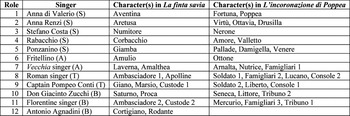
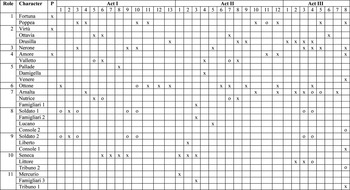
In order to work out a doubling chart, we must collect as much information as possible about the performers, and recent research has, in fact, permitted the reconstruction of most of the original cast for L'incoronazione di Poppea. The opera can be performed unabridged by 11 singers including two women, which would be consistent, too, with the cast sizes in Figure 1. In order to render this cast size plausible and demonstrate that the roles were distributed as suggested in Figs. 2–3, however, it is necessary also to consider which role each performer would have taken in La finta savia, the opera that preceded Poppea on the stage of SS Giovanni e Paolo in the 1643 Carnival.Footnote 35 The reconstruction of the doubling plan for La finta savia – a pasticcio setting of Giulio Strozzi's libretto by Filiberto Laurenzi, Giovanni Battista Crivelli, Tarquinio Merula and Benedetto Ferrari – is hampered by the fact that the only surviving music is a collection of some of Laurenzi's arias (which also names four of the singers and the roles they took).Footnote 36 Furthermore, Strozzi makes clear in the libretto that ‘many verses will be omitted’ in performance,Footnote 37 but he does not mark the omissions or state whether entire scenes or characters were to be cut. It would be difficult even for 12 singers to perform the libretto unabridged, and I hold it possible that a Choro di Ninfe, one of the two Cortigiani, a Choro di vecchie and two Hore volanti were omitted. Similarly, the Choro di Virtù, Petronio, Tigellino and the Choro d'Amori were omitted in the performed setting of Busenello's libretto.Footnote 38
Reconstructed cast list for the Teatro SS. Giovanni e Paolo in 1643

Doubling chart for L'incoronazione di Poppea 1643. ‘o’ indicates that the character remains silent.

It appears from Laurenzi's collection, from the postscript to Strozzi's libretto and from some of the texts in Le glorie della signora Anna Renzi romana that Renzi created the Assyrian princess Aretusa, the title role of La finta savia. In addition to Renzi, Strozzi's postscript mentions the Roman singer Anna di Valerio who apparently made her Venetian debut in this season,Footnote 39 Laurenzi's collection showing that she sang Aventina, the second female lead in La finta savia. This led Alan Curtis to suggest that she probably created the title role in Poppea,Footnote 40 but it was not until Roberta Ziosi studied the correspondence of the Ferrarese Marquess Cornelio Bentivoglio, who clearly functioned as a kind of co-impresario for SS Giovanni e Paolo, that all doubt was removed. In a letter to Bentivoglio of 29 November 1642, the theatre owner Giovanni Grimani explicitly discusses the size of di Valerio's roles in the two operas, apparently referring to the fact that Aventina only has six scenes in La finta savia (against Aretusa's 11), for which reason Giulio Strozzi was obliged to write the two intermezzi for her as well:
As for the part of Signora Anna [di Valerio], it has been looked over, and [Strozzi] has already set about composing additions. And I think it is certain, as for the second [opera], that it will be appropriate for her to be entitled to choose what she wants, although Signor Busenello has destined the role of Poppea for her as being larger and more appropriate [than her role in the first opera].Footnote 41
It appears from Bentivoglio's correspondence that di Valerio, who lived in Rome as the mistress of his brother-in-law, Francesco Sforza, was not engaged until mid-November 1642, and a letter to Bentivoglio of 19 October 1641 from Marco Marazzoli perhaps suggests that the role of Poppea had originally been intended for one Signora Cecilia.Footnote 42 Marazzoli anticipates this singer's performance in the 1642 Carnival, when she was to ‘perform in a theatre where Signor Monteverde composes music so novel that I was astounded when hearing it’.Footnote 43 However, while Cecilia did sing at the SS Giovanni e Paolo in 1642, it was in operas by Marazzoli and Filippo Vitali.Footnote 44 Marazzoli's letter may imply that Poppea was originally meant to have been produced in 1642, but that the premiere was postponed one year.Footnote 45
That the 1643 season featured two women of equal stature was implied not only in Strozzi's postscript to La finta savia, but also in the letter of a French diplomat to Cardinal Mazarin of 25 March 1643, a month after the end of the Carnival season. The diplomat had heard ‘Signora Anna Valeria’ and ‘another Signora Annuccia [i.e. Anna Renzi], who cedes the palm but little’, apparently in an opera by ‘Mondevergo’, and though he preferred the former singer, it appears that the two were considered of equal importance to the production,Footnote 46 which is remarkable since Ottavia's role is half the size of Poppea's. In addition to singing the leading female roles, however, di Valerio and Renzi probably also sang Fortuna and Virtù, respectively (see the discussion below). While both Curtis and Carter suggest that Virtù and Drusilla can be doubled, none of them suggests the doubling of Fortuna and Poppea, Curtis conceiving of Fortuna as a mezzosoprano (due to her single low c′) and of Poppea as a lyric soprano. Seventeenth-century vocal categories were less specialized than today, however, and sometimes served different dramatic purposes. In 1635 the music theorist Giovanni Battista Doni associated the basic voice categories (soprano, contralto, tenor, baritone and bass) with age: more virile or mature goddesses like Juno, Ceres, Minerva and Venus should, for example, have somewhat lower voices than Diana and Proserpina who are usually portrayed as young girls.Footnote 47 Another theorist, Girolamo Mei, who in the previous century had provided the theoretical basis for the recitative style, associated tessitura with the passions of the speech: quiet and moderate passions were best expressed in the middle register, excited or elevated passions in the high register, and base and dull passions in the low register.Footnote 48 While Doni may be said to emphasize the stable persona (character), Mei emphasized the variable affetti (passions), both of which should be taken into consideration. Fortuna's tessitura may simply be lower than Poppea's because she is disdainful while Poppea is mostly seductive or excited. The difference in tessitura would also be consistent with the view expressed in the Parmesan theatre manual Il Corago from ca. 1630, according to which ‘it will be a good thing to write music clearly destined for the singer [notabilmente destinata], and to make the styles of performance [modi portarla] as dissimilar as possible’ if a singer plays many roles.Footnote 49 The obvious way to generate contrasting music and singing styles, including tessituras, would be to create roles differing either in character (young Rodomira vs. old Scarabea) or in passion (lamenting Ascalà vs. victorious Perseo).
The third singer mentioned in Laurenzi's aria collection is the young Roman soprano castrato Stefano Costa who sang Numitore, one of the two male leads in La finta savia. Curtis's suggestion that Costa created the role of Nerone in Poppea Footnote 50 is supported by the facts that he was known as a performer of serious parts,Footnote 51 and that he referred to the opera as Il Nerone when he took it to Paris in the 1647 Carnival.Footnote 52
The fourth singer mentioned in Laurenzi's collection is the ‘famous Rabacchio’, a Roman soprano castrato who sang the role of Corbacchio, an ‘astuto buffoncello’ in La finta savia; Curtis suggests that he sang the Valletto in Poppea.Footnote 53 While this seems right, as both characters are young and impertinent buffoni (Rabacchio's specialty),Footnote 54 it is unlikely that the Valletto was his only role in Poppea. Corbacchio appears in nine scenes, whereas the Valletto appears in just three scenes, far fewer than the central characters in Poppea. Though Curtis finds boy sopranos ideal for both Amore and the Valletto, neither he nor Carter considers doubling them, Curtis apparently dismissing this possibility due to awareness that the Valletto is too difficult for a child. Rabacchio, whose career at least went back to 1639, however, was hardly a child in 1643, and the libretto for L'Andromeda, in which ‘three very beautiful youths, dressed as Cupid’ danced one of the intermezzi, indeed reveals that this deity was not necessarily a child's part.Footnote 55 In fact, the doubling of the two wanton boys would have been a splendid opportunity for a young buffone to excel in contrasting roles: whereas Amore's formal recitatives, conventional cadences and pompous strophic aria suggest the mock-solemnity of the child-like deity, the Valletto's music abounds in hilarious gesticulating effects and comical word-painting. Furthermore, the Damigella seems to refer to the doubling when teasing the Valletto in Act II scene 4:
[Shrewd little boy, Cupid is smiling coyly in you, […] Cupid plays games with children just for his own fun, but Cupid and you are a pair of rascals.]
That the cast for the 1643 Carnival included a third male soprano is attested in a letter of 19 October 1642 from Carlo Caproli in Rome to Bentivoglio, in which we hear of a young singer called Ponzanino ‘who, apart from his good behaviour, is still new [bono] in the profession, and yet he'll get used to it and he sings with the best grace [bonis.mo garbo], not too much voice, but it really isn't unattractive [disdicevole]. In fact, he is better than others, especially in these days’.Footnote 56 The obvious role for this singer in La finta savia would have been that of Giamba, the custodian of the garden of the Sibyl: a serva role which in the 1650s would have been sung by the third woman in the company but which in 1643 was more likely to have been taken by a castrato. The equivalent roles in Poppea are Pallade, the Damigella (also a serva coupled with Rabacchio's character) and Venere, which would allow the singer one appearance in each act. Carter does suggest that Pallade and the Damigella could be doubles, but neither he nor Curtis suggests that either of these roles could be doubled with Venere, which Curtis thinks requires ‘a luscious contralto or mezzo with an astonishingly beautiful, sustained messa di voce’.Footnote 57 The difference in tessitura is probably more suggestive of Venere's mature age and maternal indulgence, however – in contrast to Pallade's solemnity and the Damigella's youth and flirtatiousness – than of the singer's preferences. Moreover, the reappearance of the lascivious servant couple as the deities Amore and Venere in the finale might have been intended as an allegorical subversion of the courtesan Poppea's apotheosis.
The role of Ottone may originally have been written for the young Roman contralto Filippo Bombaglia detto MonelloFootnote 58 who apparently sang at SS Giovanni e Paolo in the 1642 Carnival,Footnote 59 and the postponement of Monteverdi's opera may explain why the part was transposed from the alto into the mezzosoprano range, as Curtis has argued.Footnote 60 A letter of 5 December 1643 from the singer Jacomo Razzi in Venice to Giacomo Carissimi in Rome implies that Monello had been called back to Rome ‘during the past years [sic]’,Footnote 61 probably by his patron Cardinal Antonio Barberini,Footnote 62 and his late departure in 1642 would explain why Giovanni Grimani did not hire a contralto until the autumn, which is suggested by Caproli's letter to Bentivoglio, discussed above.Footnote 63 In a letter to Bentivoglio of 6 December 1642, Grimani mentions a Roman singer with the stage name ‘Frittellino’ who was probably the new contralto, as he was apparently to sing Amulio, one of the two male leads in La finta savia,Footnote 64 which would make him the obvious choice for Ottone. His stage name suggests that he had sung the boy Fritellino in the Barberini's 1639 production of Marazzoli's and Virgilio Mazzocchi's Egisto, ovvero Chi soffre speri, so Cardinal Barberini may have lent Bentivoglio this singer as a replacement for the more famous Monello. That Marazzoli's Fritellino is a sopranoFootnote 65 and Ottone a mezzosoprano part may be because the singer's voice had deepened since 1639;Footnote 66 that he apparently had a higher voice than Monello may explain the transposition of Ottone's part.
The Bentivoglio correspondence makes no mention of a contralto who could have played the vecchia in the 1643 Carnival, which probably indicates that the singer was already in Venice and was perhaps the same singer as had scored a success as the vecchia at SS Giovanni e Paolo in the previous season, alongside Signora Cecilia, Stefano Costa, Rabacchio, Pompeo Conti and probably Monello.Footnote 67 As Ellen Rosand shows, a speech given to Arnalta in the Neapolitan libretto of Poppea makes clear that she and the Nutrice were meant to be doubled in Naples in 1651,Footnote 68 but Carter seems to reject the possibility that this was also the case in Venice in 1643, though he suggests that the Nutrice could be doubled with one of Seneca's Famigliari. It is unlikely that the nurses were ever cast individually, however: while the two scenes for the Nutrice seem tailored to a star comedian, the part would have been too small for such a performer. Furthermore, La finta savia, too, seems to call for only one vecchia performer: Laverna, Aretusa's nurse, appears in thirteen scenes, which is more than any other character in the opera, but could easily be doubled with Amalthea, the decrepit Cumaean Sibyl who only appears in three adjoining scenes in Act III. Like the doubling of Amore and the Valletto, the doubling of the nurses in Poppea would offer rich acting possibilities for a skilled comic performer. Their first scenes are obviously contrasted, the brooding Arnalta cautioning the optimistic Poppea against the intrigues of Ottavia, while the frivolous Nutrice encourages the pessimistic Ottavia to intrigue against Nerone. Similarly, Arnalta's sombre lullaby seems deliberately contrasted to the recent bawdy song of the Nutrice. Not unlike Rodomira/Scarabea, the nurses may be seen as contrasting approaches to the same existential situation. The imperial nurse is Arnalta reborn, as the latter jokingly implies in Act III scene 7:
[I was born a servant and shall die a lady. I shall die unwillingly; if I were reborn someday, I should like to be born a lady and die a servant.]
Poppea calls for two tenors. Caproli mentions that he had engaged a ‘very adequate [comportabile] tenor’ in Rome, though the contract had not yet been signed,Footnote 69 and the other tenor may have been Captain Pompeo Conti who had appeared with success at SS Giovanni e Paolo in 1642 and functioned as Cornelio Bentivoglio's talent scout for the 1643 Carnival.Footnote 70 Conti's military rank (which was only held by noblemen before the French Revolution) suggests that he was no castrato, while the fact that he had sung the leading part in the intermedio L'Andromeda in Florence in 1617Footnote 71 may suggest that he was no bass, while also revealing that he was at least in his mid-forties by the time of Poppea's premiere.Footnote 72 The fact that Conti came to Venice in December with four of the soloists hired to perform in the Carnival (Anna di Valerio, Fritellino, a Florentine bass and probably the Roman tenor)Footnote 73 also suggests that he was meant to perform himself.
The two tenors would, of course, have sung the two Soldati in Poppea. One of them would then have sung Lucano, as both Curtis and Carter suggest, while the other would have sung the Liberto who conveys the death sentence to Seneca. While Carter does consider doubling a Soldato and the Liberto, Curtis rejects this option, claiming that the latter can be taken by ‘a low tenor, or baritone, but cannot so conveniently be doubled’.Footnote 74 The Liberto's tessitura is likely to be lower than the Soldato's, however, because his mood is depressed while that of the Soldati is excited. In fact, he is arguably identical with one of them, as it seems to be one of the two Soldati – the Emperor's omnipresent Praetorian GuardsFootnote 75 – whom Nerone in Act I scene 10 orders to convey the death sentence: the chosen Soldato would then have left the stage only to reappear as the Liberto in Act II scene 2, probably without a costume change. The tenor roles were probably designed to be of equal size, since the one who sings Lucano must have sung the middle part in the trio of Famigliari, as Curtis suggests, while the one who sings the Liberto could have sung the Console's part in the final scene. It seems likely that Conti, due to his more advanced age, sang the Liberto, while the anonymous Roman tenor sang the poet Lucano, who was only 25 when he died in 65 CE; the latter part also requires more vocal brilliance. What speaks for this distribution of roles, too, is the curious fact that Conti and the Liberto were both captains: the only non-historical rank occurring in the libretto.
The Bentivoglio correspondence contains references to three basses engaged for the 1643 Carnival. One was the young Parmesan Don Giacinto Zucchi who may have shared the stage with Stefano Costa in Act III scene 1 of La finta savia, the only scene that Benedetto Ferrari set for the latter, since the composer sent parts for both of them in a letter of 15 November 1642.Footnote 76 In that case, Zucchi would have sung either the major role of old King Proca Silvano of the Latins who appears in eleven scenes, or the comic role of Rodante, Proca's Greek court philosopher who appears in five scenes. The fact that he was engaged much earlier than the two other basses may suggest that he was to sing Proca as well as Seneca in Poppea: though he was only about 23 at the time,Footnote 77 he was later to become a leading performer in Venice.Footnote 78 In the second part of the letter, Giovanni Grimani refers to Conti's negotiations concerning a Florentine bass associated with Marquess Filippo Niccolini,Footnote 79 who is known to have procured a singer from the Medici court for Cornelio Bentivoglio on another occasion.Footnote 80 Unwilling to rely on the successful outcome of these dealings, however, Grimani decided to contact the bass Antonio Agnadini in Imola.Footnote 81 Yet that Conti's negotiations did eventually bear fruit, is suggested by Grimani's letter to Bentivoglio of 29 November, which implies that Conti should bring the anonymous bass along when he passed through Florence on his way from Rome to Venice: ‘Yet I am sorry that the parts have been sent out, for he will not have a suitable [qualificata] role in the first opera. This will be repaired [riffatto] in the second one, however’.Footnote 82 The regret suggests that Agnadini had been hired to sing the bass role that Zucchi did not sing – probably Rodante – while the Florentine bass may have had to content himself with the second of the Cumaean Ambasciadori who appear in five scenes, possibly doubling as the second of the Custodi who appear in a single scene. That his part in Poppea was to be ‘repaired’ as compensation might suggest that he was given the Tribuno's part and that Mercurio was transposed down for him, as Mercury was traditionally a role for contraltos or tenors in Venetian opera.Footnote 83
It seems unlikely that all three basses sang in Poppea. Curtis and Carter are both in doubt as to whether the singer of Mercurio flying towards heaven at the end of Act II scene 1 would have had enough time to double as the third of Seneca's Famigliari who appear in scene 3, 55 lines later, but the early Ferrari librettos show that much quicker changes were possible on the Venetian stage. One particularly striking example is Act II scenes 4–6 in La maga fulminata, in which most of the cast was involved in a spectacular series of quick-change acts. Felicita Uga had 31 lines to transform herself from Artusia wearing a short harness into a Sirena emerging from the sea; Antonio Panni 7 lines to transform himself from Prince Floridoro dressed in the Turkish fashion into the knight Filampo standing on board a ship; Guido Antonio Boretti 16 lines to transform himself from a Cavaliere into another Sirena; Francesco Pesarini 6 lines to transform himself from the knight Rosillo standing on board the ship into Mercurio walking through the air; and Maddalena Manelli 21 lines to transform herself from a third Sirena into Pallade driving through the air in a chariot. Considering Annibale Graselli's relatively fast change from the flying Mercurio into Ascalà in L'Andromeda, furthermore, one is led to wonder whether the frequent transformations of this deity were meant to bring out his ‘mercurial’ nature. Curtis and Carter both double Mercurio with the Littore, but it is perhaps equally likely that the latter part was doubled with Seneca, as this would give the leading bass an opportunity for comic acting in a contrasting role. The libretto for La maga fulminata suggests that singers were only hired to sing small roles if it was impossible for another cast member to double: one of only two singers to appear as just one character was Camillo Gianotti whose entire role consisted of a few lines in Act II scene 4 in which he appeared as one out of three Cavalieri Trasformati. Gianotti was probably a tenor, since the other two Cavalieri were an alto (Boretti) and a bass (Francesco Manelli), which would make up a classical ATB trio, and so his participation may have been needed because the other tenors in the production, Panni and Pesarini, were not available for doubling in this scene.Footnote 84
The one role for which we have not yet found a performer is that of Drusilla. Since all Anna Renzi's roles were tailor-made for her by poets and composers who knew her abilities, as Rosand points out,Footnote 85 and since my proposition that she doubled as Ottavia and Drusilla clearly challenges established interpretations of the opera, it is necessary to consider this potential double role in the context of the other roles she performed.
Anna Renzi on stage
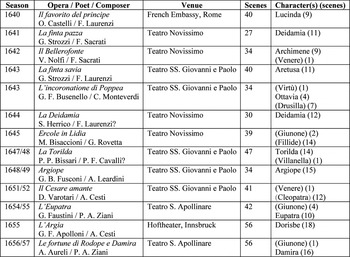
We have the librettos for thirteen operas in which Anna Renzi is known to have sung a leading role (Fig. 4), and music for five of these is extant: La finta pazza by Francesco Sacrati, La finta savia by Filiberto Laurenzi, L'incoronazione di Poppea by Claudio Monteverdi, L'Argia by Antonio Cesti and Le fortune di Rodope e Damira by Pietro Andrea Ziani. As the parentheses in Figure 4 indicate, we sometimes lack secure information about exactly which role she sang in a production. In nine cases we have secure – and in two cases almost secure – information about the leading character she created,Footnote 86 but it is not known which roles she sang in Ercole in Lidia (though probably Fillide)Footnote 87 and in Il Cesare amante (though probably Cleopatra), nor whether she appeared in the Venetian premiere of the latter opera, though it seems likely.Footnote 88 Above all, we have no information about whether she doubled in smaller roles, though she must have done so occasionally.Footnote 89 Tim Carter's suggestion that she would probably not have been one of the Amori in the final scene of Poppea because she ‘might not have been prepared to demean herself by taking such a secondary role’Footnote 90 conflicts with the fact that the two women in La maga fulminata doubled as two Sirene. Ziani implied, furthermore, that doubling was sometimes used to enlarge a singer's part,Footnote 91 while Ellen Rosand's excerpts from the contracts and correspondence of Venetian opera houses offer no evidence of star singers declining opportunities to increase their stage presence. In fact, they were mostly anxious to require additional arias, to ensure that they had enough scenes in each act, or even that their part was the largest in the show.Footnote 92 Though Tim Carter rejects the idea of a prima donna doubling in a small role, he does admit that Ottavia ‘seems not quite to fulfil the expectations of her position in the drama, of her role for a star-singer (Anna Renzi), and of her place in the sympathies of the audience.’Footnote 93Figure 4, listing the complete number of scenes in each of Renzi's operas as well as the number of scenes in which her characters sing, indeed shows that she was on stage in approximately a third of the scenes in her other operas, while Ottavia appears in only four out of 34 scenes. This makes the part half the size of her second-smallest part: her debut role, Lucinda in Il favorito del principe, who appears in nine out of 40 scenes. If she doubled as Virtù and Drusilla, however, Renzi would appear in 12 scenes, which would make her part in Poppea similar in size to the others she sang.
The roles of Anna Renzi

Another reason why Anna Renzi is unlikely to have agreed to sing only Ottavia is the Empress' striking lack of emotional, dramatic and musical variety. While all the other roles written for her feature at least one solo lament, the melancholy moments are invariably set off by starkly contrasting passions: pastoral simplicity, amorous reverie, self-denying heroism, searing jealousy or blood-crazed fury. All her roles feature most of these moods, but in Poppea, melancholy, jealousy and fury are Ottavia's domain, while simplicity, reverie and heroism are Drusilla's. Furthermore, all Renzi's other characters are extremely resourceful princesses or queens who defy various obstacles in order to be either united with men from whom some form of patriarchal power separates them, or reunited with men who have forsaken them due to misunderstandings and/or cooled interest. While Ottavia fits the bill as a resourceful queen, it is Drusilla who is reunited with one of the male leads at the end. In most of the other operas, furthermore, the heroine is constrained to achieve her ends by means of deceit, such as feigned simplicity, feigned madness or disguises. Offering opportunities for the display of contrasting emotions, the character's strategic craft would be allegorically mirrored in Anna Renzi's theatrical craft. A survey of her roles shows a striking consistency in this regard, the reactions of spectators often focussing on her ability to make contrasting emotions convincing.
Deidamia in La finta pazza feigns madness in order to move her lover Achille to compassion, as he is about to forsake her and depart for the Trojan War. As suggested above, her mad scenes are a veritable inventory of theatrical topoi, one F. M.Footnote 94 describing her as ‘a manslayer, both in her coquettish ways and in her disdain’,Footnote 95 while he elsewhere describes the touching effect of her tears: ‘Sembran fiumi i begli occhi, e miste in tanto / Scorron trà l'onde lor fiamme, ed ardori’ [Her lovely eyes are like rivers and their flames and ardour flow down mingling in their waves].Footnote 96
Archimene in Il Bellerofonte pretends to be interested only in flowers, singing and similar childish pursuits in order to conceal her adult affections for the title hero from her father who wants to marry her off to a foreign prince. According to a long narrative ‘idyll’ by the above-mentioned G. B. V., ‘coprendo il desio / Con atti gravi, & andamenti honesti / Hor semplicetta, hor scaltra ti fingesti’ [covering your desire, moving gravely and behaving chastely, you feigned now simplicity, now shrewdness],Footnote 97 while Giulio del Colle in his description of the production says she ‘now gave vent to, now feigned, now disclosed and now bewailed her amorous passions’.Footnote 98
The lascivious Aretusa in La finta savia pretends to be a chaste follower of the Cumaean Sibyl in order to avoid the advances of King Proca and marry his son instead.Footnote 99 G. B. V. vividly describes how Renzi merged anger with love in her central confrontation with the man who has betrayed her:
[While you were feigning disdain, I saw among the lilies of your cheeks those haughty vermillion roses, in which Cupid's graces lie hidden.]
The title heroine in La Deidamia has disguised herself as the youth Ergindo in order to reawaken the passion of her runaway lover. This is the first documented instance of Renzi playing two contrasting characters in one opera, though the double role here occurs within the fictional frame of the drama. One M. T. (Michelangelo Torcigliani?) describes how Renzi contrasted Ergindo's vivacity with Deidamia's laments:
[If she sighs as Ergindo, a heavenly breeze blows, bringing bliss to every soul here below that drinks the nourishing nectar from above, and if a delicate laughter spreads over the fair countenance, it is almost a bright flame that lights up hearts with the flash of lightning. But if Deidamia, wrapped up in love's pains, sometimes sprinkles the vermillion roses with the water of her tears, lingering in her moist splendours, then the souls of her unhappy lovers become an amorous rain, and their hearts likewise.]
Other roles, of which no account of her performance survives, clearly call for similar contrasting effects. Lucinda feigns virginal innocence in order to deceive her adulterous sister-in-law who covets her lover. Argiope pretends to be a naïve shepherdess only interested in catching birds in order to conceal her amorous passion and avoid being procured by her stepmother. Eupatra is a warrior-princess who first feigns madness in order to uncover the deceits of the two leading men, and then disguises herself as a shepherdess when one of them plots against her life. Dorisbe in L'Argia is persuaded by one of her three suitors to pretend love for one of the others, but ends up marrying the third. Damira in Le fortune di Rodope e Damira, a queen whom everyone thinks dead, has disguised herself as the shepherdess Fidalba and feigns madness in order to undeceive her husband who is about to marry a courtesan. Though Fillide, Torilda and Cleopatra do not employ deceit or disguises, they display emotional variety in other ways, ranging from erotic or pastoral love scenes and heart-rending laments or prison scenes to dramatic scenes of vengeance or self-sacrifice. In an oft-quoted passage in his introductory essay to the Renzi volume, Giulio Strozzi describes how the employment of contrasting tessituras, tempi, gestures and emotions were central to her art:
The action that gives soul, spirit, and existence to things must be governed by the movements of the body, by gestures, by the face and by the voice, now raising it [innalzandola], now lowering it [abbassandola], becoming enraged and immediately becoming calm again; at times speaking hurriedly, at others slowly, moving the body now in one, now in another direction, drawing in the arms, and extending them, laughing and crying, now with little, now with much agitation of the hands. Our Signora Anna is endowed with such lifelike expression that her responses and speeches seem not memorized but born at the very moment. In sum, she transforms herself completely into the person she represents, and seems now a Thalia full of comic gaiety, now a Melpomene rich in tragic majesty.Footnote 102
The contrasting of the comic and the tragic Muse might give the impression that Renzi was equally convincing in comedy and tragedy, but none of her roles can be described as purely comic. The modes clearly met within the individual drama, and while laughter and tears alternate in all her roles, Strozzi could well have been referring to the alternation of Drusilla and Ottavia. Significantly, his characterization of Anna Renzi as a performer as well as the first role he wrote for her, Deidamia in La finta pazza, bring to mind the title role of his and Monteverdi's aborted opera Licori finta pazza innamorata d'Aminta, which the composer discussed thoroughly in a series of letters from 1627 to his Orfeo librettist, Alessandro Striggio. Renzi was clearly the kind of brilliant singer-actress and quick-change artist Monteverdi had envisioned for Licori, and hence it seems likely that he would have wanted to exploit her peculiar skills in the field of virtuoso transformation when he got the chance to write a role for her. In 1627 he had emphasized the necessity of such skills in the singer of Licori while enthusiastically describing Strozzi's libretto as ‘full of many beautiful variations’,Footnote 103 words like ‘novel’, ‘versatile’, ‘amusing’, ‘varied’ and ‘diverse’ abounding in the letters. Whenever the feigned madwoman was to come on stage, she had to introduce ‘fresh delights and new inventions’,Footnote 104 i.e. ‘new moods and fresh changes of music, as indeed of gestures’.Footnote 105 As the aim was that ‘the changes between the vigorous, noisy harmonies and the gentle, suave ones will take place suddenly so that the words will really come through well’,Footnote 106 Licori required a singer who was skilled as an actress:
[…] the part of Licoris, because of its variety of moods, must not fall into the hands of a woman who cannot play first a man and then a woman, with lively gestures and different emotions. […] And since the transformations take place in the shortest possible time, and the imitations as well – then whoever has to play this leading role, which moves us to laughter and to compassion, must be a woman capable of leaving aside all imitations except the immediate one, which the word she utters will suggest to her.Footnote 107
For unknown reasons, the libretto was never set to music, but as Ellen Rosand points out, its most important features went into Strozzi's libretto for La finta pazza.Footnote 108 In her comparison of Monteverdi's projected opera to Sacrati's score for La finta pazza, Rosand shows how the feigned madness of both heroines was designed to occasion music of great formal variety: in Deidamia's mad scenes, conventional recitative passages alternate with the imitation of trumpet fanfares, softer melodic lines, literal word imitations and a lament-parody.Footnote 109 While similar formal contrasts are featured in Damira's mad scenes in Le fortune di Rodope e Damira,Footnote 110 it must again be emphasized that feigned madness was only one way of employing the principle of contrast, which recurs in all Renzi's roles. Deceit, disguise and doubling were means with which to achieve similar effects, and the surviving settings are all characterized by strong contrasts.
Aretusa's entrance canzonetta, ‘Ben si vede, che fuggito’, in the opening scene of La finta savia immediately establishes the contrast between lasciviousness and feigned piety, which is central to the character. In the first two stanzas she sings sympathetically of the goddess Aurora's love of young mortals, but when suddenly remembering that she is overheard by the other maidens in the Sibyl's garden, she turns the canzonetta into an innocent morning song in the third stanza. While the representation of contrasting affections would have depended on Renzi's acting and vocal delivery here, since the three stanzas have identical music, Laurenzi supported the contrast with his settings of Aretusa's next two arias. ‘Se mi coglie Amor, mio danno’ in Act I scene 7, in which the hypocritical princess publicly renounces Cupid's power, is set as a pastoral air replete with exuberant word repetitions and echo effects in the violins, while ‘Amata mi trovo’ in Act II scene 4, in which she secretly asks Cupid for luck in love, is given a simpler, syllabic setting with no word repetitions. Renzi's tour de force, however, would have been her performance of the five successive canzonette in Act II scene 10, each of which refers to a different classical myth about a woman finding happiness after being abducted by an enamoured deity, the songs calling for contrasting emotions in a manner not unlike Renzi's mad scenes. The most striking contrast is between the last two canzonette: ‘Su l'erba fiorita’ is a tribute to the rape of Proserpina ending with a long and triumphant melisma, while ‘Spero, aspetto, e non viene’ is a tormented reflection on Aretusa's own uncertain position, which has been a given syllabic setting with halting sigh figures. G. B. V. describes how Renzi moved the audience with her ‘pitiful diction’ and ‘truncated and sad accents’ in this lament.Footnote 111
Dorisbe in L'Argia is dramatically less variable than most of Renzi's other roles, but Cesti enhanced the contrasting effect with his settings of her three solos. The strophic love song ‘S'un guardo mi vinse’ in Act I scene 6 is given a mellifluous, melismatic melody, which differs markedly from the syllabic setting of her strophic lament ‘O Cieli e che sarà’ in Act II scene 2. This aria is close in mood and dramatic situation to the lament-prayer ‘Pietà, Numi, pietà’ in Act III scene 12, however, but poet and composer avoided repetitiveness by giving the latter a da capo form: the A section is set as an anguished triple-time melody full of word repetitions and with a three-part string accompaniment, while the B section, in which the condemned Dorisbe accuses her father of injustice, is set as recitative.
As this survey of Anna Renzi's roles shows, the command of diverse musical styles was as central to her art as was the alternation of simplicity and shrewdness, of laughter and tears, the miraculous clearly overruling the verisimilar. Monteverdi's Licori letters leave no doubt that he was as fascinated by this theatrical aesthetic as were his younger Venetian colleagues, which makes the casting of Renzi as Ottavia peculiar indeed. The part is not only considerably smaller and emotionally and dramatically more uniform than Renzi's other parts, but the Empress is the only major character in the opera to communicate exclusively in recitative, apart from eight measures in triple time in her first lament, in which she sarcastically mimics Poppea's voluptuous arioso style (‘In braccio di Poppea / Tu dimori felice, e godi’). But why would the kaleidoscopic Anna Renzi have agreed to sing a part with what Wendy Heller describes as such a ‘limited vocabulary of musical expressive devices’?Footnote 112 And if Sacrati, Laurenzi, Cesti and Ziani all wrote formally contrasting music for her, why would such a skilled man of the theatre as Monteverdi not do the same? Though Ottavia's musical austerity was obviously a dramaturgical choice, a comparison with Renzi's other roles suggests that musical characterization alone cannot account for the complete absence of lyricism. It is worth noting, for example, that Damira's entrance lament, ‘Che mi giova esser Reina’ (Act I scene 5), though clearly modelled on Ottavia's ‘Disprezzata Regina’, is framed by arioso sections, even if the part includes much lyricism elsewhere. Ottavia's lack of formal variety should probably be explained theatrically, with reference to the advice given by the author of Il corago who suggests that two characters performed by the same singer are given stylistically contrasting music. The obvious character with which to double Ottavia is Drusilla, not just because she is the largest female role after Poppea and Ottavia, not just because we know of no other singer in the cast who could have taken this part, nor just because her comic nature would provide an effective contrast to Ottavia's tragic nature, but also because Drusilla's music, with its abundance of dance-like arioso forms, is the exact opposite of Ottavia's. As pointed out by Ellen Rosand, she ‘sings, even in her recitatives’,Footnote 113 her dominant musical characteristic being a ‘readiness to burst into effusive song’.Footnote 114
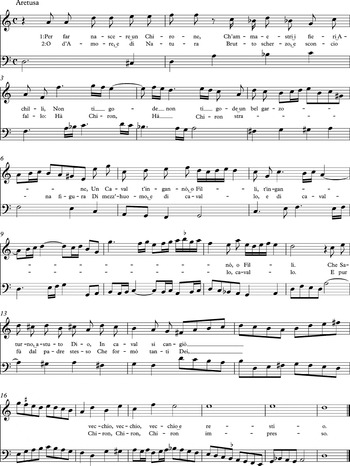
One reason why the doubling of Ottavia and Drusilla strikes us as surprising is that they apparently call for different voice types, Alan Curtis claiming that modern tradition ‘correctly casts Ottavia as a mezzo’ and is ‘justified in assigning Drusilla to a light soprano’.Footnote 115 A comparison with Anna Renzi's other roles shows that she was no mezzosoprano, however, but rather a soprano with a flexible voice. She was clearly most comfortable in the area between a″ and f″, which Tim Carter describes as Drusilla's usual tessitura, and while her most frequent top note is g″, Laurenzi and Cesti required her to go up to b′′′ flat (Ex. 1 shows one of Laurenzi's arias for her, which clearly required her to sing in Drusilla's range). Curtis's primary argument for casting Ottavia as a mezzo is the single c′ on ‘fulmini’ in Act I scene 5, but apart from this harsh dig into the chest voice, Ottavia and Drusilla have the same range: d′ to g″. The difference in tessitura is part of their characterization, on a par with the difference in musical style and in agreement with Mei's association of the passions with vocal registers. It should also be remembered that Renzi, according to Strozzi's essay, made use of her vocal range for dramatic effect, Ellen Rosand pointing out that Deidamia in La finta pazza uses ‘schizophrenic tessituras an octave apart’ in her mad scenes,Footnote 116 and Ferrari referring to the ‘high and low notes’ of the Siren's song in Poppea. That Monteverdi was more focussed on a singer's range than on her preferred tessitura, furthermore, is implied in his question about ‘the actual range’ of the singer meant to create Licori ‘as regards her highest and lowest notes’ before setting out to compose her music.Footnote 117
‘Per far nascere un Chirone’, canzonetta sung by Aretusa in La finta savia, by Giulio Strozzi and Filiberto Laurenzi, Act II scene 10.

A comparison of the 1643 premiere with the 1651 Neapolitan production further suggests that Ottavia was originally doubled. The Naples score includes a solo lament for Ottavia in Act II and a soliloquy at the end of her scene with Ottone, which the (unknown) singer probably requested because she found four scenes inadequate. The part would only have been too small if she did not double in another role, however, and hence the expansion of Ottavia's part in Naples suggests, indirectly, that Renzi had doubled (as Drusilla) in 1643 (and also that she did not sing in the Neapolitan production). Besides, a twice-repeated refrain in triple time in the new solo lament, which would have disrupted the otherwise consistent contrast between Ottavia's and Drusilla's musical styles, may suggest that this was no longer deemed dramaturgically necessary.
The opera contains, furthermore, a number of jokes that seem to point outside the drama to the theatrical context. As with Annibale Graselli's and Francesco Angeletti's doubled roles in the Ferrari/Manelli operas, discussed earlier, some lines make most sense if seen as a play on Renzi's act of doubling. The most conspicuous of these is Drusilla's exit lines at the end of Act I where she suddenly addresses the audience directly:
[I leave gladly. Otho stays content. I go to see the Empress again.]
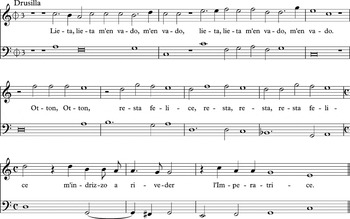
Drusilla's only reference to Ottavia in the opera seems to have been Renzi's playful hint to the audience that her next appearance on stage would be as the Empress.Footnote 118 Monteverdi's peculiar setting of this speech (Ex. 2), furthermore, may have served the purpose of emphasizing the joke: the first line is set as one of Drusilla's typical bubbly airs, the second line as recitative, and on the word ‘Imperatrice’ the singer was required to descend to e′, her lowest note in the scene, which might have signalled a shift from the ringing upper register of Renzi's Drusilla voice to the gloomy lower register of her Ottavia voice. The wish to create such a contrasting effect would explain why these lines were changed when Monteverdi set them to music. In Busenello's original libretto, which was published among his collected dramas in 1656,Footnote 119 the lines read:
[I leave gladly (Otho stays content) in order to visit the Empress at once.]
Lines sung by Drusilla in L'incoronazione di Poppea, by Gian Francesco Busenello and Claudio Monteverdi, Act I scene 13.

Not only would ‘see the Empress again’ point more directly to the doubling than ‘visit the Empress at once’, since it implies that the singer had ‘seen’ the Empress earlier in the opera, but by turning a sentence divided by an inserted remark into three discrete statements, it was possible to clothe the lines in distinct musical styles.Footnote 120
The most spectacular instance of meta-theatricality would have been the quick-change act at the heart of the opera. Here the singer would have left the stage as Ottavia at the end of Act II scene 7, threatening Ottone with a rape charge and death by torture if he fails to keep his promise and kill Poppea (‘perche dunque ricusi / Quel che già promettesti!’) – only to re-enter as Drusilla three lines (ten measures) later, singing exuberantly about the same man's promise to love her faithfully (‘Hoggi spero che Ottone / Mi riconfermo il suo promesso Amore’). The fact that Ottone's three-line soliloquy is absent from Busenello's original libretto may imply that it turned out, either during the composition of the music or during rehearsals, that Renzi needed this speech for her costume change.Footnote 121 In its place was originally a five-line exit speech for Ottavia, which would have left the singer no time for her change, and which was cut by Monteverdi. Not surprisingly, it was restored and expanded into the above-mentioned soliloquy in the Naples production, in which Ottavia and Drusilla were not doubled. As Stephen Booth points out with regard to doubling on Shakespeare's stage, quick transformations such as the one required by the Venice score may seem incredible to modern spectators, who are used to changes of costume and makeup being radical and time-consuming.Footnote 122 Yet Renzi would not have had much less time to go into the wings and dispense with the Empress' crown and mantle (which probably concealed Drusilla's costume) than had the singers in La maga fulminata, some of whose changes involved moving from floor level into the flies. We should not forget that quick-change acts were part of the theatrical aesthetic of the period, meant to evoke a sense of wonder, and Monteverdi may have aimed to enhance this effect by setting Ottavia's last speech in scene 7 as her most violent recitative and Drusilla's entrance speech in scene 8 as her most exuberant and melismatic air: ‘Felice cor mio / Festeggiami in seno’.Footnote 123
Since the idea of one actress doubling as Ottavia and Drusilla is bound to strike modern spectators as an incredible theatrical feat – due to the swiftness of the implied quick-change act as well as to the characters' obvious differences in tessitura and mood – it seems odd that the seventeenth-century spectators apparently fail to mention this presumed aspect of Renzi's performance. Yet the sonnets in Le glorie della signora Anna Renzi romana that specifically refer to the singer's appearance in Poppea concentrate on Ottavia's departure from Rome in Act III – clearly the high point of her performance in the eyes of the audience – rather than on her performance as a whole. The poems quoted above may be referring implicitly to the doubling, however, as I have argued, while the only poem to actually offer a general account of Renzi's performance in Poppea, the long narrative idyll by G. B. V., seems only to make sense fully if she played both characters. The reason why the author never names Drusilla may be that he did not perceive her as a separate character, but rather as an aspect of the character appearing under the ‘pretended name’ of Empress Ottavia:
[Finally, you undertook, on the same stage, to make a delightful and amorous display of your graces and charms under the pretended name of Empress Octavia: an action matched by your clever manner, by your worthy and sincere and pure and grave and graceful gestures. And when you entered, before your song unfolded, your languishing face revealed your torments to everyone with the sweet refinements of stifled sighs. Troubled, you then began your sung complaints with your divine voice, despised Queen, and continuing the lament you made Cupid sigh and shed tears of pain. I know well that if the heart-felt grief and the woeful tale had been true, oh I know well that Nero would have become humble and pious, just as our breasts were filled with pity at the sound of your sad voice, of your sweet words, of your lovely diction. The stages were seen to produce immortal victories by your supreme gifts, Anna, and the rivals of your virtues seemed like beautiful emulators, small stars next to the bright sun. Overwhelmed with wrath at your wicked husband and in order to satisfy your most just desires with the blood of your enemy Poppaea, you entrusted the luckless Otho, who was her faithful lover, with her death by his own hands. That imperious voice, which with a grave appearance gave expression to a barbarous desire, seemed to pass the death sentence even on us, but with such sweetness and such tenderness that it also offered aid, and in the end that death meant life. Then, alas, you walked towards your exile on the sea, and while you, embraced and caught by the sea's rage, were seated in a hollow ship almost set on fire with amorous flames, our souls, released from their vital bonds, followed you, for on the perilous voyage they never tired of following the light and rays of your life.]
After a description of Anna Renzi's silent entrance as Ottavia in Act I scene 5, probably accompanied by a now lost sinfonia, we hear of her performance of ‘Disprezzata Regina’. Later follow clear references to Ottavia's interview with Ottone in Act II scene 7 and to her lament in Act III scene 6. Wendy Heller was the first to point out that some features of the poem are incompatible with Busenello's and Monteverdi's characterization of Ottavia, however: in particular the ‘sweetness’ and ‘tenderness’ with which Renzi's voice apparently passed the death sentence on Poppea in Act II. As explanation, she suggests that G. B. V., insensitive to Busenello's and Monteverdi's charmless characterization of Ottavia, ‘created for his beloved prima donna a character who was not only more suitable for Renzi's public persona, but also more compatible with the innocent and tragic bearing of the historical Octavia and the conventional representation of the lamenting woman’.Footnote 125 Heller here points to the ‘fluid boundary between singer and character’ in the description of Renzi's performance,Footnote 126 and I would like to take that perception further in my alternative interpretation of these lines. Fluidity may have been an integral part of the production itself, Renzi's doubling possibly dissolving the distinction between Ottavia and Drusilla in the spectator's mind, uniting the barbarity of the former and the devotion of the latter in one and the same woman. Since G. B. V. explicitly describes Renzi's Ottavia as ‘overwhelmed with wrath’, her ‘imperious voice’ apparently passing the death sentence on the audience as well as on Poppea, praise of her vocal ‘sweetness’ and ‘tenderness’ in that very scene would seem strangely self-contradictory. Even the most imaginative singer could hardly find occasion for softness in Ottavia's murderous threats, and since the previous lines clearly show the poet's awareness that this was not the effect Renzi aimed at, his paradox would seem to deny the terrifying effect of her performance, which he himself describes. Nor is it clear, indeed, in what sense Renzi's/Ottavia's voice could have ‘offered aid’ to anyone. If we, however, assume that Renzi sang both Ottavia and Drusilla, these lines begin to make sense: while it was her ‘imperious voice’ that passed the death sentence on Poppea in scene 7, it was also her voice that ‘offered aid’ to Ottone in scene 9 with ‘sweetness’ and ‘tenderness’, and since Drusilla both helps Ottavia and Ottone to carry out Poppea's death sentence and thereby paves the way for Ottone's salvation and union with herself, ‘in the end that death meant life’. The merging of Ottavia and Drusilla seems also to be implied in the description of Act III, in which Renzi's ship is ‘almost set on fire with amorous flames’, though Ottavia makes clear in her lament that she will sail into her exile in ‘pianti amari’ [bitter tears]. It is Drusilla, in fact, who looks forward to spending the ‘giorni ridenti’ [smiling days] of her exile together with Ottone in the most distant corners of the empire. Their means of transport is not mentioned, but G. B. V. seems to be suggesting that the boat of the ardent Drusilla and that of the weeping Ottavia is one and the same. Something similar may be implied in the two sonnets, both of which seem to refer, curiously, to Ottavia's amorousness.
Melpomene and Thalia
In the symmetrical structure of L'incoronazione di Poppea, the prologue, in which a recently crowned and apotheosized Fortuna gloats over a dethroned and forgotten Virtù, allegorically mirrors the end of the opera in which Poppea is given the titles of Empress and goddess, while Ottavia is dethroned and abandoned. Doubtless, Anna di Valerio sang Fortuna and Anna Renzi Virtù. This points to a further layer in the prologue, however: that of two prima donnas who both claim to be the world's greatest ‘diva’. Just like Poppea and Ottavia, di Valerio and Renzi may have been linked allegorically to Fortuna and Virtù: thus in his postscript to La finta savia, Giulio Strozzi praises Anna di Valerio for knowing with her ‘heavenly song’ how to ‘season all earthly bitterness, not leaving anything to be desired by eyes and ears’, whereas Anna Renzi, ‘the wonder of the stage’, is praised for her ‘harmonious and miraculous expression’.Footnote 127 In other words, while di Valerio (a newcomer to the city and hence an ‘upstart’ like Fortuna) was the fortunata blessed with wonderful looks and vocal means,Footnote 128 Renzi (the established ‘queen’ and ‘goddess’ of Venetian theatre) was the virtuosa admired for her theatrical craft. Both the French diplomat and G. B. V. hint that the singers were perceived as rivals (the former claiming that Renzi ‘ceded the palm but little’, the latter that Renzi's rivals ‘seemed like small stars next to the bright sun’), but whether their rivalry was real or projected, it must have been magnified for comic effect by Busenello who invited them to play ironically on their respective public personas the only time they appeared together on stage in the opera.Footnote 129 Such meta-theatrical play occurs when Fortuna claims that Virtù is a ‘Diva senza devoti’, a goddess without worshippers – or a diva without fans. Virtù, on the other hand, compares herself to the north wind teaching human intellects the art of navigating towards Olympus while calling Fortuna a vile chimera made goddess by the imprudent, implying that her own success relies on skill and artistry, while her rival's relies on the mindlessness of her fans.
Just as the audience was invited to explore the legamenti between the allegorical figures in the prologue, the singers and the singers' characters in the drama proper, I suggest they were invited to explore the legamento between Ottavia and Drusilla. Like Mercurio/Perseo and Rodomira/Scarabea, they face almost identical existential situations: Poppea has taken both their men, and both women end up leaving Rome for a life in exile. Yet they respond to these situations differently. Ottavia behaves as a tragic protagonist: she is torn by jealousy, accuses Jupiter of injustice, is prompted by her vindictiveness to form a scheme for murdering her rival and will spend her exile in bitter tears. Drusilla, on the other hand, behaves more like the heroine of a comedy: she makes fun of Ottone's pain, praises Cupid for his justice, eventually succeeds in winning her lover back and will spend her exile in laughter. Furthermore, her involvement in the plot and her acquittal by Nerone are largely coincidental, as is typical of comedy, whereas Ottavia's actions are deliberate, her punishment following as their logical consequence, as is typical of tragedy. It is beyond the scope of this article to delve into all the allegorical meanings generated by the doubling, but for the present purpose it suffices to point to the opera's juxtaposition of two intertexts, which the doubling would have highlighted: that of the first-century Roman tragedy Octavia, which served as the basis for Ottavia's appearances in Acts I and III (among other scenes), and of Girolamo Bargagli's comedy La pellegrina, which apparently provided Busenello with the character of Drusilla.
Since Kurt von Fischer in 1968 discovered the many similarities in content, structure, imagery and the gallery of characters between Busenello's libretto and Octavia, which in the seventeenth century was misattributed to Seneca; the tragedy has been studied as one of the libretto's possible sources, most scholars agreeing that Busenello borrowed various elements.Footnote 130 Seventeenth-century playwrights, however, not only borrowed from classical and modern literature, but also tended to draw on the erudition of the educated part of their audience, expecting them to appreciate their subtle departures from the revered models. In the words of the Shakespeare scholar Jan Kott, borrowings are never neutral; each quotation enlists its own context ‘to challenge the author's text for better understanding or for mockery’.Footnote 131 It is when read as an intertextual reference, in other words, that Octavia truly furthers our understanding of the opera, the difference between the pseudo-Senecan and the operatic Empress appearing as early as in their respective entrance laments. These are Octavia's lines in the Latin tragedy:
These are Ottavia's lines in the opera:
[Despised Queen, wounded wife of the Roman ruler: what am I doing? Where am I? What am I thinking? O miserable female sex! If nature and heaven bring us forth free-born, marriage enchains us as slaves. If we conceive a man, O miserable female sex, we shape the limbs of our own evil tyrant, we suckle the cruel executioner who flays us and slashes our veins, and we are constrained by an unworthy fate to give birth to our own death.]
Whereas the classical Octavia fears for her life and mourns her father and her brother, both murdered by Nero or his mother Agrippina, the murdered relatives are not mentioned in the lament of the operatic Empress. She mourns her husband's infidelity and fears divorce, but her allusions to the historical Nero's execution of his mother and wife (Agrippina indeed gave birth to her own executioner; Octavia had her veins opened on Nero's orders) are distilled to a general metaphorical reflection on unhappy marriages, as she hardly means to imply that all men literally kill their mothers and wives. The classical Octavia fears Nero's marriage to Poppaea because she knows that she ‘has designs on my marriage; she burns with hatred for me, and as the price of adultery she keeps asking my husband for the head of his lawfully wedded wife’.Footnote 133 Ottavia, on the other hand, is consumed with jealousy, vividly imagining how Nerone nestles in Poppea's arms, but does not see her own death as resulting from their liaison. In this way, while retaining the setting and outward form of classical tragedy, Busenello has subtly removed the very core of the genre – the tragic situation – and replaced it with a marital triangle, a situation native to comedy (thus also placing Ottavia on the same footing as Renzi's other heroines).
As has often been pointed out, Ottavia's murder plot in Act II constitutes the most radical departure from her pseudo-Senecan model, who never considers murdering anyone. Critics have not paid attention to the fact, however, that Ottavia's behaviour is more morally dubious than it would have been in the classical Octavia, since she is only threatened by repudiation, while the latter faces a death sentence. This crucial difference makes ‘A Dio Roma’, Ottavia's final lament, modelled on the equivalent lament in Octavia, highly ambiguous. These lines are from the classical lament:
And Ottavia's equivalent lines in the opera:
[The air, which will receive my breaths at once, will carry them in the name of my heart to see and kiss the walls of my country. But I shall wander alone, weeping and walking by turns while teaching pity to the trees and the rocks. Row, then, you unnatural men: take me far away from my beloved shores.]
Neither the libretto, the printed scenario from the premiere, nor the poems by Ferrari and G. B. V. imply that Ottavia faces death when boarding the ship after her final lament, and a comparison with Octavia indeed shows that Busenello carefully replaced the execution of the historical Empress, which she predicts in the tragedy, with exile. While exile was certainly no light matter in ancient times, Ottavia's ‘tragic’ response to Nerone's decree is subtly undercut by the fact that Drusilla embraces her exile with glee. In this way, Busenello hints to the attentive spectator that the difference between Ottavia's tragedy and Drusilla's comedy is not really a difference in situation, but rather in dramatic rhetoric, in theatrical persuasion. By contrasting their reactions to an identical fate he has, in effect, removed the tragic situation from Ottavia's Act III lament, just as he had removed it from her Act I lament. His subversion of the tragic model is enhanced by the fact that the classical Octavia dies innocently while the operatic Ottavia is spared although she is guilty of attempted murder. The implicit theatricality of the latter's farewell to Rome is further emphasized by the fact that the image she projects of herself – walking on a foreign coast, longing for her homeland, cursing her betrayer and repenting of her curses – owes less to the equivalent scene in Octavia than to Arianna's iconic lament in Ottavio Rinuccini's and Monteverdi's eponymous tragedia di lieto fine from 1608, which would have been fresh in Venetian audiences' memories due to its revival for the 1640 inauguration of Teatro S. Moisè. Whereas the mythological prototype of the pseudo-Senecan Octavia is Electra, the humiliated daughter of a murdered king, that of the operatic Ottavia is Ariadne, the princess abandoned by her faithless bridegroom, and as Rinuccini's paradoxical genre specification spells out, the latter is not a truly tragic figure. While Arianna might move the audience to tears with her famous lament, she eventually ends up dismissing the faithless Teseo from her mind in favour of Bacco, the bridegroom she encounters in her exile on Naxos. Hence the intertextual reference implies that the destinies of Ottavia and Drusilla, notwithstanding their public protestations, are both contained in the figure of Ariadne. This fundamental discrepancy between the classical and the modern Empress exposes Ottavia as one of Anna Renzi's numerous beguiling transformations, and may further explain why Ferrari and G. B. V. focussed on her illusoriness.
As has often been pointed out, Drusilla is the only major character in the opera without a model in history or in Octavia. Iain Fenlon and Peter Miller argue that she was inspired by Drusilla in Ariosto's Orlando furioso, a model of female constancy,Footnote 135 though Wendy Heller points out that she could just as well have been inspired by the far less respectable Julia Drusilla, Nero's aunt.Footnote 136 Both suggestions rely exclusively on the identity of the name, but the Ariostan character was probably the model of the eponymous title heroine in Girolamo Bargagli's comedy La pellegrina (written 1567–68), which offers certain points of resemblance with the plot of the opera and may have been the real source of the character, though Ariosto and Julia Drusilla might have loomed in the background. Like the Ariostan Drusilla and the pseudo-Senecan Octavia, Bargagli's Drusilla is a model of female constancy, but her virtue is displayed within the framework of classical comedy. So while the title heroine of Octavia could be taken to represent the genre of tragedy (Seneca was regarded as the quintessential classical tragedian in the seventeenth century), the title heroine of La pellegrina could be taken to represent the genre of comedy. Both characters ‘reappear’ in L'incoronazione di Poppea, and the actress performing both of them will at one moment seem ‘a Melpomene rich in tragic majesty’ and at the next ‘a Thalia full of comic gaiety’. The Venetian audience would certainly have been familiar with La pellegrina, furthermore, which was read all over Europe and had been published in several editions. The play was known to Shakespeare (Drusilla arguably served as a model for Helena in All's Well That Ends Well),Footnote 137 but to opera scholars it is famous above all for the lavish intermedi devised for its original production in connection with the 1589 wedding of Grand Duke Ferdinando I of Tuscany to Christine of Lorraine, with music by Cristofano Malvezzi, Luca Marenzio and various members of the Florentine Camerata.Footnote 138 If Monteverdi had not heard of this widely publicized event from his patron, Duke Vincenzo I of Mantua, who was present in the audience, he would have heard of it from either of his two early librettists who were both involved in the production: Rinuccini had written the texts for the intermedi, and Striggio was a viol player in the orchestra.Footnote 139
The plot of La pellegrina is as follows. The Pisan nobleman Cassandro intends to marry off his daughter Lepida to Lucrezio, without knowing that she is four months pregnant by her lover who is also named Lucrezio, but who visits her every day disguised as the pedantic doctor Terenzio. The latter advises her to feign madness in order to be kept indoors and thereby conceal the pregnancy, but her betrothed is anxious to see her because he wants to use her madness as a pretext for breaking the engagement. Drusilla is a girl from Valencia whom Lucrezio, now betrothed to Lepida, once promised to marry, but believing her dead he left Spain. Disguised as a pilgrim, she is searching for her runaway lover who she thinks has deceived her, but when she finds him in Pisa, she keeps her true identity concealed, wanting to test the sincerity of his feelings. Cassandro, believing in the medical gifts of the pilgrim, decides that only she shall have access to his daughter, and when Drusilla realizes that Lepida is pregnant, she decides to keep her secret. The pregnancy is revealed anyway, however, and due to the confusion arising from the identical names of the young men the father first accuses Lucrezio the betrothed of seducing his daughter, and then Lucrezio the lover whom, in the culminating trial scene, he threatens to have sent to the galleys, backed up by a constable. In the end, however, the two Lucrezios marry the right girls, Drusilla revealing her identity to her lover in the moving final scene: ‘I'm dying to cast off this pilgrim's dress since my pilgrimage is over. Now all my prayers and my wishes have been granted!’Footnote 140
According to Louise George Clubb, Bargagli's Drusilla, with her ‘chaste and law-abiding self-denial’ and her ‘combination of enterprising independence with moral and intellectual superiority’, is a model example of ‘the commedia grave figure of the woman as an embodiment of spiritual values’.Footnote 141 Knowledge of the heavy Neoplatonic symbolism of the 1589 intermedi might have enforced these idealistic connotations – yet the operatic Drusilla subverts the image of comedic constancy, just as Ottavia subverts the image of tragic constancy. Like her model in Bargagli's play, Drusilla follows her runaway lover from country to country, offering her aid and forgiving his transgressions, their reunion in Act III scene 4 paralleling the reunion scene in La pellegrina. Like Ottavia, however, she departs radically from her dramatic model in Act II. Whereas Bargagli's pilgrim decides to keep her rival's secret when realizing she is pregnant, Busenello's Drusilla is actively involved in the attempt to murder Poppea. But just as Ottavia potentially seduces the audience with her heart-rending laments in Acts I and III, Drusilla potentially seduces with her comic hilarity in Act I and her selfless devotion in Act III.Footnote 142
According to my interpretation of the first staging of this opera, however, the constancy of Ottavia and Drusilla would not only have been belied by their behaviour. The supreme irony of the drama in 1643 would have consisted in the fact that they were both represented by that infinitely inconstant quick-change artist, Anna Renzi. Both also being represented in the figure of Virtù in the prologue, their shared virtue would thus have been not the virtus of Stoic constancy, but the virtù of the protean actress.
But might the subversion of the virtue of constancy go even deeper into the structure of this complex work? Might it not be possible, as G. B. V.'s poetic circumlocutions seem to hint, that Ottavia and Drusilla were not only performed by the same actress, but that Drusilla is simply Ottavia in disguise (similar to Renzi's disguises in her other roles: the madwoman, the Sibyl's disciple, the charming youth, the ingenuous shepherdess)? If so, then both characters would emerge as even more duplicitous. Were that the case, we would see that Ottavia secretly heeds the advice given by her nurse in Act I scene 5, taking a lover in order to avenge herself on her faithless husband, while she publicly heeds the advice given to her by Seneca in scene 6, leaving Rome as the very image of Stoic constancy and fortitude. And while she cruelly forces Ottone to attempt the murder of her rival, as the sweet ‘Drusilla’ she dresses him up in her own costume, thus making him perform the deed on her behalf while she charms him with her selflessness. In such a light, it would only be logical that Ferrari and G. B. V. fantasized about what was happening on the boat that carried Renzi's character into exile: they perhaps dreamt about the tantalizing moment of recognition when the repudiated Empress whose prayers and wishes had finally been granted, would cast off her ‘pilgrim's dress’ and reveal her true self to her lover. Like them, we can only guess at what happened on the boat, however, because we cannot know whether Ottavia and Drusilla were – within the drama or within the theatre – the same woman. At the heart of the allegory is the question of whether Ottavia was unfaithful to her husband, but the answer will remain unknown (incognito), as the Nutrice reminds her ward:
[The love affairs of queens have this advantage, too: if the idiot knows about them, he doesn't believe in them; if the shrewd man sees through them, he conceals them: and the sin concealed and disbelieved remains secret and safe everywhere, as if one were speaking between a deaf and a mute man.]
Ottavia knows what Poppea does not know, but which Arnalta – the Nutrice's alter ego – vainly tries to teach her in Act II scene 10: not even Jupiter is able to introduce fidelity at court. While Poppea naively informs Ottone about her imperial ambitions and lets the turncoat Drusilla into her garden during her afternoon sleep, the scheming Empress trusts no one: the Nutrice, Seneca and Ottone all serve her in different ways, but she shares her secret thoughts neither with them nor with the spectators. It is up to the shrewd men and women at court and in the audience to observe the political actress and draw their conclusions in silence.