

When a couple faces conflict in their relationship, partners react and respond in complex ways that involve both observable interaction patterns and underlying cognitive processes. Although current research has generally studied these realms separately, examining couples’ patterns of interacting in the context of their thoughts and beliefs about relationships has the potential to deepen our understanding of couples’ responses to conflict. We argue that it is important to explore the beliefs, assumptions, and expectations that underlie and motivate the observable behaviour. Understanding the function of implicit theories of relationships in relation to couples’ communication around conflict has the potential to inform how foundational beliefs about relationships are ultimately acted out in a couple's lived experience. Thereby, this approach allows us to better understand one piece of the complex puzzle that underlies couples’ conflict communication patterns.
While much of the existing research on implicit theories of relationships has considered individuals’ responses in isolation as a proxy for dyadic outcomes (Knee, Reference Knee1998; Knee & Petty, Reference Knee, Petty, Simpson and Campbell2013), relatively little research has utilised data from both partners in a couple to examine dyadic outcomes. The present study utilises a dyadic approach to examine the relationship between implicit theories of relationships and conflict communication patterns, with the goal of uniting these two realms into a more complete understanding of how each partners’ beliefs about relationships interact to contribute to couples’ joint reactions to relational conflict.
Theoretical Background
There are many factors that influence how couples interact during conflict, including attachment style (Corcoran & Mallinckrodt, Reference Corcoran and Mallinckrodt2000), personality (Thomsen & Gilbert, Reference Thomsen and Gilbert1998), and external stressors (Crohan, Reference Crohan1996). One such factor that has received less attention in the literature is individuals’ implicit theories of relationships (ITRs), or the beliefs that individuals hold about the nature and stability of relationships (Knee, Reference Knee1998). It is worth noting the complexity of this term; namely, while the field refers to these measures as implicit theories, ‘implicit’ suggests only that these are deeply held theories about the nature of relationships, not that these theories are inaccessible or below consciousness (Knee & Petty, Reference Knee, Petty, Simpson and Campbell2013).
Foundational Research on Implicit Theories
Implicit theories are fundamental assumptions about the stability or malleability of an attribute, and the conditions that promote change (Ross, Reference Ross1989). These strongly held but rarely articulated beliefs play an instrumental role in determining how people approach, interpret, and respond to their environment. The foundational ideas underlying implicit theories stem from Kelly's (Reference Kelly1955) theory of personality and Heider's (Reference Heider1958) field theory of social perception, which first suggested that an individual's fundamental, implicit beliefs about the social world relate to their expectations and interpretations of future events.
More recently, Carol Dweck has advanced the literature on implicit theories, focusing largely on domains of intelligence, personality, talent, and morality (see Dweck, Chiu, & Hong, Reference Dweck, Chiu and Hong1995, for a review). In this research, Dweck and her colleagues identified two types of implicit theories, termed incremental and entity theories. Incremental theories are characterised by a belief in the malleability of attributes and a conviction that they can be changed through effort. Conversely, entity theories posit that attributes are fixed and unchangeable (Dweck et al., Reference Dweck, Chiu and Hong1995).
These implicit theories influence the way people approach, interpret, and respond to their environment (Schumann, Zaki, & Dweck, Reference Schumann, Zaki and Dweck2014). Specifically, when faced with negative feedback, entity theorists are more likely to interpret the feedback as fixed and global, and they tend to respond by withdrawing and experiencing negative affect. In contrast, incremental theorists tend to interpret the feedback as specific and malleable, and respond by increasing their motivation and viewing it as an opportunity for development (Schumann et al., Reference Schumann, Zaki and Dweck2014; Kammrath & Dweck, Reference Kammrath and Dweck2006; Yeager & Dweck, Reference Yeager and Dweck2012). This pattern of interpretation and response, based in implicit theories, occurs in a similar fashion across a variety of domains, ranging from developing empathy (Schumann et al., Reference Schumann, Zaki and Dweck2014) to learning online games (Lee, Heeter, Magerko, & Medler, Reference Lee, Heeter, Magerko and Medler2012).
However, implicit theories are not necessarily consistent across domains (Dweck et al., Reference Dweck, Chiu and Hong1995). For example, one could hold an incremental theory regarding intelligence but view personality from an entity perspective. Since one's implicit theory in one realm may not be consistent with his/her theories in other domains, many researchers have worked to evaluate implicit theories across a wide variety of domains (Karwowski, Reference Karwowski2014; Yeager & Dweck, Reference Yeager and Dweck2012; Rudolph, Reference Rudolph2010), including implicit theories of romantic relationships (Knee, Reference Knee1998).
Implicit Theories of Relationships
Stemming from research on implicit theories in individual domains, Knee (Reference Knee1998) extended implicit theories to romantic relationships. Implicit theories of relationships (ITRs) are beliefs surrounding the nature of relationships, conceptualised in two independent domains: destiny and growth. Destiny beliefs capture individuals’ theories of whether relationships are either meant to be or not, while growth beliefs capture the idea that relational problems are malleable and can be overcome (Knee, Reference Knee1998).
These implicit theories of relationships are similar to implicit theories in individual domains, such that growth beliefs relate to incremental theories, and destiny beliefs relate to entity theories. Similar to the way that implicit theories of intelligence predict different thoughts and responses in the face of a failing grade (Schumann et al., Reference Schumann, Zaki and Dweck2014), implicit theories of relationships are predictive of different interpretations and sets of coping responses when couples are faced with relational conflicts (Knee, Reference Knee1998; Knee & Bush, Reference Knee, Bush, Sprecher, Wenzel and Harvey2008). Specifically, partners who more strongly endorse destiny theories tend to see their relationship as ‘meant to be’ and view the relationship as stable. From this perspective, conflict in the relationship can be seen as a challenge to the idea that the relationship is meant to be. When faced with this threat to their belief system, partners endorsing destiny theories are prone to use avoidance coping strategies, including denying the problem and disengaging from the relationship (Knee, Reference Knee1998). In contrast, partners who more strongly endorse growth theories tend to believe that hard work is central to their evolving relationship, and view conflict as an opportunity for strengthening their connection to their partner. For these partners, conflict is more typically seen as something that can be overcome. Therefore, partners endorsing growth beliefs tend to address conflict with approach-based strategies, such as talking with their partner and optimistically reframing the problem (Knee, Reference Knee1998; Knee & Petty, Reference Knee, Petty, Simpson and Campbell2013).
In addition to favouring different strategies during conflict, individuals with different ITRs also experience differences in their emotions and cognitions following conflict (Knee, Nanayakkara, Vietor, Neighbors, & Patrick, Reference Knee, Nanayakkara, Vietor, Neighbors and Patrick2001). Knee et al. (Reference Knee, Nanayakkara, Vietor, Neighbors and Patrick2001) found that after a discussion surrounding discrepancies in their relationship, individuals high on growth beliefs and low on destiny beliefs experienced an increase in positivity, while individuals high on destiny beliefs and low on growth beliefs experienced increased hostility. Furthermore, endorsement of growth beliefs was found to be a moderating variable between conflict and commitment, such that endorsement of growth beliefs buffered against declines in feelings of commitment that are typical in the aftermath of a conflict (Knee, Patrick, Vietor, & Neighbors, Reference Knee, Patrick, Vietor and Neighbors2004).
Despite the predictive differences between growth and destiny theories, neither belief is considered to be more or less adaptive. Instead, the adaptiveness depends primarily on the context of the relationship and the flexibility with which it is applied (Knee, Reference Knee1998). ITRs tend to be relatively stable over time, with slightly more flexibility in early adulthood (Knee, Reference Knee1998; Knee, Patrick, & Lonsbary, Reference Knee, Patrick and Lonsbary2003). Additionally, while ITRs can be influenced by salient relationship experiences (Knee, Reference Knee1998), the proposed direction of effect is such that implicit theories inform expectations about relationships, which in turn inform interpretations of relational events, and ultimately shape behaviours within the relationship (Knee et al., Reference Knee, Patrick and Lonsbary2003).
One key difference between the literature on implicit theories of relationships and implicit theories in other domains (i.e., intelligence, personality, morality) is that entity and incremental beliefs have been conceptualised unidimensionally, as two opposite ends of a single spectrum (Dweck et al., Reference Dweck, Chiu and Hong1995), while research around ITRs has instead supported viewing destiny and growth beliefs as two orthogonal dimensions (Knee et al., Reference Knee, Patrick and Lonsbary2003). Knee et al. (Reference Knee, Patrick and Lonsbary2003) and Franiuk, Cohen, and Pomerantz (Reference Franiuk, Cohen and Pomerantz2002) established the independence of growth and destiny theories (r = −.01, found by both studies). This independence suggests that rather than being conceptualised as two opposing ends of one dimension, as is the case for implicit theories in other domains, ITRs should be conceptualised along two dimensions (growth and destiny), such that endorsement of one dimension does not preclude endorsement of the other (Knee et al., Reference Knee, Patrick and Lonsbary2003; Knee & Petty, Reference Knee, Petty, Simpson and Campbell2013).
This orthogonal conceptualisation allows an individual to fall in one of four orientations: Cultivation (low destiny/high growth), a belief that potential partners are not meant to be and problems can be resolved; Evaluation (high destiny/low growth), a belief that potential partners are meant to be and problems cannot be resolved; Hopelessness (low destiny/low growth), a belief that potential partners are not meant to be and problems cannot be resolved; and Optimism (high destiny/high growth), a belief that potential partners are meant to be and problems can be resolved (Knee et al., Reference Knee, Patrick and Lonsbary2003; Knee & Petty, Reference Knee, Petty, Simpson and Campbell2013). Although this conceptualisation allows for a wide range of potential relationship beliefs, researchers have primarily focused on the more extreme pairings represented by Cultivation and Evaluation orientations for their theoretical simplicity (Knee et al., Reference Knee, Patrick and Lonsbary2003; Knee & Petty, Reference Knee, Petty, Simpson and Campbell2013). In line with the orthogonal conceptualisation of destiny and growth theories, Knee and Petty (Reference Knee, Petty, Simpson and Campbell2013) recommend that ITRs be measured and conceptualised continuously, allowing for the full range of possible responses.
Implicit theories of relationships are conceptually similar, yet distinct from other measures of relationship beliefs. Several measures of relationship beliefs have been established with the shared goal of understanding the cognitive components underlying relationship expectations, functioning, and behaviours. The Relationship Beliefs Inventory (RBI; Eidelson & Epstein, Reference Eidelson and Epstein1982) assesses dysfunctional relationship beliefs across five areas: disagreement is destructive, mindreading is expected, partners cannot change, sexual perfectionism, and the sexes are different. Of these subscales, the partners cannot change scale relates most closely to implicit theories of relationships, due to its similarity with a belief in destiny, centred on fixedness and a lack of potential for change. Paralleling findings that destiny beliefs relate to more withdraw and less active constructive communication in conflict (Knee, Reference Knee1998), a strong endorsement of the partners cannot change belief is thought to relate to fewer attempts to actively resolve conflict (Eidelson & Epstein, Reference Eidelson and Epstein1982).
The Love Attitudes Scale (LAS; Hendrick & Hendrick, Reference Hendrick and Hendrick1986) measures six love styles: eros (passionate), ludus (game playing), storge (friendship based), pragma (logical), agape (selfless), and mania (possessive). Of these six subscales, pragma and storge relate most closely to destiny and growth beliefs. Conceptually, belief in destiny shares commonalities with pragma through the focus on evaluating early compatibility and expecting stability. In contrast, growth beliefs are most similar to storge, built from the idea that love develops gradually over time. Destiny and growth beliefs are not thought to relate to the other love styles (Knee, Reference Knee1998).
The Romantic Beliefs Scale (RBS; Sprecher & Metts, Reference Sprecher and Metts1989) assesses four beliefs about romantic relationships: love finds a way, one and only, idealisation, and love at first sight. Destiny and growth beliefs share some overlap with the RBS due to shared features of romanticism. Destiny beliefs relate most closely to love finds a way, while growth beliefs are most similar to love at first sight (Knee, Reference Knee1998).
More recently, Franiuk et al. (Reference Franiuk, Cohen and Pomerantz2002) developed the Relationship Theories Questionnaire (RTQ). Perhaps the scale most similar to implicit theories of relationships, the RTQ measures soulmate and work-it-out theories. Soulmate theories capture a belief that there is one or very few people who each person can have a satisfying relationship with, while work-it-out theories suggest there are many potentially compatible people and relationships are maintained through hard work. Work-it-out and soulmate theories are moderately correlated with growth and destiny beliefs respectively (r = −.25 and r = .29; Franiuk et al., Reference Franiuk, Cohen and Pomerantz2002). Although using different terms, research on soulmate and work-it-out theories has explored similar questions and found largely similar results as research on destiny and growth theories (Franiuk et al., Reference Franiuk, Cohen and Pomerantz2002; Knee, Reference Knee1998).
In an analysis of the Implicit Theories of Relationships (ITR) Scale compared with the RBI, LAS, and RBS, Knee (Reference Knee1998) found that implicit theories of relationships have convergent validity with similar constructs from these scales but were not redundant with any existing scale. Although the ITR Scale shares considerable overlap with the RTQ, the two are not synonymous due to additional factors encompassed by the RTQ, including the importance of passion, the idealisation of one's partner, and the perception of scarcity in selecting a partner (Franiuk, Pomerantz, & Cohen, Reference Franiuk, Pomerantz and Cohen2004).
Interaction Patterns
Research investigating the relationship between ITRs and responses to relational conflict has maintained an individual focus (Knee, Reference Knee1998). To our best knowledge, researchers have only assessed individuals’ reports of their conflict communication and coping behaviour as it relates to ITRs (Knee, Reference Knee1998), while partner reports and dyadic-level interaction patterns have been largely ignored by this line of research. Given the dyadic focus of the present study, the underlying theory and accompanying measures of conflict patterns are intentionally focused on the dyad.
In line with this dyadic focus, conflict communication patterns were conceptualised using Sullaway and Christensen's (Reference Sullaway and Christensen1983) framework. These patterns, defined by Sullaway and Christensen (Reference Sullaway and Christensen1983) as ‘repetitious communication sequences between members of a couple’, (p. 653) involve both the individuals’ reaction to the conflict at hand, as well as their reaction to their partner's responses, thereby capturing conflict communication at a dyadic level. Interaction patterns do not address the content of the conflict, but rather describe the process that the couple typically engages in (Sullaway & Christensen, Reference Sullaway and Christensen1983).
Three interaction patterns that have received considerable attention and garnered empirical support are demand/withdraw, mutual constructive communication, and mutual avoidance communication (Sullaway & Christensen, Reference Sullaway and Christensen1983; Schrodt, Witt, & Shimkowski, Reference Schrodt, Witt and Shimkowski2014). Mutual constructive communication is defined as both partners engaging in relationship maintaining communication patterns. Mutual avoidance communication is characterised by both partners withdrawing from the conflict. Finally, demand/withdraw is characterised by one partner seeking to engage and demanding action, while the other attempts to retreat in passive inaction (Sullaway & Christensen, Reference Sullaway and Christensen1983).
Extant research using Sullaway and Christensen's communication patterns has established outcomes associated with the different communication patterns and their association with relational prosperity or distress (Christensen, Reference Christensen, Noller, Fitzpatrick, Noller and Fitzpatrick1988; Christensen & Shenk, Reference Christensen and Shenk1991). While mutual constructive communication is typically an adaptive response to conflict and is associated with relationship satisfaction (Heavey, Larson, Zumtobel, & Christensen, Reference Heavey, Larson, Zumtobel and Christensen1996), both mutual avoidance communication and demand/withdraw communication can be maladaptive for the couple and are linked with increased relational distress (Christensen & Shenk, Reference Christensen and Shenk1991; Noller & White, Reference Noller and White1990; Schrodt et al., Reference Schrodt, Witt and Shimkowski2014). Although the consequences of each communication pattern are well established, relatively less literature has been devoted to understanding the cognitions and expectations that give rise to these dyadic interaction patterns.
Research on communication patterns has largely centred around opposite-sex couples (Christensen & Shenk, Reference Christensen and Shenk1991). However, more recently, researchers have explored communication patterns with same-sex couples as well (Baucom, McFarland, & Christensen, Reference Baucom, McFarland and Christensen2010). Broadly, research on gay and lesbian couples has suggested far more similarities than differences between same-sex and opposite-sex couples in terms of conflict, satisfaction, and variables related to relationship quality (Kurdek, Reference Kurdek2005). Similarly, researchers investigating demand and withdraw behaviours with both same-sex and opposite-sex couples have found no differences between heterosexual, gay, and lesbian couples in the asymmetry of demand-withdraw communication, or in the amount of demand or withdraw behaviours for the couple, measured both as independent behaviours and as a total pattern (Holley, Sturm, & Levenson, Reference Holley, Sturm and Levenson2010).
Limitations in the Present Literature
While the literature on growth and destiny theories in relationships has empirically supported the relationship between individuals’ ITRs and their responses to relational conflict, it is not without limitations. The primary limitation in the current research on ITRs is a predominantly individual approach to a relational phenomenon. While the domains classically studied in research on implicit theories, including intelligence, talent, and personality, can be individual pursuits, relationships involve more than just the individual. That is to say, since relationships are inherently interactional, the implicit theory of one partner alone may not fully determine the outcome for the couple. Therefore, it is likely that in order to fully understand the role that ITRs play in couples’ conflict communication patterns, a dyadic approach is necessary.
Additionally, existing research on ITRs has largely focused on samples of undergraduate students in opposite-sex relationships. While this research has provided important foundational knowledge about the function of ITRs, increasing the diversity of research samples is critical in order to draw meaningful and generalisable implications that better represent all romantic relationships.
The Present Study
In light of these key limitations, the present study aims to address three primary goals. First, we aim to gain a more complete understanding of what drives couples to respond to conflict in the way they do by taking a dyadic approach to examining the relationship between ITRs and conflict communication patterns. Second, we aim to establish the importance of exploring these relational questions at the dyadic level, rather than individual level. Third, we aim to represent couples in both same-sex and opposite-sex relationships in order to increase the generalisability of research on implicit theories of relationships, and to better represent all couples.
Based on Knee's (Reference Knee1998) findings that when faced with relational conflict, individuals with greater endorsement of growth theories engage in more approach-based strategies, while individuals who more strongly endorse destiny theories employ more avoidance-based strategies, it is hypothesised that ITRs will be similarly associated with dyadic coping patterns in response to conflict. Due to the interactions and complexity inherent in relational conflict, we hypothesise that including partner effects and interactions effects between couples’ ITRs will offer a more comprehensive understanding than looking at individuals’ main effects in isolation.
Generally, we predict that for each individual, a greater endorsement of destiny beliefs will predict more withdraw in conflict communication and a greater endorsement of growth beliefs will predict more approach behaviours. However, we also predict partners’ ITRs will make a meaningful difference in the conflict communication pattern the couple ultimately engages in. Specifically, we predict that when both partners endorse growth beliefs more strongly than destiny beliefs, the couple will report more mutual constructive communication; when both partners endorse destiny beliefs more strongly than growth beliefs, the couple will report more mutual avoidance; and when one partner endorses growth beliefs more strongly, while the other endorses destiny beliefs more strongly, the couple will report more demand-withdraw, such that the growth-endorsing partner will demand, and the destiny-endorsing partner will withdraw. Additionally, based on Knee and Petty's (Reference Knee, Petty, Simpson and Campbell2013) finding that growth beliefs are stronger predictors of conflict response patterns than destiny beliefs, it is hypothesised that when growth and destiny beliefs conflict (i.e., an individual strongly endorses both growth and destiny beliefs), growth beliefs will exert a stronger effect. By better understanding the dyadic patterns at play, we aim to emphasise that while individual characteristics are well suited to individual analyses, relationships are inherently interpersonal and therefore, researchers should look to the combined effect of both partners’ ITRs when they are studying relational variables.
Method
Participants
Participants were 104 couples (208 individuals) who self-identified as currently in a committed romantic relationship of at least 3 months. Given findings suggesting that destiny and growth beliefs are not significantly correlated with sex, age, relationship status, relationship length, and relationship satisfaction (Knee & Petty, Reference Knee, Petty, Simpson and Campbell2013), we did not impose additional exclusion criteria and instead aimed to recruit a diverse sample. Of the 104 couples, 12.5% were in same-sex relationships. Participants’ age ranged from 18 to 73 years (M = 31.5, SD = 15.4). Reported relationship lengths ranged from 4 months to 47 years (M = 9.5 years, SD = 12.9 years); 88% of participants were Caucasian, and 50.1% of participants reported holding a bachelor's degree or higher; 46.6% of couples reported cohabitating, 29.8% were married to their current partner, and 25% reported having children.
Procedure
We recruited participants through flyers posted in community locations, as well as on online forums including Facebook, Reddit, and Craigslist. Using an online survey, participants completed informed consent, demographic information and measures assessing their implicit theories before being asked to reflect on a recent conflict with their partner and answer questions on how they typically respond to conflict. The questionnaires were arranged in this order so that implicit theories were assessed before participants reflected on conflict in their relationship. Following the completion of all measures, participants were given the option to enter into a drawing for one of six $25 gift cards.
Measures
The online survey included the Implicit Theories of Relationships Scale (Knee et al., Reference Knee, Patrick and Lonsbary2003) and the Communication Patterns Questionnaire (CPQ; Christensen, Reference Christensen, Hahlweg, Goldstein, Hahlweg and Goldstein1987).
Implicit Theories of Relationships Scale
The ITR Scale (Knee et al., Reference Knee, Patrick and Lonsbary2003) is a 22-item, self-report scale designed to assess implicit theories of romantic relationships. Responses are measured on a 7-point Likert scale ranging from 1 (strongly disagree) to 7 (strongly agree). Participants receive two separate scores representing their endorsement of destiny beliefs and of growth beliefs. A sample item is: ‘Potential relationship partners are either destined to get along or they are not.’ Internal reliabilities were .84 and .73 for destiny and growth beliefs respectively.
Communication Patterns Questionnaire
The CPQ (Christensen, Reference Christensen, Hahlweg, Goldstein, Hahlweg and Goldstein1987) is a 35-item, self-report measure comprised of subscales for demand/withdraw, mutual constructive, and mutual avoidance patterns that assesses couples’ typical interaction patterns during three stages of conflict: (1) when a problem in the relationship arises, (2) during a discussion of a relationship problem, and (3) after a discussion of a relationship problem. Responses are measured on 9-point rating scales ranging from 1 (very unlikely) to 9 (very likely). In accordance with the revised scoring system (Crenshaw, Christensen, Baucom, Epestein, & Baucom, Reference Crenshaw, Christensen, Baucom, Epstein and Baucom2017), participants received scores on three separate subscales: Self-Demand/Partner-Withdraw (SDPW, 7 items, α = .85), Partner-Demand/Self-Withdraw (PDSW, 7 items, α = .79), and Constructive Communication (CC, 9 items, α = .86). Based on this revised scoring, Mutual Avoidance items have been subsumed as reverse-scored items on the Constructive Communication scale. A sample item is: ‘I nag and demand while my partner withdraws, becomes silent, or refuses to discuss the matter further.’
Results
To examine dyadic effects and account for the non-independence of partners, we used structural equation modelling following an Actor-Partner Interdependence Model (APIM)–Common-Fate Model (CFM) hybrid (Kenny & Cook, Reference Kenny and Cook1999; Kenny, Kashy, & Cook, Reference Kenny, Kashy and Cook2006; Ledermann, Macho, & Kenny, Reference Ledermann, Macho and Kenny2011). This model allowed for individual-level predictors and couple-level outcome variables. Each partner's ITR, as well as the interaction terms between partners’ ITRs, were represented as exogenous variables. Growth and Destiny variables were centred prior to analysis (Aiken & West, Reference Aiken and West1991). Conflict communication patterns were conceptualised as common-fate latent variables composed of both partners’ reports on the couple's communication patterns. Dyads were treated as indistinguishable by randomly assigning each partner to ‘A’ or ‘B’ and constraining the effects of A and B partners to be equal. This approach allows for same-sex couples to be included in the analyses and also offers a more parsimonious approach (Kenny et al., Reference Kenny, Kashy and Cook2006). In order to evaluate model fit, the following fit criteria were used: root mean square error of approximation (RMSEA) ≤ .06, comparative fit index (CFI) ≥ .95, and Tucker-Lewis index (TLI) ≥ .95 for good fit, and RMSEA ≤ .10, CFI ≥ .90, and TLI ≥ .90 for acceptable fit (Hu & Bentler, Reference Hu and Bentler1999; Weston & Gore, Reference Weston and Gore2006). Constructive Communication and Demand-Withdraw were analysed separately. The models were evaluated using IBM SPSS Amos 19 (Arbuckle, Reference Arbuckle2010).
Constructive Communication
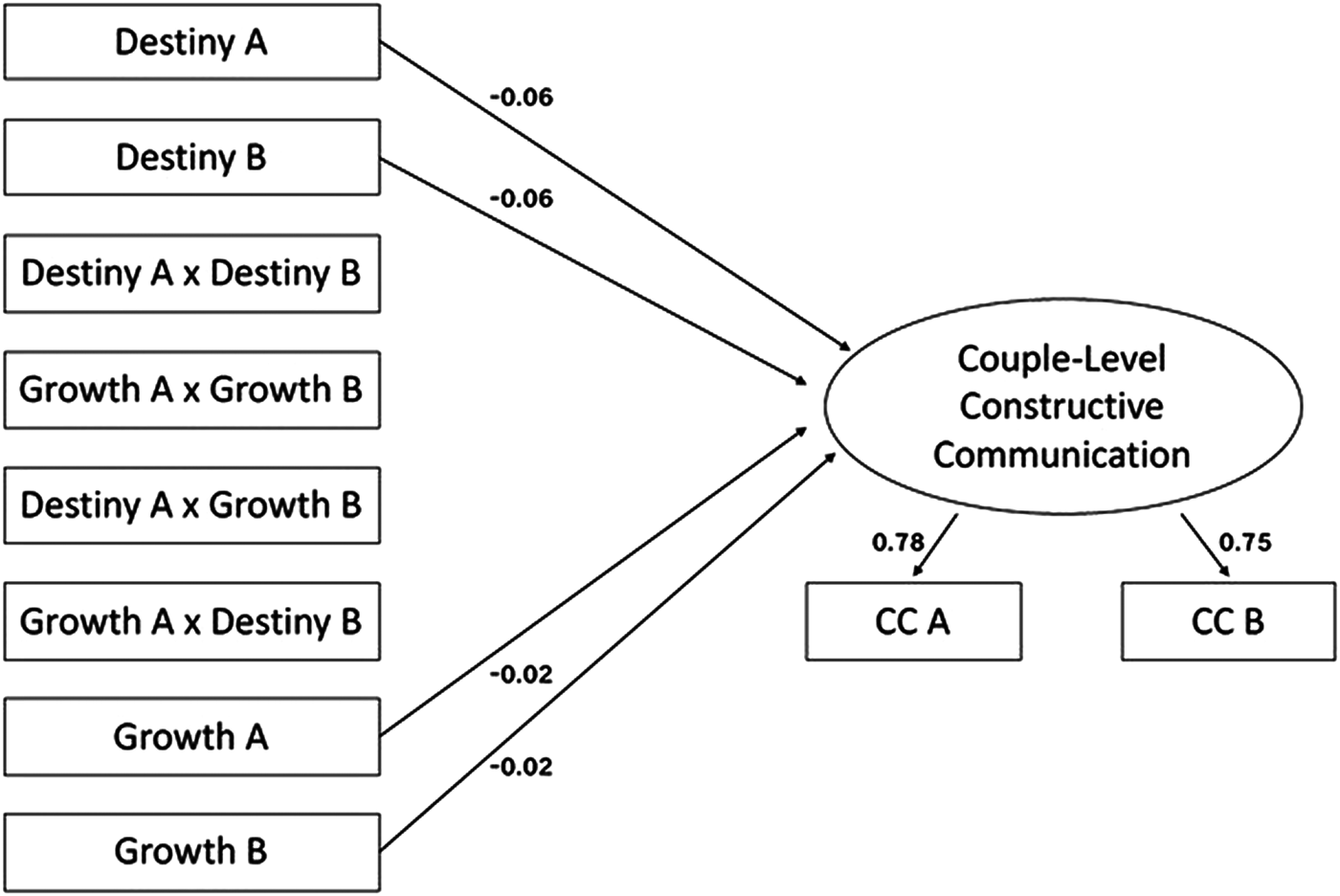
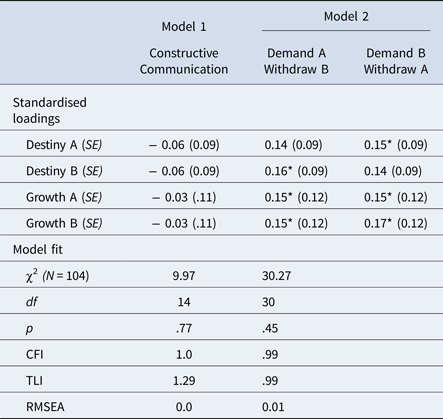
For the Constructive Communication model, we first block-tested the interaction effects by comparing a model with interactions between partners’ ITRs to a reduced model with interaction effects removed. The simpler model did not worsen fit, χ2Diff(3) = 2.64, p = .45, indicating that the interaction effects were non-significant. Consequently, we selected the more parsimonious, reduced model as our final model. This model, presented in Figure 1 and Table 1, predicted that both growth and destiny beliefs of each partner would relate to the amount of constructive communication at the dyadic-level. The model offers a good fit to the data: χ2(N = 104, df = 14) = 9.97, p = .77, CFI = 1.00, RMSEA = 0.00, TLI = 1.29. All paths were non-significant. This suggests that neither growth nor destiny beliefs were significantly related to the amount of constructive communication or mutual avoidance that couples engaged in.
Model 1: An APIM-CFM hybrid model with standardised estimates representing the influence of individuals’ ITRs on couple-level Constructive Communication. Measurement error terms and correlations between exogenous variables are not shown.

Parameter Estimates and Model Fit

Note: *p < .05.
Demand-Withdraw
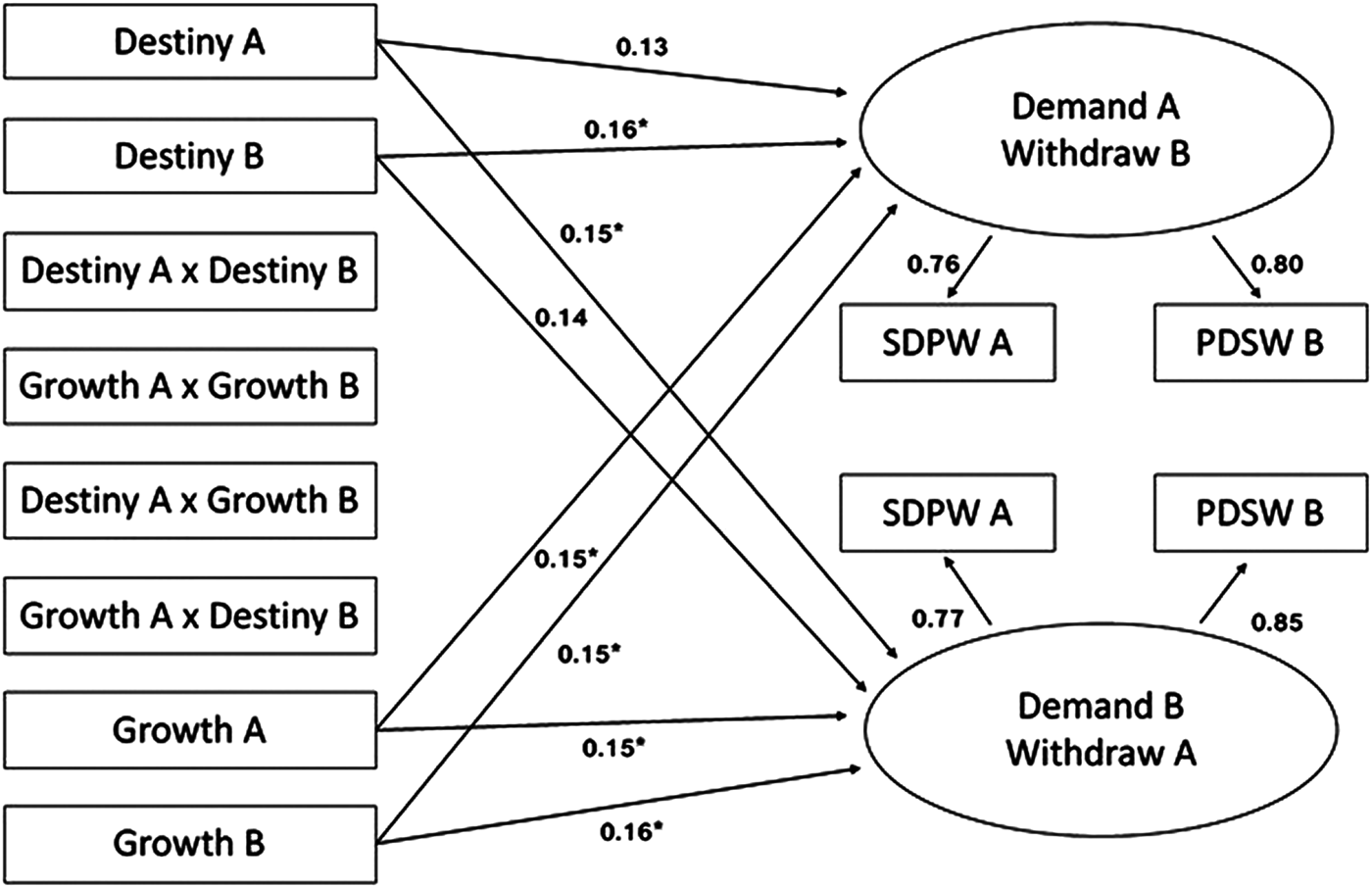
For the Demand-Withdraw model, we first block-tested the interaction effects by comparing a model with interactions between partners’ ITRs to a reduced model with interaction effects removed. The simpler model did not worsen fit, χ2Diff(4) = 2.77, p = .60, indicating that the interaction effects were non-significant. Consequently, we selected the more parsimonious, reduced model as our final model. This model, presented in Figure 2, predicted both growth and destiny beliefs of each partner would relate to the amount of demand-withdraw at the dyadic-level. The proposed model offers a good fit to the data: χ2(N = 104, df = 30) = 30.27, p = .45, CFI = 1.00, RMSEA = 0.01, TLI = 1.00. Six of the eight main effect paths were statistically significant. These significant paths indicated that a stronger endorsement of both growth and, counterintuitively, destiny beliefs at an individual level, predicted more demand-withdraw behaviour at a couple level. Specifically, a stronger endorsement of destiny beliefs predicted greater withdraw for the individual, and greater occurrence of a demand-withdraw pattern for the couple. Additionally, a stronger endorsement of growth beliefs was related to increases in both demand and withdraw behaviours for the individual, as well as a greater occurrence of a demand-withdraw pattern for the couple. Results are presented in Table 1.
Model 2: An APIM-CFM hybrid model with standardised estimates representing the influence of individuals’ ITRs on couple-level Demand-Withdraw. Measurement error terms and correlations between exogenous variables are not shown.

Discussion
This study aimed to more fully explore the relationship between foundational beliefs and expectations about romantic relationships and responses to conflict by introducing a dyadic approach to research on implicit theories of relationships. The pattern of results suggests partial support for our hypotheses, and also introduces novel and unexpected findings. Our findings challenge existing research on implicit theories of relationships by introducing new complexity to the established patterns between ITRs and communication patterns. Additionally, our results inform the understanding of conflict communication patterns by suggesting that vastly different foundational beliefs and expectations about relationships can give rise to the same communication behaviours, as is seen by both destiny and growth beliefs relating to withdraw behaviours. Ultimately, improving our understanding of the complex interplay between both partners’ ITRs offers clinical utility in allowing us to better understand the ways that these beliefs give rise to dyadic responses to conflict.
Based on the existing literature, we hypothesised that a greater endorsement of destiny beliefs would relate to more withdraw behaviour, as captured in both Mutual Avoidance and Demand-Withdraw patterns. Contrary to our prediction, we found no significant relationship between destiny beliefs and withdraw behaviours when looking at Mutual Avoidance (Model 1). However, as predicted, when looking at Demand-Withdraw, Model 2 suggests that a stronger endorsement of destiny beliefs predicts greater levels of withdraw for the individual, reported by both the actor and partner, and a greater occurrence of the Demand-Withdraw pattern at the dyadic level.
Regarding growth beliefs, we predicted that a stronger endorsement of growth beliefs would relate to increased approach behaviours in terms of both Constructive Communication (Model 1) and demand in a Demand-Withdraw pattern (Model 2). This hypothesis was not supported in Model 1. We found no significant relationship between the endorsement of growth beliefs and the amount of Constructive Communication for the couple, as reported by both partners. However, our hypothesis was supported in Model 2, where we found that endorsement of growth beliefs predicted more demand behaviour for the individual, and more Demand-Withdraw communication for the couple. Additionally, we encountered a surprising finding in the Demand-Withdraw model wherein a stronger endorsement of growth beliefs was also related to increased withdraw for the individual, and more Demand-Withdraw communication for the couple.
While these results partially support findings from the extant literature focusing on individuals (Knee, Reference Knee1998), they also suggest that the direct relationships observed by using individuals’ reports to predict individuals’ behaviours may in fact be oversimplified and a poor indicator of the actual patterns couples engage in. In considering data from both partners, our results suggest that neither growth nor destiny beliefs predict Constructive Communication for the couple, and that growth and destiny theories are not singularly or simply predictive of Demand-Withdraw patterns, with growth beliefs relating to both demand and withdraw behaviours. Therefore, the findings presented in this article challenge the usefulness of the existing, individual-only approaches to studying ITRs and demand/withdraw behaviours by suggesting that once the dyad is considered in full, more complexity is unveiled that merits further research.
Considering our dyadic results in more detail raises several possibilities. One potential explanation for the non-significant results of the Constructive Communication model may lay in whether the individual or the couple is seen as the unit of analysis. This difference is reflected in measurement choice. For example, Knee (Reference Knee1998) used the COPE Inventory (Carver, Scheier, & Weintraub, Reference Carver, Scheier and Weintraub1989) to measure individuals’ coping strategies when faced with relational conflict. However, this scale assesses only for the individual's coping style, without taking into account partner behaviour, or the larger, couple-level patterns. In contrast, for the present study, we used the CPQ (Christensen, Reference Christensen, Hahlweg, Goldstein, Hahlweg and Goldstein1987), which is designed to assess couple-level communication and coping around conflict. Based on these differences in measurement, it may be the case that the individual-focused approach that dominates the current literature measures only what the individual would ideally do if their partner was not considered. However, this individual-only approach may not accurately capture the complex response that ultimately occurs when both partners’ responses are considered.
Additionally, by taking an individual approach to understanding a dyadic phenomenon, researchers may be overlooking important relationship factors that could moderate the impact of ITRs on conflict communication patterns. Associations that are replicable at the individual level, may fail to replicate in the context of actual dyads, because the relationship introduces several other variables that may offset the otherwise simple relationship captured in the existing literature. Potential variables may include each partner's communication skills, emotional reactivity, or perception of partner responsiveness. Take, for example, an individual who endorses a growth theory and ideally would respond with constructive, approach-based coping. Considered at the individual level, we would likely see a clear relationship between endorsement of a growth theory and self-reported coping using constructive communication. However, a person's preference to respond constructively could be impeded by either the partner having poor communication skills or high emotional reactivity — such that an approach intended to result in constructive communication instead results in emotional dysregulation and conflict — thereby creating a discrepancy between the individual's ideal coping style and the actual pattern that the couple engages in. Someone holding a growth theory may learn that engagement with their current partner does not result in positive outcomes, but only greater degrees of withdrawal. This could lead to a mutual withdraw pattern, despite a strong growth orientation. While these are only two examples, it seems that considering the partner and the relationship gives way to more complexity than is captured in the existing literature.
Our findings from the Demand-Withdraw model appear to suggest the presence of couple-level effects that have not previously been considered in the individual-focused literature. While results from existing literature were supported in finding that endorsement of destiny beliefs predicts greater withdrawal, and endorsement of growth beliefs predicts greater demand, additional complexity was introduced in that growth beliefs also predicted greater withdraw. In considering this unexpected finding, we speculate that the relationship between growth beliefs and coping behaviour may be moderated by other variables. For example, it may be the case that intimate safety (Cordova & Scott, Reference Cordova and Scott2001) plays a role in determining how productive engaging with a partner around a conflict might be. People who endorse growth theories and believe that approaching their partner will be both emotionally safe and productive may be better able to access their preferred style of approach-based coping behaviours. However, people who endorse growth theories but have learned that approaching their partner regarding a conflict will be emotionally painful and unproductive may not be able to access their preferred style and may instead simply withdraw. For those individuals who hold destiny theories, however, we would speculate that intimate safety would not moderate the effect, because regardless of degree of intimate safety, approach-based coping, in keeping with previous theory, would not be seen as productive. This suggests that knowing an individual's implicit theory alone is not enough to predict how the couple may respond to conflict.
Taken together, our findings suggest that while appealing in its simplicity, data derived from individuals alone may not be generalisable to the actual patterns at play in the relationships. Instead, we suggest that in order to fully understand how implicit theories of relationships influence coping for couples, asking the individual as a proxy for the relationship is simply not enough. By finding novel and contradictory results, our research highlights the importance of collecting data from both partners and positioning the couple as the unit of analysis.
Clinical Implications
Clinically, implicit theories of relationships can be seen as a strong inclination to adopt a particular cognitive set — one with a greater presumption of the potential for change and thus a greater degree of flexibility (growth) and one with a somewhat greater presumption of immutability and thus a greater degree of inflexibility (destiny; Knee et al., Reference Knee, Patrick and Lonsbary2003). This potential difference in flexibility is of particular clinical importance in the context of conflict because it has implications for how challenging moments in the relationship might be acted out. As we have previously discussed, growth theorists may be more likely to engage and stay engaged around conflict, operating from the presumption that the partner is also inclined to a growth mindset and thus available to be persuaded and/or respond to change. Destiny theorists on the other hand may be more likely to either withdraw (as noted in our hypothesis) or ‘dig in their heels’ and resist discussion and accompanying change.
Thus, these findings suggest that beyond demand-withdraw, there may also be patterns more akin to ‘demand-resist’, which could ultimately lead to the outcomes suggested by our data, wherein a frustrated growth theorist may simply give up and withdraw temporarily, with some frustrated hope that change is still possible; whereas the destiny theorist may read that withdrawal as tacit consent to their point of view. Given that there is substantial evidence that these ITRs genuinely capture a predictable amount of variance in people's behaviour, we would argue that these patterns are likely appearing in clinical settings, wherein a clinician's understanding of ITRs could add valuable information in considering the factors motivating a couple's particular response to conflict, and thereby inform the case conceptualisation and course of therapy. Given the proposed clinical utility of ITRs, it remains important for relationship researchers to further investigate the potential for this phenomenon to inform our understanding of couples’ behaviour and our approaches to treatment.
Limitations and Directions for Future Research
Despite offering a novel approach to the existing research, this study faced three key limitations. First, in answering questions about their typical coping, couples were allowed to draw on any recent conflict, without guidance as to the type of issue they considered. Since couples were not limited in the type of conflicts that they drew upon to answer the questions, it is possible that the results of the present study were obscured through variation in the type of conflict that couples referenced. One potential distinction in the type of conflict that may have had a meaningful impact on our results is that between perpetual issues and more fleeting conflicts (Gottman & Levenson, Reference Gottman and Levenson1992). It is possible that the relationship between ITRs and conflict coping varies as a function of conflict severity. Thus, it is suggested that future researchers assess for type of conflict or provide direction around the type of conflict couples consider.
A second limitation of the study is that causality cannot be established between ITRs and conflict communication patterns. Since the methodology of the present study assesses couples at a single time point, requiring participants to remember and report on a past conflict, it is possible that participants may have changed their view on the conflict between when it happened and when they completed the questionnaire. For example, it is possible that a partner initially held a growth theory towards the conflict, but after unsuccessful attempts at resolution has since changed their belief to a destiny theory. Therefore, a participant could report holding a destiny theory, yet engage in a set of coping behaviours typical of growth theorists. This limitation could be eliminated through a different methodology, such as daily diary recording or a longitudinal design that does not allow for the passage of time between a conflict and reflection, and does not rely as heavily on participants’ memory.
Finally, our sample represented a more diverse population by including both same-sex and opposite-sex couples, married and unmarried couples, and couples across a wide range of ages and relationship lengths. We believe that this diversity improves the generalisability of our findings, but we recognise that it may also complicate our findings. Specifically, it may be the case that our unique pattern of results may be due in part to the unique demographics of our sample, or our use of indistinguishable dyads.
We intend to address these concerns in our future work, as we strive to take a more complete approach to understanding the complexities that underlay the associations between ITRs and couples’ coping communication. Additionally, we recommend that as researchers continue to explore how ITRs relate to the lived experience of the couple, the couple is considered as the unit of analysis. In taking this approach, we encourage future researchers to embrace the complexities of relationships by considering more relationship-specific variables that may be influencing the deceptively simple path between implicit theories and couples’ communication patterns.
Conflict of Interest
None.
Ethical Standards
The authors assert that all procedures contributing to this work comply with the ethical standards of the relevant national and institutional committees on human experimentation and with the Helsinki Declaration of 1975, as revised in 2008.