

Introduction
Cuprodongchuanite (IMA2021-065) is a new mineral accepted by the Commission on New Minerals, Nomenclature and Classification of the International Mineralogical Association (IMA CNMNC, Sun et al., Reference Sun, Li, Xue, Shen and Hao2021), with the symbol ‘Cdc’. It belongs to the dongchuanite group, which currently comprises four members: dongchuanite (Li et al., Reference Li, Sun, Shen, Xue, Hao and de Fourestier2023), zheshengite (Sun et al., Reference Sun, Li, Xue, Shen and Hao2024b), cuprozheshengite (Sun et al., Reference Sun, Grey, Li, Rewitzer, Xue, Mumme, Shen, Hao, MacRae, Riboldi-Tunnicliffe, Boer, Williams and Kampf2024a), and the present cuprodongchuanite. Cuprodongchuanite is the phosphorus analogy of cuprozheshengite and the copper analogue of dongchuanite. Its name combines the prefix ‘cupro’ (for copper) with the root ‘dongchuanite’. The holotype specimen of cuprodongchuanite is deposited in the Geological Museum of China, located at Xisi Yangrou Hutong No. 15, Xicheng District, Beijing, P.R. China (catalogue no. M16127). A co-type specimen is housed at the Crystal Structure Laboratory of the China University of Geosciences (Beijing), under catalogue No. DC-2.
The general formula of minerals in the dongchuanite group is A 4VIB IVB 2(X1O4)2(X2O4)2(OH)2. In this structure, A represents interlayer cations, typically dominated by Pb. The B sites are occupied by transition metals at two distinct crystallographic positions: IVB, which has tetrahedral coordination and is exclusively filled by Zn, and VIB, with octahedral coordination, mainly occupied by Zn or Cu. The X1 and X2 sites are tetrahedrally coordinated and primarily occupied by P or As.
This study focuses on the atomic occupancy at the B sites and the influence of the Jahn-Teller effect. Both Cu2+ and Zn2+ can exhibit four-fold coordination. However, square planar coordination, unique to Cu2+ (Burns and Hawthorne Reference Burns and Hawthorne1995, Reference Burns and Hawthorne1996; Tait and Hawthorne., Reference Tait and Hawthorne2004; Pekov et al., Reference Pekov, Lykova, Koshlyakova, Belakovskiy, Vigasina, Turchkova, Britvin, Sidorov and Scheidl2020), is incompatible with the tetrahedral structure of the IVB site. Conversely, Zn2+, which prefers tetrahedral coordination (Burns et al., Reference Burns, Pluth, Smith, Eng, Steele and Housley2000; Ismagilova et al., Reference Ismagilova, Rieck, Kampf, Giester, Zhitova, Lengauer, Krivovichev, Zolotarev, Ciesielczuk, Mikhailova, Belakovsky, Bocharov, Shilovskikh, Vlasenko, Nash and Adams2022), simplifies occupancy at the IVB site, predominantly Zn-occupied in structural refinement and crystal chemical formulas. The VIB site, characterised by octahedral coordination, presents a more nuanced challenge. Cu2+ and Zn2+ can both occupy this site, but their similar scattering powers and nearly identical ionic sizes complicate differentiation through bond lengths or occupation factors. As a result, accurately determining the dominant element at the VIB site typically necessitates quantitative chemical composition analysis to accurately identify the species of the dongchuanite-group minerals.
Nevertheless, Cu2+ is likely to show an obvious Jahn-Teller effect, which should lead to higher distortions of octahedra (Jahn and Teller Reference Jahn and Teller1937; Burns and Hawthorne Reference Burns and Hawthorne1996; Braithwaite et al., Reference Braithwaite, Pritchard, Paar and Pattrick2005). This effect is much more pronounced in Cu2+ than in Zn2+ (Wildner and Giester Reference Wildner and Giester1988; Danisi et al., Reference Danisi, Armbruster, Lazić, Vulić, Kaindl, Dimitrijević and Kahlenberg2013).
As a result, by quantitatively characterizing ligand distortion, researchers gain the tools to ascertain the Cu-Zn ratio at specific sites. This analytical approach has already been successfully applied to resolve the Cu-Zn ordering at octahedral positions in some minerals and has identified several new, ordered mineral species (Adiwidjaja et al., Reference Adiwidjaja, Friese, Klaska and Schlüter1996; Siidra et al., Reference Siidra, Nazarchuk, Agakhanov, Lukina, Zaitsev, Turne, Filatov, Pekov, Karpov and Yapaskurt2018). We also have successfully applied this effect to determine the Cu-Zn ratio at the VIB site of dongchuanite-group minerals.
Occurrence and mineral description
Occurrence
Cuprodongchuanite was found in an abandoned mine near Sanguozhuang Village, in the eastern region of the Dongchuan Copper Ore Field, Dongchuan District, Kunming, Yunnan Province, China (26°08′14″N, 102°59′36″E). Initially, this mine drew attention due to the discovery by local miners of some of the world’s finest veszelyite specimens, of great interest to mineral collectors. These veszelyite samples are often associated with crusty radial or spherical aggregates, initially misidentified as kipushite based solely on their appearance. Subsequent compositional analysis revealed significant differences, particularly the presence of Pb, suggesting the potential discovery of a new mineral. Later studies confirmed these aggregates as minerals of the dongchuanite group. Cuprodongchuanite is the most commonly encountered dongchuanite-group mineral in this area, typically found in intensely weathered veins in which the primary minerals include sphalerite, galena and tennantite-(Zn). Cuprodongchuanite is closely associated with galena and hemimorphite.
General appearance, optical data and physical properties
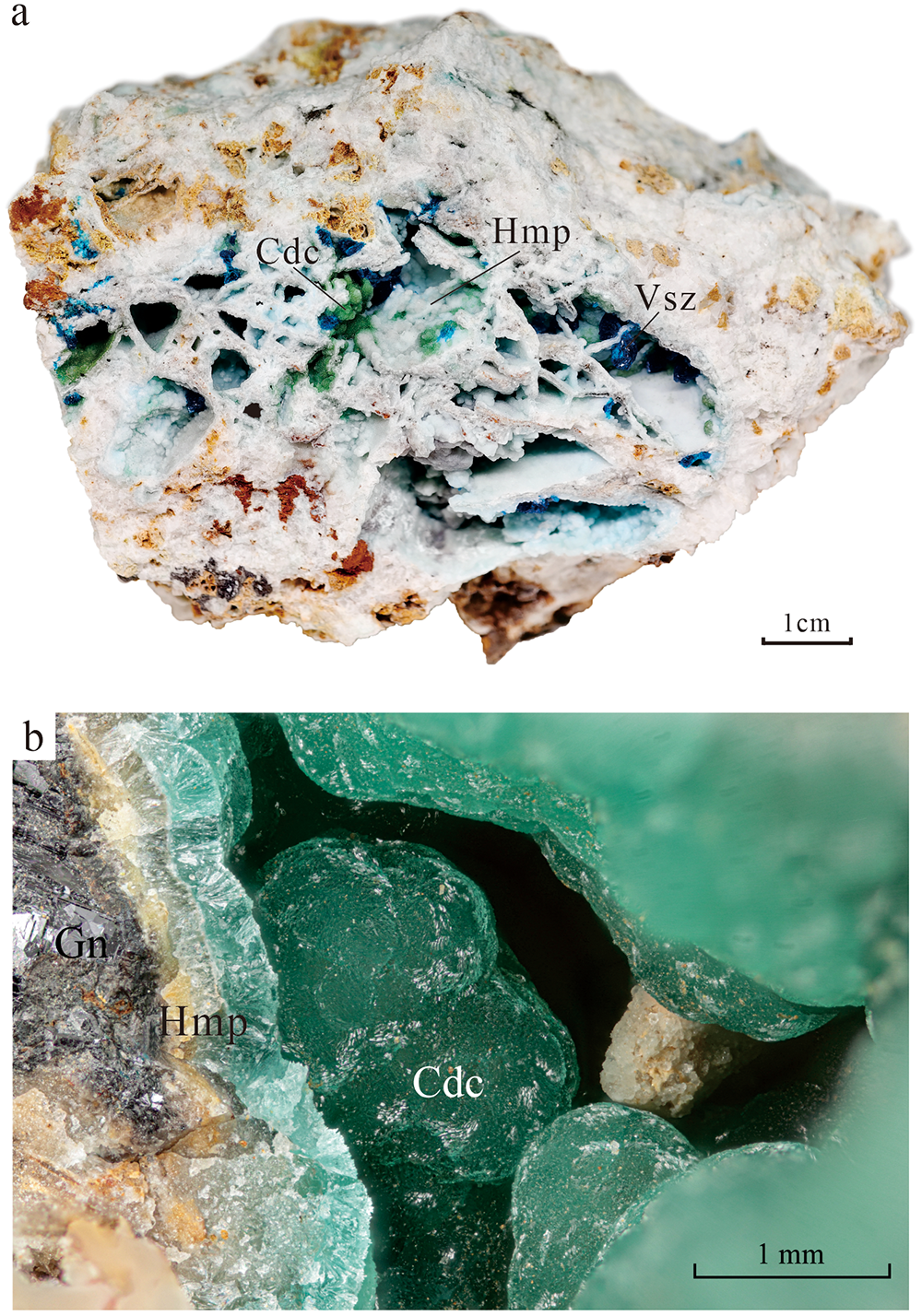
Cuprodongchuanite (Fig. 1) occurs mainly as crust-like radial or spherical aggregates of fine lamellar crystals. The crust-like aggregates typically cover the surface of hemimorphite, while the spherical aggregates generally range from 0.3 to 1 mm in size. The crystals are apple green, with a white streak, and are translucent with a vitreous lustre. They are brittle and show an irregular fracture. Cleavage is perfect, predominantly along the {011} plane, while twinning and parting are not apparent.
Aggregates of cuprodongchuanite (Cdc) associated with galena (Gn), veszelyite (Vsz) and hemimorphite (Hmp).

Due to its refractive index (RI) being higher than that of standard immersion oils (>1.80), the RI of the mineral was calculated using the Gladstone-Dale relationship (Mandarino, Reference Mandarino1981), yielding a value of 1.91. The small size of the available crystals prevented direct density measurement; instead, the density was calculated as 6.10 g/cm3 using the empirical formula and unit cell parameters obtained from single-crystal X-ray diffraction. Vickers microhardness measurements (VHN10g) ranged from 125.2 to 131.4 kg/mm2, corresponding to a Mohs hardness of ∼2½ to 3. The mineral is soluble in hydrochloric acid, producing white PbCl2 as a reaction product.
Analytical methods
Chemical composition analysis
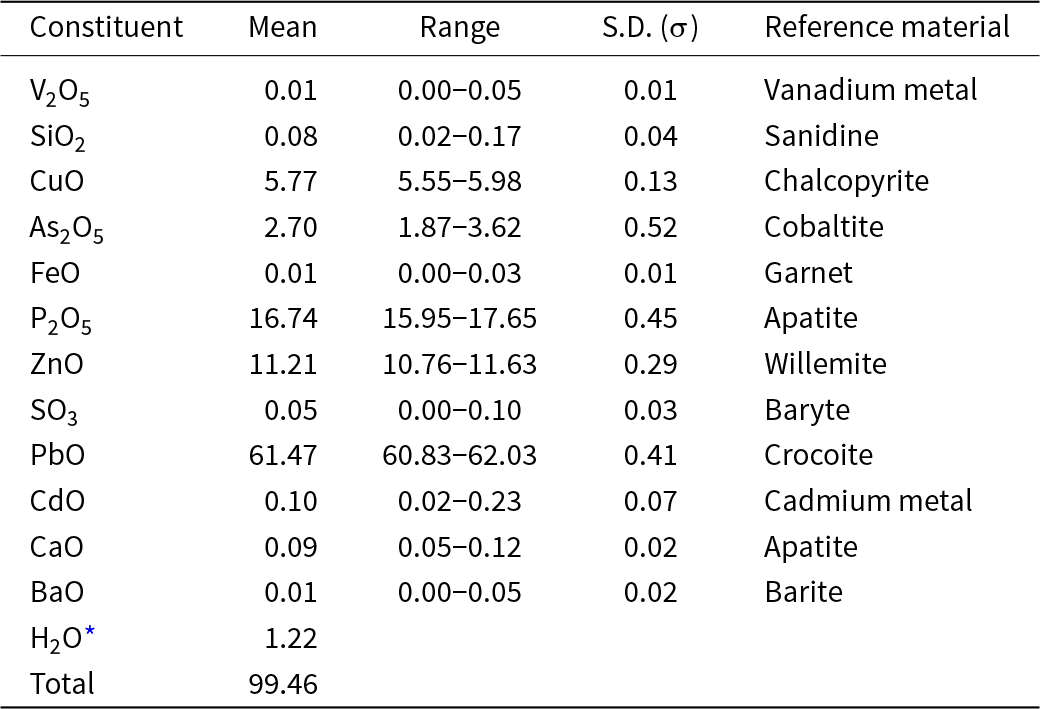
The chemical composition of cuprodongchuanite was analysed using wavelength-dispersive spectrometry (WDS) using a SHIMADZU EPMA-1720 electron microprobe at the Electron Probe Micro-Analysis Laboratory, China University of Geosciences. Analytical conditions included a 15 kV accelerating voltage, 10 nA beam current, and a 5 μm spot size. Ten points were measured to obtain average values, and the reference standards used for calibration are provided in Table 1.
Chemical data (in wt.%) for cuprodongchuanite (n = 10)

Table 1 Long description
Constituent |
Mean |
Range |
S.D. (σ) |
Reference material |
V2O5 |
0.01 |
0.00−0.05 |
0.01 |
Vanadium metal |
SiO2 |
0.08 |
0.02−0.17 |
0.04 |
Sanidine |
CuO |
5.77 |
5.55−5.98 |
0.13 |
Chalcopyrite |
As2O5 |
2.70 |
1.87−3.62 |
0.52 |
Cobaltite |
FeO |
0.01 |
0.00−0.03 |
0.01 |
Garnet |
P2O5 |
16.74 |
15.95−17.65 |
0.45 |
Apatite |
ZnO |
11.21 |
10.76−11.63 |
0.29 |
Willemite |
SO3 |
0.05 |
0.00−0.10 |
0.03 |
Barite |
PbO |
61.47 |
60.83−62.03 |
0.41 |
Crocoite |
CdO |
0.10 |
0.02-0.23 |
0.07 |
Cadmium metal |
CaO |
0.09 |
0.05−0.12 |
0.02 |
Apatite |
BaO |
0.01 |
0.00−0.05 |
0.02 |
Barite |
H2O* |
1.22 |
|||
Total |
99.46 |
* Calculated from crystal structure refinement.
S.D. – standard deviation.
Raman spectrum analysis
The Raman spectrum of cuprodongchuanite was recorded using a HORIBA LabRAM HR Evolution Raman spectrometer in reflection mode (Via-Reflex), employing a 532 nm excitation laser and a 600 gr/mm grating. The spectral range covered 4000–200 cm–1, with a resolution of 4 cm–1, using a 20-second acquisition time and two accumulations.
Crystal structure analysis
Powder X-ray diffraction data were collected using a Rigaku XtaLAB PRO-007HF diffractometer with the rotating crystal method. The instrument was equipped with a microfocus rotating anode MoKα source operating at 50 kV and 24 mA, and a hybrid pixel array detector. Unit cell parameters were indexed and refined using the Chekcell software (Laugier and Bochu, Reference Laugier and Bochu2000), and the calculated diffraction pattern was generated using the PowderCell software (Kraus and Nolze, Reference Kraus and Nolze1998).
Single-crystal X-ray diffraction was performed using the same Rigaku XtaLAB PRO-007HF diffractometer. A pure crystal fragment measuring 0.010 × 0.020 × 0.020 mm was selected, and a full hemisphere of data was collected (–4 < h < 6, –10 < k < 11, –13 < l < 13), yielding an R int = 0.013. Multi-scan absorption and Lorentz-polarization corrections were applied to the intensity data. Structure solution and refinement were carried-out using OLEX2–1.3 (Dolomanov et al., Reference Dolomanov, Bourhis, Gildea, Howard and Puschmann2010) with SHELXT (Sheldrick Reference Sheldrick2015), employing the intrinsic phasing method. Refinement based on 1707 independent reflections with I > 2σ(I) converged to R = 0.020. The structure was confirmed in the centrosymmetric space group P  $\bar 1$(#2). Complete crystallographic data are provided in the CIF and are available as Supplementary material (see below).
Results and discussion
Chemical composition
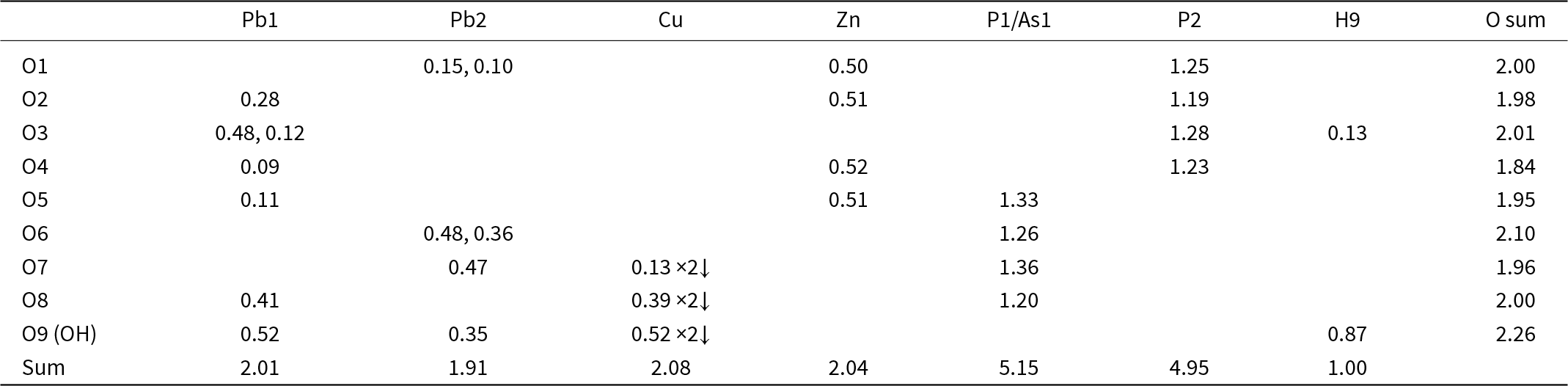
The chemical data for cuprodongchuanite are presented in Table 1. The H2O content was not measured directly; instead, its amount was calculated assuming full occupancy of the O9 site by OH−, as indicated by the crystal structure refinement and bond-valence sum (BVS) analysis, with O9 being the only oxygen site identified as OH−.
The empirical formula of cuprodongchuanite based on average electron microprobe data is (Pb4.06Ca0.02)Σ4.08(Cu1.07Cd0.01)Σ1.08Zn2.03[(P0.74As0.20S0.01Si0.01)Σ0.96O4]2(PO4)2(OH)2, on the basis of O = 18 atoms per formula unit (apfu). The simplified formula is Pb4CuZn2[(P,As)O4]2((PO4)2(OH)2, and the ideal formula is Pb4CuZn2(PO4)2(PO4)2(OH)2, which requires PbO 62.13, ZnO 11.33, CuO 5.54, P2O5 19.76, H2O 1.25, total amount 100 wt.%.
The suggested Dana classification of cuprodongchuanite is 42.9 (Hydrated phosphates, etc. containing hydroxyl or halogen: (AB)7(XO4)4Z q·xH2O). The Strunz classification should be 8.BG (8: Phosphates, arsenates, vanadates; B: Phosphates, etc., with additional anions, without H2O; G: With medium-sized and large cations, (OH, etc.): RO4 = 0.5:1)
Raman spectroscopy
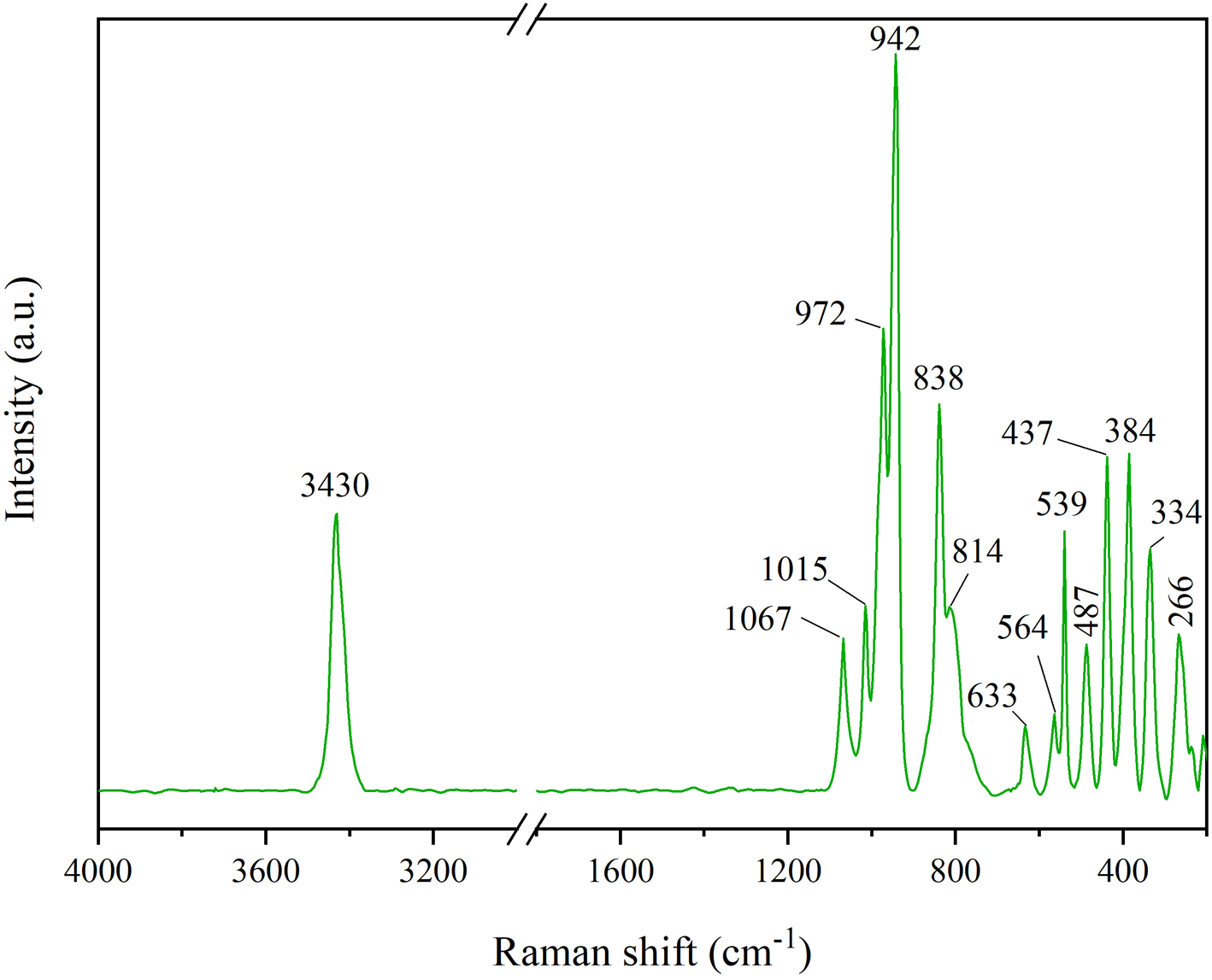
The Raman spectrum of cuprodongchuanite is shown in Fig. 2. Bands in the 1100–450 cm−1 range are primarily related to vibrations of the anionic groups (PO4)3− and (AsO4)3− (Farmer, Reference Farmer1974). The bands at 1067 and 1015 cm−1 are assigned to the v 3 mode of (PO4)3−, whereas those at 972 and 942 cm−1 correspond to the v 1 mode. Bands observed at 838 cm−1 and 814 cm−1 are attributed to the v 3 mode of (AsO4)3−. A weak band at 633 cm–1 is assigned to the v 2 vibration of (PO4)3−. Bands at 564, 539 and 487 cm–1 have unclear assignments and may correspond to the v 4 and v 2 vibrations of either (PO4)3− or (AsO4)3− groups (Frost et al., Reference Frost, Martens and Williams2002; Ciesielczuk et al., Reference Ciesielczuk, Janeczek, Dulski and Krzykawski2016; Ismagilova et al., Reference Ismagilova, Rieck, Kampf, Giester, Zhitova, Lengauer, Krivovichev, Zolotarev, Ciesielczuk, Mikhailova, Belakovsky, Bocharov, Shilovskikh, Vlasenko, Nash and Adams2022).
Raman spectrum for cuprodongchuanite.

The band at 437 cm−1 is probably related to the symmetric stretching vibration of the ZnO4 tetrahedra (Hawthorne et al., Reference Hawthorne, Cooper, Abdu, Ball, Back and K.T2012). The bands at 384, 334 and 266 cm–1, which occur below 400 cm–1, are lattice vibrations.
The band at 3430 cm−1 corresponds to the O–H stretching vibration (Elliott et al., Reference Elliott, Kolitsch, Giester, Libowitzky, McCammon, Pring, Birch, Brugger and Brugger2009).
Diffraction data and crystal structure
The X-ray powder-diffraction data are given in Table S1 of the Supplementary Materials. The seven strongest X-ray powder-diffraction peaks [d in Å (I, %)] are 3.408(100), 3.022(99), 2.916(64), 4.618(59), 2.800(49), 2.367(40) and 3.249(39). The unit cell parameters obtained from indexing and refinement of the powder diffraction data are: a = 4.7418(1) Å, b = 8.5008(1) Å, c = 10.2928(1) Å, α = 97.22(1)°, β = 101.88(1)°, γ = 91.79(1)°, V = 402.12(20) Å3.
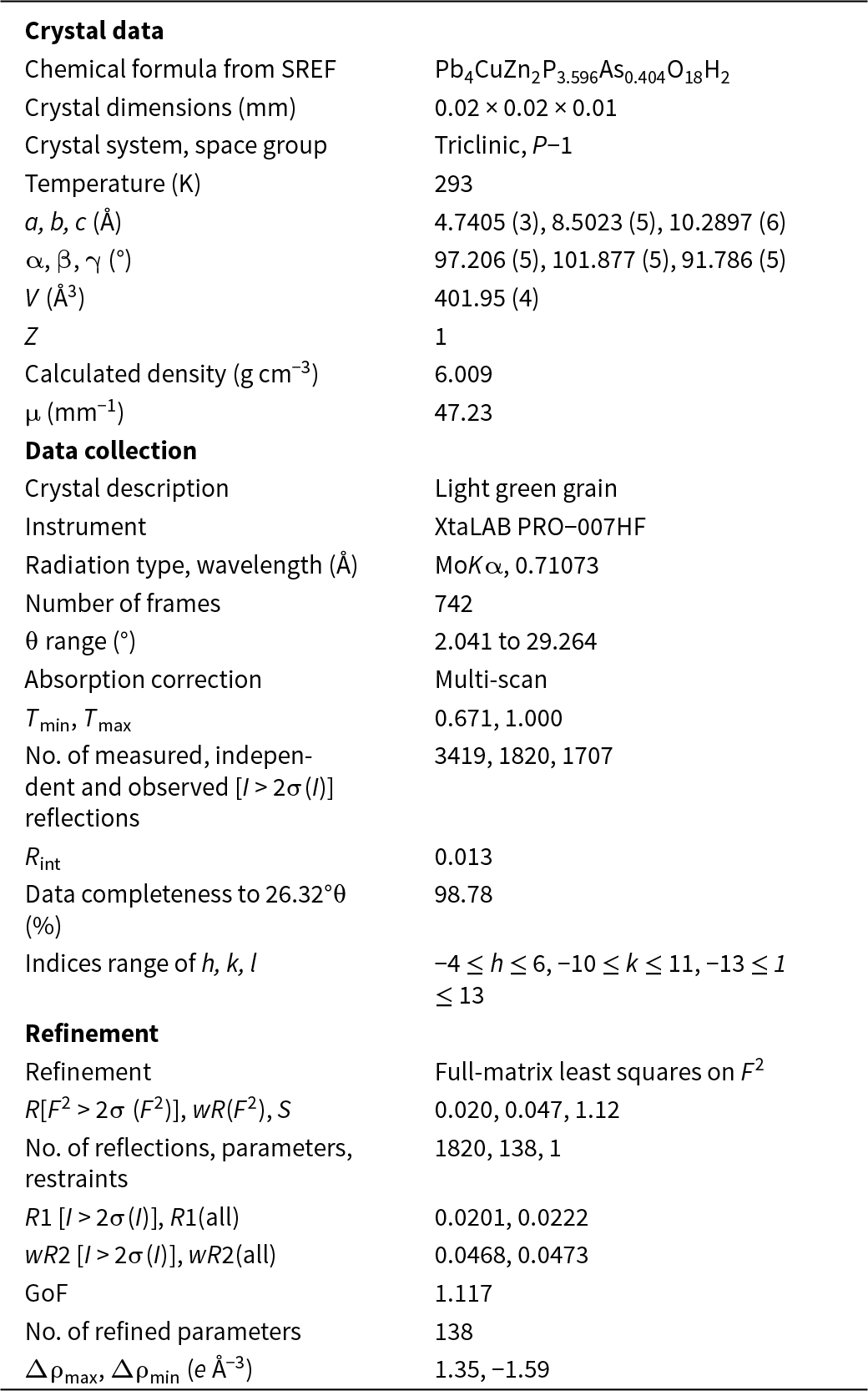
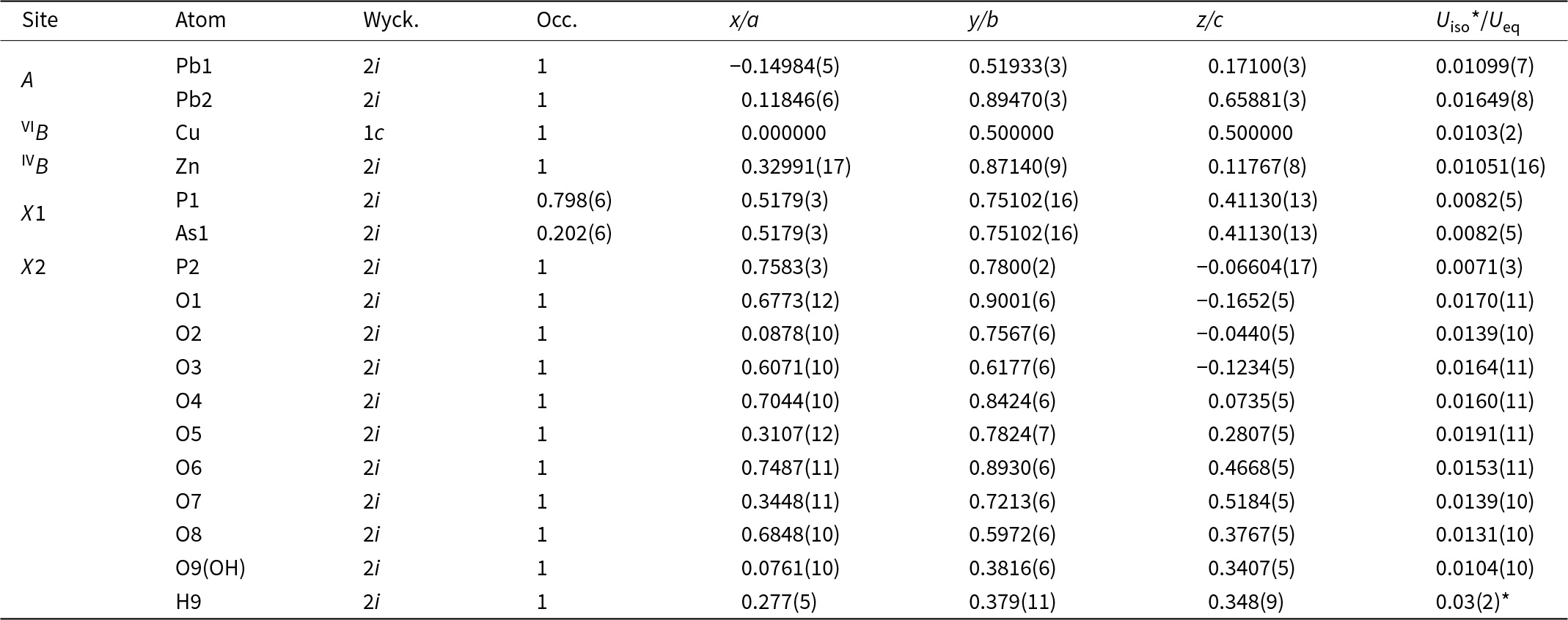
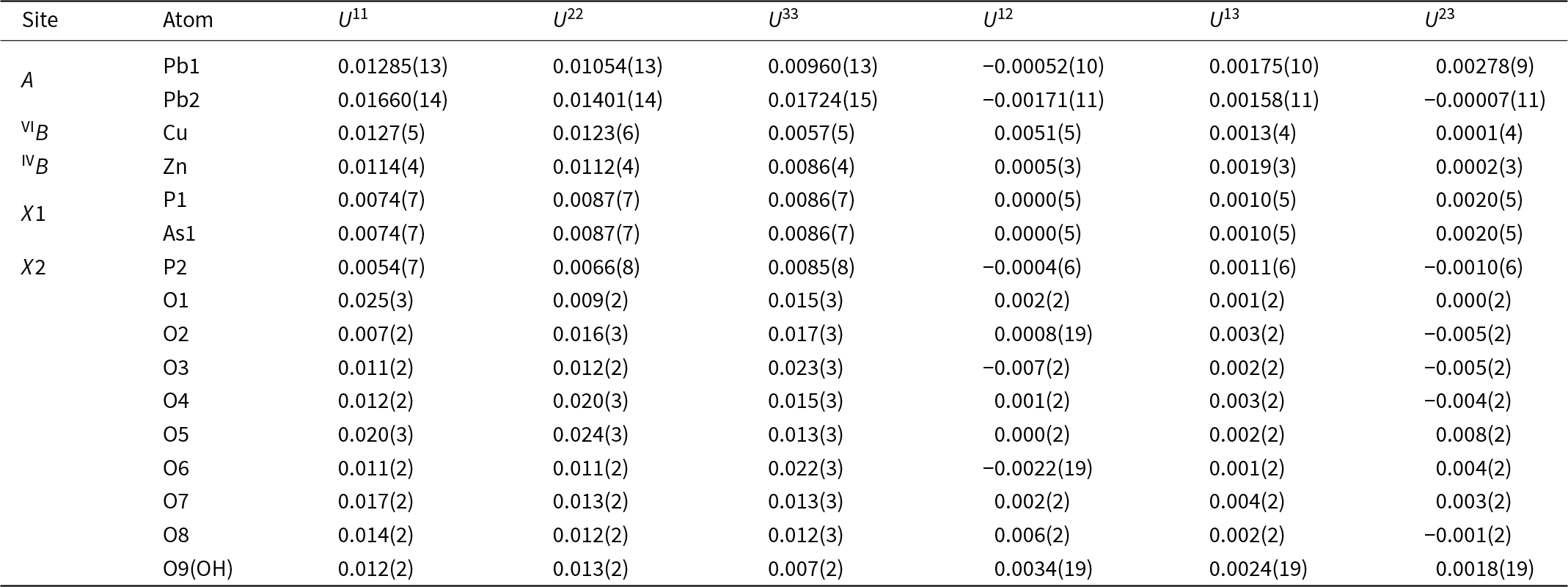
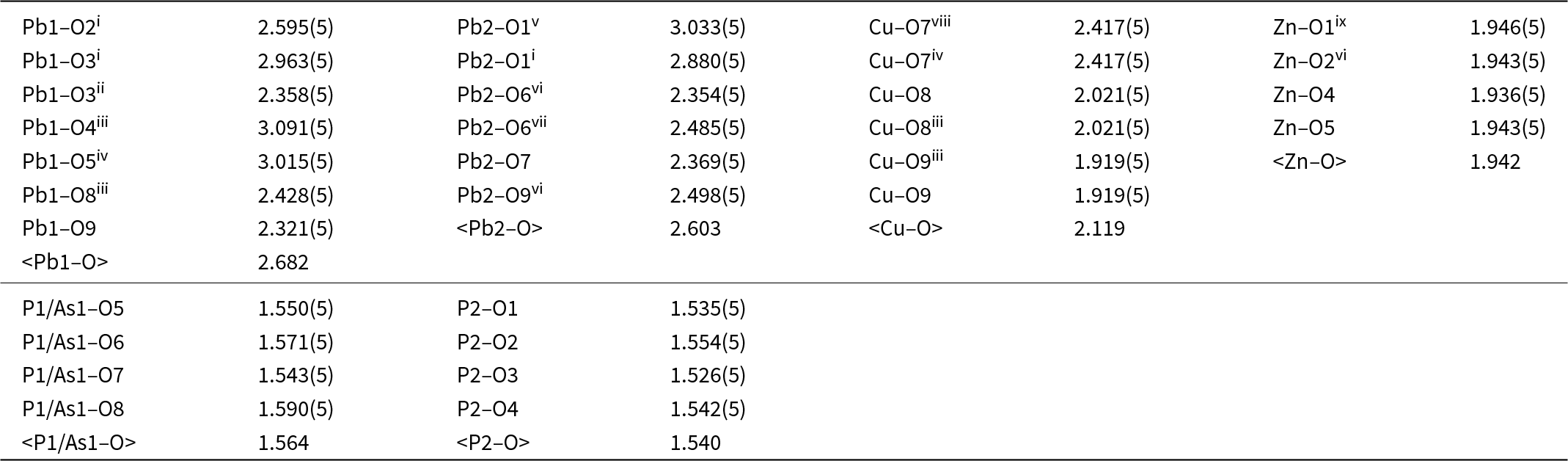
The unit-cell parameters obtained from single-crystal X-ray diffraction are: a = 4.7405(3) Å, b = 8.5023(5) Å, c = 10.2897(6) Å, α = 97.206(5)°, β = 101.877(5)°, γ = 91.786(5)°, V = 401.95(4) Å3 and Z = 1. The structure was solved and refined in the centrosymmetric space group P  $\bar 1$(#2). Data collection and refinement details are summarized in Table 2. Atomic coordinates, site occupancies, and thermal displacement parameters are presented in Tables 3 and 4, respectively, while selected bond lengths are listed in Table 5. The bond-valence sums (BVS) of atoms are presented in Table 6. The crystal structure data is available in the cif with the supplementary materials
Data collection and structure refinement details for cuprodongchuanite

Table 2 Long description
Chemical formula from SREF is Pb4CuZn2P3.596As0.404O18H2 ; Crystal system, space group is Triclinic, P–1 ; Temp (K) is 293 ; Calc density (g cm–3) is 6.009 ; μ (mm–1) is 47.23 ; Crystal description is Light green grain ; Radiation type, wavelength (Å) is MoKα, 0.71073 ; No of frames is 742 ; θ range (°) is 2.041 to 29.264 ; Absorption correction is Multi-scan; Tmin, Tmax is 0.671, 1.000 ; No. of measured, independent and observed [I > 2σ(I)] reflections is 3419, 1820, 1707 ; Data completeness to 26.32°θ (%) is 98.78 ; Refinement is Full-matrix least squares on F2 ; R[F2 > 2σ (F2)], wR(F2), S is 0.020, 0.047, 1.12 ; No. of reflections, parameters, restraints is 1820, 138, 1 ; R1 [I > 2σ(I)], R1(all) is 0.0201, 0.0222 ; wR2 [I > 2σ(I)], wR2(all) is 0.0468, 0.0473 ; GoF is 1.117 ; No. of refined parameters is 138 ; ρmax, ρmin (e Å–3) is 1.35, –1.59
Weighting scheme: w = 1/[σ2(F o2) + (0.0153P)2 + 4.2381P] where P = (F o2 + 2F c2)/3. Applied to the calculation of wR2.
Atomic coordinates, Wyckoff positions (Wyck.) and site occupancies (Occ.) for cuprodongchuanite

Table 3 Long description
Site |
Atom |
Wyck. |
Occ. |
x/a |
y/b |
z/c |
Uiso*/Ueq |
A |
Pb1 |
2i |
1 |
–0.14984(5) |
0.51933(3) |
0.17100(3) |
0.01099(7) |
Pb2 |
2i |
1 |
0.11846(6) |
0.89470(3) |
0.65881(3) |
0.01649(8) |
|
VIB |
Cu |
1c |
1 |
0.000000 |
0.500000 |
0.500000 |
0.0103(2) |
IVB |
Zn |
2i |
1 |
0.32991(17) |
0.87140(9) |
0.11767(8) |
0.01051(16) |
X1 |
P1 |
2i |
0.798(6) |
0.5179(3) |
0.75102(16) |
0.41130(13) |
0.0082(5) |
As1 |
2i |
0.202(6) |
0.5179(3) |
0.75102(16) |
0.41130(13) |
0.0082(5) |
|
X2 |
P2 |
2i |
1 |
0.7583(3) |
0.7800(2) |
–0.06604(17) |
0.0071(3) |
O1 |
2i |
1 |
0.6773(12) |
0.9001(6) |
–0.1652(5) |
0.0170(11) |
|
O2 |
2i |
1 |
0.0878(10) |
0.7567(6) |
–0.0440(5) |
0.0139(10) |
|
O3 |
2i |
1 |
0.6071(10) |
0.6177(6) |
–0.1234(5) |
0.0164(11) |
|
O4 |
2i |
1 |
0.7044(10) |
0.8424(6) |
0.0735(5) |
0.0160(11) |
|
O5 |
2i |
1 |
0.3107(12) |
0.7824(7) |
0.2807(5) |
0.0191(11) |
|
O6 |
2i |
1 |
0.7487(11) |
0.8930(6) |
0.4668(5) |
0.0153(11) |
|
O7 |
2i |
1 |
0.3448(11) |
0.7213(6) |
0.5184(5) |
0.0139(10) |
|
O8 |
2i |
1 |
0.6848(10) |
0.5972(6) |
0.3767(5) |
0.0131(10) |
|
O9(OH) |
2i |
1 |
0.0761(10) |
0.3816(6) |
0.3407(5) |
0.0104(10) |
|
H9 |
2i |
1 |
0.277(5) |
0.379(11) |
0.348(9) |
0.03(2)* |
Anisotropic displacement parameters (in Å2) for cuprodongchuanite

Table 4 Long description
Site |
Atom |
U11 |
U22 |
U33 |
U12 |
U13 |
U23 |
A |
Pb1 |
0.01285(13) |
0.01054(13) |
0.00960(13) |
–0.00052(10) |
0.00175(10) |
0.00278(9) |
Pb2 |
0.01660(14) |
0.01401(14) |
0.01724(15) |
–0.00171(11) |
0.00158(11) |
–0.00007(11) |
|
VIB |
Cu |
0.0127(5) |
0.0123(6) |
0.0057(5) |
0.0051(5) |
0.0013(4) |
0.0001(4) |
IVB |
Zn |
0.0114(4) |
0.0112(4) |
0.0086(4) |
0.0005(3) |
0.0019(3) |
0.0002(3) |
X1 |
P1 |
0.0074(7) |
0.0087(7) |
0.0086(7) |
0.0000(5) |
0.0010(5) |
0.0020(5) |
As1 |
0.0074(7) |
0.0087(7) |
0.0086(7) |
0.0000(5) |
0.0010(5) |
0.0020(5) |
|
X2 |
P2 |
0.0054(7) |
0.0066(8) |
0.0085(8) |
–0.0004(6) |
0.0011(6) |
–0.0010(6) |
O1 |
0.025(3) |
0.009(2) |
0.015(3) |
0.002(2) |
0.001(2) |
0.000(2) |
|
O2 |
0.007(2) |
0.016(3) |
0.017(3) |
0.0008(19) |
0.003(2) |
–0.005(2) |
|
O3 |
0.011(2) |
0.012(2) |
0.023(3) |
–0.007(2) |
0.002(2) |
–0.005(2) |
|
O4 |
0.012(2) |
0.020(3) |
0.015(3) |
0.001(2) |
0.003(2) |
–0.004(2) |
|
O5 |
0.020(3) |
0.024(3) |
0.013(3) |
0.000(2) |
0.002(2) |
0.008(2) |
|
O6 |
0.011(2) |
0.011(2) |
0.022(3) |
–0.0022(19) |
0.001(2) |
0.004(2) |
|
O7 |
0.017(2) |
0.013(2) |
0.013(3) |
0.002(2) |
0.004(2) |
0.003(2) |
|
O8 |
0.014(2) |
0.012(2) |
0.012(3) |
0.006(2) |
0.002(2) |
–0.001(2) |
|
O9(OH) |
0.012(2) |
0.013(2) |
0.007(2) |
0.0034(19) |
0.0024(19) |
0.0018(19) |
Selected geometric parameters (Å) for cuprodongchuanite

Table 5 Long description
Pb1—O2i = 2.595 (5); Pb1—O3i = 2.963 (5); Pb1—O3ii = 2.358 (5); Pb1—O4iii = 3.091 (5); Pb1—O5iv = 3.015 (5); Pb1—O8iii = 2.428 (5); Pb1—O9 = 2.321 (5); <Pb1–O> = 2.682; Pb2—O1v = 3.033 (5); Pb2—O1i = 2.880 (5); Pb2—O6vi = 2.354 (5); Pb2—O6vii = 2.485 (5); Pb2—O7 = 2.369 (5); Pb2—O9vi = 2.498 (5); <Pb2–O> = 2.603; Zn—O1ix = 1.946 (5); Zn—O2vi = 1.943 (5); Zn—O4 = 1.936 (5); Zn—O5 = 1.943 (5); <Zn–O> = 1.942; P1|As1–O5 = 1.550 (5); P1|As1–O6 = 1.571 (5); P1|As1–O7 = 1.543 (5); P1|As1–O8 = 1.590 (5); <P1|As1–O> = 1.564; P2–O1 = 1.535 (5); P2–O2 = 1.554 (5); P2–O3 = 1.526 (5); P2–O4 = 1.542 (5); <P2–O> = 1.540; Cu—O7viii = 2.417 (5); Cu—O7iv = 2.417 (5); Cu—O8 = 2.021 (5); Cu—O8iii = 2.021 (5); Cu—O9iii = 1.919 (5); Cu—O9 = 1.919 (5); <Cu–O> = 2.119
Symmetry codes: (i) –x, –y+1, –z; (ii) –x+1, –y+1, –z; (iii) x–1, y, z; (iv) x–1, y, z+1; (v) x, y, z+1; (vi) –x+1, –y+2, –z+1; (vii) –x, –y+1, –z+1; (viii) –x+1, –y+1, –z+1; (ix) –x+1, –y+2, –z; (x) x+1, y, z; (xi) x, y, z–1; (xii) x+1, y, z–1.
Bond-valence sum for cuprodongchuanite

Table 6 Long description
Valence sums show only O9 has OH. For: Pb1, Pb2, Cu, Zn, P1|As1, P2, H9, (sum of O) each site has, where - is an empty value: O1 = -, 0.15, 0.10, -, 0.50, -, 1.25, -, 2.00; O2 = 0.28, -, -, 0.51, -, 1.19, -, 1.98; O3 = 0.48, 0.12, -, -, -, -, 1.28, 0.13, 2.01; O4 = 0.09, -, -, 0.52, -, 1.23, -, 1.84; O5 = 0.11, -, -, 0.51, 1.33, -, -, 1.95; O6 = -, 0.48, 0.36, -, -, 1.26, -, -, 2.10; O7 = -, 0.47, 0.13 ×2↓, -, 1.36, -, -, 1.96; O8 = 0.41, -, 0.39 ×2↓, -, 1.20, -, -, 2.00; O9(OH) = 0.52, 0.35, 0.52 ×2↓, -, -, -, 0.87, 2.26; Sum = 2.01, 1.91, 2.08, 2.04, 5.15, 4.95, 1.00
Note: The BVS was calculated using the bond valences with the ECoN21 program (Ilinca, Reference Ilinca2022), based on the equation and constants of Brown (Reference Brown1977), S = exp[R 0−d 0)/b], with bond-valence parameters refined by Gagné and Hawthorne (Reference Gagné and Hawthorne2015). The occupancy of X1 site is 0.798P5++0.202As5+. Hydrogen-bond valences based on O–O bond lengths, are from Brown and Altermatt (Reference Brown and Altermatt1985).
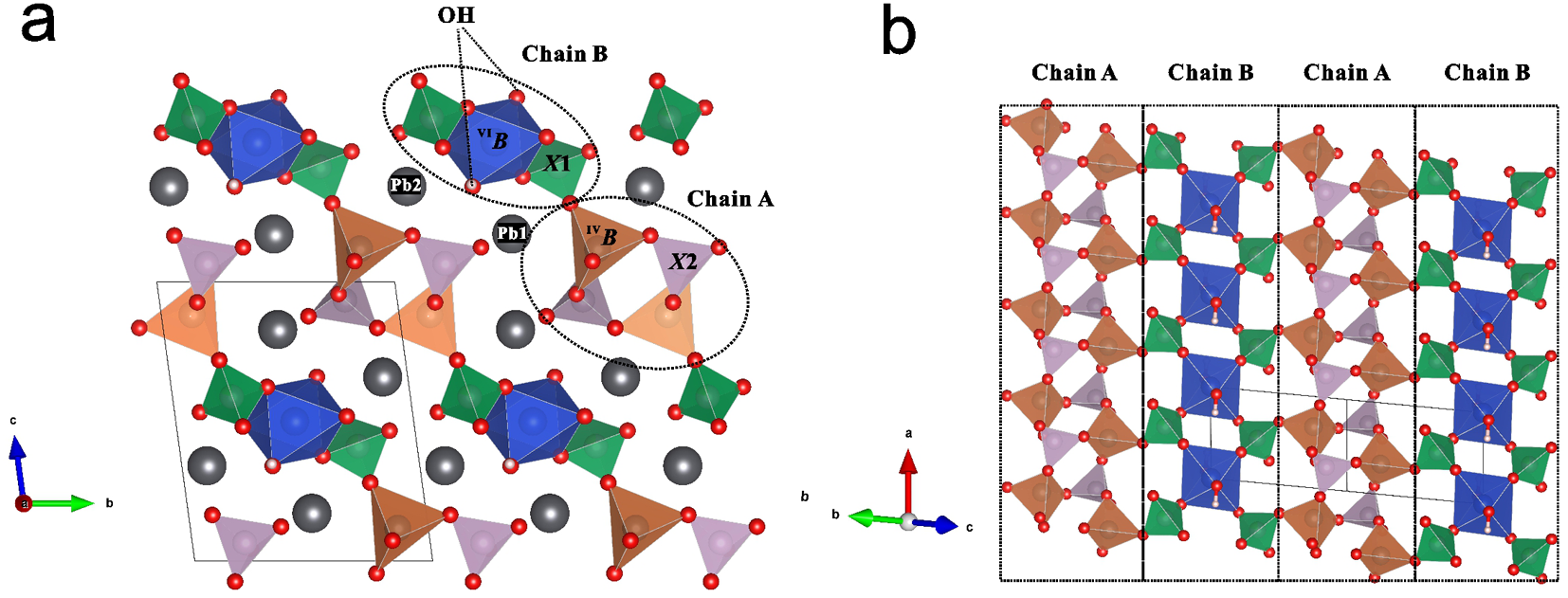
Dongchuanite-group minerals share the same topological structure. The general structure of the dongchuanite group is shown in Fig. 3. This structure consists of two distinct heteropolyhedral chains aligned along [100], as depicted in Fig. 3a. These chains, interconnected through corner-sharing between [X1O4] and [IVBO4] tetrahedra, form layers parallel to the (011) plane (Fig. 3b). The chain A comprises corner-linked [X2O4] and [IVBO4] tetrahedra, with each tetrahedron being 3-connected within the chain. The chain B features [VIBO4(OH)2] octahedra alternating with paired corner-connected [X1O4] tetrahedra. Two independent sites within the interlayer spaces are occupied by Pb atoms.
(a) Structural projection of a dongchuanite group mineral viewed along the [100] direction, highlighting the isomorphous series and the spatial organization of heteropolyhedral chains. (b) The detailed view of heteropolyhedral chains A and B parallel to [100], displaying corner-linked [IVBO4] and [X1O4] tetrahedra forming layers roughly parallel to the (011) plane. The crystal structure was visualized using VESTA software (Momma and Izumi, Reference Momma and Izumi2011).

For the holotype sample of cuprodongchuanite, the chemical composition and structural refinement data indicate that Cu and Zn exclusively occupy the VIB and IVB sites, respectively. The interatomic distances at the VIB site indicate four bonds within the 1.9–2.0 Å range and two significantly elongated bonds exceeding 2.4 Å. This is a characteristic feature of the Jahn-Teller distortion commonly associated with Cu2+ (Danisi et al., Reference Danisi, Armbruster, Lazić, Vulić, Kaindl, Dimitrijević and Kahlenberg2013).
Site occupancy refinements and bond-valence sums indicate that two independent X sites (X1 and X2) are predominantly occupied by P. The scattering power observed at the X2 site closely matches that of ‘pure P’. However, the X1 site exhibits a scattering power that is notably stronger than that of P atoms alone. To account for this discrepancy, both P and As were considered for the X1 site. Subsequent refinements revealed that the occupancy at the X1 site comprises a combination of 0.798(6) P + 0.202(6) As. Given that As atoms have a larger atomic radius than P atoms, the average bond length of X1–O (1.564 Å) is higher than that of X2–O (1.540 Å).
Both Pb sites exhibit asymmetric coordination geometries, due to stereochemically active 6s2 lone-pair electrons (Krivovicheva et al., Reference Krivovicheva, Armbrusterb and Depmeiera2004). The bond numbers of the two Pb atoms are slightly different (considering Pb–O distances shorter than 3.1 Å). Pb1 forms seven bonds, with four shorter ones ranging from 2.32 to 2.59 Å and three longer ones between 2.96 and 3.09 Å, giving an average bond length of 2.682 Å. Pb2 has seven bonds, including four shorter bonds (2.35 to 2.49 Å) and two longer ones (2.88 and 3.03 Å), with an average bond length of 2.603 Å.
Due to the high quality of the data, the hydrogen atom was located from the Fourier-difference electron-density map. A hydrogen bond of the type O9–H9···O3 (D–H···A-type hydrogen bond) was identified, where O9 acts as the donor atom (D), H9 is the hydrogen atom (H), and O3 is the acceptor atom (A). Detailed geometric parameters are provided in Table 7.
Proposed hydrogen-bond geometries for crystal structures of cuprodongchuanite

Notes: D = donor, A = acceptor
Cation occupancy at the VIB site
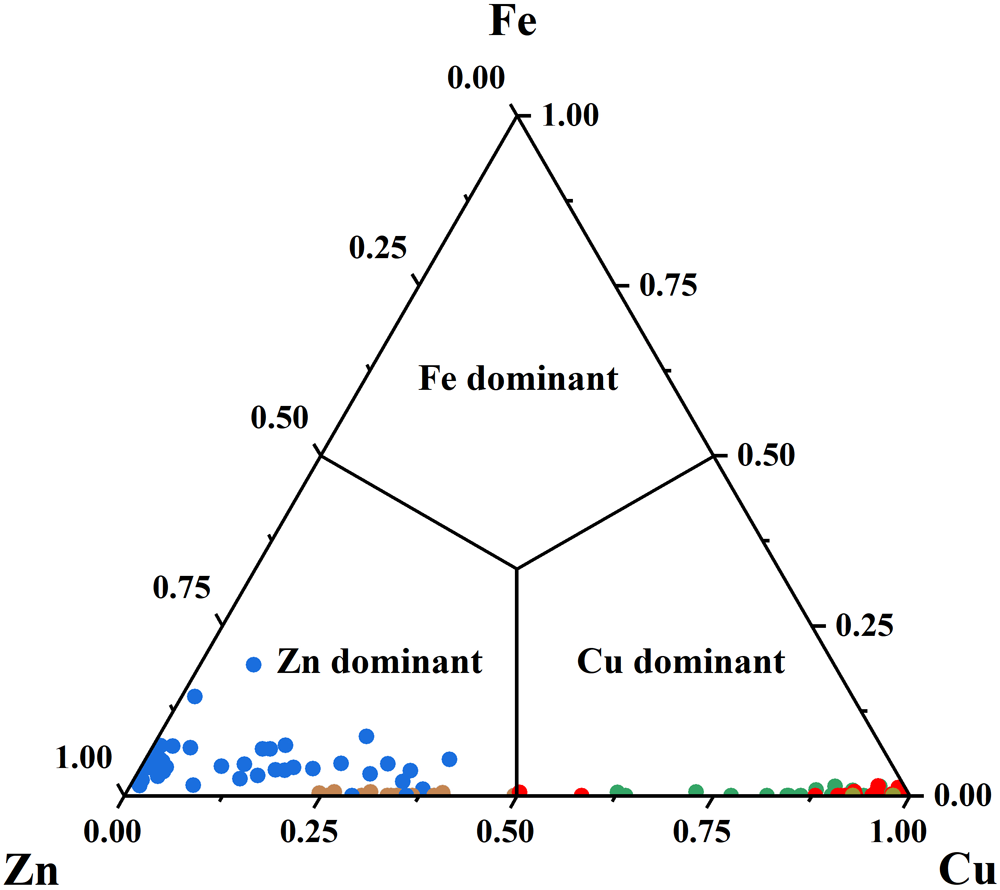
Based on 104 spot quantitative chemical analyses of dongchuanite-group minerals (Fig. 4), it was found that, in addition to Cu and Zn, the VIB site can also host trace amounts of Fe, with a maximum content of up to 0.18 apfu. A ternary diagram is used to illustrate the distribution of Cu, Zn and Fe at the VIB site, allowing for the classification of the dominant cation at this position. The results indicate that Zn and Cu form a complete solid-solution series, which is not affected by whether the X1 site is dominated by As or P. This supports the existence of a continuous solid-solution series between dongchuanite and cuprodongchuanite, as well as between zheshengite and cuprozheshengite.
Ternary diagram for the Zn, Cu, and Fe dominant occupancy at the octahedral coordination VIB-site. (Blue: zheshengite; orange: dongchuanite; red: cuprodongchuanite; green: cuprozheshengite and yellow: potential full As analogue of cuprodongchuanite).

Iron is found in slightly higher amounts only in zheshengite, while in the Cu-dominant members of the dongchuanite group, its content is nearly negligible. This suggests that Fe may lose its competitive advantage in environments where Cu is abundant. Although no Fe-dominant species of the dongchuanite group have been identified so far, the possibility of their existence cannot be ruled out.
The Jahn-Teller effect at the VIB site
The degree of octahedral distortion at the VIB site was quantified using the Δoct parameter, suggested in Wildner (Reference Wildner1992).
The formula is:
 \begin{equation*}\Delta _{\text{oct}}\,{\text{ = }}\frac{1}{6}\sum\limits_{i = 1}^6 {{{\left[ {\frac{{(d_\text{i} - d_\text{m})}}{{d_\text{m}}}} \right]}^2}} \end{equation*}
Where d i is the VIB-O bond-length, and d m is the average value of VIB-O bond-length (VIB = Cu, Zn).
In dongchuanite-group minerals, the VIB site demonstrates a coordination of O7, O8 and O7 twice. The bond lengths of VIB–O7 span from 2.21 to 2.37, while those of VIB–O8 range from 2.02 to 2.12. Additionally, the bond length of VIB–O9 varies between 1.92 and 1.99; the average bond length for VIB–O falls within the range of 2.10 to 2.13.
Utilizing the bond length data, we calculated the Δoct value for each sample (Table 8). Based on the average values derived from the quantitative chemical composition analysis, we determined the Cu-Zn ratio at the VIB site.
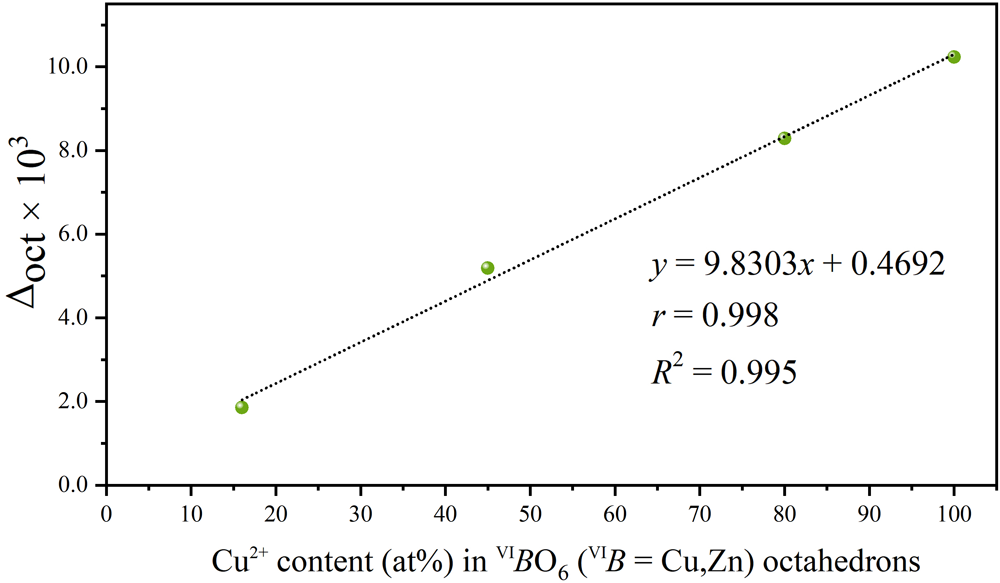
Linear fitting between the Δoct parameters for the VIB site and the normalized atomic percentage of Cu.

Bond lengths and Δoct parameters for the VIB site in dongchuanite-group minerals

Table 8 Long description
The table reports three VIB to oxygen bond lengths (to O7, O8, and O9), their mean bond length, an octahedral distortion metric, and the copper to zinc ratio for four dongchuanite-group minerals. Mean VIB to oxygen distances are similar across minerals, ranging from 2.106 in cuprozheshengite to 2.130 in dongchuanite. Individual bonds show a consistent pattern within each mineral: the O7 bond is longest, O8 is intermediate, and O9 is shortest. The distortion metric increases strongly as copper becomes more dominant: 1.86 for zheshengite with Cu:Zn 16:84, 5.19 for dongchuanite with 45:55, 8.29 for cuprozheshengite with 80:20, and 10.27 for cuprodongchuanite with 100:0. O7 bond lengths also lengthen with increasing copper, from 2.213 in zheshengite to 2.417 in cuprodongchuanite, while O9 shortens slightly from 1.992 to 1.919. Copper and zinc proportions are normalized because calculated compositions may not sum exactly to a perfect total, so the ratios should be read as adjusted occupancies rather than exact bulk totals.
* Note: Based on the calculation of chemical composition, it is often challenging to precisely achieve an ideal chemical stoichiometry where the sum adds up to 100%. The Cu:Zn proportions here have been normalized based on the occupancy of Cu and Zn.
The value of Δoct shows an excellent linear correlation with the Cu-Zn ratio. The fitting formulas are y = 9.8303x + 0.4692 (Goodness of Fit, R 2 = 0.998) (Fig. 5). This correlation is consistent with the earlier discussion on the Jahn-Teller effect, indicating that an elevated Cu2+ occupancy leads to a more pronounced octahedral distortion. According to the fitting formula intercept, it can be inferred that when the VIB site is exclusively occupied by Zn2+, the octahedral distortion tends to be highly symmetrical. With a high determination coefficient, this fitting formula provides a means to infer the relative proportions of Cu and Zn at the VIB site from structural information by quantifying the extent of octahedral distortion.
Conclusions and implications
Cuprodongchuanite, a member of the dongchuanite mineral group, is characterized by Cu occupancy at VIB site, with P occupying both X sites. The ordering of Cu and Zn in minerals may be widespread. However, due to their similar scattering powers and nearly identical ionic sizes, distinguishing between them is often challenging. By employing the Δoct parameter to characterise octahedral distortion and determining a fitting curve, it becomes possible to estimate the occupancy of Cu and Zn in octahedral sites when both elements are present. Nevertheless, it is rare to find a complete solid-solution series in Nature. In future studies, density functional theory (DFT) could be used to simulate the coordination environments of pure Cu- or Zn-end-member minerals. By deriving the corresponding geometric parameters and applying linear fitting, it may be feasible to address the difficulties in quantifying Cu and Zn site occupancy, thereby resolving issues related to Cu-Zn ordering. This approach suggests that more Zn-Cu ordered minerals are probably awaiting discovery.
Supplementary material
The supplementary material for this article can be found at https://doi.org/10.1180/mgm.2025.10154.
Acknowledgements
We thank Ritsuro Miyawaki and his colleagues for their careful review and valuable suggestions on cuprodongchuanite. We are also grateful to Xiang Wu and Zhaochu Hu for providing access to analytical facilities. This study was supported by the National Natural Science Foundation of China (grants 41672043 and 42302042) and the Fundamental Research Funds for the Central Universities (2-9-2022-030).
Competing interests
The authors declare none.