1 Shall/will variation in Irish English?
Why study variation between first-person shall and will in Irish English (IrE)? As Hickey observes (Reference Hickey2007: 179), accounts are unanimous that shall is virtually non-existent in this variety, and there is solid empirical support for this in studies of twentieth-century IrE (Corrigan Reference Corrigan2000: 37; Kallen & Kirk Reference Kallen, Kirk, Kirk and Baoill2001: 71–3). Moreover, commentators from the last two centuries condemn the Irish inability to use shall and will ‘correctly’ (Beal Reference Beal2004: 96f.; Hickey Reference Hickey2007: 179). Hence, the present situation seems to have emerged by the mid eighteenth century (see Sundby et al. Reference Sundby, Bjørge and Haugland1991: 190–2, 392). Later commentaries on IrE confirm the persistence of first-person will through the nineteenth century (e.g. Biggar Reference Biggar1897: 46f.; Molloy Reference Molloy1897), into the twentieth (Joyce Reference Joyce1988 [1910]: 74–6; Taniguchi Reference Taniguchi1972 [1956]: 53), and down to the present (e.g. Harris Reference Harris, Milroy and Milroy1993: 158; Dolan Reference Dolan2006: xxv–xxvi; Amador-Moreno Reference Amador-Moreno2010a: 44f.; Corrigan Reference Corrigan2010: 64f.). It is tempting, therefore, to conclude that shall has never been used in IrE.
The above might support claims that IrE usage promoted replacement of first-person shall by will in other varieties, rather than maintaining the distinction originally described by seventeeth-century grammarians (e.g. Mason Reference Mason and Brotanek1905 [1622]; Wallis Reference Wallis1972 [1653]).Footnote 2 Today, in spite of long-lived normative pressure to preserve the distinction, the decline of shall is reported in North American English (NAmE) and British English (BrE) alike, with the former assumed to be influencing the latter (e.g. Mair Reference Mair2006: 100ff.; Leech et al. Reference Leech, Hundt, Mair and Smith2009: 21, 71ff.). There is a tradition of attributing this change to IrE – and Scots – influence on NAmE (e.g. Jespersen Reference Jespersen1909–49, vol. 4: 260; Mencken Reference Mencken1936: 179, 384; Kytö Reference Kytö1991: 336; Montgomery Reference Montgomery and Algeo2001a: 120, 133; Dollinger Reference Dollinger2008: 239–41).
It is difficult to accept at face value this account of the Irish/Scots origins of will with all persons.Footnote 3 First, there have been few historical studies of shall/will variation in IrE, and these have until recently been case studies using small amounts of data and focused on the upper strata of Irish society. Second, studies using relevant historical data offer at best equivocal support for the view that shall has never been widely used in IrE (Hulbert Reference Hulbert1947), or even evidence to the contrary (Facchinetti Reference Facchinetti, Kastovsky and Mettinger2000). Third, recent corpus-based historical work, using larger amounts of data from longer time periods, indicates that usage in Ireland changed from predominant use of shall in the eighteenth to will since the nineteenth century. This has been observed in studies based on the literary data of Hickey's (Reference Hickey2003) Corpus of Irish English (Nikolaisen Reference Nikolaisen2011) and work using data from CORIECOR, the Corpus of Irish English Correspondence (McCafferty Reference McCafferty2011; McCafferty & Amador-Moreno Reference McCafferty and Amador-Moreno2012a).
The present study examines shall/will use in IrE in the crucial years between 1761 and 1890, a period spanning the era of language shift in Ireland. Our results tally with Nikolaisen's (Reference Nikolaisen2011) findings, based on literary texts (mainly dramas), showing shall was dominant in Ireland in the late eighteenth century. We show that, from the late eighteenth and the late nineteenth centuries shall was a variant used primarily by urban writers and in more formal contexts. Like Nikolaisen's study, ours also shows a sharp fall in shall-use in the nineteenth century, though it was most likely to be maintained in more formal and/or polite usage, and among the ‘better sort’. Comparison with other regional varieties in the late eighteenth and early nineteenth centuries suggests IrE was unlikely to be the source of innovation in NAmE. Rather, we seem to have a case of widespread colloquialisation, with vernacular usage gaining ground and beginning to oust an established distinction of the standard language that enjoyed overt prestige and use by the educated and upper classes, as well as the advocacy of normative grammarians and educationalists.
This development might be linked to the advance of literacy in the English-speaking world as a whole and in Ireland specifically. Widespread vernacular usage – a continuing colloquial preference for will with all persons contra standard usage and the normative tradition (Rissanen Reference Rissanen and Lass1999) – may have found its way into the written record as more people of lower social status acquired literacy skills and left recorded evidence of their language. In Ireland, the spread of literacy was also connected with the spread of the English language itself as the language shift from Irish to English progressed.
Since language shift was involved in the spread of English in Ireland, we must consider the possibility of Irish substrate influence. Direct formal influence on the choice between shall and will can be ruled out. The Irish future is a true tense, formed morphologically. Simplifying somewhat, the future in Irish is formed by adding one of the endings -fa(i)dh, -óidh/-eoidh to the root form of the verb: leag ‘lay’ > leagfaidh ‘will lay’, nigh ‘wash’ > nighfidh ‘will wash’, fan ‘wait’ > fanóidh ‘will wait’, etc. (Ó Siadhail Reference Ó Siadhail1989: 171–6). It is thus of an entirely different kind to the English expression of futurity using the modals will/shall or going to. However, it has been suggested that phonetic similarity between will and the form of the Irish substantive verb bí ‘be’ used in forming, e.g., questions (An bhfuil tú . . .? /ə wʌl tʉ/ ‘Are you . . .?’) might have contributed to generalisation of will by speakers of Irish English (Amador-Moreno Reference Amador-Moreno2010a: 45), at least in interrogatives, where shall has been strongly maintained in BrE.
We suggest that the acquisition of the standard distinction between shall with first-person and will with other subjects is precisely the kind of rule requiring an arcane and rather arbitrary distinction that is likely not to be acquired, particularly by Irish-speaking adults learning English as a second language in informal settings. Consequently, the shall/will distinction would not have been part of the input for Irish children acquiring English as their first language, and would not have survived long in IrE. Until late in the eighteenth century, English in Ireland remained primarily the language of British settlers and their descendants, which might explain why shall remained solidly in use until then. In the nineteenth century, a swelling majority of English-speakers in Ireland were either bilinguals or (descendants of) people who had only recently abandoned ancestral Irish. In a situation of contact with language shift, the shall/will distinction would have been a prime candidate for decline and obsolescence.
2 Empirical history of ‘the Irish difficulty’
As previously noted, there has been little empirical research into the shall/will issue in IrE. Centuries of condemnation of the Irish for not making the distinction, and recent findings that shall is not used in Ireland today, suggest little scope for diachronic investigation of shall/will variation. Yet variation and change in this area of IrE grammar can be documented from the late seventeenth and early eighteenth centuries onwards, and historical records of Irish aversion to shall might be due to prescriptivists’ preference for anecdotal evidence and plagiarism, rather than empirical observation.
The earliest relevant empirical work is Hulbert's (Reference Hulbert1947) study of shall/will in the eighteenth century. This is not directly concerned with IrE, but offers useful evidence, because it includes data from Dubliner Jonathan Swift (1667–1745). Perhaps unexpectedly, given his prescriptivist reputation, Swift did not follow the normative rule: his usage was variable but showed a preference for first-person will (78%, n = 537) (Hulbert Reference Hulbert1947: 1181, fn. 15). That Swift, the only Irish writer in Hulbert's sample, strongly preferred will might suggest this was the norm in Ireland at the time.
Further evidence of eighteenth-century IrE variation is provided by comparison of Swift and fellow Irish writer and close contemporary, George Farquhar (1677–1707). Farquhar showed an equally strong opposing preference for shall (72%, total n = 50). So usage in eighteenth-century Ireland might have been more variable than comments on IrE would suggest (see McCafferty & Amador-Moreno Reference McCafferty and Amador-Moreno2012a: 187f.).
Things are complicated by a study of nineteenth-century British newspaper reports citing Irish politicians, clergy and other public figures, which concludes that ‘the Irish employed shall with first person subject even more frequently than the English’ (2000: 130). Was there then a rapid shift towards first-person shall in the nineteenth century? This is suggested in a survey that cites Facchinetti's work (Tieken-Boon van Ostade Reference Tieken-Boon van Ostade2009: 90). The puzzle is that this apparently new-found conformity must have been abandoned well before the twenieth century, as shown by subsequent surveys of IrE (e.g. Biggar Reference Biggar1897; Molloy Reference Molloy1897; Joyce Reference Joyce1988 [1910]), and continuing prescriptivist condemnation: e.g. Alford (Reference Alford1866) in Britain and Whitney (Reference Whitney1877: 120) in North America. How can we resolve these contradictory views?
Only diachronic approaches based on large amounts of data can tell us what changes have occurred in IrE shall/will use in recent centuries. Using the Corpus of Irish English (Hickey Reference Hickey2003), Nikolaisen (Reference Nikolaisen2011: 81) shows that will predominated with first-person subjects in seventeenth-century Ireland (77% will), but there was a sharp shift to shall in the eighteenth century (65% shall). Then a rapid swing back to will in the nineteenth century (71% will) was consolidated in the early twentieth (76% will). Thus, the preference for shall observed by Facchinetti (Reference Facchinetti, Kastovsky and Mettinger2000) in the nineteenth century might have been due to linguistic conservatism or normative influence among the relatively higher-class users represented in her data, or the editorial practices of British newspapers.
Our own corpus does not contain sufficient data from the seventeenth and early eighteenth centuries for comparison with Nikolaisen's study throughout her period, but as we will see, the shift away from shall towards will from the nineteenth century onwards is also evident in the more vernacular letter data in CORIECOR (see also McCafferty Reference McCafferty2011; McCafferty & Amador-Moreno Reference McCafferty and Amador-Moreno2012a). The next section turns to our own study of CORIECOR data for the decades between the 1760s and 1880s.
3 Data for a diachronic study of Irish English
As noted in McCafferty (Reference McCafferty2011), there are few empirical diachronic studies of any aspect of IrE, which is a primary motivation for compiling CORIECOR. Only a small number of historical studies of IrE take a long-term view of developments (e.g. Bliss Reference Bliss1979; Sullivan Reference Sullivan1980; Hickey Reference Hickey2003; McCafferty Reference McCafferty2004a; Nikolaisen Reference Nikolaisen2011), and these are all based on literary data, whose validity as linguistic evidence is still sometimes disputed (see discussion in McCafferty Reference McCafferty and Hickey2010: 142–5). This is an unfortunate lacuna, because it would be interesting in itself to know more about the development of this early overseas English.
The lack of historical accounts of IrE is all the more unfortunate, given the enormous flow of emigration from Ireland to other English-speaking countries, especially North America, but also Australia and New Zealand, where immigrants from Ireland provided substantial input into the populations of colonial settler societies, as well as to Great Britain itself (see Hickey Reference Hickey and Hickey2004: 99–110; Reference Hickey2007: 384–418), where the Irish in the nineteenth century became sizeable communities in growing industrial conurbations. Irish migration was so large that IrE influence on other overseas Englishes is often claimed, even in the absence of empirical support. Besides the replacement of shall by will, it has been suggested that IrE influence promoted, e.g., the dramatic increase in the use of progressive aspect since the nineteenth century (e.g. Strang Reference Strang and Anderson1982; Arnaud Reference Arnaud1998), and the decline of the have-perfect in NAmE and BrE (e.g. Elsness Reference Elsness, Rohdenburg and Schlüter2009). But what is known about the IrE history of these features rests on little data, usually from literary works and/or the correspondence of literary authors (e.g. Strang Reference Strang and Anderson1982; Arnaud Reference Arnaud1998), or British press reports of speeches and statements by Irish politicians, clergy and lawyers (e.g. Facchinetti Reference Facchinetti, Kastovsky and Mettinger2000). Such data are unlikely to be representative of the language of the Irish emigrants who might have carried these features to other territories. Until recently, there have been no diachronic studies of these phenomena in IrE, and CORIECOR is being developed with precisely such studies in mind.
3.1 Letters as linguistic evidence
CORIECOR is a corpus of personal letters between Irish emigrants and their families, friends and contacts in Ireland and elsewhere. Personal letters are often regarded as a relatively ‘oral’ text type. Both historians (e.g. Fitzpatrick Reference Fitzpatrick, Elliott, Gerber and Sinke2006: 102) and linguists (e.g. Cusack Reference Cusack1998: 190) observe that letter writers often regarded their correspondence as ‘substitute speech’. For example, writing from Maitland, New South Wales, to his father in County Clare in 1861, Michael Normile sees his letter as standing in for real talk:
(1) I fancy I am speaking to you verbaly while I am writing this scroll to you [. . .]. (Fitzpatrick Reference Fitzpatrick1994: 89)
It was common to view letters in this way, as part of an ongoing, if slow, conversation between writer and addressee(s). Of course, all were aware that these ‘conversations’ were imaginary.
Letters are not perfectly accurate transcripts – orthographic or phonetic – of actual speech. Outlining the speech-to-text relationship of written records that might be used to study the vernacular, Schneider (Reference Schneider, Chambers, Trudgill and Schilling-Estes2002) places letters halfway along a five-point scale from the ‘recorded’ speech of texts like verbatim stenographed trial records at one pole, to the ‘invented’ speech of, e.g., literary dialect at the other (Schneider Reference Schneider, Chambers, Trudgill and Schilling-Estes2002: 72f.). In this typology, letters are ‘imagined’ speech, and Schneider emphasises the potential usefulness of letters from semi-literate writers as a means of accessing the vernacular in the past, because:
. . . when persons who have had but limited experience in writing and exposure to the norms of written expression are forced to write nevertheless, their writing reflects many features of their speech fairly accurately. (Schneider 2002: 75f.)
This is also what Montgomery has in mind when he claims that: ‘[N]o other type of document . . . reveals the speech patterns of earlier days nearly so well or as fully as family letters’ (1995: 28). Like Schneider, Montgomery was concerned with accessing the vernacular, and this influenced his evaluation of what kinds of personal correspondence were worth studying: documents in standard English are of little interest (Montgomery Reference Montgomery, Fitzgerald and Ickringill2001b: 25).
While only the most vernacular letters may be interesting to linguists sharing Montgomery's aim of tracing the British and Irish roots of vernacular features of Appalachian and other US varieties, our concern is with IrE more generally, and we wish to apply historical sociolinguistic methods to the study of CORIECOR letter data. Hence, we are interested in letters written in broad vernacular IrE by semi-literate writers, but we also see the need to include less vernacular documents. Even letters written in standard English by high-status or upwardly mobile writers may reflect the speech of their writers. Such documents have proven good sources of data showing variation and change in more standardised English, too (e.g. Nevalainen & Raumolin-Brunberg Reference Nevalainen and Raumolin-Brunberg2003).
3.2 Brief description of CORIECOR
CORIECOR letters span the social spectrum from aristocrats and gentry via the professional middle classes to farmers and labourers. Some of these letters have been used by historians of Irish emigration (e.g. Schrier Reference Schrier1997 [1958]; Fitzpatrick Reference Fitzpatrick1994; K. Miller Reference Miller, Kortmann and Upton2008; Miller et al. Reference Miller, Schrier, Boling and Doyle2003), who often comment on their style and ‘Irishness’, though both remain unexplored by historians primarily interested in the letters’ contents. Schrier, who pioneered the use of correspondence in the study of Irish emigration, noted that:
The style of the letters varied with the training and education of their writers, although nearly all were enhanced by a charm of expression inherent in the modes and manners peculiar to Irish speech. (Schrier 1997 [1958]: 23; emphasis added, KMcC & CAM).
Similarly, Fitzpatrick notes that: ‘the language and flavor of the letters were overwhelmingly Irish’ (2006: 98). As linguists, our focus is, of course, not on the letters’ contents, but on their language, both in general terms and including precisely the Irishness mentioned by historians.
Many CORIECOR letters provide evidence of vernacular usage, where a writer obviously produced writing based on their own IrE speech, as in (2–4), all from a single short letter, which illustrate phonological features of IrE in the corpus:Footnote 4
(2) the [ðiː] look verry old (John S. Sinclair, 21 October 1881)
(3) lucinda was sent a great manny [mani] preasants (John S. Sinclair, 21 October 1881)
(4) a gentleman went from Healdsburg to the Pacific coastt and tuck [tʌk] Robert a long (John S. Sinclair, 21 October 1881)
A widespread IrE pronunciation of they with a long close front unrounded /i/ is represented in (2), while (3) shows an IrE realisation of many with a short open front vowel /æ~a/. And in (4), we have took with a short open central vowel /ʌ/, which is one of the best-studied vernacular features of Northern IrE (e.g. McCafferty Reference McCafferty2001: 157–66).
In morphosyntax, too, this letter shows not only a number of familiar IrE features, like the Northern Subject Rule, but also some not widely regarded as part of IrE (e.g. zero possessive ’s and be-deletion). The latter are particularly interesting because they raise questions of how typical such features were in earlier IrE, where they originate, and which social groups and regions they were associated with. CORIECOR enables us to address such questions empirically. Clearly, such letters can reward the linguist by providing evidence of past language use. Such evidence not only potentially fills gaps in the diachronic account of an important overseas variety of English, but may also extend our knowledge of IrE in new directions.
But the vernacular is not the only style present in CORIECOR, and it is important to bear in mind that style is more than the difference between writing and speech, which are modes of language use rather than styles. Neither spoken nor written mode represents a fixed, clearly defined or self-contained style. Moreover, it is an axiom of modern sociolinguistics that ‘there are no single-style speakers’ (Labov Reference Labov1972a: 208); rather, all speakers (and writers) style-shift in systematic ways that have been explored in terms of, e.g., attention to speech (Labov Reference Labov1972b) or audience design (Bell Reference Bell1991). From whatever perspective, variation is to be expected from writers of all social and educational backgrounds.
In a large corpus of letters between people of varied social and regional backgrounds, there is bound to be a range of styles along vernacular–standard and informal–formal dimensions. The view taken here is the broad one that all letters passing between Irish emigrants and their families, friends, neighbours, acquaintances and other correspondents, whether in Ireland or of Irish origin living elsewhere, may be representative of English usage in Ireland, and may therefore provide data for the study of IrE. Thus, IrE is defined for our purposes as a continuum of related varieties comprising more standard(ised), nonstandard, and dialectal or vernacular varieties, all of which vary.
The relative orality of expression in personal letters, and the stylistic range from vernacular to informal colloquial and formal, makes the language of letters potentially ideal data for linguistic study of earlier centuries. Moreover, the spread of literacy and the explosion of letter-writing that occurred in the nineteenth century following the introduction of affordable global postage means that this period provides more vernacular letters by less well-educated members of lower social strata, in addition to correspondence from the more educated upper strata.Footnote 5
Personal correspondence has provided data for a number of studies of aspects of vernacular Englishes (e.g. Montgomery Reference Montgomery1995, Reference Montgomery and Algeo2001b; Filppula Reference Filppula1999; McCafferty Reference McCafferty2003, Reference McCafferty2004b; Hickey Reference Hickey2005: 158–66; Amador-Moreno Reference Amador-Moreno2010b; Fritz Reference Fritz2007; Pietsch Reference Pietsch, Siemund and Kintana2008, Reference Pietsch2009; Dollinger Reference Dollinger2008). Letters have also provided data for studies of other languages (e.g. Elspaß Reference Elspaß2005; also contributions to Dossena & Del Lungo Camiciotti 2012). It has been demonstrated empirically that the language of personal correspondence is both more vernacular, and more sensitive to linguistic variation and change, than other text types (e.g. Kytö Reference Kytö1991; Nevalainen & Raumolin-Brunberg Reference Nevalainen and Raumolin-Brunberg2003; Fritz Reference Fritz2007). Where it is possible to compare correspondence with other text types, letters consistently show greater use of linguistic innovations, such as the use of progressive aspect, which has been especially marked since about 1800 (see McCafferty & Amador-Moreno Reference McCafferty, Amador-Moreno, Migge and Chiosáin2012b: 268f.).
CORIECOR is currently under development. It comprises letters spanning the period from before 1700 to 1940, covering almost the entire period in which IrE emerged. The version used here incorporates the letter collection of the Irish Emigration Database (IED) and a couple of smaller collections,Footnote 6 amounting to a total of some 5000 documents, of which approximately 4,300 are letters. The database comprises around 3.1m words, with some 2.7m words in letters. Coverage is good from the 1760s to the 1940s.
Since the core collection in the IED was compiled by the Public Record Office of Northern Ireland, there is a bias towards the northern province of Ulster, which is over-represented, particularly in the earlier subperiods. This bias towards the north-east (and to some extent the south-east) of Ireland may, especially for earlier subperiods, reflect the fact that these were the first regions of Ireland that became English-speaking. Here, English was imported by settlers from Britain up to the early eighteenth century (e.g. Fitzgerald & Lambkin Reference Fitzgerald and Lambkin2008), and here English was the majority language by 1800 (Fitzgerald Reference Fitzgerald1984).
CORIECOR is intended for long-term diachronic research on IrE. Documents of this kind, representing speakers from all over Ireland, may permit us to trace the emergence and development of features of IrE through time, as well as studying stylistic, regional, and social variation. CORIECOR may also be used for comparative studies of IrE and other varieties. The study of shall/will reported below is an example of this kind of work.
4 Shall and will in Irish English, 1761–1890
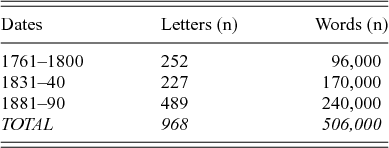
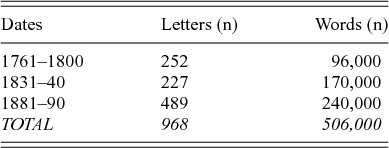
This study samples CORIECOR, using data from the period 1761–90 because directly comparable evidence is available for these years from (US) AmE, CanE and NWBrE in Dollinger (Reference Dollinger2008), whose work also permits comparison with CanE data to 1849; for the latter purpose, we have also sampled the 1830s in CORIECOR. The trend in IrE from the late eighteenth century to 1840 was towards rapidly increasing use of first-person will, and in order to see how this developed as the century progressed, we have also sampled the 1880s.Footnote 7 Our data thus cover a 130-year timespan that includes the core period of language shift. The amount of material in each subperiod studied is shown in table 1.
Distribution of CORIECOR data in subperiods studied
For comparison with other varieties and previous studies, we follow the most relevant corpus-based studies in counting only full forms of the modals, since contracted ’ll may be a contraction of either shall or will; the unambiguous contracted negative forms shan't and won't are included (Kytö Reference Kytö1991; Dollinger Reference Dollinger2008: 232). Exclusion of contracted forms does not affect the present study much, since there are few contractions of any kind in the CORIECOR data studied. Examples of the forms counted are given in (5–10).
(5) We shall only take care that his attendance shall be regular at Public Worship. (Carlile Pollock, 23 June 1789)
(6) However, if my Mother thinks proper I will take it at Glasgow (William Drennan, 25 January 1778)
(7) I shant neglect writing you often (Hamilton Young, 5 December 1787)
(8) and for that Reason I will Not Drink one half [kenn?] in his house this year (Thomas Shipboy, 9 November 1774)
(9) How shall I describe our sensation when we first saw this stupendous fancy of Nature (Robert Peel Dawson, 24 August 1838)
(10) if you write soon I will get it & shall reply at once (A.M. Faul, 8 September 1889)
Most of the data consist of first-person shall and will in declarative clauses, both positive and negative, as in (5–8); the contracted form shant in (7) is one of very few negative contractions in the data (n = 16/1463, 1%). Interrogative clauses are also infrequent (n = 12/1463, 1%) and occur exclusively with shall, as in (9); these must be excluded from GoldVarb analysis because they show no variation. Finally, tokens like (10) are encountered, with shall and will in close proximity, referring to the same first-person subject, and both conveying futurity.
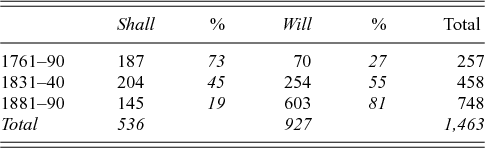
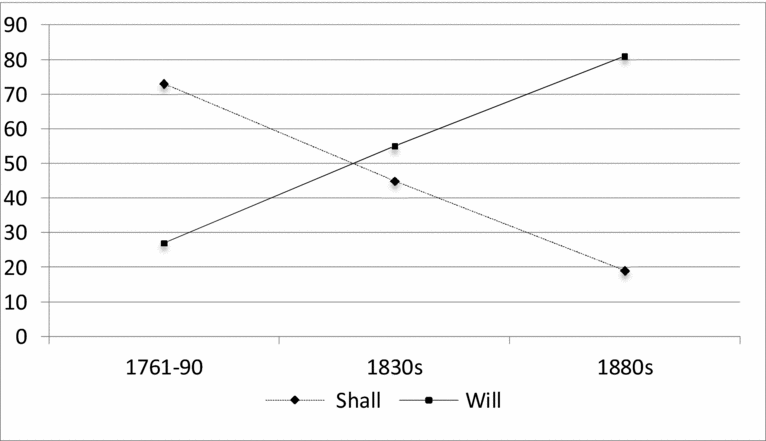
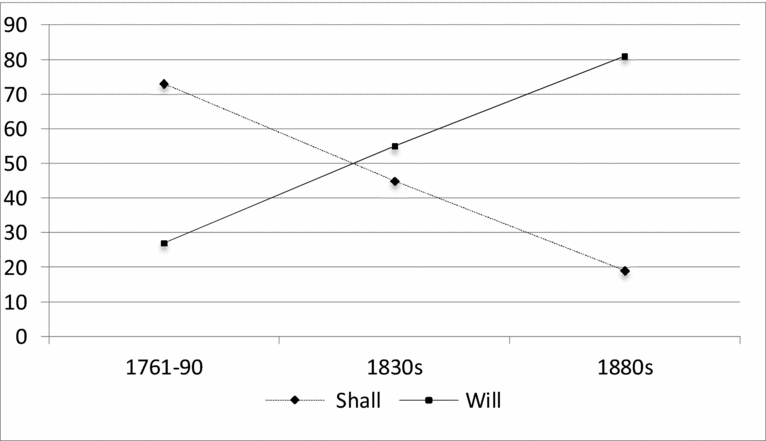
The raw frequencies presented in table 2 and figure 1 indicate that shall was more common in earlier IrE than the normative tradition or studies of more recent IrE would suggest. Shall/will variation extended throughout our period, though with a sharp drop in the proportion of shall and an increase in will. In the late eighteenth century, 73 per cent of tokens were shall, while will was the majority form by the 1830s (55 per cent), increasing further to 81 per cent by the 1880s. This rapid change shows that IrE only began approaching its present-day exclusive use of will in the late nineteenth century. This accords with the findings reported in Nikolaisen (Reference Nikolaisen2011).
First-person shall and will in IrE personal letters, 1761–1890 (n = 1463)
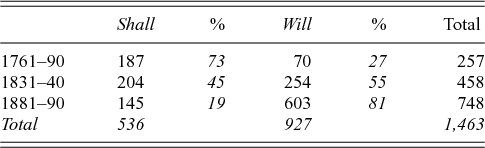
First-person shall/will in IrE personal letters, 1761–1890 (n = 1463)
How does this compare with other Englishes? Dollinger (Reference Dollinger2008) provides points of comparison with other varieties. In a recent study, we compared our IrE findings to Dollinger's results from the US, Canada and Great Britain in the late eighteenth century, and with CanE also in the early nineteenth (McCafferty & Amador-Moreno Reference McCafferty and Amador-Moreno2012a: 193–6). In the eighteenth century, CanE and IrE were equally conservative in generally using first-person shall. Our study also partly supports Dollinger's claim that what he terms ‘SIN-speakers’ (Scots, Irish, Northern English) may have promoted the spread of will in Canada. However, will was more frequent in late eighteenth-century NWBrE than in the colonial varieties AmE, IrE and CanE. Replacement of shall by will thus appears to have happened simultaneously in Ireland, North America, and parts of England, suggesting to us that the switch to will might be associated with increasing literacy and associated colloquialisation, which is one linguistic effect of the spread of literacy (McCafferty & Amador-Moreno Reference McCafferty and Amador-Moreno2012a: 197). Our hypothesis is, therefore, that literacy helped spread first-person will as a change from below.
5 Multivariate analysis of shall/will in Irish English, 1761–1890
Turning now to the influence of selected internal and external constraints on shall/will variation in IrE from 1761 to 1890, we test the relative strength of a small set of social and linguistic factor groups shown in previous studies to affect variation between these modals. The five factor groups studied are: intimacy, verb (type), clause type, gender/sex, and geographical origin. Their influence is assessed using GoldVarb X (Sankoff et al. Reference Sankoff, Tagliamonte and Smith2005) to analyse data extracted from CORIECOR using Wordsmith tools 5.0 (Scott Reference Scott2009). Our total data set consists of 1463 tokens of the full forms shall and will (and shan't/won't) across the CORIECOR subsamples: 1761–90, the 1830s and 1880s.
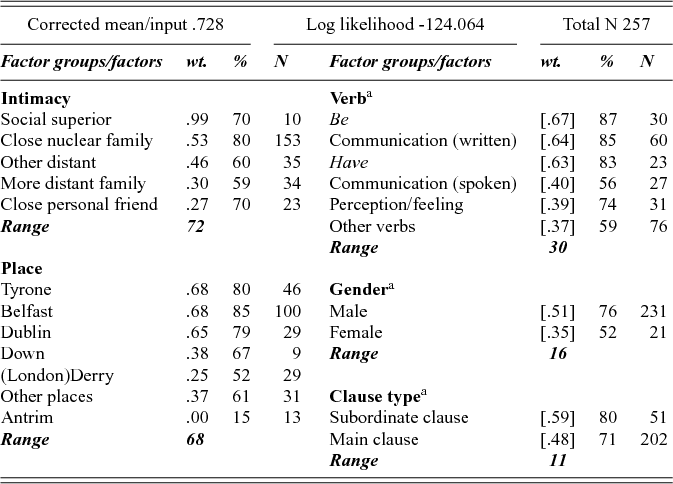
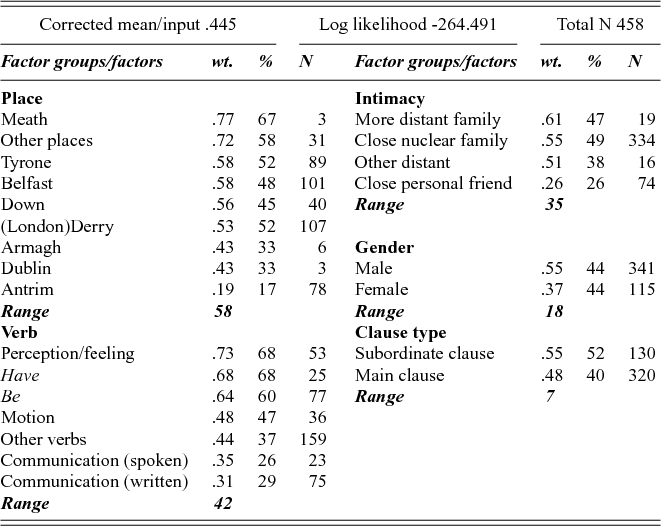
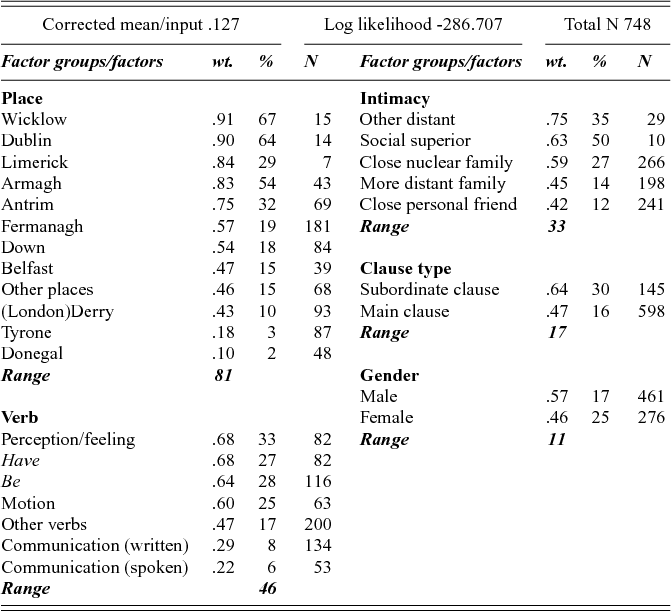
The results of the multivariate analysis are summarised in tables 3, 4 and 5 for each subperiod. Factor groups are arranged in order of significance according to the range of weightings in each group, so that the order of presentation changes between tables. GoldVarb weightings measure the likelihood of shall-use: the rule of thumb is that scores over .50 favour while weights below .50 disfavour shall; scores close to .50 are interpreted as neutral. Table 3 presents the results for the late eighteenth century; here, just two factor groups – intimacy and place – proved statistically significant at the .05 level, while gender, clause type, and verb were not significant. In the analyses for the 1830s (table 4) and 1880s (table 5), all five factor groups are significant.
GoldVarb analysis of shall/will in late eighteenth-century IrE (CORIECOR 1761–90)

aNot significant at 0.05 level; other factor groups significant.
GoldVarb analysis of shall/will in IrE (CORIECOR 1831–40)
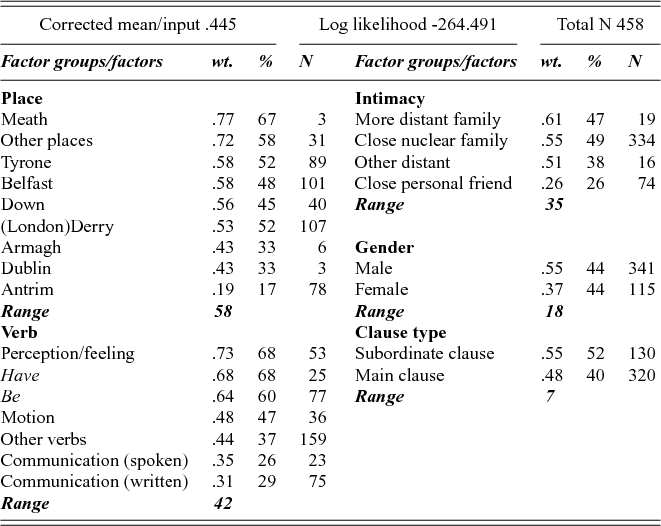
All factor groups significant at 0.05 level.
GoldVarb analysis of shall/will in IrE (CORIECOR 1881–90)
All factor groups significant at 0.05 level.
5.1 Intimacy
Intimacy is for our purposes defined in terms of relationships between correspondents.Footnote 8 In the 1830s, unfortunately, there were no data from letters to social superiors. As table 4 shows, in this decade, intimacy was the third most significant factor group. Close nuclear family (perhaps motivated by respect or deference to parents) slightly favour shall (.55), while letters to more distant family do so even more strongly (.61). In the family categories, subdivision by inter- versus intragenerational letters (e.g. from parent to child and uncle/aunt to nephew/niece or vice versa, and between coevals) might be revealing, though for the present data, the low number of tokens would make this unfeasible. Other distant addressees were neutral (.51), while shall was disfavoured in letters to close friends (.26). Once again, intimacy or formality is important in relation to the use of shall.
In the 1880s (table 5), intimacy remained the third most significant factor group. Other distant (non-family) addressees most strongly favoured shall in this decade (.75), followed by social superiors (.63) and nuclear family members (.59). Again, this weighting for close nuclear family might indicate continuing respect for parents. That shall apparently tended to be increasingly favoured in letters between nuclear family members as the nineteenth century progressed might reflect changing family structures, and it might therefore be interesting to distinguish between child-parent correspondence on the one hand and parent–child and sibling–sibling letters on the other. With more distant family and close personal friends, as expected, shall is disfavoured (.45 and .42, respectively).
5.2 Place
CORIECOR's regional bias towards the northern province of Ulster has been noted. While token numbers are small outside Ulster, there is no reason to suppose there is a North–South difference with regard to shall/will. There are few morphosyntactic differences between Northern and Southern IrE, and it has never been suggested that treatment of shall/will is one of them.
Nurmi (Reference Nurmi and Hart2003: 94f.) reports no regional pattern in England involving London, East Anglia, the North and the Royal Court. Our results for the late eighteenth century indicate a rural–urban split in Ireland. Shall was strongest in urban centres like Belfast and Dublin (.68 and .65, respectively), weakest in rural areas of Down, (London)Derry and Antrim (ranging from .00 to .38), where shall was disfavoured, as it was in the miscellaneous ‘Other places’ (.37).Footnote 9 Rural Tyrone appears to go against this trend, with a shall weighting equal to the urban areas. But much of the Tyrone data comes from correspondence between a merchant and clients; this may reflect relative formality as much as regional difference.
Regional origin is significant in relation to shall/will variation in Ireland, and is worth further attention in a larger-scale study. By the 1830s, regional patterns are more difficult to perceive, though the preference for shall persists in Belfast and Tyrone (both .58). The eastern county of Meath has the highest weighting (.77), but this is based on very little data (n = 3). Another eastern county, Down (.56), also favours shall, as do those subsumed in the ‘Other places’ category (.72). (London)Derry is neutral (.53), while Armagh and Dublin disfavour shall in this analysis (both .43), and Antrim, as in the previous subperiod, continues to strongly disfavour it (.19).
By the 1880s (table 5), we discern a broad east–west split: with the exception of Limerick (.84), where the number of tokens is small (n = 7) and from a single writer, eastern areas (Dublin, Wicklow, Armagh and Antrim) range from .75 to .91 in favour of shall. Fermanagh and Down (the latter also on the east coast) weight slightly in favour (.57 and .54, respectively), while Belfast is neutral (.47) and (London)Derry is weighted against (.43). Finally, Tyrone and Donegal weight heavily against shall-use with .18 and .10, respectively. Place is the most significant factor group in relation to both the 1830s and the 1880s data.
5.3 Verb (type)
We investigated verbs by coding for the following frequent verbs and verb types: be and have, verbs of perception/feeling (see, hear, etc.), verbs of written communication (write, send, etc.), verbs of spoken communication (say, tell, etc.), and miscellaneous ‘Other verbs’. In the late eighteenth century, verbs of motion were categorically used with shall and were excluded from GoldVarb analysis, but they are included for the 1830s and 1880s, where there is variation.
Table 3 shows that, although verb (type) was not significant in the late eighteenth century, the two most frequent verbs – be and have – both favoured shall (.67 and .63, respectively), as did verbs of written communication (.64). On the other hand, verbs of spoken communication disfavoured shall (.40), and the same applies to verbs of perception/feeling (.39) and the miscellaneous ‘Other verbs’ (.37). Verbs relating to written communication may be particularly frequent in the data because they are directly linked to the activity of writing, which correspondents often refer to. The data set for the late eighteenth century was small (n = 257), which restricted the number of tokens for even fairly frequent verbs. In future research, more individual verbs might occur frequently enough for separate analysis. In the present study, none of the most frequent verbs, and few others within categories favouring shall, were notably formal, though it may also be worth examining this aspect in future.
In the 1830s (table 4), verbs of perception/feeling, have and be all favour shall-use (.64 to .73). On the other hand, verbs of motion (.48) and the miscellaneous ‘Other verbs’ (.44) are either neutral or mildly disfavour shall. Verbs of communication disfavour shall-use more strongly in this decade (.35 for spoken, .31 for written). Verb (type) was the second most significant factor group in the 1830s.
Moving on to the 1880s, table 5 shows verb (type) remained the second most significant factor group. Here, verbs of perception/feeling, be and have, and verbs of motion all favoured shall (ranging from .60 to .68), while verbs of written and spoken communication are weighted against (.29 and .22, respectively).
5.4 Gender
Linguistic change tends to pattern along gender lines. However, Kytö (Reference Kytö1991: 326) found the writer's gender had no effect on first-person shall/will in seventeeth-century English. Nurmi, on the other hand, concluded that, in the Early Modern period, women led the shift to will (2003: 105f.), though the decline of shall had begun in men's usage in the sixteenth century (Nurmi Reference Nurmi and Hart2003: 95–7).
Our IrE data contain few tokens from women (n = 21) in the eighteenth century, and gender was not significant. However, the data might be interpreted as showing a male tendency to prefer shall (76%, compared to 52% for women): GoldVarb weightings were respectively .52 and .32. In the 1830s, men favoured shall slightly (.55), while women continued to disfavour it (.37), and in the 1880s, men (.57) remained more likely to use shall than women (.46). There is a consistent gender difference, then, albeit not a very robust one: women tended to lead in using the non-standard variant. It is tempting to suggest that different male/female literacy rates might have affected usage, and men in Ireland were indeed more likely to be literate than women early in our period (Ó Ciosáin Reference Ó Ciosáin1997: 44f.), and continued to lead in literacy rates until the 1881 census (Fitzpatrick Reference Fitzpatrick, Daly and Dickson1990: 169, table I). Men might, therefore, have been more disposed to use the ‘literate’ variant shall, associated with standard English.
5.5 Clause type
Dollinger (Reference Dollinger2008) studied shall/will in declaratives (negative and affirmative) and interrogatives. In interrogatives, shall was favoured in both CanE and BrE; will predominated in declaratives (Dollinger Reference Dollinger2008: 235). These findings for interrogatives agree with Kytö's results for AmE and BrE a century earlier (Kytö Reference Kytö1991: 329f.).
In all our subperiods, only shall occurred in interrogatives (n = 12); this clause type is excluded from GoldVarb analysis. In the eighteenth century, there was a preference for shall in subordinate clauses (.59), while declarative main clauses were neutral (.48). The tendency towards shall in subordinate clauses might be interpreted as indicating that shall occurs in more formal (and linguistically complex) contexts.
Clause type continued to play little role in selection of shall in the 1830s, though it remained most likely in subordinate clauses. Confirming the relative formality of shall-use, it was more likely in subordinate clauses (.55) than in declarative main clauses (.48). While only shall occurred in interrogatives, exclamatives were categorically found with will (n = 2).
Finally, in the 1880s, shall remained more likely in subordinate (.57) than in main declarative clauses (.46), further supporting the idea that formality was important in relation to shall-use. The sole exclamative in the 1880s data used shall.
5.6 Summary
As we have seen, shall was very frequent in late eighteenth-century IrE, but its use declined so that it was the minority form in the 1830s, and will was close to categorical in first-person contexts by the 1880s. Use of shall was constrained by linguistic and social factors. In the late eighteenth century, the nature of relations between correspondents affected shall: in particular, shall was more likely in letters to social superiors, and to a lesser extent in letters between nuclear family members. With the proviso that there was no data for social superiors in the 1830s, this pattern seems to have continued throughout our period, with distant family also favouring shall in the 1830s, and ‘Other distant’ addressees in the 1880s. Subdividing these broad categories might reveal usage differences attributable to deference to, e.g., parents or older generations generally in a society where family relationships were hierarchical and parents exerted a great deal of authority over their children (K. Miller Reference Miller, Kortmann and Upton2008).
Use of shall was also affected by geographical origin throughout. In the late eighteenth century, people from urban areas were more likely to use shall, while those from rural Down, Antrim and (London)Derry – all areas of Scottish settlement in the seventeenth century – avoided it.Footnote 10 In the 1830s, the pattern is less clear, but writers from urban Belfast still favoured shall, as did eastern counties like Meath and Down. By the 1880s, there was a clearer tendency for shall, where used at all, to be favoured in urban and eastern counties, i.e. in the more prosperous regions that had become English-speaking earliest, and where the middle class might have been more susceptible to BrE norms. As regards the other social factor, gender, men showed a consistent but weak tendency to select shall more than women throughout the period 1761–1890.
Shall was more likely throughout with the most frequent verbs, be and have. By the 1830s, verbs of perception/feeling were likely contexts for shall-use, and remained so in the 1880s. Verbs of motion, which disfavoured shall in the 1830s, were favourable contexts by the 1880s. Meanwhile, verbs referring to written communication at first favoured shall, but in the 1830s and 1880s it was not likely with such verbs; verbs of spoken communication disfavoured shall throughout.
As for clause type, the few interrogatives in this CORIECOR data all used shall, making this the most likely clausal context for this modal. This, of course, conforms to a general pattern that was more widespread in the past and continues in BrE today (see Kallen & Kirk Reference Kallen, Kirk, Kirk and Baoill2001), but it is intriguing, given that present-day IrE generally does not use shall in this clause type: the shift from shall to will has been total in this context, and it would be interesting to try to trace this change through the entire corpus.
Otherwise, in all three subperiods there was a greater likelihood of shall in subordinate clauses, while it was disfavoured in declarative main clauses. This might be read as supporting the hypothesis that shall tended to occur in more formal contexts, since subordinate clauses are more syntactically complex than main clauses.
6 Conclusions and further directions
There is a tradition of partly attributing the shift to first-person will in NAmE to Irish immigration. Our results cast doubt on the notion that IrE influence drove the spread of first-person will in NAmE, since IrE did not lead in the use of first-person will in the late eighteenth century. In fact, BrE, specifically NWBrE, led by a small margin before 1800, when CanE and IrE were equally conservative in preferring shall.
That the use of will increased rapidly in the nineteenth century is clear from our comparison of Dollinger's (Reference Dollinger2008) study of CanE and IrE data from CORIECOR. However, given Dollinger's findings for BrE and NWBrE, these results do not suggest that large-scale migration from Ireland to North America in the eighteenth and nineteenth centuries advanced first-person will. We might rather be looking at a widespread general development in English vernaculars. The situation in other colonial Englishes that emerged in the nineteenth century might also support the view that first-person will was a general development in regional Englishes. In Australian and New Zealand English, too, will dominates today in a way that suggests it may have done so in the south-eastern English English that constituted the majority input into those Englishes (see Hundt et al. Reference Hundt, Hay and Gordon2008: 316f.; Collins & Peters Reference Collins and Peters2008: 348f.).
Whatever further diachronic studies of regional Englishes may reveal, it seems safe at present to reject the hypothesis that IrE drove the change to first-person will in NAmE, which is said in turn to have influenced the same change in BrE since the early twentieth century. That will use in the written record of IrE and other varieties might have been driven rather by the growth of literacy among the lower classes, contributing to greater colloquialisation or vernacularisation of the written language, seems a potentially more fruitful hypothesis, which we will pursue in future work.
Some of the findings of our multivariate analysis of shall/will, which show that the use of shall was constrained by linguistic and social factors, offer support for the colloquialisation hypothesis. Intimacy between writers and addressees proved an important constraint: shall was particularly likely to occur in letters to social superiors, and ‘Other distant’ addressees (without close family ties), but also letters to close family members were more likely to use shall. This factor group must clearly be refined to take account of differential levels of intergenerational deference or respect. In any case, shall seems to have occurred in contexts of relative distance, deference or formality. This aspect of intimacy or relative social distance seems potentially very important in relation to shall/will variation and may reward further refinement and analysis. Further indication that shall was primarily a formal feature in IrE comes from the results for clause type, which consistently showed that, after interrogatives, shall was more likely in syntactically more complex subordinate clauses than in main clauses.
Regional variation emerged as another potentially interesting constraint on the use of shall, but the pattern was not unambiguous. First, we saw an urban–rural difference in the late eighteenth-century data (as also reported in McCafferty Reference McCafferty2011; McCafferty & Amador-Moreno Reference McCafferty and Amador-Moreno2012a), with shall used more by writers from urban areas. By the 1880s, however, shall – by then much less frequent than in the previous century – was more likely to be retained in Dublin and the east-coast region. This geographical distribution is interesting historically, given that the regions that became English-speaking earliest were centred on the east-coast cities of Belfast and Dublin. Maintenance of the shall/will distinction in the areas that have been English-speaking longest suggests it might be worth investigating this feature in relation to the spread of English from this eastern base into the west and south-west of Ireland, where Irish survived longer and the English language diffused more as a result of language shift than British settlement. These, and other lines of enquiry, will be pursued as part of the CONVAR project.